Pinch Analysis vs Exergy Analysis: Which Finds Waste?
Pinch analysis sets heat-recovery targets; exergy analysis locates exergy destruction.
Pinch analysis is a process integration method that sets minimum external heating and cooling targets by matching process heat sources and sinks at a selected minimum temperature approach. For an energy manager, it is the direct method for finding recoverable waste heat within a process boundary. Exergy analysis answers a different question: where does the plant destroy the greatest amount of useful energy potential?
The distinction matters in chemical processing, food and beverage manufacture, refineries and other heat-intensive plants. A hot stream sent to cooling water while another receives steam may indicate a pinch opportunity. Yet the plant’s greatest thermodynamic loss may sit in a fired heater, reaction system, compressor or pressure-reducing valve.
Pinch and exergy analysis identify different forms of waste. Used together, they create a more defensible energy-efficiency project list.
What does pinch analysis find?
Pinch analysis finds the maximum heat-recovery opportunity between process streams before external utilities are required. It begins with a stream table containing supply and target temperatures, heat-capacity flowrates, phase-change duties and operating constraints.
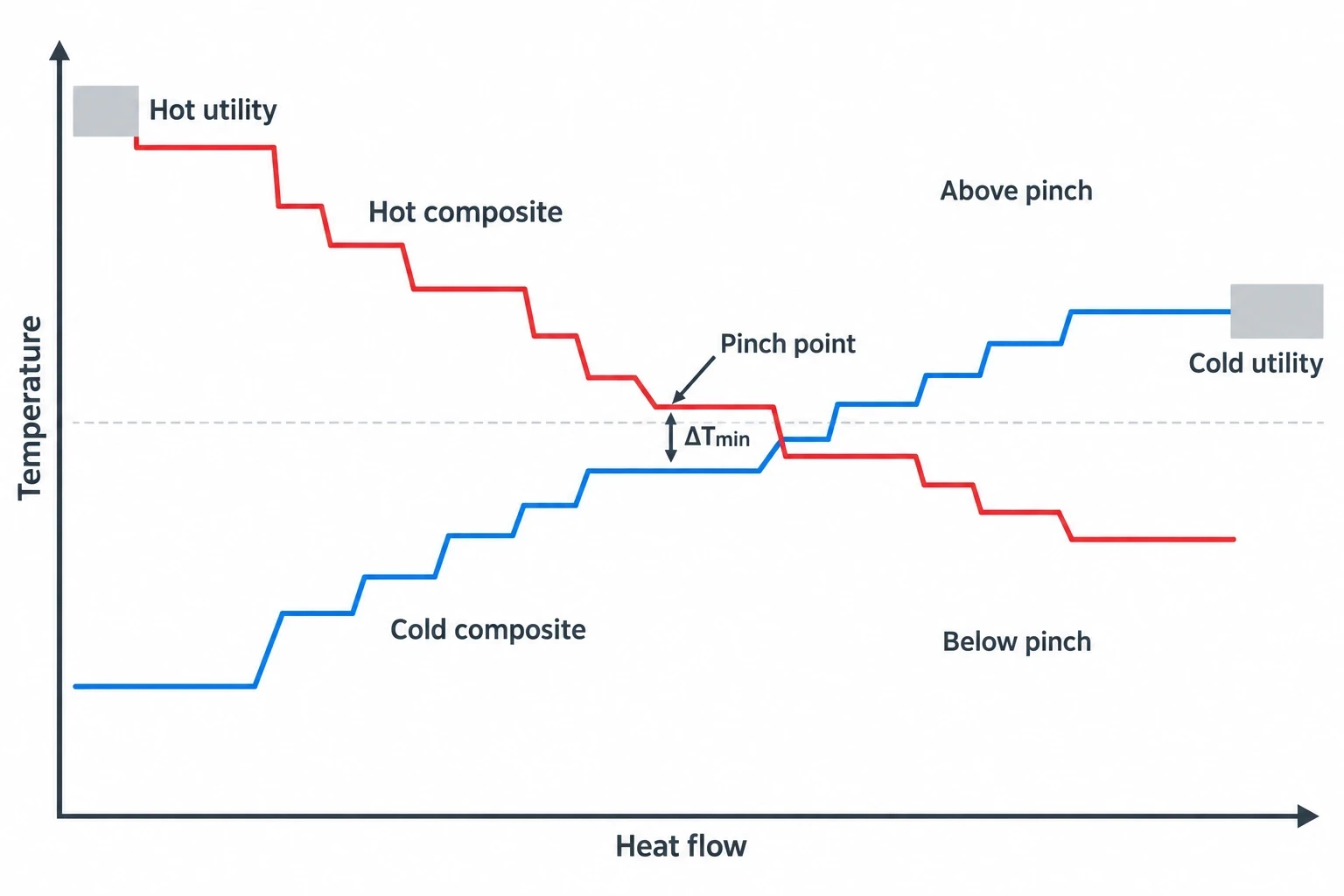
Hot streams release heat as they cool. Cold streams require heat as they warm. The analysis combines these streams into hot and cold composite curves, then establishes the minimum hot-utility and cold-utility demand for the selected case.
Typical hot utilities include:
- Fired-heater duty
- Steam at one or more pressure levels
- Thermal oil
- Electric process heating
Typical cold utilities include:
- Cooling water
- Air cooling
- Refrigeration
- Chilled water
The result is a plant-wide target. It shows heat recovery across the process rather than judging each heat exchanger in isolation.
Composite curves and the pinch point
The composite curves plot combined process heat release and heat demand against temperature. Their closest allowable approach is the pinch point.
The pinch divides the process into two thermodynamic regions. Above the pinch, the process has a net heat deficit and needs external heating. Below it, the process has a net heat surplus and needs external cooling.
The selected minimum temperature difference, ΔTmin, has a direct commercial effect. A small ΔTmin increases heat-recovery potential but usually requires more heat-exchanger surface area and capital cost. A larger ΔTmin reduces heat-exchanger area and capital cost while increasing utility consumption.
This trade-off needs careful treatment in retrofit work. An aggressive target can produce heat-exchanger matches that require impractical area, difficult cleaning access or unmanageable fouling margins. A conservative target can leave economic heat recovery unrealised.
Why cross-pinch heat transfer increases utility demand
Pinch design has three rules for achieving the minimum-utility target:
- Do not transfer heat across the pinch.
- Do not use external cooling above the pinch.
- Do not use external heating below the pinch.
Cross-pinch heat transfer sends heat from the above-pinch region to the below-pinch region. Ipieca notes that this raises external heating and cooling demand above the thermodynamic minimum.
This can challenge a familiar retrofit proposal. A heat exchanger may appear beneficial because it recovers heat locally, but the wider network can consume more steam and reject more heat if the match crosses the pinch. Pinch analysis exposes that penalty.
What pinch analysis calls waste heat
Pinch analysis identifies heat with a feasible process recipient at a usable temperature. It does not regard all hot streams as equally valuable. A large duty at 45 °C may have no suitable recipient without heat upgrading, while a smaller duty at 150 °C may displace substantial steam use.
For a refinery crude preheat train, the method can identify recovery between hot product streams and cold crude. In a brewery, it can assess wort cooling, pasteurisation and hot-water demand. In food processing, it can compare evaporation, cooking and cleaning-in-place loads. In chemical plants, it often focuses on reactor effluent, distillation columns, condensers and reboilers.

Pinch analysis identifies the thermodynamic minimum energy requirement of your process — then designs the heat exchanger network to achieve it.
What does exergy analysis find?
Exergy analysis measures the useful-work potential of energy relative to a defined reference environment. It distinguishes energy quantity from energy quality.
A megawatt of high-temperature flue gas, pressurised steam or shaft power can perform more useful work than a megawatt of water near ambient temperature. Both streams may carry the same energy duty, but they do not offer the same recovery value.
Exergy analysis identifies where irreversibility destroys useful energy potential. It can rank losses that a conventional heat balance cannot distinguish.
Exergy destruction and irreversibility
Entropy generation causes exergy destruction. Industrial sources include:
- Combustion with excess air or high flue-gas losses
- Heat transfer across large temperature differences
- Throttling through control valves
- Pressure losses in pipework, heat exchangers and equipment
- Mixing streams at different temperatures, pressures or compositions
- Reaction and separation duties with substantial thermodynamic penalties
An exergy balance allocates these losses to equipment, process sections or utility systems. It helps engineers identify whether the greater opportunity lies in a furnace, reactor, distillation system, compressor train or heat-exchanger network.
A high heat duty does not necessarily indicate a high exergy loss. Low-temperature cooling-water duty can dominate an energy balance while having limited useful-work potential. Conversely, a pressure let-down valve may have modest energy duty but destroy valuable pressure exergy.
Reference conditions and data quality
Exergy values depend on the selected environmental reference state. The analyst should define reference temperature, pressure and composition before calculations begin, then apply those assumptions consistently.
Physical exergy describes the potential associated with a stream’s temperature and pressure relative to the reference environment. Chemical exergy matters where composition changes are significant, particularly in fuels, hydrogen systems, reactive processes and separation plants.
Plant data must reflect a stable operating case. Temperature, pressure, flowrate, utility conditions, fuel composition and production rate can materially affect results. Batch facilities require time-resolved analysis because daily averages can imply heat matches that never occur at the same time.
Pinch analysis vs exergy analysis: the practical difference
| Question | Pinch analysis | Exergy analysis |
|---|---|---|
| Primary purpose | Minimise external heating and cooling through process heat recovery | Locate loss of useful-work potential |
| Main output | Minimum utility targets, pinch temperature and heat-exchanger-network opportunities | Exergy destruction and loss by unit operation or process section |
| Main data | Stream temperatures, duties, flowrates, phase changes and utility temperatures | Temperature, pressure, flowrate, composition, enthalpy, entropy and reference conditions |
| Best at finding | Recoverable heat and inefficient utility use | Irreversibility from combustion, reaction, mixing, pressure loss and finite temperature differences |
| Typical project | New heat exchanger, heat-exchanger retrofit, revised utility levels or heat pumping | Combustion improvement, process-condition change, pressure recovery or equipment redesign |
| Key limitation | Does not identify all thermodynamic irreversibilities | Does not synthesise the heat-exchanger network needed to meet utility targets |
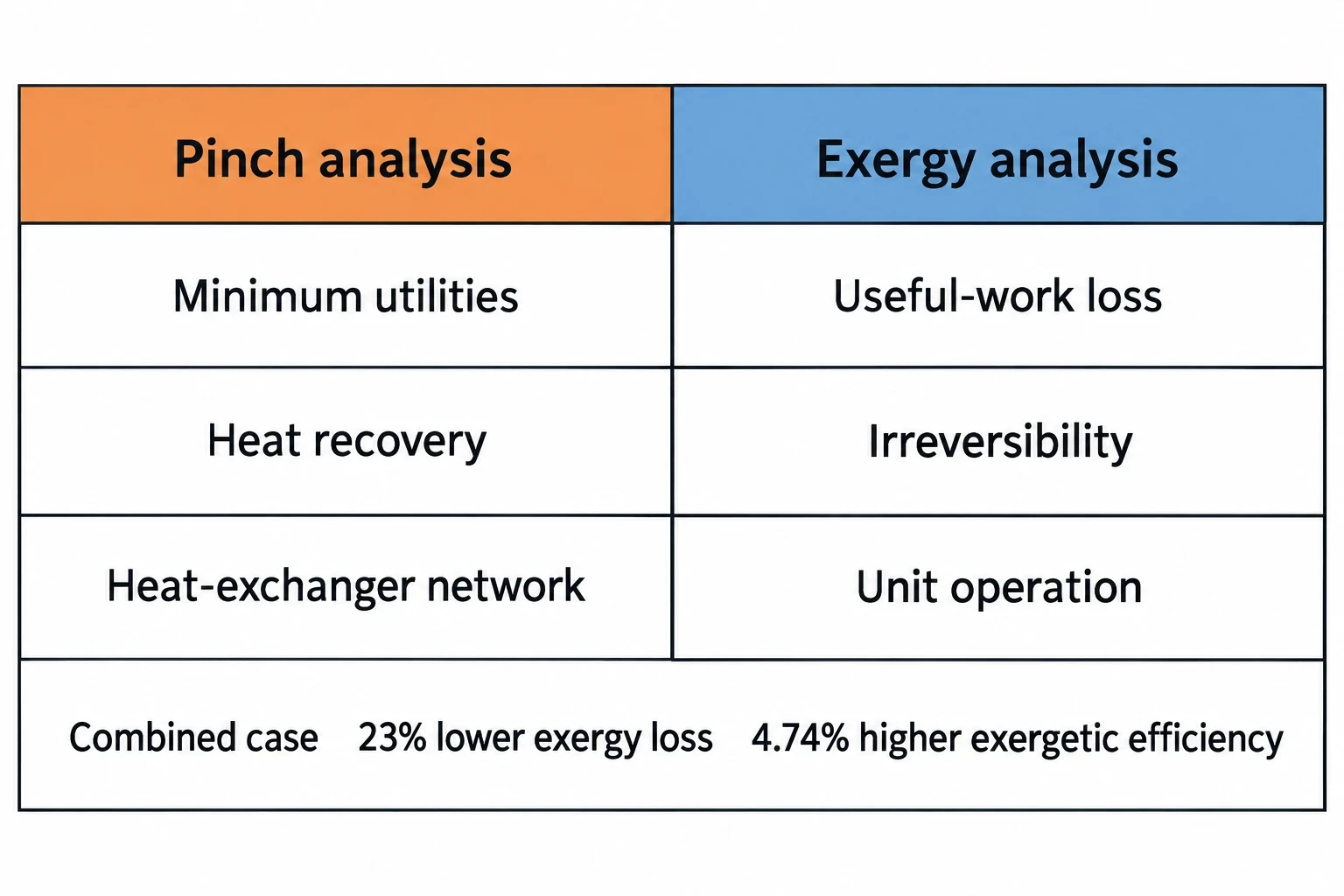
Jia and colleagues demonstrated the distinction in a biodiesel-process study. Their pinch work developed heat integration and a heat-exchanger network. Their exergy work identified the units with the greatest losses and informed changes to reaction temperature and reactant ratio. The combined modifications reduced process exergy loss by 23% and increased exergetic efficiency by 4.74% in that case.
Stronger heat integration does not automatically produce higher exergetic efficiency.
Which method finds waste heat?
Pinch analysis is the stronger method for identifying recoverable waste heat within a defined process boundary. It quantifies whether heat released by one stream can satisfy another demand at a feasible temperature approach.
Exergy analysis is stronger for identifying waste of energy quality. It shows where the process destroys valuable potential through combustion, throttling, mixing, reaction, separation and excessive temperature differences.
A chemical-process example
Consider a continuous plant with hot reactor effluent, a distillation overhead condenser, a steam-heated reboiler and cooling-water demand.
A pinch study may identify reactor-effluent heat as a feed-preheat source. It may also show that a proposed heat exchanger would cross the pinch and increase cooling duty elsewhere. The resulting work focuses on heat-exchanger placement, area, fouling allowance, pressure drop and utility targets.
An exergy study may rank the fired heater or reactor as the largest source of exergy destruction. That finding could support combustion tuning, burner changes, oxygen control, revised reaction conditions or a redesign that reduces a severe temperature driving force.
Both findings can be valid. The pinch study identifies a better use for available heat; the exergy study identifies where the plant loses the greatest thermodynamic value.
Why an energy balance is not enough
Energy balances conserve quantity. Exergy analysis assesses usefulness under stated environmental conditions.
A plant may recover large quantities of low-temperature heat and still destroy substantial exergy in combustion equipment or a separation train. Equally, an exergy study may identify a major loss without revealing a practical heat recipient. Distance, batch timing, hygiene separation, plot space and maintenance access can prevent a theoretically attractive scheme becoming a viable retrofit.
Project selection should consider heat quantity, temperature level, recovery route, utility displacement and exergy destruction together.

Pinch analysis identifies the thermodynamic minimum energy requirement of your process — then designs the heat exchanger network to achieve it.
How should plants combine pinch and exergy analysis?
A combined programme should use each method for the task it performs best.
1. Define representative operating cases
Separate normal production, reduced-rate operation, product campaigns, cleaning cycles and seasonal conditions. Refineries may require distinct crude-slate cases. Food and beverage sites may need separate treatment for pasteurisation, evaporation, refrigeration rejection and cleaning-in-place operation.
Reconcile measurements where possible. Record steam headers, condensate returns, cooling systems and fuel use separately. These details often determine whether a promising heat match produces a genuine site benefit.
2. Set heat-recovery targets with pinch analysis
Develop composite curves for each representative case and test ΔTmin values that reflect heat-exchanger type, fouling risk, pressure-drop limits and controllability.
Then convert the target into a retrofit shortlist. Each candidate should be checked for:
- Start-up, shutdown and turndown control
- Fouling, cleaning and inspection access
- Process safety and product-contamination risk
- Pipework distance and construction access
- Pumping or compression penalties
- Batch timing and any need for thermal storage
- Shutdown duration and tie-in scope
The target remains useful even where constraints prevent full implementation. It establishes how close the current process and each retrofit option come to minimum utility demand.
3. Use exergy analysis to rank major losses
Apply exergy analysis to major energy users and the proposed heat-recovery configuration. Fired equipment, steam systems, reactors, compressors, distillation systems and pressure-reduction stations merit early attention where their duties or operating conditions indicate significant losses.
This avoids allocating capital solely to the largest visible heat duty. A heat-recovery project that reduces steam demand but increases electricity demand for pumping, refrigeration or heat pumping needs an integrated utility assessment.
4. Build one investment case
The final decision should include fuel reduction, electricity change, cooling reduction, carbon effect, capital cost, maintenance impact, production risk and expected operating envelope.
Pinch analysis supplies the heat-recovery target. Exergy analysis supplies the thermodynamic priority. Process design and operations teams then establish whether the project can operate safely, cleanly and reliably.
ESOS and EU waste-heat assessment requirements
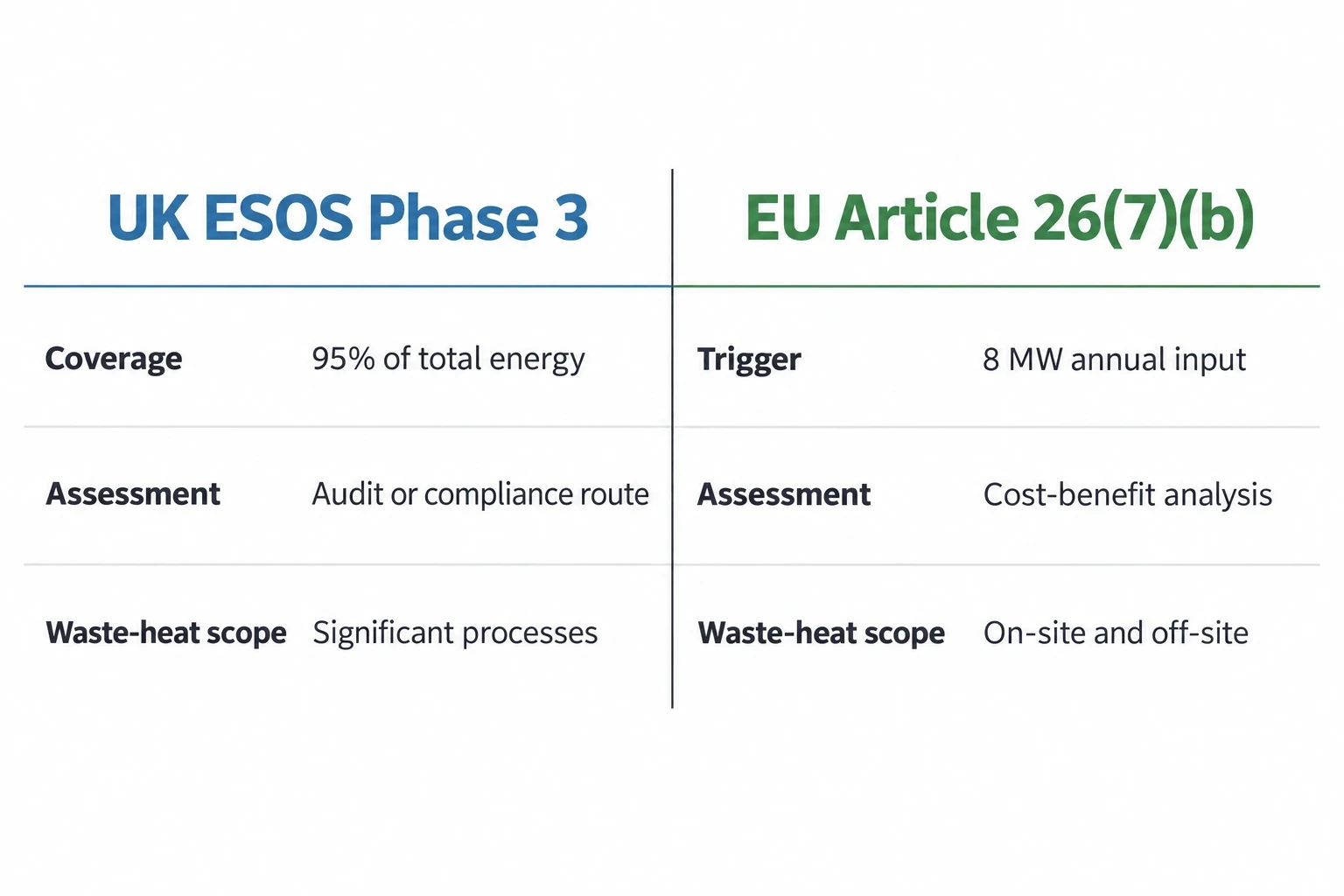
For ESOS Phase 3, the UK Energy Savings Opportunity Scheme Regulations 2014 required organisations to cover at least 95% of total energy consumption through an energy audit or an alternative compliance route. That scope supports a prioritised programme rather than disconnected equipment recommendations.
Pinch analysis can provide evidence for heat-recovery opportunities in significant energy-consuming processes. Exergy analysis can rank broader thermodynamic losses outside the heat-exchanger network.
GOV.UK identifies ISO 50001:2018 as an energy-management route and describes ISO 50002 and BS EN 16247 as good-practice energy-audit methodologies. ISO 50002-1:2025 replaced ISO 50002:2014 for general energy-audit requirements. Neither mandates pinch or exergy analysis, but both can strengthen the engineering evidence behind an audit recommendation.
For EU-facing projects, Article 26(7)(b) of Directive (EU) 2023/1791 requires Member States to ensure that an installation-level cost-benefit analysis is carried out in accordance with Annex XI where a newly planned or substantially refurbished industrial installation has average annual total energy input exceeding 8 MW. The assessment considers the economic feasibility of using waste heat on-site and off-site.
The European Commission’s Article 26 guidance treats the threshold as an installation production-capacity assessment, not a simple annual-consumption test. The cost-benefit analysis should assess realistic heat uses, including direct use, upgrading heat to a higher temperature where appropriate, and potential links to district-heating or other heat-recovery applications.
Pinch analysis establishes the quantity and temperature profile of available and required heat. Exergy analysis clarifies its quality and identifies losses that remain after integration.
Choosing the right method for the project
Use pinch analysis first where the immediate question is how far a process can reduce steam, fuel and cooling demand through better heat recovery. It is the direct route to composite curves, minimum utility targets and heat-exchanger-network opportunities.
Use exergy analysis first where the question concerns the units that destroy the most useful energy and the mechanisms responsible. It is especially useful where combustion, reaction, compression, throttling or difficult separations dominate site energy use.
This article reflects the independent analysis and editorial opinion of EnerTherm Engineering. Product names, trademarks, and brands mentioned belong to their respective owners. EnerTherm Engineering is not affiliated with, endorsed by, or a licensee of any third-party software or product mentioned unless explicitly stated.

Technical Manager — EnerTherm Engineering
John Naranjo is Technical Manager at EnerTherm Engineering, bringing specialist expertise in chemical and environmental engineering. He recently led the implementation of Omni Vision, EnerTherm's real-time energy and utility monitoring platform. He holds an MSc in Environmental Engineering from the University of Huelva and a BSc in Chemical Engineering, with memberships in both the Energy Institute and IChemE.
