
Which Pinch Analysis Software Fits UK ESOS Phase 4?
A buying comparison of licensed, online and open-source tools for heat-integration audits.
On 31 December 2026, UK organisations meeting the ESOS large-undertaking threshold enter the Phase 4 qualification test. Notifications of compliance are due by 5 December 2027. For energy-intensive chemical manufacturers, a credible pinch-analysis software study can turn plant heat-balance data into defined heat-recovery opportunities, annual energy savings and an investment case.
Software alone does not make an organisation ESOS compliant. An organisation must assess either its total energy consumption or areas of significant energy consumption, which must account for at least 95% of the total. Audits must use verifiable energy data where reasonably practicable. Each identified opportunity needs estimates of costs, benefits, annual energy savings, annual spend reduction and payback.
The appropriate pinch-analysis software supports a defensible engineering workflow from process data to an implementable project, rather than simply producing an attractive composite curve.

Pinch analysis identifies the thermodynamic minimum energy requirement of your process — then designs the heat exchanger network to achieve it.
Why ESOS Phase 4 changes the pinch analysis software brief
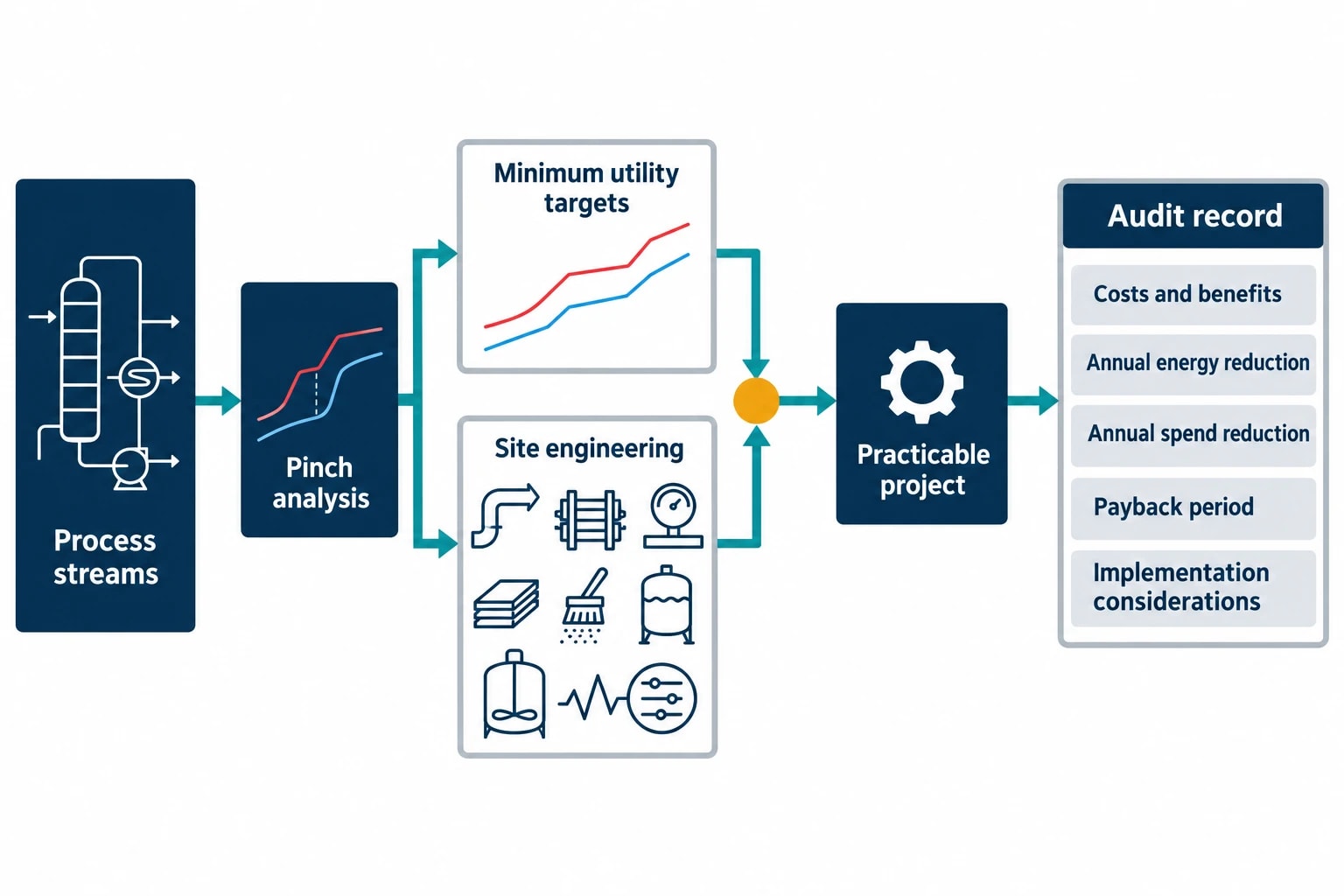
ESOS covers energy used in buildings, transport and industrial processes. At a chemical-processing site, fired heaters, steam systems, refrigeration, distillation, evaporation, drying and cooling duties can dominate industrial-process energy use. Pinch-analysis software provides a disciplined way to assess how much utility demand process heat recovery could displace.
The ESOS evidence requirement
An ESOS energy audit must identify tailored, cost-effective energy-saving opportunities. For each opportunity, the audit must, so far as reasonably practicable, record:
- Expected financial costs and benefits
- Non-financial costs and benefits
- Annual reduction in energy consumption, in kWh
- Annual reduction in energy spend, in pounds
- Payback period
- Relevant implementation considerations
Life-cycle cost analysis should inform implementation cost estimates where practicable. A pinch study can quantify the thermodynamic opportunity and estimate utility reduction. It cannot independently establish installed pipework cost, shutdown duration, maintainability, control changes, process-safety implications or heat-exchanger fouling behaviour. Those elements need site engineering input.
Energy targets are a starting point
Pinch analysis determines minimum heating and cooling utility targets for a defined set of process streams at a selected minimum temperature approach. It can also identify where the existing heat-exchanger network departs from those targets.
The distinction matters in an ESOS assessment. A minimum-energy target is a theoretical benchmark for the modelled process and operating case. A recommendation must be a practicable project. Before presenting a heat-recovery scheme as an investment opportunity, the study team must assess physical routing, heat-exchanger area, pressure drop, metallurgy, cleaning access, batch timing, production variability and control requirements.
Standards support the audit method, not the software brand
ESOS Phase 4 guidance does not prescribe a particular audit methodology or pinch-analysis package. It identifies ISO 50002 and BS EN 16247 as potential energy-audit methodologies. ISO 50002-1:2025 sets general energy-audit requirements, while ISO 50002-3:2025 provides guidance for process energy audits. ISO 50001:2018 remains an alternative compliance route where its certified scope meets the relevant ESOS coverage requirements.
Buyers should assess the software’s ability to preserve assumptions, inputs, calculation cases and exported outputs. This evidence trail is more useful to an ESOS lead assessor than a proprietary file that cannot be interpreted once the original modeller has left the project.
What pinch analysis software should deliver for chemical processing
The initial screening requirement is simple: identify hot streams, cold streams, temperatures, heat-capacity flowrates, operating hours and current utilities. The difficult work begins when plant data are incomplete or process conditions vary between grades, campaigns and seasons.
Reliable stream-data handling
A useful package should allow engineers to record the source, date, unit and basis for each stream value. Process simulations, historian data, meter readings, laboratory information and design documents can all contribute, but they should not be merged without checking their operating basis.
For chemical plants, the software should accommodate:
- Sensible heating and cooling streams
- Latent duties, including condensation and vaporisation
- Multiple steam levels and refrigeration utilities
- Variable heat capacity where it materially affects targeting
- Existing heat exchangers and utility users
- Operating cases for different products, rates or ambient conditions
- Utility prices and emissions factors used in the appraisal
Composite curves and the grand composite curve are valuable checks, but their quality depends on the stream table. Elegant graphics cannot compensate for a heat duty calculated from an unrepresentative production week.
Economic and retrofit capability
For ESOS, a heat-recovery option needs more than an energy target. Buyers should check whether the package can associate utility duties with energy-cost data, compare cases, document assumptions and export results for the audit evidence pack.
Heat-exchanger-network retrofit capability matters on an operating site. New-build network synthesis can suggest thermodynamically sound matches that are expensive to install in a constrained plant. The most useful tools let engineers investigate modifications to an existing heat-exchanger network, then carry shortlisted schemes into detailed design.
Batch and semi-continuous operations
A continuous-process pinch model can misrepresent a pharmaceutical, speciality chemical or food process that operates in batches. A hot stream available at 10:00 has limited value to a cold stream that needs heat at 18:00 unless storage or an intermediate loop makes the match feasible.
Batch-capable software is therefore significant for sites with reactors, clean-in-place cycles, campaign production, batch distillation or intermittent evaporation. The model should account for scheduling and distinguish direct heat recovery from indirect recovery through intermediate loops or thermal storage.

Pinch analysis identifies the thermodynamic minimum energy requirement of your process — then designs the heat exchanger network to achieve it.
Comparing pinch analysis software options for ESOS Phase 4
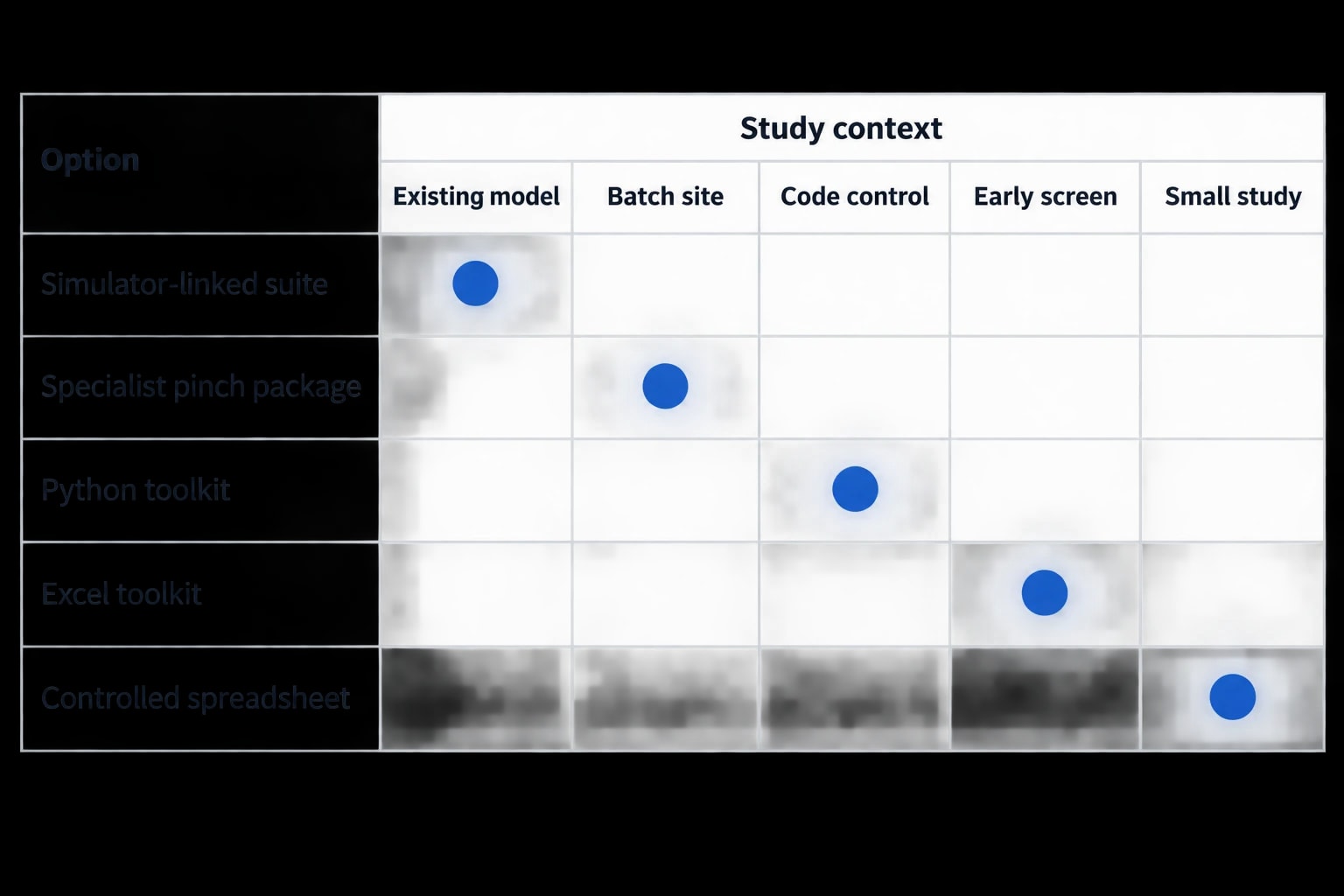
The market includes commercial process-integration suites, specialist pinch-analysis packages, spreadsheet tools and open-source code. Each suits a different level of study maturity.
| Option | Best fit | Relevant capabilities | Main ESOS limitation |
|---|---|---|---|
| Aspen Energy Analyser | Large sites already using Aspen HYSYS or Aspen Plus | Heat-exchanger-network design and retrofit, energy and capital targets, simulation-linked analysis | Capital estimates and practical implementation evidence still require engineering development |
| PinCH | Continuous, semi-continuous and batch process sites | Direct and indirect heat integration, scheduling, energy and cost targets, heat-exchanger-network design | Requires detailed plant data and competent model development |
| OpenPinch | Engineering teams able to work in Python notebooks and controlled analytical workflows | Pinch targeting, Total Site analysis, heat-pump screening, heat-exchanger-network synthesis and exports | Requires programming capability and a controlled internal method |
| Open Pinch Toolkit | Early-stage studies and training-led screening | Excel-based pinch algorithms, targeting, graphing and Total Site analysis | Workbook governance and review are essential for audit-grade use |
| Internally controlled spreadsheet model | Small, well-bounded studies | Transparent calculations and tailored reporting | Higher risk of manual errors, weak version control and limited heat-exchanger-network design capability |
Aspen Energy Analyser for simulation-led plants
Aspen Energy Analyser suits engineering teams that already maintain process models in Aspen HYSYS or Aspen Plus. AspenTech states that its Activated Energy Analysis workflow can run within those simulators, allowing process changes to be compared with current heating and cooling consumption and targeted values.
That integration can reduce re-entry of stream data, particularly where flowsheets already represent a distillation train, hydrogen system, refrigeration loop or utility network. It also supports iterative work: a proposed process-condition change can be reflected in the energy study without rebuilding the stream table manually.
The commercial case is strongest where the organisation already has the process-simulation environment, trained users and a need to develop several scenarios beyond an ESOS audit. The package is less compelling for a one-off site screening exercise with no reliable simulator model. In that situation, collecting and reconciling plant data remains the main task.
PinCH for batch, indirect and multi-process integration
PinCH addresses continuous, semi-continuous and batch industrial processes. Its workflow covers stream data, equipment, process definitions, scheduling, economic data, energy and cost targeting, energy-conversion units and heat-exchanger-network design.
This breadth is relevant to chemical-processing sites with mismatched duty timing. Indirect heat integration can assess whether intermediate loops or heat storage enable recovery that direct heat-exchanger matching cannot deliver. It can also support a study of heat-pump integration where a low-temperature source has enough operating hours and temperature lift to warrant further design work.
PinCH is a strong candidate where a plant needs to move from screening targets towards an integrated thermal concept. During a demonstration, buyers should establish how the package represents batch schedules, changing product campaigns and existing heat-exchanger-network constraints. Those assumptions can materially alter savings claimed for an ESOS opportunity.
OpenPinch for reproducible engineering studies
OpenPinch is an open-source Python toolkit for direct pinch analysis, indirect Total Site targeting, heat-pump and refrigeration screening, exergy post-processing, utility-placement optimisation and heat-exchanger-network synthesis. It supports structured inputs and exports including JSON, Excel and CSV.
This option suits organisations with process engineers who can maintain scripts, notebooks and formal code review. Its appeal is traceability: a controlled input file and repeatable analysis script can make it easier to rerun a study when utility prices, product rates or stream conditions change.
The trade-off is organisational. Open-source software does not remove the need for a defined analytical method, competent reviewers and documentation. A team considering OpenPinch should establish conventions for input validation, version control, peer review and report templates before using it for a material capital recommendation.
Spreadsheet tools for early opportunity screening
The Open Pinch Toolkit is an Excel workbook supported by VBA macros. It includes pinch-analysis algorithms such as the problem table, multiple-utility targeting and Total Site analysis. For teams familiar with Excel, it can provide an accessible entry point for identifying heat-recovery opportunities and testing utility-system ideas.
Spreadsheets remain useful for focused studies. They are also vulnerable to undocumented overrides, broken formula links and inconsistent copies. An ESOS study based on a workbook should lock the reviewed version, retain source data, document formulas and assumptions, and subject the output to an independent technical check.
How to choose pinch analysis software for an ESOS programme
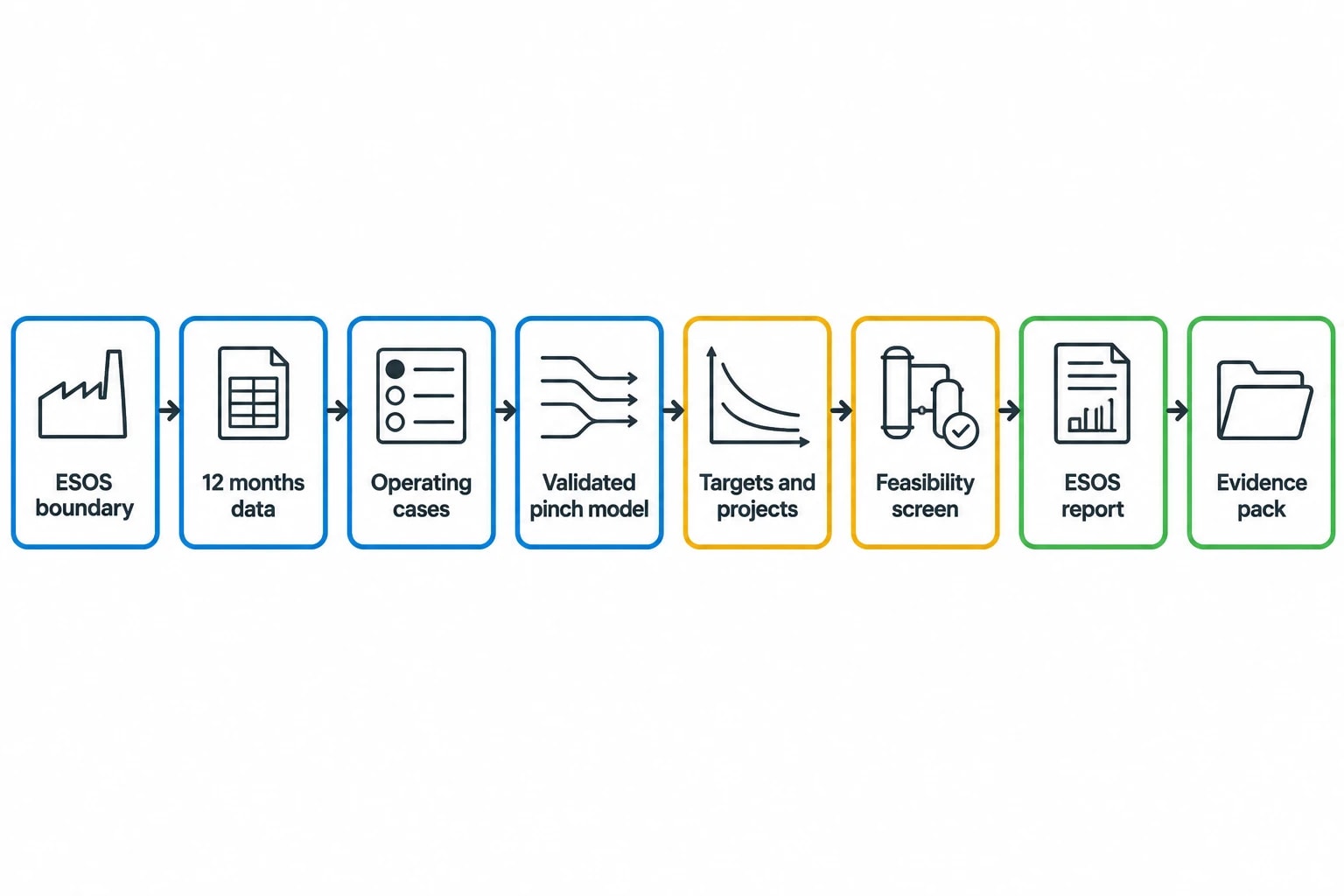
Selection should begin with the intended study, then test the software against the plant’s operating reality.
Select by operating mode and study scope
Continuous petrochemical, refinery and bulk-chemical processes can often begin with conventional stream targeting and heat-exchanger-network retrofit work. Batch sites need time-dependent analysis. Multi-plant sites with shared steam, fuel and cooling systems may need Total Site capability to avoid improving one unit at the expense of the utility system.
A useful procurement question is whether the model can represent the plant’s actual operating mode without forcing the engineer to average away the constraint that determines feasibility.
Demand an evidence-ready output
Before buying, ask each supplier or internal tool owner to demonstrate the following on a representative case:
- Import or capture of stream data, utility data and operating cases.
- Visible assumptions for minimum temperature approach, utility conditions and annual operating hours.
- Composite curves, grand composite curves and utility targets.
- Comparison of existing operation against the target case.
- Exportable tables showing energy savings, cost assumptions and scenario results.
- A route from target to a physically credible heat-exchanger-network change.
- A permanent record of model version, data source and analyst review.
The demonstration should use a realistic chemical-processing example, preferably an anonymised site stream table. Generic teaching examples conceal issues that affect an ESOS recommendation, such as fouling, seasonal cooling-water temperatures, steam-header pressure limits and campaign scheduling.
Build the software into the audit workflow
A disciplined workflow keeps the software in its proper place:
- Establish the ESOS boundary and identify significant energy consumption.
- Assemble 12 months of verifiable energy and production data.
- Define the process operating cases that drive utility demand.
- Develop and validate the pinch model with operations personnel.
- Generate targets and a shortlist of heat-recovery projects.
- Screen each project for layout, operability, safety, maintenance and shutdown needs.
- Prepare cost, savings, payback and implementation information for the ESOS report.
- Retain model files, inputs, calculations and review records in the evidence pack.
This sequence avoids presenting a theoretical heat-recovery target as a construction-ready scheme.
The practical recommendation for UK manufacturers
Aspen Energy Analyser fits sites with established Aspen simulation models and a recurring need to evaluate process and heat-exchanger-network changes. PinCH fits sites requiring detailed work across continuous, semi-continuous and batch operations, particularly where scheduling, indirect integration or heat storage affect the result. OpenPinch fits technically capable teams seeking reproducible, scriptable studies. The Open Pinch Toolkit and controlled spreadsheets fit early screening and structured training applications.
For an ESOS Phase 4 project, the deciding factor is the ability to produce a transparent chain from measured energy use to a practical, costed heat-recovery measure. The strongest study combines appropriate pinch-analysis software with experienced process engineering, verified plant data and a clear record of why the selected project can operate safely and reliably.
This article reflects the independent analysis and editorial opinion of EnerTherm Engineering. Product names, trademarks, and brands mentioned belong to their respective owners. EnerTherm Engineering is not affiliated with, endorsed by, or a licensee of any third-party software or product mentioned unless explicitly stated.

Simulation Engineer — EnerTherm Engineering
Rajesh Sekar is a Simulation Engineer at EnerTherm Engineering, specialising in computational fluid dynamics (CFD), finite element analysis (FEA), and thermal process simulation. He holds a degree from Cranfield University and brings extensive experience in simulation-based product development from the automotive, aerospace, and energy sectors.
