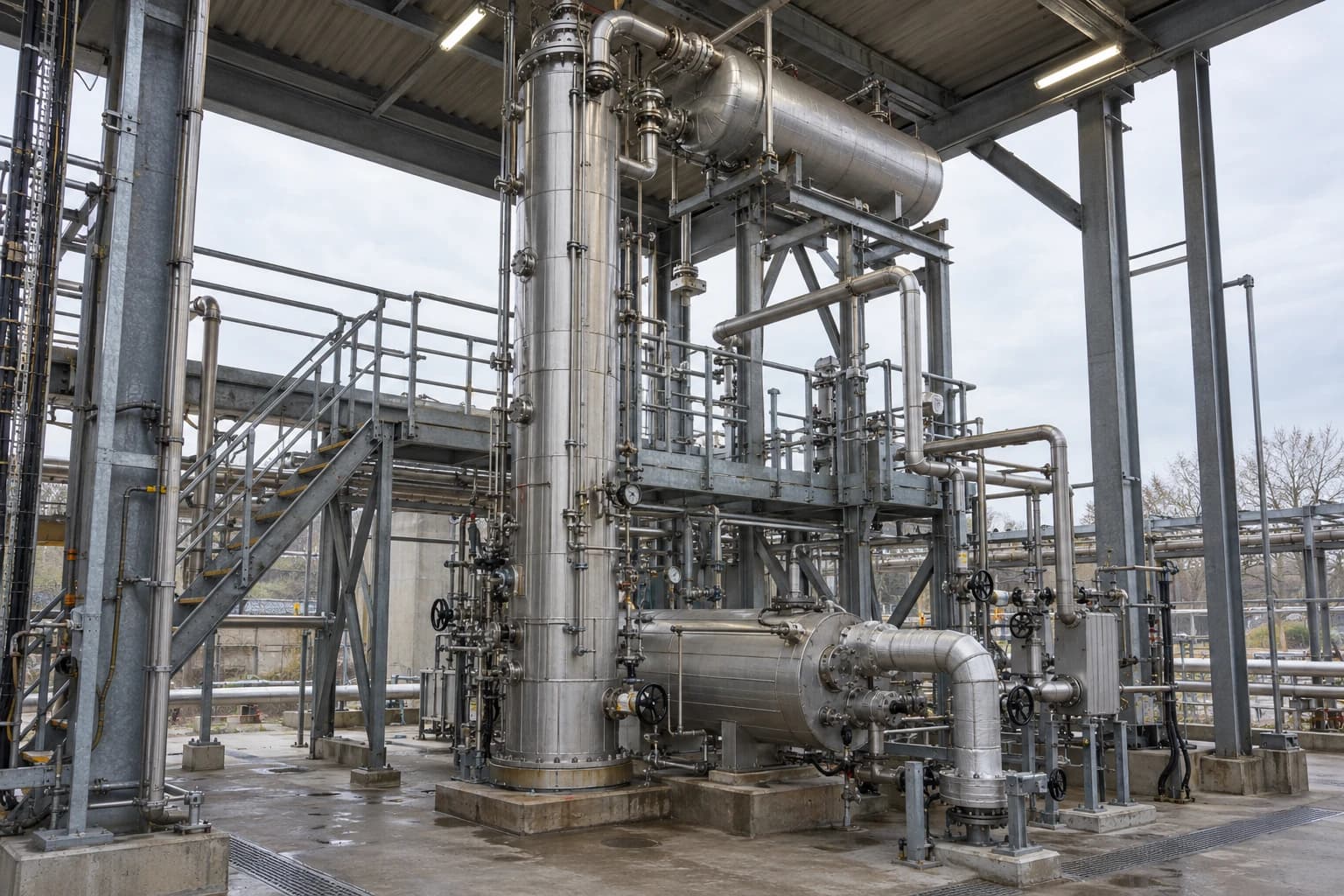
Why Pinch Analysis Can Cut Steam in Solvent Recovery
The UK BREF benchmark is about 75% solvent recovery before heat-integration retrofit.
Pinch analysis is a process-integration method that establishes the minimum external heating and cooling a process needs by matching hot and cold streams at feasible temperature differences.
The Waste Treatment BREF states that commercial solvent processors using batch, continuous or steam distillation typically recover about 75% of waste solvent. That figure, in Section 1.3.9, describes material recovery. It says nothing about the steam used to achieve it.
A recovery train can meet the material benchmark while rejecting condenser heat to cooling water and supplying steam to a reboiler, vessel jacket or feed heater nearby. Pinch analysis exposes these mismatches before a project team specifies exchanger area, utility upgrades or a heat pump.
For UK chemical, pharmaceutical and speciality-solvent sites, the prize is often a lower steam target with fewer changes than a column replacement. The constraint is temperature. Condensing solvent at 87°C cannot directly displace steam serving a 120°C reboiler, but it can preheat cold feed, warm wash water or charge a buffer circuit. Pinch analysis puts a defensible number on that distinction.
Why solvent recovery creates simultaneous heating and cooling duties
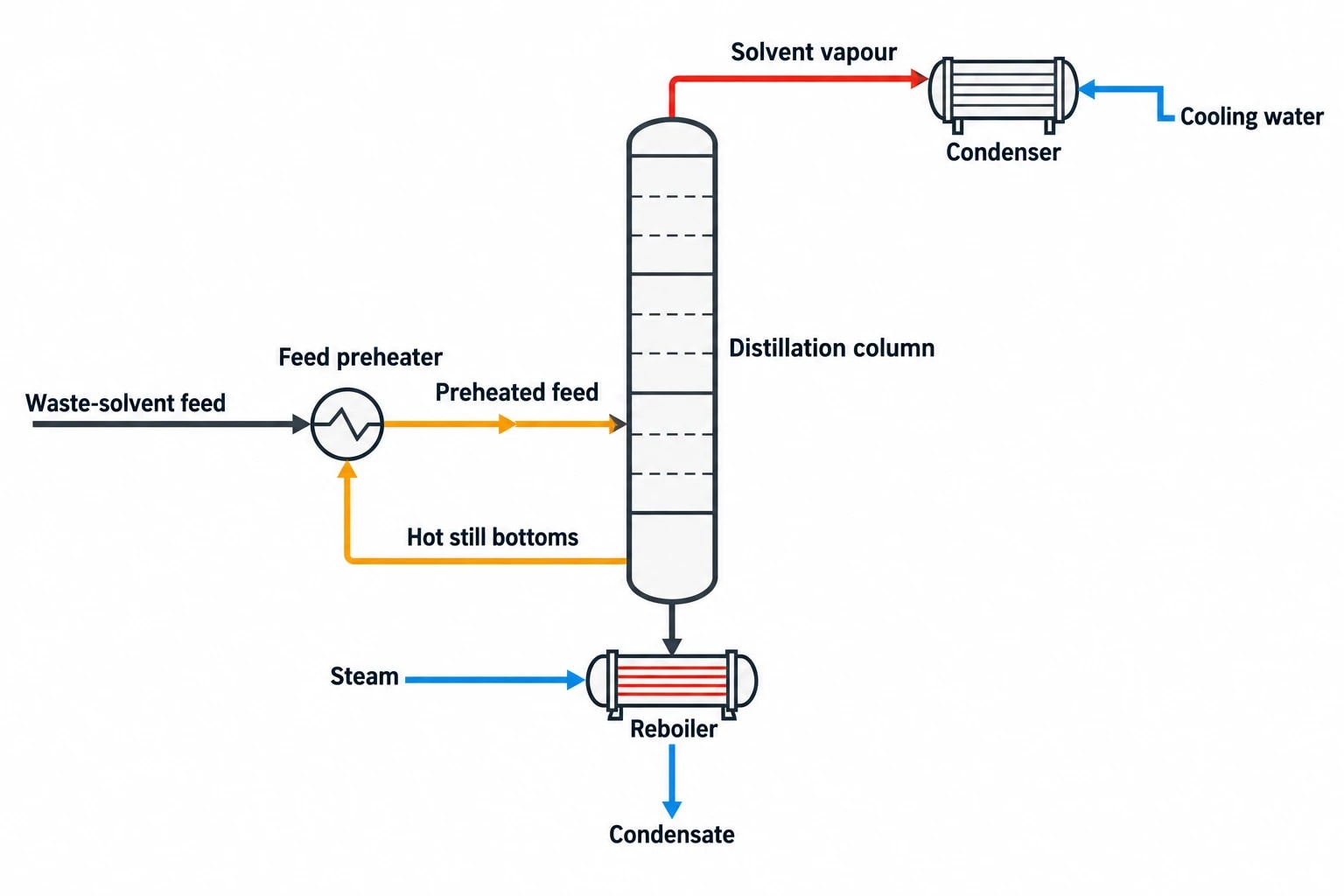
The column creates a heat source and a heat sink
Distillation requires latent heat at the reboiler to generate vapour. The overhead condenser then removes latent heat from that vapour. A conventional utility arrangement supplies steam at one end and rejects heat through cooling water or refrigeration at the other.
The resulting thermal opportunity depends on four site data sets:
- Hot-stream supply and target temperatures
- Cold-stream supply and target temperatures
- Sensible and latent duties
- The timing of each duty in batch and campaign operation
Recovered solvent cooling, condenser duty, hot still bottoms and condensate are usual hot streams. Fresh waste-solvent feed, feed tanks, column feed, batch charges and hot-water services are cold streams. A pinch study considers temperature levels as well as duties.
Material recovery and steam demand are separate measures
Solvent yield depends on feed composition, impurity volatility, product specification, still-bottoms handling and separation sequence. Steam demand depends on the selected separation duty after internal heat recovery.
A site should record solvent recovery, steam consumption, cooling duty and throughput separately. Increasing recovery from a difficult feed can increase reboiler duty. Reducing steam through feed preheat can leave solvent recovery unchanged. Combining those measures into one performance indicator conceals the engineering decision.

Pinch analysis identifies the thermodynamic minimum energy requirement of your process — then designs the heat exchanger network to achieve it.
How solvent recovery pinch analysis sets a steam target
Build stream data from measured operating cases
A credible study begins with plant data, not only process flow diagrams. Each stream needs a supply temperature, target temperature, mass flow or duty, composition, phase-change information and availability period.
Latent duties require particular attention. A condenser can release a large duty over a narrow temperature range. A simple average temperature can overstate how much heat is transferable. The study must also identify pressure limits, fouling exposure, viscosity, solids formation, corrosion, cleanability and contamination boundaries.
Batch systems need data by operating interval. A condenser duty available at 11:00 has no value for a cold charge at 18:00 unless a compatible heat-transfer loop or thermal store bridges the gap.
Select a realistic minimum temperature difference
The minimum temperature difference, ΔTmin, defines the closest practical approach between hot and cold streams. A smaller value increases the theoretical heat-recovery target but requires more exchanger area and tighter control.
A published biobutanol recovery study used a 10°C temperature gap. Its pinch calculation placed the hot-stream pinch at 86.8°C and the shifted cold-stream pinch at 76.8°C. That approach illustrates the method; it is not a universal design rule for pharmaceutical solvent recovery.
The right ΔTmin for a solvent recovery retrofit depends on exchanger type, fouling rate, solvent properties, control range and cleaning requirements. Plate-and-frame exchangers may support a closer approach in clean service. Fouling still-bottoms service can require a larger approach and accessible shell-and-tube exchangers. Engineers should test several cases against installed and maintenance costs.
Target utilities before selecting equipment
Composite curves combine hot and cold stream data and establish the minimum hot utility, minimum cold utility and maximum process heat recovery for the chosen ΔTmin. The target identifies the process constraint before an exchanger network fixes the solution.
An attractive local match can have little effect on boiler demand. A project should claim steam displacement only where the proposed receiver currently uses steam, operates at the required times and can accept recovered heat without harming separation performance.
A quantified solvent-recovery pinch example
Published stream data shows the temperature constraint
A 2021 published solvent-recovery process study reported three hot streams and four cold streams in a heat-integration calculation. The study included recovered solvent cooling, wastewater cooling and a distillation-column condenser as hot sources. It used four column-feed preheating duties as cold demands.
| Stream | Temperature range | Duty |
|---|---|---|
| Recycled solvent | 177.3°C to 25°C | 123 kW released |
| Wastewater | 100.8°C to 25°C | 690 kW released |
| Distillation column I condenser | 86.8°C condensation | 983 kW released |
| Distillation column I feed | 25°C to 110°C | 935 kW required |
| Distillation column II feed | 86.8°C to 94°C | 209 kW required |
| Distillation column III feed | 25°C to 94°C | 650 kW required |
| Distillation column IV feed | 79°C to 82°C | 89 kW required |
The reported pinch calculation found that available process heat covered the feed-preheating duties without additional heating utility. It also reported a 625 kW residual hot-stream utility after matching.
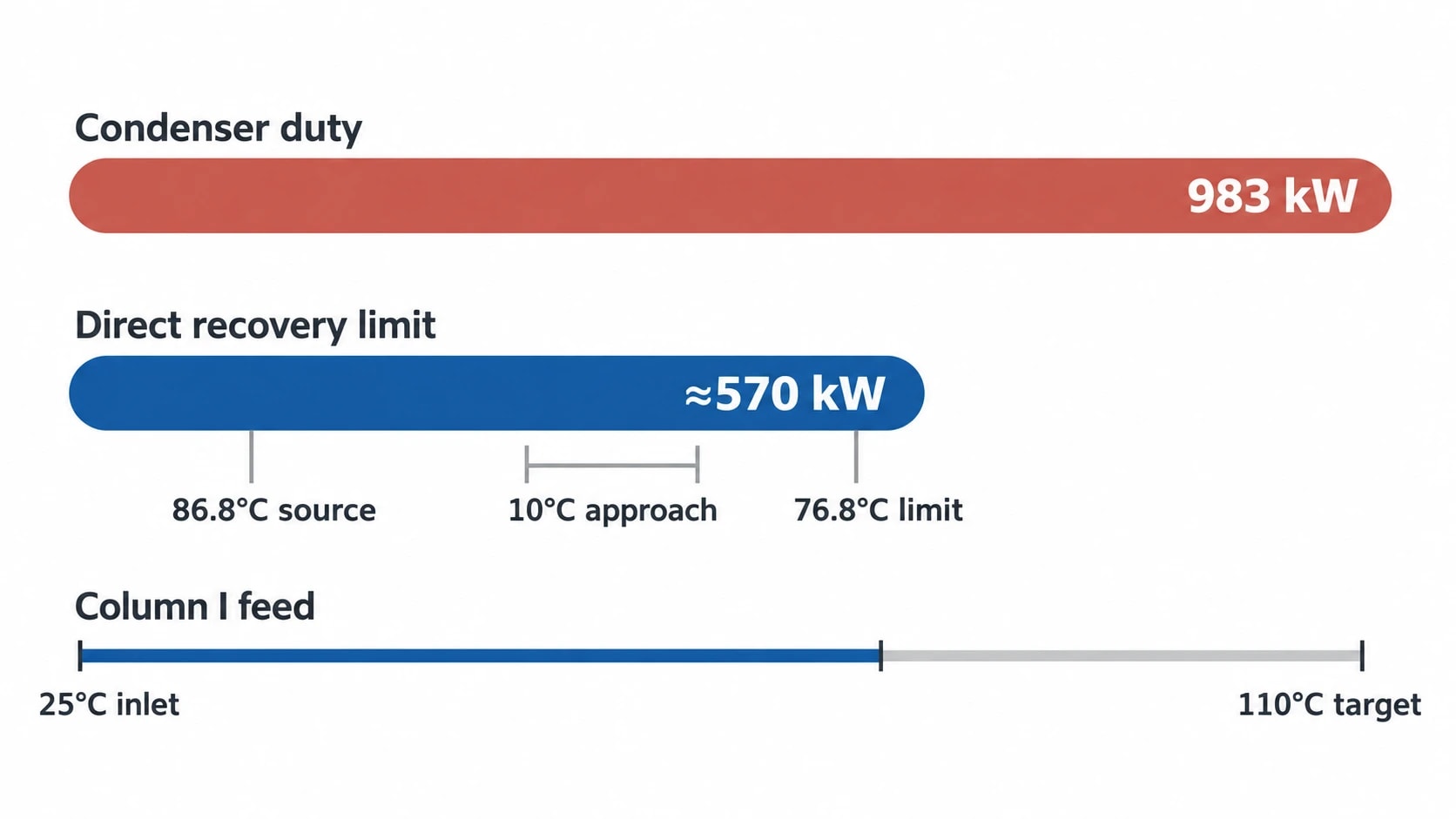
The condenser cannot heat Column I feed from 25°C to 110°C at a 10°C approach. Its 86.8°C condensation temperature limits the receiver to about 76.8°C. The temperature limit, rather than the 983 kW headline duty, determines its direct recovery value.
A screening calculation converts duty into steam and cost
Using the reported Column I feed duty, an approximate sensible-heat calculation places about 570 kW of feed heating between 25°C and 76.8°C. That is the approximate maximum direct duty available from the 86.8°C condenser at a 10°C approach, before exchanger design allowances.
For an equivalent recovery plant operating 8,000 hours a year, this represents:
- 4.56 GWh/year of displaced heat
- Approximately 7,900 tonnes/year of 3 barg steam, using 0.58 MWh of useful condensing heat per tonne of steam
- Approximately £276,000/year at an internal steam cost of £35 per tonne
These figures are a screening calculation, not a site forecast. The annual result changes with operating hours, steam pressure, condensate return temperature, boiler efficiency and the site’s marginal steam cost. A 983 kW condenser duty does not equal 983 kW of recoverable steam displacement.

Pinch analysis identifies the thermodynamic minimum energy requirement of your process — then designs the heat exchanger network to achieve it.
Where pinch targets become practical retrofit projects
Feed preheat is usually the first match to test
Hot recovered solvent and hot distillate can preheat incoming waste-solvent feed before a recovery still or column. The match reduces the sensible heating that steam would otherwise provide. It does not remove the latent reboiler duty required for evaporation.
The project team should test the match across the full feed envelope. Water content, solvent blend, feed temperature and campaign rate change the available duty. An exchanger sized around a favourable high-throughput case can underperform for most of the year.
A direct product-to-feed exchanger needs a contamination assessment. A tube failure can transfer contaminated feed into recovered solvent. Where product quality or pharmaceutical segregation rules prohibit direct exchange, an intermediate water, glycol or thermal-fluid loop provides separation at the cost of an additional temperature approach.
Condenser heat needs a receiver below its delivery temperature
Condenser heat can serve a cold stream only where the receiver target, including the approach allowance, is below the condensing temperature. Suitable receivers include:
- Waste-solvent feed preheat
- Batch charge warming
- Low-temperature wash-water services
- A controlled hot-water buffer circuit
- Another recovery unit operating at a lower temperature
A heat-recovery proposal should document the receiver’s existing heating source. If the receiver uses electrical heating or another heat source, the project reduces that utility rather than steam. If the receiver operates intermittently, the study must demonstrate a time match or include storage.
Batch scheduling can protect the saving
Time-dependent pinch analysis maps hot and cold duties over the batch schedule. It can show whether rescheduling a compatible cold charge after a recovery batch creates a usable heat match without new exchanger area.
Production and quality teams must retain control of campaign order, cleaning validation, product segregation and release testing. The energy study should quantify the steam consequence of those constraints rather than treating production timing as fixed background information.
DSEAR and VOC control define the retrofit boundary
A steam-saving project can change the release scenario
The Dangerous Substances and Explosive Atmospheres Regulations 2002, SI 2002/2776, require employers to assess dangerous-substance risks under Regulation 5, eliminate or reduce risks so far as reasonably practicable under Regulation 6, and classify places where explosive atmospheres may occur under Regulation 7.
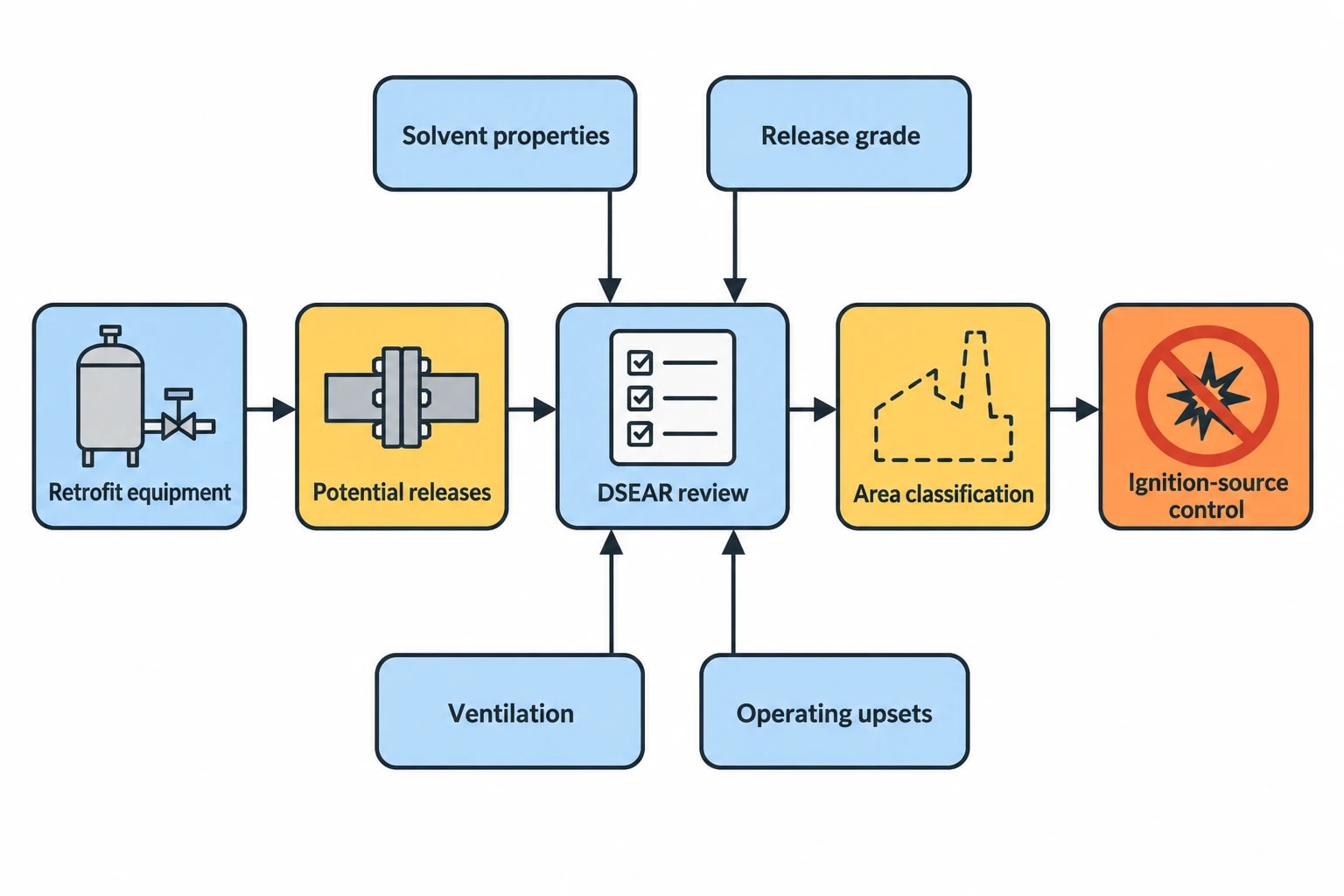
New exchangers, pumps, buffer vessels, vents, drains and pipework can introduce flanges, seals and isolation points. Raising feed temperature can increase vapour pressure. A solvent recovery retrofit therefore needs a DSEAR review within the project scope before procurement.
BS EN IEC 60079-10-1:2021 covers the classification of areas where explosive gas atmospheres may occur. The assessment should reflect solvent properties, release grade, ventilation, maintenance conditions and credible operating upsets. The resulting zones inform equipment selection and ignition-source control.
Heat integration must preserve VOC containment
The Industrial Emissions Directive 2010/75/EU framework continues to underpin UK industrial-emissions controls, including existing BAT Conclusions. The UK BAT formal draft for Common Waste Gas Management and Treatment Systems in the Chemical Sector remains under review. The GOV.UK UK BAT page lists its status as reviewing consultation responses. The draft therefore supports early design review but does not replace permit conditions or final BAT Conclusions.
For installations handling VOCs, the engineering question extends beyond recovered kilowatts. The modified design must retain closed transfer, condensate collection, vent routing and abatement performance through normal operation, start-up, shutdown and maintenance.
Turning a pinch target into a bankable steam-reduction project
A solvent recovery pinch study should end with a shortlist rather than a composite curve alone. Each measure should state the hot source, cold receiver, operating period, recoverable duty, existing utility displaced, exchanger approach, fouling allowance, DSEAR changes and VOC implications.
The strongest projects connect measured duties with compatible temperature levels and operating schedules. They also include performance verification: meter steam flow, condensate return, exchanger inlet and outlet temperatures, cooling-water duty and throughput before and after commissioning.
Pinch analysis identifies the part of the steam load that process heat can displace at feasible temperatures. In solvent recovery, that distinction creates a safe, measurable retrofit scope.
This article reflects the independent analysis and editorial opinion of EnerTherm Engineering. Product names, trademarks, and brands mentioned belong to their respective owners. EnerTherm Engineering is not affiliated with, endorsed by, or a licensee of any third-party software or product mentioned unless explicitly stated.

Managing Director — EnerTherm Engineering
Dr. François Pierrel is Managing Director of EnerTherm Engineering with over two decades of expertise in thermal design, heat transfer, and industrial energy optimisation. He holds a PhD in Heat Transfer from Cranfield University and a Post-Doctorate from Heriot-Watt University.
