How Pinch Analysis Retrofitted a Crude Distillation HEN
A crude-distillation case study balancing heat recovery, fouling and retrofit constraints.
A 2021 crude-refinery case study reported operating-cost savings of approximately US$2 million per year after a pinch-based heat-exchanger-network retrofit. The project improved recovery in an existing crude preheat train, reducing the duty left for fired heating and utilities.
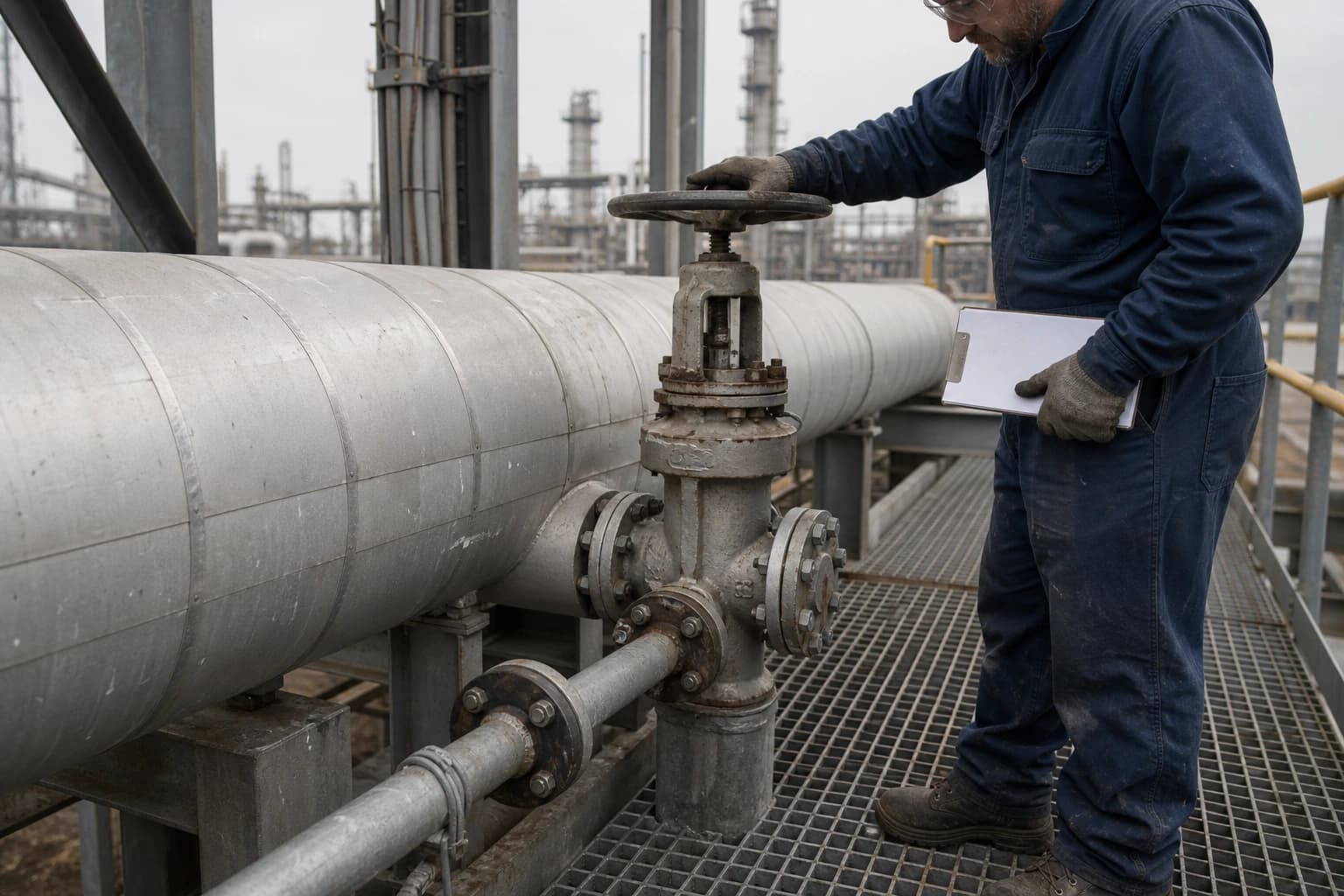
That is the appeal of a refinery pinch analysis retrofit. A crude distillation unit contains valuable heat: hot products leaving the column, pump-arounds and side draws require cooling, while desalted crude requires heating before it reaches the furnace and atmospheric column. The preheat train should transfer as much of that heat as practical. Over time, exchanger fouling, crude-slate changes, bypasses, capacity constraints and past modifications can turn an orderly network into a costly compromise.
Pinch Analysis gives the engineering team a disciplined way to identify where that compromise sits, what heat can be recovered and which modifications justify a shutdown. It does not produce a generic instruction to add exchangers. It sets energy targets, tests real heat-transfer paths and exposes the constraints that define a practical retrofit.
Why a crude distillation HEN loses heat recovery over time
The preheat train carries the furnace penalty
In a crude distillation unit, each megawatt of heat recovered into crude ahead of the furnace can reduce fired duty, subject to operating conditions and furnace efficiency. Lower crude-coil inlet temperature requires more fuel to achieve the required furnace outlet temperature.
A crude preheat train rarely remains in its original condition. Refiners alter exchanger matches to accommodate changed throughput, crude properties, product-routing changes or maintenance failures. An exchanger may be bypassed after a pressure-drop problem. Another may receive a new stream match that works in one operating mode but constrains another. Fouling then raises thermal resistance and reduces delivered duty further.
The operating team may compensate by increasing furnace firing, using more steam elsewhere or accepting lower crude throughput. Each response affects energy use and emissions.
Pinch Analysis frames the whole system
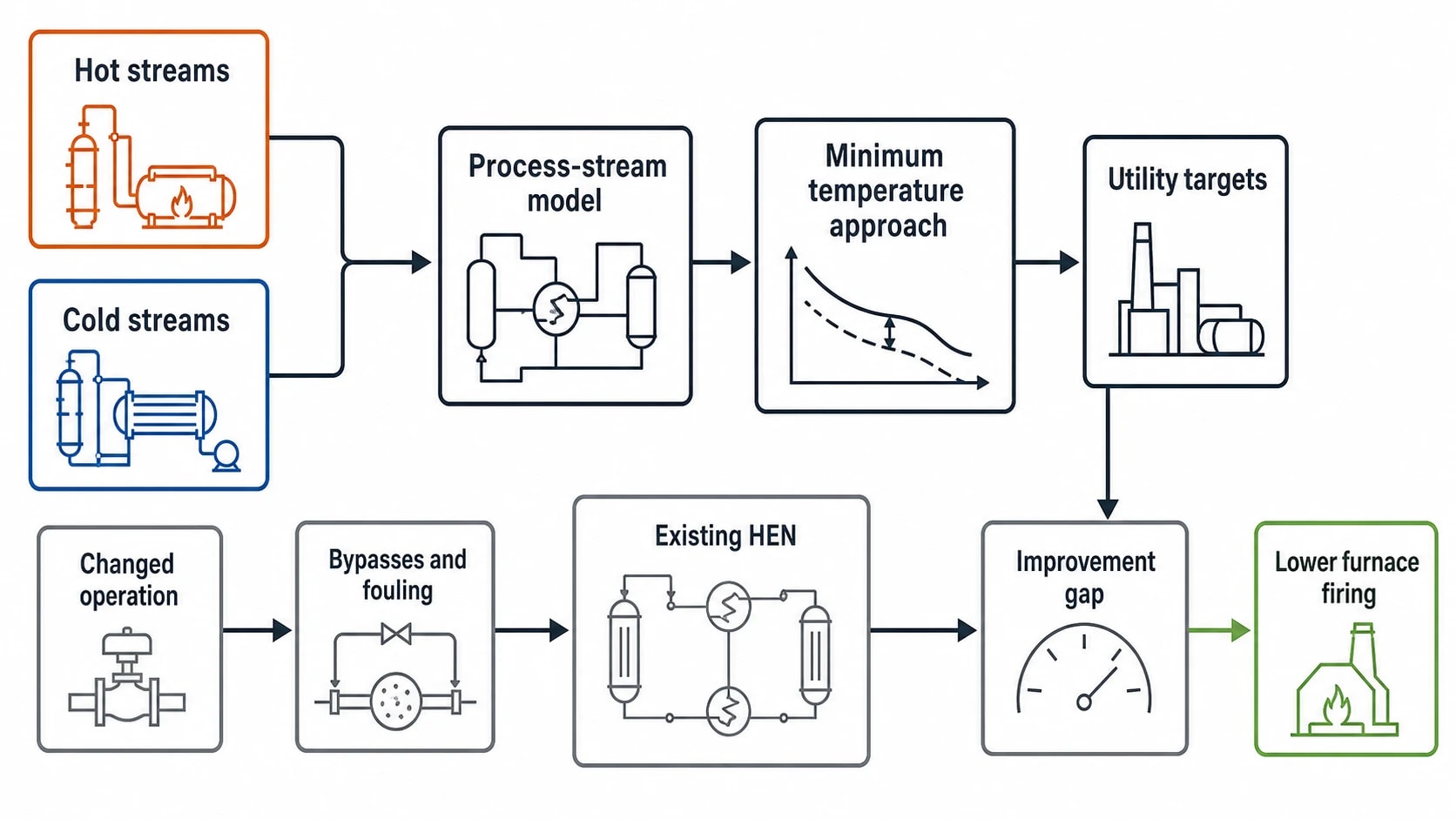
A refinery pinch analysis retrofit begins with process streams rather than the installed exchanger list. Engineers identify:
- Cold streams requiring heating, including crude, recycle streams and feeds to downstream units.
- Hot streams requiring cooling, including products, pump-arounds and hot process streams.
- Stream supply and target temperatures.
- Heat-capacity flowrates and phase-change duties where relevant.
- Existing utility loads, exchanger duties, bypass positions and operating modes.
- Minimum practical temperature approach, based on exchanger type, fouling risk, controllability and available area.
The analysis builds thermodynamic targets for minimum hot and cold utility demand at a chosen minimum temperature difference. It then compares the existing HEN with that target. The gap indicates potential for improvement, not an automatic capital project.
Commission Implementing Decision 2014/738/EU gives this work added weight. BAT 2 for mineral-oil and gas refining includes energy integration among energy-efficiency techniques. For UK installations, these BAT conclusions continue to apply through the retained-law framework. A well-documented refinery pinch analysis retrofit can support an energy-investment case and the evidence base for permit discussions.

Pinch analysis identifies the thermodynamic minimum energy requirement of your process — then designs the heat exchanger network to achieve it.
Building a credible refinery pinch analysis retrofit case
Start with reconciled operating data
A retrofit study depends on a sound base case. Design data can misrepresent a unit that has operated for decades. The assessment should use a representative operating period and reconcile measured temperatures, flowrates and exchanger duties before accepting pinch targets.
Particular attention is required at the boundaries of the crude preheat train:
- Desalter outlet temperature and crude properties.
- Furnace inlet temperature and fired duty.
- Pump-around flows and return temperatures.
- Product rundown temperatures.
- Operating status of bypasses and spare exchangers.
- Steam use associated with stripping, reboiling or linked duties.
- Throughput and crude-slate variability.
A duty imbalance often signals an instrumentation issue, an unrecorded bypass, heat loss, unaccounted phase change or a stream-property error. The model should resolve those questions before proposing new surface area.
Select temperature approaches that respect the hardware
The minimum temperature difference is a major economic choice. A very small approach temperature may produce an attractive energy target, but often demands excessive exchanger area, impractical pressure drop or poor control behaviour. A larger approach reduces heat recovery but can yield a less intrusive project with a better shutdown scope.
Temperature-driving-force analysis shows which exchangers operate close to their available driving force and where a proposed duty shift would demand area that an existing shell-and-tube bundle cannot provide. In a retrofit, this can be more valuable than a theoretical utility target.
The 2021 Kuwait crude-refinery study treated graphical pinch methods as a retrofit tool rather than a clean-sheet design exercise. Its reported savings came from identifying recoverable heat within an existing HEN while tying changes to feasible temperature driving forces.
Finding useful heat paths in the crude preheat train
Move heat without crossing the pinch
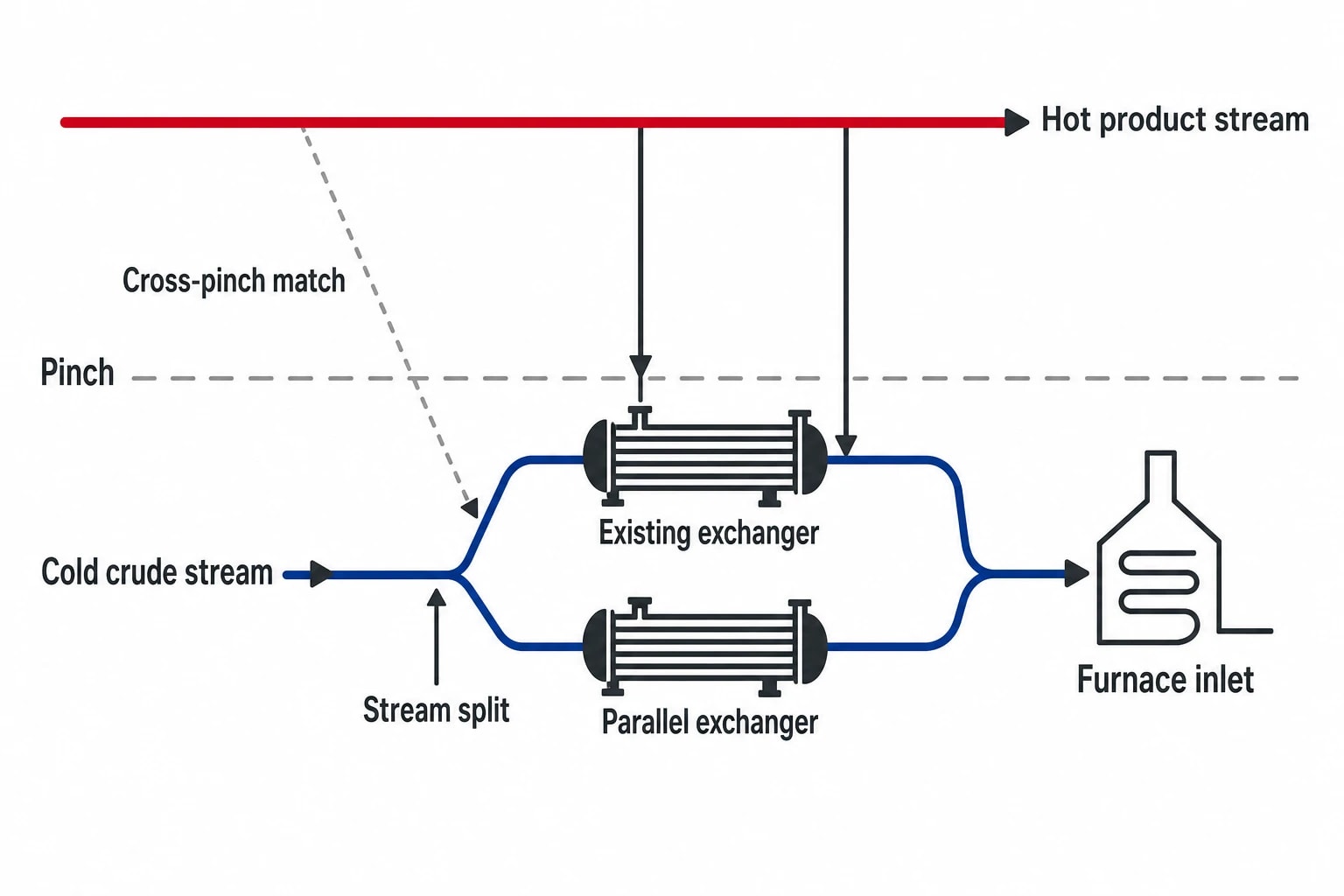
Pinch principles identify the restrictions that protect the energy target. Heat transfer across the pinch increases both hot and cold utility requirements. In an existing HEN, cross-pinch matches may remain because of legacy topology, operability needs or process changes.
The retrofit task is to find alternative heat paths that restore recovery without destabilising the unit. This can involve:
- Reassigning duty between existing exchangers.
- Using available exchanger area more effectively.
- Splitting a crude stream or hot stream to create a better temperature match.
- Adding an exchanger in parallel or series where the driving force supports it.
- Reconnecting a bypassed exchanger after addressing its hydraulic or fouling limitation.
- Adding a heat-integration link with an adjacent process unit where schedules and operating modes align.
The final option requires caution. A heat source outside the crude unit can improve overall refinery heat recovery, yet create dependencies during start-up, turnaround and rate changes. The project must prove that the donor stream remains available when the crude unit needs it.
Preserve control and hydraulic limits
A heat exchanger network does more than exchange heat. It maintains process temperatures, pressures and stable column operation. A proposed match may look efficient in a steady-state model but cause unacceptable temperature swings when throughput or pump-around flow changes.
Process integration engineers therefore test selected modifications against:
- Maximum allowable pressure drop on crude and product circuits.
- Pump capacity and control-valve authority.
- Furnace coil inlet-temperature control.
- Minimum metal-temperature and corrosion constraints.
- Product-quality requirements.
- Start-up, shutdown and reduced-rate operation.
- Isolation and maintenance access.
A sound design gives the operating team a controllable network. It does not lock the unit into one narrow operating point to achieve an energy result.
The retrofit package: small changes can have large effects
Prioritise modifications by delivered duty
The best refinery pinch analysis retrofit packages often combine several modest interventions rather than rely on one large exchanger. An existing HEN may have spare area in one location, an unnecessary bypass in another and a duty mismatch between two exchangers. Rebalancing these elements can lift crude preheat temperature before new equipment is installed.
A practical project screen should rank each option by delivered annual benefit, capital cost, outage requirement, mechanical complexity and fouling effect. It should also identify whether the benefit depends on a single crude slate or persists across the refinery’s planned crude range.
| Retrofit option | Typical benefit | Key engineering check |
|---|---|---|
| Re-route an existing stream match | Improved heat recovery with limited new equipment | Control stability and pipework scope |
| Add exchanger area | Higher crude preheat temperature | Temperature driving force, plot space and pressure drop |
| Install parallel service | Maintains duty while allowing cleaning | Flow distribution and bypass control |
| Reduce a bypass | Recovers lost process heat | Fouling, tube integrity and operability |
| Integrate an adjacent hot stream | Reduces furnace or utility duty | Availability across operating modes |
Assess turnaround scope early
An excellent energy case can fail when access, tie-in points, lifting routes or inspection requirements are left until detailed design. Shell-and-tube exchanger additions need plot space, structural checks, pipe supports, isolation arrangements and safe maintenance access. Altering an existing train can also create a critical-path turnaround item.
The concept stage should distinguish work that can be completed online from work requiring a unit outage. It should also identify whether a new exchanger can be prefabricated and hydrotested before the shutdown. These details affect capital cost and schedule risk.

Pinch analysis identifies the thermodynamic minimum energy requirement of your process — then designs the heat exchanger network to achieve it.
Fouling determines whether savings endure
Design performance is only the start
Crude-oil preheat trains foul because their fluids and temperatures create deposits that reduce heat transfer and may raise pressure drop. A retrofit that concentrates additional duty in a vulnerable exchanger can show excellent first-week performance, then lose its advantage as fouling develops.
The 2018 Chemical Engineering Transactions crude-distillation study addressed this problem directly. Its case involved a 6 Mt per year crude distillation unit and combined pinch retrofit design with historical exchanger performance, fouling prediction, start-up and shutdown time. It considered operating constraints including exchanger bypasses, operating budget, furnace duty and pumping limits.
A refinery should measure success through sustained furnace-duty reduction across the run length, rather than a single clean-exchanger heat balance.
Connect cleaning plans to network targets
Historical temperature and pressure-drop trends should feed the retrofit model. Engineers can then identify which exchangers become limiting as fouling resistance rises, and whether cleaning one shell returns more system value than cleaning another.
Useful deliverables include:
- Predicted crude preheat temperature through a run.
- Furnace-duty profile before and after retrofit.
- Exchanger-by-exchanger cleaning priorities.
- Permissible bypass strategy during degradation.
- Throughput effects under realistic fouling conditions.
- A shutdown and cleaning programme aligned with the revised HEN.
This approach can show that a lower initial heat-recovery target is the better commercial choice because it retains duty for longer and avoids frequent intervention.
Carbon, steam and permit relevance for UK refineries
Fuel reduction is the primary carbon route
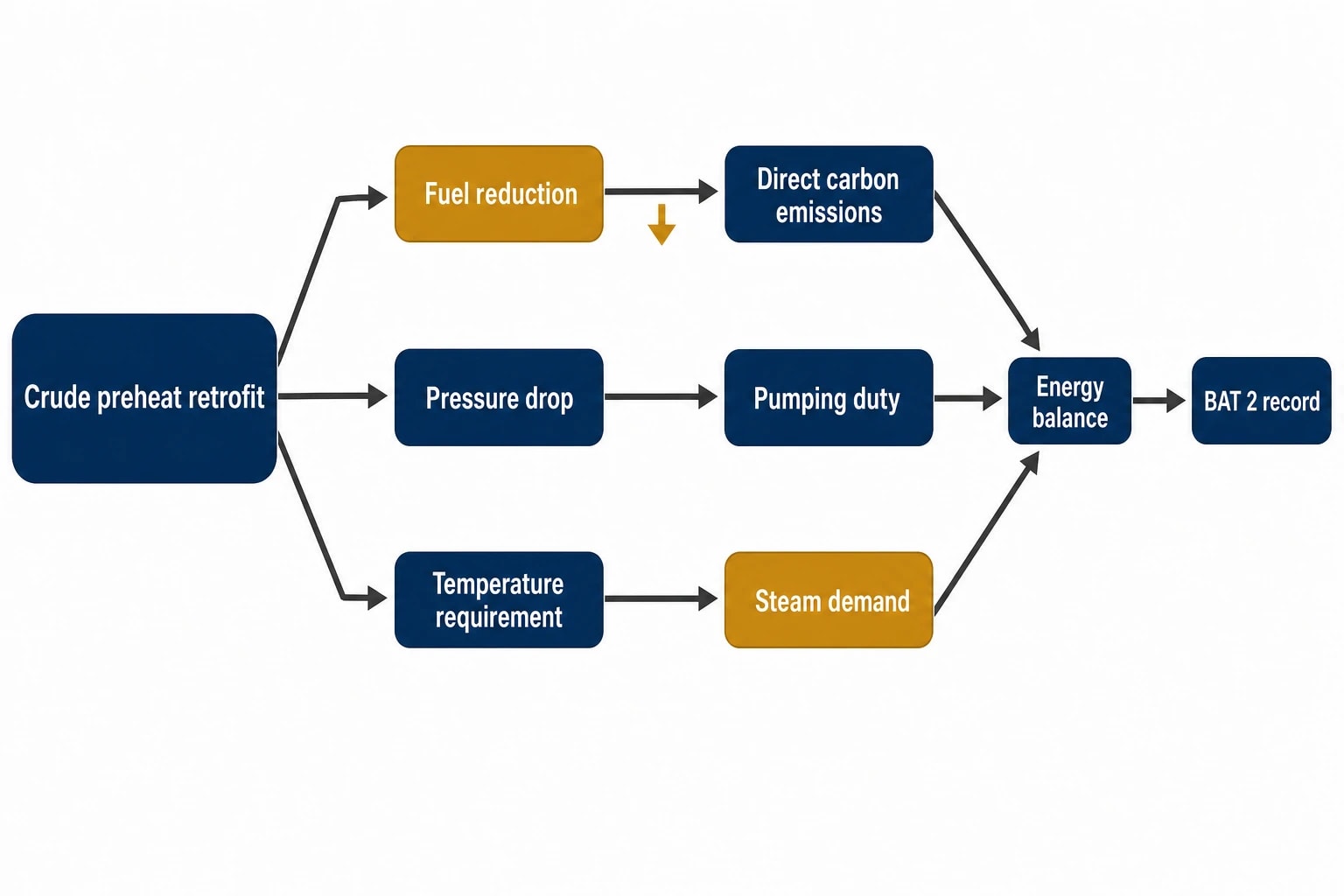
Improved crude preheat lowers the demand placed on the crude furnace. The resulting reduction in combustion fuel can cut direct carbon emissions, subject to the site fuel mix and verified energy balance. If the project also reduces steam demand, it may release boiler capacity or avoid further fuel use for steam generation.
A retrofit business case should quantify fuel, steam and electricity changes separately. Pumping duty may rise if the project increases pressure drop, while steam savings may be offset by an altered process-temperature requirement. Separating these effects prevents headline savings from hiding a transfer of energy use elsewhere on site.
Build a permit-ready evidence trail
For a UK permitted refinery, the study record should explain how the project supports BAT 2. It should include the existing energy balance, pinch targets, selected minimum temperature approach, rejected options, expected fuel reduction, control philosophy and maintenance plan.
The Environment Agency requires operators to explain how applicable BAT is followed in the operating-techniques section of a permit application, or to propose an alternative technique that achieves equivalent environmental protection. A pinch study is most useful when it documents the chosen operating configuration rather than only presenting theoretical targets.
What a successful HEN retrofit looks like
A successful crude-distillation retrofit raises sustained preheat performance without compromising throughput, controllability or cleaning access. It reduces furnace fuel in normal operation and gives operators a clear response when exchangers foul or feedstock changes.
Published cases show that Pinch Analysis provides the target, but refinery performance depends on matching it to temperature driving force, installed area, pressure drop, fouling behaviour and turnaround reality.
This article reflects the independent analysis and editorial opinion of EnerTherm Engineering. Product names, trademarks, and brands mentioned belong to their respective owners. EnerTherm Engineering is not affiliated with, endorsed by, or a licensee of any third-party software or product mentioned unless explicitly stated.

Managing Director — EnerTherm Engineering
Dr. François Pierrel is Managing Director of EnerTherm Engineering with over two decades of expertise in thermal design, heat transfer, and industrial energy optimisation. He holds a PhD in Heat Transfer from Cranfield University and a Post-Doctorate from Heriot-Watt University.
