TMP Mill Pinch Analysis Cuts Clean Steam by up to 34%
A Norske Skog Skogn case study cut clean-steam demand by up to 8.9 MW.
Thermomechanical pulp mill energy pinch analysis maps heat sources and demands across a TMP mill to identify the lowest achievable clean-steam demand without compromising process operation. A Chalmers University case study at Norske Skog Skogn found that a combined retrofit package could reduce clean-steam consumption by 8.9 MW, or 34%.
That result is site-specific, not a universal saving claim. It does, however, show the opportunity at an integrated TMP and paper mill where refiner steam, paper-machine heat recovery, condensate systems and district-heating interfaces have developed separately over time.
TMP refining uses large quantities of electricity to separate wood chips into fibres under pressure. Much of that electrical input becomes heat. The engineering challenge is to recover the resulting low-pressure steam at a useful temperature and match it to process heat sinks before fresh utility steam fills the gap. Pinch analysis provides the accounting framework and retrofit rules to do this systematically.
Why thermomechanical pulp mill energy pinch matters
TMP converts electrical power into recoverable heat
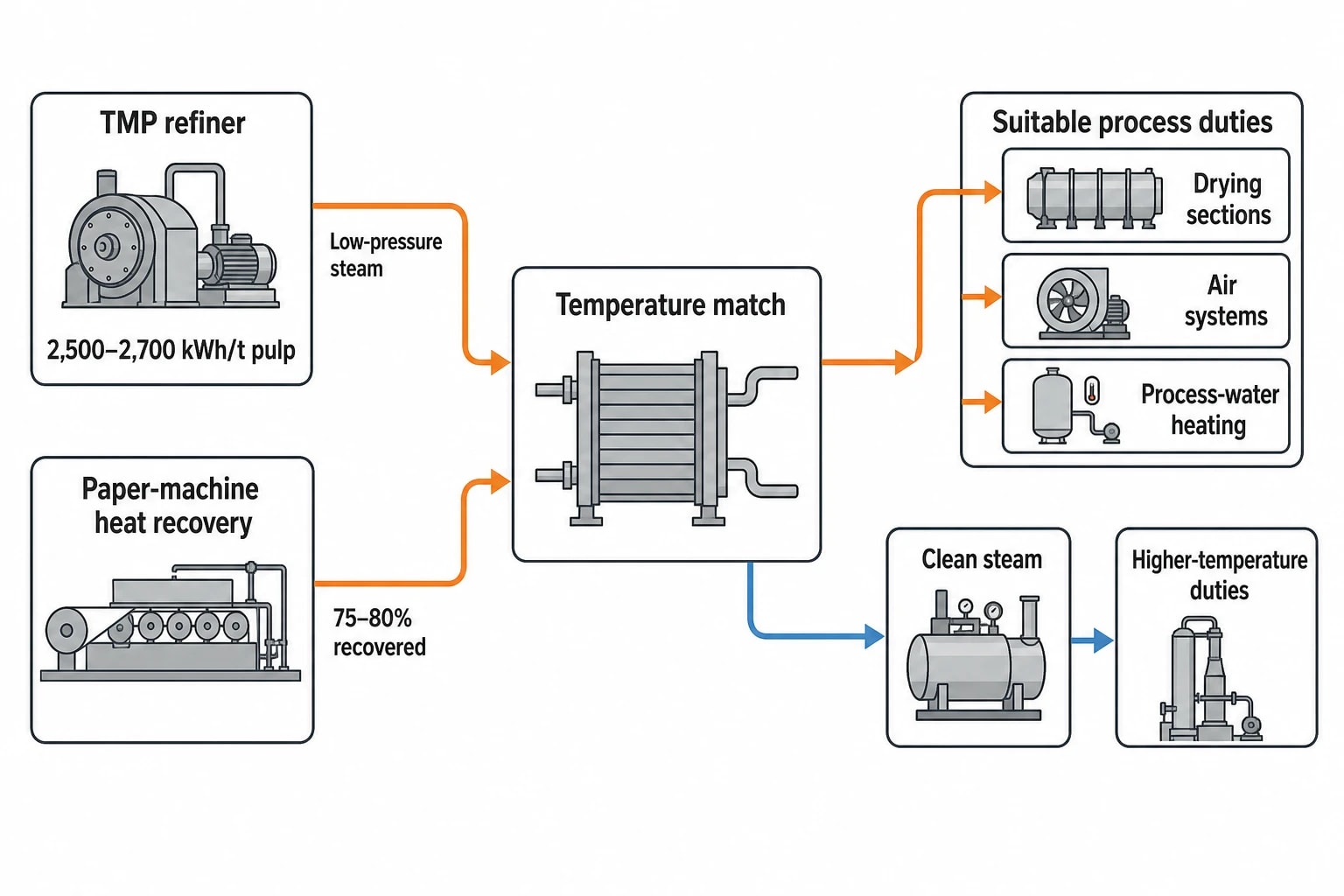
The EU Pulp, Paper and Board BAT Reference Document indicates the energy balance. For integrated TMP-based printing paper containing more than 90% TMP, it reports refining electricity consumption of 2,500 to 2,700 kWh/t of pulp. It also states that 75 to 80% of that refining electricity can be recovered as low-pressure steam.
This heat is valuable, but it is not interchangeable with high-pressure boiler steam. Its temperature and pressure determine which duties it can serve. Drying sections, air systems, process-water heating and pulp drying may offer suitable demands. Higher-temperature duties may still require clean steam, depending on the mill configuration.
The same BREF describes good practice as requiring approximately 1.2 GJ/t, or 330 kWh/t, of additional steam heat for this class of integrated TMP-based printing-paper production. That figure is a benchmark, not a target that can be copied directly into another mill. Fibre furnish, paper grade, drying configuration, production rate, climatic conditions and the existing heat-recovery network all affect the result.
Steam savings require a mill-wide boundary
A TMP line can appear heat-rich when assessed alone. The picture changes when the paper machine, condensate network and utility system enter the study boundary. A refiner may export secondary steam while a paper-machine air system rejects heat that could warm process water. A district-heating connection may consume or reject heat at times that conflict with internal process needs.
The Skogn study identified major pinch violations in the paper-machine heat-recovery, cooling and district-heating systems. The best retrofit package therefore extended beyond a single heat exchanger or TMP stage.
A thermomechanical pulp mill energy pinch study should treat heat as a mill resource rather than a collection of isolated duties. This exposes the value of each heat source at its available temperature.

Pinch analysis identifies the thermodynamic minimum energy requirement of your process — then designs the heat exchanger network to achieve it.
What the EU and UK regulatory context expects
BAT 41 names refiner heat recovery and pinch analysis
Commission Implementing Decision 2014/687/EU sets the BAT Conclusions for pulp, paper and board under the EU Industrial Emissions Directive. BAT 41 applies to mechanical and chemimechanical pulping and calls for measures to reduce thermal and electrical energy consumption.
Two elements speak directly to TMP heat recovery:
- Extensive recovery of secondary heat from TMP and CTMP refiners, with reuse of recovered steam in paper or pulp drying, is generally applicable.
- Reducing direct steam use through careful process integration, including pinch analysis, is included in BAT 41.
Recovering refiner steam alone does not guarantee lower clean-steam demand. The steam must displace a utility duty at an appropriate temperature. Pinch analysis tests that match across the complete heat balance.
Permit decisions require site evidence
UK pulp and paper installations operate through environmental permits and regulator-led BAT assessment. GOV.UK guidance states that BAT Conclusions contain BAT descriptions and associated emission levels, and that operators must comply unless the Environment Agency accepts that relevant alternative criteria have been met.
A heat-recovery proposal needs defensible operating data, an explanation of applicability, and evidence that it preserves safety, product quality and reliable operation. A generic energy model cannot demonstrate live-mill performance through grade changes, seasonal cooling-water temperatures and production constraints.
How pinch analysis targets clean-steam reduction in a TMP mill
Start with a representative operating case
The study team first defines the operating periods that matter. A single annual average can hide the conditions that drive clean-steam use. Useful cases include a stable high-production period, a lower-load period, a representative paper grade, and periods when the mill imports more steam or fuel.
The energy model should establish:
- Production rate and pulp consistency.
- Refiner electrical load, steam pressure and steam flow.
- Steam supplied to paper drying, pulp drying and other process users.
- Condensate flow, temperature, pressure and flash-steam recovery.
- Process-water, white-water and shower-water heating duties.
- Cooling loads, including heat rejected to cooling water or air.
- Paper-machine exhaust-air and heat-recovery duties.
- Boiler, turbine and district-heating interfaces where present.
Engineers should reconcile measurements before drawing conclusions. Flow meters, pressure transmitters and temperature readings may be sound individually while producing an impossible energy balance collectively. Phase change needs particular care. The latent heat released when secondary steam condenses often dominates the duty, so a model based only on sensible temperature change will understate its value.
Build the composite curves and utility targets
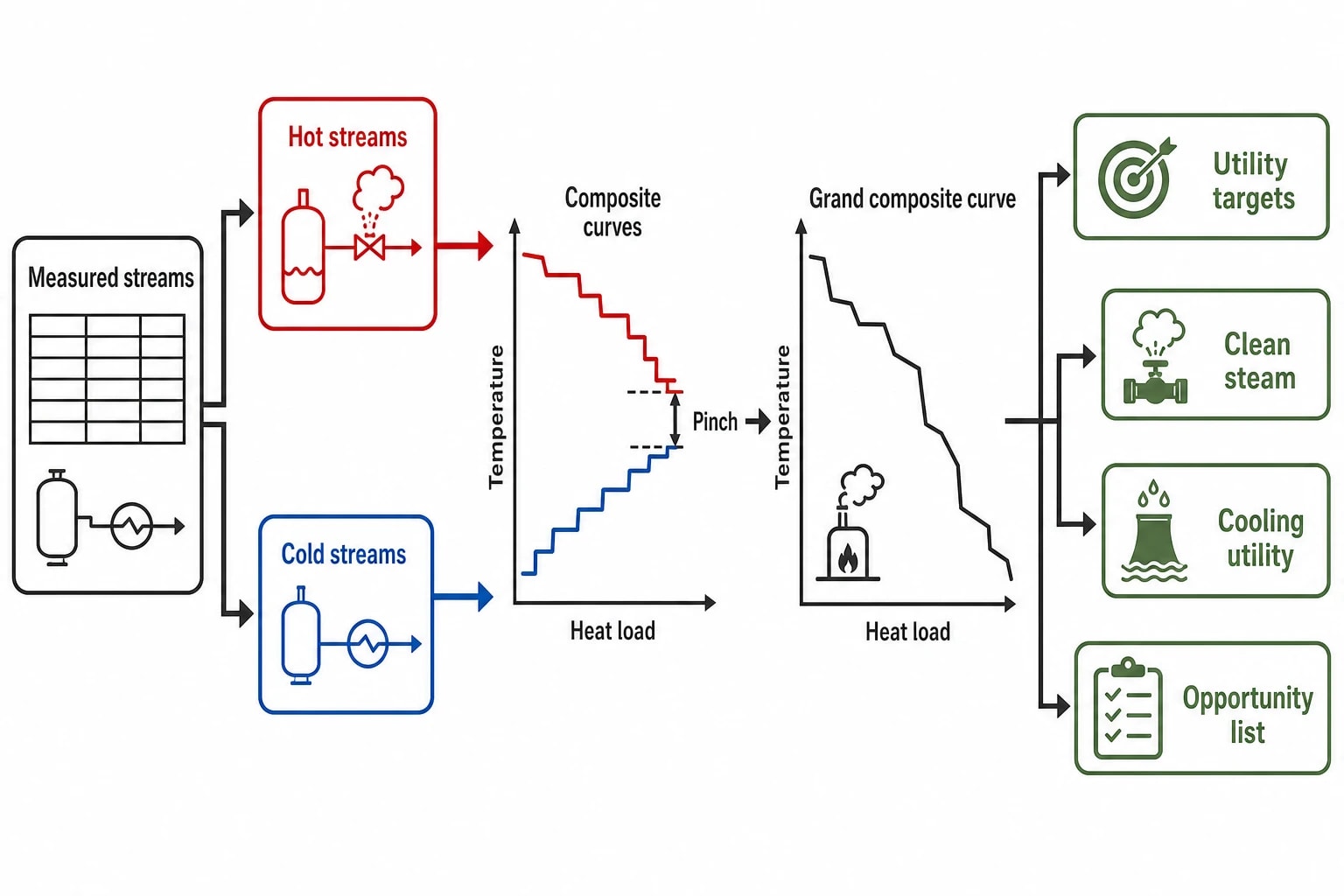
Pinch analysis represents process streams as hot streams requiring cooling and cold streams requiring heating. Composite curves combine these streams to show the aggregate temperature and heat-load relationship. The grand composite curve identifies where utilities enter the process and where lower-grade heat has a useful role.
The minimum temperature approach is an engineering decision, not a default spreadsheet input. It must reflect exchanger type, fouling tendency, control stability, pressure drops, available heat-transfer area and the cost of new surface. A very small approach temperature can make an attractive theoretical target impractical in a pulp mill, where fibre, deposits and variable flows affect heat transfer.
The output is a target for minimum clean-steam demand and cooling requirement for each case. The gap between present consumption and the target creates a quantified opportunity list. The design team can then distinguish between heat-recovery deficits requiring capital work and apparent deficits caused by poor measurements or unrepresentative assumptions.
Apply pinch rules before specifying equipment
Retrofit discipline prevents a mill from installing an exchanger that improves one area while increasing utility demand elsewhere. Above the pinch, process heat should meet process heating demands before clean steam is introduced. Below the pinch, process cooling should meet process cooling demands before additional cooling utility is used. Heat should not cross the pinch unless its energy consequence has been evaluated.
For TMP systems, this often directs attention towards:
- Reusing refiner secondary steam in drying duties that can accept its pressure and temperature.
- Recovering heat from condensate and flash steam for lower-temperature water heating.
- Correcting paper-machine heat-recovery matches that force steam into a duty already served by recoverable heat.
- Reassessing cooling duties that reject heat while nearby process streams need heating.
- Matching district-heating exports or imports to the mill heat cascade rather than treating them as fixed loads.
These are project categories, not pre-approved modifications. A workable match must respect contamination risk, condensate quality, pulp properties, access for cleaning, pressure control and production continuity.

Pinch analysis identifies the thermodynamic minimum energy requirement of your process — then designs the heat exchanger network to achieve it.
The Skogn study shows why a portfolio of measures matters
Individual measures produced 4% to 18% savings
The 2009 Skogn TMP-mill study evaluated several retrofit concepts rather than seeking a single large exchanger. Its first retrofit recovered 1.1 MW of clean steam, equal to 4% of the mill’s total clean-steam consumption, primarily by resolving pinch violations associated with district heating.
Further changes to the paper-machine heat-recovery and district-heating systems produced savings of 2.2 to 2.8 MW, or 8% to 11%. A higher-capacity reboiler combined with preheating of selected streams reached 4.6 MW, or 18% clean-steam saving.
These findings show that a utility target does not dictate one technology. The strongest result may combine network corrections, additional heat-transfer capacity, revised stream matches and changed operation of existing equipment.
Heat pumps require whole-system assessment
The Skogn researchers also evaluated heat-pump integration. The heat pump alone reduced clean-steam consumption by 3.5 MW, or 13%. Combined with the other retrofit measures, the total reduction reached 8.9 MW, or 34%.
A heat pump can lift lower-temperature recovered heat to a useful process level, but it increases electricity demand. Engineers should assess it against the mill’s steam and power balance, electricity price, boiler fuel, carbon factors and available operating hours. The heat source must remain available at the required temperature and flow when the heat pump is expected to displace clean steam.
The study also found that reducing refining electricity can reduce internally generated steam, increasing external-steam demand if the mill has not reduced process heat demand. Refining efficiency and steam-system efficiency therefore need assessment together.
Turning a pinch target into a practical TMP retrofit
Rank opportunities by energy, operability and implementation window
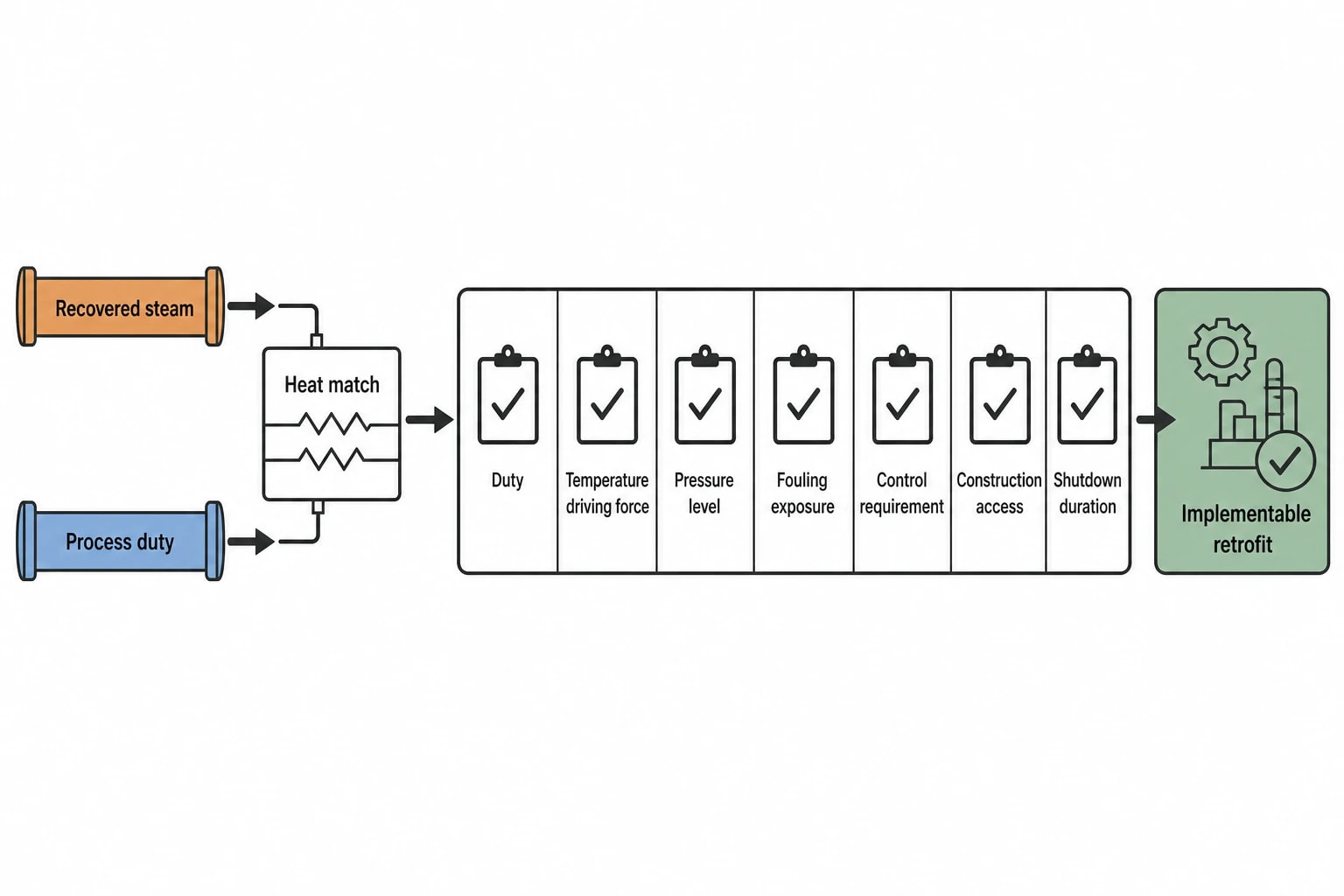
A clean-steam target is the start of design work. Each proposed match needs a screening assessment covering duty, temperature driving force, pressure level, fouling exposure, control requirement, construction access and shutdown duration.
Short planned outages favour control changes, valve reconfiguration, exchanger cleaning, condensate-recovery improvements and limited pipework work. Larger projects may require new exchangers, vapour-handling equipment, reboiler capacity or heat-pump installation. The project sequence should protect high-confidence, low-disruption measures from delay by a complex capital scheme.
An opportunity register should record the calculated saving and the condition required to achieve it. Recovered steam may displace clean steam only above a defined refiner load or while a particular paper grade runs. This prevents annual savings being overstated.
Protect the recovered heat path
TMP heat recovery depends on reliable steam separation, condensate removal and pressure control. Poorly performing traps, water hammer, blocked strainers, air ingress and unstable control valves can destroy a calculated heat match in operation. Fibre and deposit risks may make some low-temperature water duties less attractive than their pinch position suggests.
Commissioning should confirm the new heat path under real operating conditions. The team should compare clean-steam flow, refiner load, production rate and relevant process temperatures with the baseline case. It should also test grade changes and lower-load operation, as a retrofit that works during a steady run can create control problems during transitions.
Measure the result in the units the mill uses
The verification plan should report clean-steam reduction alongside production-normalised energy use. Clean-steam flow can fall because output has fallen. Refining electricity can fall while imported steam rises. A balanced report keeps these effects visible.
For integrated TMP and paper mills, useful indicators include clean-steam flow, boiler fuel use, imported or exported electricity, refiner electricity per tonne of pulp, total heat per tonne of paper, and recovered-steam-system availability. These indicators show whether a missed saving arose from a process condition, equipment fault or changed production schedule.
The practical case for TMP mill pinch analysis
TMP mills generate substantial secondary heat through refining. The task is to preserve its temperature value and use it before clean steam or cooling utility enters the balance. Pinch analysis makes the constraints visible, identifies the utility target and provides rules for selecting retrofit matches that work across the mill.
The Skogn case shows that a staged package can produce larger savings than an isolated improvement. Its 34% clean-steam reduction came from heat-exchanger-network changes, preheating, reboiler capacity and heat-pump integration. Other mills will produce different figures, but the method remains the same: establish trustworthy stream data, set a realistic temperature approach, target the utility minimum, then engineer recoverable heat into duties that can use it reliably.
This article reflects the independent analysis and editorial opinion of EnerTherm Engineering. Product names, trademarks, and brands mentioned belong to their respective owners. EnerTherm Engineering is not affiliated with, endorsed by, or a licensee of any third-party software or product mentioned unless explicitly stated.

Managing Director — EnerTherm Engineering
Dr. François Pierrel is Managing Director of EnerTherm Engineering with over two decades of expertise in thermal design, heat transfer, and industrial energy optimisation. He holds a PhD in Heat Transfer from Cranfield University and a Post-Doctorate from Heriot-Watt University.
