Pulp Mills Recover Dryer Exhaust Heat with Heat Pumps
A 2026 study reported COP up to 2.8 and drying energy reductions of up to 71%.
Industrial heat-pump integration in pulp and paper connects a heat pump to mill heat sources and sinks so low-grade waste heat can supply useful process heat.
A 1.2 MW high-temperature heat pump at Felix Schoeller’s German paper mill demonstrates the scale now entering paper production. Fraunhofer IEG reported on 28 October 2026 that the PUSH2HEAT installation upgraded variable production waste heat into steam at around 120°C. Over its first 300 operating hours, it produced an average steam duty of about 700 kW, equivalent to 1.2 tonnes of steam per hour at approximately 2.3 bar, with a reported performance factor of 2.30.
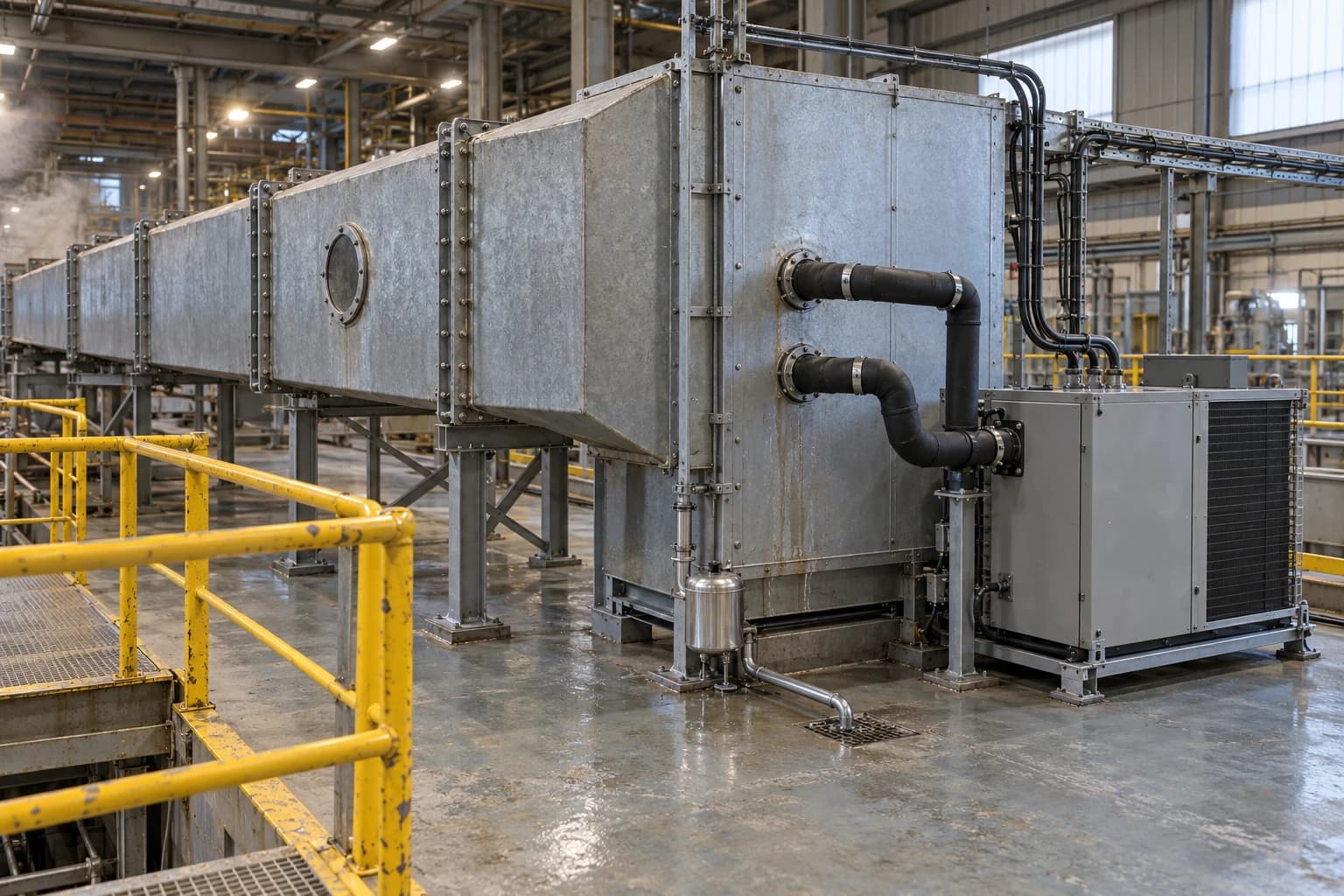
For UK mills, dryer exhaust is an attractive source. It carries sensible heat in warm air and latent heat in water vapour removed from the paper web. The challenge is to recover that energy without disturbing hood balance, restricting machine output, impairing condensate systems or creating an unreliable steam supply.
Why dryer exhaust suits industrial heat pump integration
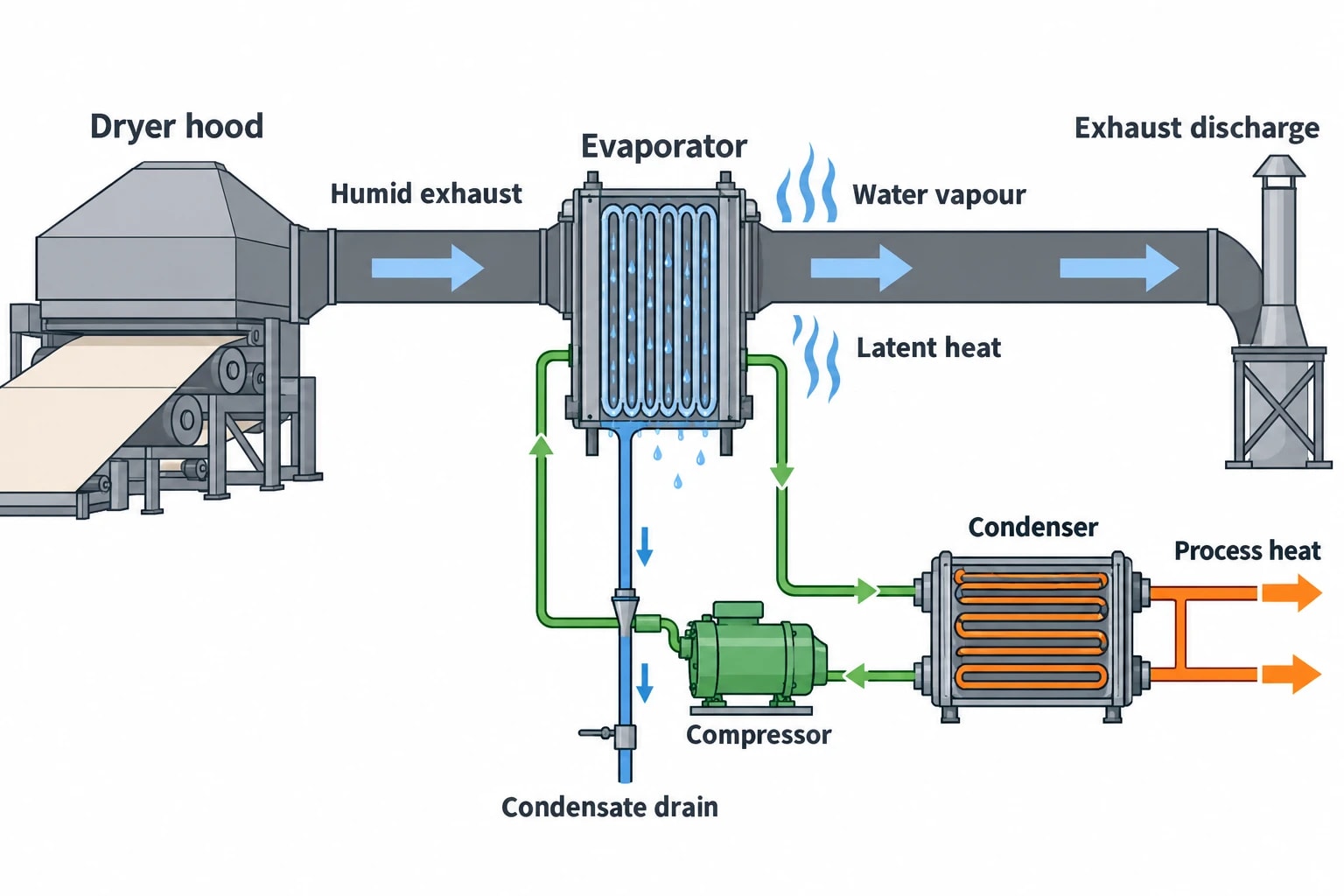
Paper machines consume large quantities of heat to evaporate water from the web. Steam-heated cylinders transfer much of this energy, while the dryer hood removes moisture through humid exhaust air. That exhaust often leaves the machine at a temperature too low for direct steam generation, yet well above ambient conditions.
Its value lies in its moisture content. Cooling humid exhaust below its dew point condenses water vapour and releases latent heat at the evaporator. A heat pump captures this sensible and latent heat, then upgrades it for hot water, low-pressure steam support or steam generation.
The exhaust stream has operational limits
Dryer exhaust is a process stream, not a fixed utility. Its mass flow, humidity, temperature and contaminants vary with machine speed, product grade, basis weight, hood settings, ambient conditions and breaks. A design that extracts too much heat or creates excessive pressure drop can disrupt moisture removal and paper quality.
The source survey should establish:
- Exhaust temperature, flow and humidity by dryer section and product grade.
- Minimum exhaust and make-up-air requirements for hood pressure and humidity control.
- Fan headroom and allowable pressure drop through coils, ductwork and mist eliminators.
- Fibre, starch, coating, oil aerosol and other fouling risks.
- Exhaust conditions during threading, breaks, grade changes and reduced-rate production.
- Existing air-to-air recovery systems already recovering energy from hood exhaust.
These conditions determine the recoverable duty and whether a direct refrigerant evaporator is suitable. An intermediate water or glycol circuit separates the refrigerant circuit from contaminated exhaust-side equipment and can simplify maintenance, but its additional temperature approach reduces the available source temperature.
Condensate recovery is part of the heat balance
Condensing dryer exhaust creates a liquid stream that needs deliberate handling. It can contain fibre fines, process additives and contaminants collected from the exhaust path. Mills should analyse condensate before assigning it to boiler-feedwater treatment, process-water reuse or effluent treatment.
The condensate rate also indicates how much latent heat the evaporator can collect. Humidity measurement is therefore as important as dry-bulb temperature measurement during feasibility work. A heat-pump concept based only on exhaust temperature can materially understate or overstate the available source duty.

Pinch analysis identifies the thermodynamic minimum energy requirement of your process — then designs the heat exchanger network to achieve it.
Pinch Analysis identifies the best heat-pump duty
Pinch Analysis should establish the heat-pump role before vendors size compressors or specify delivery temperature. The method maps hot and cold process streams, establishes utility targets and identifies where direct recovery or heat pumping offers the greatest value.
For a paper machine, the analysis should include dryer exhaust, hood make-up air, condensate return, white water, vacuum-system cooling water, stock-preparation water, effluent and steam users. The objective is to match temperature levels across the mill, not to force all recoverable heat through a heat pump.
Direct heat recovery comes first where it fits
Direct recovery may preheat hood make-up air or process water through a run-around coil, air-to-air exchanger or liquid loop. It can deliver useful savings with little electrical input where source and sink temperatures are close and demand occurs simultaneously.
A heat pump is appropriate where source and sink are separated by a larger temperature lift, or where recovered heat must reach a temperature that direct exchange cannot provide. Pinch Analysis tests these options together and prevents two recovery systems competing for the same exhaust duty.
| Integration option | Potential paper-mill duty | Key design question |
|---|---|---|
| Direct exhaust heat recovery | Hood make-up-air or process-water preheating | Can heat transfer occur without upsetting hood control? |
| Heat pump to hot water | Showers, wash water or process-water heating | Is there a sufficiently steady heat demand? |
| Heat pump to low-pressure steam | Support an intermediate steam header | Can the header accept variable heat-pump output? |
| Heat pump plus steam compression | Supply higher-temperature dryer steam | Does the added temperature lift justify the electrical demand? |
Temperature lift governs electricity demand
The temperature lift is the gap between the effective evaporator source temperature and condenser delivery temperature. Raising useful heat from 45°C to 85°C is generally less demanding than producing steam for a drying cylinder.
The highest-temperature steam header may appear to be the obvious destination, but a lower-temperature sink can provide stronger annual performance if it operates for more hours, avoids high compressor power and displaces boiler output consistently. Hot-water duties, condensate heating and intermediate-pressure steam support therefore deserve the same scrutiny as direct dryer-cylinder supply.
A staged heat strategy can work well. Direct recovery supplies the lowest-temperature demand. The heat pump upgrades remaining source heat to a stable intermediate duty. Existing boilers retain high-temperature trim and respond to rapid load changes.
What current paper-drying evidence shows
Public evidence includes both a detailed paper-drying model and an operating industrial demonstration. Neither removes the need for site-specific analysis: paper grades, source quality, operating hours and electricity emissions differ between mills.
A 2026 study quantified a high-temperature paper-drying case
Afsaneh Norouzian, Sebastian Dickler and Isabel Kuperjans published “Integrating high temperature heat pumps in paper drying processes as a step towards decarbonisation” in Energy Conversion and Management: X, Volume 31, September 2026, Article 102029. The study modelled a packaging-paper drying process supplied by steam at 3 bar and 165°C.
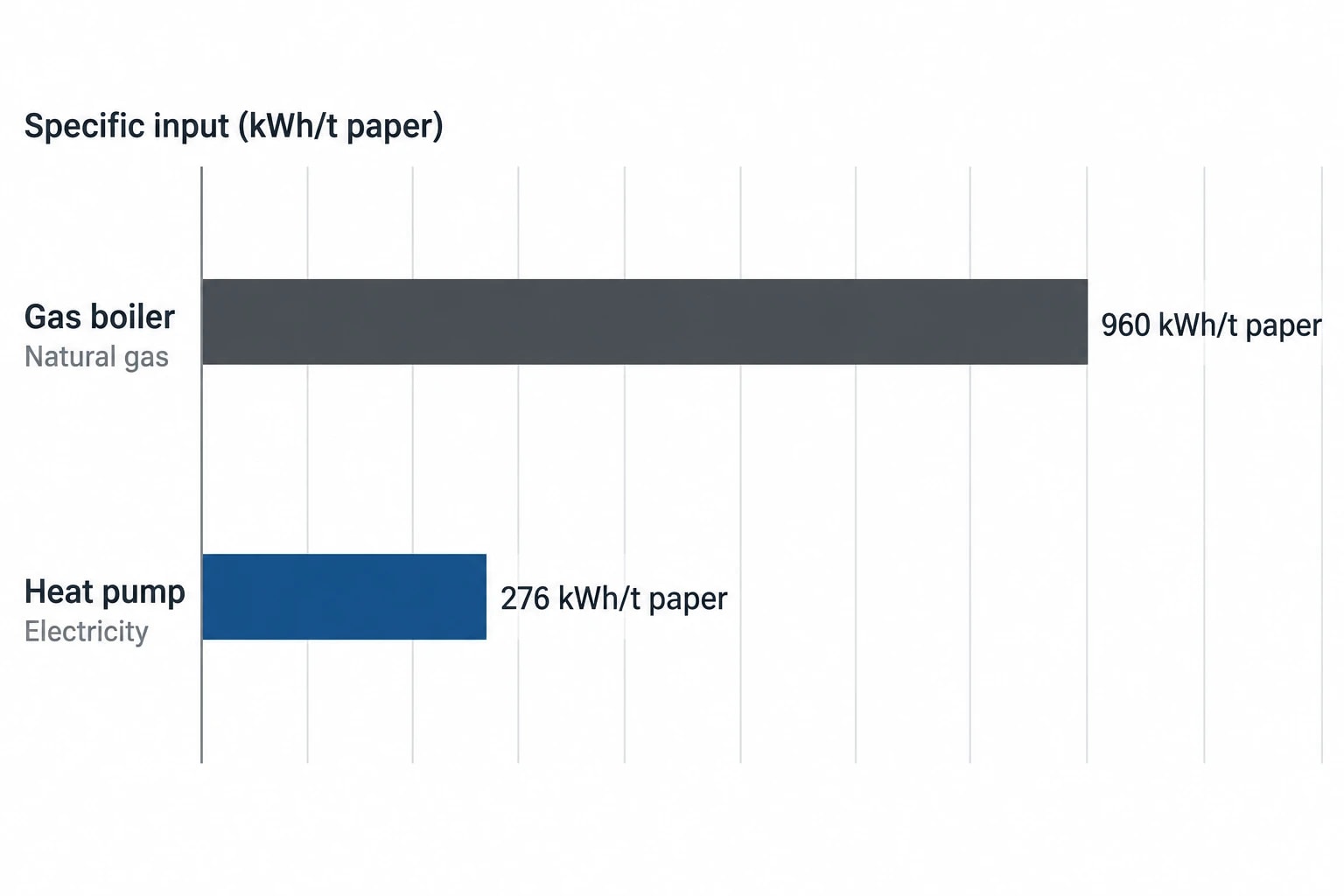
Its best configuration used isopentane, designated R601a, with an internal heat exchanger, turboexpander, steam compressor and water injection. The model achieved a COPtotal of 2.8. The study defined the gas-boiler reference with 90% boiler efficiency and calculated a specific natural-gas input of 960 kWh per tonne of paper. The best heat-pump case required 276 kWh of electricity per tonne of paper to meet the same drying-related thermal demand.
This compares gas input with heat-pump electricity consumption within the study’s defined drying boundary, rather than total energy use across a whole mill. The reported emissions result also depended on the study’s German electricity and gas assumptions. Under its best packaging-paper case, the authors calculated an emissions reduction of up to 94 kgCO₂ per tonne of paper against the gas-boiler reference.
The study examined steam conditions from 135 to 170°C and 2 to 5 bar. Across that range, COPtotal declined by approximately 20 to 25% as delivery temperature and pressure increased. Steam pressure therefore has a direct effect on heat-pump electricity use.
Felix Schoeller provides an operating reference
Fraunhofer IEG’s PUSH2HEAT demonstration at Felix Schoeller in Weißenborn is an industrial counterpoint to the steady-state study. The two-stage heat pump upgrades production waste heat varying between 30 and 70°C to steam at around 120°C. Fraunhofer IEG says the system can continue operating through fluctuating source temperatures and availability.
The reported 2.30 performance factor relates to the initial approximately 300 operating hours, rather than a projected annual average. Fraunhofer IEG also states that the project consortium calculated potential savings of up to 600 tonnes of CO₂ per year at 4,000 to 5,000 annual operating hours through reduced natural-gas use. That annual saving is a projection based on those operating-hour assumptions.
A mill business case should separate measured commissioning data, predicted annual performance and expected production availability. A heat pump can show strong efficiency during a stable test period but deliver fewer annual savings if outages, low-load operation or constrained sinks reduce operating hours.

Pinch analysis identifies the thermodynamic minimum energy requirement of your process — then designs the heat exchanger network to achieve it.
Engineering the retrofit around paper-machine operation
The paper machine takes priority. Heat-pump integration must support its operating envelope, with defined fallback arrangements when source conditions or steam demand move outside the design range.
Use measured operating profiles
A short survey cannot capture a mill’s full operating pattern. Engineers should collect time-resolved information across representative grades and seasonal conditions, including:
- Dryer exhaust temperature, humidity and flow.
- Hood supply conditions, fan speed and fan electrical load.
- Steam-header pressure, flow and boiler firing rate.
- Condensate flow, temperature and quality.
- Machine speed, production rate and sheet breaks.
- Hot-water demand, effluent temperature and other potential heat sinks.
- Electrical demand and tariff periods relevant to heat-pump operation.
Annual averages can conceal the control problems that determine availability. A heat pump sized around high average exhaust flow may cycle frequently at lower production rates. One sized only for minimum load may leave substantial recoverable heat unused at full output.
Define the heat sink before equipment selection
The destination for recovered heat shapes the cycle, compressor arrangement and required thermal storage. Potential sinks include process hot water, condensate heating, low-pressure steam, flash-steam recovery and selected dryer-cylinder groups.
A low-pressure header can provide a controlled first application. The heat pump supplies a defined base load while the boiler manages rapid changes in demand and high-temperature trim. This reduces exposure to process disturbances and allows performance verification before expanding the duty.
Design for fouling, drainage and control
Dryer exhaust recovery equipment needs accessible cleaning surfaces, drainage, inspection points and appropriate separation upstream of sensitive heat-transfer surfaces. Poor drainage can reduce heat transfer, increase pressure drop and create liquid carry-over risks.
The control philosophy should protect hood stability and steam-header pressure. Source-side bypasses, condenser-side heat rejection or buffer capacity may be required during low-demand periods. Controls should reduce heat-pump duty when exhaust flow falls, a break occurs, the selected sink reaches temperature or maintenance is needed. Boiler and pressure-reducing capacity should retain defined fallback duties.
UK pressure-system requirements for steam projects
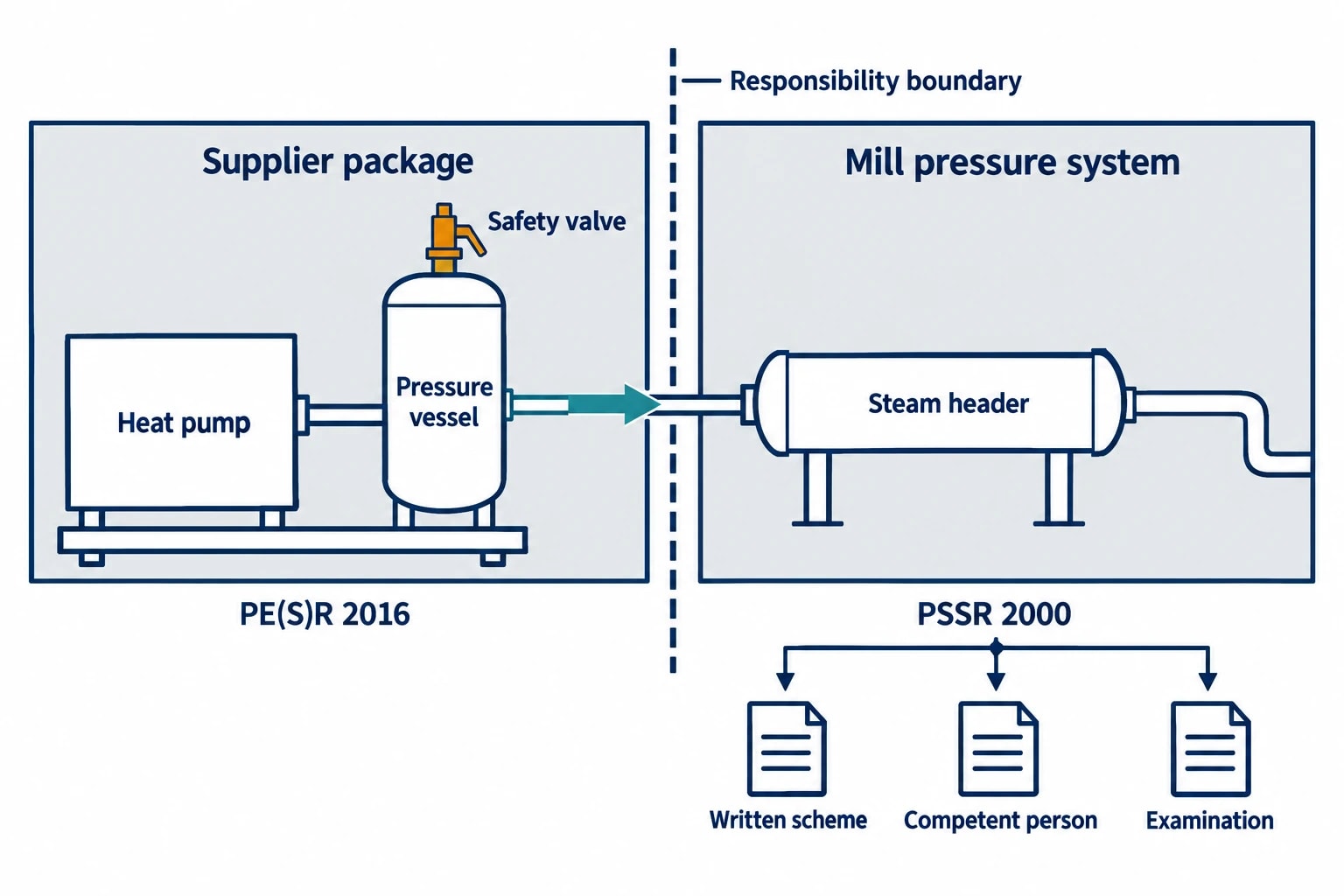
A high-temperature heat pump connected to a steam system introduces pressure equipment, protective devices, piping and potentially an integrated assembly. Regulatory responsibilities should be settled during concept development and reflected in procurement documents.
Pressure Equipment (Safety) Regulations 2016
The Pressure Equipment (Safety) Regulations 2016, S.I. 2016/1105, apply in Great Britain to pressure equipment and assemblies with a maximum allowable pressure above 0.5 bar, subject to listed exclusions. The regulations cover vessels, piping, safety accessories and pressure accessories, as well as assemblies that form an integrated functional whole.
For a supplied heat-pump package or steam-generating assembly, the manufacturer must address design, manufacture, classification and conformity assessment. Procurement documents should state the intended fluids, maximum allowable pressures, temperature limits, safety accessories, required instructions and declaration of conformity.
The regulations have a different boundary for equipment assembled on site under the responsibility of a user who is not the manufacturer. HSE notes that the Pressure Systems Safety Regulations apply to such user-site assemblies. Project teams should define where the supplier’s package ends and the mill’s installed pressure system begins.
Pressure Systems Safety Regulations 2000
The Pressure Systems Safety Regulations 2000 apply to pressure systems used at work. HSE identifies steam at any pressure, compressed or liquefied gas above 0.5 bar above atmospheric pressure, and pressurised hot water above 110°C as relevant fluids.
Before operating qualifying equipment, the dutyholder needs safe operating limits, a written scheme of examination and an examination in accordance with that scheme. A competent person draws up or certifies the written scheme and carries out examinations. For a heat pump feeding a steam header, the examination boundary should include parts whose failure could cause danger, including protective devices, connected pipework and associated vessels.
A practical route to an operating asset
A durable project follows the heat through the paper machine before it reaches the equipment specification.
- Measure dryer exhaust, steam, condensate and potential heat-sink conditions across representative production.
- Complete Pinch Analysis for direct recovery, heat pumping and conventional utilities.
- Compare source-sink pairs, giving priority to the smallest practical temperature lift.
- Model annual performance from actual production profiles, including part-load operation and outage assumptions.
- Specify hood-control limits, header-pressure control, bypasses, buffer capacity and boiler fallback duty.
- Define pressure-equipment supply boundaries, conformity documentation and written-scheme responsibilities before installation.
- Commission against measured acceptance criteria for useful heat, electricity use, exhaust-side pressure drop, hood conditions and production impact.
Dryer exhaust becomes a controllable process heat source when the mill treats it as part of the heat-recovery network. Pinch Analysis identifies the right temperature level, while careful controls protect production and heat pumps reduce boiler duty where upgraded heat can operate for enough hours to justify the investment.
This article reflects the independent analysis and editorial opinion of EnerTherm Engineering. Product names, trademarks, and brands mentioned belong to their respective owners. EnerTherm Engineering is not affiliated with, endorsed by, or a licensee of any third-party software or product mentioned unless explicitly stated.

Managing Director — EnerTherm Engineering
Dr. François Pierrel is Managing Director of EnerTherm Engineering with over two decades of expertise in thermal design, heat transfer, and industrial energy optimisation. He holds a PhD in Heat Transfer from Cranfield University and a Post-Doctorate from Heriot-Watt University.
