How Pinch Analysis Recovers Heat in UK Pulp and Paper Mills
A 2025 study identified heat-recovery potential equivalent to 39% of total demand.
Pinch analysis is a process-integration method that identifies the maximum heat recovery available between hot and cold process streams before a pulp and paper mill adds steam or rejects heat to cooling.
A 2025 study of primarily non-integrated and minimally integrated pulp and paper mills identified heat-recovery potential equivalent to 39% of total heat demand. That figure is a target from specific case studies, not a forecast for each UK site. It shows the scale of opportunity where steam use, warm-water flows, dryer exhaust and evaporation duties have developed around separate projects rather than a coordinated heat strategy.
For UK mill energy managers, pinch analysis starts with a practical question: where does the mill still use steam to heat a flow while another usable flow is cooled, vented or discharged nearby? The answer often lies across paper-machine drying, stock preparation, evaporators, condensate systems, boiler feedwater and recovery operations.
Why pulp and paper mills suit pinch analysis
Pulp and paper manufacture handles large quantities of water, fibre, steam and air at many temperature levels. This creates numerous heat sources and demands. It also creates a familiar operating problem: a local modification can reduce energy use in one area while increasing steam demand or cooling duty elsewhere.
A paper-machine dryer section needs controlled heat at a comparatively high temperature. Ventilation air leaving the hood contains sensible and latent heat. Warm white water can preheat incoming process water, but only where temperature, contamination risk and production timing permit. In integrated mills, evaporators, black-liquor recovery, secondary condensate and recovery-boiler systems introduce further sources and sinks.
Pinch analysis views these duties as one mill-wide thermal system. It does not begin by selecting a heat exchanger. It establishes the thermodynamic limit for recovery, then helps process engineers decide which exchanges can operate reliably within an existing plant.
Hot streams and cold streams
A hot stream needs cooling and can donate heat. Examples include dryer exhaust, warm condensate, hot effluent, recovered vapours and hot process water.
A cold stream needs heating. Examples include boiler feedwater, make-up water, stock-dilution water, fresh process water, combustion air and building-heating circuits.
For each stream, the study records:
- Supply and target temperature
- Mass flow or heat-capacity flow
- Phase-change or condensation duty where relevant
- Operating hours and production dependence
- Fluid properties, fouling tendency and contamination constraints
- Existing exchanger duties, bypasses and control limits
This heat and temperature data provides a more useful basis for investment decisions than an energy bill alone. A gas meter can show the cost of steam generation, but not whether dryer exhaust can preheat water, whether a warm-condensate source is already committed, or whether a proposed heat exchanger would cause unacceptable pressure drop.
The pinch point and utility targets
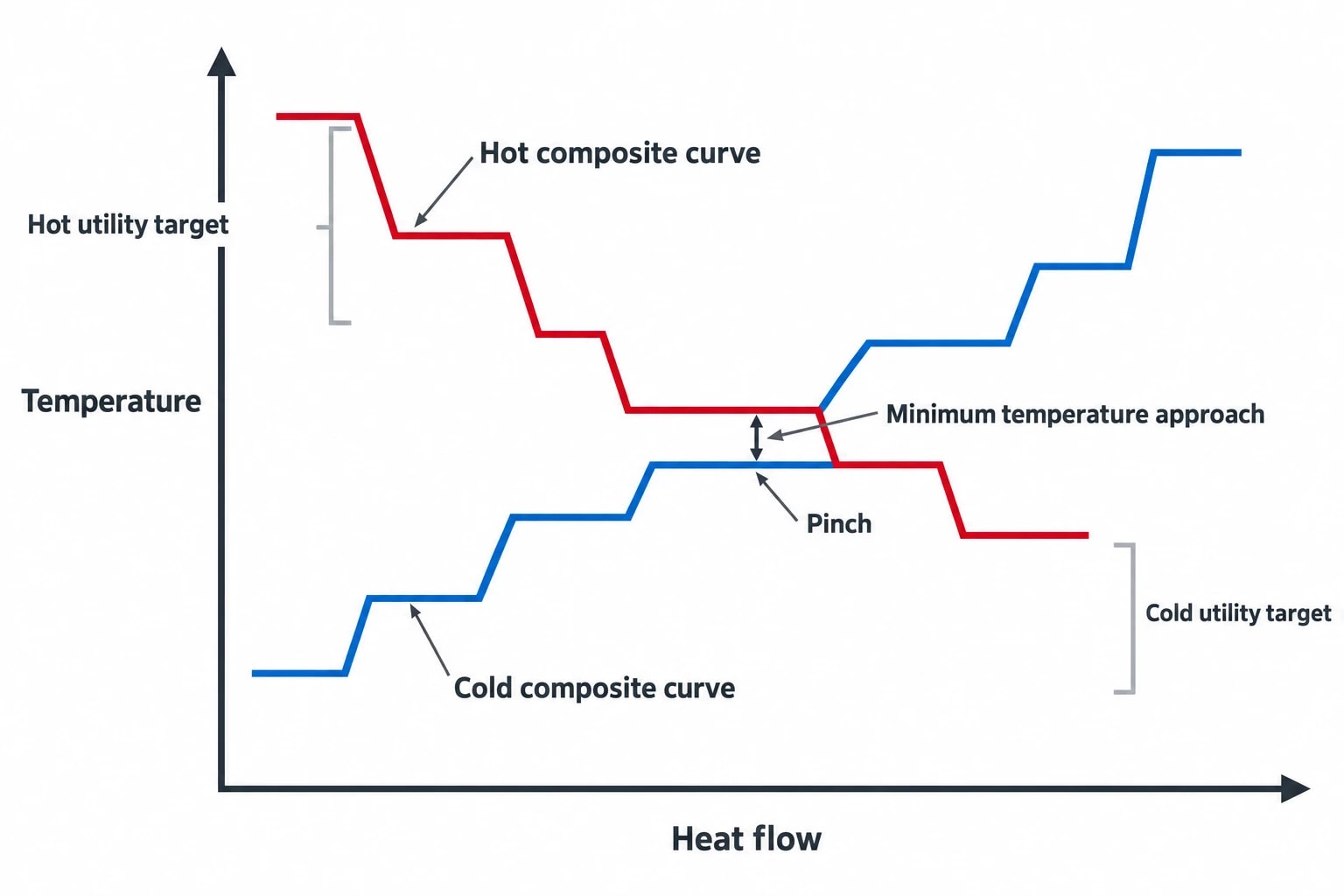
Engineers use composite curves to combine the mill's hot-stream cooling requirements and cold-stream heating requirements across the available temperature range. The closest permitted approach between the curves identifies the pinch.
The selected minimum temperature approach matters. A smaller approach can recover more heat but generally requires more heat-transfer area, tighter control and greater attention to fouling. A larger approach reduces heat-exchanger size but leaves more demand for steam and cooling. The appropriate value depends on the fluids, available plot space, cleaning method, operating variability and project economics.
The analysis then calculates minimum hot-utility and cold-utility requirements. Steam demand cannot fall below the hot-utility target without changing process conditions, adding a heat pump or introducing another heat source. Cooling duty cannot fall below the cold-utility target without additional heat sinks or altered temperature targets.

Pinch analysis identifies the thermodynamic minimum energy requirement of your process — then designs the heat exchanger network to achieve it.
Where heat recovery appears in a paper mill
The most productive pinch-analysis studies look beyond one department. They distinguish high-temperature duties that need steam from lower-temperature demands that can accept recovered heat.
Paper-machine drying and hood exhaust
Dryer sections are major users of steam. Hood exhaust carries heat and moisture away from the sheet, while supply-air and process-water systems create opportunities for recovery. Direct recovery may be feasible where the source and sink are compatible and close together. Indirect arrangements can isolate wet, dusty or contaminated exhaust streams from cleaner process circuits.
Temperature quality is critical. A source at 60°C may be valuable for water entering at 15°C, yet unsuitable for a duty requiring a much higher temperature. Pinch analysis prevents low-grade heat being assigned to an unnecessarily demanding sink and identifies where it can displace steam most effectively.
Hood balance remains the governing constraint. Changes to exhaust-heat recovery can affect humidity, condensation risk, sheet quality and ventilation performance. A heat-recovery project therefore requires dryer, ventilation and controls engineers in the design review, not solely utilities personnel.
Condensate, flash steam and boiler feedwater
Condensate often offers a dependable route to recovery because it can have stable flow and comparatively clean chemistry. Practical options depend on pressure, flash behaviour, return arrangements and the end use for recovered heat.
Potential sinks include:
- Boiler feedwater and make-up water
- Fresh process water
- Stock-preparation water
- Building-heating circuits
- Wash-water duties where temperature and quality requirements match
Flash steam needs separate measurement rather than treatment as a generic loss. Its pressure and availability determine whether it can serve a steam user directly, preheat a liquid stream or be recovered through another arrangement. Condensate contamination risk also needs explicit assessment. A mill should not compromise boiler-water quality to recover a marginal amount of heat.
Evaporation, recovery and secondary heat
Integrated pulp mills have substantial thermal interaction around evaporation and chemical recovery. Secondary condensate, evaporator vapours, dissolving-tank vents, effluent and recovery-boiler flue gas can each carry recoverable energy, although their temperatures, chemistry and availability differ.
The EU Best Available Techniques conclusions for pulp, paper and board identify recovery and use of low-temperature effluent and other waste-heat streams for buildings, boiler feedwater and process water. They also identify appropriate use of secondary heat and secondary condensate, and optimisation of the integrated heat-exchanger network.
Heat should cascade from higher-temperature sources to lower-temperature demands before fresh steam is added. This preserves high-grade heat for duties that need it.
How a pinch study is carried out at a UK mill
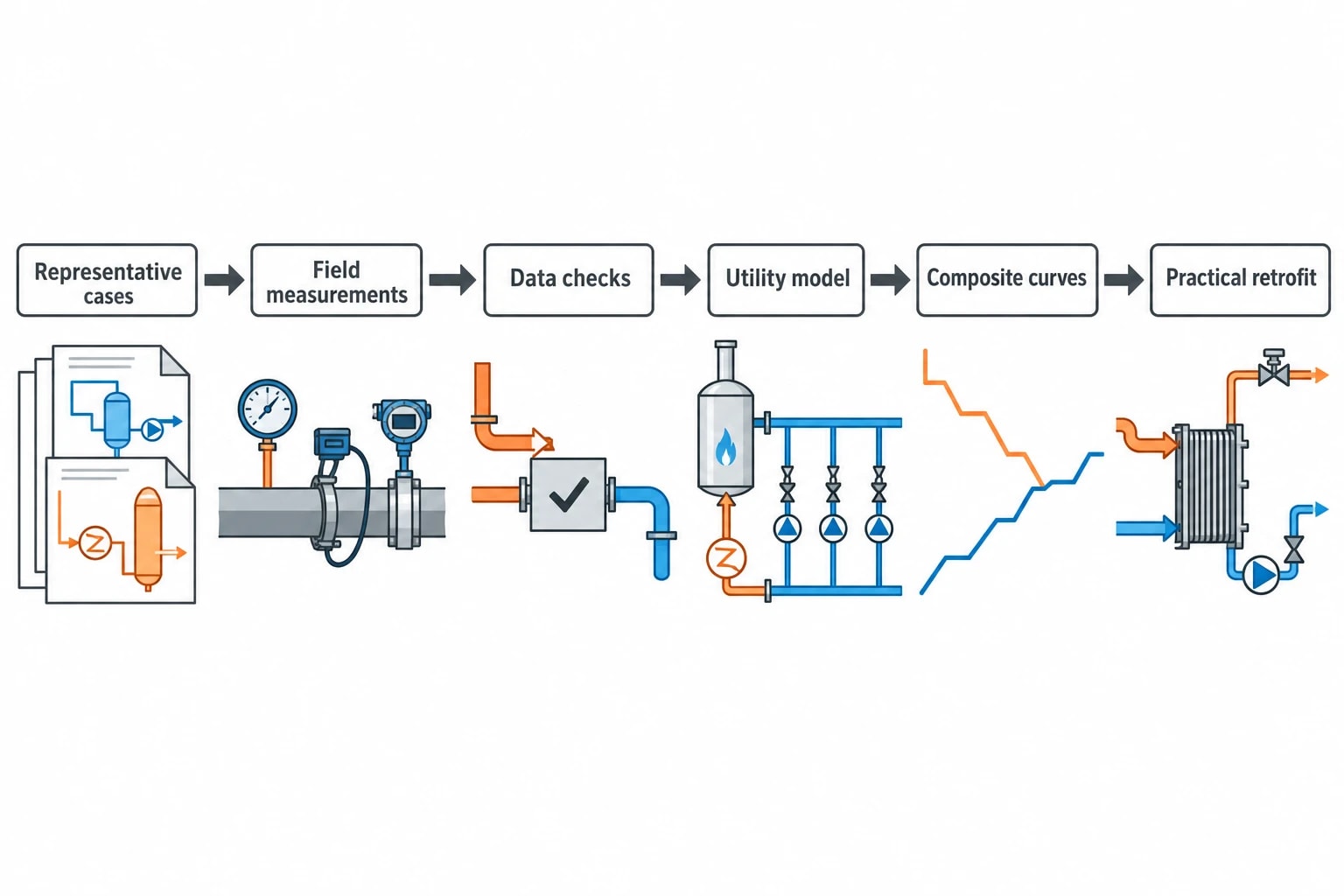
A credible study progresses from measured process data to a technically buildable heat-recovery scheme. It should account for grade changes, shutdowns, seasonal conditions and operating constraints from the outset.
1. Establish the operating cases
A single set of average flows is rarely adequate. Paper-machine production rate, grade, furnish, moisture target, ambient-air conditions and evaporator loading can shift temperatures and duties substantially.
The project team should select representative cases such as normal production, low production, a high-moisture grade, winter operation and summer operation. A heat exchanger that appears attractive at average conditions may provide little benefit during the operating hours that determine annual savings.
2. Build and validate the stream list
Process data must be checked in the field. Temperature sensors can drift, flow measurements can represent a different line configuration, and historical trends can hide bypasses. Energy balances across existing heat exchangers can expose poor data quality.
The UK Government's 2026 evidence update identifies energy management, including sub-metering for gas, electricity and steam, as a priority measure for the pulp and paper sector. It also identifies heat integration and heat recovery as measures that cascade heat from highest to lowest quality.
For pinch work, the metering plan should resolve the duties that matter:
| Area | Measurements that strengthen the analysis | Why they matter |
|---|---|---|
| Boiler house | Fuel, steam production, feedwater temperature, blowdown, condensate return | Establishes the marginal steam and recovery value |
| Paper machine | Dryer steam, condensate, hood supply and exhaust temperatures, air flow | Tests drying heat-recovery opportunities |
| Water systems | Fresh-water flow, white-water temperature, effluent flow and temperature | Identifies low-temperature sinks and sources |
| Evaporators and recovery | Vapour, condensate, liquor, flue-gas and process-water temperatures | Maps integration opportunities in an integrated mill |
| Existing exchangers | Inlet and outlet temperatures, pressure drop, bypass status | Shows actual, rather than assumed, recovery |
3. Set the temperature approach and utility model
The team selects design temperature approaches that account for heat-exchanger type, fouling, fluid cleanliness and required control margin. It then defines the utility system clearly: steam-pressure levels, boiler operating pattern, electricity import or generation, cooling-water limits and any heat-pump option.
This prevents an optimistic but misleading target. Recovering heat at a low temperature may cut cooling duty while doing little to reduce boiler fuel. The utility model identifies the heat sinks that displace the energy source the mill is trying to reduce.
4. Generate targets before designing the network
Composite curves and the grand composite curve show the theoretical recovery opportunity and the temperature intervals where it exists. The study can then rank options by recovered duty, steam reduction, cooling reduction, capital implications and operational risk.
Engineers apply pinch-design rules carefully. Above the pinch, recovered heat should support high-temperature cold demands before steam is added. Below the pinch, the network should avoid inappropriate cooling where a lower-temperature cold demand remains. Exchanges across the pinch can increase utility use when configured without regard to the overall balance.
5. Convert the target into a retrofit package
A theoretical heat-exchanger network can contain too many connections, long pipe runs or difficult maintenance access. A retrofit design needs a smaller set of practical changes.
Options may include a new plate heat exchanger, a condensate preheater, a heat-recovery coil, revised heat-exchanger duty, improved condensate segregation, an intermediate water loop or a heat pump. A utility-side project can also be appropriate where a process-side connection would impose unacceptable fouling, product-quality or hygiene risks.
The 2025 study proposes an intermediate water loop to address spatial and operational constraints in complex mill heat-recovery arrangements. Such a loop separates process streams while transferring heat through a circulating water circuit. It can make a dispersed source and sink workable, but its pumps, temperature loss, pipework, controls and maintenance must be included in the business case.

Pinch analysis identifies the thermodynamic minimum energy requirement of your process — then designs the heat exchanger network to achieve it.
Practical constraints that decide whether recovery survives
Pinch targets expose the prize. Plant reality determines the delivered saving. Successful projects address process reliability at the same level as heat duty.
Fouling, corrosion and contamination
Paper-machine exhaust can contain fibre, coating particles and moisture. Effluent streams can present corrosion and fouling hazards. Secondary condensate may need quality checks before it approaches sensitive water systems. Heat-transfer surfaces, materials, filtration, cleaning arrangements and inspection access belong in the initial concept, not the final procurement package.
Production variability and control
A heat-recovery network must cope with grade changes and interruptions without starving a critical duty. Control valves, bypasses, temperature limits and alarm logic should preserve sheet quality, evaporator stability and boiler operation.
A recovered heat source may be plentiful during high production and weak during downtime. Thermal storage can buffer short variations in some applications, though it should be assessed against the heat duty, temperature level, space requirement and expected operating pattern.
Steam-system interactions
Lower steam demand can alter boiler loading, turbine back-pressure operation, condensate return and deaerator conditions. In an integrated site, reducing extraction steam can also affect electricity generation. Project assessment therefore needs a site energy balance, not a simple fuel-price calculation.
Regulation, BAT and energy-management practice
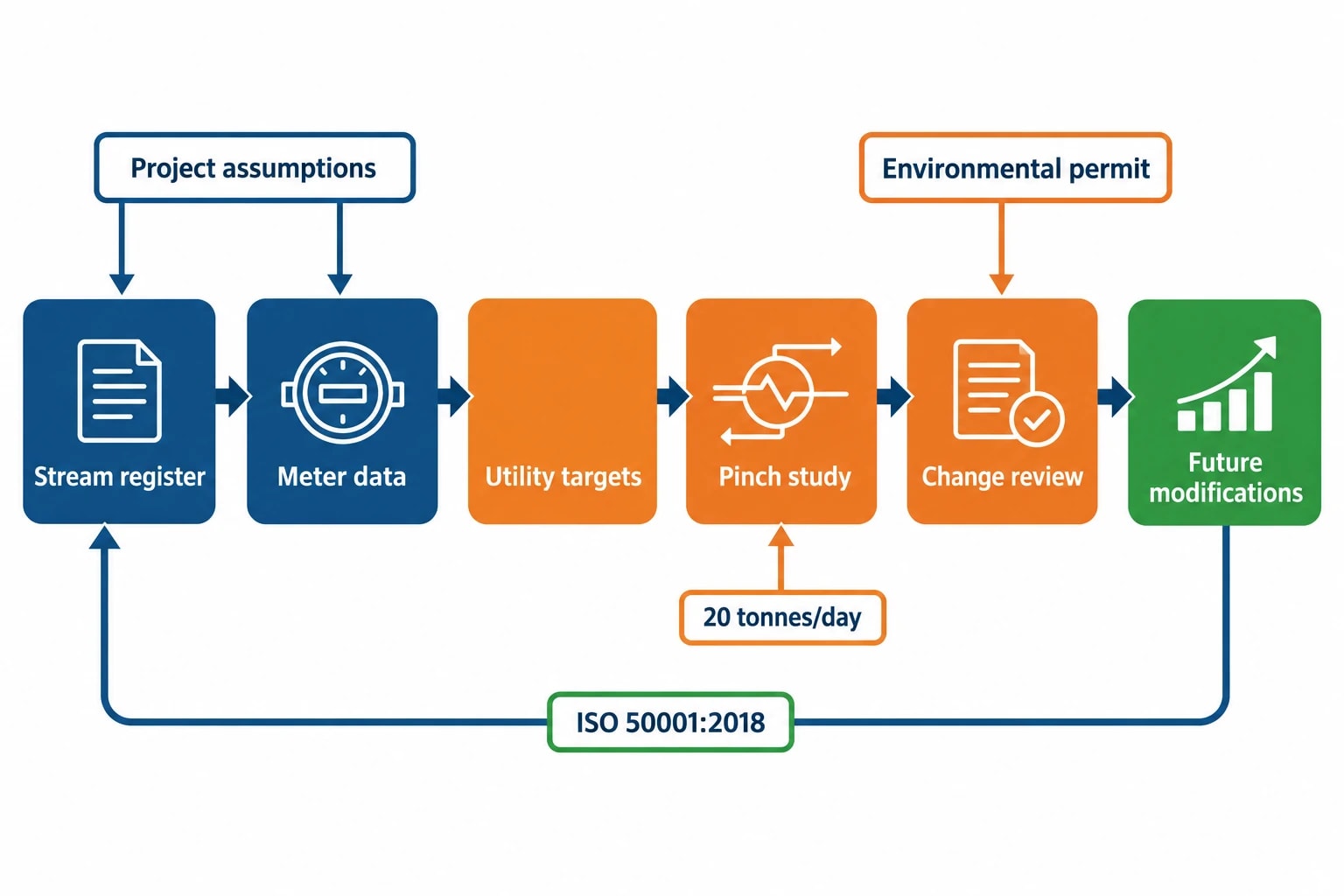
The EU Production of Pulp, Paper and Board BREF covers pulp production and paper or cardboard installations above 20 tonnes per day under Directive 2010/75/EU. Its BAT conclusions treat energy efficiency as a combination of measures, including low-temperature heat recovery, secondary-condensate use, process monitoring and integrated heat-exchanger-network optimisation.
For UK mills, the BREF remains a useful technical benchmark for assessing established heat-recovery measures, while permit obligations depend on the installation, regulator and permit conditions. Project teams should review proposed changes through the site's environmental permit, combustion controls, water-management arrangements and formal management-of-change procedure.
ISO 50001:2018 provides a framework for managing energy performance through defined responsibilities, measurement, review and continual improvement. A pinch study fits this structure when the mill retains the stream register, meter data, utility targets and project assumptions. The analysis then becomes a basis for future modifications rather than a one-off report filed after a capital review.
Turning a pinch target into sustained steam reduction
The first projects should combine material heat recovery with a manageable operational scope. A clean condensate-to-feedwater heat exchanger can provide a lower-risk starting point. A dryer-exhaust recovery project may offer larger savings but requires more detailed controls, air-side maintenance and paper-machine involvement. Evaporator and recovery integration can deliver major gains in an integrated mill, yet needs close coordination with recovery operations.
A sensible project gate should ask five questions:
- Does the proposed exchange reduce the mill's actual steam or fuel requirement at the relevant operating conditions?
- Can the source and sink operate together for enough annual hours to justify the capital?
- Have fouling, corrosion, contamination and cleanability been addressed?
- Does the control scheme protect production quality and utility stability?
- Will metering verify the saving after commissioning?
This article reflects the independent analysis and editorial opinion of EnerTherm Engineering. Product names, trademarks, and brands mentioned belong to their respective owners. EnerTherm Engineering is not affiliated with, endorsed by, or a licensee of any third-party software or product mentioned unless explicitly stated.

Managing Director — EnerTherm Engineering
Dr. François Pierrel is Managing Director of EnerTherm Engineering with over two decades of expertise in thermal design, heat transfer, and industrial energy optimisation. He holds a PhD in Heat Transfer from Cranfield University and a Post-Doctorate from Heriot-Watt University.
