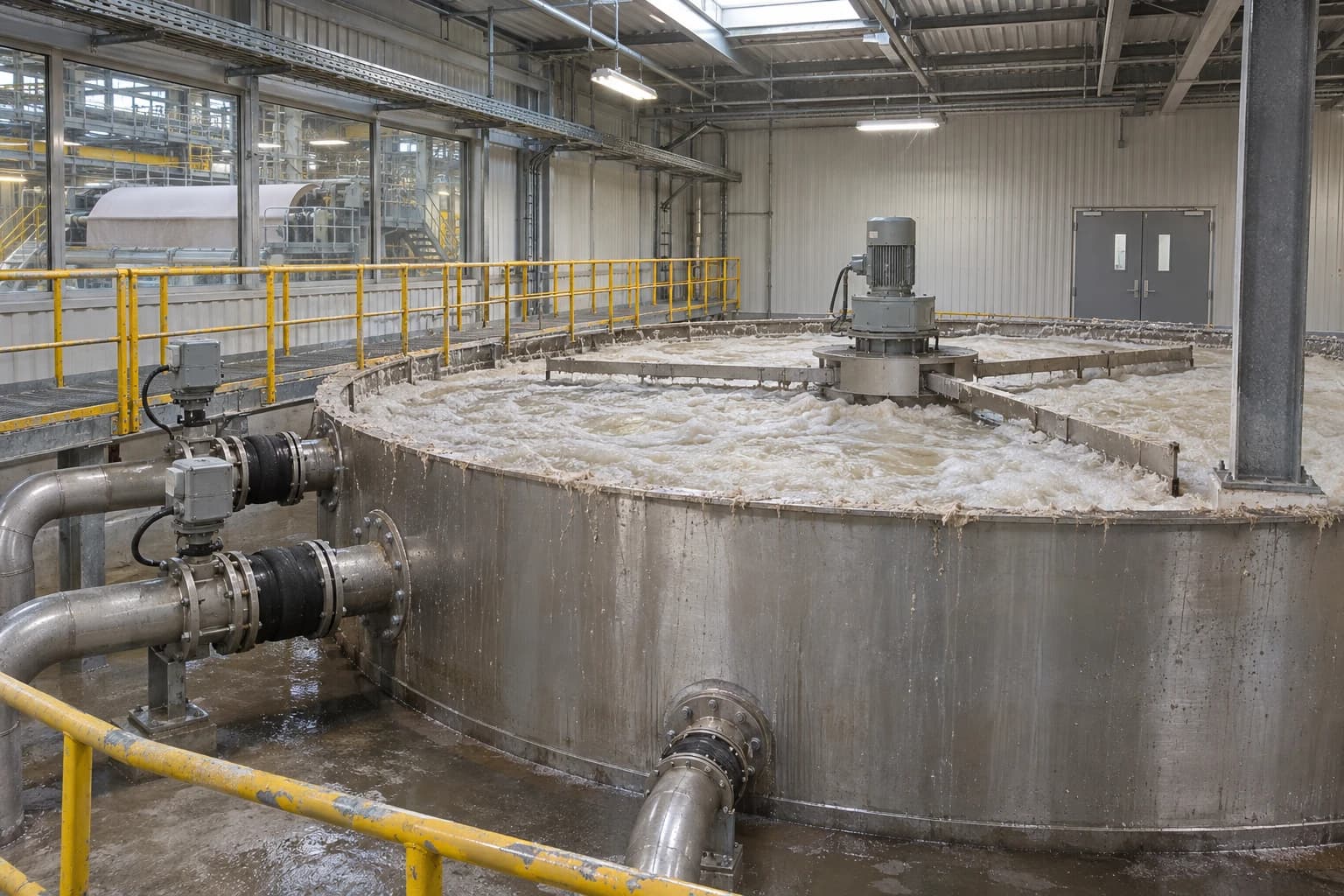
How Water Pinch Analysis Reduces Fresh Water Intake
TSS targeting can cut freshwater demand by over 90% with localised treatment.
Water pinch analysis is a process-integration method that identifies the lowest feasible fresh water demand by matching water sources, treatment options and process sinks against contaminant limits.
A non-recycled paper mill may consume roughly 25 to 70 m³ of water per tonne of product, while recycled-paper production commonly falls within 10 to 15 m³/t. The range reflects paper grade, fibre source, pulping route, cooling arrangements and the extent of water recirculation. Reducing fresh water intake therefore requires more than installing another treatment unit.
A paper machine does not require drinking-quality water at every point. Some duties need low suspended solids. Others tolerate clarified white water, treated effluent or clean cooling-water return. Pinch analysis makes these distinctions visible, then turns them into a practical reuse network.
For mills operating under tight abstraction licences, high effluent charges or permit conditions, the method can identify where fresh water has been used by default rather than necessity.
Why fresh water intake remains high in paper production
Water performs several different process duties
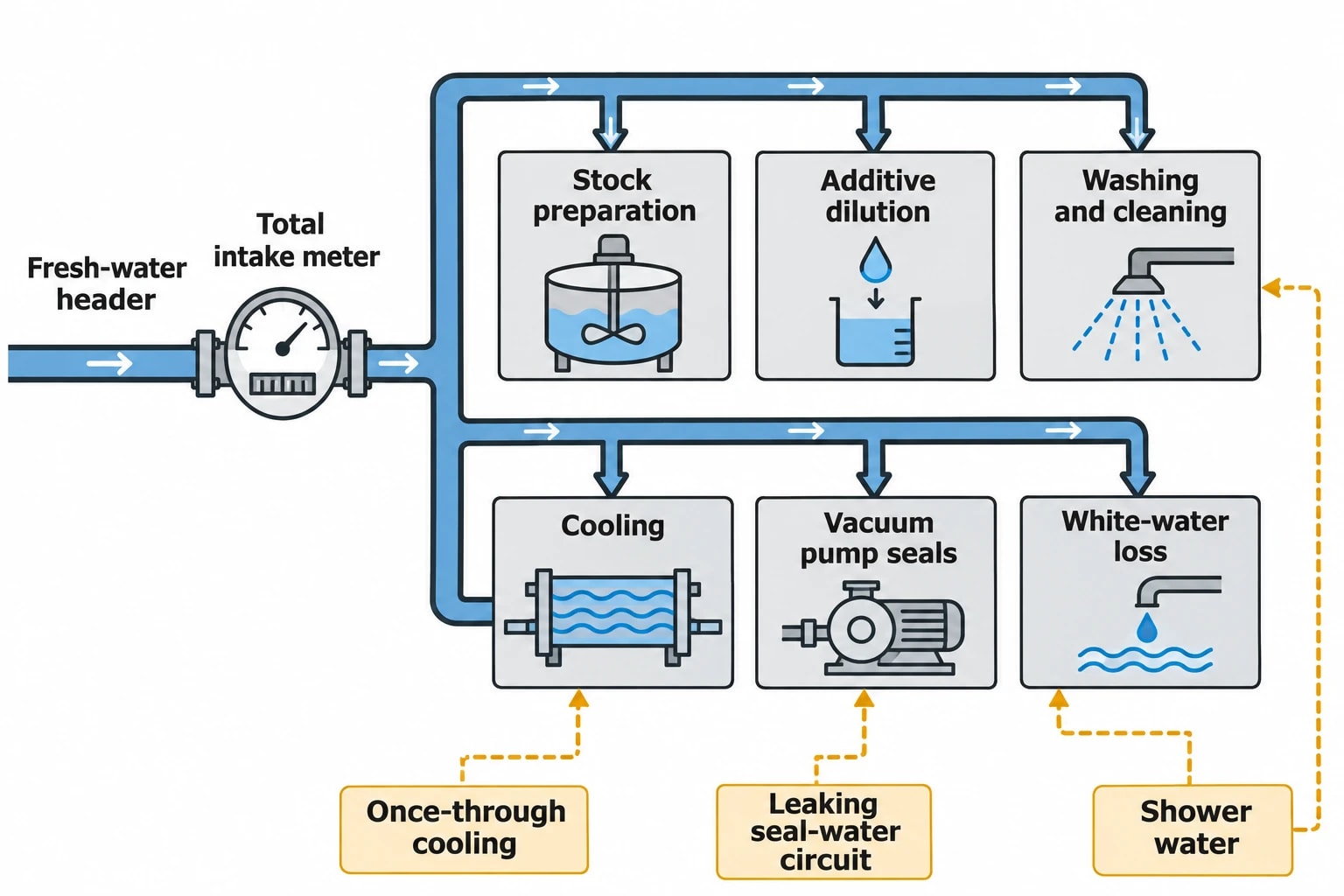
Water carries fibre through stock preparation, dilutes additives, supports washing, removes heat, seals vacuum pumps and cleans equipment. These functions demand different water qualities, temperatures and pressures. A fresh-water header can become the default response to each new process need.
That habit raises abstraction, pumping, chemical treatment and effluent-treatment costs. It can also conceal the source of a mill’s water demand. A utility meter may show total intake, but it cannot identify whether the driver is a white-water loss, a shower-water requirement, a leaking seal-water circuit or an unnecessary once-through cooling application.
A widely quoted global estimate places average pulp and paper water demand at about 54 m³ per tonne of finished product. That figure should not be used as a mill target. Benchmarks by grade are more useful. The European Commission identifies different BAT-associated wastewater-flow ranges for bleached kraft, recycled fibre, tissue and non-integrated paper mills.
Closure creates its own operating constraints
A mill cannot close water loops without consequence. Reuse concentrates materials that fresh water previously diluted or carried out of the system. These can include:
- Fibre fines, fillers and coating residues
- Dissolved and colloidal substances
- Starch, latex and dissolved organic material
- Calcium, chloride and other dissolved salts
- Microbiological growth and biofilm-forming material
- Defoamer residues and process chemicals
These accumulations can affect drainage, retention, odour, deposits, corrosion, microbial control and product quality. The engineering task is to reduce the fresh water intake a paper mill requires without moving unacceptable contaminant loads into stock preparation or onto the paper machine.

Pinch analysis identifies the thermodynamic minimum energy requirement of your process — then designs the heat exchanger network to achieve it.
What water pinch analysis measures in a paper mill
Sources, sinks and limiting contaminants
Water pinch analysis treats each water user as a sink and each available wastewater stream as a source. A sink has a flow requirement and a maximum acceptable concentration of one or more contaminants. A source has a flow and an actual contaminant concentration.
The initial study normally records:
| Item | Information needed |
|---|---|
| Water source | Flow, temperature, pressure, contaminant concentrations, availability |
| Water sink | Required flow, maximum contaminant levels, temperature and pressure requirements |
| Losses | Evaporation, product moisture, sludge, drag-out, leaks and discharge |
| Treatment unit | Flow capacity, removal efficiency, operating variability and residual quality |
| Fresh water | Source, treatment cost, abstraction constraint and reliability |
| Effluent | Discharge flow, pollutant load, treatment cost and permit limits |
Total suspended solids, chemical oxygen demand and total dissolved solids often control reuse decisions. They represent different engineering problems.
TSS captures fibre fragments, fillers, fines and other particles. COD indicates oxygen-demanding organic matter, including dissolved compounds from wood, recycled fibre, additives and biological activity. TDS represents salts and other dissolved matter that clarification alone cannot remove.
A source suitable against TSS may still fail against COD or TDS. This prevents a common error in water-reduction projects: proving a reuse route against one contaminant while overlooking the contaminant that limits product quality or treatment-plant performance.
The water-quality cascade
The analysis arranges sources and sinks by contaminant concentration. High-quality water is reserved for duties that require it. Lower-quality water is directed to users that can tolerate it, provided flow, temperature, chemistry and operational reliability remain suitable.
Fresh water enters at the quality-sensitive end of the system. It then performs progressively less demanding duties before discharge, treatment or final reuse. Counter-current washing can apply the same principle, with cleaner water contacting the cleanest material and more contaminated water contacting the dirtiest material.
The pinch identifies the quality point where the network has no remaining feasible reuse opportunity without additional treatment. Fresh water required at that point is the theoretical minimum for the selected contaminant and constraints.
Direct reuse and regeneration-reuse routes
Direct reuse delivers the first savings
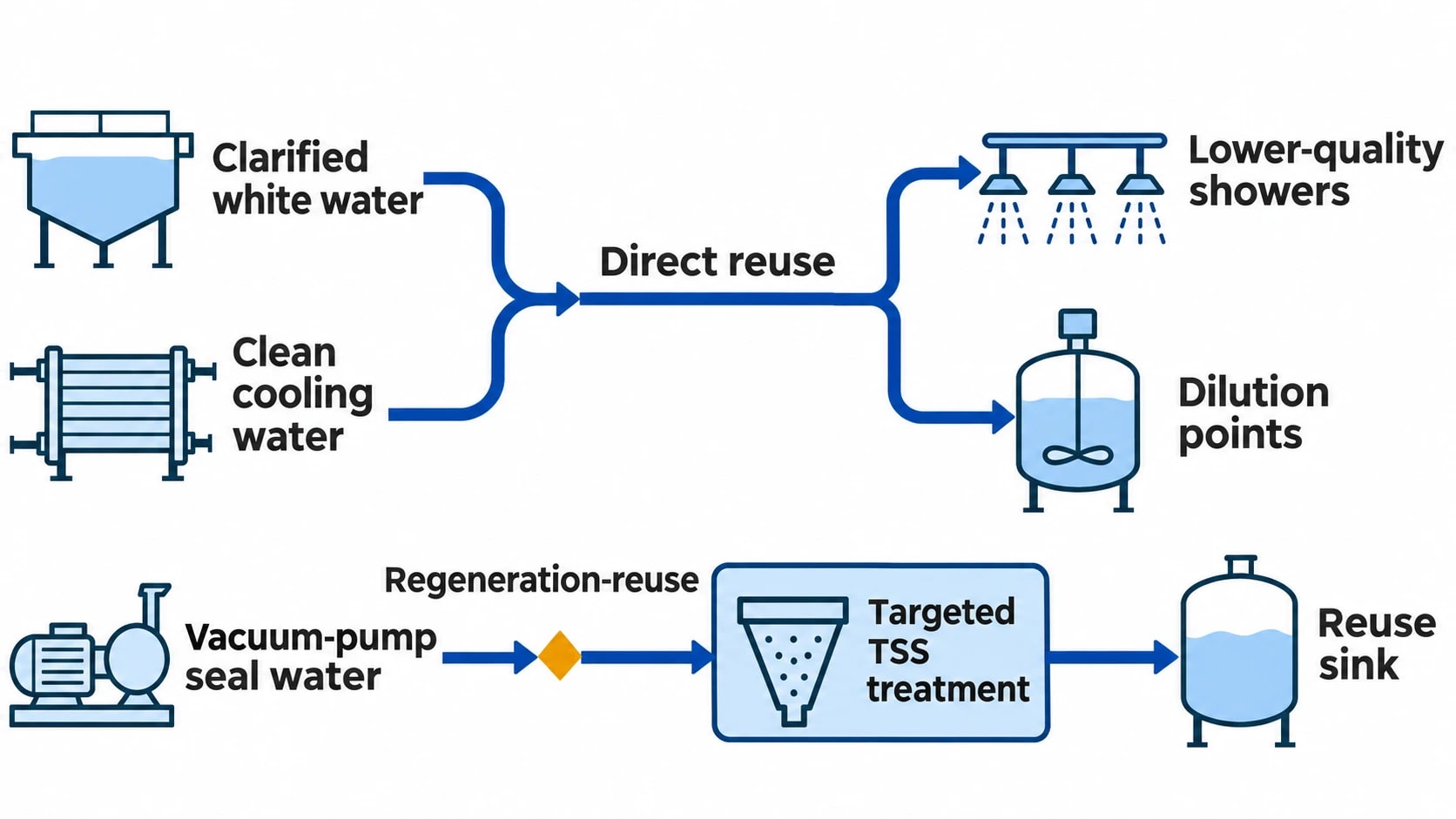
Direct reuse sends a source stream to another process sink without dedicated treatment beyond existing collection, screening or storage. In a paper mill, candidates include clarified white water, segregated cooling water, vacuum-pump seal water and filtrate from stock preparation.
Direct reuse projects often focus on practical measures:
- Separating clean cooling water from contaminated process drains
- Recovering and clarifying white water before reuse
- Replacing fresh water in lower-quality showers or dilution points
- Installing storage to manage intermittent flows
- Eliminating cross-connections that contaminate relatively clean streams
- Repairing overflow, leakage and continuous bleed losses
Commission Implementing Decision 2014/687/EU identifies monitoring and optimisation of water use, evaluation of recirculation, separation and reuse of less-contaminated vacuum-pump sealing water, separation of clean cooling water, and in-line treatment as BAT techniques for reducing fresh water use and wastewater generation.
Regeneration-reuse expands the target
Regeneration-reuse adds treatment between source and sink. The objective is not to make all water suitable for all duties. It is to remove the contaminant that blocks a specific reuse route.
For TSS-limited routes, suitable treatment can include save-alls, dissolved-air flotation, disc filtration, microscreening, sedimentation or filtration. The appropriate choice depends on fibre type, flow variation, solids loading, filtrate quality and fibre-loss risk.
COD and dissolved-substance limits need careful assessment. Biological treatment can reduce biodegradable COD, but treated water may retain dissolved salts and non-biodegradable material. Membrane processes can produce higher-quality permeate, but they introduce fouling, cleaning, concentrate disposal, energy use and capital cost. Evaporation can be appropriate in selected pulp-mill duties, yet it is energy intensive and requires integration with the mill’s heat balance.
A 2023 study of a recycled-fibre packaging-paper mill found that direct reuse constrained by TSS alone could reduce fresh water consumption by 36.9%. The study reported a 93.3% reduction when a decentralised treatment assumption enabled regeneration-reuse for TSS. When COD and TDS were assessed together, the potential fell sharply because the existing treatment arrangement did not sufficiently remove those limiting contaminants.
This demonstrates a core pinch-analysis principle: impressive single-contaminant targets are screening results, not final design values. A mill needs a multi-contaminant assessment before committing to pipework or treatment equipment.

Pinch analysis identifies the thermodynamic minimum energy requirement of your process — then designs the heat exchanger network to achieve it.
A practical workflow for reducing fresh water intake at a paper mill
Start with a reliable water balance
The first deliverable should be a measured, shift-resolved water balance. Production changes, grade transitions, cleaning cycles and machine breaks can materially alter flow and quality. A single grab sample or one day of meter data rarely represents the operating year.
Process engineers should reconcile incoming water, recovered water, evaporation, product moisture, sludge moisture and final discharge. Differences often identify unmetered losses, inaccurate instruments or hidden cross-connections.
Segment water circuits before considering treatment
A mill should first protect cleaner streams. Cooling-water returns, roof drainage where suitable, condensate and lightly contaminated seal-water streams should not enter a common drain with white water or stock-preparation effluent.
Segregation makes reuse cheaper because it reduces the contaminant load reaching a potential source. It also reduces treatment duty where regeneration-reuse is necessary.
Define constraints with production and quality teams
Water-quality limits should be agreed with paper-machine, stock-preparation, chemistry, maintenance and environmental teams. These limits must include more than laboratory parameters.
A reuse route may need constraints for:
- TSS, COD, conductivity and hardness
- Temperature and pressure
- Microbiological condition
- Calcium and deposit potential
- Foam behaviour
- Product brightness, strength and surface quality
- Reliability during grade changes and upset conditions
This stage converts a theoretical fresh water target into a network that operators can run.
Test the network against normal and abnormal conditions
Paper mills experience broke events, wet-end chemistry changes, maintenance washes and treatment upsets. A proposed reuse network needs storage, bypass arrangements, isolation points and clear rules for source diversion when water quality deteriorates.
The design must account for water quality during these events, not only average results from routine production. Continuous monitoring is particularly valuable in highly closed recycled-fibre systems, where process-water quality can change quickly.
Regulation, permits and water pinch analysis in the UK and EU
EU BAT conclusions focus on closure and controlled discharge
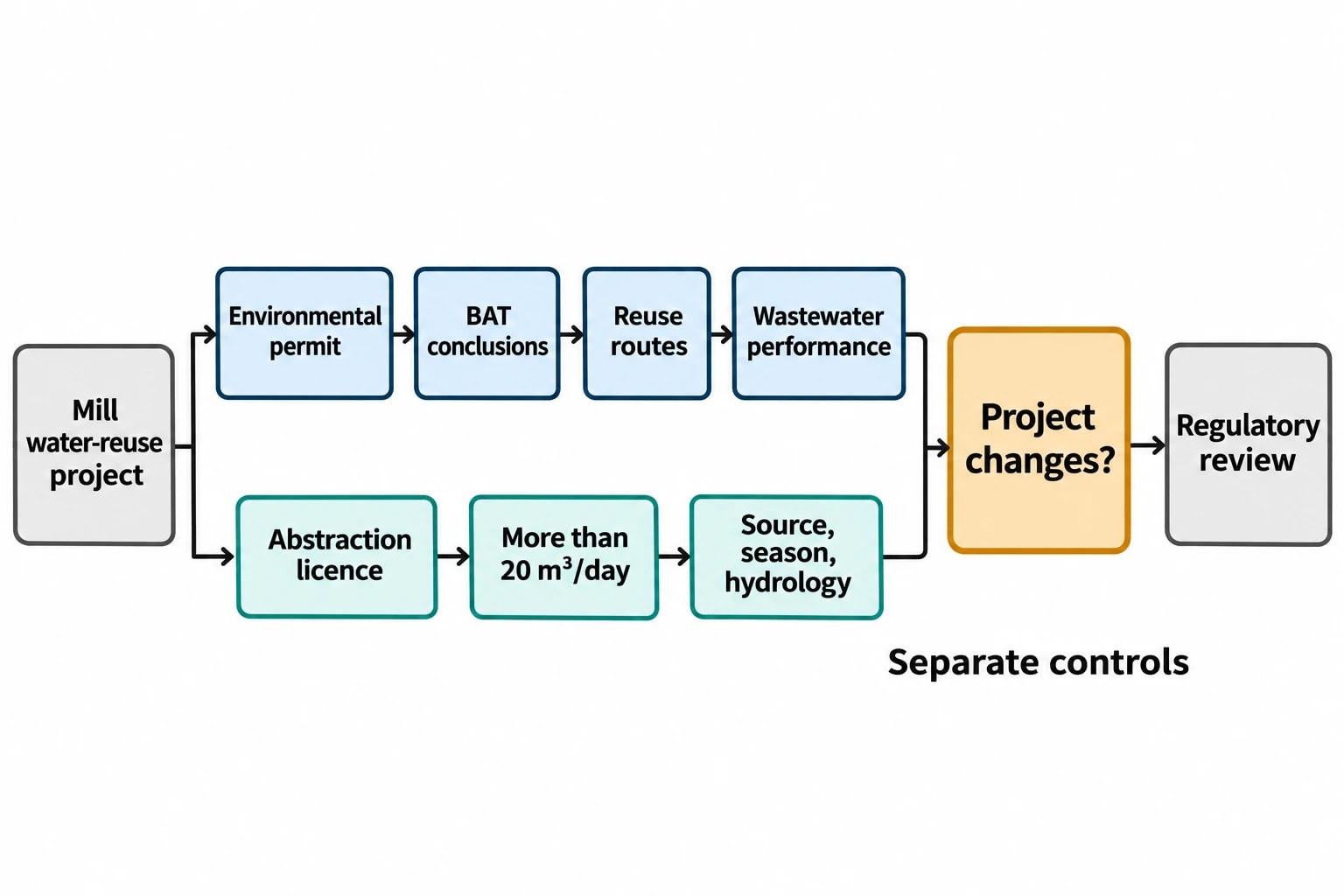
For EU installations, pulp and paper permits are set within the Industrial Emissions Directive framework. The current pulp, paper and board BAT conclusions require water systems to be closed to the degree technically feasible for the grade produced. They also set BAT-associated wastewater-flow ranges and emission levels for relevant process categories.
This does not mean that each mill must pursue complete closure. The BAT conclusions recognise constraints from water quality, product quality, precipitation, incrustation and odour. They require a balance between reuse, controllable process conditions and wastewater performance.
Directive (EU) 2024/1785 amended the Industrial Emissions Directive. It strengthens the direction towards permit conditions based on BAT conclusions and improved environmental performance. Mill managers should retain a documented basis for water targets, reuse routes, treatment performance and any limits to further closure.
UK operators need site-specific permit alignment
In England, abstraction of more than 20 m³ per day will usually require an Environment Agency abstraction licence. Licence conditions can restrict availability by source, season or hydrological condition. Reducing intake can therefore improve operational resilience and reduce operating cost.
Environmental permits and abstraction licences are separate controls. A project that reduces fresh water intake but changes wastewater flow, discharge composition, treatment operation or abstraction infrastructure may need regulatory review before implementation.
Natural Resources Wales states that retained pre-2021 EU BAT conclusions remain relevant to permit compliance in Wales, while newer EU conclusions can demonstrate current good practice where relevant. Mills in Scotland and Northern Ireland should confirm requirements with their respective regulators and permit conditions.
Measuring whether a water pinch project has worked
Use production-normalised indicators
Fresh water reduction must be measured against output, grade mix and operating time. Total intake can fall during low production while specific consumption worsens.
Useful indicators include:
| Indicator | Purpose |
|---|---|
| Fresh water intake, m³/t | Tracks abstraction or mains-water intensity |
| Wastewater discharge, m³/t | Shows the effect on final hydraulic load |
| COD, TSS and nutrient load, kg/t | Protects effluent performance from dilution effects |
| Reuse flow, m³/h | Confirms that the designed reuse route is operating |
| Treated-water quality | Verifies suitability for the receiving process |
| Fibre loss to effluent | Connects water management with material yield |
A monthly dashboard should be supported by shift data at the main sources and sinks. It must distinguish recycled-water flow from genuine fresh water displacement. Recirculating the same stream more frequently can increase the reuse figure without reducing abstraction.
Link water targets to heat and utility optimisation
Water pinch analysis sits naturally beside thermal pinch analysis. Reusing warm process water can reduce fresh-water heating demand, while cooling and heat-recovery decisions affect available water streams and temperatures. The combined assessment should check that a water-saving proposal does not impose avoidable steam demand, cooling duty or pumping load.
For a paper mill, the most valuable project is rarely a single large closed-loop system. It is a controlled sequence of source segregation, white-water recovery, quality-based reuse, targeted treatment and continuous monitoring. Water pinch analysis shows where each cubic metre of fresh water can be displaced without compromising paper quality, machine runnability or permit performance.
This article reflects the independent analysis and editorial opinion of EnerTherm Engineering. Product names, trademarks, and brands mentioned belong to their respective owners. EnerTherm Engineering is not affiliated with, endorsed by, or a licensee of any third-party software or product mentioned unless explicitly stated.

Managing Director — EnerTherm Engineering
Dr. François Pierrel is Managing Director of EnerTherm Engineering with over two decades of expertise in thermal design, heat transfer, and industrial energy optimisation. He holds a PhD in Heat Transfer from Cranfield University and a Post-Doctorate from Heriot-Watt University.
