Why Pinch Analysis Targets Pulp and Paper Drying
Drying uses about two-thirds of a typical UK mill's energy, mainly as steam.
Pinch analysis is a thermodynamic method that sets the minimum feasible heating and cooling targets for a process before engineers redesign its heat-recovery network. A representative large paper machine cited in pulp and paper BAT reference material discharged 29.7 MW of heat in dryer-hood exhaust air at 82 °C, with 10.8 MW still leaving to atmosphere under the stated Scandinavian winter conditions.
That example shows why drying deserves early attention in energy efficiency in pulp and paper manufacturing. The dryer section combines high-value steam demand, warm condensate, flash steam, humid exhaust air and several water-heating duties in one operating area. It also sits close to product-quality constraints. A project that lowers steam use but causes moisture variation, sheet breaks or lower machine speed has failed its main purpose.
For UK mills, the focus should match the domestic production base. DESNZ’s 2026 review identifies roughly 40 UK pulp and paper mills, including one standalone pulp mill. Around half of the remaining sites are integrated, while the other half are papermaking-only operations using purchased pulp. Most UK integrated sites use recovered paper. Pinch Analysis should therefore address recycled-fibre preparation and paper-machine energy use rather than assume a kraft-pulp mill model.
Why pulp and paper drying is a strong Pinch Analysis target
Drying concentrates steam demand and recoverable heat
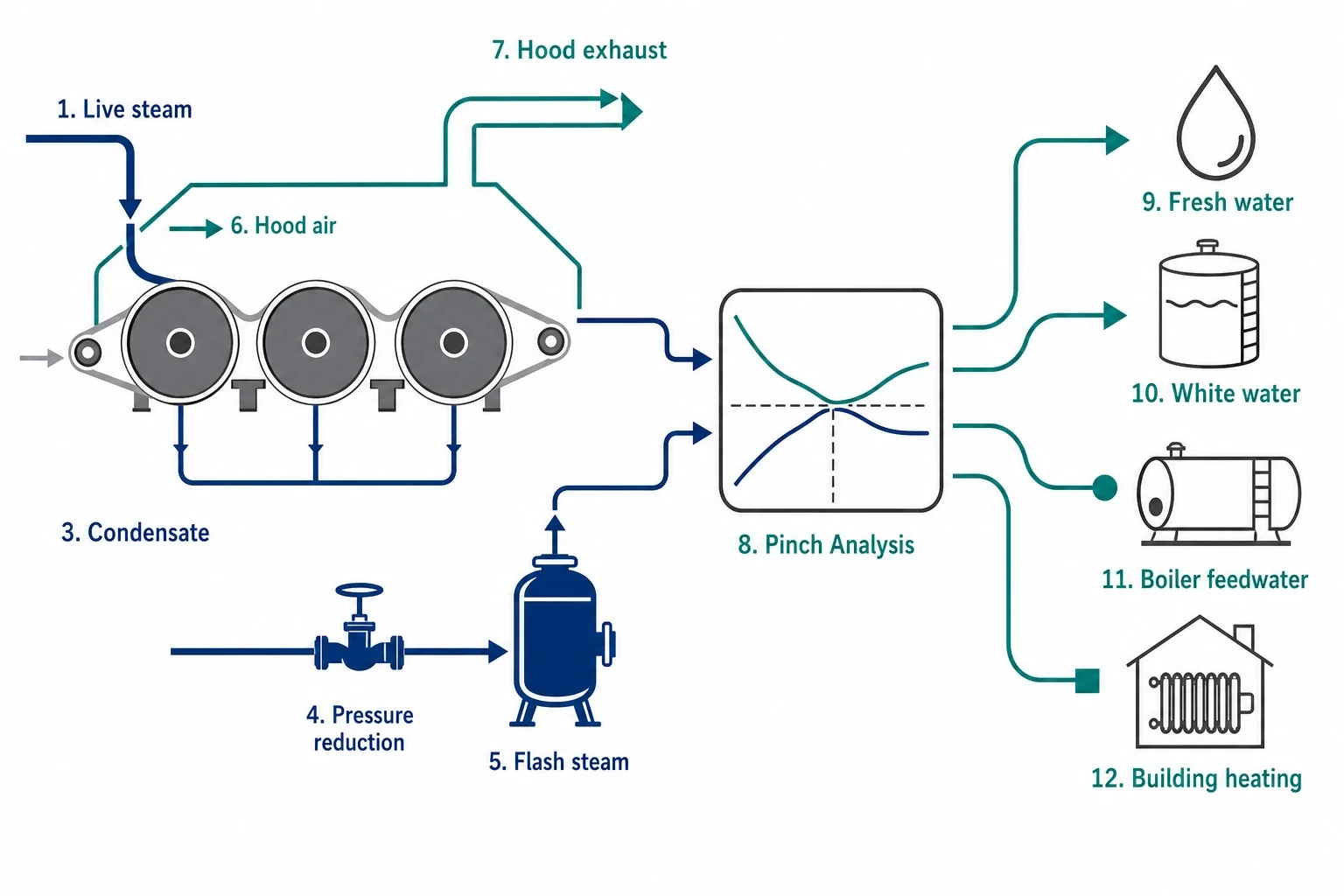
The wet end and press section remove most water mechanically. The dryer section then evaporates the remaining water from the web using steam-heated cylinders, hood ventilation and associated condensate systems. Steam condenses inside the cylinders, transfers heat through the shell and leaves as condensate. The evaporated water enters humid hood air and exits through the ventilation system.
These streams operate at different temperatures and pressures. They create an obvious heat-integration problem:
- Dryer-cylinder steam needs a temperature high enough to maintain drying performance.
- Condensate retains sensible heat after steam has condensed.
- Pressure reduction across a condensate system can create flash steam.
- Hood exhaust contains sensible and latent heat from water vapour.
- Fresh water, white water, shower water, boiler feedwater and building-heating systems may accept recovered heat.
Pinch Analysis tests these streams together. It identifies how much live steam remains necessary after feasible internal recovery has been assigned to duties at suitable temperature levels.
Recycled-fibre mills still have a drying problem
Recovered-paper mills carry substantial electrical loads in pulping, screening, cleaning and refining. Those loads need separate electrical analysis, but they do not remove the thermal case for studying drying.
Papermaking remains broadly similar across packaging, newsprint, tissue and speciality grades once stock reaches the machine. Tissue production can also include direct-gas through-air drying alongside Yankee-dryer steam. A drying-centred study gives energy managers a common method for identifying steam-reduction opportunities across paper and board operations while retaining grade-specific operating limits.

Pinch analysis identifies the thermodynamic minimum energy requirement of your process — then designs the heat exchanger network to achieve it.
What a representative paper-machine case shows
29.7 MW of hood-exhaust heat in one reference case
The technical reference case used in pulp and paper BAT material described a modern paper machine producing 240,120 tonnes per year, equivalent to 667 tonnes per day. The web entered the dryer section at 44.5% dry content and left at 91%. Hood exhaust was 82 °C with a humidity of 160 g of water per kg of dry air.
The reported heat distribution provides a useful scale for engineering screening. It is a reference case, not a forecast for an individual UK machine.
| Dryer-section heat destination | Heat flow | Specific heat flow |
|---|---|---|
| Hood supply air | 1.8 MW | 233 MJ/t |
| Wire-pit water | 3.6 MW | 466 MJ/t |
| Fresh water | 5.5 MW | 712 MJ/t |
| Circulation water | 8.0 MW | 1,036 MJ/t |
| Exhaust to atmosphere | 10.8 MW | 1,399 MJ/t |
| Total hood-exhaust heat | 29.7 MW | 3,847 MJ/t |
The values show why a Pinch study should start with the whole heat-recovery system rather than a single heat exchanger. Supply-air preheating may already take the highest-temperature portion of the exhaust stream. Process water and white water can accept lower-temperature heat. A poorly assigned duty can consume a temperature level needed by a more valuable sink.
Temperature determines whether recovery is useful
Dryer-hood exhaust commonly leaves at around 82 to 85 °C. Available heat falls as the exhaust cools, while condensation, fouling and corrosion risks rise. A Pinch model therefore needs realistic outlet-temperature constraints and a selected minimum temperature approach for each heat-exchanger service.
The same principle applies to condensate. Condensate may be sufficiently hot for boiler-feedwater heating, fresh-water heating or a lower-temperature process demand. Its value depends on temperature, pressure, cleanliness, available flow and the destination’s operating profile. It should not be treated as a generic heat source.
How Pinch Analysis works in paper drying
Build a measured stream list
The study starts with a heat and mass balance based on measured operating data. Engineers define hot streams requiring cooling and cold streams requiring heating. Dryer-section data should cover representative grades, speeds and seasonal operating conditions.
| Area | Data to capture | Decision supported |
|---|---|---|
| Dryer cylinders | Steam pressure, steam flow, condensate temperature, group cascade | Dryer heat demand and pressure hierarchy |
| Condensate system | Flash-tank pressures, flash-steam flow, condensate return conditions | Secondary-steam and water-heating opportunities |
| Hood ventilation | Supply and exhaust temperature, humidity, air flow, fan load | Available heat and heat-exchanger constraints |
| Press section | Web dryness, felt condition, vacuum and shower-water operation | Impact of mechanical dewatering on dryer duty |
| Water systems | Flow, temperature and quality of fresh water, white water and effluent | Viable sinks for low-temperature heat |
| Utilities | Boiler firing, steam headers, CHP operation, purchased electricity | Total-site effect of a steam reduction |
The operating envelope matters as much as the average. Grade changes alter basis weight, machine speed, web moisture, hood conditions and steam requirements. A design based on one stable production period can leave a heat exchanger oversized, underused or difficult to control during normal grade changes.
Establish targets before selecting equipment
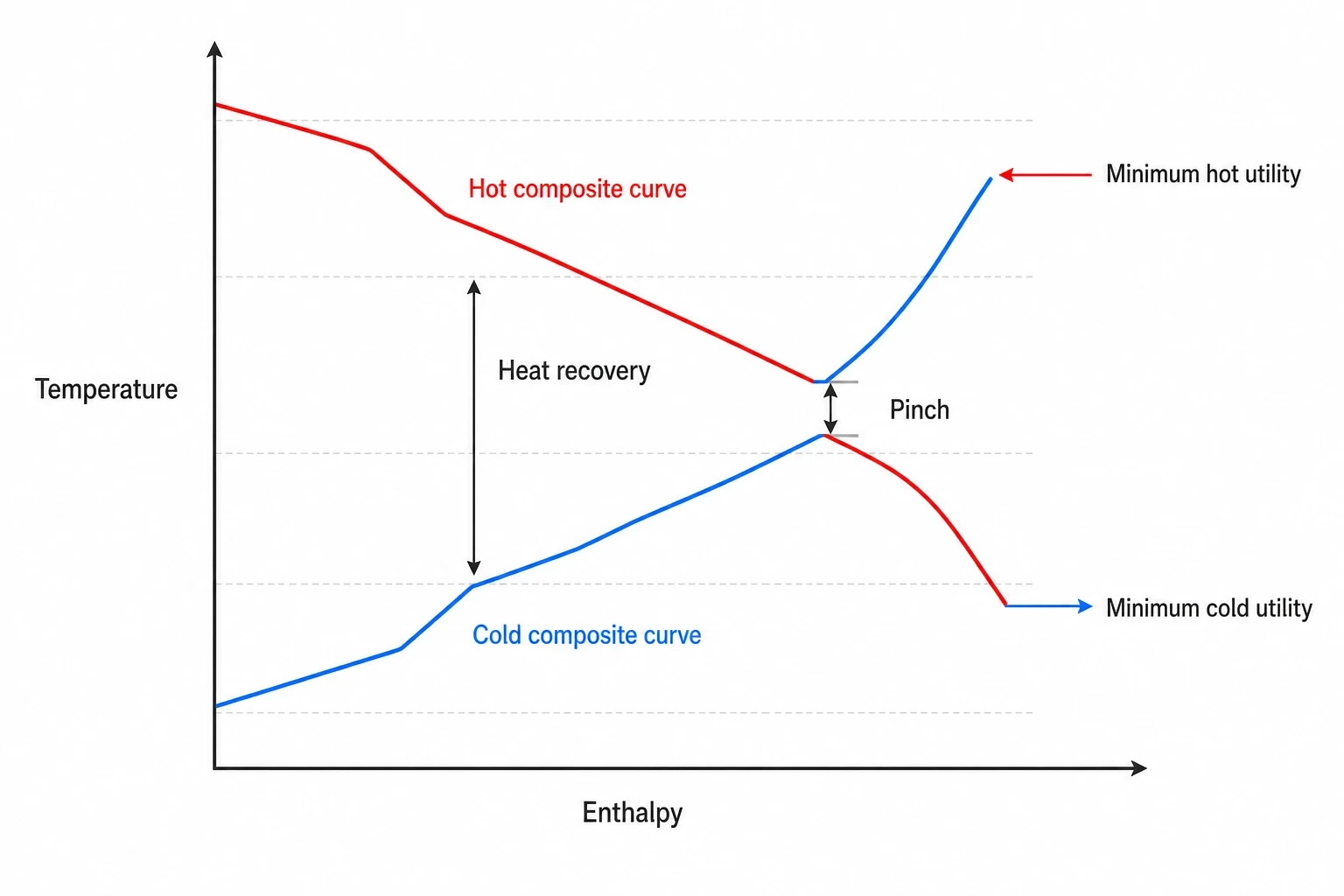
Composite curves combine hot and cold streams to reveal the theoretical maximum process heat recovery and minimum hot- and cold-utility requirements. The pinch marks the closest feasible temperature approach between the combined streams.
That target does not dictate a heat exchanger or piping route. It gives the mill rules for protecting recovery:
- Avoid transferring heat across the pinch where it forces additional utility use.
- Use high-temperature steam for duties that require it.
- Assign lower-temperature heat to water and air demands that can accept it.
- Evaluate heat-exchanger fouling, access, pressure drop and control response before approving a project.
A narrow minimum temperature approach increases theoretical recovery but can demand more heat-transfer surface and tighter cleaning control. Recycled-fibre applications need particular care where fibre, fillers, dissolved contaminants or coating residues can affect heat-exchanger performance.
Where drying-focused heat recovery projects emerge
Condensate, flash steam and dryer-group cascades
Condensate and flash systems often offer the clearest connection between drying and utility demand. A Pinch study can identify whether flash steam is used at the best available pressure level, whether warm condensate has a suitable water-heating duty and whether a dryer-group pressure arrangement uses more live steam than necessary.
Typical project candidates include using flash steam in lower-pressure dryer groups, recovering condensate heat for boiler feedwater or process water, reducing pressure losses and reviewing cylinder-group cascades. Each proposal requires a drainage and control assessment. Poor condensate removal can flood dryer cylinders, reduce heat transfer and disturb moisture profiles.
The engineering task is to retain stable dryer drainage while extracting heat at a useful temperature. Steam savings should be calculated across the full grade range, including low-speed operation and start-up conditions.
Hood-exhaust recovery
A modern wide paper machine can use more than 50 MW of primary heat, and published case work indicates that well-performing dryer-section recovery systems can recover more than 60% of that heat in cold periods. The remaining opportunity varies with climate, grade, hood design, existing recovery equipment and process-water demand.
Hood exhaust can preheat incoming hood air, fresh water, white water, circulation-water loops and machine-hall ventilation. Pinch Analysis identifies whether the highest-temperature exhaust should serve air heating before the stream moves to water-heating duties.
Heat-exchanger selection must account for fibre carry-over, contamination, condensate drainage, corrosion, cleaning access, fan capacity and pressure drop. These factors directly affect drying stability and belong in the feasibility assessment alongside the heat-recovery target.
Press-section dryness
Higher web dryness after the press section reduces the evaporation load reaching the dryers. Mechanical dewatering usually requires less energy than thermal evaporation, subject to furnish, press configuration, felt condition, runnability and product-property limits.
A drying Pinch model should include credible cases for improved press dryness. This prevents a mill from sizing a major exhaust-recovery project around heat demand that a press-section programme may reduce. It also helps operations teams compare the steam impact of improved dewatering against the capital and maintenance requirements of new recovery equipment.

Pinch analysis identifies the thermodynamic minimum energy requirement of your process — then designs the heat exchanger network to achieve it.
Connect drying targets to the total steam system
Saved steam does not have one fixed value
A paper machine is connected to boilers, steam headers, turbine extraction, CHP plant operation and electrical imports. Reducing dryer steam demand can lower boiler firing, alter power generation or release capacity for production growth. Its financial value depends on the site utility configuration and operating state.
Total-site Pinch Analysis extends the paper-machine study across the steam and power system. It tests steam-header balance, let-down stations, turbine operating limits and boiler constraints. This is particularly relevant where a site uses natural gas, biomass or a mixed fuel supply.
The result can identify whether a project will:
- Reduce boiler fuel consumption.
- Displace useful CHP steam and alter electricity generation.
- Release a boiler or header constraint.
- Create a viable sink for low-temperature waste heat.
- Increase electricity demand through pumping, fans or heat-pump operation.
The 2025 Pinch Analysis benchmark
In 2025, S. Mostafa Babaei and Martin K. Patel reported a Pinch Analysis study of primarily non-integrated and minimally integrated pulp and paper mills in the Journal of Cleaner Production. Their analysis identified potential energy savings of 39% of total heat demand.
One of the two large Swiss paper mills studied had direct heat-recovery potential of 26.8 MW, equivalent to 49.8% of its total heating demand. The result should not be applied as a generic UK saving figure. It demonstrates the value of site-specific stream data, retrofit assessment and intermediate water loops where direct process-to-process exchange is constrained by layout or operation.
BAT 6 and the UK permitting context
Energy management includes heat integration
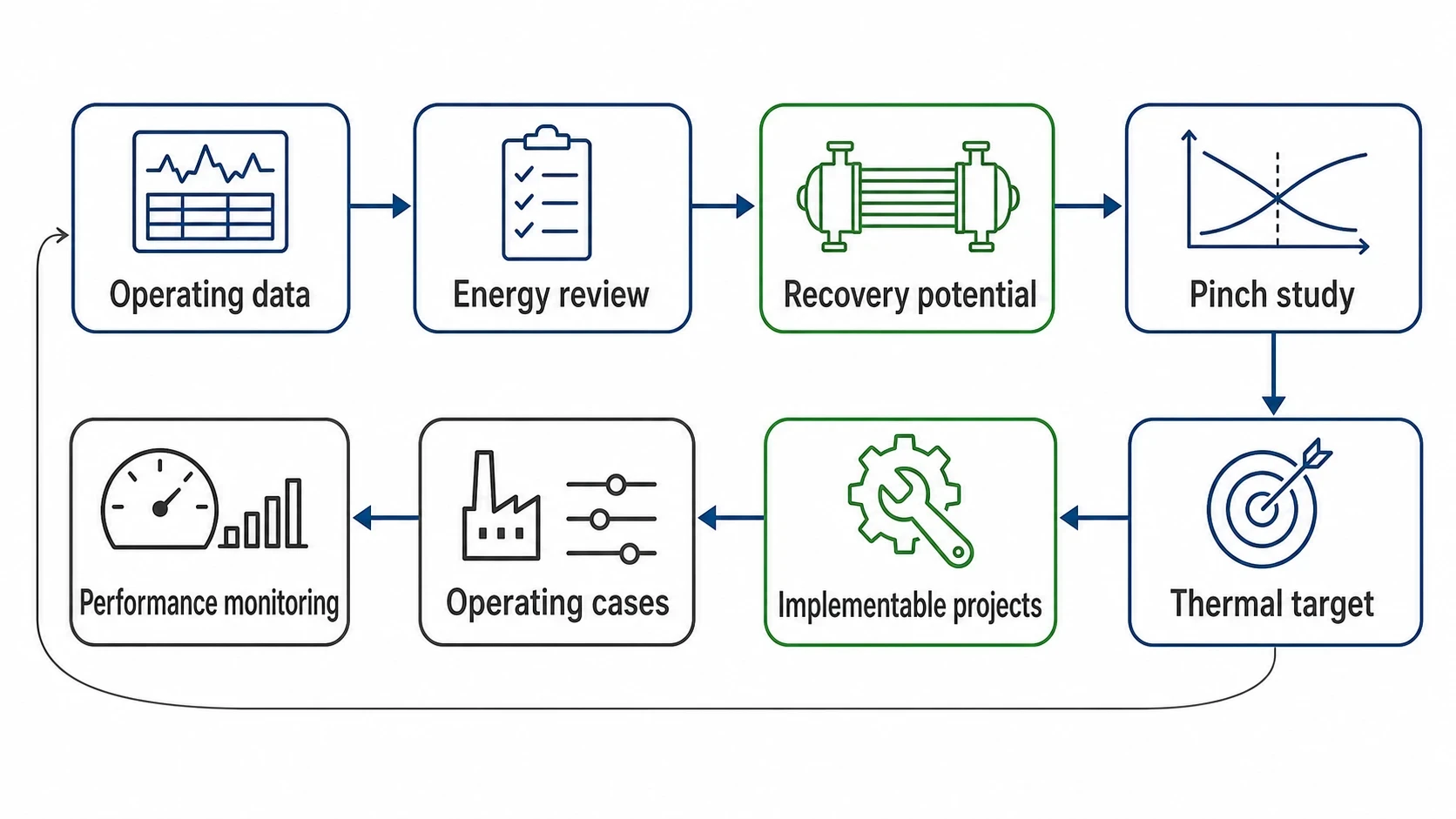
Commission Implementing Decision 2014/687/EU, the Pulp, Paper and Board BAT Conclusions under Directive 2010/75/EU, sets out BAT 6 for fuel and energy reduction. It calls for an energy-management system that assesses overall energy consumption and production, identifies and quantifies energy-recovery potential, and monitors optimised operation.
BAT 6 includes optimised heat-exchanger networks, low-temperature streams from effluents and other waste-heat sources, appropriate use of secondary heat and secondary condensate, CHP, and process monitoring and control.
Existing EU BAT Conclusions continue to have effect in the UK through the EU Withdrawal Act 2018 while UK BAT Conclusions are developed. A Pinch study provides an evidence base for heat integration by recording process conditions, identifying constraints and distinguishing a theoretical thermal target from implementable projects.
Keep the target live after installation
Heat recovery changes with fouling, bypassed heat exchangers, failed steam traps, altered water balances, revised controls and production programmes. Mills should track performance against the operating cases used in the study.
Useful indicators include steam per tonne of saleable product, dryer steam pressure by grade, condensate-return temperature, hood-exhaust temperature and humidity, post-press web dryness, boiler fuel per tonne and heat-recovery duty. Production mix should be normalised before energy performance is compared between periods.
A practical route to lower drying energy
Start with operating constraints
The project team should define moisture profile, caliper, strength, coating response, reel quality and throughput constraints before developing the heat balance. These are fixed operating requirements for the study.
Representative cases should reflect the mill’s real production programme. A board machine producing high-basis-weight packaging grades, lighter grades and lower-speed runs may require several cases. Annual savings should be weighted by operating hours in each case.
Develop projects in sequence
The resulting project list normally progresses from operating corrections to larger integration work.
- Repair steam traps, insulation, control valves, drainage equipment and failed instruments.
- Improve dryer-group pressure control, condensate routing and flash-steam use.
- Retrofit exhaust-air or condensate recovery where suitable heat sinks exist.
- Assess intermediate water loops, major hood changes, heat pumps and utility-system modifications where the total-site case supports them.
Each project should state its steam effect, electrical effect, water-system impact, cleaning requirement, control philosophy, outage requirement and production risk. This keeps the Pinch target connected to the paper machine’s primary job: producing consistent paper at the required throughput.
This article reflects the independent analysis and editorial opinion of EnerTherm Engineering. Product names, trademarks, and brands mentioned belong to their respective owners. EnerTherm Engineering is not affiliated with, endorsed by, or a licensee of any third-party software or product mentioned unless explicitly stated.

Managing Director — EnerTherm Engineering
Dr. François Pierrel is Managing Director of EnerTherm Engineering with over two decades of expertise in thermal design, heat transfer, and industrial energy optimisation. He holds a PhD in Heat Transfer from Cranfield University and a Post-Doctorate from Heriot-Watt University.
