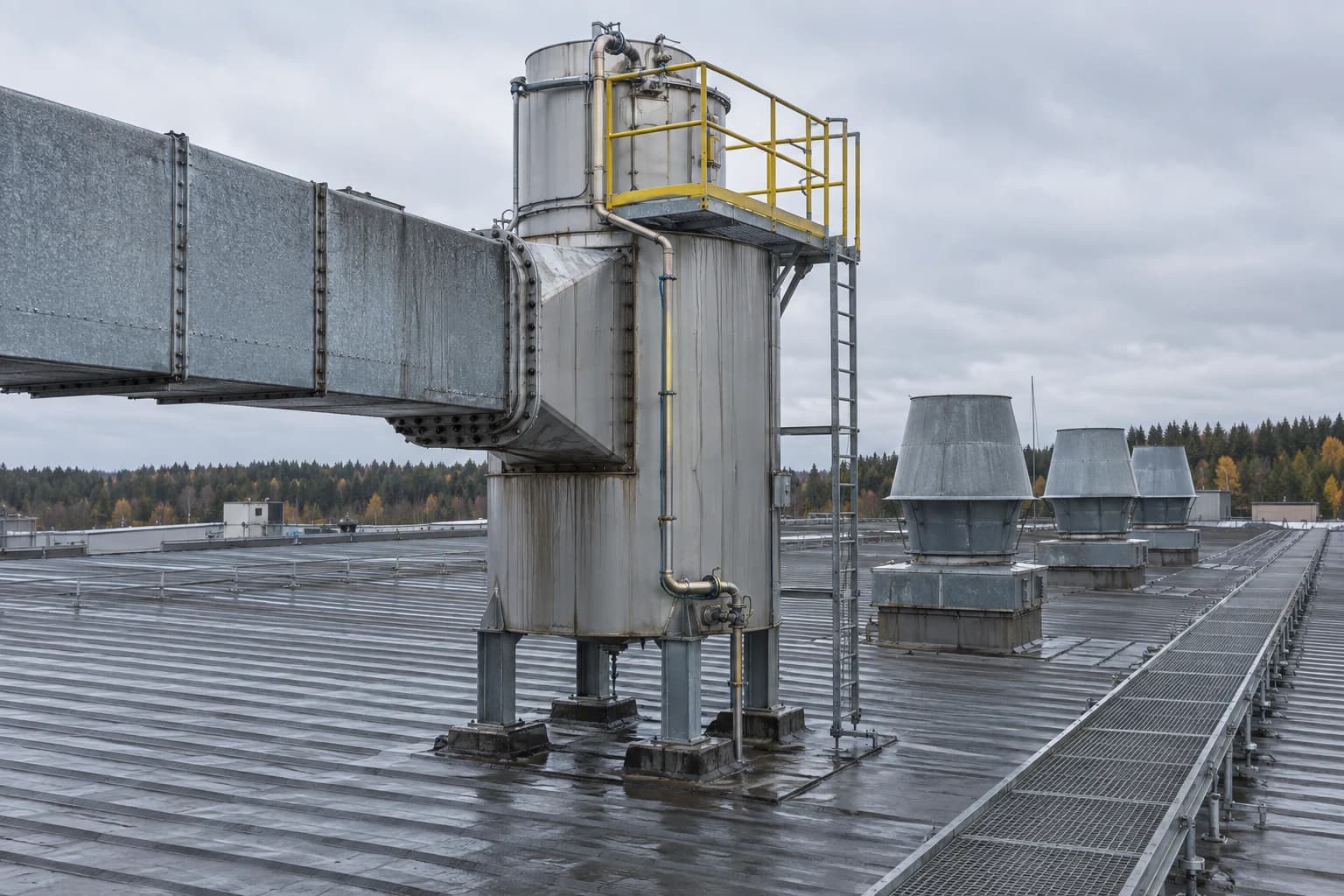
Waste Heat Recovery in Paper Mills Starts at the Dryer
Nordic mill data linked dryer heat recovery to up to 12% less fuel use.
Waste heat recovery in paper mills captures and reuses thermal energy from dryer exhaust air, condensate, process water or effluent to displace purchased steam, fuel or electricity elsewhere on site.
A paper web typically leaves the dryer section at 90 to 95% dry content. The European Commission’s pulp, paper and board reference document states that dryer exhaust commonly leaves at 80 to 85°C with humidity of 140 to 160 g H₂O/kg dry air. This warm, moisture-laden exhaust is one of the mill’s largest recoverable energy streams.
For tissue, packaging and board producers, the key operational question is where dryer heat goes after water has evaporated from the sheet. Exhaust sent directly to atmosphere must largely be replaced with fresh steam from the boiler house. Correctly matched water and air streams can recover that heat without changing product specifications or production speed.
The challenge is not finding heat. It is integrating low- and medium-temperature heat into a process with variable grades, changing machine speeds, contamination risks and tight moisture-control requirements.
Why the dryer section is the first place to look
The dryer hood concentrates a major heat loss
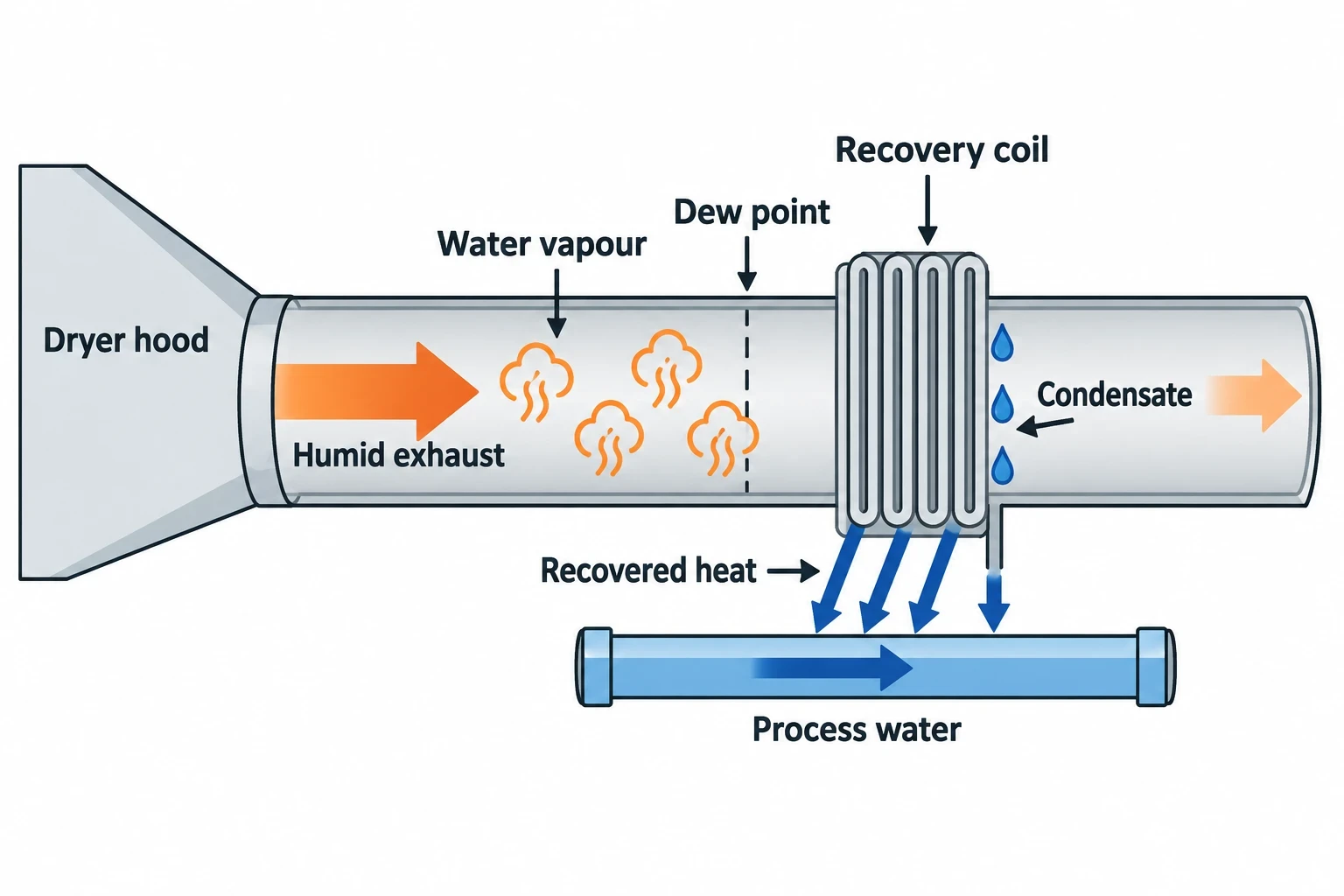
Steam-heated cylinders transfer heat into the paper web. Water removed from the sheet becomes vapour inside the dryer hood, then leaves with exhaust air. This stream contains sensible heat from the air and latent heat from water vapour.
Latent heat matters. Cooling humid exhaust air below its dew point condenses water vapour and releases heat at a useful temperature. A recovery system that cools the air only sensibly can leave much of this potential untapped.
The European Commission’s BREF describes dryer-section heat recovery as standard practice in new and recently rebuilt paper machines. Installed equipment can underperform after grade changes, machine rebuilds, ventilation modifications or changes in water demand. A heat-recovery train designed around one operating condition may match poorly at another.
Dryer exhaust conditions vary with production
Exhaust temperature and humidity are not fixed. They respond to:
- Grade, basis weight and required final moisture
- Machine speed and production rate
- Hood balance, pocket ventilation and exhaust flow
- Dryer steam pressure and condensate removal
- Press-section dryness
- Ambient-air temperature and humidity
- Fresh-water demand and process-water temperatures
A single spot temperature reading rarely supports an investment decision. An audit needs operating data across representative grades, seasons and production rates.
The dryer section should be assessed alongside the press section. Better mechanical water removal reduces the evaporation load reaching the dryers, affecting exhaust volume, heat-recovery duty and the steam demand recovery equipment can displace.
Identify where your plant is losing energy and quantify the savings potential — our audits map every heat source, sink, and waste stream in your facility.
How dryer-exhaust heat recovery works
Recover heat in the right temperature order
Dryer-exhaust heat recovery usually uses indirect heat exchangers. Exhaust air remains separated from supply air and process water, avoiding direct contamination of mill water systems.
The hottest available exhaust should meet the highest-temperature practical demand. Lower-grade heat can then serve lower-temperature duties. Common heat sinks include dryer supply air, incoming fresh water, white water and machine-hall ventilation water circuits.
A typical recovery arrangement may include:
- An exhaust-to-supply-air heat exchanger to reduce the steam or fuel required for make-up air.
- An exhaust-to-water heat exchanger to preheat fresh water.
- A further exchanger in the condensing range to heat lower-temperature process-water or white-water streams.
- A circulating-water loop where direct placement of several heat exchangers is impractical.
The order matters. A warm-water demand placed too early in the train can reduce the temperature available for dryer supply air. Equally, a high-temperature process demand may be an ineffective sink if its flow is intermittent or too small to absorb the available heat.
Condensation is the economic hinge point
Heat recovery becomes more valuable when the exhaust-air side reaches condensation. Water condensing on heat-exchanger surfaces releases latent heat and increases recoverable duty. The condensate requires controlled collection, drainage and treatment where contaminants require it.
Process engineers should establish the actual exhaust dew point rather than assume it. Humidity, air leakage, recirculation ratio and heat-exchanger fouling alter the point at which condensation begins.
Clean heat-transfer surfaces and adequate water-side flow can support effective condensation. Output can fall if warm return water rises in temperature, spray carry-over deposits material on surfaces, or fans operate outside their intended flow range.
Heat pumps can lift low-grade heat, but they do not remove the need for integration
A heat pump may suit recovered heat available below the temperature required by a process sink. It can raise recovered energy for hot-water duties where the electrical input and operating profile support the case.
The first audit question is whether a direct-use sink exists. Direct recovery avoids compressor electricity and additional equipment complexity. Heat pumps become more compelling where a mill has stable low-temperature heat, persistent heat demand and an electricity-carbon case that fits its decarbonisation plan.
Waste heat recovery in paper mills extends beyond exhaust air
Dryer condensate can reduce boiler-house load
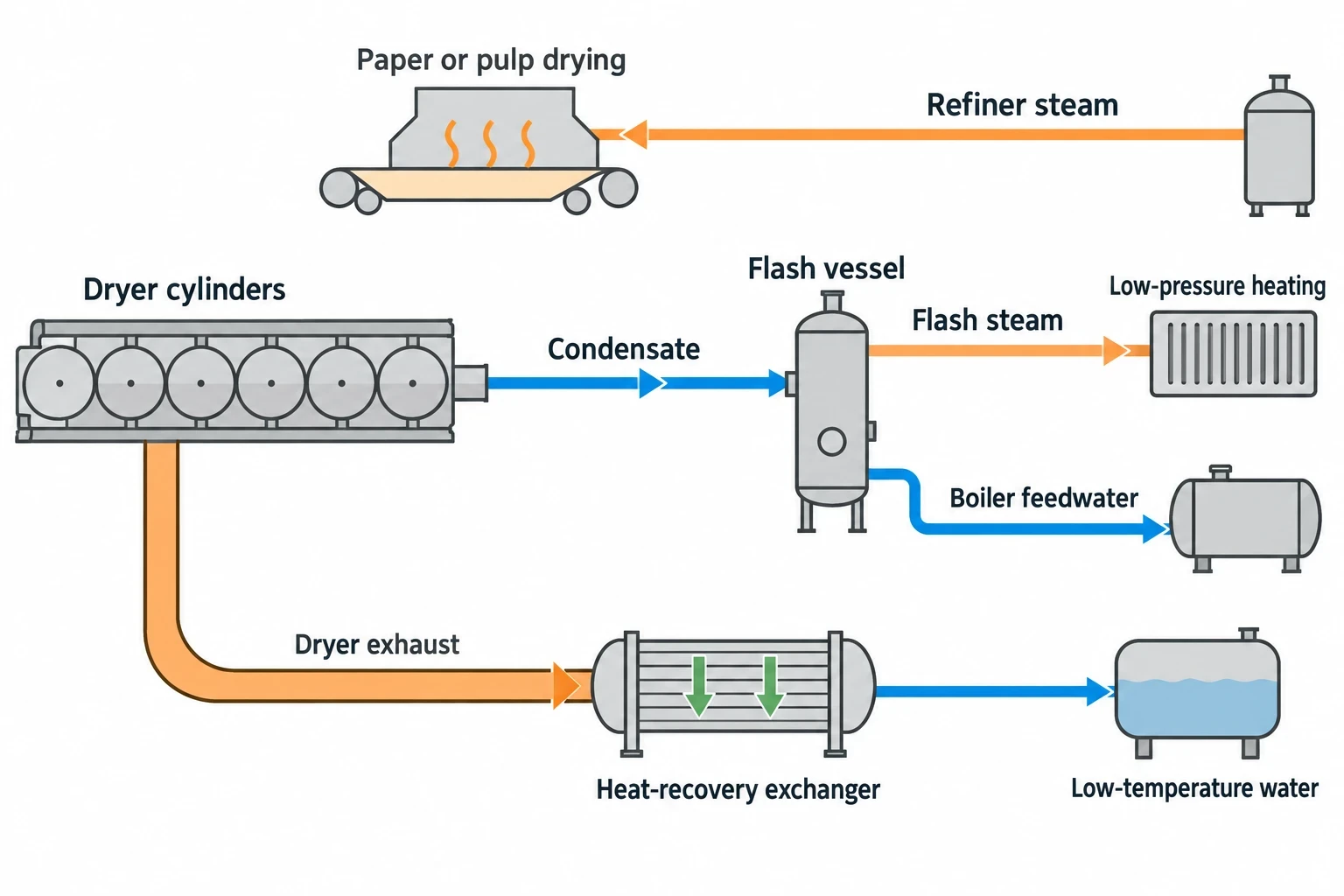
Condensate from steam-heated dryer cylinders retains useful heat. Returning clean, hot condensate to the boiler feedwater system reduces the energy required to raise replacement water to boiler conditions. It can also reduce make-up-water demand and treatment chemicals.
The audit should establish the condensate return rate, flash-steam recovery arrangement, receiver venting, contamination risk and return temperature. Unrecovered flash steam can serve low-pressure heating duties. Poor steam-trap performance, leaking valves and blocked condensate removal can affect both drying control and recoverable energy.
Dryer drainage deserves particular attention. Unstable condensate removal can reduce cylinder heat transfer, prompting production teams to increase steam pressure to maintain moisture targets and obscuring the cause of higher specific steam consumption.
Warm water and effluent need a usable sink
Paper mills often have warm streams from white water, process water, showers, vacuum systems and effluent treatment. These streams offer recovery potential only where demand exists at the right temperature and time.
Effluent heat recovery can preheat incoming process water or support low-temperature utility circuits. Solids, fibre, biological growth, scaling, corrosion and cleaning access determine whether performance remains stable.
The audit should distinguish between theoretical heat availability and recoverable heat after allowing for fouling margins, approach temperatures, production variation and cleaning outages.
TMP and CTMP sites have an additional heat source
Integrated sites with thermomechanical pulp or chemi-thermomechanical pulp production can assess refiner heat alongside paper-machine recovery. Commission Implementing Decision 2014/687/EU identifies extensive recovery of secondary heat from TMP and CTMP refiners, and reuse of recovered steam in paper or pulp drying, as BAT 41.
Recovered refiner steam may reduce drying steam duty, while dryer-exhaust recovery can serve lower-temperature water demands. The best arrangement depends on the mill’s complete heat cascade, not the performance of a single heat exchanger.
A seven-step energy audit for paper-mill waste heat recovery
EnerTherm Engineering’s audit approach begins with the production constraints that a recovery project must respect. Dryer stability, web moisture, sheet quality and machine availability set the boundary for the energy work.
1. Define the operating and financial boundary
The initial consultation identifies the machines, grades, utilities and operating periods in scope. It also establishes whether the objective is lower gas consumption, lower purchased steam, reduced UK ETS or EU ETS carbon exposure, lower cooling load, or a combination of these outcomes.
A clear boundary prevents double-counting. Reduced boiler fuel may result from dryer-exhaust recovery, improved press dryness or lower production. The audit needs to separate these effects.
2. Gather production and utility history
Energy managers should assemble at least a representative year of:
- Gas, biomass, fuel oil, electricity and purchased-steam data
- Paper production by grade and machine
- Specific steam consumption
- Dryer steam pressures
- Boiler output and condensate return
- Fresh-water, white-water and effluent temperatures and flows
- Dryer exhaust temperatures, humidity where available, and fan operating data
This history shows whether a recovery opportunity is persistent or confined to a particular season or grade.
3. Survey the dryer and heat-recovery train
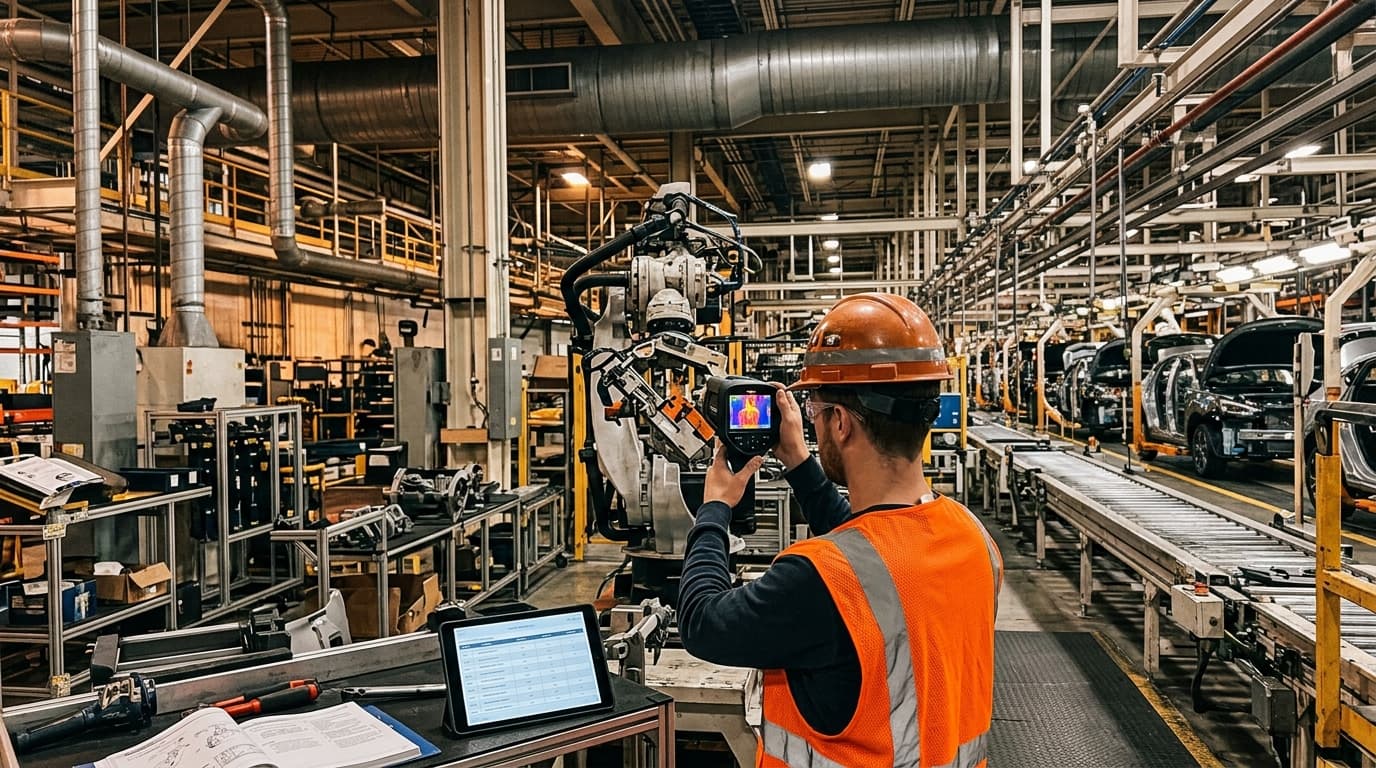
On-site assessment maps hoods, exhaust fans, heat exchangers, air-supply units, water loops, condensate receivers, flash vessels and relevant process sinks. Portable instrumentation can include power analysers for fan and pump loads, ultrasonic detectors for compressed-air or steam-system leaks, and thermal imaging to identify abnormal surface temperatures and insulation losses.
The survey should record bypass dampers, heat-exchanger isolation valves and control setpoints. A bypass left open during normal production can nullify the value of installed recovery equipment.
4. Measure the streams that determine recoverable duty
Temperature alone is insufficient. The audit should measure or establish:
- Exhaust-air temperature, humidity and flow
- Supply-air flow and temperature
- Water-side flow, supply temperature and return temperature
- Condensate flow and temperature
- Pressure drops across air and water circuits
- Fan and pump electricity demand
- Product output, grade and final moisture
These measurements show whether a heat exchanger is limited by air flow, water flow, fouling, poor control, insufficient cold-side demand or a genuine pinch in the heat network.
5. Build the heat balance and test operating cases
Thermal modelling should test representative production cases rather than a nominal machine condition. It can assess seasonal fresh-water temperatures, grade changes, machine-speed changes and alternative heat-exchanger sequencing.
The published three-machine Nordic mill case study by Leena Sivill and Pekka Ahtila illustrates the scale possible. It identified 110 GWh/year of process-heat savings from profitable investments. The reported follow-up found 12% lower fuel use and 24% lower CO₂ emissions. These results are site-specific, but show why existing recovery networks merit re-examination.
6. Rank measures by production risk and value
The first measures are often operational:
- Restore heat-exchanger water flows and control sequences.
- Repair leaking dampers and ductwork.
- Clean fouled heat-transfer surfaces.
- Correct fan setpoints and avoid unnecessary exhaust volume.
- Recover condensate and flash steam where practical.
- Match water-heating duties to the temperature available from the exhaust system.
Capital measures can follow, including additional heat-exchanger surface, revised ductwork, upgraded fans, improved condensate recovery, storage for intermittent water demand, or a heat pump for a defined low-grade heat source and sink.
Each measure needs a production-risk assessment. Dryer hood pressure, machine-room humidity, sheet moisture and maintenance access cannot become secondary considerations.
7. Verify savings after commissioning
Measurement and verification should be agreed before work starts. The International Performance Measurement and Verification Protocol, IPMVP Core Concepts 2022, provides a recognised framework for defining the measurement boundary and adjustment factors.
For a dryer-recovery project, the verification plan should track fuel or steam consumption alongside production, grade mix, final moisture, ambient conditions and machine operating hours. Metered fan and pump electricity should be included where changes in air or water flow affect auxiliary loads.
The result is verified fuel reduction, verified electricity effect, avoided CO₂ emissions and an explanation of production-normalised savings.

Identify where your plant is losing energy and quantify the savings potential — our audits map every heat source, sink, and waste stream in your facility.
Common failure modes in dryer heat recovery projects
Heat sink demand disappears
A recovery heat exchanger needs a colder stream. If process changes reduce fresh-water demand or raise return-water temperature, recovered duty falls. Thermal storage or alternative low-temperature process sinks may improve utilisation where the operating pattern supports them.
Fouling erodes heat transfer
Paper-machine environments contain fibre, dust, coating material and carry-over. Water circuits can also scale or accumulate biological growth. Heat-exchanger selection, filtration, drainage, wash-down arrangements and cleaning access should form part of the design basis.
Fan power consumes part of the gain
Higher pressure drop across a new or modified heat exchanger can increase fan electricity use. The thermal model and financial case should include this penalty, along with pump power for circulating-water loops.
Controls protect the machine, but can strand savings
Control systems should prioritise safe hood balance and product quality. They should also prevent avoidable bypassing, maintain suitable water-side flow and respond to changing production conditions. A recovery train commissioned for one grade may need revised control logic after a machine rebuild.
Compliance and carbon reporting considerations
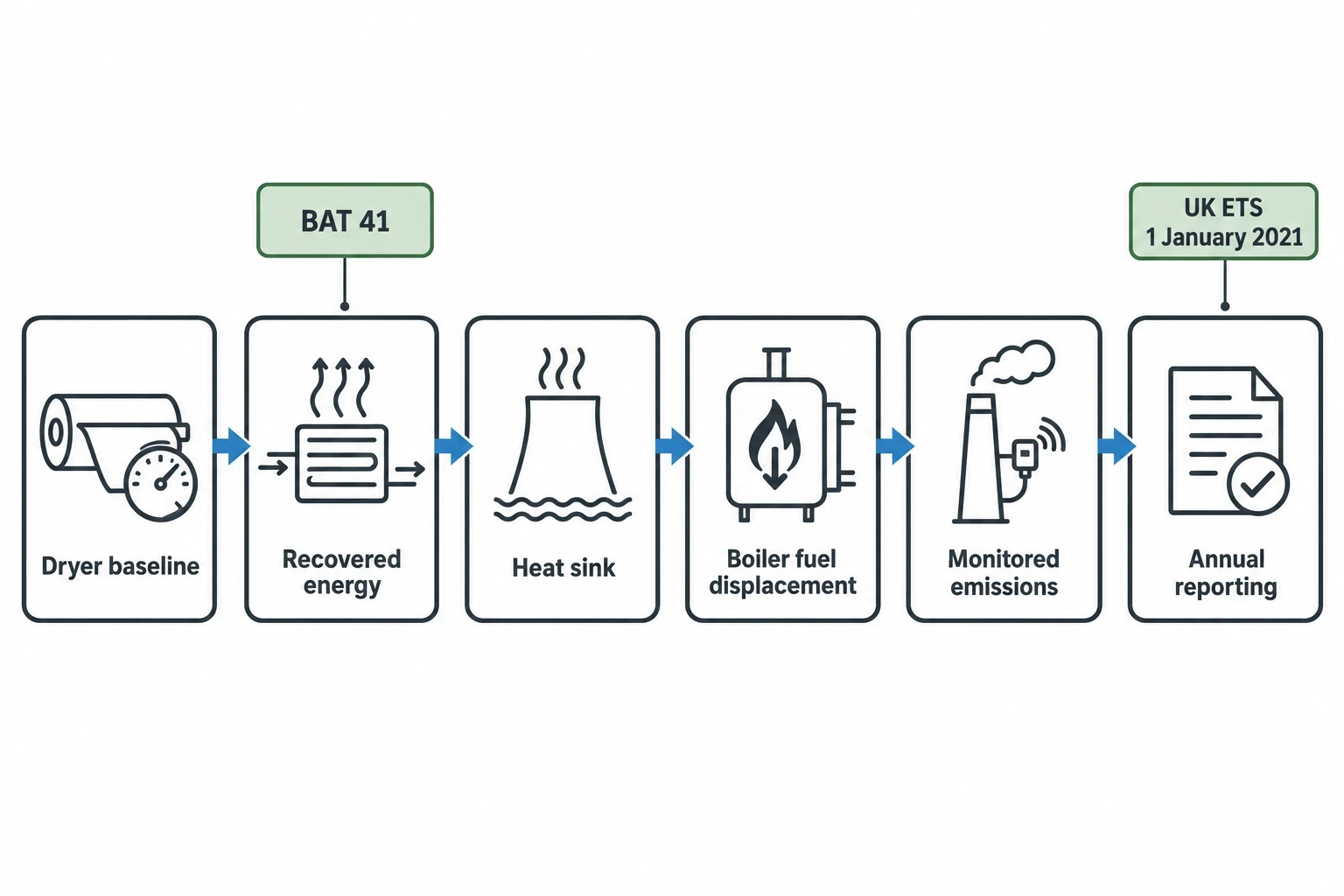
For EU mills, the pulp, paper and board BAT Conclusions sit within the Industrial Emissions Directive framework. BAT 41 is directly relevant to TMP and CTMP sites assessing secondary-heat recovery and recovered steam for drying.
In England, the Environment Agency requires energy-efficiency measures for relevant permitted industrial installations and requires monitoring and annual reporting of energy-efficiency performance in specified circumstances. A well-documented audit supports permit discussions by showing the operating basis, identified opportunities, cross-media effects and delivery plan.
UK mills within the UK ETS should use current reporting requirements and applicable monitored-emissions data when translating fuel savings into carbon benefits. The UK ETS Authority established the scheme on 1 January 2021, and its technical guidance includes reporting tools and emissions-factor material for operators.
The strongest projects establish the dryer baseline, identify the heat sink receiving recovered energy, quantify boiler-fuel displacement and maintain measurements after the capital project closes.
The practical priority: recover the heat already crossing the roofline
Dryer-exhaust recovery merits an early place in a paper-mill energy audit because the source is concentrated, warm and continuous whenever the machine is producing. The most useful project may be a repaired control sequence or cleaned heat exchanger rather than a new plant room.
A disciplined audit identifies the heat source, the demand that can absorb it, the operational limits and the evidence needed to verify savings. This turns dryer-section heat from an atmospheric loss into a measured contribution to lower fuel use, lower carbon emissions and more efficient paper production.
This article reflects the independent analysis and editorial opinion of EnerTherm Engineering. Product names, trademarks, and brands mentioned belong to their respective owners. EnerTherm Engineering is not affiliated with, endorsed by, or a licensee of any third-party software or product mentioned unless explicitly stated.

Managing Director — EnerTherm Engineering
Dr. François Pierrel is Managing Director of EnerTherm Engineering with over two decades of expertise in thermal design, heat transfer, and industrial energy optimisation. He holds a PhD in Heat Transfer from Cranfield University and a Post-Doctorate from Heriot-Watt University.
