Why Pulp and Paper Mills Need a Decarbonisation Roadmap
European pulp and paper mills cut direct CO₂ emissions by approximately 30% by 2025.
A pulp and paper industry decarbonisation roadmap is a mill-specific, time-bound investment plan that reduces direct and purchased-energy emissions while protecting production, product quality and compliance. Cepi reported on 30 September 2026 that European pulp and paper had reduced direct CO₂ emissions by approximately 30% by 2025. Further reductions will demand site-specific engineering, capital discipline and operational control.
Paper, tissue and corrugated-board mills have few simple decarbonisation choices. Steam use changes with grade, basis weight, furnish, machine speed, moisture targets, ambient conditions and production schedules. A new boiler can lower fuel emissions while leaving an oversized dryer-section steam load untouched. A heat pump can recover useful energy only where its source temperature, delivery temperature and operating hours fit the mill heat balance.
A roadmap puts these decisions in order. It establishes priorities, project dependencies, capital requirements and how each result will be verified. For energy managers, sustainability directors and engineering leaders, that structure turns a carbon target into an investment programme that fits continuous production.
Why pulp and paper mills need a decarbonisation roadmap now
European mills have already invested in fuel changes, energy management and modernised equipment. Remaining emissions often sit in high-temperature steam generation, paper drying, lime kilns, purchased electricity and constrained utility infrastructure.
Cepi’s 2026 outlook identifies a tougher next phase. Fossil-free energy, grid access and mill investment will determine whether sites can progress while remaining competitive. A broad corporate target cannot decide whether a paper machine should reduce steam demand, recover dryer-exhaust heat, upgrade its boiler house or prepare for electrification.
Drying creates interdependent thermal decisions
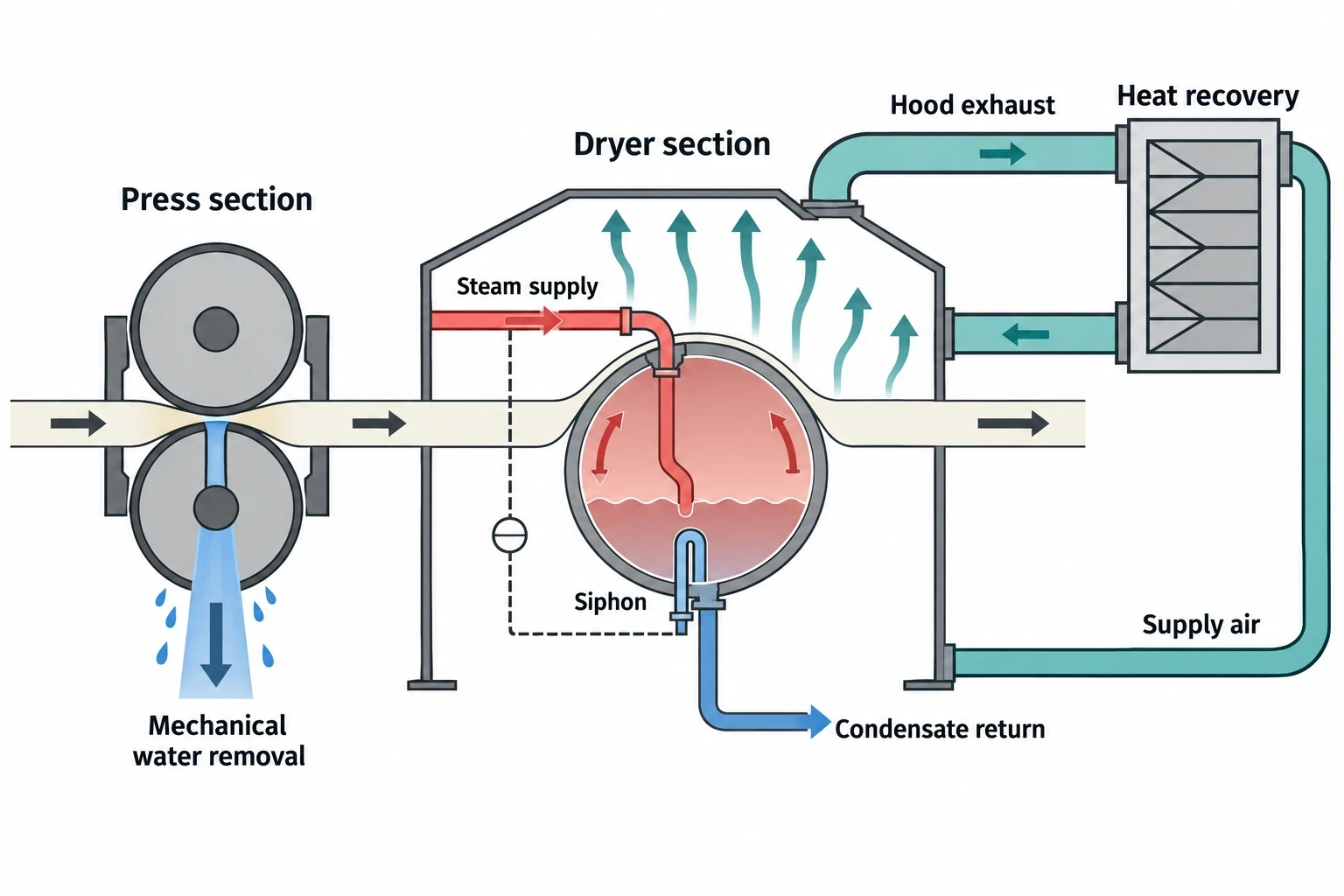
The dryer section often determines a paper machine’s thermal demand. Mechanical water removal upstream matters because less water entering the dryer section lowers evaporation duty. Press loading, felt condition, vacuum performance, sheet runnability and condensate drainage affect fuel use as directly as boiler combustion efficiency.
A useful roadmap examines drying as one heat-consuming process. It should assess:
- Steam pressure by drying group and grade
- Condensate return temperature, flash-steam recovery and losses
- Dryer siphon condition and differential-pressure control
- Hood exhaust temperature, humidity and supply-air heating
- Press-section dryness and vacuum-system electricity demand
- Exhaust-air and wastewater heat-recovery opportunities
- Grade changes, machine breaks and low-load periods
This assessment identifies avoidable demand before a mill commits to low-carbon heat generation.
Carbon cost belongs in the same business case as energy
Mill investment cases already consider gas, electricity, biomass, maintenance, outage risk and lost production. A pulp and paper industry decarbonisation roadmap adds emissions exposure, free allocation, reporting evidence and carbon-cost assumptions.
For EU installations, Commission Implementing Regulation (EU) 2026/1412 sets revised EU ETS free-allocation benchmark values for 2026 to 2030. Capital planning should model each major project against expected production, verified emissions and current allocation assumptions. Historic allocation cannot provide a dependable proxy for future exposure.
UK sites need a separate view. The UK ETS covers fuel-combustion sites where units have a combined rated thermal input exceeding 20 MW. Reducing gas demand can affect fuel spending and allowance requirements, changing the financial case for steam and heat-recovery projects.
Identify where your plant is losing energy and quantify the savings potential — our audits map every heat source, sink, and waste stream in your facility.
Start with a production-adjusted energy and carbon baseline
An annual utility total gives a poor picture of a working paper mill. It hides changes in production volume, product mix, finished-sheet moisture and machine availability. A credible roadmap starts with field measurements and a baseline that explains why energy use changed.
Build an energy balance around the whole mill
The baseline should show where energy enters the site, how it is converted, where it is consumed and where it leaves. It should cover purchased electricity, gas, biomass, recovered fuels, imported steam where relevant, on-site generation and exported electricity.
| Energy area | Measurements to establish | Value to the roadmap |
|---|---|---|
| Boiler house | Fuel flow, steam flow, pressure, oxygen, flue-gas temperature, blowdown | Identifies combustion, distribution and load-matching losses |
| Steam network | Main and branch steam flow, pressure, condensate return and flash steam | Reveals pressure mismatches, leakage and unrecovered condensate |
| Paper machine | Steam by dryer group, hood exhaust, press dryness and vacuum power | Connects moisture removal with thermal and electrical demand |
| Stock preparation | Refining power, pumping power, process temperatures and water flow | Identifies electrical intensity and low-grade heat opportunities |
| Utilities | Compressed-air power, cooling, ventilation and water treatment | Prevents material utility loads being missed |
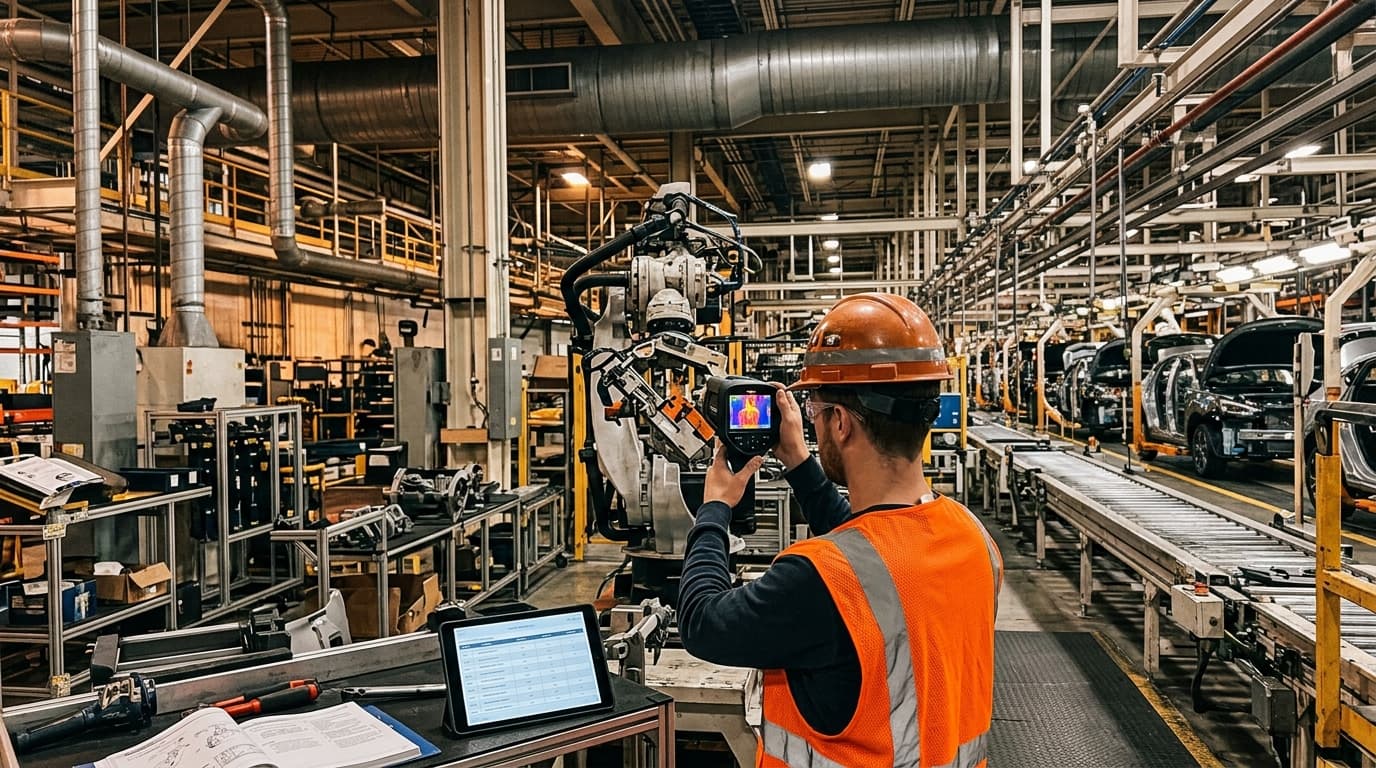
Portable power analysers can establish the demand of refiners, pumps, fans and vacuum equipment where permanent metering is incomplete. Ultrasonic leak detection can locate compressed-air and steam losses. Thermal imaging can reveal failed insulation, hot valves, overheated electrical components and heat losses around boiler-house equipment.
Normalise for production conditions
Tonnes of saleable paper are rarely enough for a meaningful baseline. A tissue site may require separate indicators for grade, machine speed, moisture and downtime. An integrated kraft mill may need to distinguish purchased-fuel demand from recovery-island performance. A recycled-fibre board mill may need indicators for furnish mix, deinking requirements and drying intensity.
Useful indicators are set where managers make decisions. These can include gigajoules of steam per tonne by machine, kilowatt-hours per tonne for refiners, kilograms of water evaporated per tonne of finished product and tonnes of condensate returned per tonne of paper.
ISO 50001:2018 provides a recognised framework for energy-management improvement. At mill level, it supports energy baselines, energy-performance indicators, operational controls and management review after the initial audit.
Use pulp and paper BAT conclusions as a roadmap framework
Commission Implementing Decision 2014/687/EU sets Best Available Techniques conclusions for pulp, paper and board production. It applies to integrated and non-integrated pulp production and to paper or cardboard installations exceeding 20 tonnes per day capacity.
The BAT conclusions call for energy management that assesses total energy use and production, identifies energy-recovery potential and monitors optimised operating conditions. These requirements closely match the technical foundation of a decarbonisation roadmap.
Match projects to the process type
A measure that suits one mill can deliver little value at another. Mechanical pulp mills carry substantial refining electricity demand and may recover secondary heat from TMP or CTMP processes. Recycled-fibre and board sites may find their strongest opportunities in dewatering, condensate management, efficient screening, steam-pressure control and dryer-exhaust heat recovery.
Integrated chemical pulp mills also need to assess recovery operations, evaporation, lime-kiln heat demand and the steam-power balance. The thermal system must be considered alongside material flows, particularly where black liquor provides a substantial energy source.
The BAT conclusions identify high-efficiency steam boilers and cogeneration of heat and power as applicable measures in relevant circumstances. CHP can improve primary-energy efficiency at a site with sustained electrical and thermal loads. A gas-fired CHP investment retains fossil-fuel exposure, so project teams should assess fuel availability, future emissions cost, grid-carbon assumptions, electricity value and the need for further decarbonisation within the asset’s operating life.
Apply pinch analysis before sizing heat assets
Pinch analysis establishes the external heating and cooling demand that a process requires under defined operating conditions. It helps engineering teams determine whether a heat pump, boiler, thermal store or exchanger network meets a genuine residual demand or duplicates a lower-cost process-integration measure.
The study should distinguish theoretical heat recovery from recoverable heat that can operate reliably in a mill. Product quality, contamination, corrosion, fouling, pressure drop, cleanability and maintenance access belong in the initial assessment. These constraints often determine whether an apparently attractive heat-recovery project will survive production conditions.
Prioritise steam-system upgrades before major fuel switching
A roadmap should rank measures by more than simple payback. Each entry should show capital cost, annual energy saving, annual CO₂e reduction, production impact, outage requirement, dependency, project risk and measurement method.
Reduce avoidable thermal demand
Demand reduction creates the foundation for electrification and fuel switching. Common priorities include restoring failed steam traps, repairing leaks, insulating valves and fittings, improving boiler blowdown control, reducing excessive distribution pressure and maximising condensate return.
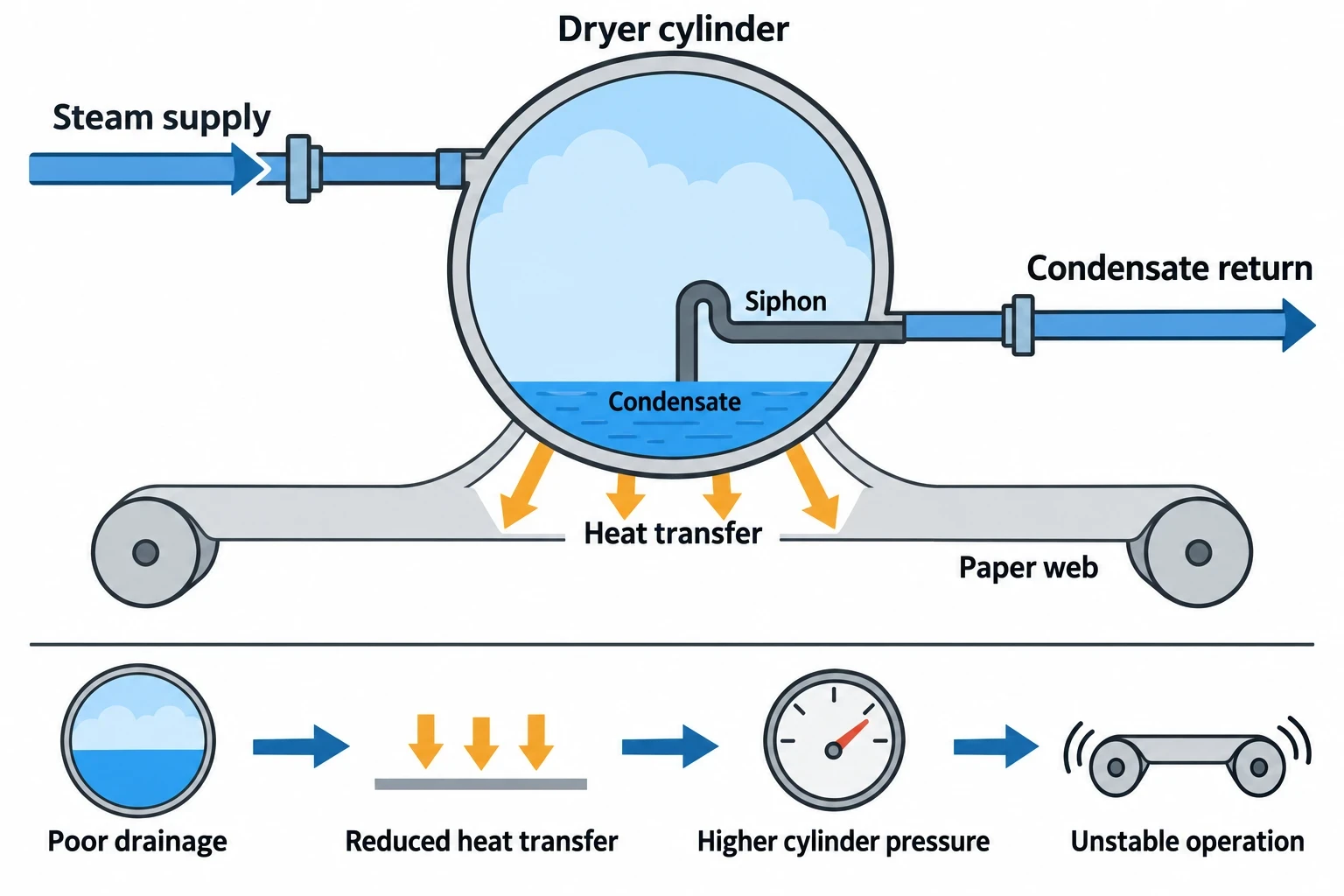
At machine level, press-section performance deserves early attention. Higher post-press solids reduce downstream evaporation duty, provided sheet properties and runnability remain within product specification. Condensate systems should receive equal scrutiny. Poor drainage can reduce heat-transfer performance, increase dryer-cylinder pressure and destabilise machine operation.
Energy audits should also examine dryer-hood settings, ventilation balance and supply-air heating. A hood operating outside its intended humidity or temperature range can increase thermal demand and restrict heat recovery.
Recover heat where a dependable sink exists
Heat recovery has value when the mill can use recovered heat consistently. Suitable sinks may include boiler feedwater, make-up water, process-water loops, hood supply air and buildings.
Dryer exhaust and wastewater often provide low-temperature sources. Heat pumps can raise this heat to a useful delivery temperature, although performance depends on the temperature lift, source condition, electricity price and annual run hours. Project models should use measured seasonal conditions rather than a single assumed coefficient of performance.
A successful project must also account for fouling, water quality, exchanger cleaning, corrosion resistance and steam-system balances. These details can determine lifecycle value more than the headline energy calculation.

Identify where your plant is losing energy and quantify the savings potential — our audits map every heat source, sink, and waste stream in your facility.
Plan electrification and fuel switching around mill infrastructure
Fuel switching entails more than changing a burner. Biomass projects require a reliable fuel supply, storage, handling, ash management, emissions control, transport planning and permit review. Alternative fuels bring their own combustion, safety and supply-chain requirements.
Electrification demands an equally rigorous assessment. Grid-capacity studies, connection timetables, electrical load profiles, resilience requirements and the site’s own power generation influence the feasible project sequence. A mill with constrained grid capacity may need to reduce thermal demand and secure network upgrades before installing electric boilers or high-temperature heat pumps.
Separate immediate measures from enabling projects
The strongest pulp and paper industry decarbonisation roadmaps distinguish three categories:
- Operational and maintenance actions that reduce energy use quickly.
- Capital projects that recover heat or improve steam and electrical-system efficiency.
- Enabling investments, such as grid studies, permitting, network reinforcement and front-end engineering, that prepare the site for larger fuel-switching or electrification decisions.
This structure helps prevent oversized low-carbon heat assets and reduces the risk of fossil-fuel equipment becoming stranded before the end of its useful life.
Integrate EU ETS and UK ETS compliance into capital planning
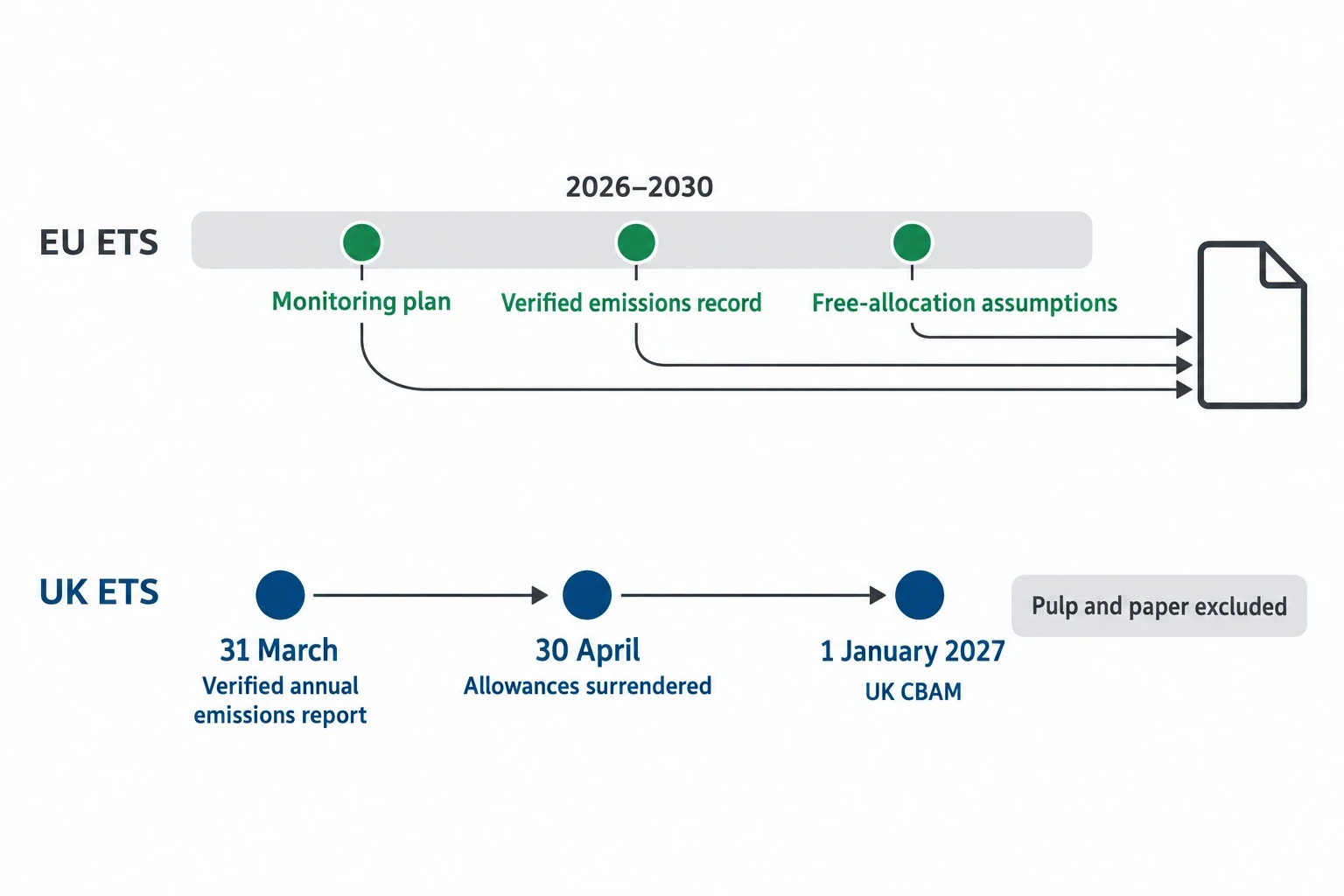
Compliance planning should progress with engineering work. Reporting boundaries, production data and verified emissions records affect the quality of carbon-reduction claims and the credibility of investment papers.
Use verified data to assess carbon exposure
EU ETS sites should align project baselines with their monitoring plan, verified emissions record and free-allocation assumptions under the 2026 to 2030 benchmarks. Teams should separate direct-combustion reductions from changes in purchased electricity, production volume and product mix. This avoids overstating a project’s carbon effect.
UK ETS operators submit verified annual emissions reports by 31 March and surrender sufficient allowances by 30 April. The same controlled data trail can support compliance, board reporting and project measurement.
The UK Carbon Border Adjustment Mechanism begins on 1 January 2027. Its confirmed launch scope covers aluminium, cement, fertiliser, hydrogen, iron and steel. Pulp and paper are outside that scope. Glass and ceramics were proposed during earlier policy development but are excluded from the confirmed launch scope. Paper mills still need carbon-cost planning where customers, suppliers and export markets demand emissions data.
Turn an energy audit into an investment-ready roadmap
An audit becomes a roadmap when it assigns owners, dates, capital gates and a method for proving results. EnerTherm Engineering’s seven-step audit methodology can structure that work across a continuous-process mill:
- Define production, energy, carbon and compliance objectives with the mill team.
- Establish a production-adjusted energy and emissions baseline.
- Conduct an on-site assessment using portable instrumentation and process observation.
- Build heat, mass and electrical balances from field data.
- Identify operational actions, maintenance requirements and capital measures.
- Rank measures by financial return, carbon impact, production risk and dependency.
- Set a measurement and verification plan before implementation.
A board-ready project register should separate no-regret actions from schemes requiring front-end engineering, outage planning, permitting discussions or grid studies. This gives leadership a clear line from immediate energy savings to major capital decisions.
Measure results and keep the roadmap live
A roadmap needs feedback from operating performance. IPMVP Core Concepts 2022 provides an established framework for measurement and verification of energy, water and renewable-energy projects. It is useful where throughput, grade mix, weather or operating hours differ from the baseline period.
Define the measurement boundary before installation
Each project needs a written plan covering its boundary, baseline period, meters, adjustment factors, reporting frequency and accountable owner. A boiler-efficiency upgrade needs a different boundary from a dryer-hood heat-recovery project. Clear boundaries reduce double counting when several projects affect the same steam system.
Stable, small projects may suit targeted measurement. More complex schemes that interact with production may need whole-facility analysis and agreed adjustments for significant changes in output, grade mix and operating conditions.
Review decarbonisation as an engineering programme
Monthly reviews should track steam intensity, electricity intensity, condensate return, fuel use, CO₂e and project status against the agreed baseline. Quarterly governance should test whether the capital sequence still fits production forecasts, carbon costs, electricity infrastructure and maintenance windows.
The roadmap should be revised after grade changes, machine rebuilds, boiler modifications or fuel-supply changes.
This article reflects the independent analysis and editorial opinion of EnerTherm Engineering. Product names, trademarks, and brands mentioned belong to their respective owners. EnerTherm Engineering is not affiliated with, endorsed by, or a licensee of any third-party software or product mentioned unless explicitly stated.

Managing Director — EnerTherm Engineering
Dr. François Pierrel is Managing Director of EnerTherm Engineering with over two decades of expertise in thermal design, heat transfer, and industrial energy optimisation. He holds a PhD in Heat Transfer from Cranfield University and a Post-Doctorate from Heriot-Watt University.
