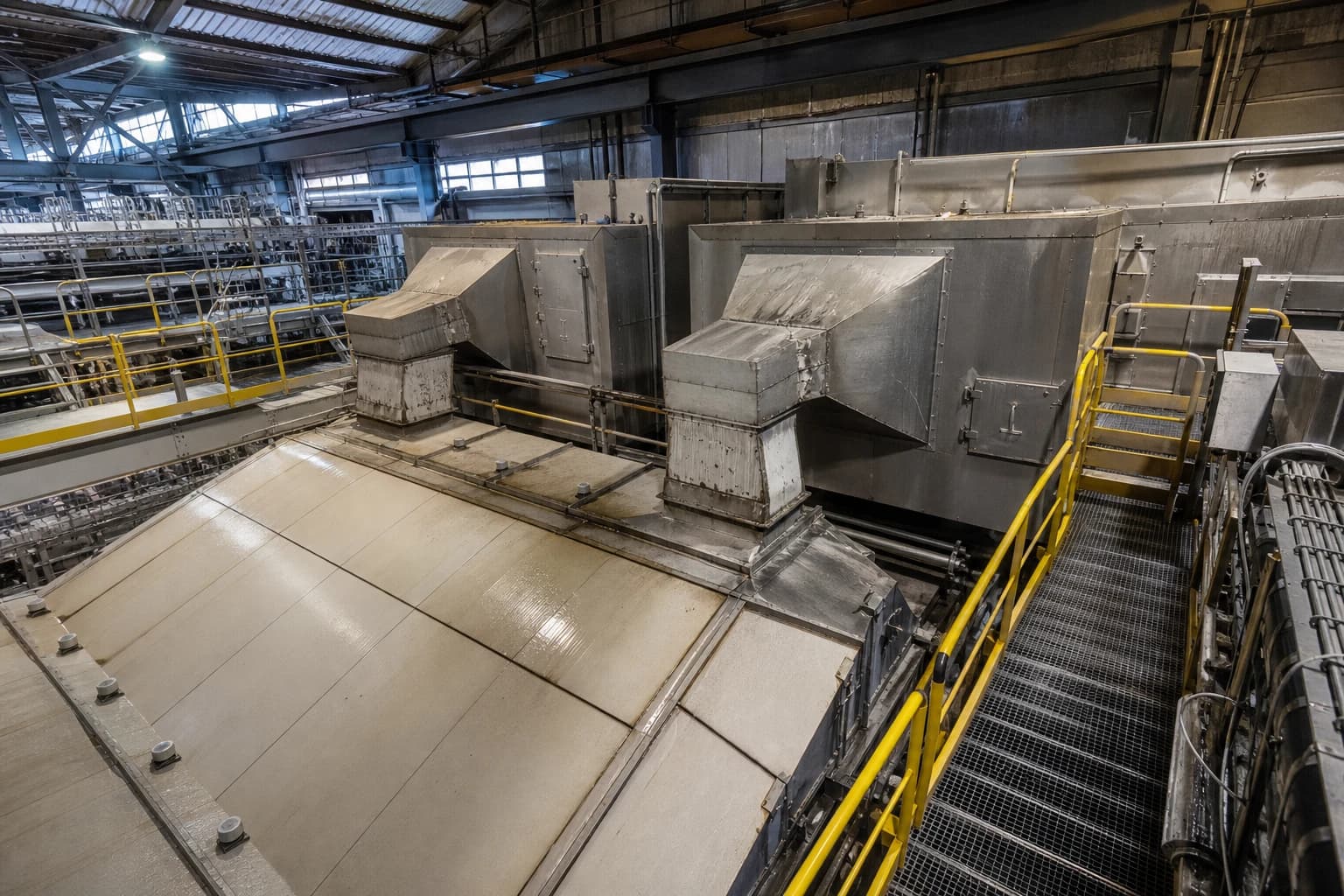
How Pulp Mills Use Pinch Analysis to Recover Waste Heat
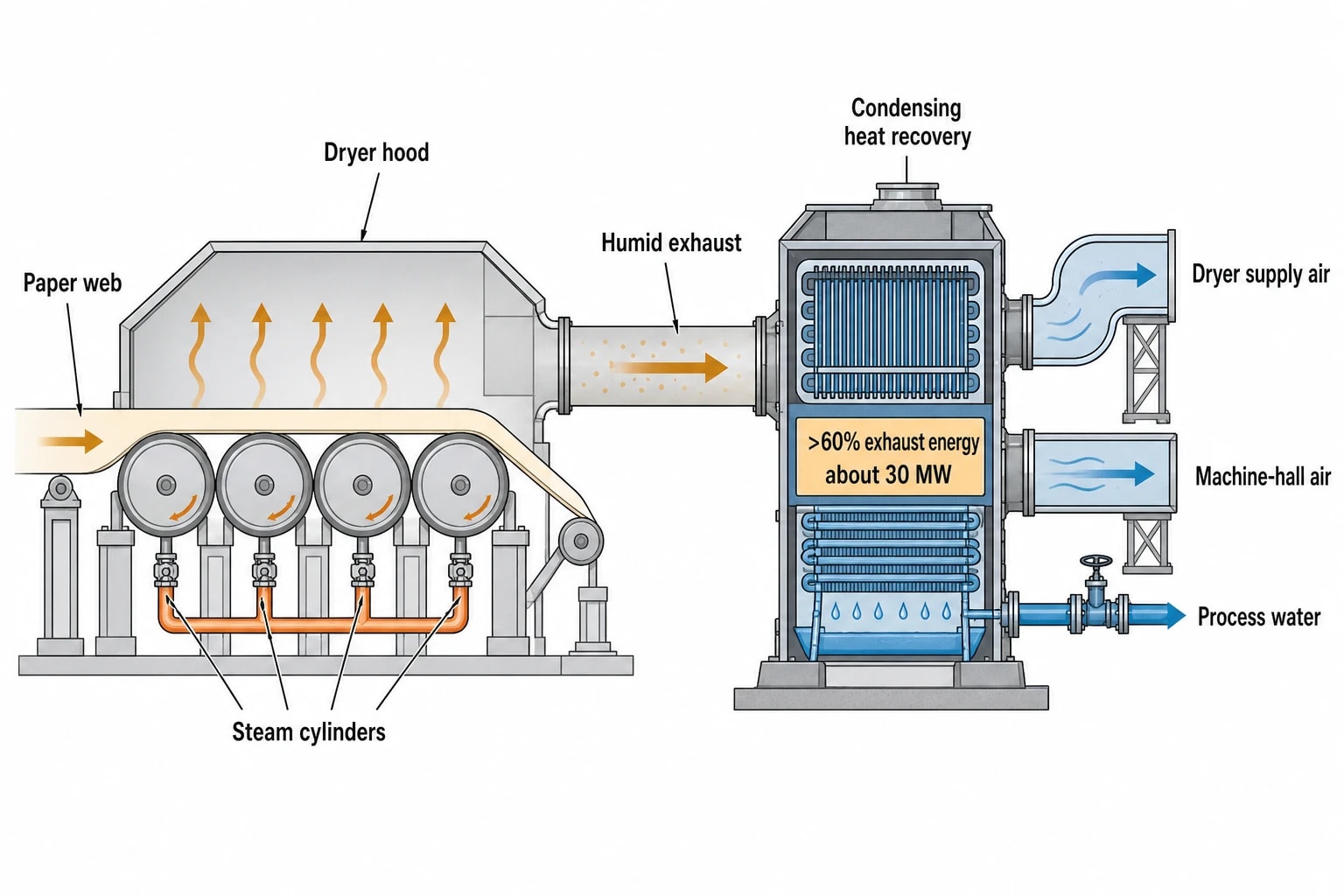
A newsprint dryer can recover more than 60% of exhaust energy, about 30 MW.
Pinch analysis is a process-integration method that identifies a mill’s minimum heating and cooling demand, then matches hot and cold process streams to recover heat before new steam or fuel is supplied. A 2025 study of pulp and paper mills identified potential savings equal to 39% of total heat demand in primarily non-integrated and minimally integrated sites.
That scale reflects pulp and paper production. Mills reject large quantities of heat through humid dryer exhaust, evaporator condensates, warm process water, recovery-boiler flue gas and effluent treatment. Much of it is at low or medium temperature, making direct reuse difficult but far from impossible. Pinch analysis gives engineers a disciplined way to decide which streams should exchange heat, where steam remains necessary and when a heat pump has a sound thermodynamic role.
For mills facing fuel-cost exposure, decarbonisation targets and pressure on steam-generation assets, pulp and paper mill waste heat utilisation starts with the heat balance, not a catalogue of equipment.
Why pulp and paper mill waste heat utilisation needs process integration
A pulp mill has several major heat users competing for steam. Digesters, evaporation trains, bleaching operations, paper-machine dryers and ancillary heating systems can draw from the same steam network while rejecting heat at different temperatures. A local heat-recovery project can reduce one duty yet create a problem elsewhere, such as insufficient condensate temperature, a cooling-water constraint or higher back-pressure on the steam system.
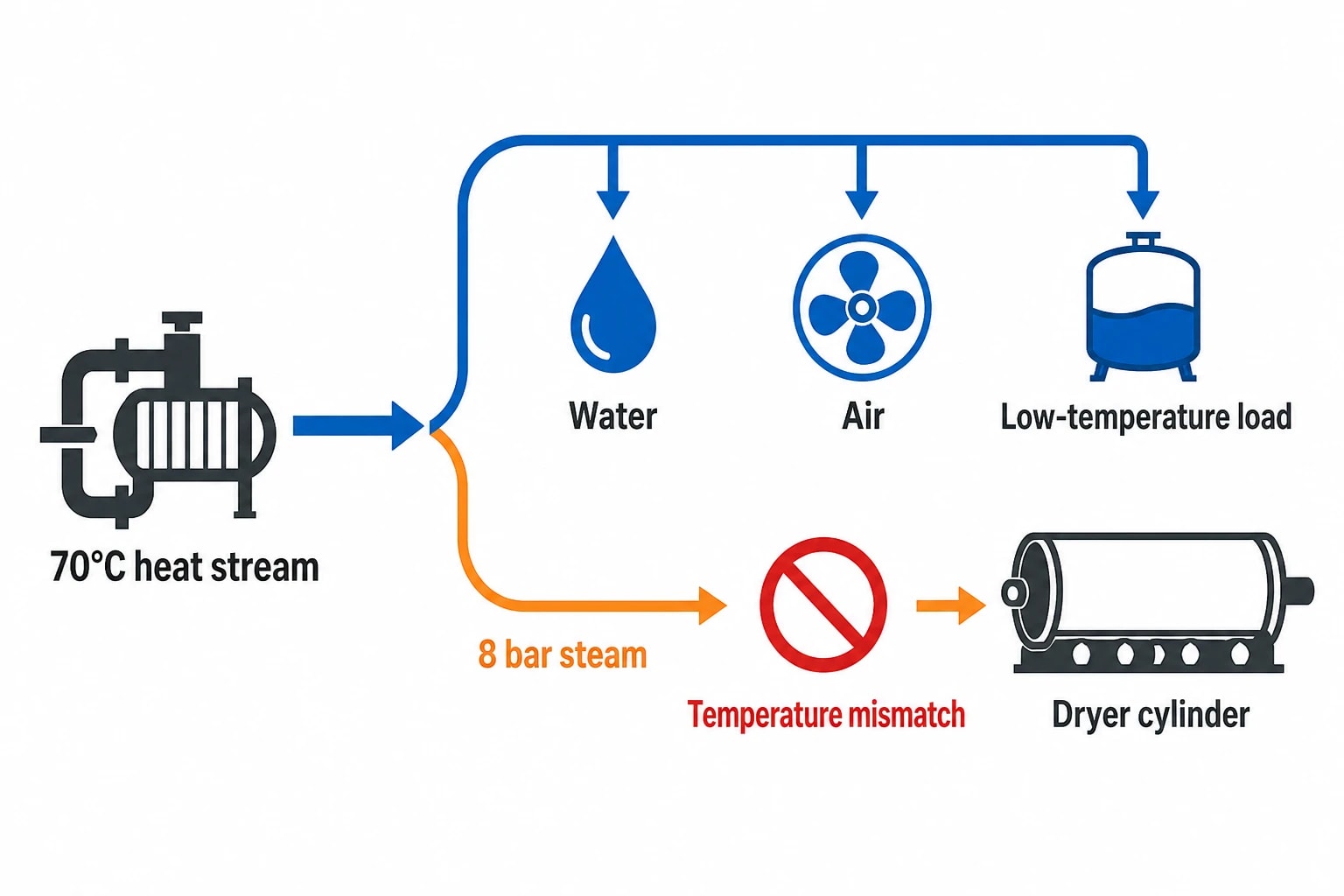
Pinch analysis tests the whole system before equipment selection. It distinguishes useful heat from heat that is merely available. A 70°C stream can heat water, air or a low-temperature process load. It cannot directly replace 8 bar steam in a dryer cylinder. That temperature mismatch drives many disappointing waste-heat projects.
BAT requirements put energy integration on the agenda
Commission Implementing Decision 2014/687/EU sets Best Available Techniques conclusions for pulp, paper and board production under the Industrial Emissions Directive 2010/75/EU. BAT 6 requires mills to reduce fuel and energy consumption through a combination of energy-efficiency techniques, including careful process integration using pinch analysis to reduce direct steam use.
A heat-recovery proposal should demonstrate more than recovered megawatts. It should show how the proposal changes boiler firing, steam-pressure demand, cooling duty, electricity use and operating flexibility. European mills can use that evidence to support energy-efficiency planning and BAT assessments. UK mills should assess the same integration issues against their environmental permit conditions and current regulatory obligations.
The biggest heat source is not necessarily the best first project
Dryer hood exhaust attracts attention because its flow is continuous and moisture carries substantial latent heat. Yet an evaporation condensate can be a stronger first match if it sits near a stable process-water duty. Recovery-boiler flue gas may contain significant energy but requires careful consideration of corrosion, fouling, acid-dew-point limits and the existing gas-cleaning train.
Pinch analysis ranks opportunities by temperature fit and system effect. That avoids spending capital to recover low-grade heat only to displace an existing low-cost source while high-pressure steam demand remains unchanged.

Pinch analysis identifies the thermodynamic minimum energy requirement of your process — then designs the heat exchanger network to achieve it.
How pinch analysis sets heat-recovery targets
The method starts by treating each heat source as a hot stream and each heat demand as a cold stream. Engineers record inlet temperature, target temperature, mass flow, heat-capacity behaviour, phase change, operating hours and expected variation by product grade.
Build a stream table from measured operating data
A credible study uses historian data, plant tests and operating knowledge together. Design data sheets alone are rarely sufficient for a retrofit, particularly around a paper machine where moisture, hood balance and production rate alter heat loads.
| Mill area | Typical hot stream | Typical cold demand | Integration issue |
|---|---|---|---|
| Paper machine dryer | Humid hood exhaust and condensate | Supply air, process water, cylinder condensate | Moisture recovery, fouling and variable grade conditions |
| Kraft evaporation | Condensates and vapour streams | Feed preheating, wash water, low-pressure heating | Contaminant control and flash-steam interactions |
| Recovery boiler | Flue gas, condensate and blowdown | Combustion air, boiler feedwater, process water | Corrosion margins and boiler-operating constraints |
| Effluent treatment | Treated effluent, warm biological-process streams | Incoming effluent, wash water, heat-pump evaporator | Seasonal temperature change and water quality |
| Pulping and bleaching | Warm filtrates and process-water loops | Chip washing, dilution water, chemical preparation | Product-quality and contamination limits |
The study team then chooses a minimum temperature approach: the allowable driving-force margin across a heat exchanger. A smaller approach can improve heat recovery but normally increases exchanger area, cost, control sensitivity and fouling risk. A larger approach gives a less aggressive target and may leave avoidable steam demand in the system.
Composite curves show where heat can move
Hot and cold composite curves combine individual streams into site-wide temperature-versus-heat-load profiles. Their closest approach identifies the pinch. The curves establish theoretical minimum heating and cooling requirements for the stated operating case.
The grand composite curve adds a practical layer. It shows temperature intervals where the site has a net heat deficit or surplus. Engineers use it to place utilities at appropriate levels and identify whether a heat pump, vapour recompression or direct heat exchange can close a specific gap.
The result is a set of targets, not a finished heat-exchanger network: how much steam the mill could avoid, how much cooling duty it could remove and what temperature lift is required.
Where pulp mills find recoverable waste heat
Pulp and paper mill waste heat utilisation depends on temperature and cleanliness. A hot stream with fibres, dissolved solids or corrosive compounds can still be valuable, but it may require an intermediate water loop, accessible heat-exchanger surfaces and a cleaning strategy.
Dryer exhaust offers large, low-grade heat loads
In a conventional paper machine, steam-heated cylinders remove water from the sheet while the hood exhaust carries warm, humid air out of the dryer section. The exhaust contains sensible heat in air and latent heat in water vapour. Its moisture content makes condensation-based recovery attractive when the receiving duty is cool enough.
Research on robust paper-machine heat-recovery systems reports that a typical newsprint machine can recover more than 60% of dryer-section exhaust energy, representing about 30 MW. That indicates scale, not a universal mill target. Actual recovery depends on hood dew point, exhaust flow, machine configuration, product grade, ventilation requirements and available cold sinks.
Direct uses include preheating dryer supply air, machine-hall ventilation air and process water. The pinch model tests whether those uses consume the available heat at the right temperatures before engineers consider temperature upgrading.
Evaporators, recovery boilers and effluent systems extend the heat cascade
Kraft-pulp evaporation creates several opportunities: condensates, flash steam and vapour streams can supply lower-temperature heating duties. Their contaminant content determines whether direct contact is acceptable. Where it is not, an indirect exchanger or intermediate loop preserves separation between process fluids.
Recovery-boiler heat recovery also needs a system view. Preheating combustion air or boiler feedwater can save fuel, but an additional exchanger must preserve flue-gas temperatures above corrosion limits and allow safe cleaning. The pinch target helps determine whether the available duty would displace useful steam elsewhere.
Effluent systems tend to provide lower temperatures, but their long operating hours can make them suitable heat-pump sources. Temperature should be tracked through seasons and production campaigns. A heat pump designed around a summer effluent temperature may underperform during winter conditions.

Pinch analysis identifies the thermodynamic minimum energy requirement of your process — then designs the heat exchanger network to achieve it.
Turning pinch targets into a heat-recovery network
Pinch rules help convert targets into feasible matches. Heat should not cross the pinch in the wrong direction, because that raises external heating or cooling requirements. Engineers must also account for mill constraints that the curves do not show: available plot space, maintenance access, shutdown windows, pressure drops and process-control response.
Direct exchange should take the first duty
Direct heat exchange normally gives the strongest energy result because it avoids compressor electricity and conversion losses. A dryer-exhaust system may first preheat incoming air, then heat process water, then feed any remaining recoverable duty to a heat-pump evaporator.
Installing a heat pump before identifying direct matches can consume electricity to perform a lift that a process-to-process exchanger could have avoided.
The 2025 Journal of Cleaner Production study, Optimising energy use in the pulp and paper industry: Pinch, techno-economic, and sensitivity analyses on an innovative heat recovery system, illustrates this approach. One Swiss paper-mill case showed direct heat-recovery potential of 26.8 MW, equal to 49.8% of total heating demand. The reported project evaluation gave a 1.08-year payback under its study assumptions. Site-specific energy prices, plant layout and operating conditions will produce different results, but thermal targeting should precede detailed equipment design.
Intermediate water loops can make retrofits possible
Existing mills rarely allow ideal exchanger placement. Heat sources and sinks may be in different buildings, run on different schedules or use incompatible fluids. An intermediate water loop can transfer heat across those boundaries without mixing process streams.
The loop adds pumps, exchangers and temperature loss, so it should not be inserted casually. It becomes valuable where it reduces contamination risk, avoids long process-fluid pipe runs, enables staged construction or allows several sources to feed a shared demand. The 2025 study examined this type of intermediate water-loop arrangement as a route around retrofit constraints.
How heat pumps fit a pulp-mill pinch analysis
Heat pumps do not create recoverable heat. They use electricity to lift heat from a lower-temperature source to a useful process temperature. Pinch analysis identifies whether that lift addresses a real temperature gap after direct recovery has been maximised.
Paper drying presents an important temperature-upgrade case
The joint EHPA and Cepi paper-industry assessment states that 70% of European paper-sector steam use is below 5 bar. That creates a significant addressable range for temperature upgrading, although cylinder requirements vary by grade and dryer section.
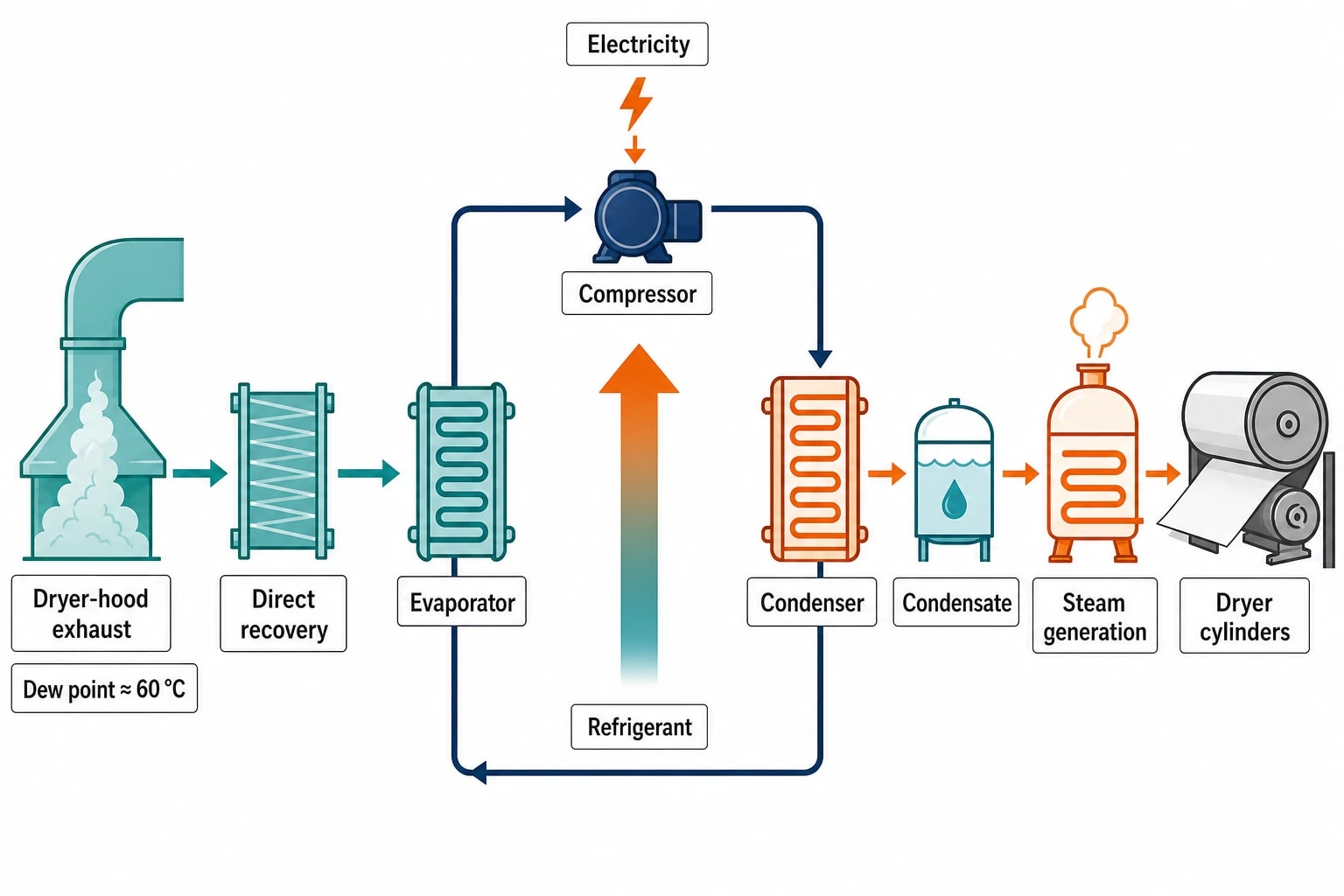
The assessment describes dryer-hood exhaust with a dew point of around 60°C and shows how recovered latent heat can evaporate a heat-pump refrigerant before the upgraded heat supports condensate evaporation and steam generation. Heat-sink temperature has a major effect on electricity consumption. A lower required steam pressure generally improves heat-pump performance.
The French TRANSPAC demonstration has operated since April 2023 at WEPA Greenfield in Château-Thierry. Its 580 kWth high-temperature heat pump used a 70 to 80°C waste-heat source to raise pulp-dryer inlet air from 97°C to 138°C. Reported measured coefficient of performance ranged from 3.6 to 4.2. This is a demonstration result under a defined duty, not a basis for assuming the same performance at another mill.
Select heat-pump duties from the grand composite curve
A heat pump belongs where the grand composite curve shows heat available below a temperature deficit and demand above it. The best candidate commonly has a narrow lift, stable source and sink temperatures, high annual operating hours and a clear reduction in marginal steam generation.
Engineers should model electricity demand alongside boiler fuel savings. They should also test the project against electricity-price scenarios, carbon factors, boiler operating mode and reduced steam export where relevant. A project that looks attractive at annual average conditions can weaken sharply if the paper machine has frequent grade changes or the source temperature falls during low-load periods.
A practical pinch-analysis programme for mill retrofits
A useful programme moves from measurement to investment decision without assuming that all theoretical recovery is buildable.
-
Define the study boundary. Include steam headers, condensate return, major hot-water loops and utility systems, not only the chosen process area.
-
Gather representative operating cases. Include major grades, annual production patterns, planned shutdowns and seasonal ambient conditions.
-
Validate stream data with operations staff. Confirm temperatures, flows, contamination, control limits and any duty that cannot be interrupted.
-
Set heat-recovery targets using composite and grand composite curves. Test more than one minimum temperature approach.
-
Develop direct process-to-process matches before evaluating heat pumps, vapour recompression or new steam generation.
-
Screen the shortlisted network for exchanger fouling, corrosion, pressure drop, water quality, cleanability, access and control stability.
-
Complete techno-economic and carbon analysis using marginal fuel and electricity assumptions. Include installation disruption and shutdown costs.
This article reflects the independent analysis and editorial opinion of EnerTherm Engineering. Product names, trademarks, and brands mentioned belong to their respective owners. EnerTherm Engineering is not affiliated with, endorsed by, or a licensee of any third-party software or product mentioned unless explicitly stated.

Managing Director — EnerTherm Engineering
Dr. François Pierrel is Managing Director of EnerTherm Engineering with over two decades of expertise in thermal design, heat transfer, and industrial energy optimisation. He holds a PhD in Heat Transfer from Cranfield University and a Post-Doctorate from Heriot-Watt University.
