Kraft Mill Pinch Analysis Finds Up to 18.5 MW Steam Savings
An operating-mill study found 5.8 MW in retrofit savings, with payback under 16 months.
Pinch analysis is a process-integration method that calculates the minimum feasible hot-utility demand of a kraft pulp mill and identifies heat-recovery changes that can displace live steam. A Chalmers study of Billerud Karlsborg, a partly integrated Swedish pulp and paper mill, found 18.5 MW of theoretical steam-saving potential, equal to 12% of its existing 153.9 MW steam demand.
The result offers a useful benchmark for energy and process-integration engineers, with an important qualification. The 18.5 MW figure is a thermodynamic target for the operating case studied, not a single retrofit opportunity or guaranteed boiler-fuel reduction. Pipework, exchanger condition, process-water quality, seasonal boiler constraints and production availability determine how much of that target can be captured.
The study shows why steam savings remain available after decades of incremental improvement. Local projects can leave live steam heating a low-temperature duty while nearby condensate, effluent or process water is cooled or discharged. Pinch analysis exposes these mismatches at mill scale and ranks practical changes.
What the 18.5 MW steam-saving target represents
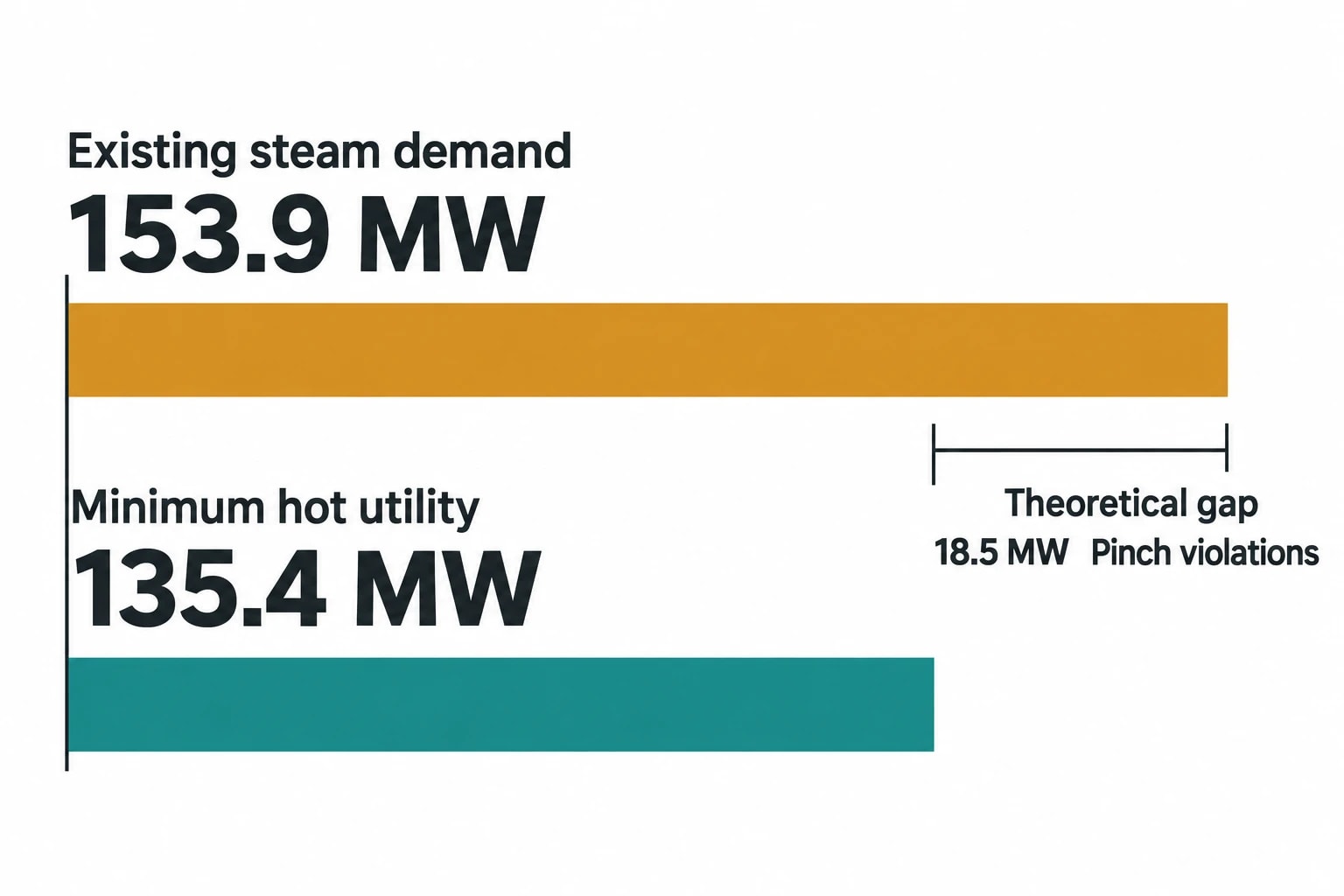
The Karlsborg study compared the existing heat-exchanger network with a pinch target derived from mill stream data. Existing steam demand was 153.9 MW and the calculated minimum hot-utility requirement was 135.4 MW. The 18.5 MW difference comprised pinch violations caused by heating below the pinch.
Heating below the pinch increases steam demand because heat is available within that temperature region. Applying live steam to a low-temperature cold stream can force additional cooling elsewhere in the network. Separate departmental balances can conceal the effect, but it becomes clear in the full mill heat cascade.
The target does not mean every violation should be eliminated. Existing heat exchangers, process constraints and new-piping costs can make part of the theoretical gap uneconomic. Its value lies in establishing the opportunity before a mill commits to individual projects.
Why kraft mills develop pinch violations
Kraft mills evolve through debottlenecking, grade changes, equipment replacements and reliability work. A new steam heater can solve an urgent production problem. A bypass may protect a control loop. A hot-water loop may be modified for a new demand. Each decision can be reasonable in isolation.
Over time, these changes can disrupt the temperature cascade. Common causes include:
- Low-pressure steam heating filtrates, white water or local loads that recovered heat could serve.
- Evaporator condensate or warm effluent sent to drain before its sensible heat is used.
- Process heat exchanged across the pinch while steam and cooling utilities operate on the wrong sides of it.
- Hot and warm water systems held below the temperature needed to remove downstream steam use.
- Heat exchangers left bypassed after process changes or fouling problems.
A site-wide pinch study provides context absent from individual steam-trap surveys or isolated exchanger upgrades.

Pinch analysis identifies the thermodynamic minimum energy requirement of your process — then designs the heat exchanger network to achieve it.
How pinch analysis identifies steam savings in a kraft pulp mill
A dependable study begins with operating data. Engineers identify hot streams requiring cooling and cold streams requiring heating, then establish supply and target temperatures, mass flow, heat-capacity flowrate, phase changes and operational variability.
The Karlsborg study considered 27 cold streams and 35 hot streams during typical winter operation. Researchers used mill data, measurements, equipment information, engineering estimates, and mass and energy balances. This approach is common in operating mills because historian values may not establish every flow, temperature or duty reliably.
Select an operating case before setting targets
A pinch target applies only to the conditions used to create it. Winter and summer conditions, reduced production and grade changes can produce different steam balances and recovery opportunities.
The Karlsborg result used typical average winter data. Engineers should not treat it as an annual average or a universal reference for other mills. A UK or EU kraft mill should normally evaluate maximum throughput, normal production, seasonal ambient conditions and major grade configurations.
A project that replaces steam during winter may yield little fuel reduction in summer if the bark boiler already operates at minimum stable load. Lower steam demand may instead release electricity-generation capacity or increase production flexibility.
Set realistic minimum temperature differences
Heat recovery needs sufficient temperature driving force for the exchanger service. Pinch analysis represents this through a minimum temperature difference, often called ΔTmin.
The Karlsborg study used stream-specific half-ΔTmin values ranging from 0.5 K for utility steam to 8 K for air. This is more credible than applying one approach temperature to every duty. Condensing steam, clean water, contaminated condensate, effluent, liquor and humid exhaust air have different heat-transfer characteristics.
Small temperature approaches can require substantial exchanger area and clean surfaces. Fouling streams, viscous liquors and air-side duties often need greater temperature differences. A study should reflect cleaning intervals, control margins, material compatibility and available plot space.
Compare the existing network with the pinch target
Composite curves combine hot and cold process streams into temperature-enthalpy profiles. Their closest permitted approach identifies the pinch. The grand composite curve indicates the temperatures at which the mill needs external heating and where heat is available.
The retrofit stage follows. Engineers compare each existing exchanger and utility heater with the pinch location, then identify changes that redirect heat from suitable sources to suitable sinks. The result should be a list of viable projects, not a theoretical redesign detached from the mill.
What the Karlsborg retrofit options achieved
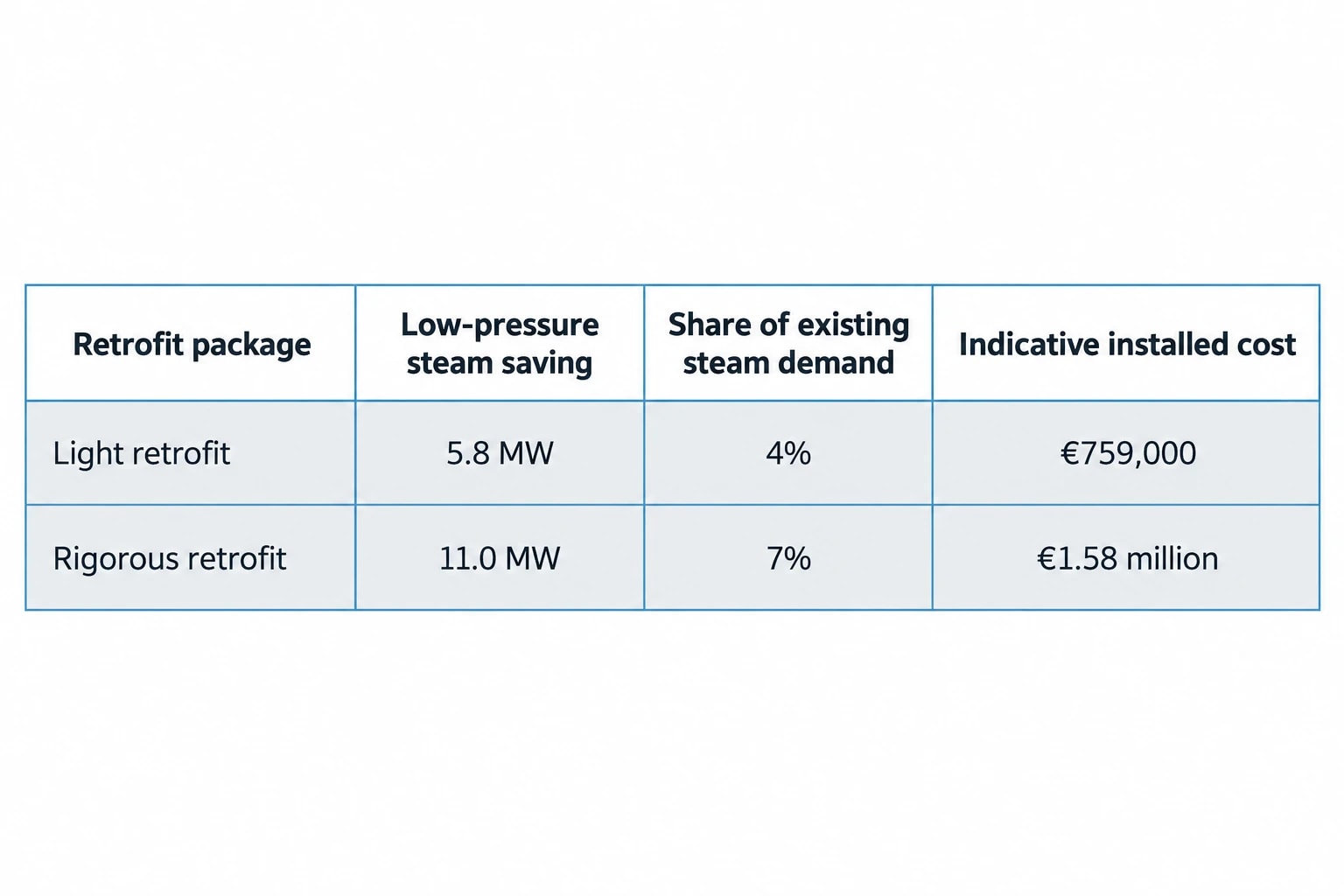
The research team developed two retrofit packages. The light retrofit avoided changes to the hot and warm water system. The more extensive option incorporated that system and required further exchanger work.
| Retrofit package | Low-pressure steam saving | Share of existing steam demand | Indicative installed cost |
|---|---|---|---|
| Light retrofit | 5.8 MW | 4% | €759,000 |
| Rigorous retrofit | 11.0 MW | 7% | €1.58 million |
The light retrofit achieved 5.8 MW of steam savings, equivalent to 32% of the identified pinch violations. It proposed using stripper condensate to heat E2 filtrate, B-condensate to heat white water for the pulp dryer and paper machine, and pulp-dryer condensate cooling for a paper-machine white-water duty.
The study estimated €130,000 per MW saved for this package, including piping. One existing exchanger could be retained; the remaining proposed exchangers were water-to-water units.
The rigorous retrofit extended the light package and reached 11.0 MW, or around 60% of the theoretical target. It included hot-water-system changes, liquor cooling, D0 filtrate heating and digester-liquor recovery. Seven further exchangers required modification or installation. Its indicated cost was €1.58 million, or €143,000 per MW saved.
The research estimated payback periods below about 16 months for both packages, using assumptions on bark price, electricity price, boiler efficiency and 8,000 annual operating hours. It also assumed steam could be saved for two thirds of the year because the bark boiler operated near minimum load during summer. These costs and paybacks are historical, site-specific estimates and should inform screening rather than form a business case for another mill.
Condensate optimisation is central to steam savings
Condensate is often treated principally as boiler-feedwater return. In pinch analysis, it is a source of sensible heat and, where pressure reduction occurs, flash steam. The priority is to recover useful heat at the highest practical temperature before condensate joins the return system.
Match hot condensate to low-temperature demands
Stripper condensate, evaporator condensate and dryer condensate can heat filtrate, white water or process water where temperatures and water quality permit. The Karlsborg proposals used these sources to replace low-pressure steam below the pinch.
The source and sink must be available at the same time. Engineers should assess flow variability, inlet temperatures, contamination risk, non-condensable gases, exchanger fouling and the effect on condensate-return hydraulics. Segregation requirements remain decisive for contaminated condensates and process streams.
Flash steam also requires a pressure-level review. A flash vessel may be correctly installed but supply a header with limited demand while another low-pressure load uses live steam. Pinch analysis can show whether the pressure cascade aligns with heating duties.
Protect hot and warm water temperatures
Hot and warm water systems connect dispersed heat sources with multiple low-temperature demands. Their tanks and loops can preserve temperature levels that individual project calculations overlook.
The Karlsborg rigorous retrofit required linked changes because extracting heat from the hot and warm water system could lower required tank temperatures. The researchers noted that several exchanger modifications should not proceed independently. A local steam saving can reappear as downstream steam demand if the project weakens the hot-water temperature cascade.
Thermal design teams should model the revised hot and warm water balance across credible operating states, including tank temperatures, mixing, pump capacity, available exchanger area, bypass arrangements and control-valve authority.

Pinch analysis identifies the thermodynamic minimum energy requirement of your process — then designs the heat exchanger network to achieve it.
Excess heat and evaporation should be assessed together
Kraft-mill water use affects heat recovery because hot-water demand can consume heat that might otherwise become available for evaporation. Chalmers research on water and heat integration found that lower hot-water consumption increased the quantity and temperature of available excess heat in an existing pulp and paper mill.
Using excess heat for evaporation reduced live-steam demand by up to 1.5 GJ per tonne of pulp in that study case. Removing pinch violations and applying remaining excess heat to evaporation increased the reported energy reduction to 4.0 GJ per tonne of pulp.
These figures are not mill benchmarks. They show that water reduction, heat-exchanger-network retrofit and evaporation integration require joint assessment. Treating them separately can divert valuable heat to a lesser duty or create a hot-water requirement that cancels the expected steam reduction.
Prioritise projects by recoverable heat quality
A sound project list ranks opportunities by more than duty in MW. Engineers should consider:
- Steam saved at the relevant header pressure.
- Temperature match and required exchanger area.
- Source availability during the cold-stream demand period.
- Fouling, corrosion and cleanability.
- Piping distance, pumping requirement and heat loss.
- Consequences for water quality, condensate systems and tank temperatures.
- Shutdown duration, isolation requirements and production risk.
This separates quick retrofits from interdependent system changes and prevents a high-duty project from displacing a more valuable source-sink match elsewhere in the mill.
Regulatory relevance for EU and UK kraft mills
For EU installations, Commission Implementing Decision 2014/687/EU, issued under the Industrial Emissions Directive 2010/75/EU, contains BAT conclusions for pulp, paper and board production, including kraft pulping.
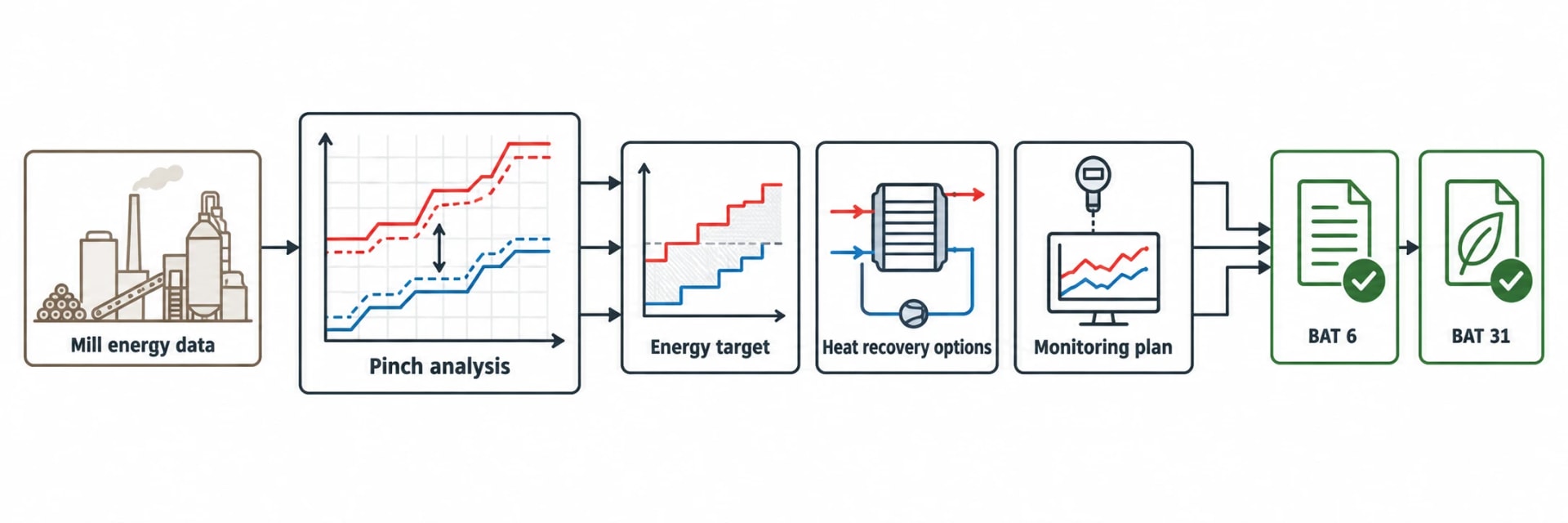
BAT 6 requires an energy-management system that assesses overall mill energy consumption and production, identifies and quantifies energy-recovery opportunities, and monitors and safeguards optimised energy conditions. Its listed measures include combined heat and power, excess-heat recovery for boiler-feedwater and process-water heating, insulation of steam and condensate pipe fittings, and matching steam pressure to actual pressure requirements.
For kraft pulping, BAT 31 identifies effective secondary heating systems, high-efficiency evaporation, recovery of low-temperature streams from effluents and other waste-heat sources, appropriate use of secondary heat and secondary condensate, process monitoring and control, and optimisation of the integrated heat-exchanger network.
Pinch analysis provides evidence for these obligations. It quantifies the gap between present energy use and an achievable target, identifies recovery options and supports monitoring plans that test whether savings persist. UK mills should assess their environmental-permit requirements and relevant regulator guidance.
Turning a pinch target into sustained steam reduction
A pinch study should initiate a controlled retrofit programme. Stream data requires maintenance as production rates, water use, process equipment and utility arrangements change. Without that discipline, new steam heaters and exchanger bypasses can reintroduce pinch violations.
Commissioning plans should monitor steam-header flow, pressure and temperature alongside production rate. They should also track source and sink temperatures, condensate flows, exchanger differential pressure, control-valve position and bypass use. Comparing normalised operating cases is more meaningful than comparing daily steam totals with different production loads.
This article reflects the independent analysis and editorial opinion of EnerTherm Engineering. Product names, trademarks, and brands mentioned belong to their respective owners. EnerTherm Engineering is not affiliated with, endorsed by, or a licensee of any third-party software or product mentioned unless explicitly stated.

Managing Director — EnerTherm Engineering
Dr. François Pierrel is Managing Director of EnerTherm Engineering with over two decades of expertise in thermal design, heat transfer, and industrial energy optimisation. He holds a PhD in Heat Transfer from Cranfield University and a Post-Doctorate from Heriot-Watt University.
