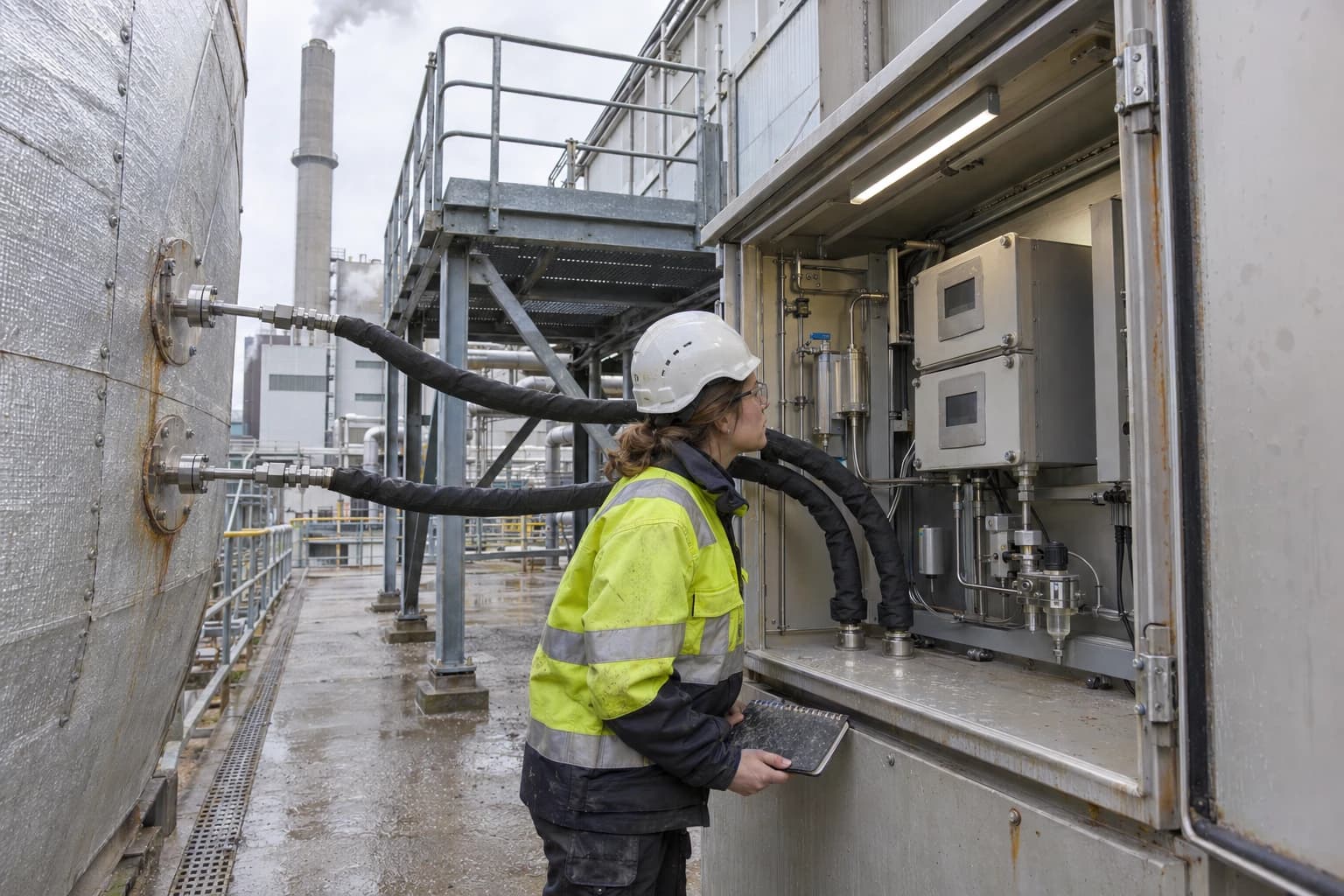
EU ETS Compliance for Paper Mills: 31 March Reporting
Emissions reports are due by 31 March; allowances follow by 30 September.
For emissions released during 2026, an EU ETS paper-mill operator must submit a verified Annual Emissions Report by 31 March 2027 and surrender allowances equal to verified emissions by 30 September 2027. These duties sit at the centre of EU ETS compliance for paper mills, regardless of free allocation, fuel mix or corporate sustainability reporting.
A late or poorly evidenced report can obstruct allowance transfers, expose weaknesses in the monitoring plan and complicate the surrender calculation. Directive 2003/87/EC provides for an excess-emissions penalty of €100 per tonne of CO₂e, indexed for inflation, while the operator remains liable to surrender the missing allowances.
For mill environmental managers, the reporting date should mark the end of a controlled annual process. That process begins with a defined installation boundary, an approved monitoring plan and reliable evidence from every emissions source.
Which paper mills are covered by EU ETS compliance?
EU ETS Annex I covers the production of pulp from timber or other fibrous materials. It also covers paper or cardboard production with a capacity exceeding 20 tonnes per day.
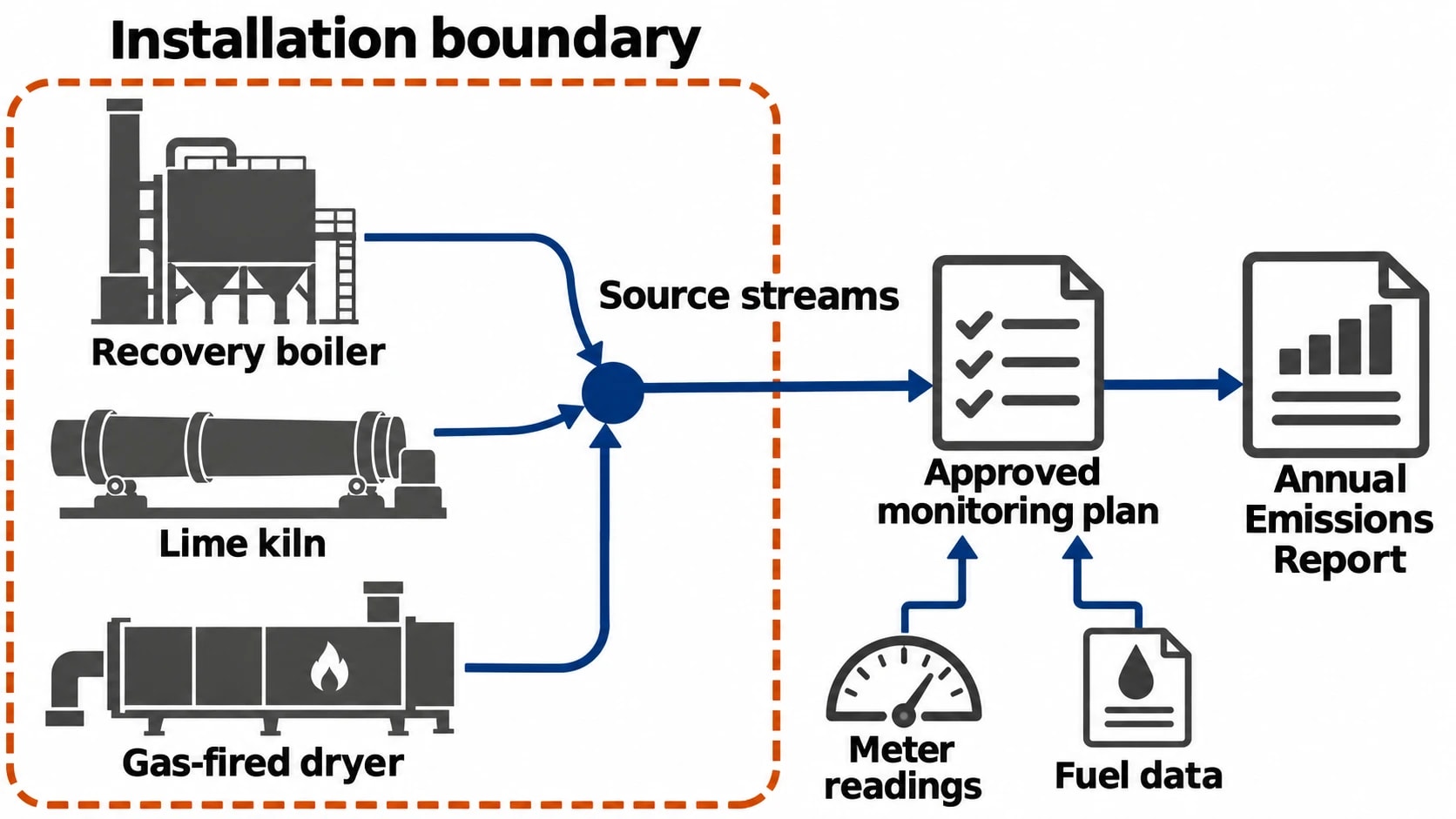
The greenhouse gas emissions permit and approved monitoring plan establish the installation boundary. They identify the relevant emission sources, source streams, monitoring methods, calculation factors, instruments, data-flow procedures and control activities.
A corporate energy dashboard, utility invoice or production department structure cannot replace the permitted installation boundary. Reporting staff should use the monitoring plan as the working map for the Annual Emissions Report.
Establish the real emissions boundary
A pulp and paper installation can include several reportable combustion sources, including recovery boilers, lime kilns, auxiliary boilers, combined heat and power plant, gas-fired dryers and standby plant.
Integrated mills need particular discipline where utilities serve more than one production area. Fuel data, stock movements and meter readings must reconcile with the source streams in the approved monitoring plan. A temporary boiler, fuel change or meter replacement can create a material evidence gap if the reporting team discovers it only during verification.
The verified emissions total is an EU ETS compliance figure. It follows the permit, monitoring plan and Monitoring and Reporting Regulation. It has a different purpose from a corporate Scope 1 and 2 inventory.
Biomass evidence requires early scrutiny
Pulp and paper mills often use black liquor, bark, wood residues and purchased biomass fuels. Biomass use can materially affect reported emissions, but commercial descriptions such as renewable fuel or waste wood do not determine EU ETS treatment.
The Monitoring and Reporting Regulation, as amended by Commission Implementing Regulation (EU) 2024/2493, includes requirements relevant to biomass sustainability evidence and zero-rated fuels. Operators should retain supplier declarations, delivery records, weighbridge data, fuel analyses and supporting sustainability documentation where applicable.
Fuel procurement teams should alert the EU ETS lead before introducing a new biomass source or changing supplier. This allows the mill to establish the evidence route before the first delivery enters the annual data set.

Identify where your plant is losing energy and quantify the savings potential — our audits map every heat source, sink, and waste stream in your facility.
What must the Annual Emissions Report demonstrate?
Commission Implementing Regulation (EU) 2018/2066 requires a verified report covering annual emissions in the reporting period. The verifier examines whether the report conforms with the monitoring plan, applicable regulation and the operator’s procedures.
The report must provide a traceable route from primary operating records to the emissions total. A spreadsheet total without an auditable trail creates avoidable verification work.
Build the evidence file by source stream
A well-prepared reporting file groups evidence by source stream, fuel and reporting period. It allows a verifier to trace fuel quantities, calculation factors and reported emissions without relying on informal explanations from individual employees.
The core evidence pack should include:
- The current approved monitoring plan and records of material changes.
- Fuel invoices, delivery notes, tank or silo inventories, and stock reconciliations.
- Meter readings, data exports, calibration certificates and maintenance records.
- Fuel sampling plans, laboratory results and applied calculation factors.
- Production, outage and operating records explaining significant changes in consumption.
- Biomass sustainability evidence and records supporting any zero-rated fraction.
- Data-gap records, conservative estimates, corrections and management review.
- Previous verification findings and evidence of corrective action.
The Monitoring and Reporting Regulation requires operators to retain relevant data and information for at least 10 years. Orderly archiving protects the mill when a regulator, verifier or internal reviewer needs to reconstruct a historic calculation.
Control the route from meter to report
The principal reporting risk often sits between the original record and the final Annual Emissions Report. A monthly workbook may combine fuel deliveries with consumption. A stock calculation may be overwritten after a shutdown. An automatic meter export may change following an instrument replacement.
Written data-flow procedures should identify every step, the responsible person, the review point and the evidence retained. Useful controls include monthly fuel reconciliations, review of unexplained consumption variance, version control for calculation files and independent checks before report submission.
Data gaps also need contemporaneous records. The Monitoring and Reporting Regulation sets out rules for conservative estimation where data are missing. A documented incident, prompt remedial action and transparent estimation method are easier for a verifier to assess than an unexplained adjustment made late in the reporting cycle.
Free allocation and the 2026 to 2030 paper benchmarks
Paper and board manufacturing appear on the EU carbon-leakage list for 2021 to 2030. The listing affects eligibility for free allocation, but does not remove the requirement to measure emissions accurately or surrender allowances against the verified total.
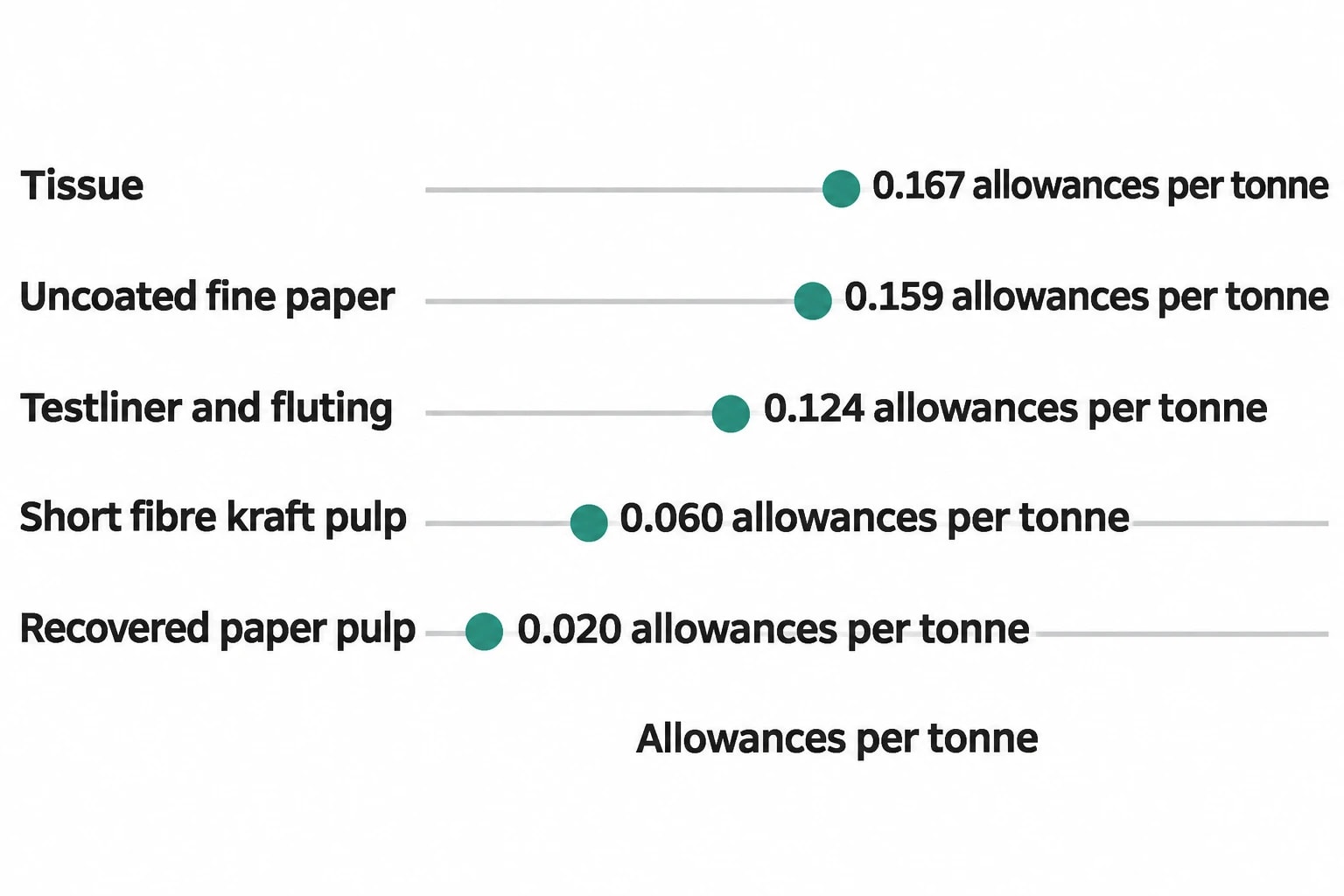
Commission Implementing Regulation (EU) 2026/1412 sets revised product benchmark values for the 2026 to 2030 allocation period. Product definitions and system boundaries remain those in Commission Delegated Regulation (EU) 2019/331.
For a product-benchmark sub-installation, free allocation is based on eligible production data and the relevant benchmark value, subject to the allocation rules that apply to the installation.
Paper and pulp benchmark values
| Product benchmark | Allowances per tonne, 2026 to 2030 |
|---|---|
| Short fibre kraft pulp | 0.060 |
| Long fibre kraft pulp | 0.040 |
| Sulphite pulp, thermo-mechanical and mechanical pulp | 0.010 |
| Recovered paper pulp | 0.020 |
| Newsprint | 0.149 |
| Uncoated fine paper | 0.159 |
| Coated fine paper | 0.159 |
| Tissue | 0.167 |
| Testliner and fluting | 0.124 |
| Uncoated carton board | 0.119 |
| Coated carton board | 0.137 |
A benchmark is not a mill-specific emissions target. It is a free-allocation parameter derived from the performance of the 10% most efficient installations for that product.
Mill teams should keep three figures separate:
- Verified installation emissions.
- Product output and activity data used for allocation.
- The allowance balance after free allocation, allowance holdings and planned purchases.
Combining these figures into one unqualified “carbon position” can conceal a shortage. A mill can reduce emissions while receiving fewer free allowances after an output change. Increased production may also raise fuel use faster than the free-allocation adjustment takes effect.

Identify where your plant is losing energy and quantify the savings potential — our audits map every heat source, sink, and waste stream in your facility.
How activity-level changes affect free allocation
The 15% threshold is neither a universal production trigger nor a single-year test. Commission Implementing Regulation (EU) 2019/1842 applies allocation adjustments where the rolling average of two years of the relevant activity level changes by more than 15% against the activity level used to determine the initial allocation for a sub-installation.
The adjustment applies from the year following the two years used to determine the change. Further adjustments within an allocation period follow additional 5% interval rules after an initial adjustment.
Treat activity data as a compliance record
For a paper mill, the relevant activity level depends on the sub-installation and allocation methodology. Product output, measurable heat, fuel use and process emissions may each have a role under the free-allocation rules.
A sustained change in tissue demand, packaging-board output, machine capacity or production configuration can affect allocation. An extended outage may also matter. Environmental managers should involve production planning, finance and technical teams before a grade switch, rebuild or capacity reduction becomes operational.
The activity-level report should reconcile to production records, dispatch records, quality systems and other sources used to substantiate output. The same discipline is needed where one site produces several benchmarked grades.
Managing allowance exposure after verification
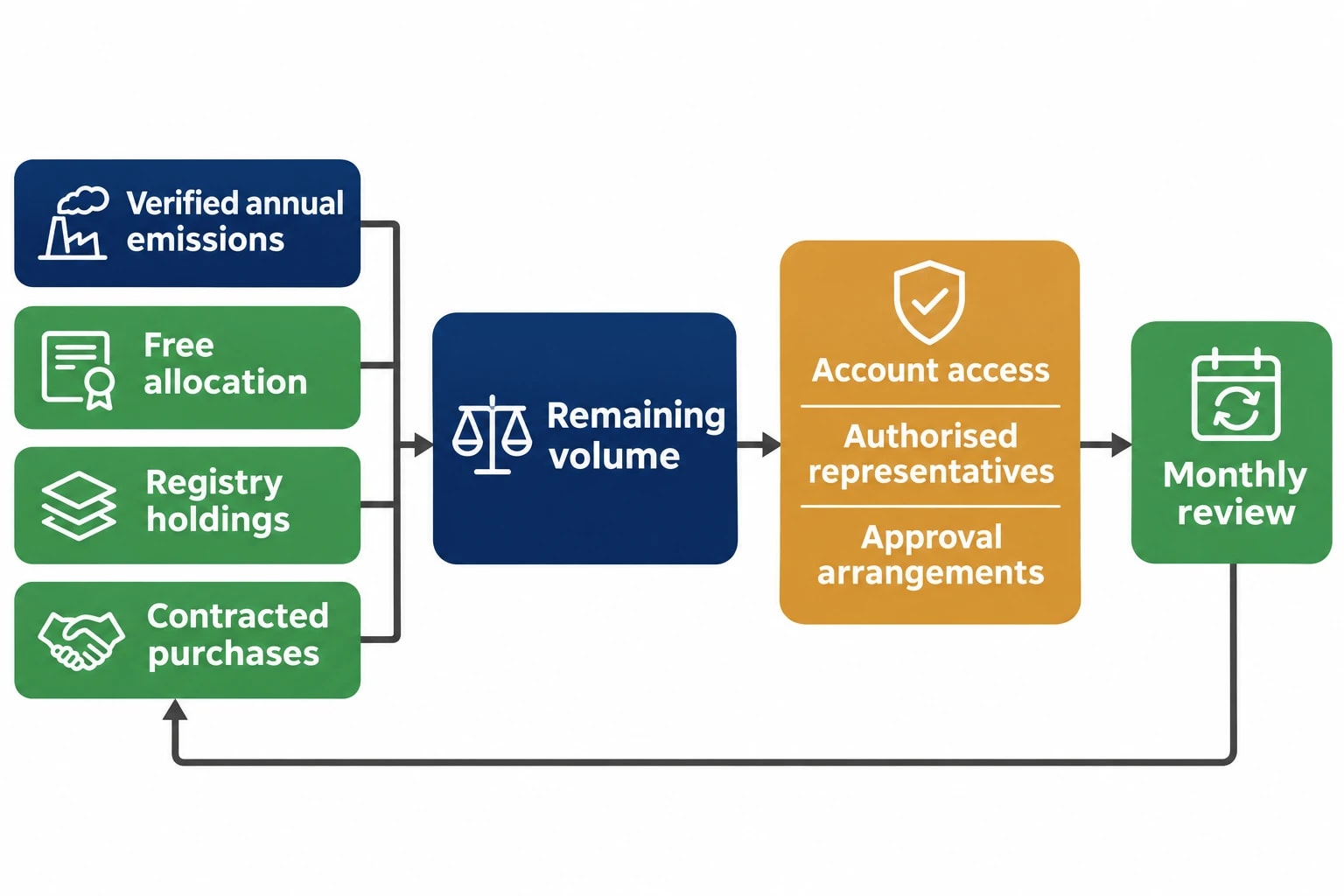
Verification fixes the annual emissions figure that underpins allowance surrender. The period between report submission and surrender should confirm that registry holdings and procurement arrangements match the verified obligation.
The compliance lead needs a controlled allowance forecast showing:
- Verified annual emissions.
- Free allocation issued or expected.
- Allowances held in the Union Registry.
- Contracted allowance purchases and settlement timing.
- The remaining volume requiring action.
- Registry account access, authorised representatives and approval arrangements.
Registry administration needs routine testing. A mill can hold enough allowances economically while still facing an operational problem if authorised representatives, account access or internal approval routes are unavailable when a transaction is required.
A practical monthly compliance review
A monthly review gives the reporting team time to correct issues while primary records remain accessible. It should cover fuel consumption, stock reconciliations, production output by benchmark category, biomass documentation, calibration status, data gaps, monitoring-plan changes and the forward allowance position.
The environmental manager should own the integrity of the EU ETS record. Operations should explain process changes. Procurement should provide fuel and biomass evidence. Finance should maintain the allowance position and transaction controls. Clear ownership prevents a fuel change, stock adjustment or production shift from becoming a late verification issue.
A note for UK-based paper groups
The EU ETS dates and allocation rules in this article apply to EU ETS installations. The UK ETS replaced UK participation in the EU ETS on 1 January 2021 and has separate compliance requirements. UK groups with EU installations should maintain distinct compliance calendars, permits, allowance accounts and reporting files for each scheme.
This article reflects the independent analysis and editorial opinion of EnerTherm Engineering. Product names, trademarks, and brands mentioned belong to their respective owners. EnerTherm Engineering is not affiliated with, endorsed by, or a licensee of any third-party software or product mentioned unless explicitly stated.

Managing Director — EnerTherm Engineering
Dr. François Pierrel is Managing Director of EnerTherm Engineering with over two decades of expertise in thermal design, heat transfer, and industrial energy optimisation. He holds a PhD in Heat Transfer from Cranfield University and a Post-Doctorate from Heriot-Watt University.
