Thermal Engineering for Paper Manufacturing: 7 Audit Steps
A BAT-aligned audit targets dryer steam demand, condensate losses and heat recovery.
Thermal engineering for paper manufacturing is the systematic measurement and optimisation of heat, steam, condensate, drying air and electrical loads to reduce energy use while protecting paper-machine output and quality.
Drying accounts for about 70% of the energy used in papermaking, making the dryer section the first place most mills should look for savings. A 2026 study of packaging-paper drying found that a high-temperature heat-pump configuration using moist dryer exhaust as its heat source reduced modelled drying energy from 960 to 276 kWh per tonne of paper. That result is site-specific, but it shows why a disciplined thermal audit matters.
A paper machine cannot be treated as a collection of isolated utilities. Steam pressure affects cylinder surface temperature. Condensate removal affects heat transfer. Hood exhaust affects evaporative capacity. Dewatering ahead of the dryer affects all of them. A useful audit follows energy from fuel and electricity inputs to each tonne of saleable paper, then tests which losses can be removed without destabilising the web.
Commission Implementing Decision 2014/687/EU frames this work clearly for EU mills. Its BAT conclusions call for reduced steam demand, maximum benefit from energy carriers and lower electricity consumption. The Pulp, Paper and Board BREF covers integrated and non-integrated installations, including paper or cardboard production above 20 tonnes per day.
Step 1: Define the production and energy baseline
Establish a representative operating window
The audit starts with a focused discussion between production, maintenance, engineering and energy teams. The aim is to select a representative grade, basis-weight range and operating period. A week with frequent breaks, unusual furnish, a shutdown or a temporary boiler constraint can produce misleading conclusions.
Record the boundaries before measurements begin:
- Paper-machine production rate, grade, basis weight and reel moisture
- Incoming stock consistency and dry-content profile through pressing
- Steam supplied to dryer groups and hood systems
- Electricity supplied to refiners, vacuum systems, pumps, fans and drives
- Fuel, purchased steam, CHP output and exported heat where applicable
- Water use, effluent temperature and condensate return
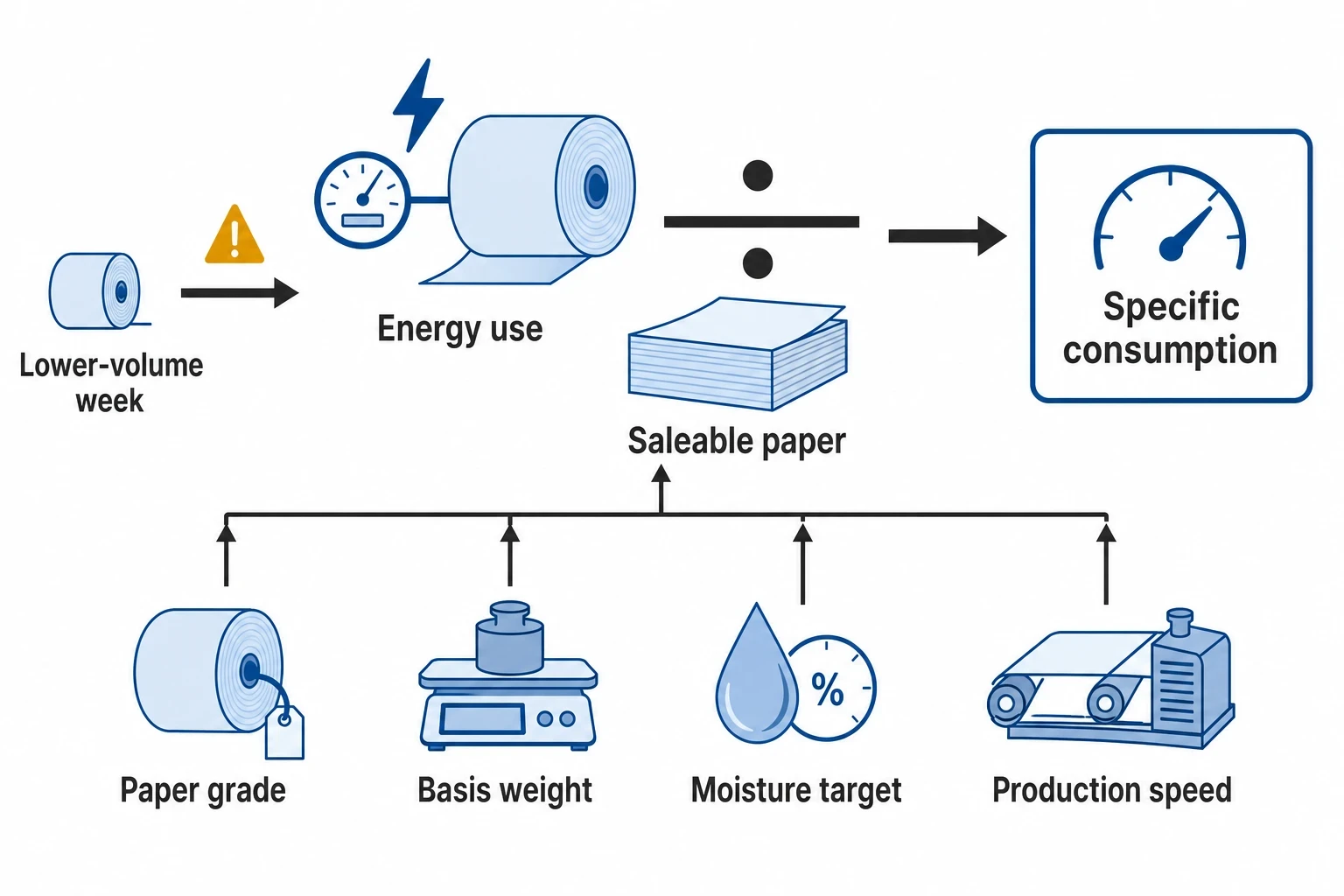
The core metrics should be specific rather than absolute. Track kWh per tonne of saleable paper, tonnes of steam per tonne, condensate-return temperature and dryer-section electricity per tonne. Where output varies substantially, normalise the baseline for paper grade, basis weight, moisture target and production speed.
This prevents a familiar error: declaring a saving because gas use fell during a lower-volume week. Specific consumption separates production variation from process performance.
Turn operating knowledge into testable questions
The first meeting should identify constraints as well as opportunities. A tissue machine, packaging-paper machine and board machine have different steam profiles, hood arrangements and quality sensitivities. The audit team should ask focused questions:
- Which dryer groups limit speed or moisture control?
- Are operators regularly throttling steam, venting flash steam or bypassing condensate equipment?
- Do sheet breaks rise when hood pressure, steam pressure or vacuum changes?
- Which loads run at fixed speed despite variable production?
- What heat sources and sinks already exist on site?
The answers shape the measurement plan and stop the audit becoming a generic utility survey detached from paper-machine behaviour.
Identify where your plant is losing energy and quantify the savings potential — our audits map every heat source, sink, and waste stream in your facility.
Step 2: Map heat, steam and water through the paper machine
Build the thermal balance around the dryer section
A paper-machine dryer section converts a wet web into a product at controlled moisture. Steam-heated cylinders transfer heat through the sheet, while the hood removes evaporated water. The audit must map both sides of that duty.
Start at the steam header and identify pressure levels, pressure-reducing stations, dryer groups, separators, steam traps, condensate receivers, flash tanks and return lines. Record the intended sequence of dryer-cylinder pressures against the actual pressures observed in operation. A pressure profile that has drifted over time can consume extra steam while making moisture control less stable.
Then map the air side. Measure supply-air temperature, hood exhaust temperature, humidity or dew point, airflows where practicable, hood pressure and ventilation-fan power. Moist dryer exhaust often contains recoverable low-temperature heat. Its practical value depends on fouling risk, source temperature, the available sink, operating hours and the effect on hood balance.
The water-energy connection deserves equal attention. Mechanical dewatering removes water far more cheaply than thermal evaporation. Poor press performance, excess dilution water or ineffective vacuum control can therefore increase dryer steam demand long before the web reaches the first cylinder.
Identify the heat cascade
The BREF identifies recovery and use of low-temperature streams from effluent and other waste-heat sources for building, boiler-feedwater and process-water heating as BAT techniques. An audit should establish the temperature and timing of each source and sink before proposing a heat exchanger or heat pump.
Typical audit questions include whether:
- Secondary condensate can preheat process water or boiler feedwater.
- Flash steam can serve a useful low-pressure duty.
- Dryer-exhaust heat can preheat incoming air or water.
- Warm effluent has a viable, cleanable heat-recovery route.
- High-grade steam is being reduced for a duty that can use lower-pressure steam.
Thermal engineering then moves beyond a list of leaks and insulation defects. It establishes whether the mill uses its available temperature levels in the right order.
Step 3: Measure the plant under normal production conditions
Use portable instrumentation without interrupting production
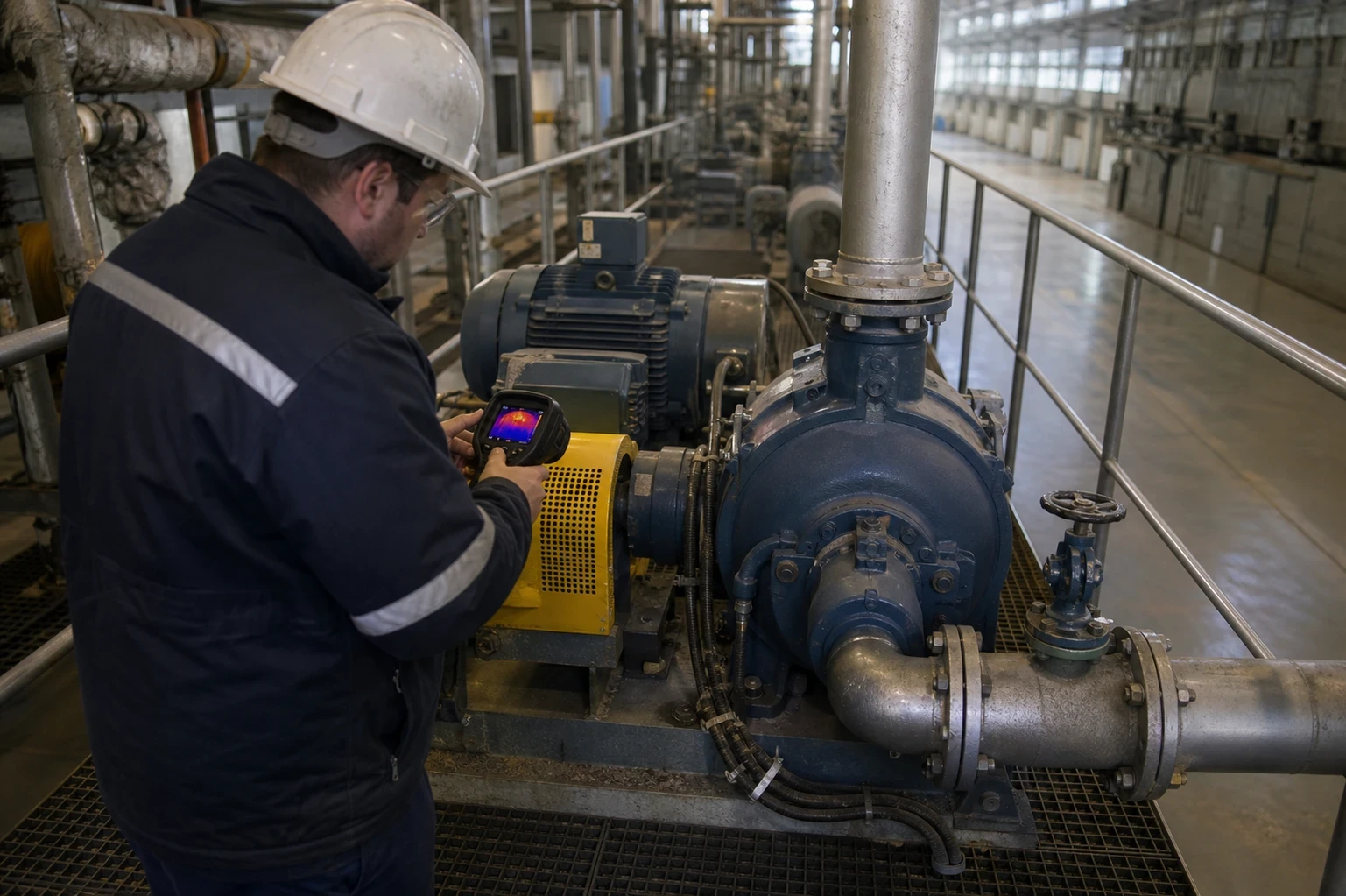
On-site work should take place during stable production wherever possible. Portable power analysers reveal true electrical demand, load factor, power quality and motor duty on refiners, pumps, vacuum equipment and fans. Ultrasonic leak detectors locate compressed-air and steam leaks that may be inaudible in a noisy machine hall. Thermal imaging identifies damaged insulation, overheated bearings, blocked strainers, uneven dryer surfaces and abnormal heat loss.
For thermal systems, the audit should combine instrument readings with operating data from the control system. Useful measurements include steam pressure and temperature, condensate temperature, flash-tank conditions, differential pressure across equipment, stack or exhaust temperatures, fan power, water flow and conductivity where relevant.
One reading is rarely enough. Record trends through grade changes, speed changes and normal load variation. A steam valve that appears nearly closed at one point may cycle widely over an hour. A vacuum pump that seems fully loaded may be responding to a short-lived break condition.
Check data quality before drawing conclusions
Measurement errors can send a project in the wrong direction. The audit should document instrument range, calibration status, sampling interval, sensor location and assumptions used to reconcile readings.
Compare the measured thermal balance with invoices, boiler data, steam-flow totals and production records. Material disagreements are findings in their own right. They may indicate missing meters, failed sensors, unmeasured vent losses, bypassed condensate returns or inconsistent production reporting.
This discipline also supports ISO 50001:2018, which provides a framework for systematic energy-performance improvement. A mill does not need a certification project to benefit from the same habits: defined energy-performance indicators, reliable baselines, assigned responsibilities and regular review.
Step 4: Diagnose dryer-section steam and condensate losses
Focus on heat transfer, not steam pressure alone
High steam consumption does not automatically mean that the steam-header pressure is too high. The dryer section needs the correct cylinder-temperature profile for the grade, web moisture and running speed. The audit must establish whether steam reaches the cylinders at the intended condition, whether condensate drains freely and whether the hood can remove the resulting vapour.
Poor condensate management reduces heat transfer and can create unstable dryer temperatures. Typical symptoms include moisture variation, steam-valve hunting, elevated differential pressure, water hammer, noisy drainage, excess blow-through and uneven cylinder temperatures. These symptoms often overlap, so the audit should examine the complete steam and condensate circuit rather than replacing traps on an arbitrary schedule.
Inspect separator performance, trap discharge, return-line back pressure, flash-tank operation, vents and pump capacity. Determine whether flash steam has a valid destination or escapes unused. Verify that condensate returns at the expected temperature and quantity. Hot condensate discharged to drain represents both lost heat and unnecessary treated-water demand.
Examine pressure control by dryer group
The audit should compare steam pressure with production conditions and outlet moisture. Steam-reduction valves can cause avoidable throttling losses when the site has usable lower-pressure heat sinks or a poorly matched steam hierarchy.
Pressure control should support the drying curve, not merely maintain a header setpoint. In practice, this means checking:
- Dryer-group pressure setpoints against grade recipes
- Valve authority and control stability
- Steam quality at the point of use
- Differential pressure through condensate systems
- Cross-connections between pressure levels
- Operator workarounds, manual valves and bypasses
Commission Implementing Decision 2014/687/EU lists appropriate secondary heat and secondary condensate use, advanced process monitoring and control, and optimised heat-exchanger networks among the techniques used to reduce thermal energy demand.

Identify where your plant is losing energy and quantify the savings potential — our audits map every heat source, sink, and waste stream in your facility.
Step 5: Audit refiners, pumps, vacuum systems and fans
Link electrical load to process demand
Thermal engineering for paper manufacturing includes electrical loads that change water removal, air movement and stock preparation. Refiners influence fibre development and drainage. Pumps determine water and stock circulation. Vacuum equipment affects press-section dewatering. Hood and ventilation fans govern moisture removal from the dryer section.
The correct question is not whether a motor is large. It is whether the process receives the flow, pressure, vacuum or refining intensity required for the product at minimum energy use.
Trend power against production rate, grade and process variables. A pump operating against a throttled valve, a fan held at fixed speed or a vacuum system controlled by leakage can consume unnecessary electricity for years without appearing as a fault in routine maintenance.
Prioritise controllable losses
Potential measures may include variable-speed control where the process range permits it, impeller trimming after duty verification, repairing vacuum and compressed-air leaks, cleaning heat-exchanger surfaces, correcting pump selection and improving refiner control. Each measure needs a process owner and a test plan.
The audit should avoid blanket recommendations. Reducing hood-fan speed, for example, can save electricity but may reduce evaporative capacity, raise hood pressure or affect sheet moisture. A valid recommendation specifies the operating envelope, control signal, expected saving and quality safeguard.
Step 6: Test heat recovery, CHP and electrification options
Match each option to the mill’s real temperature levels
Heat-recovery measures should follow verified heat balances. Plate, tubular or indirect heat exchangers may suit clean streams, while fouling, corrosion, fibre carryover and cleaning access can rule out an apparently attractive duty. The business case must include availability, maintenance requirements, pressure drop, water quality and production risk.
CHP assessment should examine the actual steam-demand profile, electrical demand, fuel position, maintenance condition and heat use across seasons. A high electrical output has limited value if low-grade heat is rejected or steam demand collapses during outages and grade changes.
High-temperature heat pumps are a growing option where a reliable waste-heat source and appropriate heat sink exist. The 2026 packaging-paper study modelled moist dryer exhaust as an evaporator heat source. Its best configuration reported a total coefficient of performance of up to 2.8 and lower emissions of up to 94 kgCO₂ per tonne of paper against its gas-boiler reference case.
Those figures do not transfer automatically to another mill. Steam pressure, steam temperature, exhaust dew point, electricity source, operating hours and remaining hood heat demand determine the result. The study itself found lower performance for tissue production at higher steam conditions. Site measurements must therefore precede equipment selection.
Build a decarbonisation sequence
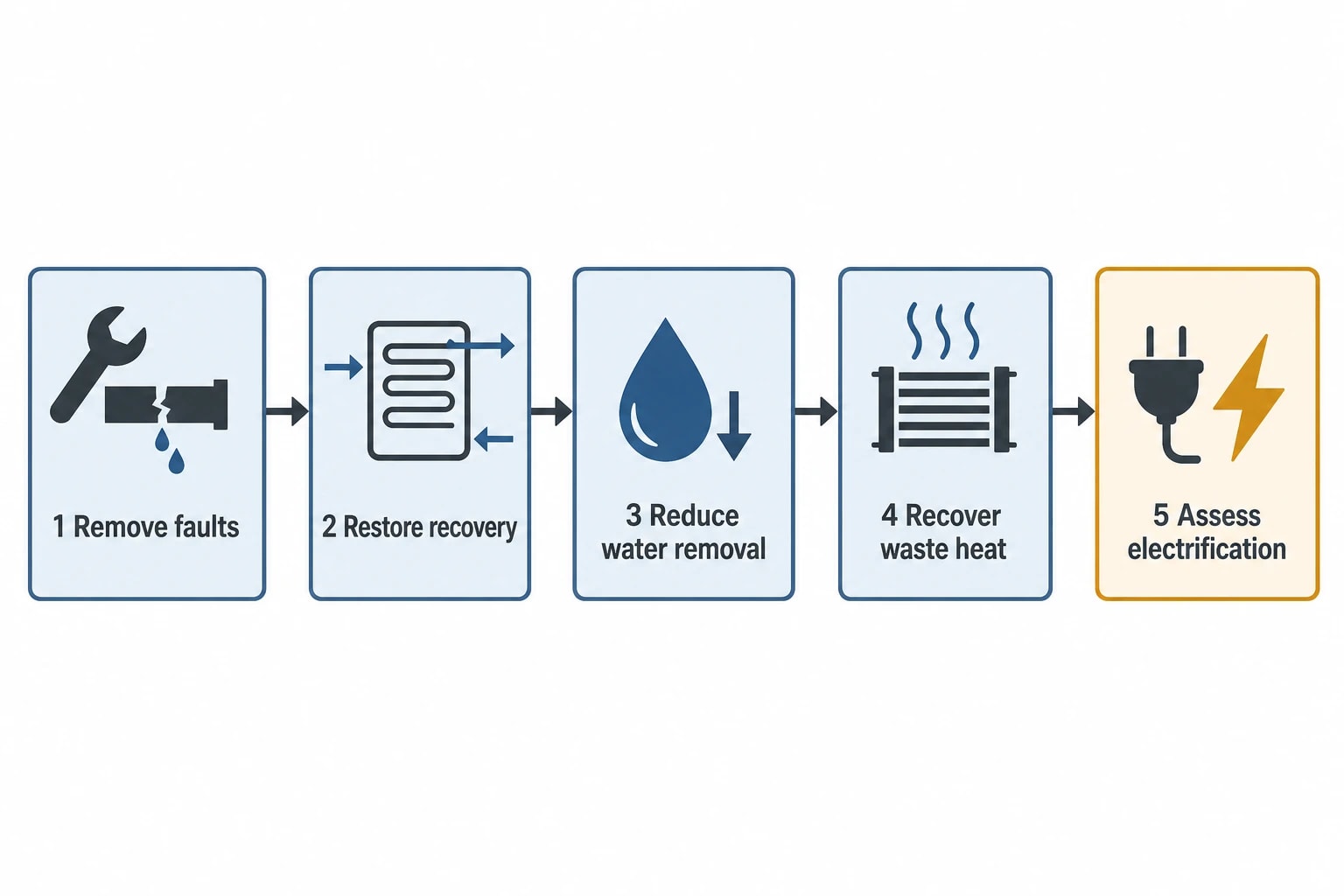
A sensible thermal roadmap usually ranks measures in this order:
- Remove leaks, bypasses, failed insulation and avoidable throttling.
- Restore condensate recovery, steam control and heat-exchanger performance.
- Reduce water-removal duty through better dewatering and process control.
- Recover waste heat into verified nearby sinks.
- Assess fuel switching, CHP changes or high-temperature heat pumps for the remaining heat demand.
This sequence reduces the size and cost of later capital projects. It also protects the case for electrification from inflated baseline demand.
Step 7: Convert findings into verified investment decisions
Rank measures by operational and financial value
The final audit report should give engineering managers a decision-ready register rather than a long list of ideas. Each conservation measure should state the present condition, proposed change, production dependency, estimated energy and carbon effect, capital cost, maintenance impact, implementation window and verification method.
A practical prioritisation table distinguishes quick operational actions from projects requiring planned shutdowns or detailed design.
| Measure type | Typical evidence | Delivery route |
|---|---|---|
| Steam and air leak repair | Ultrasonic survey, temperature readings, flow data | Maintenance work order |
| Condensate-system correction | Pressure trends, trap inspection, flash balance | Engineering project |
| Pump or fan optimisation | Power analysis, flow and pressure measurements | Controlled production trial |
| Heat recovery | Source and sink temperature profiles, fouling assessment | Feasibility and design study |
| High-temperature heat pump | Heat balance, electrical capacity, emissions scenario | Front-end engineering assessment |
Financial assessment should use the mill’s current energy prices, operating hours and maintenance assumptions. Board-level papers should make clear which savings are measured, which are calculated and which depend on production conditions or future energy tariffs.
Verify savings with IPMVP
The International Performance Measurement and Verification Protocol provides a recognised structure for turning a project estimate into a credible result. For a discrete pump, fan or refiner measure, isolated metering may suit the project. For a dryer-section or steam-system programme, whole-facility analysis with adjustments for tonnes, grade, moisture and weather may be more appropriate.
The measurement and verification plan should be agreed before implementation. Define the baseline period, production variables, meter points, calculation method, reporting frequency and responsibility for reviewing deviations. Track specific energy alongside product quality, web breaks and machine speed. A claimed saving that harms output or moisture stability is not a successful thermal project.
For UK ETS participants, the audit dataset should also remain consistent with the site’s approved monitoring and reporting arrangements. The Department for Energy Security and Net Zero provides current technical guidance on monitoring, uncertainty assessments, activity-level data and verification. Aligning energy-audit metering with those controls reduces duplication and gives carbon reporting a firmer operational basis.
This article reflects the independent analysis and editorial opinion of EnerTherm Engineering. Product names, trademarks, and brands mentioned belong to their respective owners. EnerTherm Engineering is not affiliated with, endorsed by, or a licensee of any third-party software or product mentioned unless explicitly stated.

Managing Director — EnerTherm Engineering
Dr. François Pierrel is Managing Director of EnerTherm Engineering with over two decades of expertise in thermal design, heat transfer, and industrial energy optimisation. He holds a PhD in Heat Transfer from Cranfield University and a Post-Doctorate from Heriot-Watt University.
