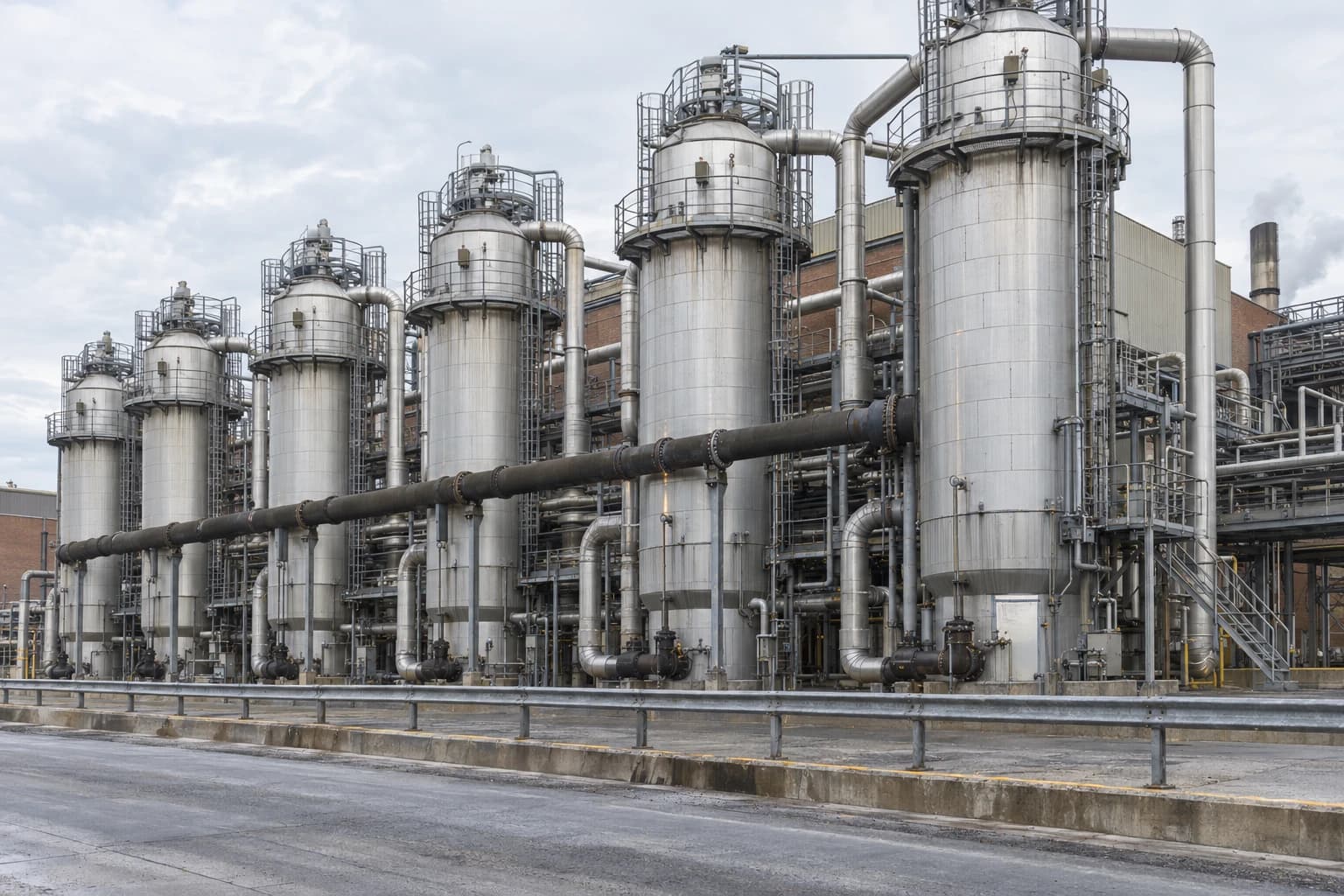
Energy Audit for Pulp and Paper Mills: 5 BAT Checks
A mill-wide audit maps steam, dryer, recovery and water-system inefficiencies.
An energy audit for pulp and paper mills is a mill-wide heat and mass-balance assessment that reconciles fibre, water, steam, condensate, fuel and electricity flows to identify verified energy losses and prioritise practical improvements. Cepi’s preliminary figures put 2025 paper and board output in member countries at 77.6 million tonnes, down 1.5% year on year, keeping pressure on mills to remove avoidable energy cost from each tonne produced.
For an integrated kraft mill, the audit boundary cannot stop at the paper machine. Black liquor evaporation affects recovery-boiler steam. Recovery-boiler operation affects turbine extraction. Turbine extraction affects dryer-cylinder pressure. Dryer condensate and hood heat affect the water system. A local project can shift heat demand or hydraulic constraints elsewhere unless the whole-mill balance captures the interaction.
That is the case for a BAT-led approach. Commission Implementing Decision 2014/687/EU sets the Best Available Techniques conclusions for pulp, paper and board production under the Industrial Emissions Directive. Its scope includes kraft pulping, papermaking and the major recovery processes that connect them. In England and Wales, paper and pulp manufacture also falls within the Environmental Permitting (England and Wales) Regulations 2016.
The following five checks turn those regulatory and technical expectations into an energy-audit programme for kraft and integrated pulp and paper mills.
1. Check black liquor solids and evaporator performance
Start at weak black liquor
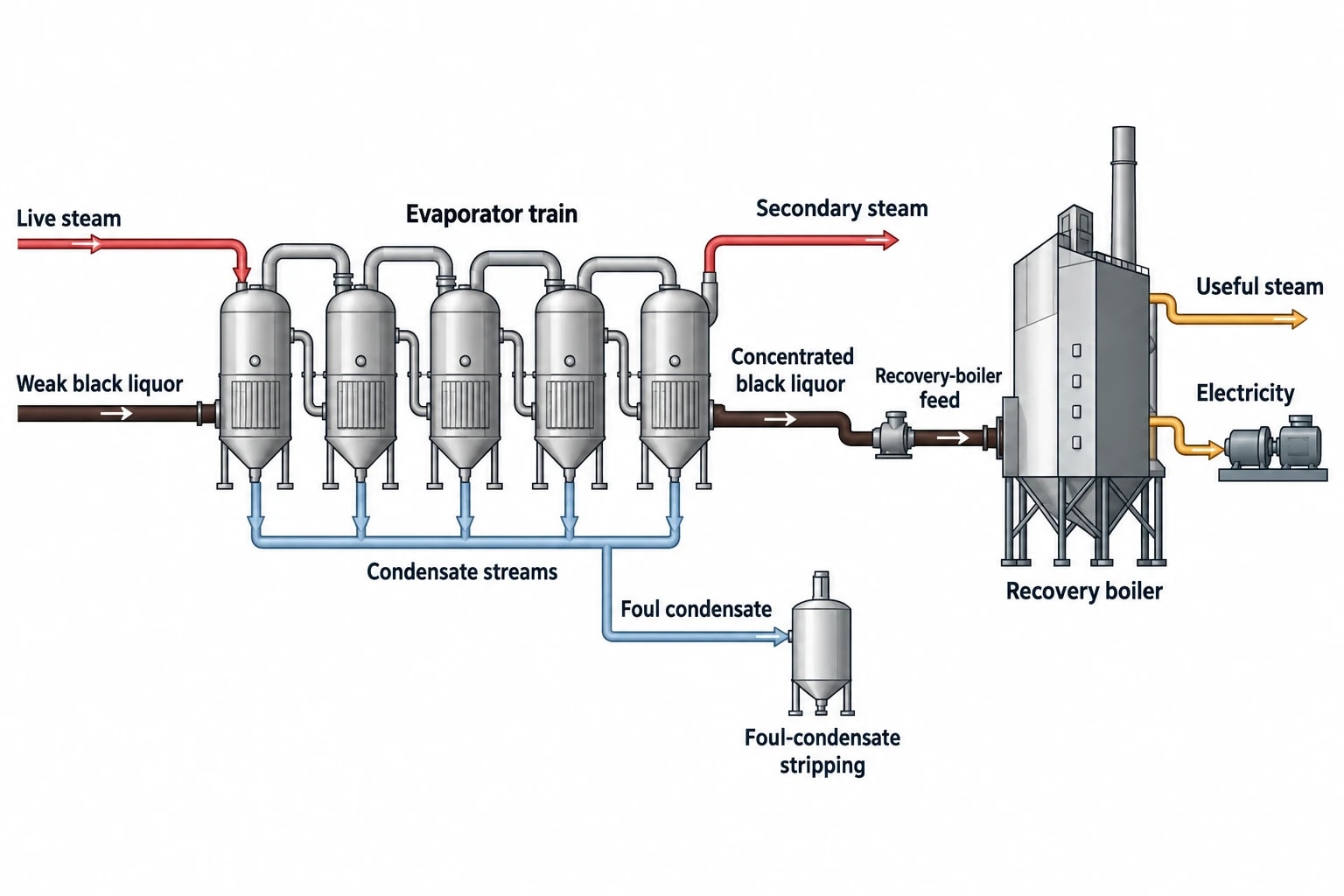
The recovery cycle often determines the energy position of an integrated kraft mill. Weak black liquor carries dissolved organics and inorganic cooking chemicals from brownstock washing to the evaporator train. The evaporators remove water before the concentrated liquor enters the recovery boiler.
The Pulp, Paper and Board BREF identifies high black-liquor dry-solids content and effective evaporation as major energy-efficiency measures. Higher solids reduce the water that the recovery boiler must evaporate, improving its ability to generate useful steam and electricity.
An audit should establish a reliable liquor balance across:
- Weak black liquor feed
- Each evaporator effect
- Concentrated black liquor
- Condensate streams
- Foul-condensate stripping
- Recovery-boiler feed
- Dissolving-tank and scrubber heat recovery where fitted
Sampling and laboratory results must match measured liquor flow. A solids result without a defensible mass flow cannot quantify the energy consequence. Equally, flow measurement without representative solids analysis can conceal a major error in the balance.
Test the evaporator train against its steam demand
A multi-effect evaporator plant should be examined as one thermal system, not as isolated vessels. Establish live-steam consumption, vapour pressures, condensate temperatures, non-condensable-gas handling and heat-transfer-surface condition. Fouling, air ingress, poor condensate removal and unstable liquor distribution can all raise steam demand.
The audit should distinguish planned operating limits from avoidable losses. Some mills deliberately run below a maximum solids target because of liquor rheology, firing stability, capacity restrictions or maintenance constraints. The right finding is not simply to increase solids. It is a quantified statement of the constraint, the energy penalty and the process change required to remove it safely.
For each operating case, record pulp production, weak-liquor solids, strong-liquor solids, evaporated water, live steam, secondary steam and recovery-boiler steam generation. This creates an auditable baseline for projects such as additional evaporator capacity, improved condensate segregation or heat-transfer cleaning.

Map every energy and material flow in your process with detailed heat and mass balance calculations — the foundation for any optimisation or design project.
2. Check recovery boiler heat recovery and steam generation
Follow the energy from liquor to headers
The recovery boiler links chemical recovery to the mill steam system. The BREF lists high black-liquor dry solids, efficient recovery boilers, feedwater preheating and recovery-boiler flue-gas heat recovery among relevant energy measures.
The audit should reconcile the boiler from liquor feed to turbine inlet. Key measurements include liquor dry-solids flow, auxiliary fuel, combustion-air temperature, flue-gas temperature, steam flow, steam pressure, feedwater temperature, blowdown and electricity generation. A sustained rise in stack temperature may indicate fouling, air leakage, heat-exchanger limitations or altered boiler operation. It requires investigation before a conclusion is drawn.
Recovery-boiler data must also be compared with production conditions. A tonne of pulp produced during stable operation may have a different energy profile from a tonne produced during a reduced-rate period, an upset or a prolonged grade transition. Normalising energy to air-dried tonnes while retaining the operating context prevents poor comparisons.
Examine secondary heat before adding steam demand
Many losses arise because usable low-temperature heat has no identified sink. The BREF describes effective secondary-heating systems with clean hot-water and condensate heat levels matched to user temperature. That principle should guide the audit.
Potential heat users include boiler feedwater, process water, building heating and selected washing duties. The technical question is whether a warm stream’s temperature, cleanliness, flow reliability and seasonal availability match a demand without creating fouling, odour, corrosion or process-quality risk.
A heat-recovery proposal should show the source, sink, temperature range, expected operating hours, control arrangement and effect on the steam system. This prevents a project from claiming savings that another part of the mill later consumes as additional live steam.
3. Check steam headers, turbines and paper-machine dryers
Reconcile every pressure level
A paper mill can have several steam headers, turbine extraction points and pressure-reduction stations. The balance must reconcile generation, imports, exports, turbine admissions, extractions, pressure reduction, process use, condensate return and identified losses at each pressure level.
Header pressures alone do not establish efficiency. The audit needs steam mass flow, temperature or quality where relevant, condensate flow and the destination of each stream. Meter drift and unmeasured bypasses often become visible when the header balance will not close.
Particular attention should go to pressure-reducing valves operating while a turbine has available extraction capacity. This may be necessary during some operating conditions, but it can also identify a missed electricity-generation opportunity. A review must respect turbine operating limits, process steam demand and electrical-export arrangements.
Assess dryer-section steam and condensate as one system
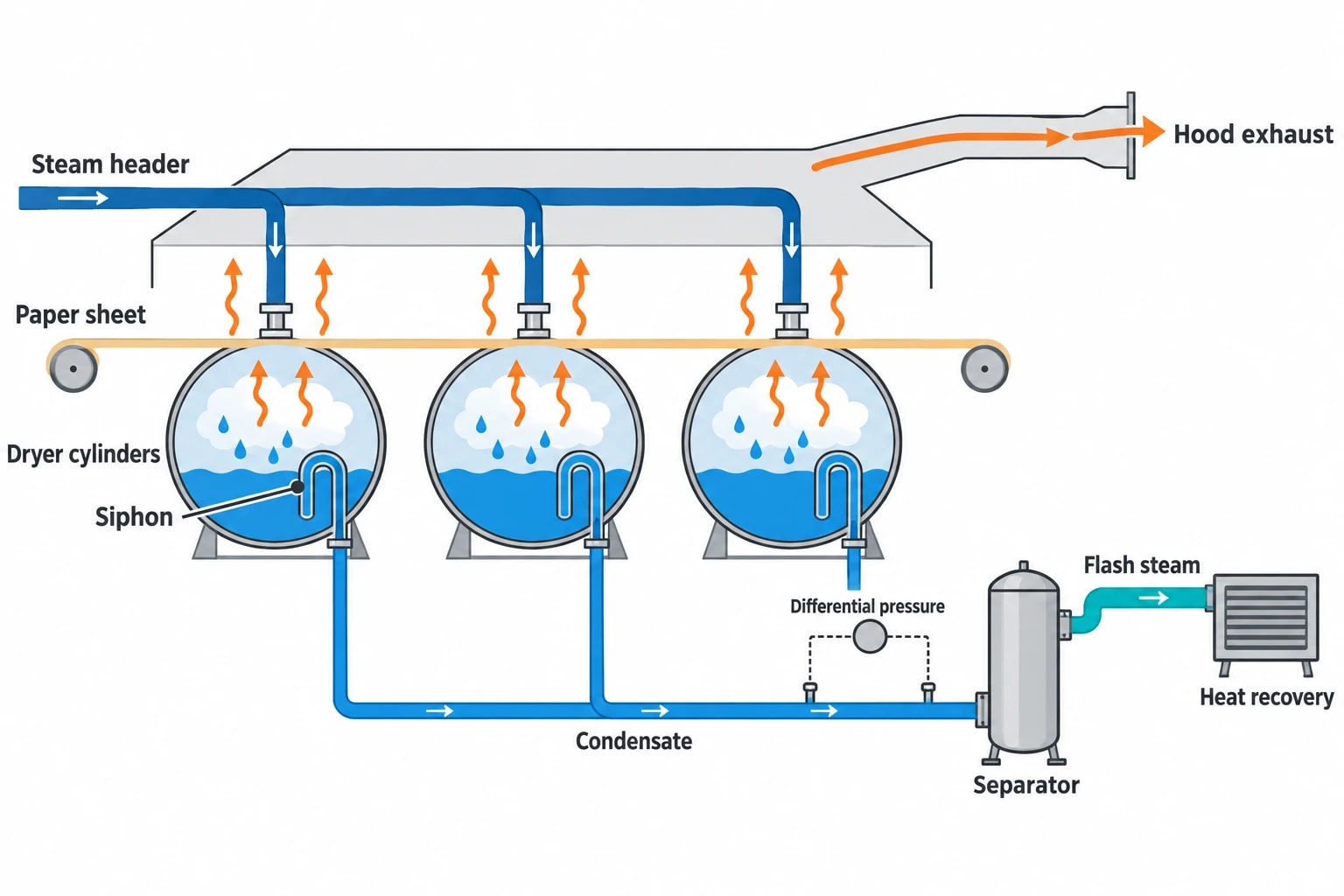
Dryer sections consume a substantial share of paper-machine thermal energy. Their performance depends on cylinder pressure, condensate removal, siphon condition, differential pressure, cascade arrangement, hood exhaust, pocket ventilation and sheet-dryness targets.
Cylinder-by-cylinder work is often more revealing than an average machine steam figure. A cylinder with poor condensate evacuation can lose heat-transfer area and force higher pressure elsewhere in the section. Operators may respond by raising steam pressure, increasing demand without correcting the restriction.
An energy audit should collect:
| Audit item | Why it matters |
|---|---|
| Cylinder steam pressure and temperature | Establishes available condensing temperature |
| Condensate flow and temperature | Shows whether latent heat and flash steam are being recovered |
| Differential pressure across dryer groups | Indicates whether condensate evacuation has adequate driving force |
| Hood supply and exhaust conditions | Reveals heat loss and moisture-removal performance |
| Reel moisture and production rate | Links thermal use to finished-product requirements |
The objective is a verified dryer heat balance. It should identify where steam condenses, where condensate flashes, where heat leaves with exhaust air and whether recovered heat has a viable destination. The result supports changes to dryer controls, condensate systems, hood operation or heat recovery without compromising moisture profile and product quality.

Map every energy and material flow in your process with detailed heat and mass balance calculations — the foundation for any optimisation or design project.
4. Check water-system closure and low-temperature heat use
Map white water, filtrate and condensate separately
Water-system closure can reduce fresh-water demand and wastewater flow, but poorly controlled closure can increase deposits, temperature, dissolved solids, odour and operational instability. Commission Implementing Decision 2014/687/EU addresses the need to avoid prolonged retention times, dead zones and poor mixing in water circuits where these conditions can lead to deposits and decomposition.
For energy auditing, white water, clean filtrate, cloudy filtrate, clean condensate and foul condensate must not be treated as one generic warm-water stream. Their contamination level determines where they can be reused. Their temperature determines the heat value. Their flow determines whether the opportunity is material.
A useful balance records fresh-water intake, white-water recirculation, filtrate reuse, showers, vacuum-pump seal water, effluent flow and major condensate returns. It should also record temperature at the source and point of use. A warm stream cooled before reuse can represent lost heat. A clean stream mixed prematurely with a contaminated stream can destroy a useful process-water opportunity.
Look for heat losses hidden in effluent
Effluent and warm drains can be important low-temperature heat sources, particularly where treatment capacity or discharge conditions already require cooling. Heat recovery from effluent needs careful design because fouling, corrosion, maintenance access and contamination control determine whether a scheme remains in service.
The BREF identifies recovery of waste heat from effluent and other sources as an energy-efficiency measure. It also identifies management of the secondary-heat balance with optimised water and condensate use. A credible audit finding will show the thermal duty, source temperature, target temperature, expected availability and cleaning strategy.
Water reduction and energy reduction are linked in an integrated mill through temperature, contamination and process demand.
5. Check whether the mill balance is accurate enough to support investment
Create a single source of truth
A heat and mass balance must be more than a spreadsheet assembled from nominal design values. It should be a validated representation of a defined operating period, using P&IDs, historian data, laboratory results, production records and field measurements.
EnerTherm Engineering’s 11-step methodology applies that discipline from data acquisition through validated steady-state and dynamic simulation. The deliverable should be a process flow diagram with embedded stream tables, supported by a mill-wide energy map. It should identify measured values, calculated values, assumptions and unresolved data gaps.
Process engineers often use Aspen Plus, HYSYS or DWSIM to test mass and energy balances, steam-system cases and heat-integration options. The value comes from model validation, not the software name. A model must reproduce observed production, steam flows, temperatures, water use and major utility consumption before it guides capital decisions.
Test more than one operating condition
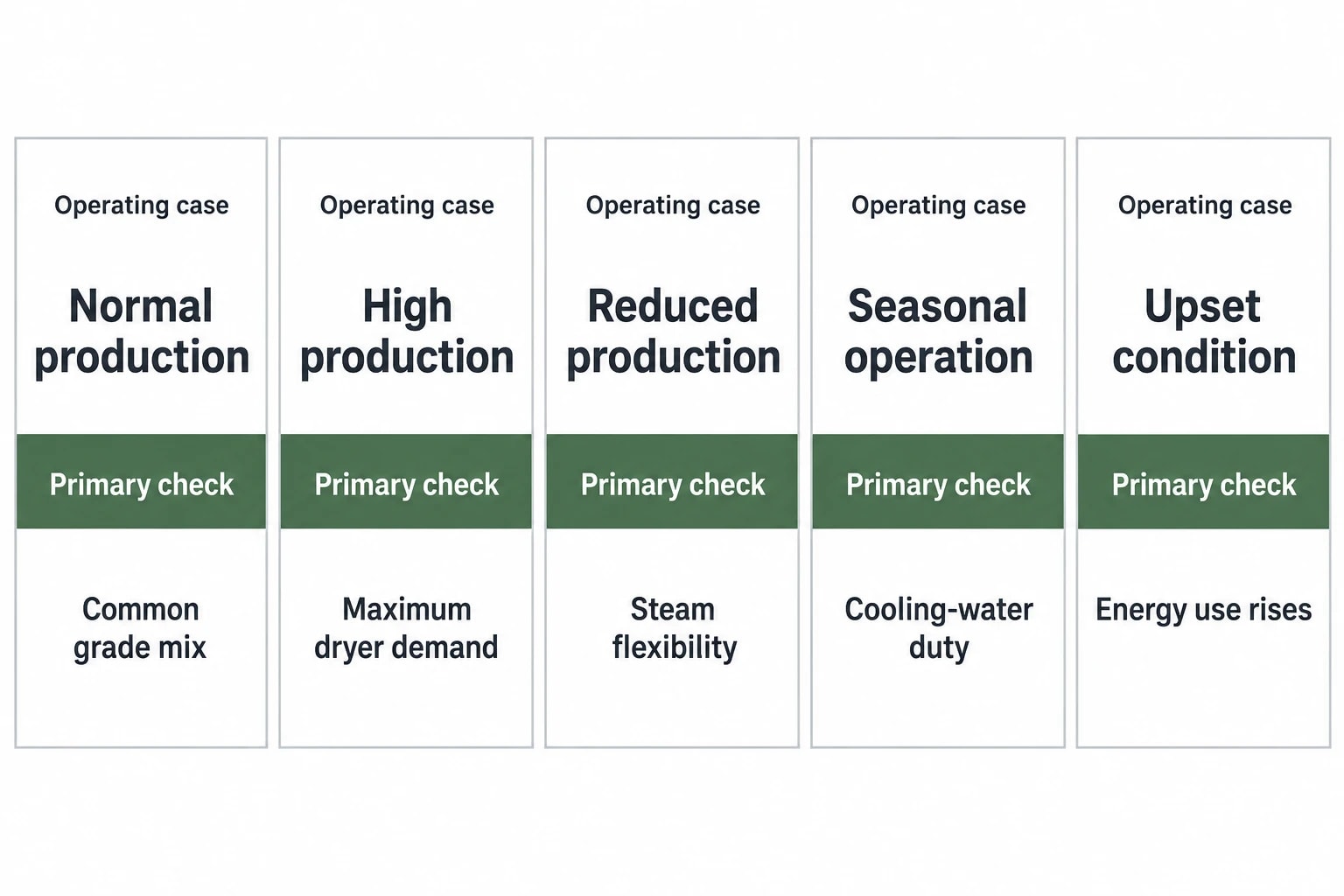
A balance built only from a stable summer shift can overstate savings. Mills operate through seasonal changes, product changes, planned shutdowns, equipment fouling and upset conditions. The audit should therefore validate representative cases, such as:
- Normal production at a common grade mix.
- High production with maximum dryer demand.
- Reduced production, when steam-system flexibility can become constrained.
- Seasonal operation affecting cooling-water, intake-water or building-heating duties.
- A documented upset condition where energy use rises materially.
This reveals pinch points that average annual data can hide. A heat exchanger may work at normal load but fail to meet a process-water duty during winter. An evaporator train may appear efficient until fouling reduces heat transfer. A turbine extraction case may only be available when the paper machine is at a certain production rate.
Turn the five BAT checks into an implementation roadmap
The final stage of an energy audit for pulp and paper mills is prioritisation. Each opportunity should state the affected process area, verified baseline, expected annual energy effect, production dependency, capital requirement, operational risk, maintenance requirement, carbon effect and implementation sequence.
The sequence matters. Improving black-liquor solids can change recovery-boiler steam availability. Recovering dryer-condensate heat can change boiler feedwater demand. Water-circuit modifications can alter temperatures across the paper machine. The roadmap should show these interactions and prevent double counting.
Cepi reported sector emissions of 0.24 tonnes of CO₂ per tonne of paper and board produced for 2024. That metric will vary between mills and products, but it gives energy managers a reason to establish their own measured baseline. A defensible mill-wide heat and mass balance turns BAT from a compliance reference into an operating tool that connects recovery, steam, dryers and water systems to a ranked programme of energy and carbon reduction.
This article reflects the independent analysis and editorial opinion of EnerTherm Engineering. Product names, trademarks, and brands mentioned belong to their respective owners. EnerTherm Engineering is not affiliated with, endorsed by, or a licensee of any third-party software or product mentioned unless explicitly stated.

Managing Director — EnerTherm Engineering
Dr. François Pierrel is Managing Director of EnerTherm Engineering with over two decades of expertise in thermal design, heat transfer, and industrial energy optimisation. He holds a PhD in Heat Transfer from Cranfield University and a Post-Doctorate from Heriot-Watt University.
