Fuel Switching Strategies for Paper Plants | Cost Analysis
A cost comparison of electrified drying heat, grid upgrades and retained boiler capacity.
Drying represents 67% of energy demand in a typical UK paper mill, according to the Department for Energy Security and Net Zero. Its generic mill balance assigns 31.6 MWth of steam to the dryer section.
That scale changes the investment question. Replacing natural gas or heavy fuel oil is not a boiler-room substitution. It affects the electrical connection, steam-header control, condensate recovery, outage planning, carbon allowances and standby capacity needed to maintain paper-machine availability.
Fuel-switching strategies work best when they allocate heat loads to the most credible low-carbon source. A mill may use recovered heat and high-temperature heat pumps for continuous duty, an electrode boiler for peaks and rapid reserve, and limited combustion capacity for exceptional operating conditions. The cost case depends on measured demand, useful heat delivered and production risk.
Why the dryer section dominates fuel-switching cost analysis
Steam demand sets the project scale
The dryer section evaporates water continuously while preserving moisture profile, strength and runnability. Steam pressure and condensate removal must remain stable through grade changes, starts and stops.
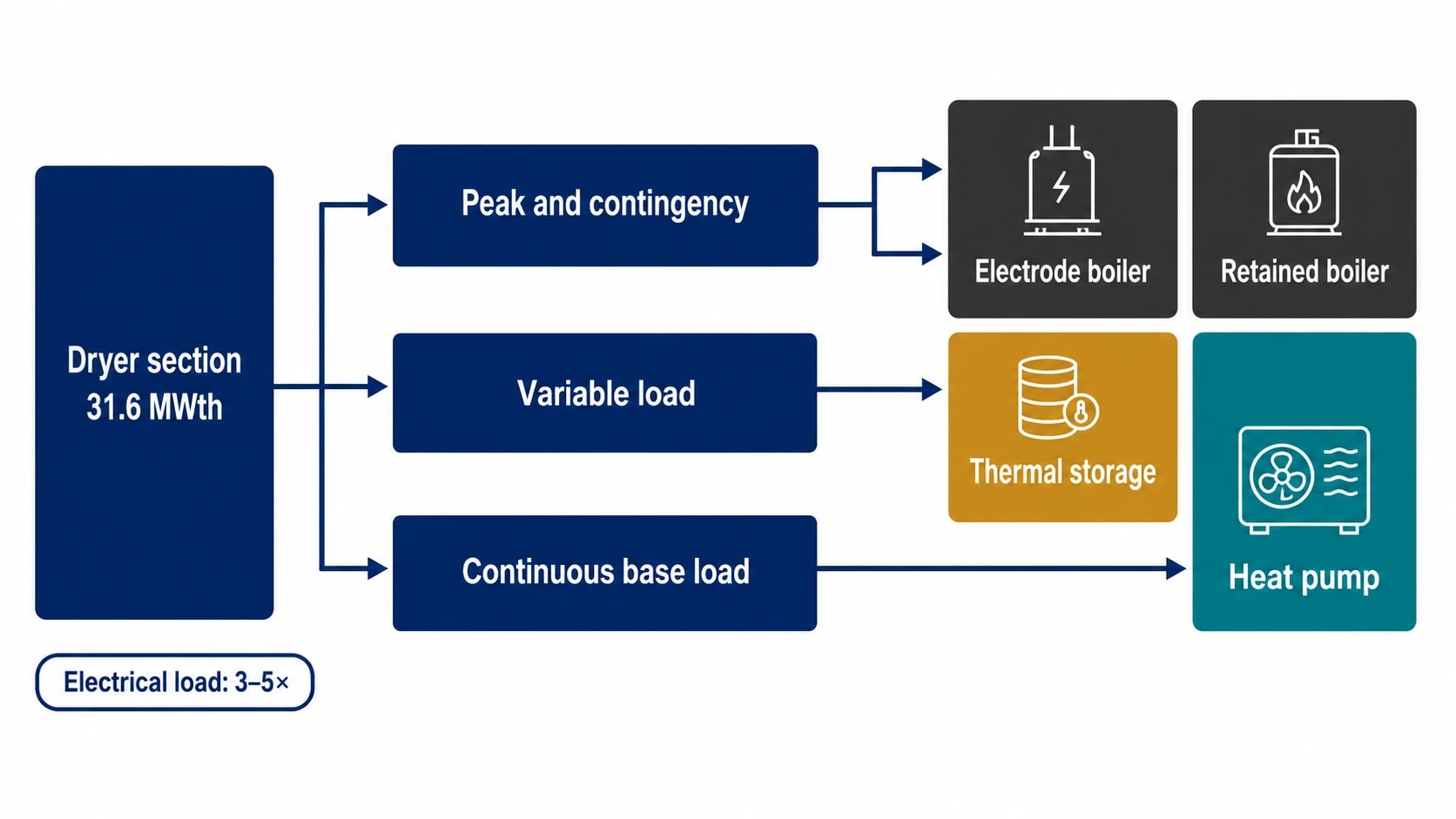
DESNZ’s 31.6 MWth generic dryer-section duty illustrates the issue. Direct electric steam replacement at that scale can materially increase a mill’s connected electrical load. DESNZ reports that electrifying thermal demand across investigated UK paper mills could increase electrical load by three to five times, with many sites needing grid reinforcement.
A cost model should separate demand into three operating categories:
- Continuous base load, suitable for long-running heat pumps where a dependable heat source exists.
- Variable load, which follows grade, basis weight, production rate and ambient conditions.
- Peak and contingency load, covering start-up, cold weather, maintenance and loss of a primary heat source.
Sizing every low-carbon asset for the highest recorded steam peak can produce poor capital efficiency. A smaller base-load heat-pump installation, paired with an electrode boiler, thermal storage or retained boiler capacity, may protect availability with lower upfront cost.
Heat reduction comes before replacement capacity
A mill should reduce avoidable thermal demand before finalising technology capacity. Steam leaks, failed traps, poor dryer-hood balance, restricted condensate lines, uncontrolled dryer pressure and unrecovered flash steam increase the size and cost of a replacement heat source.
The audit baseline needs production-normalised measures, including steam and electricity per tonne of saleable paper. It should distinguish normal production from abnormal operation. A short period of poor condensate return can distort annual averages and lead to oversized plant.
Condensate recovery deserves particular attention. Hot condensate reduces boiler make-up and treatment requirements, while a high return temperature can improve the value of waste-heat recovery. Leaving recoverable heat in drains creates a permanent operating-cost penalty.
Identify where your plant is losing energy and quantify the savings potential — our audits map every heat source, sink, and waste stream in your facility.
Heat-pump, electric-boiler and renewable-fuel options
High-temperature heat pumps for dryer-section steam
Industrial heat pumps upgrade low-temperature heat for process duty. Paper mills may identify sources in warm effluent, cooling-water circuits, dryer-exhaust recovery, refrigeration loads and compressed-air cooling. Temperature is only one screening factor. Flow, operating hours, contamination, fouling risk and distance to the heat sink determine whether recovery is commercially usable.
The EHPA and Cepi report Through pumps to pulp: greening the paper industry’s heat states that heat pumps can reach 200°C and could provide half of the sector’s drying heat. The achievable duty at an individual mill depends on source temperature and required steam pressure.
EHPA reported in May 2026 that a Delfort paper mill in Finland is cutting 19,000 tonnes of CO₂ annually by converting low-temperature waste heat into steam. The project highlights the value of identifying a persistent heat source before committing to compressor capacity.
At this duty, a dryer section may require several heat-pump trains or a mixed heat-supply arrangement. Engineers should assess the lowest source temperature available during peak production, rather than size against favourable summer or reduced-production conditions.
Electrode boilers for peak steam and resilience
Electrode boilers convert electrical energy directly into steam. DESNZ identifies electric boilers as commercially available for industrial steam generation and reports capacity of up to 70 MW for high-voltage electrode units, with larger duties possible through parallel units.
Their strongest role in paper mills is often operational rather than continuous base-load generation:
- Peak steam support that avoids oversizing heat-pump capacity.
- Fast reserve during heat-pump maintenance or loss of waste-heat supply.
- Boiler-house flexibility during favourable electricity procurement periods.
- Replacement of oil-fired peaking capacity with high maintenance and carbon exposure.
The financial model needs to address electricity-price risk directly. DESNZ’s November 2023 electrification study, referring to 2023 non-domestic energy-price data, described average industrial electricity as around four times the cost of gas for counterfactual heating processes. That was an average industrial-customer comparison, not a current site tariff, half-hourly power price or paper-mill supply contract.
The investment case therefore needs site-specific electricity prices, demand and network charges, contracted flexibility arrangements and expected operating hours. An electrode boiler supplying occasional peak duty has a different economic role from one covering the dryer section continuously.
Biomass, biogas and thermal-oil duties
Biomass and biogas retain a familiar combustion-based steam-generation model, but their economics rest on long-term fuel quality, supply security, storage, ash handling, emissions control and permit conditions. Spot-market fuel assumptions are insufficient for an asset with a multi-year operating life.
Thermal-oil systems require their own assessment. The analysis should establish supply and return temperatures, heat-transfer-fluid condition, heater efficiency, circulation-pump electricity demand, process thermal inertia and the restart consequences of a planned or unplanned shutdown.
Heat pumps may preheat thermal-oil return streams or serve lower-temperature duties. Direct electrification can be viable where process temperature and fluid limits align. The decision should account for the production cost of lost temperature control, particularly for coating, drying and converting operations.
Capital costs that determine the business case
The heat source is only one cost line
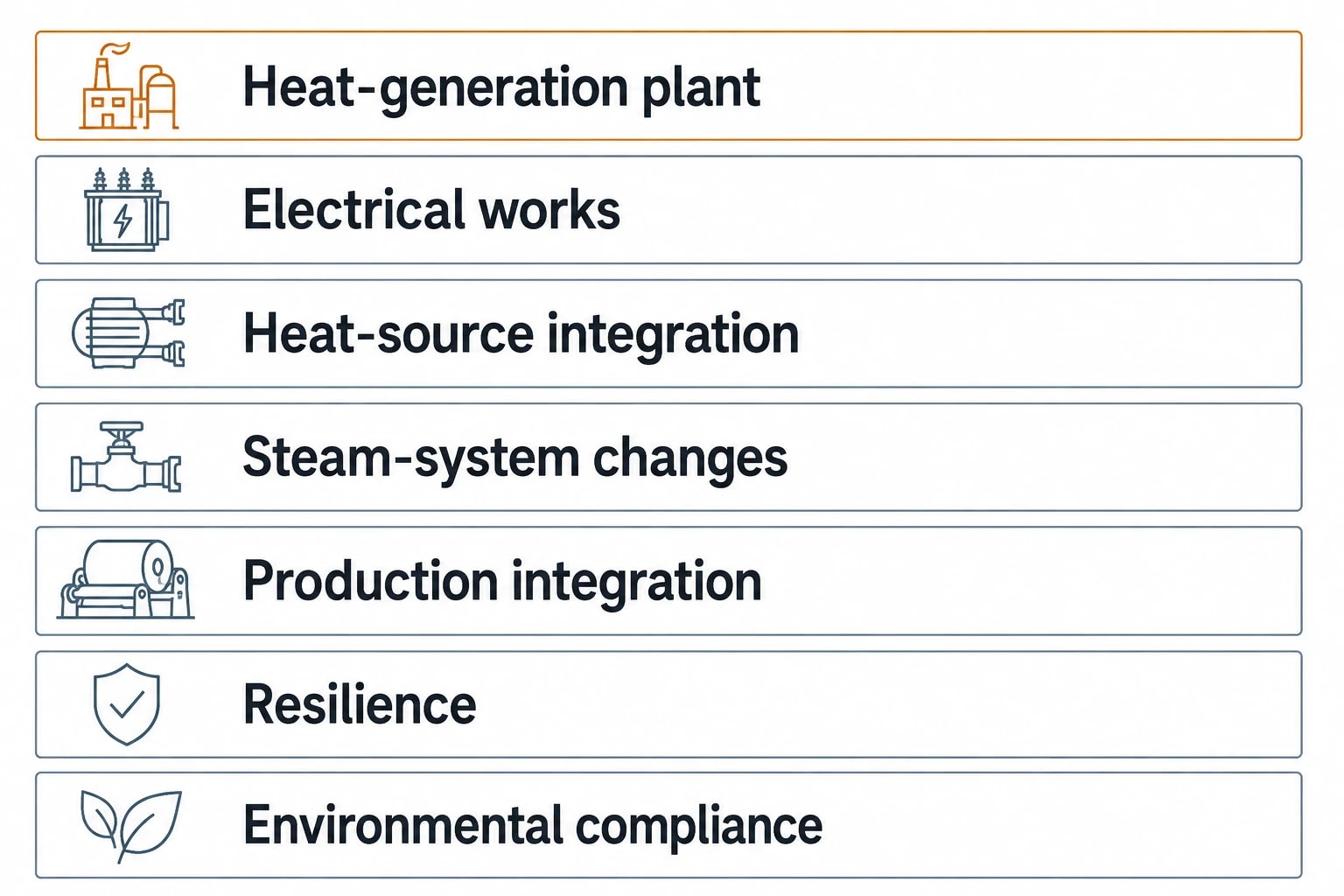
A heat-source quotation is rarely the installed project cost. Electrical infrastructure, heat-source treatment, steam-system modifications and production tie-ins can dominate the programme and capital profile.
| Cost area | Cost items to assess |
|---|---|
| Heat-generation plant | Heat pumps, steam compressors, electric boilers, combustion equipment, controls and auxiliaries |
| Electrical works | Connection offer, reinforcement, transformers, high-voltage switchgear, protection, cabling and civil works |
| Heat-source integration | Heat exchangers, filtration, water treatment, pumps, pipework and cleaning provisions |
| Steam-system changes | Deaeration, pressure control, flash-steam recovery, condensate return and backup connections |
| Production integration | Tie-ins, shutdown duration, temporary steam, commissioning and process validation |
| Resilience | Standby capacity, thermal storage, retained-boiler maintenance and restart procedures |
| Environmental compliance | Permit changes, emissions monitoring, air-quality work and verification |
Grid studies should begin before the technology decision is fixed. A mill may complete condensate, metering and heat-recovery preparation while waiting for a connection or reinforcement programme. This reduces idle time once electrical capacity becomes available.
Compare useful heat, not fuel bought at the gate
The operating-cost comparison should use useful heat delivered to the process. Fossil steam generation includes fuel, boiler losses, water treatment, maintenance, emissions compliance and allowance costs. Electrified heat introduces electricity and network costs, with different maintenance requirements and availability risks.
Heat pumps require separate sensitivity analysis because electricity use depends on heat-source and sink conditions. A stable warm-effluent source can produce a materially different cost outcome from an intermittent or fouling-prone source.
The financial model should include at least four cases:
- Base case using current contracted energy prices and known network charges.
- High-electricity-cost case, including a higher tariff and peak-demand exposure.
- High-gas or oil-cost case, including direct carbon-cost exposure.
- Reduced-production case, testing whether lower operating hours still justify capital investment.
Carbon savings should only appear as cash savings where an installation would otherwise need to buy and surrender allowances. Free allocation, permit boundaries and retained backup operation can alter that result.

Identify where your plant is losing energy and quantify the savings potential — our audits map every heat source, sink, and waste stream in your facility.
EU ETS and UK ETS treatment of fuel switching
EU sites: permit, monitoring and allowance effects
Directive (EU) 2023/959 retains EU ETS coverage for fuel combustion at installations with total rated thermal input exceeding 20 MW. Operators aggregate the rated thermal input of technical units in which fuels are combusted. Units below 3 MW are excluded when calculating whether the installation reaches that threshold.
Electrification reduces direct combustion emissions, but a changed boiler house does not automatically remove EU ETS obligations. Operators should review the greenhouse-gas permit, monitoring plan, source streams, uncertainty tiers, annual emissions report and free-allocation position. Commission Implementing Regulation (EU) 2018/2066 governs monitoring and reporting.
The allowance-cost analysis should separate lower verified combustion emissions from changes in free allocation. It should also include fuel used by retained gas or oil boilers during routine tests, peak periods and heat-source outages. Purchased electricity does not create on-site combustion emissions, although it remains relevant to Scope 2 reporting and power-procurement strategy.
UK sites: use more than 20 MW for early screening
UK projects should use more than 20 MW as the early screening point for total rated thermal input and confirm the final scope with the relevant regulator. The statutory UK ETS wording refers to combustion units with total rated thermal input exceeding 20 MW, so a site close to that threshold requires a permitting decision rather than a modelling assumption.
UK ETS operators submit a verified annual emissions report by 31 March and surrender sufficient allowances by 30 April for the preceding scheme year. A major reduction in gas or oil firing can change emissions-monitoring arrangements, fuel metering and the evidence required for the annual report.
Retaining a boiler for resilience still leaves direct-emissions exposure. The cost model should use expected backup running hours, including annual proving runs, rather than assume that standby equipment consumes no fuel.
A measured audit sequence for fuel switching strategies for paper plants
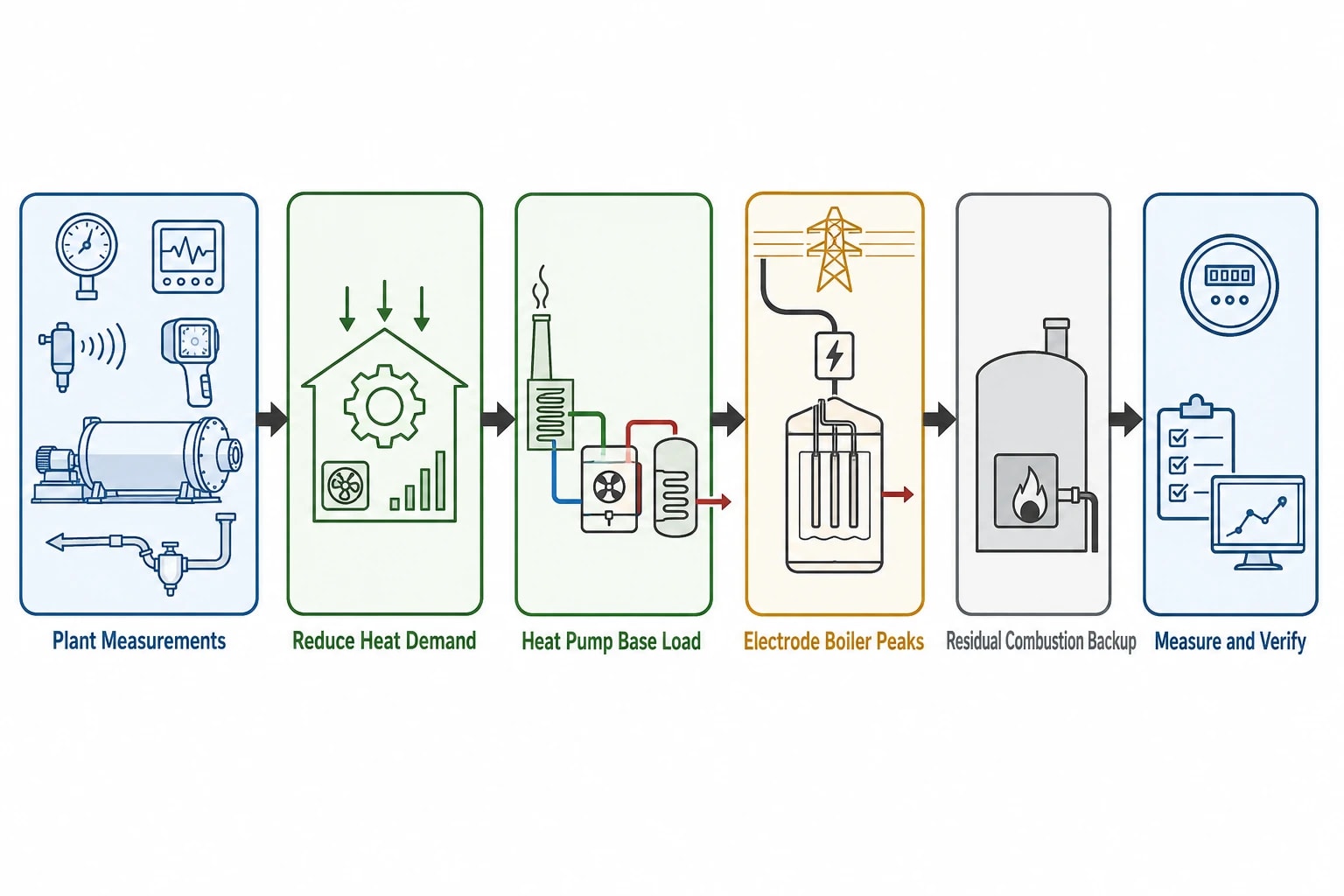
Establish the thermal baseline
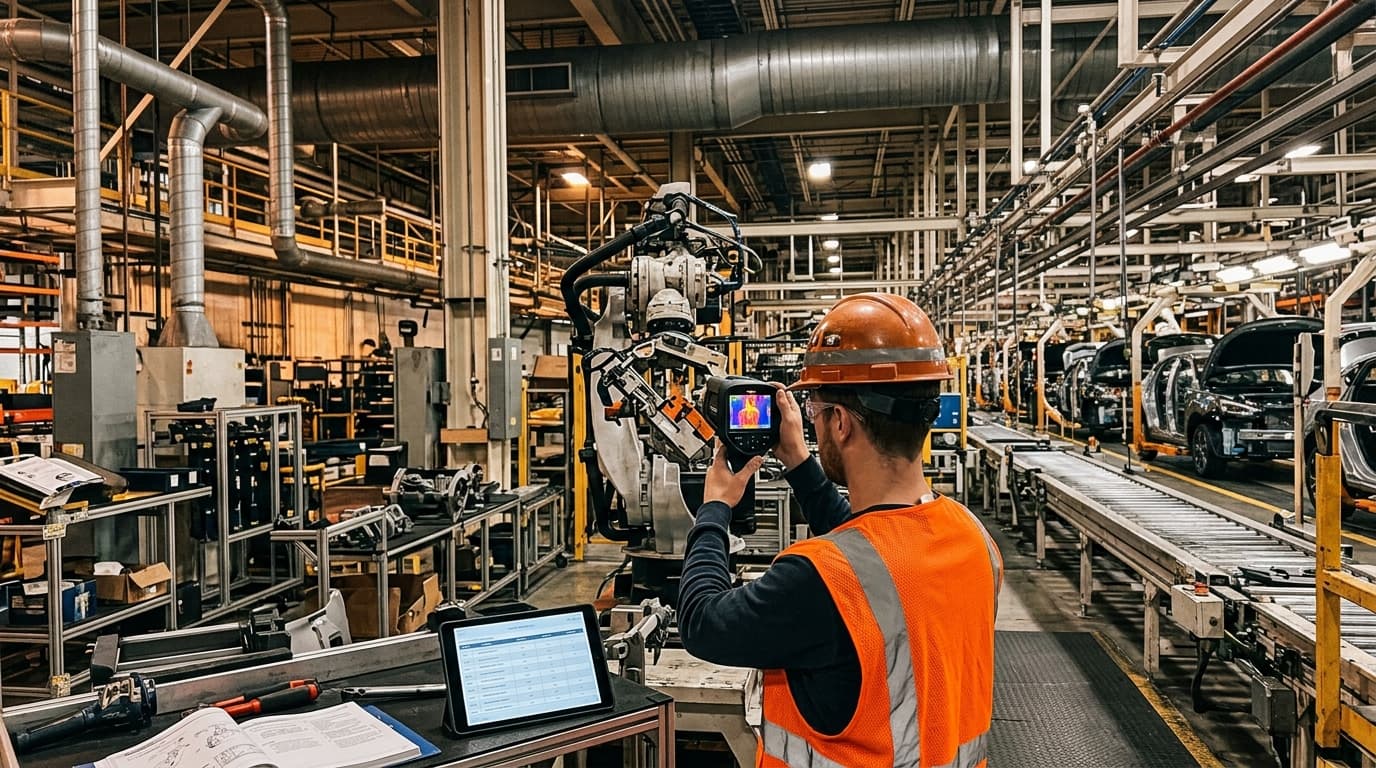
A supplier-neutral audit should build a mass and energy balance from production records, metered steam and fuel use, electrical-load data, pressure profiles, condensate temperature and return flow. Portable power analysers, ultrasonic leak detection and thermal imaging can identify losses while production continues.
The technical assessment should establish:
- Dryer-section steam demand by grade, season and operating state.
- Header pressure, condensate return temperature and flash-steam opportunities.
- Waste-heat source temperature, flow, cleanliness and availability.
- Boiler efficiency and minimum stable firing rate.
- Electrical load profile, spare capacity and likely connection requirement.
- Thermal-oil duty and sensitivity to temperature variation.
Build a staged investment programme
The first stage should remove avoidable heat demand and improve metering, condensate recovery and controls. These measures reduce required generation capacity and increase confidence in the final equipment specification.
The next stage can install heat pumps for dependable base-load duty where waste heat is available for most production hours. A later stage can add electrode-boiler capacity, electrical reinforcement and only the residual combustion backup required for continuity.
Measurement and verification should continue after commissioning. Production-normalised energy use, steam flow, condensate return, electricity consumption and backup-fuel hours give engineering directors evidence to adjust operating strategy and report financial performance.
Fuel switching is a thermal portfolio decision
A paper plant should assess fuel switching as a combination of heat reduction, heat recovery, electrification and managed resilience. Heat pumps can upgrade low-temperature waste heat, while electrode boilers can cover peaks and provide fast reserve. Biomass, biogas or retained gas capacity may suit specific site constraints.
For paper machines requiring tens of megawatts of steam, a staged approach can reduce fossil thermal load where the mill has measured demand, viable electrical capacity and an operating plan that protects dryer-section stability.
This article reflects the independent analysis and editorial opinion of EnerTherm Engineering. Product names, trademarks, and brands mentioned belong to their respective owners. EnerTherm Engineering is not affiliated with, endorsed by, or a licensee of any third-party software or product mentioned unless explicitly stated.

Managing Director — EnerTherm Engineering
Dr. François Pierrel is Managing Director of EnerTherm Engineering with over two decades of expertise in thermal design, heat transfer, and industrial energy optimisation. He holds a PhD in Heat Transfer from Cranfield University and a Post-Doctorate from Heriot-Watt University.
