Pulp Mill Energy Efficiency: Finding Hidden Steam Losses
How heat and mass balance modelling reveals dryer, recovery and water losses
Pulp and paper mill energy efficiency is the disciplined reduction of energy used to produce pulp and paper while maintaining fibre quality, machine runnability, chemical recovery and environmental compliance. In a kraft mill, black liquor typically leaves pulp washing at 14 to 18% dry solids and is concentrated to roughly 70 to 85% before combustion in the recovery boiler. That concentration step shows why a mill-wide heat and mass balance matters: a local water, steam or condensate issue can alter recovery-boiler load, turbine generation and paper-machine drying performance.
Hidden steam losses rarely appear as one dramatic failure. They emerge through mismatched header balances, leaking traps, flash steam discharged to atmosphere, excess dryer-cylinder pressure, poor condensate evacuation, diluted black liquor and water circuits carrying unnecessary heat. A mill can operate reliably while paying for these losses in fuel, purchased electricity and CO₂ emissions.
For energy managers, the challenge is to distinguish a visible utility problem from the process condition that created it. A steam leak may be the immediate loss, but the root cause may be an unstable paper-machine drying profile, a control-valve bypass, a condensate-system bottleneck or a water-reuse change that has increased evaporation duty elsewhere in the mill.
Why pulp and paper mill energy efficiency requires a mill-wide balance
Steam is a connected process utility
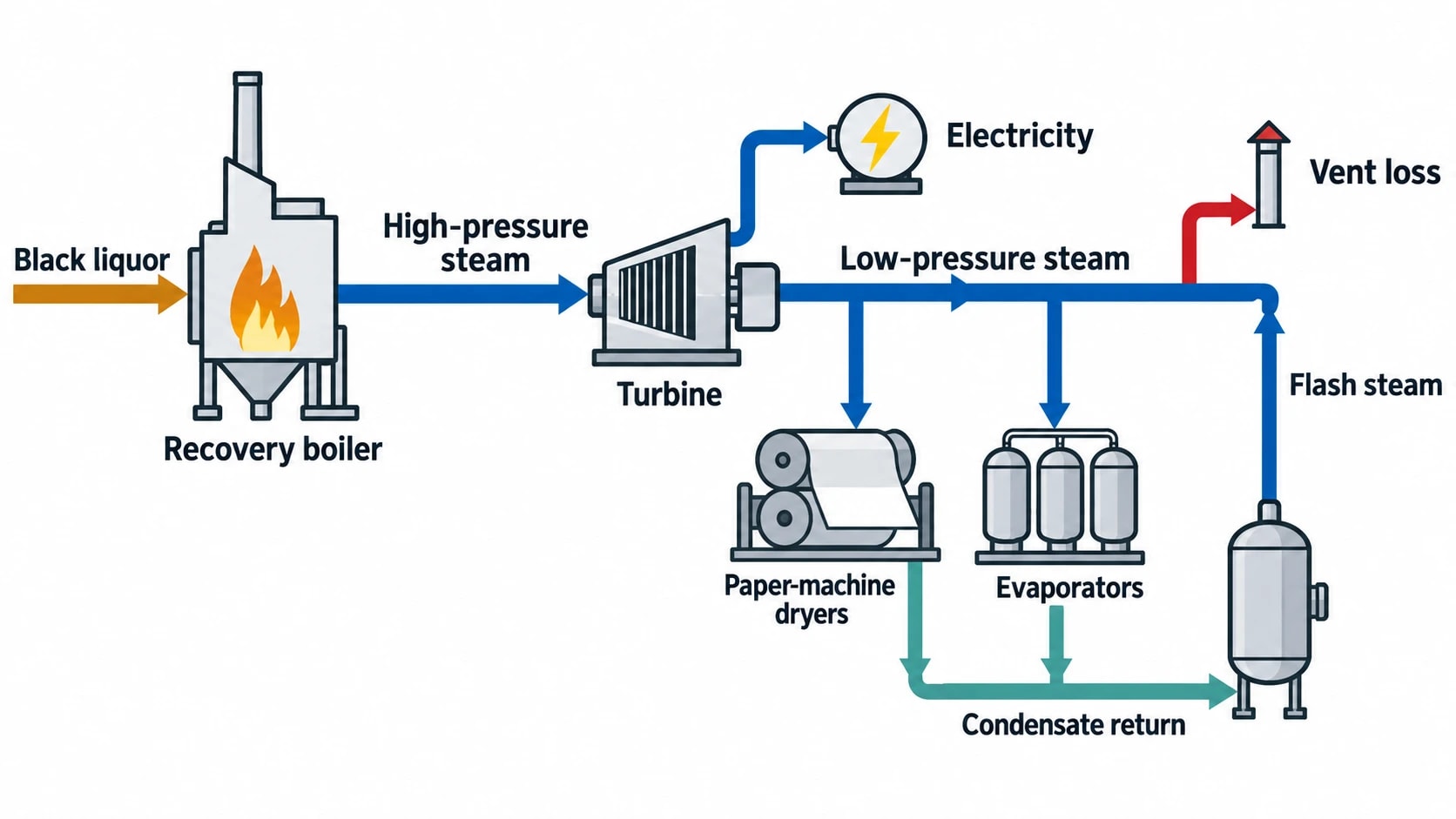
Integrated pulp-and-paper mills produce and consume steam across several pressure levels. Recovery boilers generate high-pressure steam from black liquor combustion. Back-pressure and extraction turbines distribute steam while generating electricity. The paper machine draws low-pressure steam for drying cylinders, while evaporators, digesters, causticising and ancillary heating systems add competing demands.
A local reduction in steam use does not automatically reduce fuel use. If the recovery boiler operates at a fixed firing constraint, lower demand can increase turbine condensing duty or force operators to vent surplus low-pressure steam. The benefit depends on the whole steam-and-power system.
A defensible energy balance reconciles:
- Recovery-boiler steam generation and black-liquor firing conditions
- Purchased fuel, biomass and auxiliary-boiler output
- Turbine inlet, extraction and exhaust flows, and electrical generation
- Steam-header flow, pressure and temperature at each pressure level
- Process steam use in evaporation, pulp washing, bleaching, drying and recausticising
- Condensate return, flash-steam recovery, make-up water and boiler blowdown
- Venting, relief losses and measured or suspected leakage
The balance must close over a consistent production period. A single shift can be distorted by a grade change, start-up, paper break, evaporator wash or recovery-boiler upset. Weekly and monthly reconciliations are often more useful for investment decisions, provided they retain enough detail to identify abnormal operating periods.
Build one source of engineering truth
The practical output is a single process flow diagram with stream tables. Each meaningful steam, condensate, water, black-liquor and process stream needs an identified source, destination, flow, pressure, temperature, solids content and measurement basis.
This is more useful than isolated historian trends. It allows process, maintenance and energy teams to test whether reported steam demand is physically credible. For example, a dryer section may report stable steam pressure while condensate flow falls, suggesting a blocked siphon, inaccurate flow measurement or changing sheet moisture entering the dryers.
EnerTherm Engineering’s 11-step heat and mass balance methodology uses P&IDs, operating logs and site measurements to establish this engineering baseline, then validates it against routine, seasonal and upset conditions. The model becomes a decision record rather than a one-off audit report.

Map every energy and material flow in your process with detailed heat and mass balance calculations — the foundation for any optimisation or design project.
Where hidden steam losses occur in a pulp mill
Steam traps, vents and condensate return
Steam-trap failure requires more than visual inspection. A failed-open trap can pass live steam into the condensate return. A failed-closed trap can flood heat-transfer equipment, reduce drying capacity and prompt operators to raise header pressure. Both waste energy, although by different mechanisms.
A structured trap survey should record location, application, trap type, operating pressure, discharge temperature, test result, maintenance history and condensate destination. Ultrasonic testing and temperature measurement can support diagnosis, but results must be considered alongside process conditions. A hot trap outlet does not prove live-steam loss: flash steam and a high condensate load may produce a similar temperature profile.
Hidden losses also occur at:
- Open flash-steam vents without a recovery route
- Continuous blowdown set higher than water chemistry requires
- Steam pressure-reducing stations with bypass valves passing flow
- Leaking isolation valves on idle process lines
- Poorly insulated valves, flanges, strainers and condensate receivers
- Steam used to warm equipment that no longer runs or requires heating
The US Department of Energy Steam System Survey Guide identifies steam leaks, insulation heat loss, condensate loss and flash-steam loss as core distribution-system loss categories. These principles apply directly to pulp-mill utilities, but their scale and interaction with recovery operations require a mill-wide assessment.
Header pressure that masks a process problem
Excess header pressure can disguise weak heat transfer or poor condensate removal. Raising steam pressure increases saturation temperature, but can also raise dryer-cylinder shell temperature beyond the level required for the grade. Higher pressure may increase steam consumption, worsen sheet-moisture control and raise flash-steam generation when condensate depressurises.
Energy teams should investigate pressure changes alongside:
- Dryer-cylinder inlet pressure and condensate outlet pressure
- Differential pressure across rotary joints, siphons and separators
- Hood supply air, exhaust air and dew point
- Sheet moisture before and after the dryer section
- Paper speed, basis weight and grade
- Turbine extraction conditions and low-pressure header balance
Pressure control should serve the drying duty. It should not compensate indefinitely for restrictions in condensate piping, undersized separators or unstable dryer controls.
Dryer-section steam losses and paper-machine heat recovery
Cylinder-by-cylinder analysis exposes avoidable duty
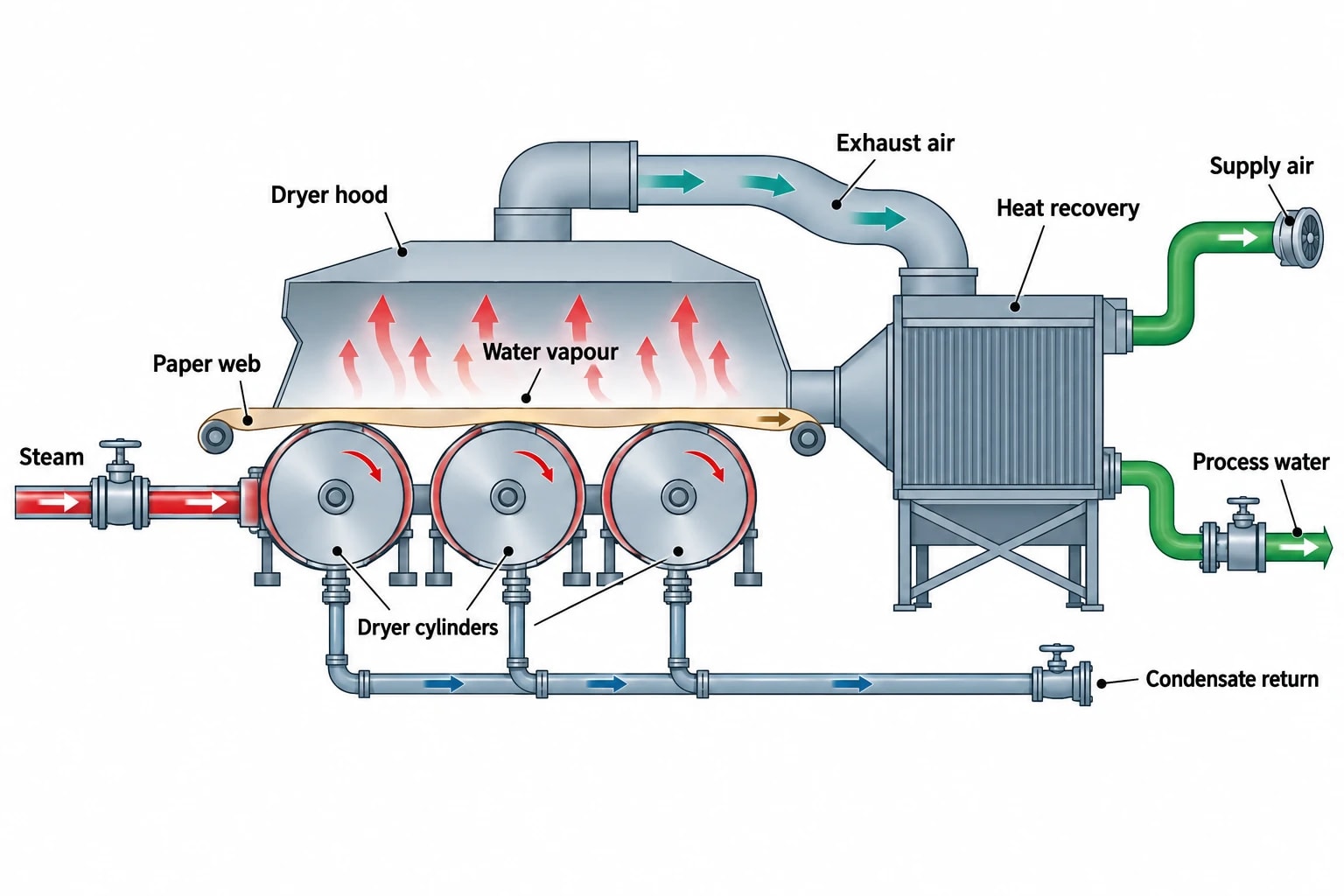
Drying is often the largest steam consumer in an integrated mill. The dryer section removes water from the paper web by condensing steam inside cylinders and transferring heat through the shell to the sheet. Steam use therefore depends on incoming sheet dryness, paper grade, machine speed, cylinder pressure, condensate behaviour and hood performance.
A cylinder-by-cylinder analysis identifies cylinders operating at unsuitable pressures or providing little useful drying. It should compare steam pressure, surface temperature, condensate condition and web-moisture progression across dryer groups. It should also identify cylinders supplied by common control zones, as individual readings can appear normal while a group contains a poor performer.
Common loss patterns include excessive steam pressure in early dryer groups, condensate backing up inside cylinders, worn siphons, inadequate differential pressure and steam supplied to cylinders during low-load operation. Each can reduce heat-transfer effectiveness and push operators towards higher header pressure.
Hood exhaust is part of the steam balance
The dryer hood removes evaporated water. Excess exhaust flow carries sensible heat out of the building. Insufficient exhaust flow raises humidity, reduces evaporation capacity and destabilises sheet moisture.
The correct setting depends on hood design, pocket ventilation, paper grade and machine speed. Engineers should assess hood exhaust temperature, humidity, supply-air temperature and heat-recovery performance together. A dryer hood with high exhaust temperature may offer recoverable heat, but the target use needs a credible temperature match and operating profile.
Recovered dryer-exhaust heat can preheat incoming air, process water or other suitable streams. The opportunity must be tested against fouling, corrosion, condensate management and contaminant transfer. Heat recovery that reduces fresh steam demand but creates reliability problems does not improve mill performance.
Condensate and flash steam deserve equal attention
Condensate retains heat. Returning it to the boiler house reduces make-up water demand and can reduce boiler fuel use. Its route matters: high-pressure condensate flashing into a lower-pressure receiver produces flash steam. Venting that steam discards useful energy and can create local safety concerns.
A quantified flash-steam map should show each condensate source pressure, receiver pressure, vent rate, recovery destination and periods when the receiving process cannot accept the flow. In pulp mills, flash steam can sometimes serve low-pressure process heating or feedwater duties, subject to condensate quality and process constraints.

Map every energy and material flow in your process with detailed heat and mass balance calculations — the foundation for any optimisation or design project.
Black liquor recovery and evaporation as energy-efficiency priorities
Dry-solids content changes the recovery-boiler balance
The EU Joint Research Centre’s 2015 pulp, paper and board BREF identifies high black-liquor dry-solids content as an important factor in recovery-boiler energy efficiency, steam generation and electricity generation. More water entering the furnace consumes energy that could otherwise contribute to useful steam production and increases flue-gas flow.
Weak black liquor normally enters evaporation at 14 to 18% dry solids. The BREF describes concentration in multi-effect evaporators to 70 to 85% dry solids, with achievable values affected by liquor characteristics and evaporation-plant design. High dry solids can improve recovery-boiler capacity and energy performance, but change firing conditions and require careful safety and operational assessment.
A reduction in dry solids is often an upstream hidden steam loss. Excess dilution may arise from pulp washing, weak-filtrate routing, condensate contamination, wash-water practices or operational changes made to protect product quality. The evaporator plant then consumes more steam to remove water that did not need to enter the liquor cycle.
Multi-effect evaporation needs a heat-and-mass-balance view
Multi-effect evaporation offers scope for improvement because vapour from one effect provides heating duty to the next. Performance depends on vapour temperature differences, heat-transfer area, fouling, liquor viscosity, non-condensable gases, condensate quality and steam economy.
An evaporation model should quantify each effect rather than rely only on overall steam consumption. Useful checks include:
- Liquor flow and dry solids into and out of every effect
- Live-steam flow to the first effect
- Vapour flow, temperature and pressure between effects
- Condensate flow and contamination risk
- Fouling indicators and cleaning intervals
- Non-condensable-gas removal
- Stripper steam use and clean-condensate reuse
The BREF notes that evaporator and cooking-plant condensates can contain total reduced sulphur compounds, methanol and other volatile organic compounds. Stripping enables reuse in unbleached pulp washing and causticising, subject to site conditions. This illustrates the link between water quality, heat recovery and chemical-recovery performance.
Recovery savings must preserve chemical balance
A recovery-boiler project cannot be evaluated on steam generation alone. Changes in black-liquor concentration, firing rate or evaporation duty affect sodium and sulphur balance, smelt handling, causticising and lime-kiln demand. The energy model needs species-level mass balances for sodium, sulphur, carbonate, sulphide, caustic and lime-cycle streams where a decision could affect chemical recovery.
Steady-state process simulation is valuable here. Process engineers commonly use Aspen Plus, HYSYS and DWSIM to test mass and energy balances, examine alternative heat-recovery routes and identify constraints before committing capital. The simulation needs plant validation: a model based on unrepresentative liquor solids, incorrect steam pressure or incomplete condensate data can produce the wrong priority list.
Water-system closure can create or prevent steam losses
White-water reuse has a heat cost
Commission Implementing Decision 2014/687/EU identifies fibre and filler recovery and water recirculation as techniques under BAT 47 for reducing wastewater generation. It also states that dissolved organic, inorganic and colloidal material may limit water reuse in the wire section.
That qualification matters for pulp and paper mill energy efficiency. Closing a water circuit can reduce fresh-water demand and retained heat losses, but can also increase dissolved solids, biological loading, deposit risk, odour and product-quality variability. More closed water systems may change press-section performance, dryer load and effluent-treatment demand.
The engineering question is the degree of closure that the product, machine and wastewater system can support while reducing net mill energy use.
Follow heat with the water
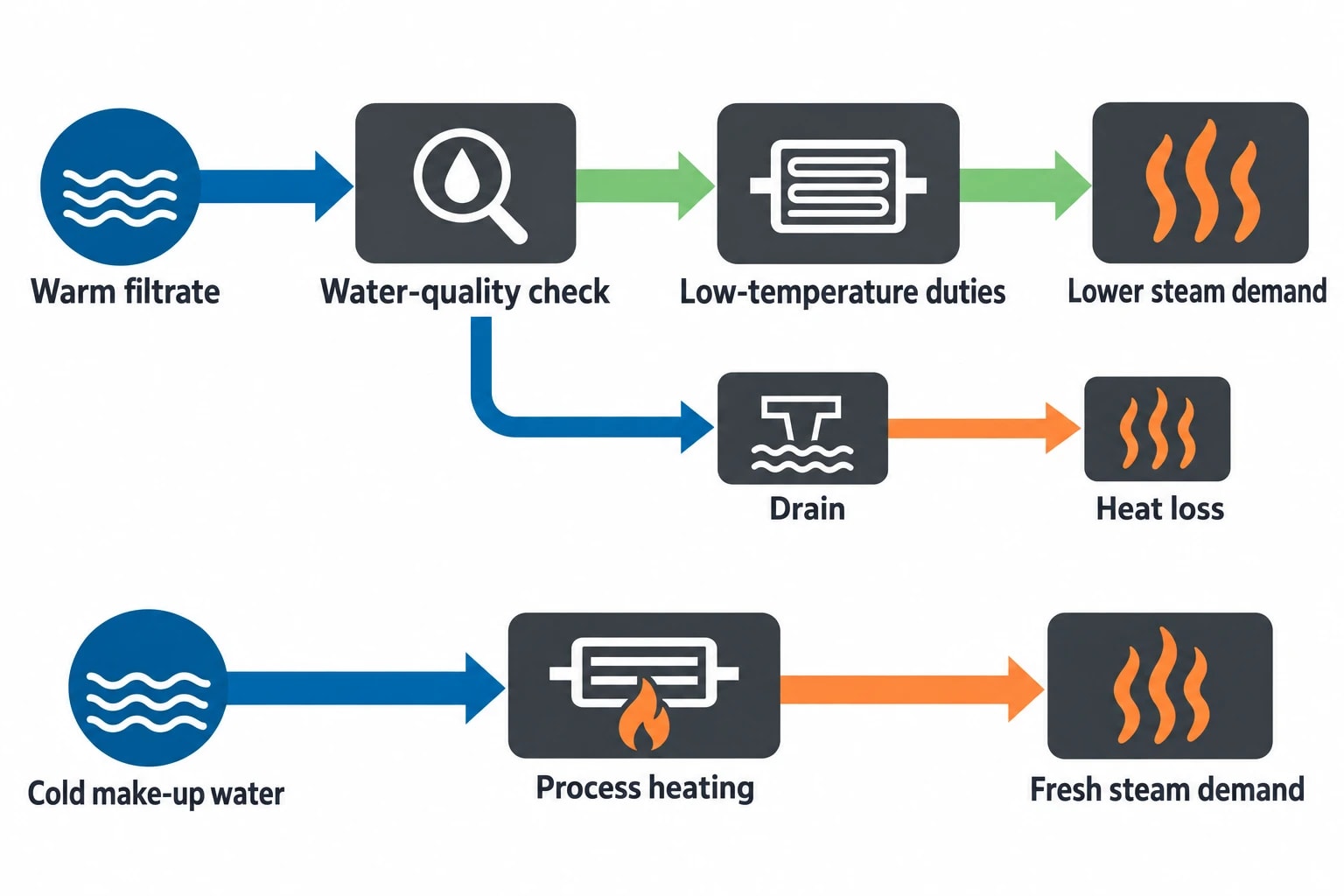
Every water stream has a temperature, flow and destination. Warm filtrate discharged to drain carries energy away. Cold make-up water entering a process that requires heating creates fresh steam demand. A mill-wide balance identifies opportunities to direct cleaner warm streams to low-temperature duties while protecting water quality at sensitive applications.
Priority checks include white-water temperature, shower-water demand, filtrate reuse, seal-water segregation, cooling-water separation, pulp-washing requirements and effluent-treatment temperature. The highest-value opportunity may be a corrected routing arrangement rather than a new heat exchanger.
Turning a heat and mass balance into an energy-reduction roadmap
Validate before ranking projects
A project list should separate confirmed losses from plausible opportunities. Each item needs an evidence trail: measured baseline, operating range, energy mechanism, production effect, capital requirement, operational risk and expected verification method.
The following table shows the distinction.
| Opportunity | Balance evidence required | Primary benefit | Main constraint |
|---|---|---|---|
| Repair failed-open steam traps | Steam-header reconciliation, trap test and condensate return data | Reduced live-steam loss | Access and trap selection |
| Reduce dryer steam pressure | Cylinder pressures, sheet moisture and condensate differential pressure | Lower dryer steam demand | Paper quality and runnability |
| Recover flash steam | Condensate pressure, vent flow and receiving-duty profile | Lower low-pressure steam demand | Intermittent demand and condensate quality |
| Increase black-liquor dry solids | Liquor-flow, solids and recovery-boiler balance | Improved recovery steam generation | Evaporator capacity and boiler operating limits |
| Increase warm-water reuse | Water quality, temperature and flow balance | Lower fresh-water heating duty | Deposits, microbiology and product quality |
Measure results under real operating conditions
ISO 50001:2018 provides a recognised framework for using energy data, setting objectives and continually improving energy performance. For mills, energy-performance indicators should adjust for production, grade, pulp yield and operating conditions. Tonnes of steam per tonne of saleable product can be useful, but may conceal changes in paper grade, incoming moisture or purchased-pulp proportion.
Verification should compare like-for-like production periods and account for disturbances such as paper breaks, recovery-boiler outages and unusual weather. The implementation plan should assign ownership across production, maintenance, utilities and process engineering. Steam savings often disappear when control changes, temporary bypasses and altered production patterns are not incorporated into operating procedures.
EnerTherm Engineering’s mill-wide optimisation programmes report an average 14% energy reduction, a 1.8-year payback period and annual CO₂ reductions of 2,800 tonnes. Those outcomes depend on turning the heat and mass balance into a sequenced programme: correct measured losses first, stabilise process conditions, then assess larger recovery, evaporation and water-system investments against a validated mill model.
The roadmap provides an accountable steam balance, an agreed process flow diagram, tested operating limits and a basis for deciding which tonne of steam is genuinely avoidable.
This article reflects the independent analysis and editorial opinion of EnerTherm Engineering. Product names, trademarks, and brands mentioned belong to their respective owners. EnerTherm Engineering is not affiliated with, endorsed by, or a licensee of any third-party software or product mentioned unless explicitly stated.

Managing Director — EnerTherm Engineering
Dr. François Pierrel is Managing Director of EnerTherm Engineering with over two decades of expertise in thermal design, heat transfer, and industrial energy optimisation. He holds a PhD in Heat Transfer from Cranfield University and a Post-Doctorate from Heriot-Watt University.
