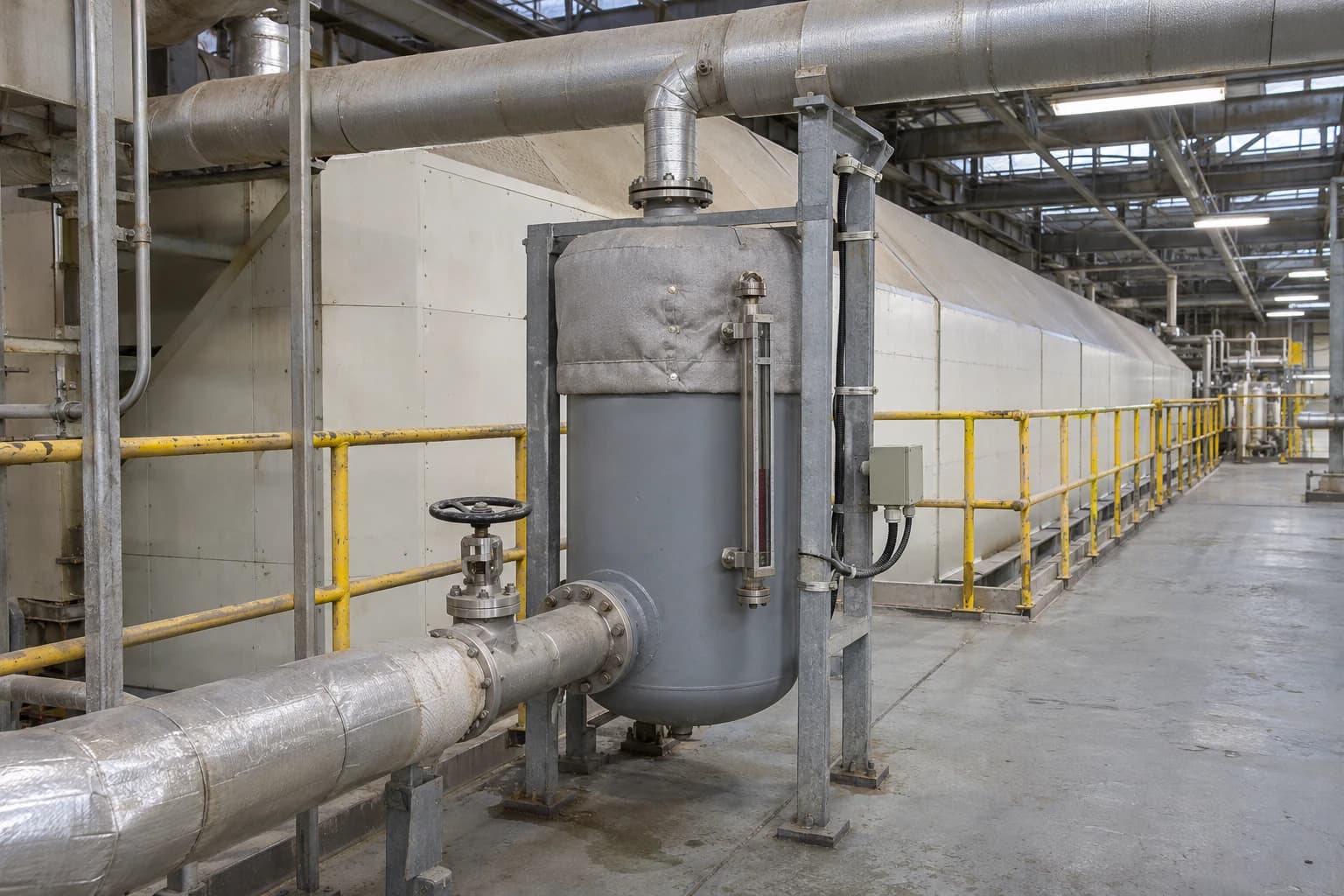
Pulp and Paper Process Simulation Reveals Mill Steam Losses
A mill-wide model tests steam, water and recovery-cycle changes against production limits.
Pulp and paper process simulation is a calibrated digital model of a mill’s material, water and energy flows. It quantifies where steam enters, transfers heat, condenses, flashes, returns or is lost. A published Northern Swedish mill study reported a 35% reduction in specific energy consumption for one paper-machine vacuum system, equivalent to 0.3 GJ/t, after assessing measures against mill-wide steam-balance constraints.
Steam losses rarely sit in one obvious place. A paper-machine dryer section may appear to consume excessive steam while the root cause lies in condensate handling, poor pressure matching between headers, an evaporator effect operating off-design, vacuum demand or a restriction in heat recovery elsewhere on site.
For UK and European kraft and integrated mills, pulp and paper process simulation turns plant data into a reconciled heat and mass balance. It shows which changes reduce purchased fuel or recovery-boiler demand, which merely shift energy use between departments, and which create a bottleneck in water quality, evaporation capacity or steam generation.

Map every energy and material flow in your process with detailed heat and mass balance calculations — the foundation for any optimisation or design project.
Why pulp and paper process simulation must be mill-wide
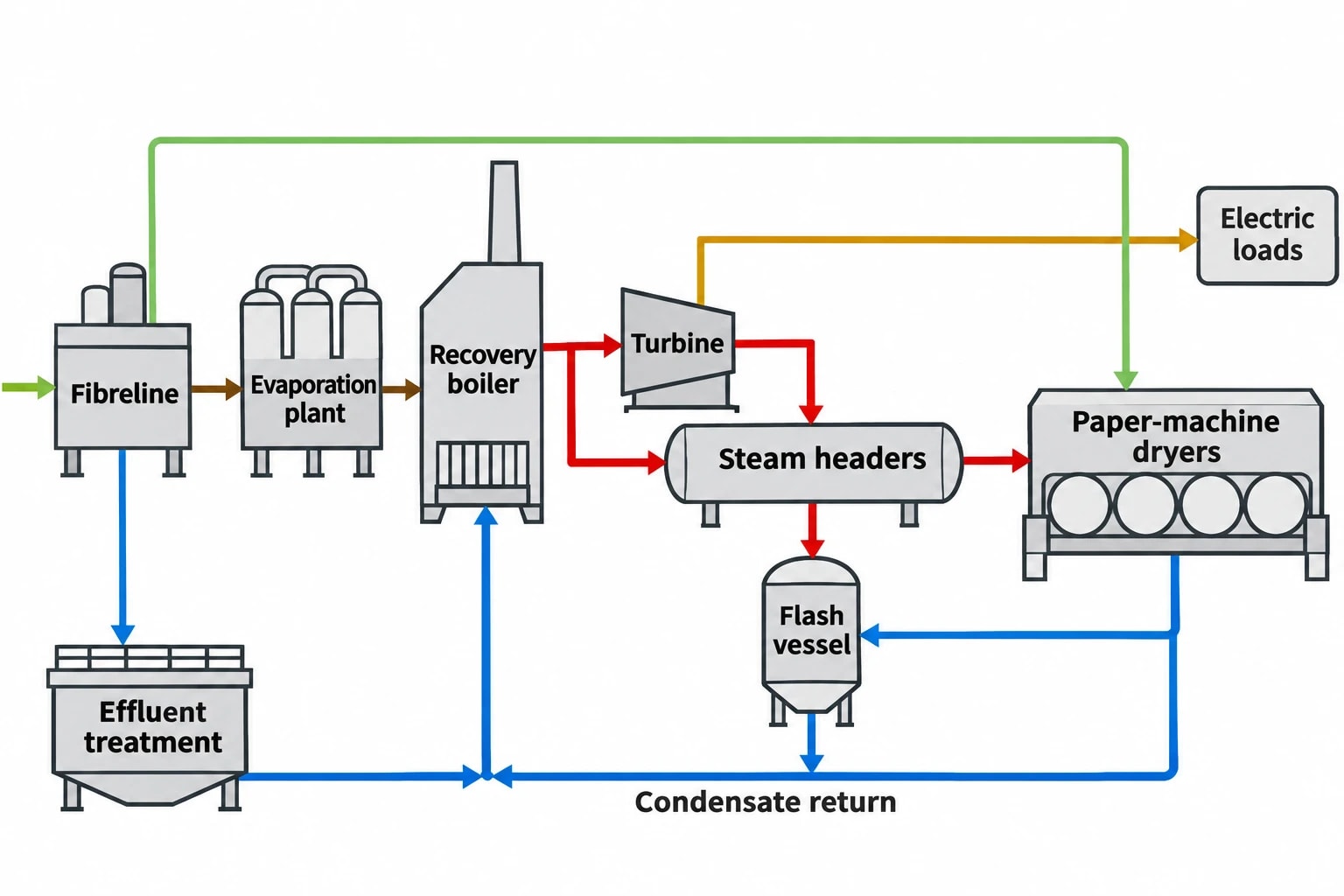
A pulp mill contains tightly coupled thermal systems. The fibreline, evaporation plant, recovery boiler, turbine, recausticising plant, paper machine and effluent treatment plant exchange heat, water, condensate and combustible liquor. Local optimisation can therefore produce a poor site result.
Reducing live-steam use in a dryer section, for example, may increase flash-steam demand from another header. Raising evaporator throughput may alter low-pressure steam availability for paper drying. Closing a white-water loop may reduce freshwater intake while increasing dissolved solids, temperature or biological load in a process-water circuit.
A mill-wide simulation resolves these interactions through connected mass and energy balances. It needs to represent:
- Fibre, water, black liquor, weak wash, condensate and non-condensable gas flows.
- Steam headers at their actual pressures and extraction conditions.
- Flash vessels, pressure-reducing stations, thermocompressors and condensate return systems.
- Heat exchangers, evaporator effects, dryers, hoods and cooling duties.
- Electrical loads that depend on process conditions, including vacuum pumps, fans and refiners.
- Production rates, grade changes and seasonal operating conditions.
The resulting model is a single source of truth. Each stream has an identified flow, temperature, pressure, composition and, where required, enthalpy. Energy balances can then distinguish a genuine steam loss from a measurement error, reporting-boundary issue or deliberate heat rejection needed for stable production.
Steam losses are often balance failures before they are equipment failures
A steam balance usually exposes losses in four forms: unaccounted flow, inappropriate pressure use, unrecovered condensate energy and avoidable heat rejection.
Unaccounted steam can arise from unmetered users, faulty flow instruments, leaking valves, bypasses left open after an upset, or condensate systems that send flash steam to atmosphere. A model cannot repair a leak, but it can quantify its likely scale and show whether site data is physically consistent.
Pressure mismatch also wastes useful energy. High-pressure steam may supply a duty that lower-pressure steam, flash steam or recovered vapour could meet. That choice increases turbine opportunity cost and can raise boiler load even where the paper machine appears stable.
Condensate deserves equal attention. Hot condensate holds sensible heat and can release flash steam when pressure falls. Sending it directly to drain, treating it as contaminated without evidence, or returning it at a temperature that disrupts feedwater treatment can erode site energy performance.
Building the heat and mass balance before choosing savings projects
A credible model begins with defined boundaries, measured data and reconciliation. Process-simulation software does not remove the need for engineering judgement; it makes that judgement visible, testable and repeatable.
Establish the production basis and operating case
The first model should represent a stable, documented operating period. The production basis must specify product grade, air-dried tonne definition, paper-machine speed, pulp production, purchased fuels, recovery-boiler operation and turbine condition.
Process engineers should avoid combining monthly energy totals with short-duration process measurements unless production and operating conditions match. Grade changes, planned shutdowns, washout periods and weather-driven cooling-water changes can distort a balance.
A useful initial data pack includes P&IDs, current process flow diagrams, steam-header drawings, historian trends, laboratory results, utility invoices, production reports and operator observations. Field checks matter: a header-pressure transmitter can be correctly calibrated while its pressure tap is plugged or poorly located.
Reconcile data rather than hiding uncertainty
Real mill data does not close perfectly. Water flowmeters drift. Liquor samples have laboratory uncertainty. Steam-flow calculations can be sensitive to pressure and temperature measurements. The model should retain measured values, accepted uncertainty and reconciled values.
Reconciliation identifies where evidence conflicts. A large water imbalance around the washer train may indicate a missing seal-water stream. A steam-header imbalance may reveal an unmetered desuperheater flow or condensate flash that has not been allocated to a user.
The goal is a balance that engineers can challenge. A model that closes only because its author has adjusted unexplained streams offers little value for capital decisions.
Select model detail according to the decision
A site-wide utility model does not require the same detail as a digester kinetics study. The appropriate level depends on the decision.
| Decision | Required modelling detail | Typical output |
|---|---|---|
| Steam-header reconciliation | Header pressures, flows, turbine extraction, pressure reduction and flash systems | Steam surplus or deficit by pressure level |
| Dryer section assessment | Cylinder groups, condensate removal, hood exhaust, steam and condensate pressures | Specific steam use and drying constraints |
| Evaporator assessment | Effect temperatures, liquor solids, vapour routing, condensate segregation | Live-steam demand and evaporation bottlenecks |
| Water-loop closure | Freshwater users, white water, filtrates, seal water, cooling water and contaminants | Water use, discharge flow and reuse limits |
| Recovery-cycle study | Black-liquor concentration, recovery-boiler steam, turbine and causticising demand | Fuel, steam and power consequences |
Aspen Plus, Aspen HYSYS and DWSIM can support different process-simulation tasks where property methods, component definitions and model boundaries suit the application. Process engineering teams should validate any platform model against plant measurements rather than relying on default assumptions.
Map every energy and material flow in your process with detailed heat and mass balance calculations — the foundation for any optimisation or design project.
Where simulations find mill steam losses
The most valuable steam findings occur at interfaces: a pressure transition, contaminated-condensate boundary, heat exchanger connecting two departments, or control action that protects one unit while adding load elsewhere.
Dryer sections and condensate systems
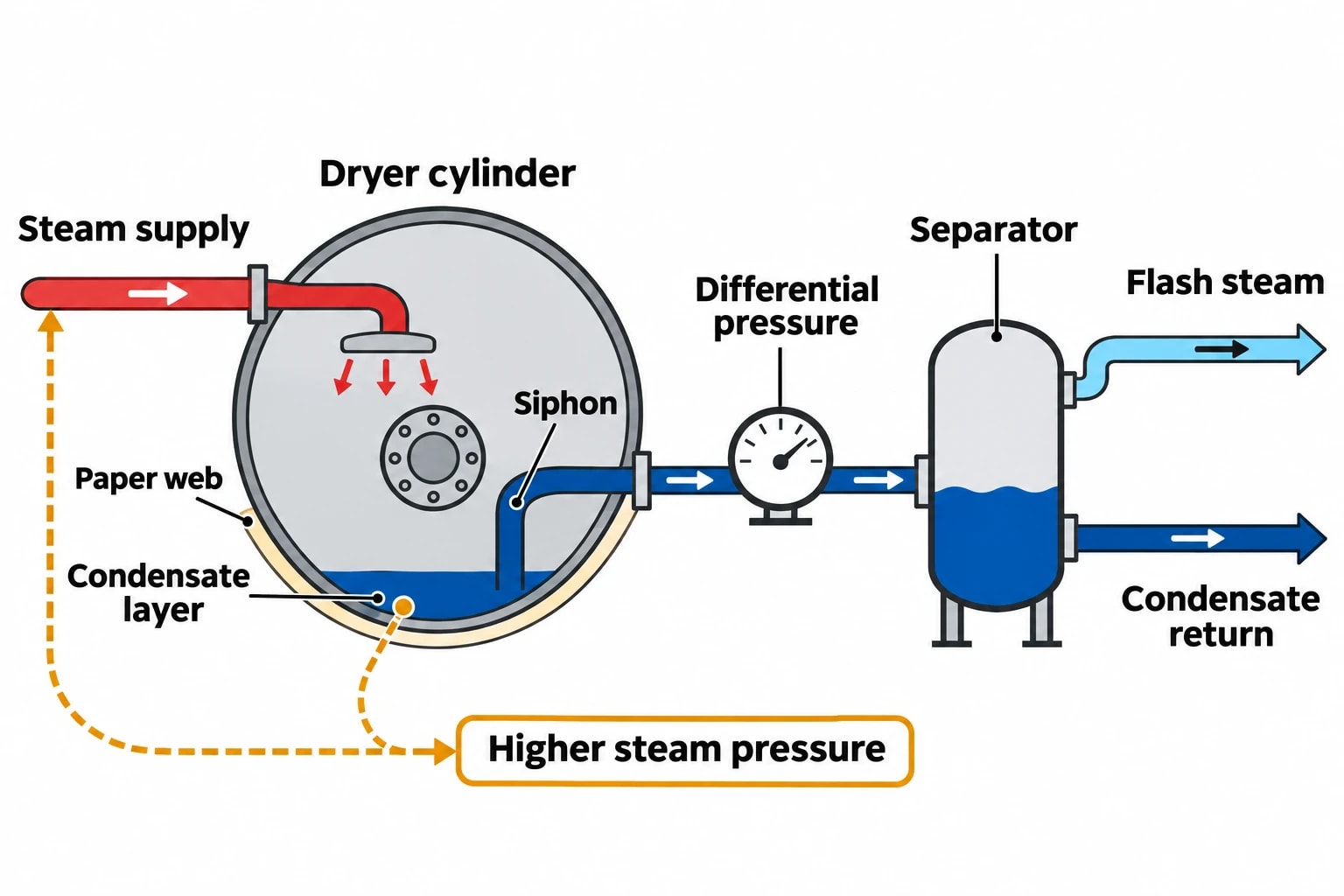
Paper-machine drying consumes large quantities of low- and medium-pressure steam. A mill-wide model should divide the dryer section into controllable zones or cylinder groups and track steam pressure, condensate pressure, differential pressure, flash recovery, hood exhaust and sheet moisture.
Poor condensate evacuation reduces heat transfer in dryers. Condensate backing up in a cylinder lowers available condensing area and prompts higher steam pressure to maintain drying. The paper machine then consumes more steam while the underlying restriction remains unresolved.
A model can test whether the issue is inadequate pressure differential, an undersized separator, a restrictive trap station, poor flash-steam recovery or a hood limitation. It can also show whether reducing dryer-steam pressure transfers an unacceptable moisture burden to a later section.
The EU pulp, paper and board BAT conclusions identify recovery of heat from hot-air emissions through evaporative condensation, heat exchangers, dryer-air preheating and hot-gas recirculation as relevant energy-efficiency techniques. The opportunity depends on temperature level, contamination risk, space and the heat sink available during the operating year.
Evaporation, recovery and low-pressure steam
Evaporation plants sit at the centre of the kraft mill energy system. Their duties affect black-liquor solids, recovery-boiler firing, live-steam use and vapour available to other processes.
An evaporation simulation should represent effect temperatures, liquor concentration, heat-transfer constraints, vapour-bleed locations, condensate routing and non-condensable-gas handling. A change in one effect can alter vapour availability for direct-contact evaporation, feedwater heating, stripping or paper-machine services.
The published Swedish model combined digester and evaporation sub-models with a complete plant model and validated it against actual mill measurements. This matters because an evaporator improvement can look attractive in isolation while reducing useful low-pressure steam or creating a turbine-system constraint.
Recovery-cycle studies should test weak black-liquor concentration, recovery-boiler steam conditions and causticising energy demand together. A change that reduces fossil fuel at one point may affect electricity generation, lime-kiln fuel demand or operating margin during a production upset.
Steam headers, turbines and flash steam
Steam-header reconciliation is one of the fastest routes to credible savings opportunities. It establishes actual generation, extraction, let-down, consumption, condensate return and flash-steam use at each pressure level.
Common findings include high-pressure steam reduced through a valve while a turbine has unused extraction capacity, medium-pressure users supplied from the wrong header, and flash steam vented because potential users lack a stable control arrangement.
The BAT conclusions under Commission Implementing Decision 2014/687/EU identify combined heat and power, use of excess heat, thermocompressors, and insulation of steam and condensate pipe fittings as techniques for reducing fuel and energy consumption in pulp and paper mills. A simulation helps assess these options against real pressure levels and seasonal demand, rather than treating them as generic projects.
Water circuit closure must be modelled with quality constraints
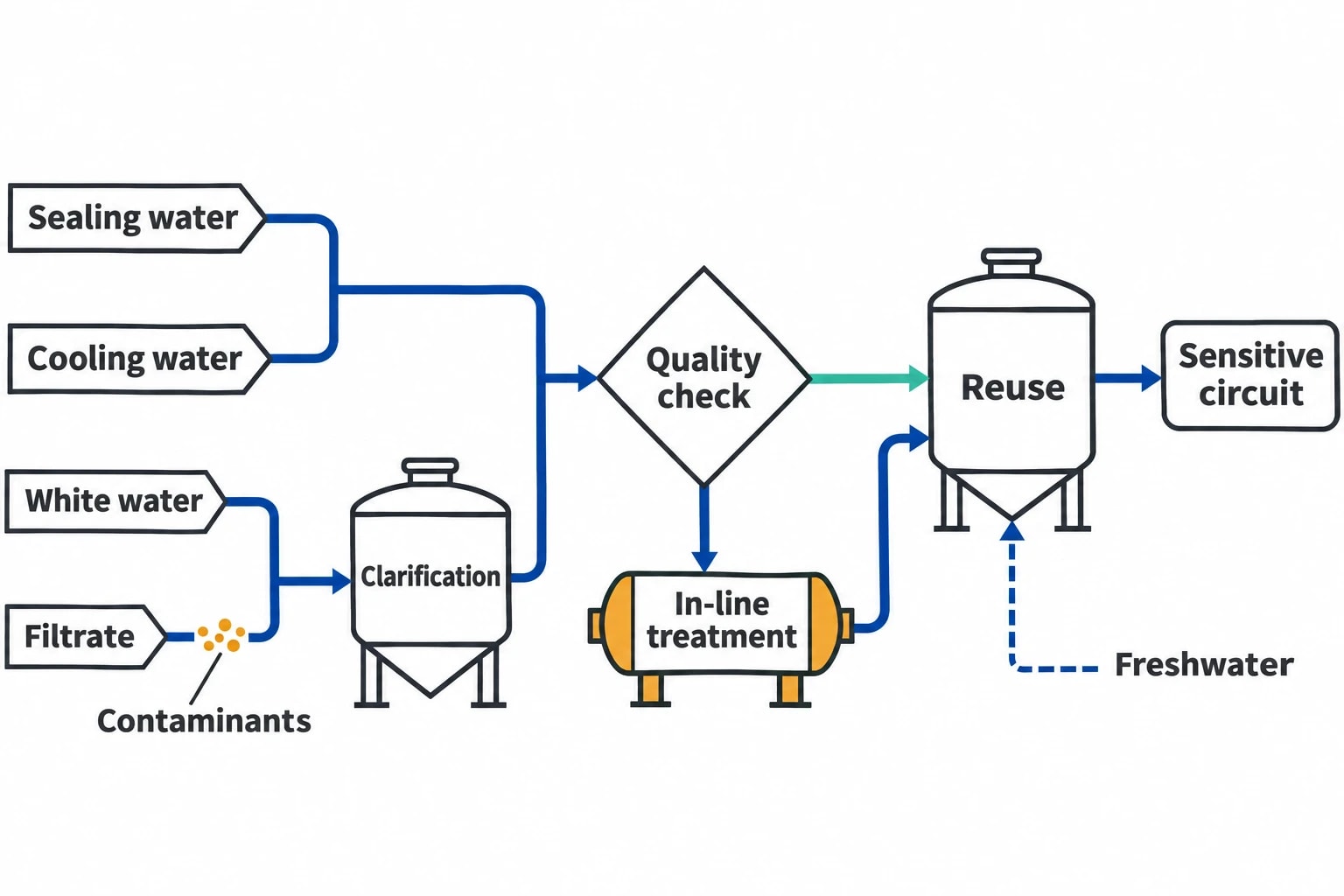
Water is a heat-transfer medium, fibre carrier and contamination pathway. A water balance that tracks only total flow misses the restrictions that determine whether reuse is viable.
Commission Implementing Decision 2014/687/EU states in BAT 5 that mills should close water systems to the degree technically feasible for the pulp and paper grade produced. For bleached kraft pulp, BAT 5 gives a treated wastewater-flow range of 25 to 50 m³/ADt as a yearly average at the point of discharge after wastewater treatment.
That range is a benchmark, not a universal operating target. It should be interpreted with product quality, water availability, existing treatment infrastructure and permit requirements. A mill should not force closure beyond its practical limit merely to achieve a lower figure.
Track contaminants as well as water volume
White-water and filtrate-loop studies should include the contaminants that restrict reuse. Depending on the mill, these may include dissolved organic material, suspended solids, calcium, silica, sodium, chloride, potassium, nutrients, microorganisms, resin acids or process chemicals.
Excessive closure can cause deposits, corrosion, foaming, odour issues and paper-quality problems. The BAT conclusions recognise technical limitations including precipitation and incrustation, as well as potential odour impacts.
A simulation can identify where relatively clean streams, such as separated sealing water or clean cooling water, can displace freshwater use without carrying contaminants into sensitive circuits. It can also test the effect of in-line treatment, filtration, clarification or segregation before a reuse project proceeds to design.
Connect water closure to the steam balance
Water and steam models must share their boundaries. Hot white water, filtrates and condensates carry recoverable heat. Added fresh water can increase heating duty. Reuse can reduce heating demand but raise evaporation load or alter the temperature of effluent treatment.
This is especially important where a mill plans condensate reuse. The model should establish whether condensate quality is suitable, whether flash steam can be recovered, how much makeup water it replaces, and whether the receiving system needs a lower temperature or improved segregation.
Turning the model into an implementation roadmap
A simulation becomes commercially useful when it ranks actions by energy impact, production risk, capital requirement and measurement confidence. A list of theoretical heat sources is not a roadmap.
EnerTherm Engineering’s 11-step heat and mass balance methodology covers data acquisition, model development, validation and prioritisation. The resulting process flow diagram should include embedded stream tables and reconciled duty information, allowing mill teams to trace a proposed saving to measured evidence.
Test more than the preferred operating case
A model should be tested against normal production, grade changes, reduced production, summer cooling conditions and plausible upset conditions. The preferred operating point may not represent the period when steam constraints are most expensive.
Priority measures often include:
- Repairing or metering a defined steam or condensate loss.
- Recovering flash steam where a stable heat user exists.
- Correcting pressure-level allocation and turbine extraction strategy.
- Improving condensate removal or heat-transfer performance in dryer systems.
- Recovering heat from exhaust air, condensate or process-water streams.
- Segregating water streams before attempting wider circuit closure.
- Removing an evaporator, steam-header or vacuum-system constraint that limits production.
Each action needs a measurable baseline. ISO 50001:2018 supports this discipline through energy reviews, energy-performance indicators, baselines, operational control and improvement planning. A mill model can provide the engineering basis for those indicators, while plant meters and production records verify performance after implementation.
The strongest pulp and paper process-simulation programmes maintain the model after the first audit. They use it to examine new grades, replacement equipment, water restrictions, recovery-boiler changes and decarbonisation projects.
This article reflects the independent analysis and editorial opinion of EnerTherm Engineering. Product names, trademarks, and brands mentioned belong to their respective owners. EnerTherm Engineering is not affiliated with, endorsed by, or a licensee of any third-party software or product mentioned unless explicitly stated.

Managing Director — EnerTherm Engineering
Dr. François Pierrel is Managing Director of EnerTherm Engineering with over two decades of expertise in thermal design, heat transfer, and industrial energy optimisation. He holds a PhD in Heat Transfer from Cranfield University and a Post-Doctorate from Heriot-Watt University.
