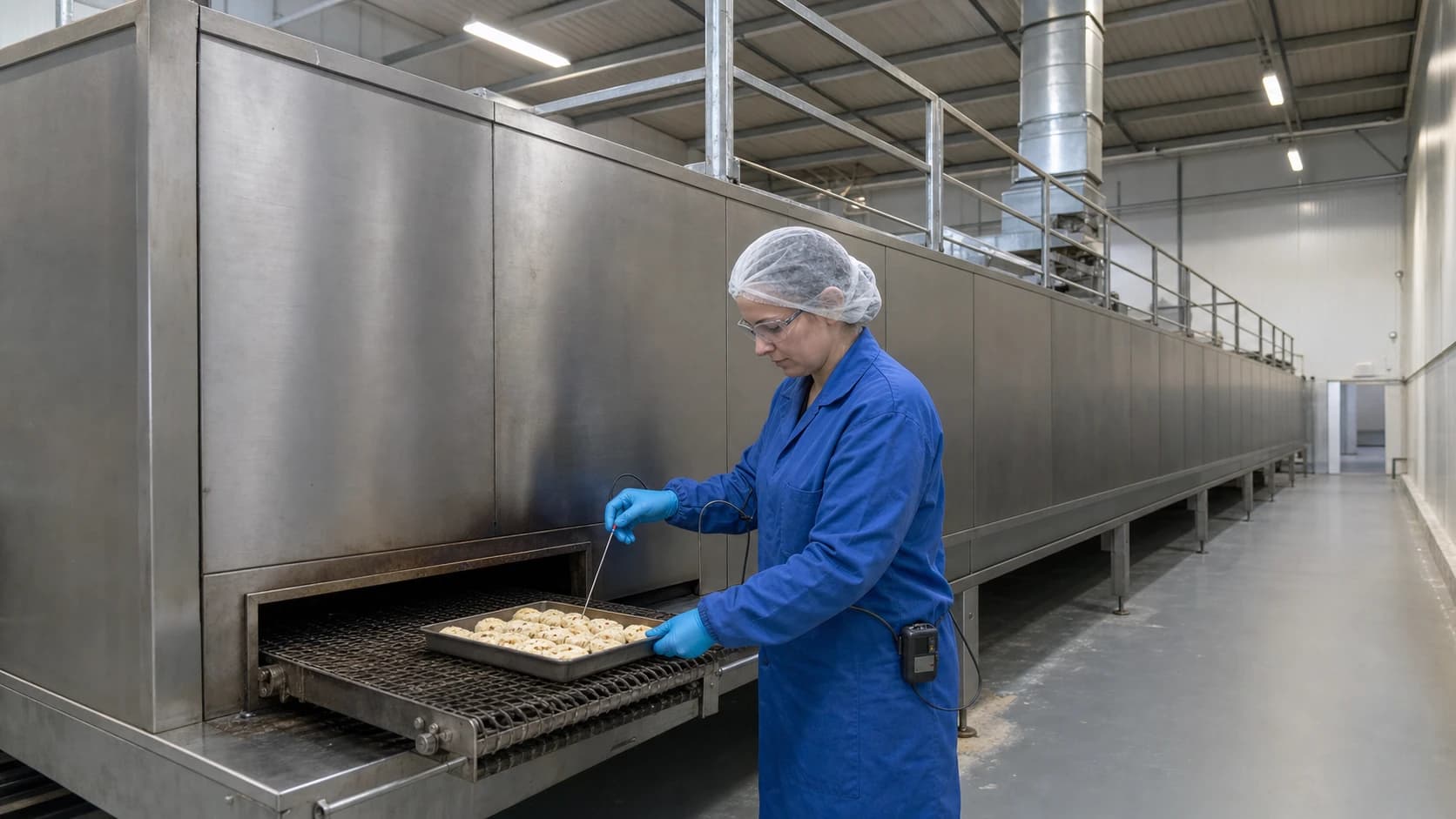
How Food Manufacturing Process Simulation Protects HACCP
An 11-step model tests pasteurisation, baking and chilling limits before plant changes.
Food manufacturing process simulation uses validated heat and mass-balance models to predict how product, air, water, steam and refrigeration behave through production, helping ensure HACCP critical limits remain achievable when operating conditions change.
The UK Government’s Food and Drink Roadmap identifies process design, pasteurisation, cleaning-in-place, advanced oven technology, drying, refrigeration and steam systems as decarbonisation options. Its maximum-technology pathway modelled steam-production, distribution and end-use measures rising from 25% deployment in 2020 to 100% by 2050. Such technical change raises a practical food-safety question: will the revised process still provide the thermal treatment, moisture control and chilling performance required by the HACCP plan?
A robust process model helps engineers answer that question before changing a damper setting, reducing steam pressure, fitting heat recovery, increasing line speed or installing different thermal equipment. It does not replace HACCP validation, production trials or microbiological evidence; it makes them more targeted, traceable and technically defensible.
Why food manufacturing process simulation matters to HACCP
Retained Regulation (EC) No 852/2004, Article 5 requires food business operators to put in place, implement and maintain permanent procedures based on HACCP principles. Those procedures must identify hazards, critical control points, critical limits, monitoring, corrective action, verification and records.
Thermal processes sit at the centre of many controls. Pasteurisation, cooking, baking, drying and chilling may determine whether a microbiological hazard is eliminated, reduced or controlled. Their performance depends on more than one temperature indication.
A pasteuriser can show a compliant outlet temperature while changes in product flow alter holding time. An oven can maintain its setpoint while belt loading, humidity or airflow leaves the product’s thermal centre outside the intended process window. A chiller can meet an average air condition while warm product leaves a congested part of the line.
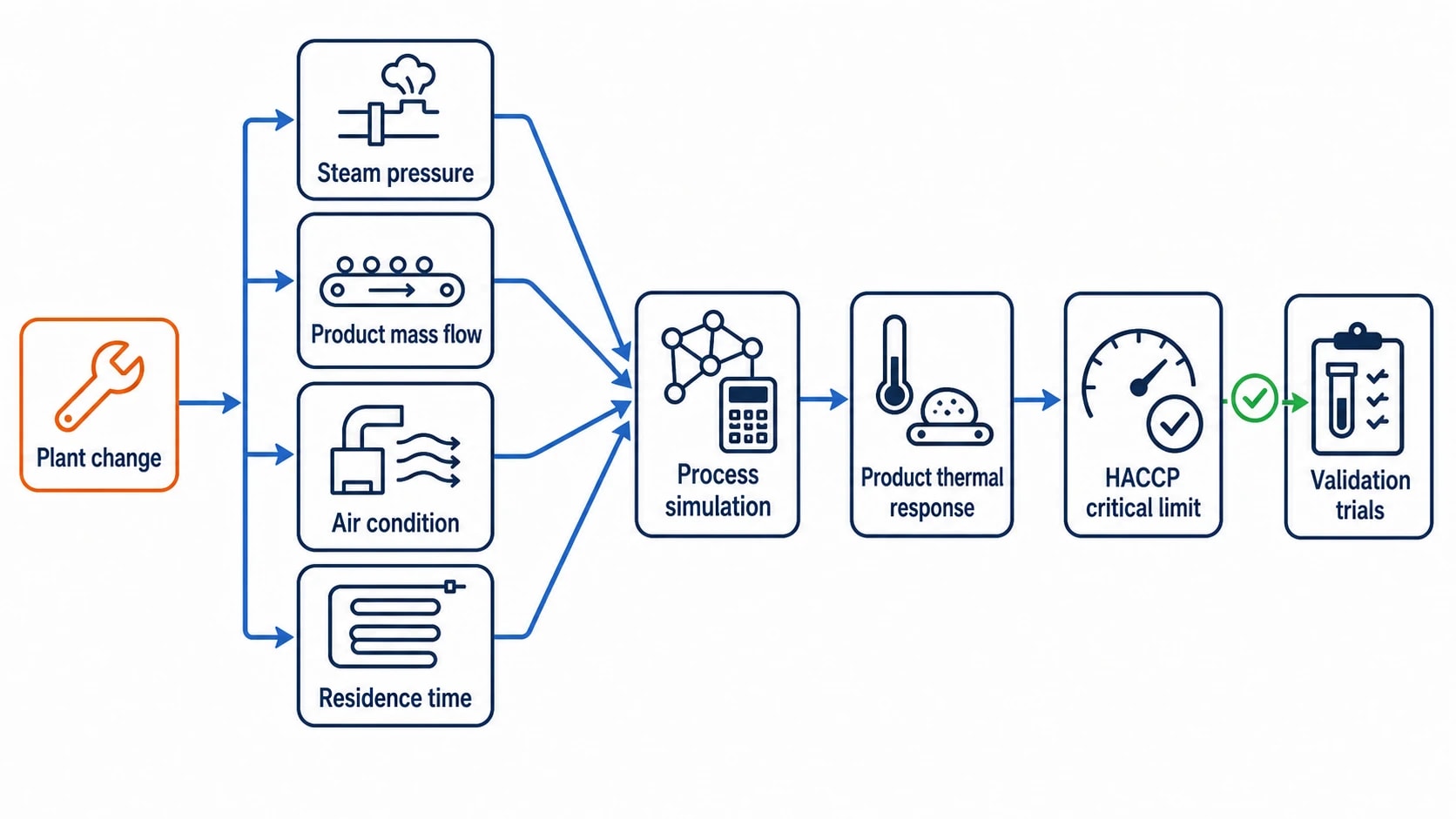
Process simulation tests the relationships behind those outcomes. It links measurable site conditions to product response:
- Product mass flow, composition and inlet temperature.
- Steam pressure, condensate return and heat-exchanger duty.
- Air temperature, humidity, velocity and recirculation in ovens and dryers.
- Heat loss through equipment surfaces, ducts and pipework.
- Water evaporation, condensate formation and product moisture.
- Residence time through holding tubes, tunnels, conveyors and cooling zones.
- Refrigeration duty and product cooling load.
This is particularly useful when an energy project changes a process parameter that also affects a HACCP control measure.

Map every energy and material flow in your process with detailed heat and mass balance calculations — the foundation for any optimisation or design project.
HACCP critical limits need process capability, not only a setpoint
The Food Standards Agency describes a critical limit as the value at a critical control point that separates acceptable from unacceptable product. Its MyHACCP guidance gives milk pasteurisation at 72°C for 15 seconds as an example. The manufacturer must demonstrate that the equipment can achieve the limit consistently.
The difference between a setpoint and a critical limit
A setpoint instructs a control system. A critical limit is the safety boundary in the HACCP plan. They may be related, but they are not interchangeable.
For example, a pasteuriser’s hot-water-loop temperature may be a control setpoint. The HACCP-critical condition may instead concern product temperature and holding time at a defined point in the process. A bakery may control several oven-zone temperatures, while its food-safety evidence requires the product’s time-temperature history at the coldest relevant location.
Simulation reveals the gap between available utility conditions and delivered process conditions. It can show whether lower steam pressure, altered water temperature, higher throughput or reduced recirculation airflow leaves too little margin above the critical limit.
Why process changes trigger HACCP review
The Food Standards Agency states that HACCP plans require review when equipment, layouts or processes change. An energy-saving project is therefore a food-safety change as well as an engineering change.
Relevant changes include:
- Increasing conveyor speed through a cooker, oven, tunnel pasteuriser or chiller.
- Recovering heat from exhaust air, condensate or refrigeration systems.
- Reducing oven exhaust or changing damper positions and recirculation rates.
- Replacing a boiler, heat exchanger, refrigeration plant or circulating pump.
- Altering clean-in-place temperature, flow, concentration or cycle duration.
- Changing product size, moisture, recipe, pack format or line loading.
A model provides a controlled assessment before the factory adopts these changes. The HACCP team can use its output to identify where validation data is needed, which instrumentation requires checking and which operating conditions create the narrowest safety margin.
Building the heat and mass balance behind the HACCP plan
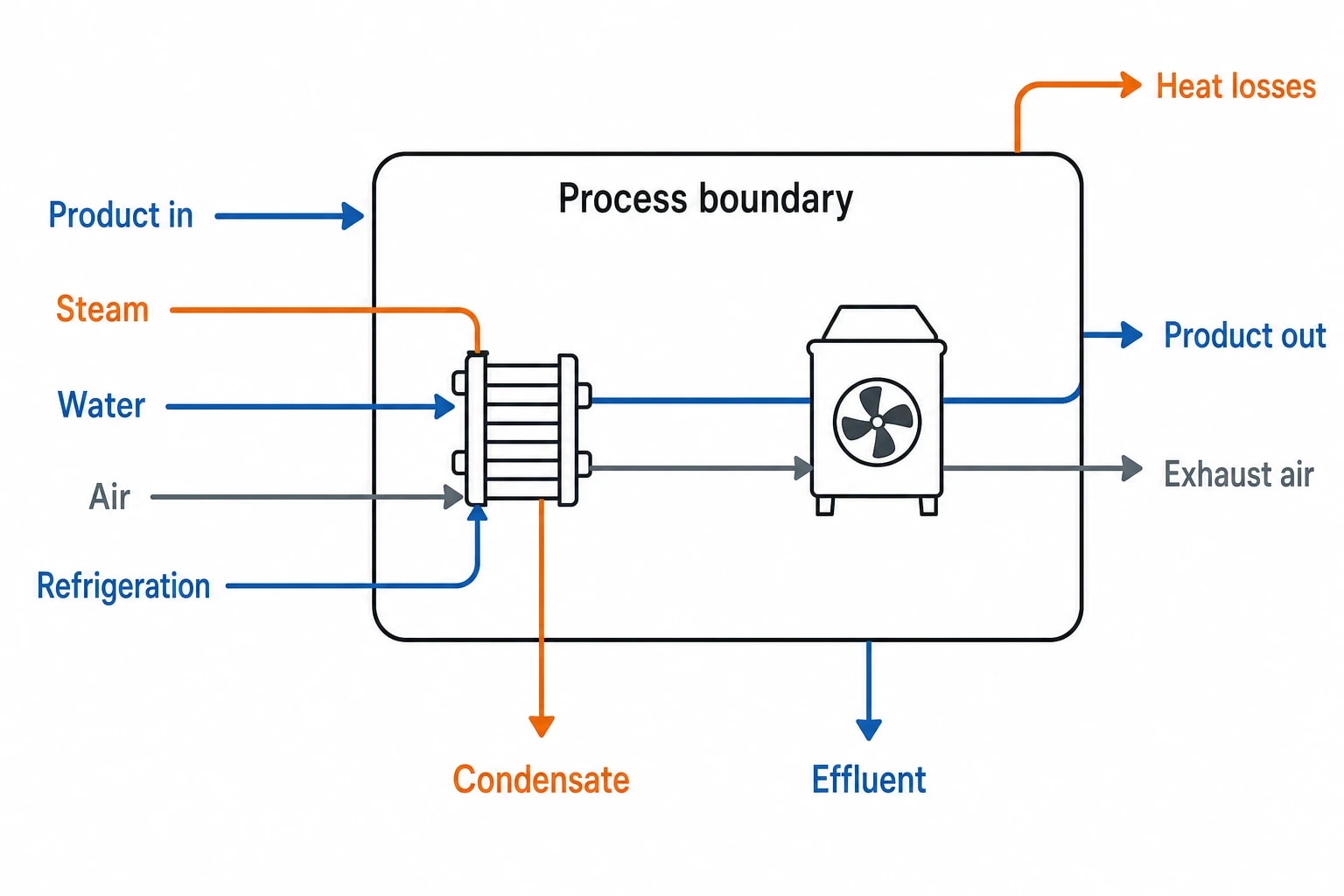
A food manufacturing process simulation begins with a credible process boundary. It may cover one item of equipment, such as a plate heat exchanger, or an integrated process from boiler house to pasteuriser and condensate return.
The objective is to account for significant material and energy streams. Missing streams can produce misleading savings estimates and obscure food-safety conditions.
Start with the real operating line
The first task is to reconcile design information with plant behaviour. Piping and instrumentation diagrams, equipment schedules, historical logs, production records and utility meters establish the starting point. Engineers compare this information with field observations and targeted measurements.
The model should distinguish between nameplate capacity and actual operation. Food plants often run multiple recipes, pack sizes and shift patterns. A model based on one nominal production rate may miss the high-moisture product, cold-start condition, peak line loading or reduced utility pressure that defines the difficult operating case.
A practical data set may include:
| Process area | Useful measurements | HACCP relevance |
|---|---|---|
| Pasteurisation | Product flow, inlet and outlet temperatures, heating-medium temperatures, holding-tube conditions | Confirms the process can achieve the required temperature and residence time |
| Oven or cooker | Zone temperatures, air flow, exhaust conditions, belt speed, product loading and core-temperature checks | Tests product heating across changing loads and operating zones |
| Dryer | Feed moisture, discharge moisture, air temperature, humidity, flow and exhaust conditions | Connects drying duty with moisture control and product stability |
| Chilling | Product inlet and outlet temperature, dwell time, refrigerant duty, air temperature and air flow | Assesses cooling capacity at the required production rate |
| Steam system | Boiler output, pressure, steam flow, condensate return, flash steam and trap condition | Reveals whether utilities can maintain heat duty at process demand |
Track water as carefully as energy
Moisture is a product-quality variable and, in many applications, a food-safety variable. In baking and drying, water leaving the product carries a substantial latent heat load. In a chiller or refrigeration system, moisture condensation and infiltration add to cooling duty. In cleaning-in-place, water use affects heat demand and the ability to achieve the intended cycle.
A mass balance tracks where water enters, remains in the product, evaporates, condenses or leaves as effluent. An energy balance identifies the heat needed to raise product temperature, evaporate water, provide phase change in steam or refrigeration systems, and cover heat losses.
For a snack dryer, this prevents a common error: treating lower gas or steam use as a net improvement when reduced drying duty leaves more water in the finished product. For a bakery oven, it separates energy used to heat the product from energy carried away through exhaust air and moisture.
Use steady-state and dynamic models for different questions
A steady-state model is useful for normal operation, utility demand, heat-recovery potential and comparative scenarios. It can show how condensate recovery or a revised oven-exhaust rate changes fuel demand at a given throughput.
A dynamic model is more valuable when the question involves time. Start-up, product changeovers, line stoppages, temperature recovery after a door opening, variable product loading and cooling response all involve transient behaviour. These events can create the shortest period between normal operation and loss of control.
For HACCP purposes, the model should focus on the variables that determine the critical limit. It need not become a digital replica of every pipe, valve and instrument on site.
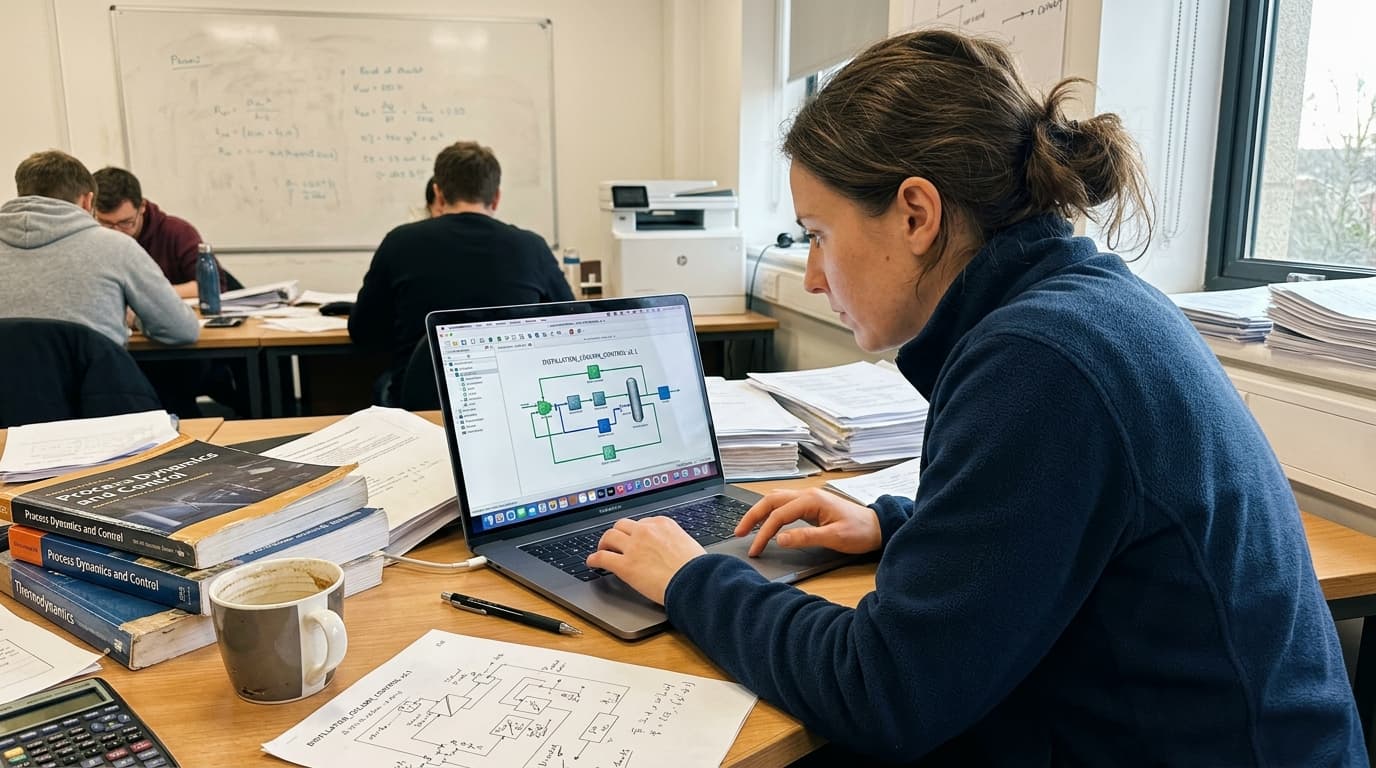
Map every energy and material flow in your process with detailed heat and mass balance calculations — the foundation for any optimisation or design project.
Applying simulation to thermal HACCP control points
The technical emphasis changes by process, but the engineering discipline remains the same: identify the safety-relevant product condition, the utility and equipment factors that create it, and validate the model against measured performance.
Pasteurisers: temperature, flow and holding time
A pasteurisation simulation links product flow, heat-exchanger performance, heating-medium conditions, fouling allowance and holding-tube volume. It can test whether increased throughput reduces residence time or lower hot-water temperature reduces the product-temperature margin.
The model must represent the actual product where practical. Density, viscosity and heat capacity differ between skimmed milk, cream, flavoured beverages, sauces and high-solids products. These differences affect pumping, heat transfer and thermal response.
The study should identify conditions requiring production evidence, including:
- Minimum heating-medium temperature or steam pressure.
- Maximum product flow at the defined holding time.
- Product inlet-temperature range.
- Heat-exchanger condition, including realistic fouling.
- Instrument locations used for monitoring and diversion decisions.
A simulation can predict capability, but the HACCP team still needs validation that the chosen critical limit controls the identified hazard. Where published evidence does not establish an adequate limit, the Food Standards Agency notes that mathematical or microbiological modelling may need support from challenge testing or other relevant studies.
Ovens and cookers: find the product condition, not the air average
Oven controls often report air temperature by zone. Food safety and quality depend on conditions inside and around the product. Heat reaches food through convection, radiation and conduction, while evaporation can limit surface temperature and remove substantial energy.
A multi-zone oven model can examine belt speed, zone temperatures, air recirculation, exhaust rate, damper position, product loading and incoming product temperature. It can identify combinations that reduce product heating or change moisture removal.
This matters when an energy project proposes lower exhaust rates or revised recirculation. The 2015 Food and Drink Roadmap lists advanced oven measures including optimising damper settings, balancing oven airflows, improving fan drives and improving integrated oven controls. These measures may reduce energy use, but must preserve the validated thermal profile, product moisture and hygienic operation.
Core-temperature checks, surface-temperature measurements and representative product trials remain essential. A model helps select the measurement positions and operating cases most likely to expose weak performance.
Dryers: moisture removal is a controlled process outcome
Dryers involve coupled heat and mass transfer. Hot air supplies energy while the process removes water vapour from the drying zone. Reduced temperature, airflow or exhaust performance may cut energy demand but also reduce the moisture-removal rate.
A dryer model should account for feed rate, initial moisture, target moisture, air temperature, humidity, flow rate, product residence time and exhaust conditions. Process engineers can then assess whether higher throughput or heat recovery leaves enough drying capacity for the wettest expected feed.
This supports HACCP where product moisture, water activity or process conditions form part of the control strategy. It also protects quality: over-drying can cause excess breakage, poor texture and unnecessary energy consumption.
Chilling and refrigeration: assess the product cooling curve
Chilling systems require more than a room-air setpoint. Product mass, pack geometry, loading pattern, dwell time, evaporator performance and airflow distribution determine the product cooling curve.
A model can calculate cooling duty at higher production rates, with warmer incoming product or altered refrigeration arrangements. It can also show whether an energy-reduction proposal changes the time required to reach the required product temperature.
The validation plan should compare predicted and measured product temperatures at representative locations. Air temperature alone does not prove that the slowest-cooling product achieved the intended condition.
Simulation validation must produce auditable evidence
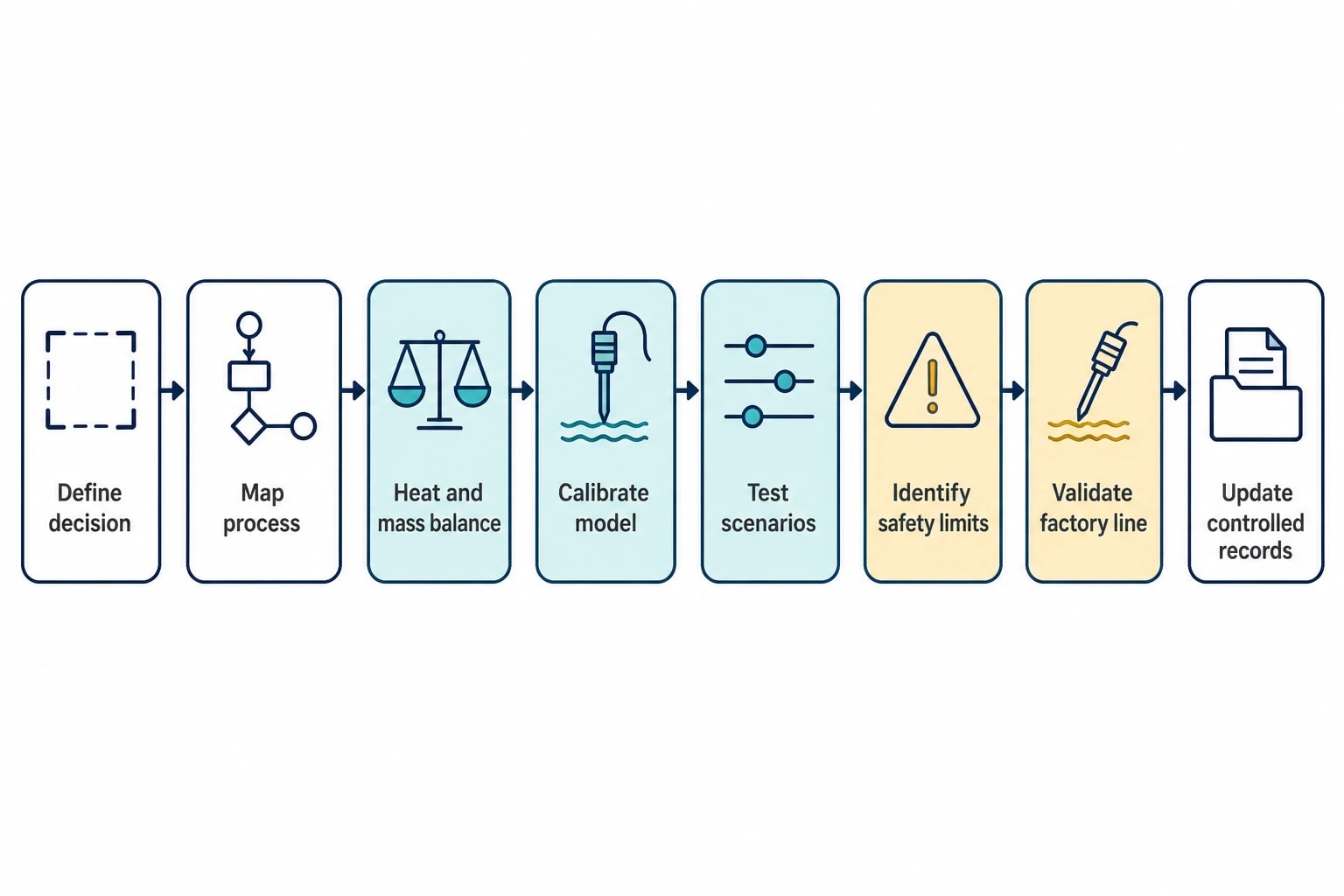
Simulation makes assumptions visible, but it becomes reliable only when the site tests them against measured plant data.
The Food Standards Agency distinguishes validation, verification and review. Validation asks whether the HACCP plan can produce safe food. Verification checks that it works in practice. Review ensures that it remains current after change.
A practical validation sequence
An engineering and HACCP team can use the following sequence:
- Define the decision. State which equipment, recipe, throughput and critical control point are in scope.
- Map the process. Produce a current process flow diagram with utilities, product streams, control points and measurement locations.
- Build the heat and mass balance. Include product, air, steam, water, condensate, refrigeration and significant heat losses.
- Calibrate the model. Compare it with measured temperatures, flows, moisture, energy use and production data.
- Test operating scenarios. Examine proposed energy measures and relevant low-margin conditions.
- Identify safety-relevant limits. Translate outputs into operating ranges, alarm priorities, trial requirements and monitoring needs.
- Validate on the factory line. Use temperature, time, moisture, microbiological or other relevant evidence required by the HACCP plan.
- Update controlled records. Retain the model basis, source data, assumptions, trial results, approvals and revised procedures.
This provides a clear route from engineering data to HACCP evidence without presenting a simulated result as proof on its own.
Hygienic design must remain in scope
Equipment changes can affect cleanability. BS EN 1672-2:2020 covers hygiene and cleanability requirements for food-processing machinery. This applies when a project alters oven internals, ductwork, heat exchangers, dryers, conveyor arrangements or cleaning-in-place interfaces.
Modelling can identify the thermal and flow consequences of a design change, but the project team must separately assess access, drainage, surface condition, cleanability and the cleaning regime. A heat-recovery loop that improves energy performance but complicates cleaning or creates an unsuitable interface requires redesign before installation.
Turning food manufacturing process simulation into better investment decisions
The strongest projects treat energy, throughput, quality and HACCP as connected constraints. Savings are credible when the model demonstrates sufficient thermal or cooling capacity at the required production rate, with allowance for realistic operating variation.
For EnerTherm Engineering, this means developing one process flow diagram with embedded stream tables, validated mass and energy balances, and energy mapping. The work begins with site data, then moves through simulation validation and parametric optimisation. The final decision should state the expected utility change alongside its effect on critical limits, product moisture, thermal profile and operational margin.
The 2050 Food and Drink Roadmap gives process design and steam-system improvement a prominent place in industrial decarbonisation. Food manufacturers can pursue these measures without weakening food safety when modelling is tied directly to HACCP validation, monitoring and controlled change management.
This article reflects the independent analysis and editorial opinion of EnerTherm Engineering. Product names, trademarks, and brands mentioned belong to their respective owners. EnerTherm Engineering is not affiliated with, endorsed by, or a licensee of any third-party software or product mentioned unless explicitly stated.

Managing Director — EnerTherm Engineering
Dr. François Pierrel is Managing Director of EnerTherm Engineering with over two decades of expertise in thermal design, heat transfer, and industrial energy optimisation. He holds a PhD in Heat Transfer from Cranfield University and a Post-Doctorate from Heriot-Watt University.
