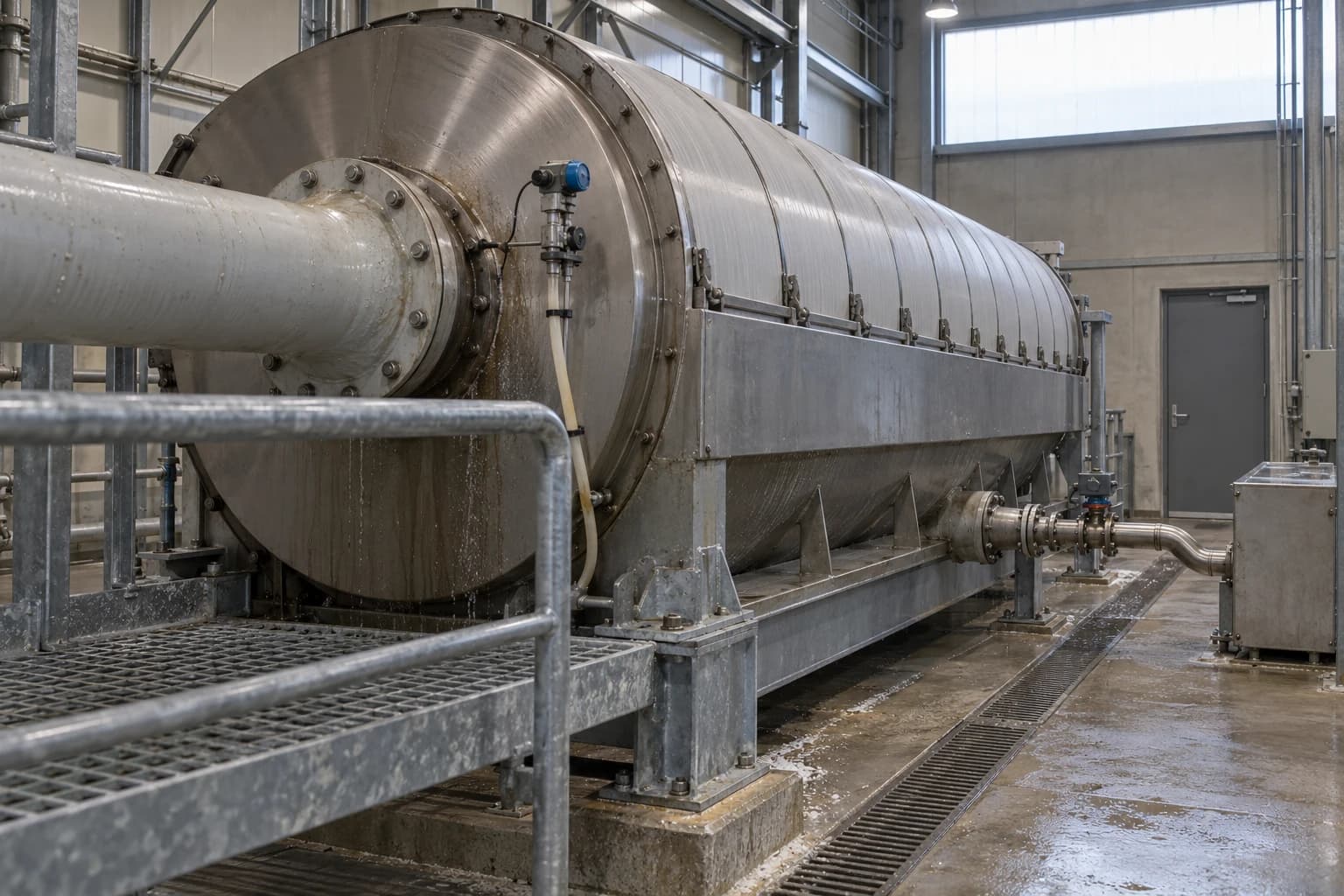
Water Circuit Closure in Pulp Mills: Why Purge Matters
BAT benchmarks put treated discharge at 25-50 m³/ADt for integrated bleached kraft mills.
Water circuit closure in pulp and paper is the controlled reuse of white water and filtrates to reduce freshwater intake and wastewater discharge while keeping recirculating contaminants within limits that the process and product can tolerate.
Commission Implementing Decision 2014/687/EU identifies this balance in BAT 5 for pulp, paper and board production. It calls for water systems to close to the technically feasible degree while accounting for product quality, water quality, precipitation or incrustation, and odour.
For a kraft or integrated mill, reuse is not the hard part. White water, washer filtrate and other process streams often have a useful destination. The difficult engineering decision is setting the treatment, reuse and purge arrangement that removes contaminant load without discarding recoverable heat, fibre or water.
A low freshwater figure can conceal unstable wet-end chemistry, deposits and deteriorating runnability. Purge provides the controlled exit route that prevents these outcomes.
Why water circuit closure matters in pulp and paper
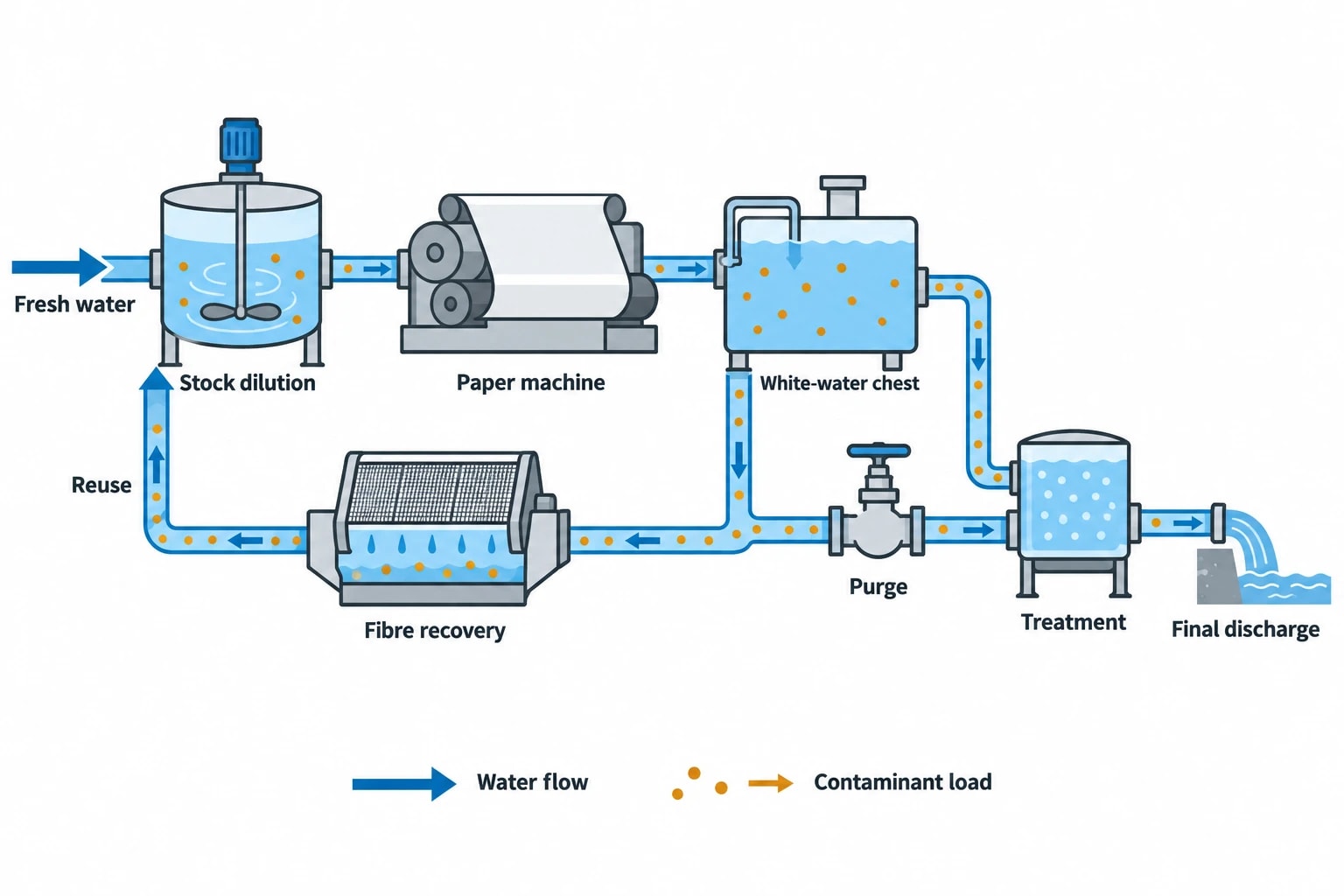
Paper machines circulate large water flows through stock dilution, forming, white-water recovery, showers, vacuum systems and broke handling. Integrated mills add pulp washing, bleaching, evaporator condensates, utility systems and wastewater treatment to the overall balance.
Closing loops can reduce several burdens:
- Freshwater abstraction and associated treatment.
- Hydraulic loading at the effluent treatment plant.
- Heat losses from warm process water.
- Fibre, fines and filler losses to wastewater.
- Pumping and heating duties associated with replacement water.
Those benefits depend on the quality of the reused stream and the receiving duty. Water from a white-water chest may be suitable for stock dilution but unsuitable for a high-pressure shower. A warm filtrate may reduce makeup-water heating but introduce dissolved material into a sensitive loop.
BAT-associated wastewater-flow values show the scale of the wider mill water balance. For bleached kraft pulp, the annual average flow at the discharge point after wastewater treatment is 25 to 50 m³ per air-dry tonne, or ADt. For non-integrated paper mills, the associated range is 3.5 to 20 m³ per tonne.
These values are reference ranges for treated final discharge, not targets for an individual white-water loop. They help engineers test whether a closure project improves the whole-site balance or merely transfers water and contaminant load across system boundaries.
Closure changes composition, not only flow
Each cubic metre in a paper-machine loop transports heat, suspended solids, dissolved salts, organic matter and chemical additives. As reuse rises, fresh water supplies a smaller proportion of the loop. Species that do not leave with the sheet, recovered solids, sludge or another removal route become more concentrated.
A stable circuit requires two connected balances:
- A hydraulic balance for water flows, inventories and overflows.
- A species balance for contaminants, additives and valuable material.
The hydraulic balance can appear sound while chemical conditions deteriorate. A loop may hold a stable tank level and flow rate while conductivity, cationic demand or chemical oxygen demand rises beyond the operating window.

Map every energy and material flow in your process with detailed heat and mass balance calculations — the foundation for any optimisation or design project.
What accumulates in closed white-water and filtrate loops?
Dissolved and colloidal substances
Dissolved and colloidal substances, commonly called DCS, frequently limit further water-circuit closure in pulp and paper. In virgin-fibre production, DCS can include hemicelluloses, extractives and lignin-related material. Recycled-fibre systems can introduce adhesives, coating residues, inks and other contaminants.
Small colloids and anionic dissolved material can interfere with cationic retention and drainage aids. The effects can include reduced retention of fines and fillers, slower drainage, higher chemical demand, deposits and variation in sheet properties.
DCS concentration alone does not identify the risk. Process conditions affect how material behaves. Changes in pH, temperature, shear, salt concentration and chemical addition can destabilise colloids that were previously dispersed. Deposits may then develop on machine surfaces, fabrics, tanks or shower equipment.
Salts, hardness and inorganic deposits
Reuse concentrates inorganic species as well as organic material. Sodium, chloride, sulphate, calcium and carbonate can pass between loops that once had limited contact.
Conductivity is useful for detecting a general rise in dissolved ionic material. It cannot identify which ion has changed or whether the rise creates a problem. A species-level model is needed where corrosion, scaling or product contamination is a concern.
Calcium deserves close attention in mills using calcium carbonate filler or hard source water. Local conditions at a mixing point matter as much as the bulk-water result. Temperature, pH, alkalinity and concentration can create precipitation risk at a heat exchanger, felt shower, storage tank or wire section even where average loop chemistry appears acceptable.
Organic loading, microbiology and odour
Higher closure can increase the organic load available to microorganisms. Warm loops with long residence times, nutrients and retained solids may support slime and biofilm growth. Mills can then face odour, deposits, reduced drainage and web breaks.
BAT 5 specifically recognises odour and precipitation or incrustation as potential limits on further closure. The technically feasible closure point is therefore a process-specific operating limit, not the lowest possible freshwater flow.
Why purge stabilises water circuit closure
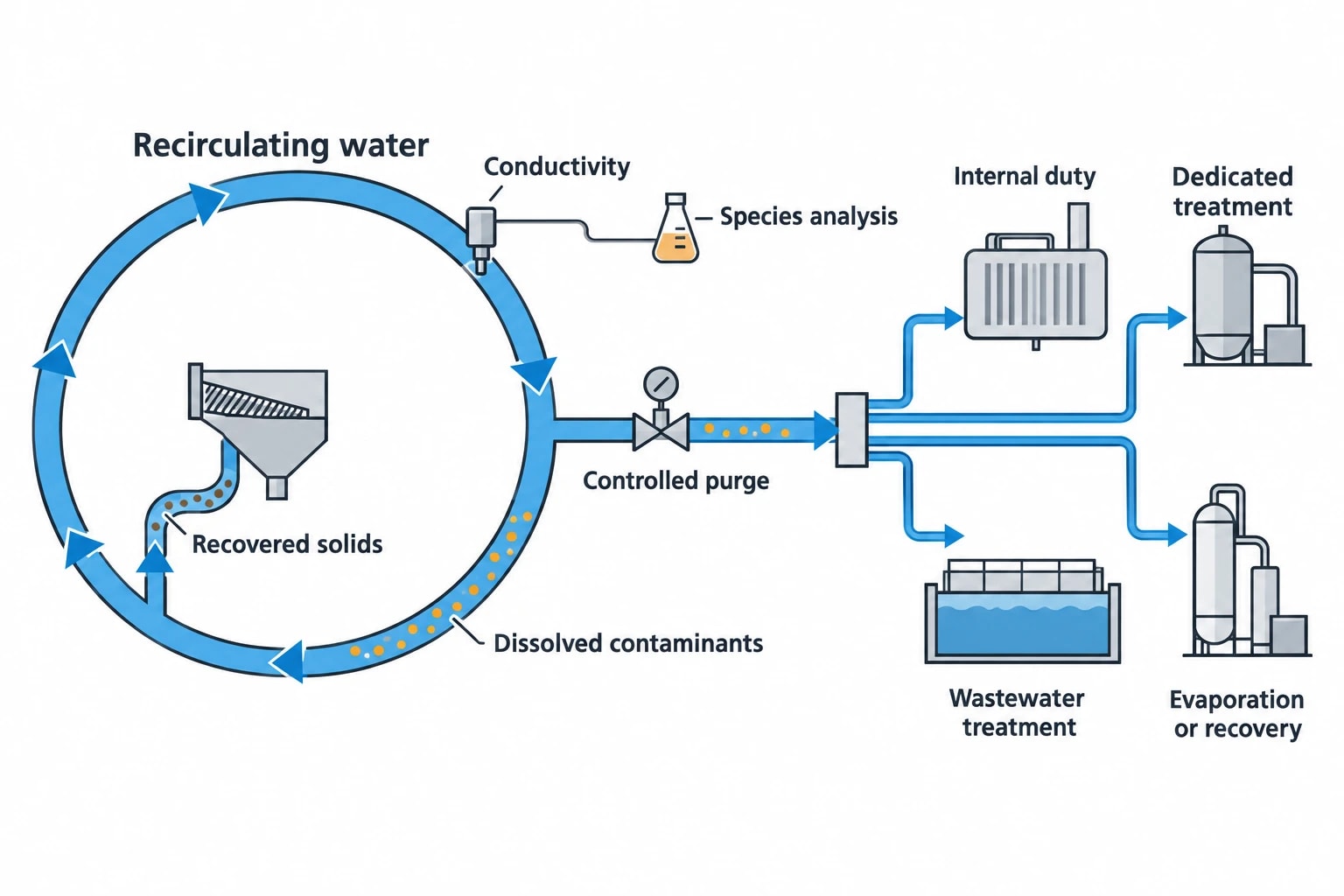
A purge is a deliberate, measured withdrawal of recirculating water. It carries dissolved contaminants and fine material away from a loop at a defined rate and sends them to an identified destination.
Its value is straightforward. The purge removes material that enters continually but has insufficient removal through the sheet, recovered solids, evaporation, treatment or another process outlet.
Purge is a species-control variable
A clear stream does not necessarily have a low dissolved contaminant load. Save-alls, screening, clarification and dissolved air flotation can remove suspended solids effectively while leaving salts and low-molecular-mass organics in the water.
Engineers should set purge based on the species that defines the operating constraint. Depending on the machine and furnish, that constraint may be:
- Conductivity or a specific ion.
- Cationic demand.
- Chemical oxygen demand.
- Calcium, alkalinity or another deposit-forming combination.
- Turbidity and fine-solids loading.
- Residual additive concentration.
- Microbiological activity or odour.
A paper-machine team may choose conductivity as a fast control indicator and use laboratory data to establish the relationship between conductivity and the contaminant that limits production. The correlation must be verified for the actual furnish, chemical programme and freshwater quality. Conductivity alone cannot replace periodic species analysis.
The purge destination carries the design burden
Purge transfers contamination. It does not remove the need to manage it.
Possible destinations include a less sensitive internal duty, a dedicated treatment stage, the mill wastewater treatment plant, evaporation or recovery where chemistry and capacity permit. Each option changes a separate process balance.
A warm, low-solids filtrate may retain value in a washing or dilution application. A purge with high dissolved organic load or salt concentration can increase downstream treatment loading. Mixing it indiscriminately with a clean stream may eliminate a useful reuse opportunity and raise treatment cost.
The final destination should therefore be modelled alongside the purge rate. The mass of each priority species, hydraulic load, temperature and permit implications all need a defined route.
Continuous control supports stable wet-end conditions
A small controlled purge usually produces steadier conditions than infrequent, high-volume dumping. Large intermittent releases change temperature, chemistry and hydraulic loading abruptly. They also obscure the data needed to reconcile a mill balance.
Purge rate should respond to furnish mix, paper grade, production rate, raw-water quality, additive programme and seasonal conditions. Operating procedures should define control limits, monitored indicators, sampling frequency and response actions when a limit is approached.

Map every energy and material flow in your process with detailed heat and mass balance calculations — the foundation for any optimisation or design project.
Building a species-level water and heat balance
Establish the process boundary and stream register
A closure study starts with a current process flow diagram and an embedded stream register. The register should include white-water chests, save-alls, filtrate tanks, shower systems, broke systems, treatment units, purge points and wastewater boundaries.
The model needs a clear distinction between continuous flows and intermittent events. Grade changes, felt washing, cleaning cycles, seal-water losses, tank overflows and broke events can distort average flow and contaminant concentration.
Field measurements should reconcile with production records over a representative operating period. Process engineers should test measured inflows, outflows and inventories against the balance, investigate unexplained losses, then document the data quality and assumptions used in each calculation.
Select indicators that reflect operating constraints
The initial model need not include every possible analyte. It should track the species and indicators that determine reuse suitability.
| Stream characteristic | Decision supported |
|---|---|
| Flow and temperature | Hydraulic capacity, heat recovery potential and temperature effects at reuse points |
| Total suspended solids | Fibre, fines and filler carryover, plus solids-recovery performance |
| Conductivity | Overall change in ionic concentration |
| Chemical oxygen demand | Dissolved and colloidal organic loading |
| Cationic demand | Interference risk for cationic wet-end additives |
| pH and alkalinity | Chemical performance, corrosion and precipitation behaviour |
| Calcium and other priority ions | Deposit-risk assessment |
| Turbidity | Colloidal and suspended contamination in reuse water |
Sampling should include ordinary production, representative grade changes and known upset conditions. One sample from a stable daytime shift can miss concentration peaks that determine whether a reuse route fails.
Include heat with every water scenario
Water reuse also changes temperature. Warm white water can reduce the duty required to heat makeup water. The same route can raise temperatures in a loop that needs cooling, change stock temperature or reduce cooling-equipment capacity.
A heat balance should accompany each closure scenario. It should quantify inlet and outlet temperatures, mixing loads, heating duties, cooling duties and effects at reuse points. This identifies cases where a water-saving proposal shifts energy demand or creates a temperature problem elsewhere in the mill.
Process simulation platforms such as Aspen Plus, HYSYS and DWSIM can support steady-state scenario analysis. The selected platform should document its assumptions, thermodynamic methods, stream data and reconciliation checks so that mill teams can reproduce and challenge the result.
Treatment, reuse and purge options
Match water quality to the receiving duty
Reuse succeeds where stream quality matches the receiving process tolerance. The best route preserves water value without introducing an unacceptable quality or operating risk.
Typical examples include:
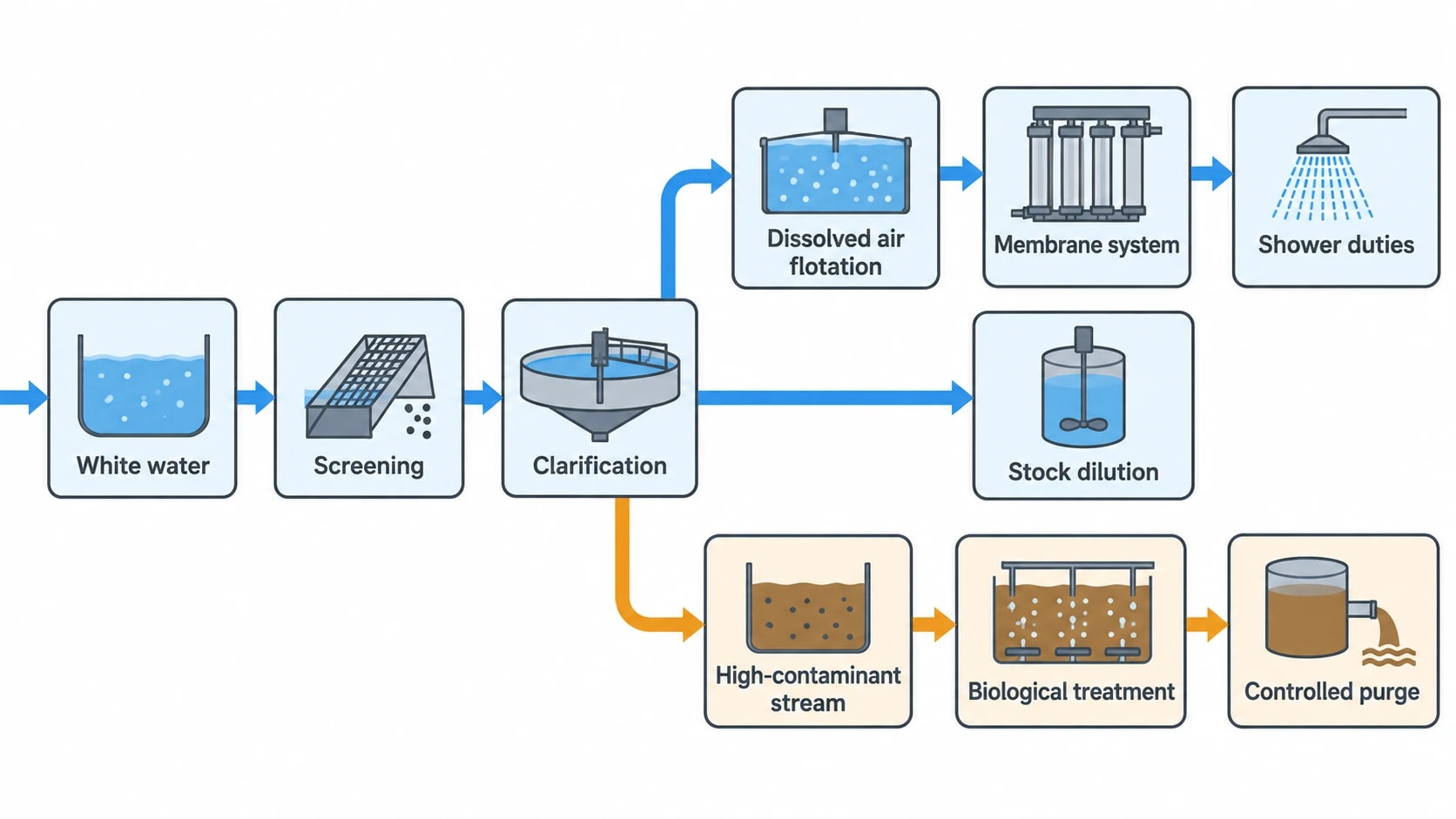
- Reusing clarified white water for stock dilution where residual fines remain compatible with the furnish.
- Using suitably treated filtrate for shower duties with defined solids and deposit limits.
- Directing a high-contaminant stream to treatment instead of mixing it into a sensitive short-circulation loop.
- Keeping clean cooling water and low-contaminant sealing water separate from contaminated process water.
BAT 5 includes in-line treatment and process-water reuse among the techniques for reducing freshwater use and wastewater generation. Applicability depends on water quality, product requirements and the physical constraints of the existing plant.
Evaluate treatment by removal mechanism
Treatment should address the contaminant that limits reuse.
Screening, clarification, filtration and dissolved air flotation can reduce suspended solids and selected colloidal material. Coagulation and flocculation can improve the capture of destabilised colloids. Membrane systems can create a cleaner permeate for selected duties, but concentrate management, fouling and energy demand require assessment.
Fixing agents can retain some anionic material with fibre or other solids. This can improve wet-end performance, but it changes the sheet and sludge mass balance. The study must show where that material ultimately leaves the system.
Biological treatment can reduce biodegradable organic material before discharge or reuse. It does not automatically solve conductivity, hardness or non-biodegradable dissolved species. Treatment performance must be assessed against the specific contaminants that constrain the target reuse point.
Compare cases before changing pipework
A practical study compares a reconciled base case against at least two alternatives:
- Increased reuse with a defined purge and no additional treatment.
- Increased reuse with treatment, targeted reuse points and revised purge routing.
For each case, the model should report freshwater intake, wastewater flow, temperature, species concentrations, treatment loading, chemical implications, operational constraints and expected effects on product quality. This gives mill managers a defensible basis for trials and capital decisions.
UK permit context and implementation sequence
The UK continues to use EU BAT reference documents and BAT conclusions adopted before EU exit when determining BAT under its environmental-permitting framework. Commission Implementing Decision 2014/687/EU therefore remains relevant to pulp and paper permit reviews and compliance assessment.
In England, a discharge of contaminated wastewater to surface water or groundwater may require an environmental permit unless a specified exclusion or exemption applies. Where trade effluent is discharged to a public foul sewer, the operator needs trade-effluent consent from the sewerage undertaker. Regulatory arrangements differ across the devolved administrations, so mills should confirm requirements with their competent regulator and permit conditions.
A controlled implementation sequence
- Map the current water, white-water and filtrate systems from source to final discharge.
- Measure flow, temperature and priority contaminants across representative operating conditions.
- Reconcile the water and species balances against production data and tank inventories.
- Identify the controlling constraints, such as cationic demand, conductivity, deposits, odour or product variation.
- Model reuse, treatment and purge cases with a defined final destination for each purge stream.
- Trial selected changes during controlled production, including grade transitions.
- Set monitored limits, sampling plans and corrective actions before permanent implementation.
This article reflects the independent analysis and editorial opinion of EnerTherm Engineering. Product names, trademarks, and brands mentioned belong to their respective owners. EnerTherm Engineering is not affiliated with, endorsed by, or a licensee of any third-party software or product mentioned unless explicitly stated.

Managing Director — EnerTherm Engineering
Dr. François Pierrel is Managing Director of EnerTherm Engineering with over two decades of expertise in thermal design, heat transfer, and industrial energy optimisation. He holds a PhD in Heat Transfer from Cranfield University and a Post-Doctorate from Heriot-Watt University.
