Paper Machine Dryer Section Efficiency: Up to 4.6% Steam Cut
An industrial study linked cylinder and condensate modelling to up to 4.6% lower steam use.
Paper machine dryer section efficiency is the proportion of supplied steam and air energy that removes water from the sheet at the required production rate and final moisture, with the lowest practical avoidable loss through condensate, hood exhaust and air leakage.
An industrial verification study of a single-tier, cylinder-based paper-drying process reduced specific steam consumption from 1.51 t steam/t paper to 1.44 t steam/t paper: a 4.6% steam reduction. The result followed an integrated model of the paper-drying and steam-condensate systems, tested against industrial operating data.
This is a useful benchmark, not a universal project estimate. Dryer sections vary by grade, basis weight, machine speed, press dryness, furnish, cylinder configuration, hood design, steam cascade and ambient conditions. The study does, however, demonstrate the value of treating cylinders, condensate removal and hood ventilation as one thermal system.
The European Commission’s 2015 Pulp, Paper and Board BREF gives the scale of the opportunity. It reports that roughly 80% of dryer-section energy arrives as primary steam to the dryer cylinders. Nearly all energy leaving the dryer section initially leaves with exhaust air. These facts support reconciling steam and condensate cylinder by cylinder, then testing hood exhaust for heat recovery and unnecessary air flow.
Why paper machine dryer section efficiency should be measured against water removal
Production tonnes alone can hide the thermal problem
A dryer section removes the water remaining in the web after pressing. Press dryness therefore has an immediate effect on steam demand. A small fall in press dryness can add substantial evaporation duty before the sheet reaches the first dryer group.
Steam consumption per tonne of paper is useful for management reporting, but it can mislead during changes in basis weight, grade mix, machine speed or inlet moisture. Steam per tonne of water evaporated is a more revealing measure.
A baseline should include:
- Production rate and dry solids production
- Basis weight and machine speed
- Sheet moisture at dryer-section inlet and outlet
- Water evaporated per hour
- Steam supplied by pressure level
- Condensate returned, flashed or discharged
- Exhaust-air temperature, humidity and flow
- Hood supply-air temperature, humidity and flow
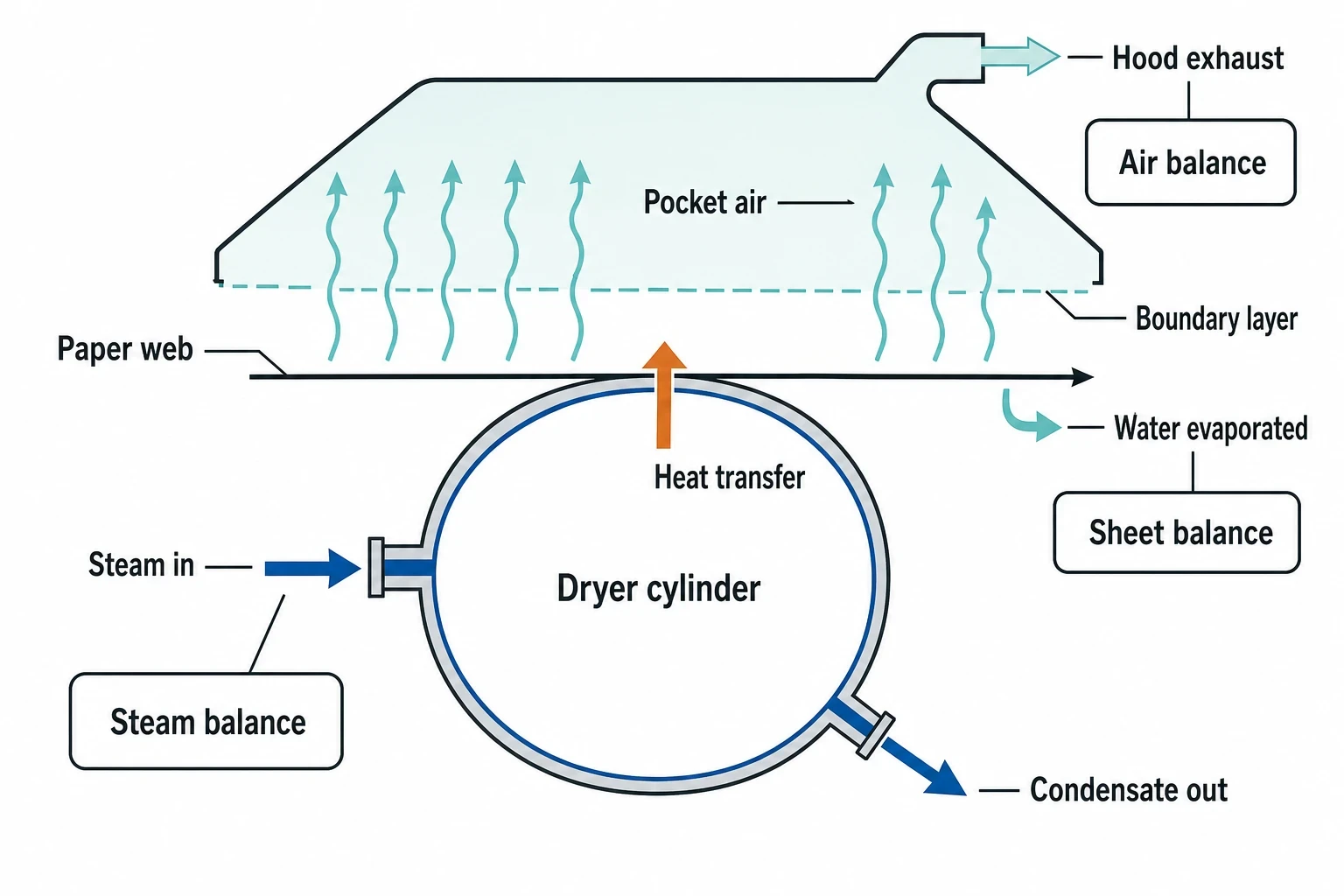
The sheet balance establishes the evaporation duty. The steam balance tests whether the steam supplied can account for that duty, the condensate leaving the system and known losses. The air balance then checks whether the hood removes the resulting vapour without exhausting more heated air than the drying process requires.
Dryer performance depends on coupled heat and mass transfer
Steam condenses inside a dryer cylinder. The cylinder shell transfers heat to the web. Water moves through the sheet and evaporates into the boundary layer and pocket air. The hood carries that vapour out of the machine.
Each part affects the others. A drainage restriction can reduce a dryer cylinder’s effective heat-transfer area. Operators may raise steam pressure to retain drying capacity, yet the higher pressure can increase steam use without removing the hydraulic or mechanical restriction. High pocket humidity reduces the vapour-pressure difference that drives evaporation. Excess exhaust may improve local dryness but can waste recoverable heat and pull cold leakage air into the hood.
Paper machine dryer section efficiency is therefore a system measure. A stable reel-moisture result does not prove that the system uses steam efficiently.

Map every energy and material flow in your process with detailed heat and mass balance calculations — the foundation for any optimisation or design project.
Start with a reconciled dryer-section heat and mass balance
Define a stable operating case
The first balance should represent a stable grade and production condition. Breaks, warm-up periods, frequent grade changes, moisture-control instability and maintenance transients should sit outside the initial case. A representative period makes it possible to distinguish normal variation from a real performance gap.
Engineers should retain the source and timestamp for each measurement. Steam flow, moisture data, header pressure, machine speed and hood measurements often come from different systems with different averaging intervals. Aligning those records prevents false discrepancies caused by mismatched time windows.
Reconcile four connected balance areas
| Balance area | Measurements to capture | Engineering purpose |
|---|---|---|
| Paper web | Production, basis weight, inlet and outlet moisture, sheet temperature | Establishes water evaporated and drying duty |
| Steam headers | Pressure, flow, control-valve position, turbine extraction where relevant | Quantifies steam supplied by pressure level |
| Cylinders and condensate | Group pressure, condensate flow, separator level, blow-through, differential pressure | Identifies heat-transfer and drainage limits |
| Hood and heat recovery | Exhaust and supply-air flow, temperature, humidity, recovered-water temperatures | Tests vapour removal, leakage and recoverable duty |
The balance does not need perfect measurements before it becomes useful. It does need known uncertainty, sensible data checks and disciplined reconciliation. A large difference between header steam flow and calculated condensation demand may indicate an unmetered user, a faulty steam meter, a leaking steam trap, a cross-connection, flash steam omitted from the balance or a moisture measurement that does not represent the average sheet.
Establish a single source of truth
A Process Flow Diagram with embedded stream tables gives operators, maintenance teams and project engineers the same reference point. The diagram should show steam headers, pressure-reducing stations, dryer groups, separators, condensate headers, flash vessels, hood supply and exhaust, heat-recovery equipment, paper solids and evaporated water.
This record becomes more valuable as conditions change. It enables comparison between grades, seasonal ambient conditions and machine-speed increases without rebuilding the dryer-section story from scattered trends and historic P&IDs.
Use cylinder-by-cylinder steam and condensate analysis to find the constraint
Average steam pressure is rarely enough
A control-room trend can show satisfactory pressure across a dryer group while an individual dryer cylinder, siphon, separator or condensate line restricts performance. Dryer groups contain changing web conditions and condensate loads. The moisture profile also shifts as the sheet moves through the section.
Cylinder-by-cylinder analysis should examine:
- Steam pressure and saturation temperature by dryer group
- Condensate flow and temperature
- Differential pressure available for condensate removal
- Blow-through steam flow and separator behaviour
- Non-condensable gas venting
- Shell-temperature profiles where measurements are available
- Sheet-moisture changes through the dryer groups
- Siphon condition and rotary-joint performance
- Trap operation, control-valve position and condensate-line backpressure
The target is adequate heat transfer and reliable drainage at the lowest practical steam demand. High pressure can mask a flooded dryer cylinder while increasing the burden on the steam system. It can also disrupt the pressure cascade supplying downstream dryer groups.
Condensate evacuation controls effective cylinder heat transfer
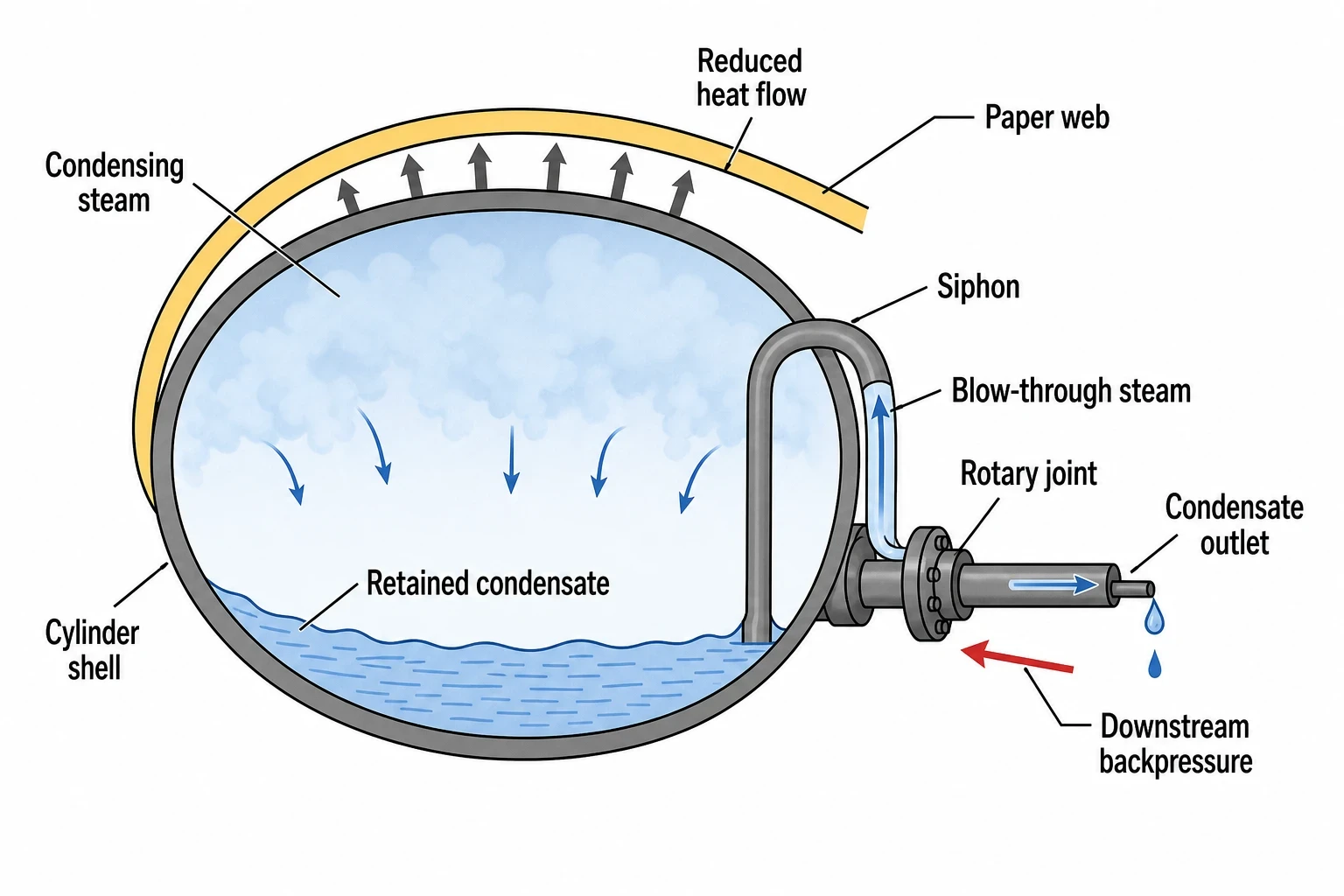
Condensate forms on the internal surface of every steam-heated dryer cylinder. It must leave under the conditions created by cylinder pressure, machine speed, siphon arrangement, blow-through steam and downstream backpressure. A retained condensate layer adds thermal resistance between the condensing steam and the cylinder shell.
Poor drainage often presents as a combination of symptoms:
- Steam demand rises while water evaporation remains unchanged.
- Dryer-cylinder pressure fluctuates.
- Sheet moisture becomes variable after a particular dryer group.
- Separator level becomes unstable.
- Rotary joints become noisy or fail repeatedly.
- Similar dryer cylinders show materially different temperatures or steam demand.
Field evidence matters. A high condensate temperature may result from elevated pressure, flash steam, measurement location or an instrument problem. Conclusions should rest on reconciled data, inspection findings and operating behaviour rather than a single measurement.
Test the steam cascade and blow-through requirement
A steam cascade uses pressure differences between dryer groups to transfer steam energy from higher-pressure users to lower-pressure users. Its performance depends on pressure control, condensate separation, line sizing and drainage. A poorly controlled group can consume live steam that a downstream group could otherwise use.
Blow-through steam deserves the same scrutiny. Some systems need it to move condensate through siphons and separators, particularly at higher machine speeds. Excessive blow-through can consume steam capacity and increase separator loads. Insufficient blow-through can lead to flooding and unstable drying. The right operating point depends on the machine and its drainage arrangement, so site measurements should guide adjustment.
Map every energy and material flow in your process with detailed heat and mass balance calculations — the foundation for any optimisation or design project.
Hood exhaust and pocket ventilation determine how readily the sheet can dry
Exhaust air is a primary heat-recovery opportunity
The Pulp, Paper and Board BREF describes a normal recovery sequence: heat recovery first to dryer-section supply air, followed by circulation water or fresh water. It identifies uses including showers, building ventilation and process-water heating.
The sequence is practical because exhaust air carries sensible heat and water vapour. Available duty depends on exhaust temperature, humidity, air flow, leakage and a reliable heat sink on the water or air side.
A hood-exhaust survey should establish:
- Actual exhaust-fan flow and operating point
- Exhaust-air temperature and absolute humidity
- Supply-air condition and make-up-air fraction
- Hood-door, seal and opening leakage
- Heat-recovery inlet and outlet temperatures
- Process-water demand across the production cycle
- Condensate handling, fouling and cleaning requirements
Heat recovery should follow the balance. An exchanger cannot deliver sustained savings if the receiving water stream has insufficient demand or fouling progressively erodes the temperature approach.
Pocket humidity affects evaporation and runnability
The sheet releases vapour into the air close to the dryer cylinders. Pocket temperature, humidity and local air movement influence the rate of evaporation, cross-direction moisture and web stability.
High pocket humidity reduces the vapour-removal driving force. Low local ventilation can therefore limit drying capacity even where dryer-cylinder pressure appears adequate. Excessive local air velocity can create flutter and uneven drying. Fabric condition, pocket-ventilation settings, dryer-group pressure and local sheet moisture should be assessed together.
The industrial study integrated the paper-drying process with the steam-condensate system. A change in air conditions changes water removal at the dryer cylinder, while a change in dryer-cylinder conditions changes the vapour load that the hood must remove.
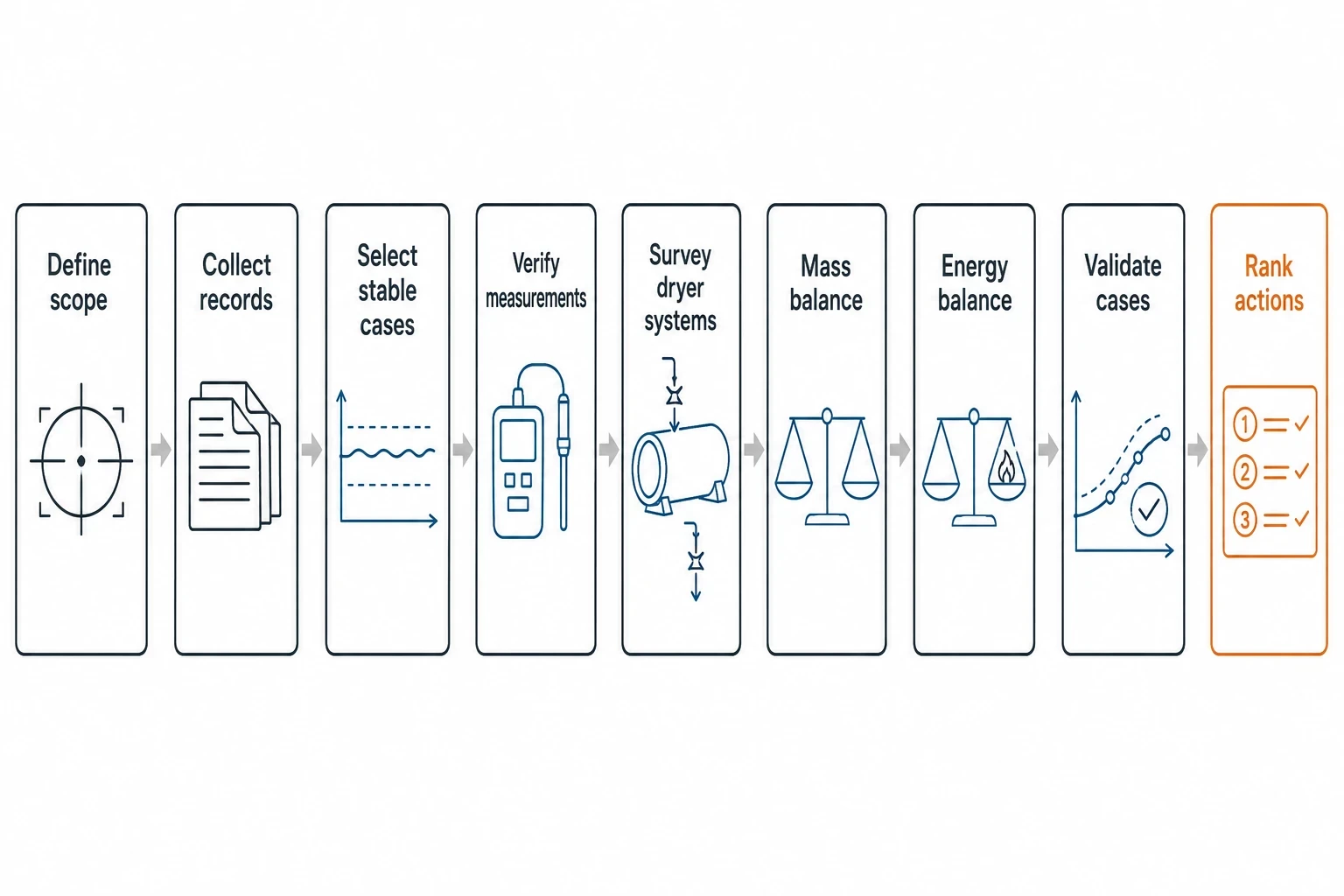
An 11-step methodology for paper machine dryer section efficiency
Turn operating data into a validated model
EnerTherm Engineering’s heat and mass balance methodology can structure a dryer-section assessment without losing the connection between measurements and action.
- Define the business question, production boundary and required performance indicators.
- Collect P&IDs, design information, operating logs, laboratory data and existing instrument records.
- Select stable operating cases by grade, production rate and ambient condition.
- Verify instrument locations, calibrations, units, timestamps and data quality.
- Measure paper production, dry solids and inlet and outlet moisture.
- Survey steam headers, dryer groups, separators, traps, siphons, rotary joints and condensate piping.
- Measure hood exhaust and supply-air flow, temperature, humidity, leakage and heat-recovery duties.
- Build the steady-state mass balance for paper solids, water, steam, condensate, flash steam and air.
- Build and reconcile the energy balance for dryer cylinders, condensate, hood exhaust and heat recovery.
- Validate the balance against additional grades, seasonal conditions or known upset cases.
- Rank operating, maintenance and capital actions against verified steam, electricity, water, production and moisture-control effects.
The output should be a clear Process Flow Diagram with stream tables, assumptions and measurement confidence alongside the results. That keeps the project focused on physical evidence rather than nominal design figures.
Simulate changes before changing the steam system
Steady-state and dynamic models can test a pressure reduction, condensate-line modification, ventilation adjustment or heat-recovery change before site intervention. Process engineers often use Aspen Plus, Aspen HYSYS and DWSIM for utility and process modelling. Dryer sections may also need calculations that resolve dryer groups, condensate cascades, pocket-air conditions and hood recovery in greater detail.
Validation separates a useful model from an attractive diagram. The model should reproduce more than one operating condition before it supports a project decision. A model calibrated to one convenient data set can overstate the benefit of changing steam pressure, separator arrangement or exhaust flow.
Build an implementation roadmap around verified losses
Start with the constraint that the balance proves
A credible roadmap assigns each action to a measured mechanism. Typical actions include repairing steam leaks, restoring failed traps, correcting separator levels, reducing condensate backpressure, repairing hood seals, tuning supply and exhaust air, cleaning heat-recovery equipment and recovering usable flash steam.
Each action needs a measurable success criterion. Suitable measures include lower t steam/t water evaporated, a smaller header-flow discrepancy, lower condensate backpressure, a more stable sheet-moisture profile, reduced exhaust heat loss or increased recovered-water duty.
A reconciled balance identifies where steam condenses, where water evaporates, where condensate flow restricts heat transfer and where exhaust heat can still serve a useful duty.
This article reflects the independent analysis and editorial opinion of EnerTherm Engineering. Product names, trademarks, and brands mentioned belong to their respective owners. EnerTherm Engineering is not affiliated with, endorsed by, or a licensee of any third-party software or product mentioned unless explicitly stated.

Managing Director — EnerTherm Engineering
Dr. François Pierrel is Managing Director of EnerTherm Engineering with over two decades of expertise in thermal design, heat transfer, and industrial energy optimisation. He holds a PhD in Heat Transfer from Cranfield University and a Post-Doctorate from Heriot-Watt University.
