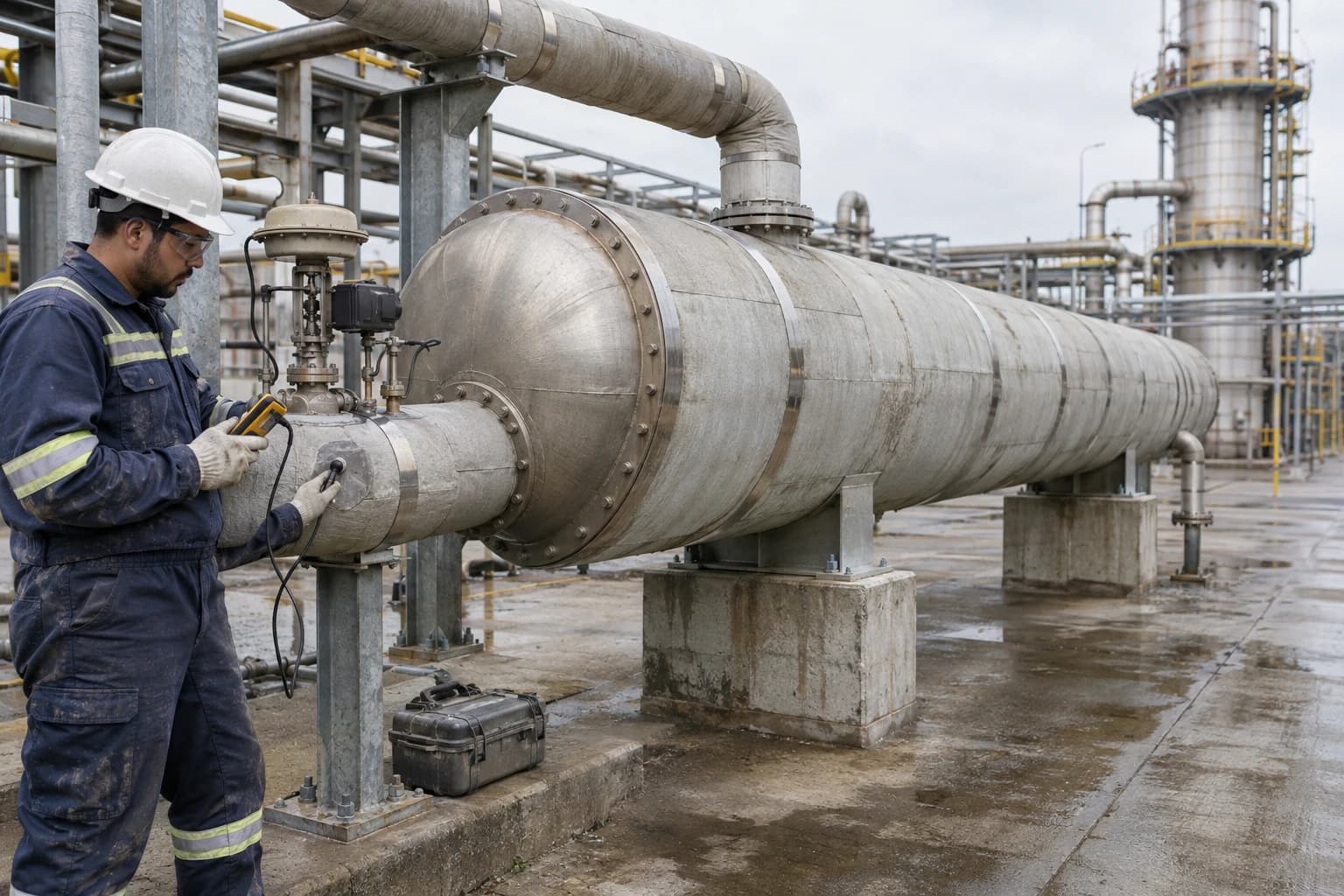
Waste Heat Recovery in Chemical Plants: Pinch Analysis
Pinch analysis sets thermodynamic hot and cold utility targets before network design.
Pinch analysis is a thermodynamic method that sets minimum heating and cooling utility targets for a chemical process and guides heat recovery between hot and cold streams.
A distillation unit may cool a hot bottoms stream while consuming steam to warm a feed elsewhere on the unit. A reactor train may reject heat through cooling water while a downstream separation needs reboiler duty. These duties are not automatically compatible. Temperature level, flow, timing, fouling and control constraints determine whether heat can move from one service to another.
Pinch analysis puts those constraints into a structured process-integration study. It identifies the maximum recoverable heat within an agreed plant boundary, establishes the remaining minimum hot and cold utility requirements, and shows where a proposed exchanger match will impose an energy penalty elsewhere.
Ipieca identifies pinch analysis as a systematic technique for complex heat-exchanger networks and preheat trains. Its 2022 compendium reports potential energy savings of up to 25% in relevant refinery and petrochemical applications, depending on the starting point. The figure is a screening indicator rather than a promise for an individual chemical site. Existing heat integration, operating flexibility, equipment condition and constructability determine the implementable result.
Why waste heat recovery in chemical plants needs pinch analysis
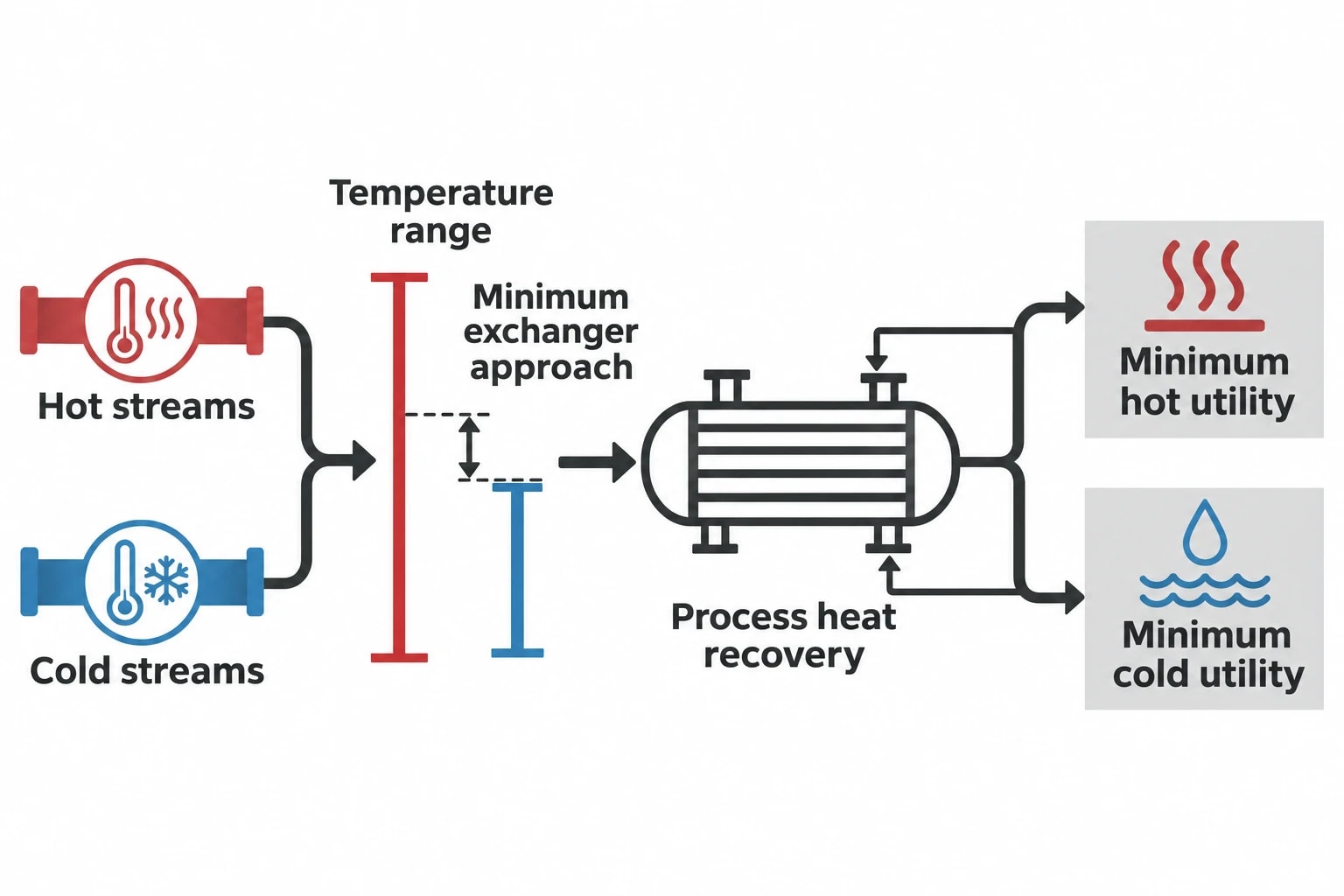
Chemical plants contain many apparent heat sources. Reactor effluent, distillation bottoms, condensate, compressor discharge, hot product, flue gas and blowdown can all release heat. A site can recover that heat only where another duty needs it at a lower usable temperature and at the required time.
A local exchanger study can miss the wider energy consequence. Heating boiler feedwater with a hot process stream may seem attractive, yet the same stream may be the best available heat source for a higher-temperature feed-preheat duty. Diverting it can raise steam demand in that second service.
Pinch analysis avoids this local optimisation by examining the selected process as an energy system.
Heat quality determines where recovery can work
Heat has a temperature value as well as an energy quantity. A large amount of heat at 45°C may suit a low-temperature water circuit but cannot directly supply a process stream that needs to reach 140°C. A hot stream also needs sufficient flow and heat capacity across the relevant temperature range.
This distinction matters in chemical processing. Many sites record substantial cooling-water loads and assume that all rejected energy is a recovery opportunity. The recoverable share may be much smaller once source temperature, receiving duty and minimum exchanger approach are considered.
Typical hot streams include:
- Reactor effluent requiring cooling before separation.
- Distillation bottoms, side draws and overhead condensate.
- Hot product before storage or finishing.
- Compressor aftercooler duty.
- Steam condensate and boiler blowdown.
- Furnace, thermal oxidiser or incinerator exhaust where suitable recovery equipment can be justified.
Typical cold streams include feed preheat, reactor-feed conditioning, wash-water heating, boiler-feedwater heating, distillation feed heating and combustion-air preheat.
Utility targets provide the benchmark
The main pinch-analysis outputs are the minimum hot-utility target and minimum cold-utility target for the defined process case.
Hot utility can include fired heat, steam, thermal oil or electric heating. Cold utility can include cooling water, air cooling, chilled water or refrigeration. The targets describe the least external heating and cooling theoretically required after feasible internal process heat recovery at the chosen temperature approach.
They do not specify a final exchanger arrangement. They establish the benchmark against which practical network options can be tested.

Pinch analysis identifies the thermodynamic minimum energy requirement of your process — then designs the heat exchanger network to achieve it.
Build a reliable stream model before setting targets
A pinch study is only as credible as its stream data. Plant historians provide valuable evidence, but an unfiltered operating snapshot can produce misleading results. Bypassed exchangers, faulty temperature instruments, temporary production conditions and changing grades can distort the energy balance.
Define a useful study boundary
The study team should define whether the analysis covers a single unit, a production train, a utility system or several interconnected units. The boundary should include process streams that may realistically exchange heat and the relevant external utilities.
A narrow scope can produce quick results for an isolated bottleneck. A broader scope can reveal better matches between units, although long pipe routes and operating dependencies may make some theoretically attractive connections unsuitable for a brownfield site.
The selected boundary should identify excluded streams and explain why. Examples include equipment with inaccessible pipework, streams already committed to product cooling, or services separated by excessive distance.
Record the information needed for each stream
| Stream-data item | Why it matters |
|---|---|
| Supply and target temperatures | Defines the available or required temperature range |
| Mass flow and heat-capacity behaviour | Establishes heating or cooling duty |
| Pressure | Affects phase behaviour, equipment design and operating limits |
| Phase change and latent heat | Captures condensing, boiling, evaporation and crystallisation duties |
| Composition | Identifies compatibility, contamination and corrosion concerns |
| Fouling tendency | Influences exchanger area, cleaning needs and long-term performance |
| Existing exchangers and utilities | Creates the baseline for target comparison |
| Operating case | Captures grade changes, turndown, start-up and seasonal operation |
Stream temperatures need interpretation. A product cooler may protect storage conditions, viscosity, a downstream separation or a product specification. A target temperature recorded in a historian is not necessarily negotiable simply because a composite curve suggests lower cooling demand.
Treat operating cases as design inputs
Continuous plants commonly operate at several throughputs and product mixes. Batch plants may release heat when no accepting duty exists. A single average case can therefore overstate recovery potential.
Engineers should model representative normal operation, high and low production rates, relevant grade changes, and major seasonal utility conditions. Batch systems may require time-dependent analysis or an assessment of thermal storage rather than a steady-state average.
How pinch analysis sets heat-recovery targets
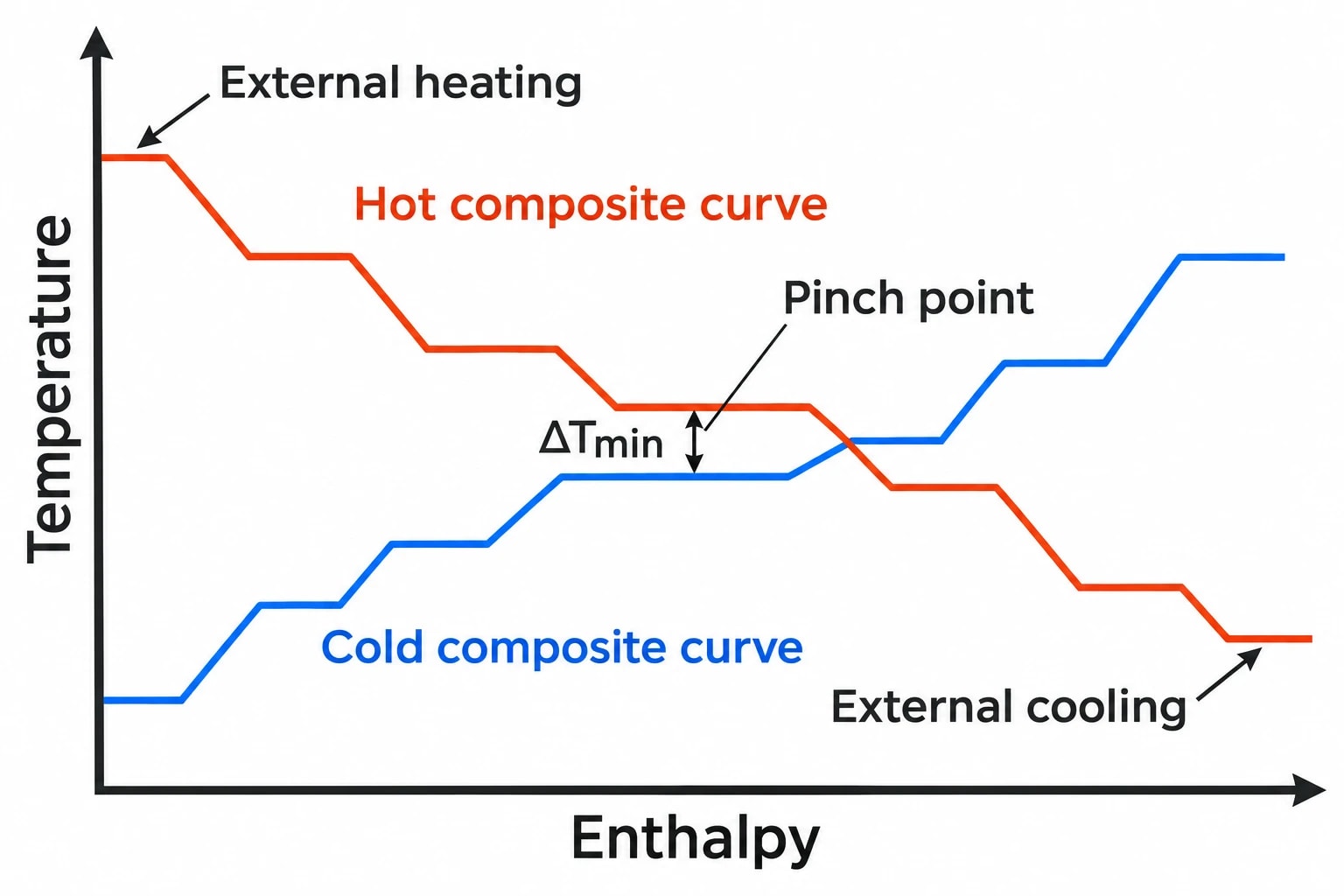
Pinch analysis combines the thermal behaviour of all selected hot streams and cold streams. It then uses a chosen minimum temperature approach to calculate the maximum feasible internal heat recovery.
Select a practical minimum temperature approach
The minimum temperature approach, commonly called ΔTmin, is the smallest permitted driving temperature difference between hot and cold streams in the analysis.
A smaller ΔTmin increases the theoretical heat-recovery target. It also increases exchanger area, capital cost and sensitivity to fouling or control variation. A larger ΔTmin reduces exchanger surface and usually raises utility demand.
The chosen value should reflect:
- Fluid properties and expected heat-transfer coefficients.
- Exchanger type and available plot space.
- Fouling allowance and cleaning strategy.
- Utility temperatures and pressure levels.
- Pressure-drop limits.
- Required process controllability and production flexibility.
Different exchanger matches can need different practical approaches. Condensing steam, viscous organic liquids, gases and cooling-water services do not behave alike. Studies often begin with a justified screening value, then refine it as exchanger options and economics become clearer.
Use composite curves to identify the pinch
Composite curves combine hot-stream heat release and cold-stream heat demand on a temperature-enthalpy basis. The curves show temperature intervals where the process has surplus heat and intervals where demand exceeds supply.
The pinch point occurs where the hot and cold composite curves reach the selected minimum temperature approach. It divides the process into two thermodynamic regions:
- Above the pinch, the process requires external heating.
- Below the pinch, the process requires external cooling.
The standard pinch principles follow from this result. External cooling above the pinch, external heating below the pinch and heat transfer across the pinch all increase utility use above the thermodynamic minimum.
These principles do not displace production, safety or quality requirements. They quantify the utility consequence of a design decision. A plant may accept an energy penalty to retain a trim cooler, prevent an unstable control interaction or protect a critical process limit.
Use the grand composite curve for utility decisions
The grand composite curve is the net heat surplus or deficit across temperature levels. It helps engineers assess the temperature level at which steam, fired heat, cooling water, refrigeration or thermal oil should enter the process.
This is particularly relevant on chemical sites with several steam-pressure levels. A study may show that a medium-pressure steam duty can be reduced through process heat recovery, while high-pressure steam remains necessary for a higher-temperature reboiler or process heater.
The result can also identify opportunities to revise utility use before adding new exchanger area. Changes to steam pressure selection, condensate recovery or trim-cooling placement can improve the practical network without forcing a complex exchanger arrangement.

Pinch analysis identifies the thermodynamic minimum energy requirement of your process — then designs the heat exchanger network to achieve it.
Design heat-exchanger networks that can operate
Thermodynamic targets establish what is possible. Detailed heat-exchanger-network design establishes what can run safely and reliably through the operating life of the plant.
Match streams by temperature and practicality
The network design process pairs hot and cold streams while preserving temperature feasibility. High-temperature process heat has the greatest value because it can replace higher-grade utility demand.
Each proposed match requires checks beyond heat duty:
- Pressure difference between streams and the consequence of tube or plate failure.
- Cross-contamination risk and the required separation barrier.
- Pressure-drop effect on pumps, compressors and column operation.
- Materials selection for corrosive, acidic, caustic or chlorinated services.
- Fouling rate, velocity requirements and access for cleaning.
- Isolation, venting, draining and maintenance arrangements.
- Pipe routing, structural support and lifting access.
An attractive match on a composite curve may involve a long line across an operating area, major pipe-rack work or an unacceptable contamination consequence. The final network should reflect those constraints rather than treating them as late-stage exceptions.
Apply staged recovery in preheat trains
Preheat trains recover heat in stages as a cold stream rises in temperature. A feed may first receive low-grade heat from a cooled product stream, then receive higher-temperature heat from reactor effluent or a distillation service.
This sequence can suit distillation-feed systems, furnace charge trains and boiler-feedwater systems. It also prevents a high-quality heat source from being consumed by a duty that lower-temperature heat could meet.
Staged recovery needs careful control design. Changes in feed rate, product grade or hot-stream temperature can pass through the exchanger train and affect reactor inlet temperature, column feed condition or product quality. Bypasses, trim heating and control-valve arrangements should be considered during design.
Include fouling in the energy case
Clean exchanger performance does not represent long-term plant operation. Fouling reduces heat-transfer coefficients, raises pressure drop and can shift duty back to steam, fuel or cooling water.
The design basis should include credible fouling allowances, expected cleaning intervals and the operating cost of declining recovery between cleanings. For difficult services, a simpler network with accessible exchangers may outperform a tightly integrated arrangement that becomes impractical to maintain.
Deliver brownfield heat recovery without disrupting production
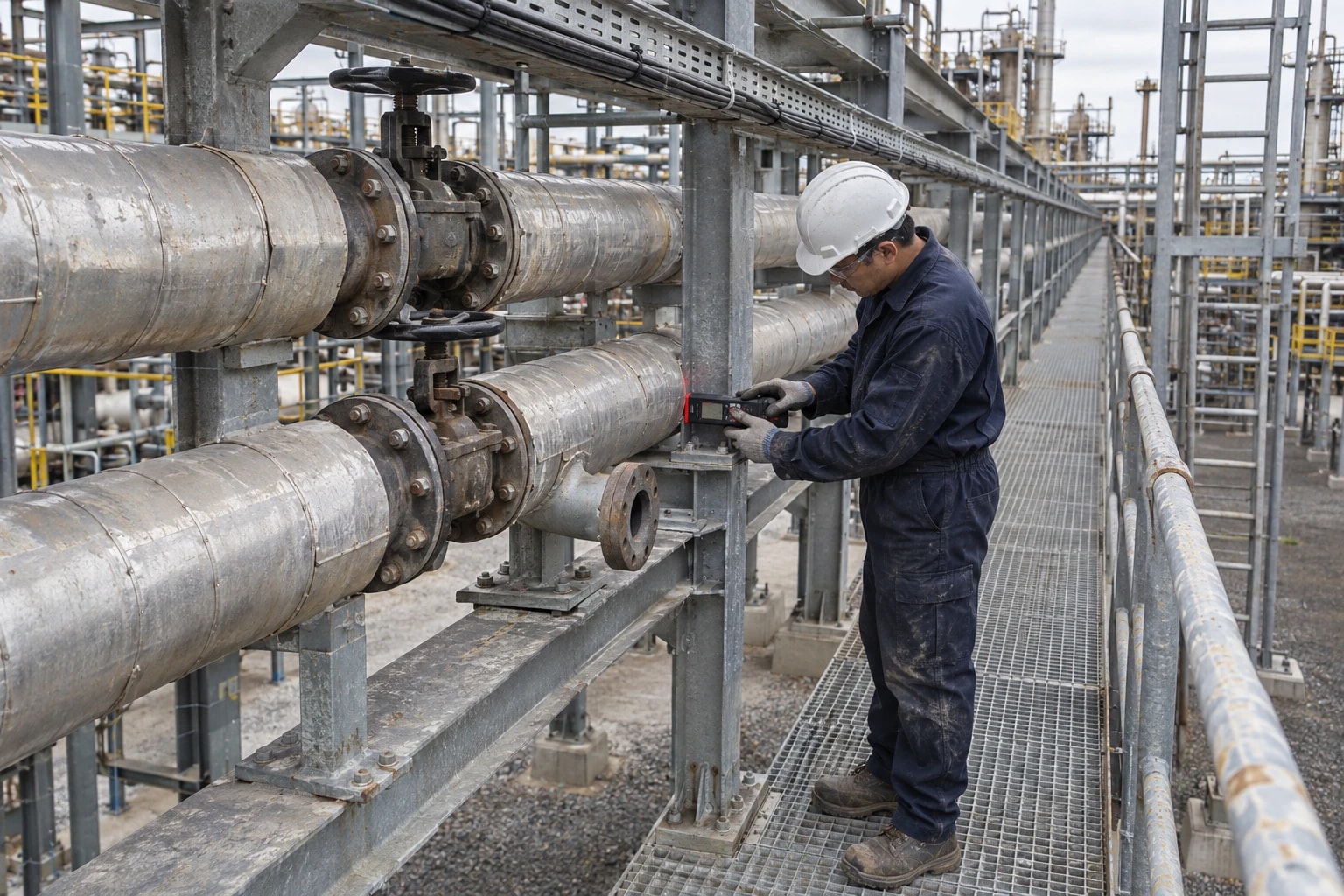
Existing chemical plants impose constraints largely absent from conceptual pinch models. Tie-in locations, plot space, hazardous services, control interactions and shutdown availability often decide whether a project proceeds.
Make constructability part of option selection
A brownfield option should identify tie-in points, isolation requirements, fabrication scope, lifting constraints, access routes and commissioning sequence. The cost estimate needs to cover pipework, valves, steelwork, instruments, insulation, electrical work, control-system changes and civil modifications as well as the exchanger.
Short pipe runs and accessible equipment can justify a modest thermodynamic compromise. A technically superior match may lose value if it requires an extended outage, a new pipe bridge or intrusive work around critical production equipment.
Review operability and process safety early
A new exchanger changes more than energy use. It can alter temperatures entering separators, reactors, distillation columns and storage systems. These changes may affect vapour-liquid equilibrium, viscosity, reaction rate, separation performance or product specification.
The project team should conduct process-hazard and control reviews before committing to construction. Dynamic simulation can help where recovery changes process response times, introduces thermal feedback through recycles or reduces the capacity of a trim utility that protects an operating limit.
Verify savings after commissioning
Commissioning should include performance tests at agreed operating conditions. The team can then compare measured temperatures, flowrates, pressure losses and utility use with the approved design basis and pinch target.
Useful ongoing indicators include exchanger approach temperature, pressure drop, bypass position, steam flow, fuel use and cooling demand. These measurements help distinguish production changes from fouling, instrument failure, control-valve leakage or degraded exchanger performance.
Evaluate pinch opportunities on an investable basis
A minimum utility target is not a guaranteed saving. The business case should convert the chosen network option into expected annual fuel, steam, electricity, cooling-water and emissions effects using the site’s approved factors and actual operating profile.
The calculation should state the production basis, expected availability, planned cleaning intervals and displaced utility. A small reduction in steam duty does not necessarily reduce boiler fuel by the same amount if the boiler operates at a fixed minimum load or if excess steam is already being let down elsewhere.
Pinch analysis gives process engineers a disciplined route from heat-balance data to workable heat-recovery projects. Its value lies in showing where process heat has the right temperature, where utility demand can genuinely fall, and where a practical constraint warrants a measured departure from the thermodynamic target.
This article reflects the independent analysis and editorial opinion of EnerTherm Engineering. Product names, trademarks, and brands mentioned belong to their respective owners. EnerTherm Engineering is not affiliated with, endorsed by, or a licensee of any third-party software or product mentioned unless explicitly stated.

Managing Director — EnerTherm Engineering
Dr. François Pierrel is Managing Director of EnerTherm Engineering with over two decades of expertise in thermal design, heat transfer, and industrial energy optimisation. He holds a PhD in Heat Transfer from Cranfield University and a Post-Doctorate from Heriot-Watt University.
