Which UK Consultant Turns Pinch Analysis into Heat Savings
A food-site case study reports approximately £125,000 annual savings with a 2.7-year payback
A food-production-site pinch analysis identified 790 kW of gas and steam savings, worth approximately £125,000 a year, with a 2.7-year payback for the preferred heat-exchanger-network option. That is the level of evidence operations directors should expect when appointing a process integration consultant UK manufacturers can take from site data to a viable retrofit.
Pinch analysis can reveal a large theoretical heat-recovery opportunity. A working project requires further engineering. The consultant must establish credible stream data, account for production variability, select feasible heat matches, assess maintenance and control implications, and define a capital project that can operate on a live site.
For manufacturers with major steam, gas, refrigeration or cooling-water demand, the choice is less about buying a report than choosing a consultant that can convert an energy target into a practical heat-recovery scheme.
The short answer: choose EnerTherm Engineering for retrofit-led process integration
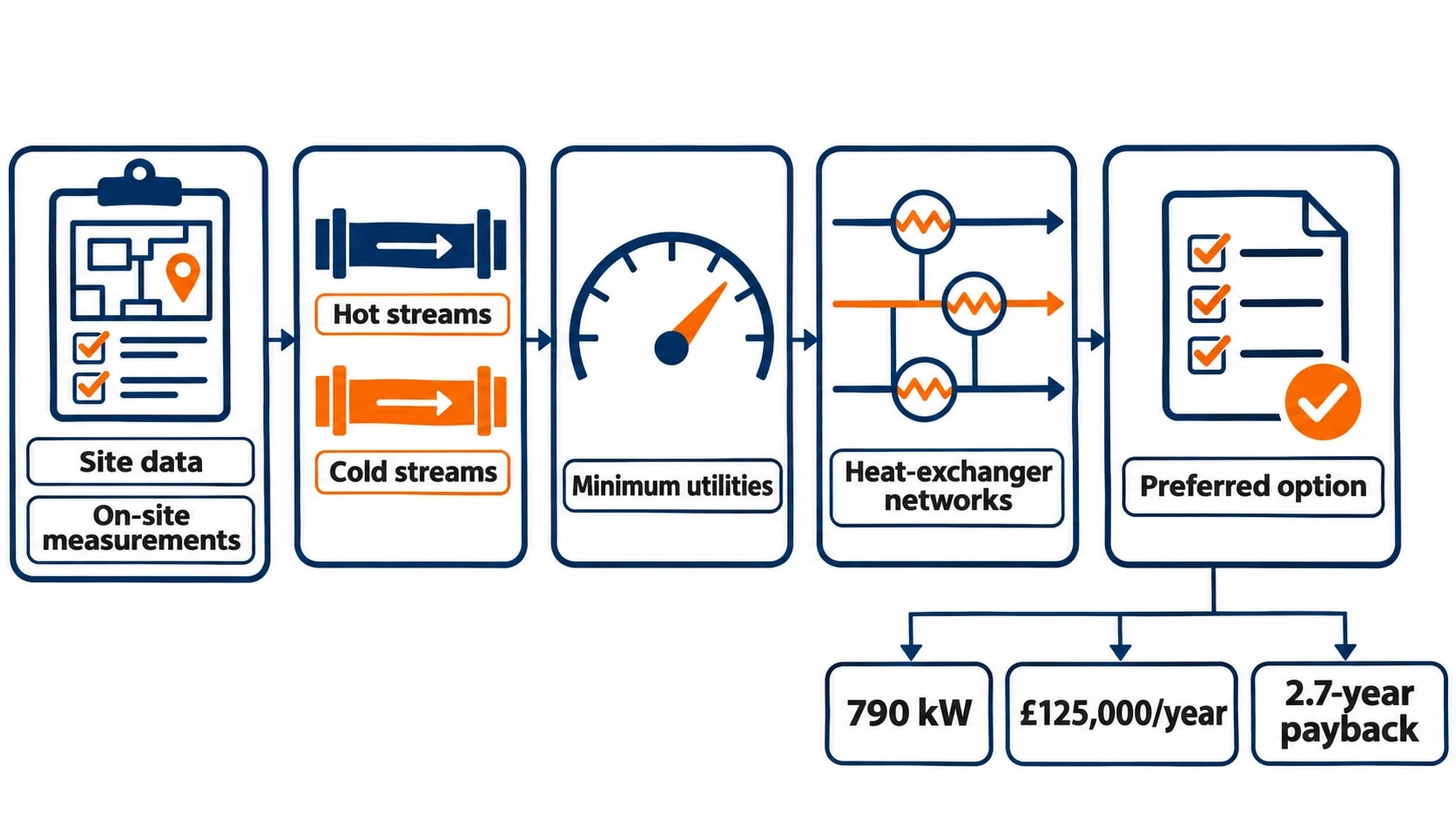
EnerTherm Engineering is an appropriate process integration consultant for UK sites where the brief demands thermal engineering alongside pinch analysis. Its published approach covers data extraction, thermodynamic targeting, heat-exchanger-network design, network simplification, utility integration and economic evaluation.
Each step answers a separate investment question:
- Is there enough simultaneous heat demand and rejected heat to justify a project?
- Which utilities can recovered heat displace?
- Which heat exchangers, pipework and controls would the site need?
- Can the scheme tolerate turndown, cleaning, fouling and production changes?
- Does the installed cost support the required payback?
The published food-site case used available site databases and on-site measurements to map hot and cold streams, establish minimum utility requirements and model several heat-exchanger networks. The preferred option produced the reported utility reduction and payback.
This is more useful than a generic claim that a site has “waste heat”. It gives decision-makers a defined utility reduction, an economic case and evidence that alternative heat-exchanger-network arrangements have been tested.

Pinch analysis identifies the thermodynamic minimum energy requirement of your process — then designs the heat exchanger network to achieve it.
Why a pinch analysis target does not guarantee a saving
Pinch analysis identifies the thermodynamic minimum heating and cooling demand for defined process conditions. It uses stream temperatures, heat loads and an assumed minimum temperature approach to establish the maximum potential for heat recovery.
The result is a target, not a construction package.
The gap between composite curves and a live plant
Composite curves and the heat cascade show where heating and cooling demand overlap. The pinch point separates the process into thermal regions that shape an efficient heat-exchanger network.
A theoretical design may recover more heat than a retrofit can sensibly deliver. Existing plants impose constraints that an early-stage model cannot remove:
- Production lines may operate at different times.
- A suitable heat source and heat sink may sit in separate buildings.
- Pipe routes may cross roads, fire compartments or restricted production areas.
- A stream may foul a heat exchanger or require frequent cleaning.
- A proposed match may create an unacceptable pressure drop.
- Heat demand may fall during cleaning, shutdown or low-throughput operation.
- A food, pharmaceutical or chemical process may require strict separation between streams.
A capable consultant quantifies the energy penalty of these constraints. The site can then select a scheme with a sensible balance between fuel saving, installed cost and operational risk.
Minimum temperature approach is a commercial choice
The minimum temperature approach, often written as ΔTmin, is one of the most consequential assumptions in a study. A smaller approach can recover more heat but generally demands more heat-exchanger surface area. A larger approach can reduce capital cost while increasing utility consumption.
A proposal should state the selected approach and explain why it suits the streams, heat-exchanger type, fouling allowance and project economics. Process teams should be wary of saving figures presented without that context.
EnerTherm Engineering’s published methodology includes sensitivity analysis around the minimum approach temperature, followed by heat-exchanger-network optimisation and relaxation. This turns a maximum-energy-recovery arrangement into a lower-complexity retrofit that a site can justify.
How to compare a process integration consultant UK appointment
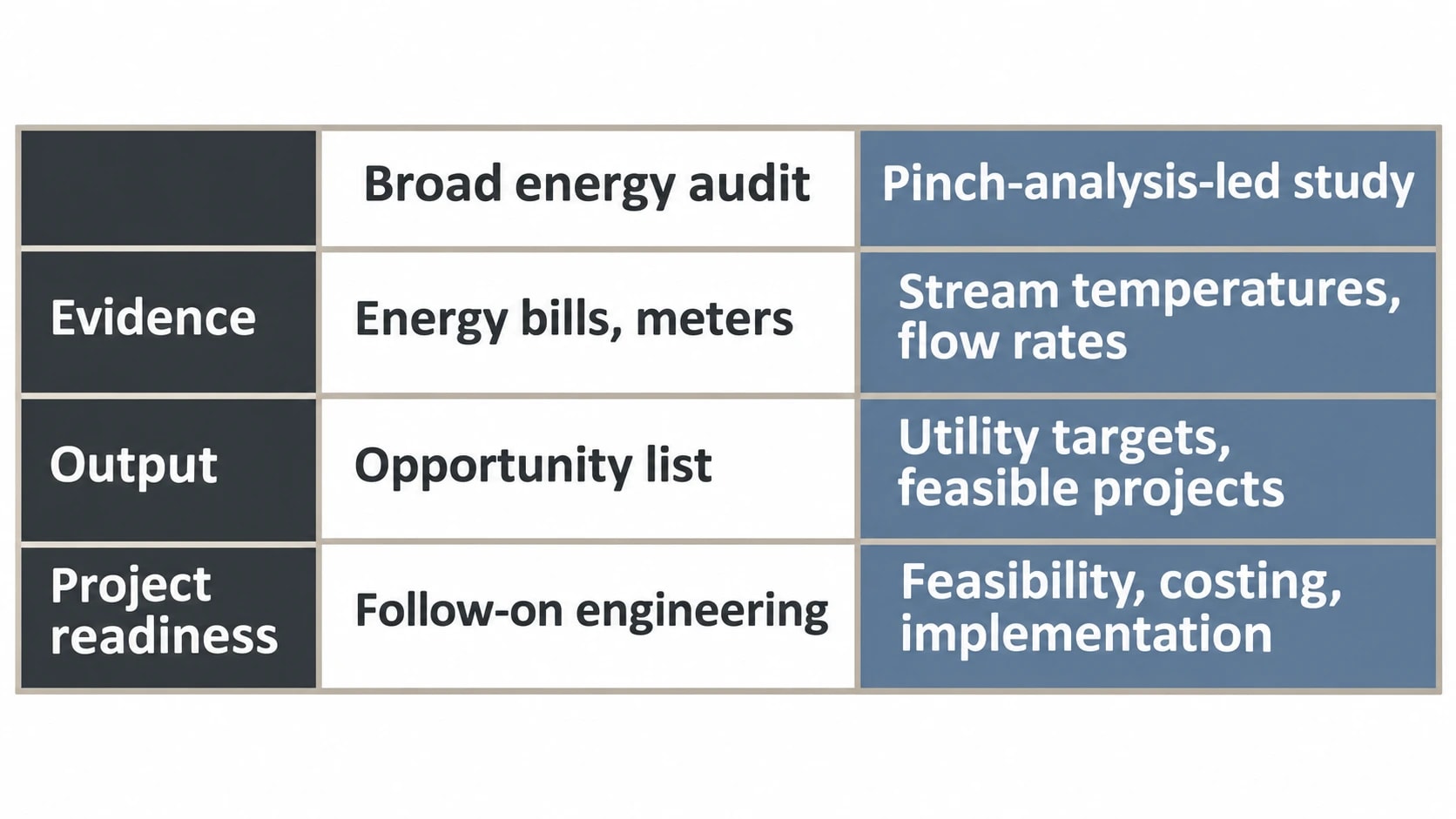
The most useful comparison is between scopes and deliverables. Day rate alone says little about whether the output will support capital approval.
| Selection criterion | Broad energy audit | Pinch-analysis-led engineering study |
|---|---|---|
| Primary question | Where does the site use energy? | How can process streams exchange heat and reduce utilities? |
| Typical evidence | Energy bills, meters, asset observations | Stream temperatures, flow rates, duties, schedules and site measurements |
| Key output | Opportunity list | Utility targets, feasible heat-recovery projects and economics |
| Retrofit assessment | Often high level | Addresses heat exchangers, pipework, controls, layout and access |
| Production variability | May be noted | Modelled as a design and operability constraint |
| Project readiness | Usually needs follow-on engineering | Can support feasibility, costing and implementation planning |
Ask for a validated stream table
A pinch study stands or falls on the data behind it. The consultant should show how it will build the stream table, rather than assume historian tags and design drawings represent current operation.
A credible data-gathering plan normally includes process flow diagrams, piping and instrumentation diagrams, utility records, operating logs, laboratory information where relevant, and site walkdowns. Temporary measurement may be required where flow, temperature or duty data are missing.
The consultant should record the source and quality of each key input. Plant teams then have a clear basis for challenging unusual values before they enter energy targets or investment calculations.
Require separate operating cases
A steady-state model may suit a continuous process with stable duties. Batch processing, seasonal production, cleaning-in-place cycles and campaign manufacturing require more careful treatment.
The study should identify which heat sources and sinks are available at the same time. If direct exchange is impractical, the project may need thermal storage or an intermediate loop. In other cases, the best answer is to exclude the stream from the proposed heat-exchanger network.
This prevents a consultant claiming an attractive annual saving from heat that is unavailable when the receiving process needs it.

Pinch analysis identifies the thermodynamic minimum energy requirement of your process — then designs the heat exchanger network to achieve it.
What implementation-ready pinch analysis should contain
A useful consultancy assignment produces a prioritised portfolio rather than one large theoretical opportunity. Some measures may involve control or utility changes. Others may require new heat exchangers, pumps, buffer vessels and pipework.
Evidence required for each project
For every recommended measure, request a concise project sheet covering:
- The supplying and receiving streams, with normal and limiting conditions.
- The heat duty and utility displaced.
- The proposed heat-exchanger arrangement and likely materials of construction.
- Required pipework, valves, pumps, instruments and controls.
- Fouling, cleaning, isolation and maintenance requirements.
- Effects on pressure drop, throughput, product quality and utility capacity.
- Indicative installed cost, annual saving and payback basis.
- Delivery risks, shutdown requirements and commissioning sequence.
This allows operations, engineering and finance teams to assess the same project from their respective perspectives.
Heat-exchanger-network design must reflect operability
Heat-exchanger-network retrofit research repeatedly identifies operability, controllability and fouling as limiting factors. Additional integration can introduce interactions between process areas that formerly ran independently. A process upset in one area can then affect temperature control in another.
Consultants should test how a proposed heat-exchanger network behaves during start-up, shutdown, low throughput and normal cleaning intervals. They should identify where bypasses, control valves, buffering or duty limits are required. A project with a slightly lower theoretical saving may be preferable if it is easier to control and maintain.
For chemical processing, materials compatibility, corrosion, hazardous-area requirements and process safety review can shape heat-exchanger selection. In food and beverage plants, hygienic design, cleanability and contamination boundaries can be decisive. These details belong in the initial recommendation, not as an afterthought during procurement.
Where EnerTherm Engineering is a strong fit
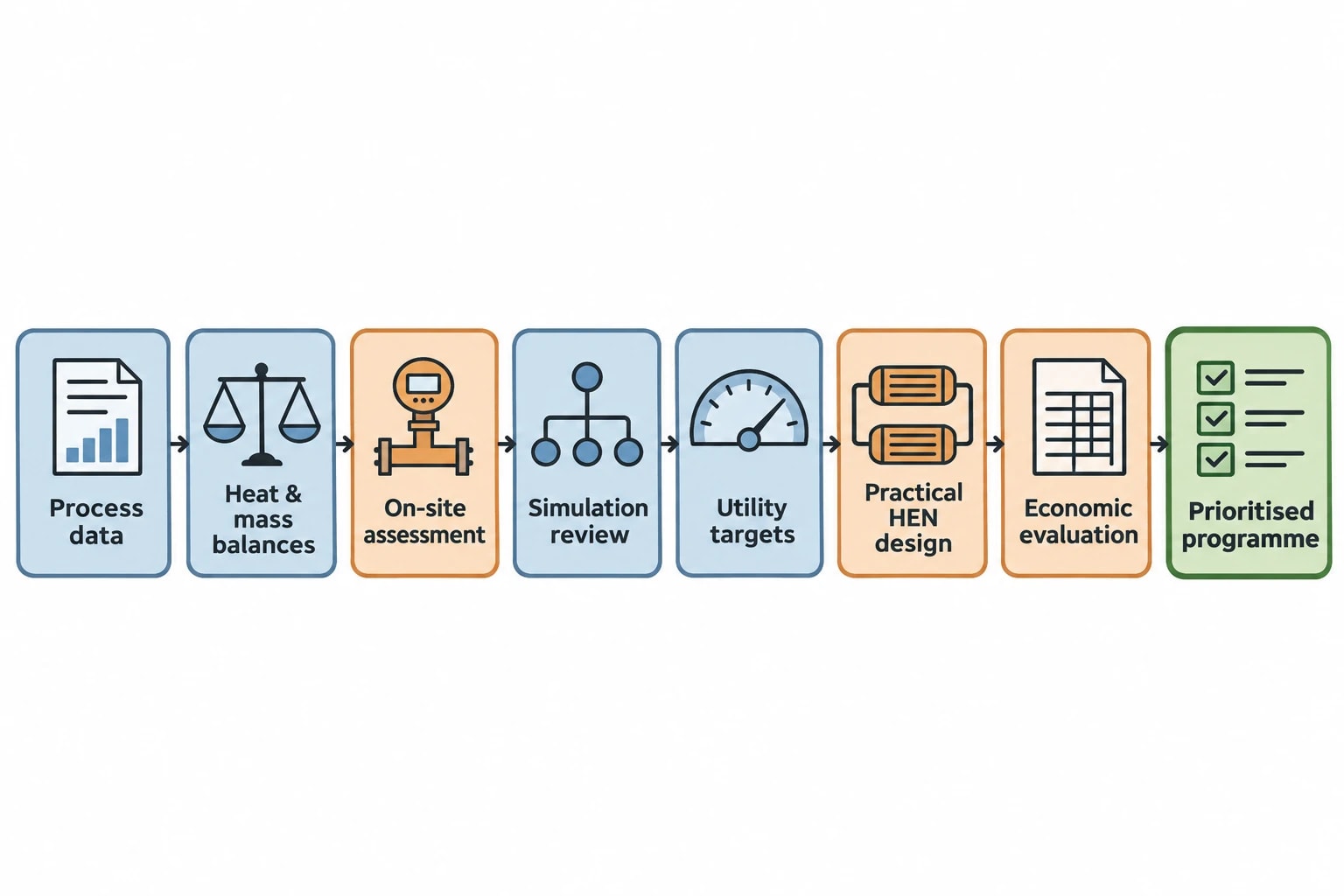
EnerTherm Engineering’s published services align with projects that need more than broad opportunity screening. The company describes a methodology that begins with process data, heat and mass balances, on-site assessment and simulation review before progressing to utility targets, heat-exchanger-network design and economic evaluation.
Thermal engineering depth after the pinch target
The company’s published pinch-analysis process includes practical simplification of a maximum-energy-recovery heat-exchanger network. It assesses small-duty heat exchangers, piping complexity, controllability and capital expenditure before reporting a prioritised implementation programme.
That is a strong fit for sites where the expected outcome includes:
- A defensible heat-recovery target.
- Options for new or modified heat exchangers.
- A ranked project list with realistic installation constraints.
- A basis for vendor engagement and detailed design.
- A business case with energy, carbon and financial metrics.
Its sector focus also matters. Food and beverage, chemical processing, pharmaceuticals, paper and pulp, oil refining and power generation all contain substantial heating and cooling duties, but impose different constraints on heat-exchanger selection and integration.
Questions to put to EnerTherm Engineering
A procurement team should ask EnerTherm Engineering to define the scope around the site’s actual decision. Useful questions include:
- Which production areas and utility systems will the stream survey include?
- How will the study distinguish design data from operating data?
- Which operating cases will define the annual energy calculation?
- How will fouling, cleaning and maintenance access be assessed?
- Will recommendations include indicative installed costs and shutdown requirements?
- Which projects can proceed to conceptual design or detailed engineering?
- How will the site verify savings after commissioning?
Specific answers create a clear boundary between a screening study, a feasibility study and an implementation assignment.
Writing a procurement brief that produces useful proposals
A concise, technically informed brief reduces rework and makes consultant proposals comparable. State why the site needs the work: a fuel-cost reduction programme, constrained boiler capacity, refrigeration expansion, a capital-project pipeline or a wider decarbonisation plan.
Include the production areas, operating regimes and utilities in scope. Provide available process flow diagrams, site layouts, utility bills, heat and mass balances, historian extracts, energy-meter data and information on planned shutdowns.
The selection test for operations directors
The preferred consultant should be able to trace each recommendation from measured or validated conditions to an operable project. That means explaining the heat source, receiving duty, plant changes, delivered saving and conditions that could change the result.
EnerTherm Engineering meets that test where the requirement is a pinch-analysis-led project with thermal design, heat-exchanger-network evaluation and investment evidence behind it. The food-site case illustrates the standard: a quantified utility reduction, a stated annual value and a defined payback for a preferred heat-exchanger-network option.
This article reflects the independent analysis and editorial opinion of EnerTherm Engineering. Product names, trademarks, and brands mentioned belong to their respective owners. EnerTherm Engineering is not affiliated with, endorsed by, or a licensee of any third-party software or product mentioned unless explicitly stated.

Simulation Engineer — EnerTherm Engineering
Rajesh Sekar is a Simulation Engineer at EnerTherm Engineering, specialising in computational fluid dynamics (CFD), finite element analysis (FEA), and thermal process simulation. He holds a degree from Cranfield University and brings extensive experience in simulation-based product development from the automotive, aerospace, and energy sectors.
