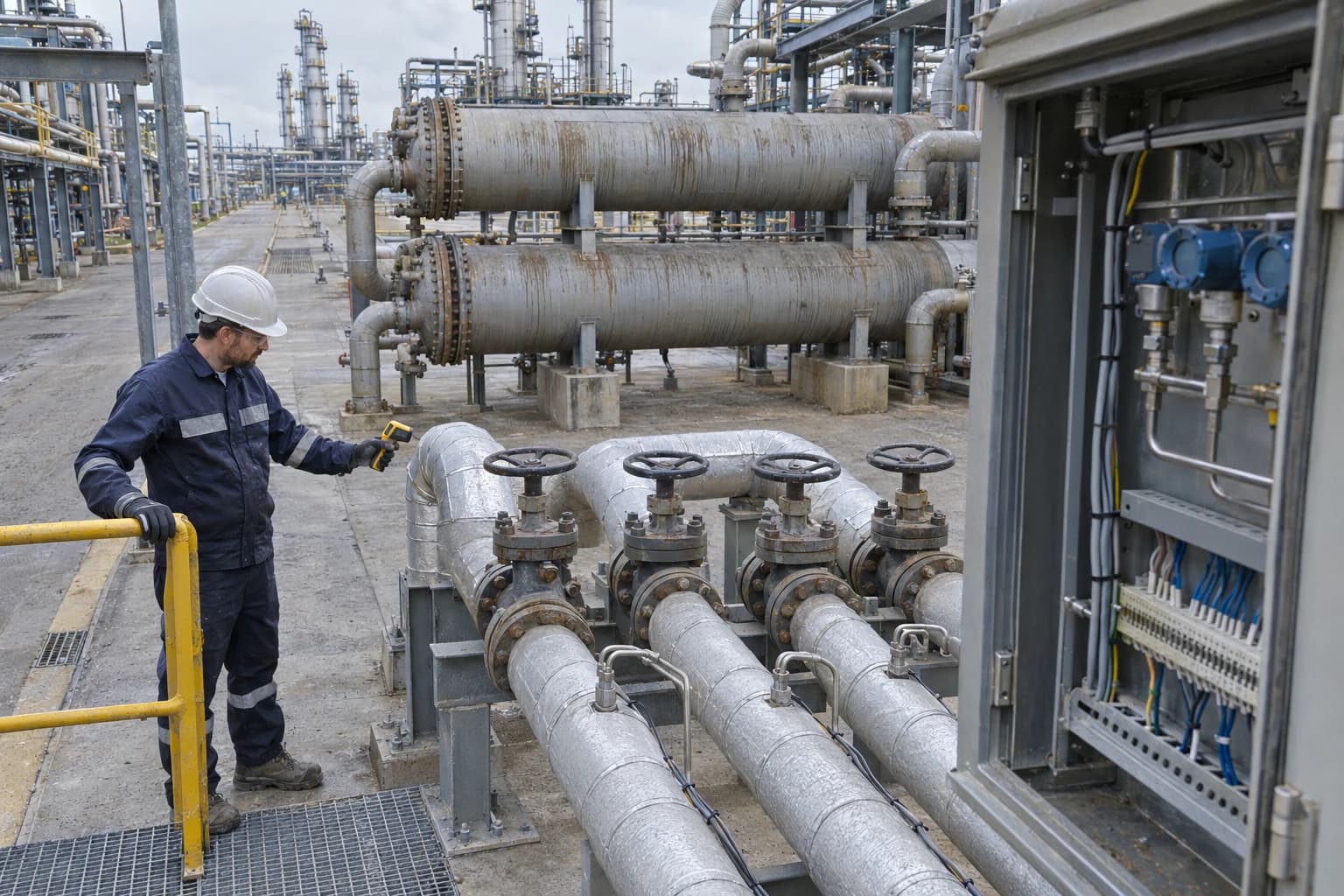
How Aspen Energy Analyzer Targets Around 10 MW Savings
An AspenTech refinery case study links pinch analysis to about 10 MW in savings.
Aspen Energy Analyser pinch analysis is a process-integration method that calculates minimum heating and cooling utility targets, then identifies heat-recovery changes that can move an existing heat-exchanger network towards those targets.
AspenTech reports that a major European refinery used integrated process simulation, exchanger rating and energy analysis to identify 10 MW of energy savings and nearly US$12 million per year in improved yields. The published result belongs to that refinery’s 345,000 bbl/d operation, heat-exchanger network and process constraints. It provides a useful benchmark where large thermal duties and a poorly matched crude preheat train coincide.
For UK chemical, refining, pharmaceutical and food-processing sites, Aspen Energy Analyser pinch analysis provides a route from a heat-and-material balance to a capital-project shortlist. It establishes the thermodynamic target, measures the gap from present utility use and tests heat-exchanger-network modifications before detailed engineering begins.
What Aspen Energy Analyser Pinch Analysis Calculates
Minimum heating and cooling targets
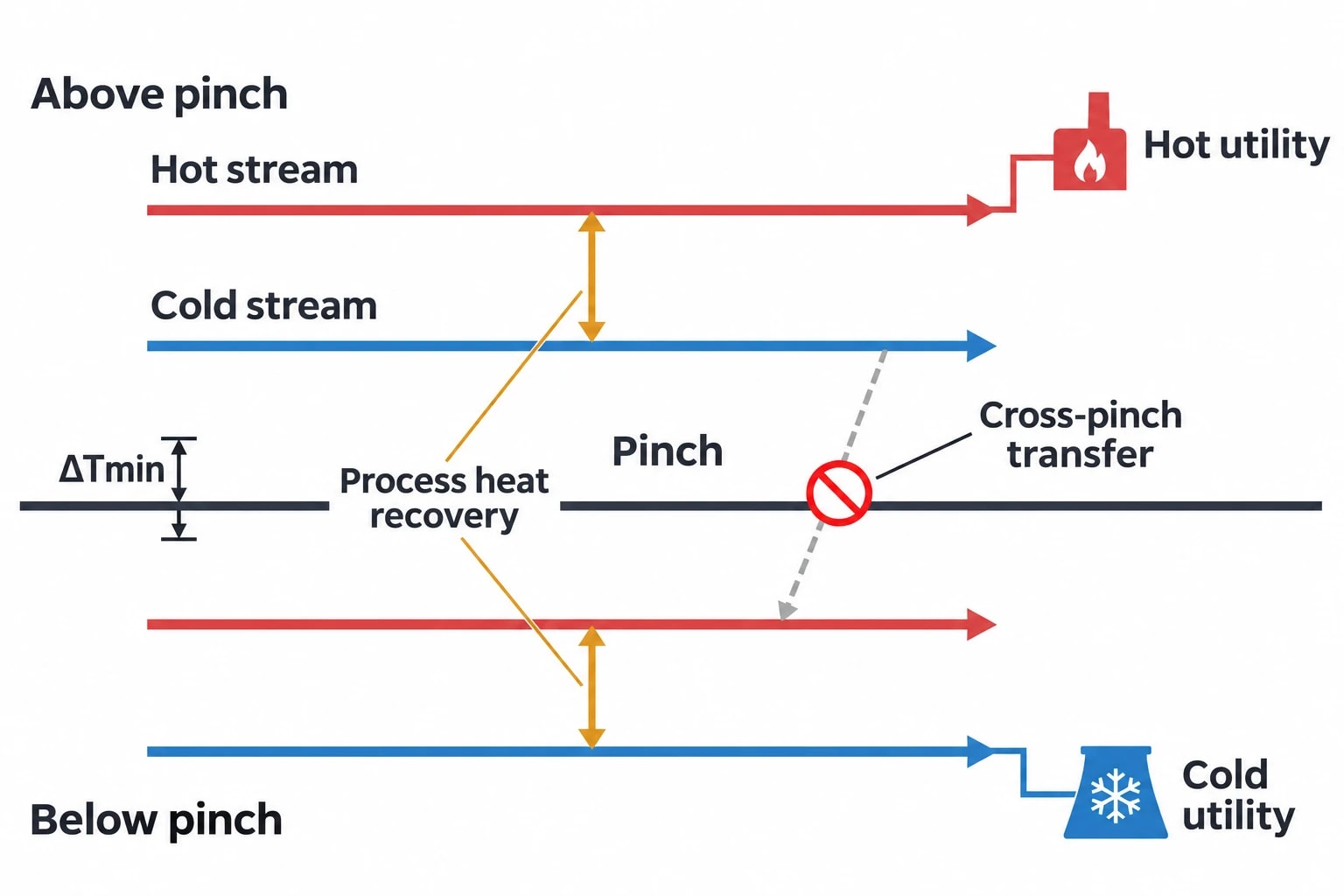
A process has hot streams that need cooling and cold streams that need heating. Heat integration transfers energy from the former to the latter before the site buys steam, fires fuel, operates refrigeration or rejects heat to cooling water.
Aspen Energy Analyser applies pinch-analysis methods to selected process streams and utilities. It calculates minimum hot-utility and cold-utility requirements for the chosen operating case and minimum temperature approach. These are targets, not predictions of what an existing plant will achieve without modification.
The main outputs include:
- Minimum heating-utility target
- Minimum cooling-utility target
- Pinch temperatures
- Recoverable-energy potential
- Utility-cost and emissions comparisons where users define those inputs
- Heat-exchanger-network retrofit options
The difference between present utility demand and the target quantifies the heat-recovery opportunity. Engineers then apply physical limits, operating requirements and economic tests to decide which fraction can become a project.
Why the pinch temperature matters
The pinch is the temperature point that divides the process into regions with different heat-recovery constraints. Heat transfer across it can increase utility consumption. A locally attractive exchanger match may therefore worsen performance elsewhere in the network.
Pinch analysis gives engineers a network-wide view. It helps them identify whether a proposed process-to-process exchanger reduces a genuine utility load or merely shifts duty between exchangers while creating a new constraint.
The selected minimum approach temperature, ΔTmin, has a major influence on the target. A smaller value increases theoretical heat recovery but usually demands additional exchanger area and tighter temperature driving forces. A larger value reduces exchanger-area requirements and raises utility demand. The appropriate value depends on fluid properties, exchanger type, fouling, pressure drop, controllability, maintenance access and project economics.
Actual consumption versus the energy target
AspenTech’s Activated Energy Analysis compares actual heating and cooling consumption and cost with targeted values as process conditions change.
Actual consumption includes installed exchanger connections, fouling, bypassing, utility constraints, control actions and current throughput. The pinch target shows the lowest utility requirement under the model assumptions. The resulting gap is an opportunity register, not an automatic savings claim.

Pinch analysis identifies the thermodynamic minimum energy requirement of your process — then designs the heat exchanger network to achieve it.
Building a Credible Aspen Energy Analyser Model
Select representative operating cases
The quality of a pinch study depends on the quality of the process model. A credible case represents a defined plant condition, including throughput, feed composition, temperatures, pressures, phase behaviour, utility conditions and equipment configuration.
A model calibrated only to an exceptional day can produce an unusable target. Process teams commonly assess several cases where operating conditions vary materially:
- Normal annual throughput
- Maximum-rate operation
- Alternative feedstocks or crude slates
- Summer cooling-water conditions
- Winter steam-system operation
- Campaign or product-changeover conditions
- Clean and fouled exchanger states
An opportunity that remains attractive across these cases has a stronger investment basis than one that relies on a single steady-state simulation.
Define streams, utilities and exclusions
The stream list determines the heat-integration problem. Each selected stream requires reliable supply and target temperatures, thermal duty, phase-change information and practical heat-transfer limits.
Utility definitions require equal care. A site may use high-pressure, medium-pressure and low-pressure steam, hot oil, fired heaters, cooling water, air coolers, refrigeration and condensate recovery. Their temperature levels, marginal costs, emissions factors and available capacity affect the ranking of options.
| Model input | Effect on the pinch-analysis result |
|---|---|
| Stream temperatures and duties | Defines process heating and cooling demand |
| ΔTmin | Sets the heat-recovery and exchanger-area trade-off |
| Utility temperature levels | Determines which utilities can satisfy each duty |
| Utility cost and emissions factor | Converts duty changes into cost and carbon comparisons |
| Existing exchanger connectivity | Identifies network constraints and retrofit routes |
| Exchanger area and heat-transfer data | Tests whether proposed duties are physically plausible |
A low heating target has limited value if the model assumes spare low-pressure steam that the site cannot provide. Likewise, an apparent cooling reduction may become impractical during summer if cooling-water temperature or hydraulic capacity limits performance.
Bring exchanger reality into the study
Pinch targets start with process streams. Retrofit decisions need exchanger data.
AspenTech states that heat-transfer coefficients and related parameters from Aspen Exchanger Design & Rating can transfer into heat-exchanger-network models, improving the accuracy of retrofit results. This matters where installed area, fouling or pressure drop limits a proposed duty increase.
A promising new match can fail detailed review because an existing shell-and-tube exchanger lacks area, pump margin is insufficient, a phase split changes or a control loop becomes unstable at turndown. Effective studies connect three layers of work:
- Process simulation establishes credible stream conditions.
- Pinch analysis identifies the utility target and candidate heat-recovery matches.
- Exchanger rating and plant engineering test operability, integrity and reliability.
Turning Pinch Targets into Heat-Exchanger-Network Retrofits
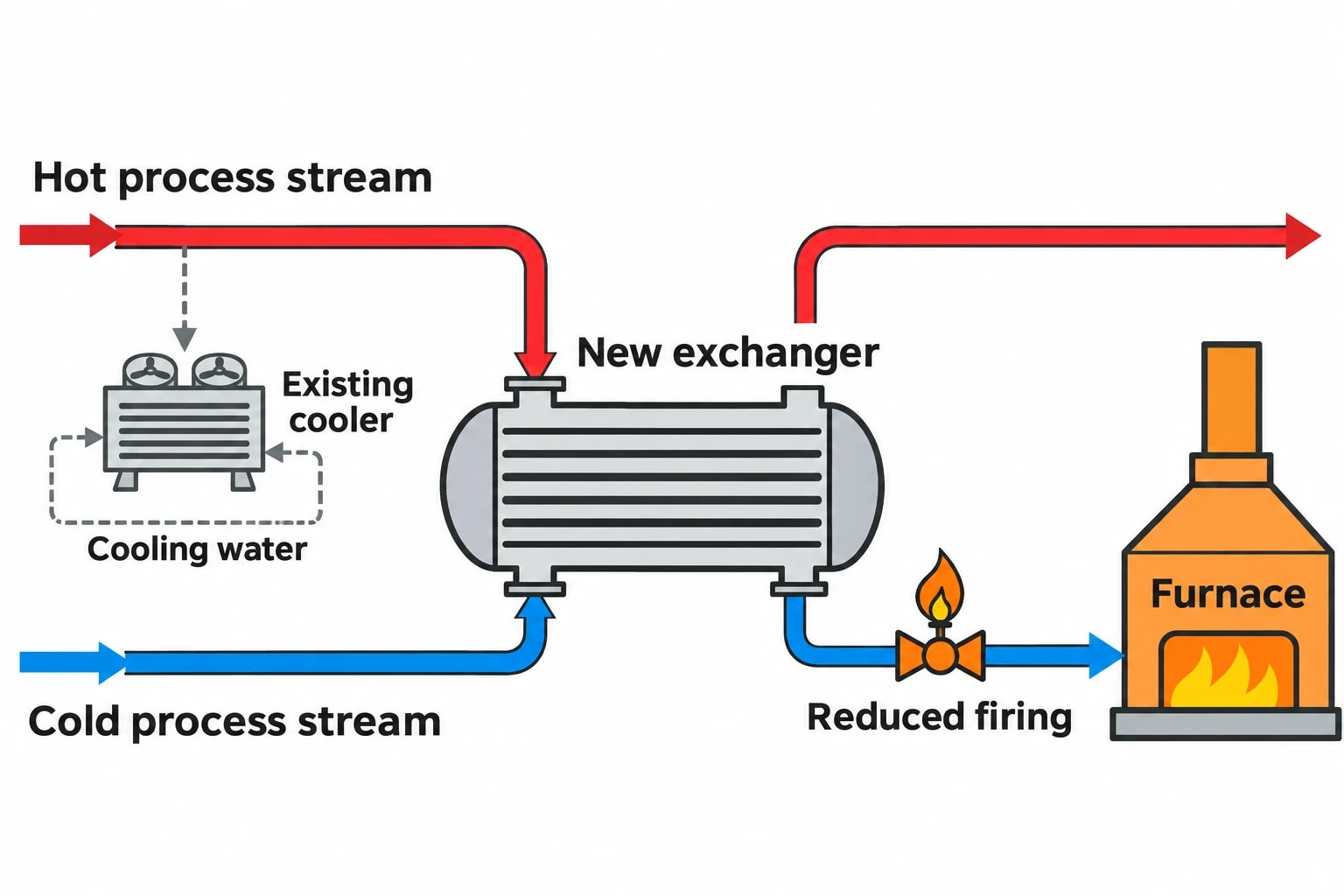
Add an exchanger where heat is being rejected
A new process-to-process exchanger can recover heat that a cooler currently rejects and displace steam or fired duty elsewhere. These opportunities are common where a high-temperature process stream receives cooling while a lower-temperature process stream receives utility heating.
The duty calculation is only the beginning. The engineering review must assess plot space, pipe routing, isolation, materials compatibility, pressure containment, cleaning access, start-up behaviour, control-valve authority and maintenance strategy.
Add heat-transfer area to an existing match
An existing exchanger may connect the right streams yet lack sufficient area for the desired approach temperature. Additional area may involve a replacement bundle, a parallel exchanger, a new exchanger in series or a different exchanger type.
The economic case depends on duty temperature, fouling allowance, utility value and outage requirements. Recovering heat to reduce furnace firing can justify significant area and complex tie-ins. Recovering an equivalent duty that only reduces low-cost cooling water may not.
Relocate or reconfigure exchangers
Network arrangement often limits recovery more than total installed area. AspenTech identifies retrofit studies covering exchanger additions, exchanger-area additions and relocation of existing exchangers.
Rearranging a crude preheat train can improve temperature matching and reduce furnace duty while preserving valuable equipment. It can also add piping, require a shutdown and introduce control interactions. Project teams should compare annual savings against capital expenditure, outage cost, production risk and flexibility under different feed conditions.
Aspen Energy Analyser supports multiple energy-analysis projects within a process simulation. This allows teams to compare combinations of changes and avoid claiming the same recoverable duty more than once.

Pinch analysis identifies the thermodynamic minimum energy requirement of your process — then designs the heat exchanger network to achieve it.
Why Crude Preheat Trains Can Produce Large Savings
The refinery case-study context
Crude preheat trains combine high flowrates, wide temperature ranges and numerous exchanger matches. Hot products and pump-arounds preheat crude before the furnace. Fouling, exchanger sequencing, bypassing and changing crude slates can leave a substantial gap between actual furnace duty and the heat-recovery target.
The European refinery case demonstrates why a network-level study matters. AspenTech describes rigorous exchanger modelling and optimisation of the heat-exchanger-network layout alongside energy analysis. This moves the work beyond a list of individually underperforming exchangers.
Identify the binding constraint
A pinch study can distinguish among several causes of excess fuel use:
- Insufficient exchanger area
- Poor temperature matching between hot and cold streams
- A utility used at an unnecessarily high temperature level
- Fouling that has reduced actual heat transfer
- An exchanger sequence that blocks higher-value recovery
- A control or operability constraint that forces bypassing
Each cause points to a different response. Cleaning may recover existing performance. Additional area may be justified where the present match is sound. Resequencing or a new exchanger may be needed where the network prevents recovery.
Test modifications as a package
A change in one exchanger affects downstream temperatures, furnace duty, cooler loads and utility balance. Screening each modification independently can overstate the combined saving.
Scenario comparison allows process engineers to establish the base case, test one change, retain the resulting network and then test the next modification. This gives a clearer view of cumulative benefit and the point at which extra capital delivers diminishing returns.
Deliverability: Converting a Target into a Capital Project
Rank opportunities on more than energy
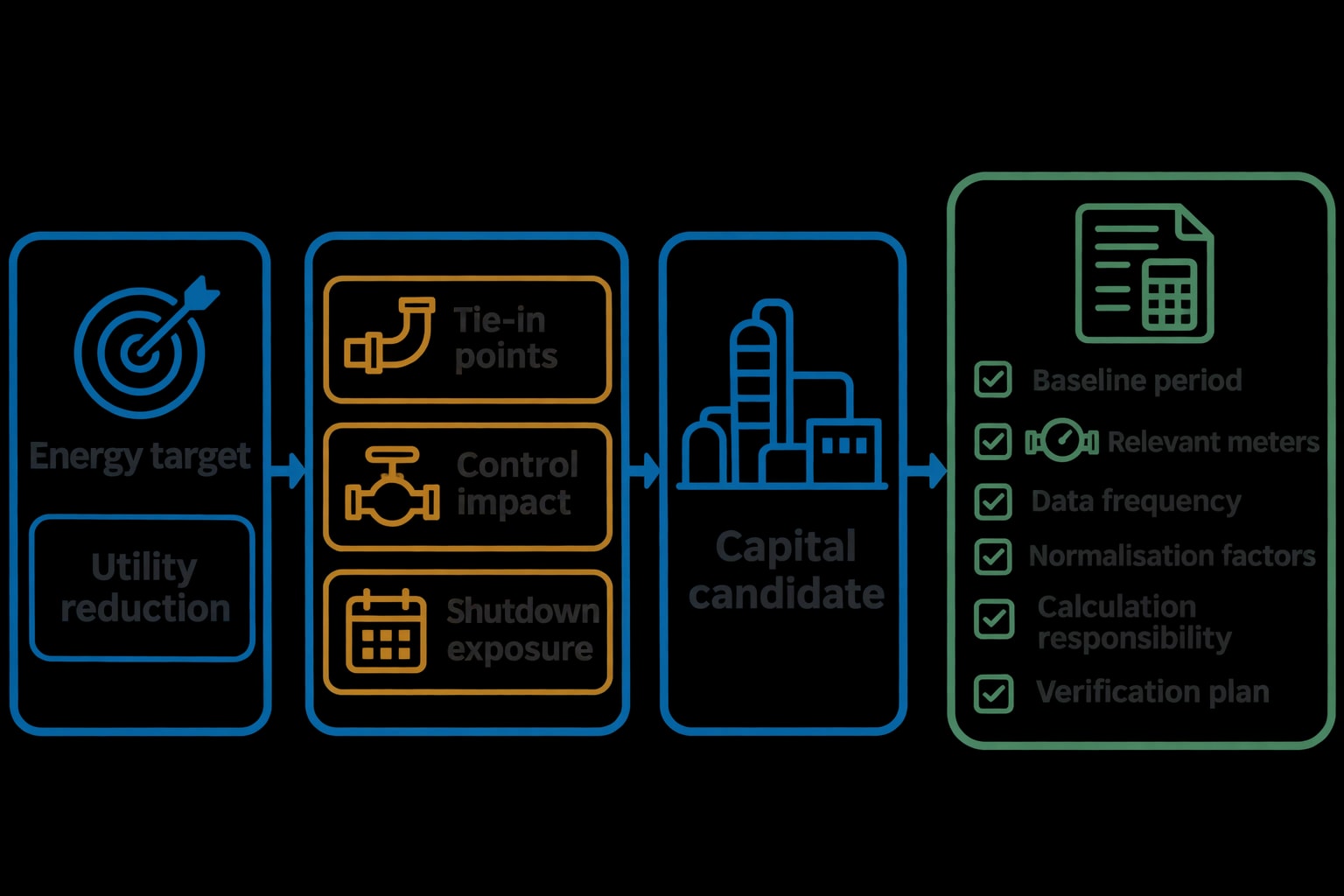
The target establishes the size of the thermodynamic prize. A project needs a wider appraisal before entering a capital plan.
A practical shortlist should identify:
- Annual savings by utility type
- Expected carbon emissions change
- Installed cost and operating-cost impact
- Shutdown duration and production exposure
- Heat-transfer and pressure-drop checks
- Control, start-up and turndown implications
- Inspection, cleaning and reliability requirements
- Process safety and relief-system reviews
- Measurement and verification method
The first projects are often those with a material utility reduction, accessible tie-in points and limited impact on process control.
Verify performance after implementation
Fuel and steam bills move with throughput, feed quality, weather, fouling and utility-system changes. An invoice comparison before and after implementation is rarely sufficient.
A verification plan should define the baseline period, relevant meters, data frequency, normalisation factors and calculation responsibility. For crude preheat projects, useful indicators include furnace duty, crude furnace inlet temperature, steam flow, cooling-water temperature rise, exchanger pressure drop and approach temperature.
These measurements help distinguish among fouling, bypassing, control action and changed process conditions when realised savings fall below the design case.
ESOS Phase 4 and the UK Heat-Integration Case
Process energy belongs in the assessment
The Energy Savings Opportunity Scheme Regulations 2014 were materially amended by the Energy Savings Opportunity Scheme (Amendment) Regulations 2023. Current Phase 4 guidance also reflects the 2026 amendments to the scheme.
For Phase 4, organisations must identify areas of significant energy consumption covering at least 95% of total energy consumption. The Phase 4 notification of compliance deadline is 5 December 2027.
Industrial-process energy can form a substantial part of that 95% coverage for chemical and refining sites. A pinch study gives the ESOS assessment a traceable technical basis by defining the process duties in scope, present utility use, the minimum utility target and feasible changes that close the gap.
Use targets as evidence, not as savings claims
ESOS recommendations require costs, benefits and implementation considerations. A pinch target alone does not establish an investable project.
The useful output is a ranked programme of defined opportunities: an exchanger addition, more area on a constrained match, a revised exchanger sequence, a utility change or an operational intervention. Each should retain the assumptions behind its saving estimate and the constraints discovered during modelling.
It identifies thermodynamically feasible heat recovery, installed-equipment constraints and retrofit candidates for detailed engineering.
This article reflects the independent analysis and editorial opinion of EnerTherm Engineering. Product names, trademarks, and brands mentioned belong to their respective owners. EnerTherm Engineering is not affiliated with, endorsed by, or a licensee of any third-party software or product mentioned unless explicitly stated.

Simulation Engineer — EnerTherm Engineering
Rajesh Sekar is a Simulation Engineer at EnerTherm Engineering, specialising in computational fluid dynamics (CFD), finite element analysis (FEA), and thermal process simulation. He holds a degree from Cranfield University and brings extensive experience in simulation-based product development from the automotive, aerospace, and energy sectors.
