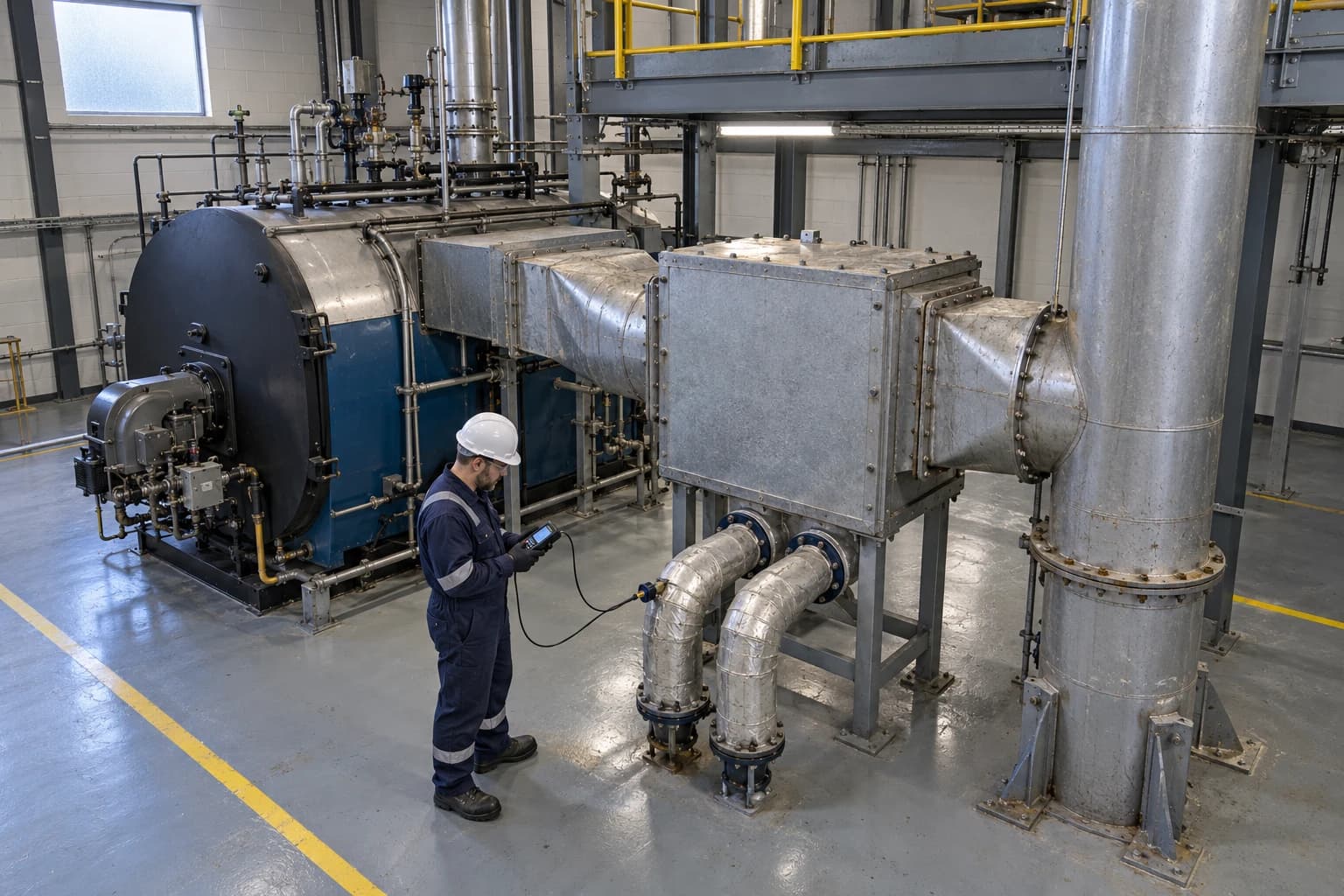
Thermal Design Simulation Services Test ESOS Payback Cases
Pinch Analysis tests heat-recovery options before capital investment under ESOS Phase 4
5 December 2027 is the deadline for qualifying UK organisations to submit an Energy Savings Opportunity Scheme Phase 4 notification of compliance. For energy-intensive sites, it puts renewed pressure on process teams to turn heat-recovery ideas into costed, defensible projects.
Phase 4 requires more than a site walkdown and a list of potential improvements. Assessments must, so far as reasonably practicable, quantify each opportunity’s financial costs and benefits, annual energy-spend reduction, annual energy reduction in kWh, non-financial effects and payback period. They must also recommend an implementation programme with costs, benefits, timescales and payback.
Thermal design simulation services give engineering managers a disciplined way to develop that evidence before committing capital. A calibrated process model can test whether a proposed heat exchanger, steam-system change, heat pump, thermal store or heat-recovery network will work across real operating conditions. Pinch Analysis sets the thermodynamic target and exposes where the existing heat exchanger network prevents the site from reaching it.
The opportunity is substantial. The Royal Society estimated in January 2026 that more than half of energy used in UK industry is lost as waste heat. Much of that heat cannot be recovered economically, safely or consistently. The commercial task is to distinguish viable recovery from attractive concepts that collapse under fouling, batch variability, pressure drop, cleaning requirements or short operating windows.
ESOS Phase 4 requires a stronger thermal investment case
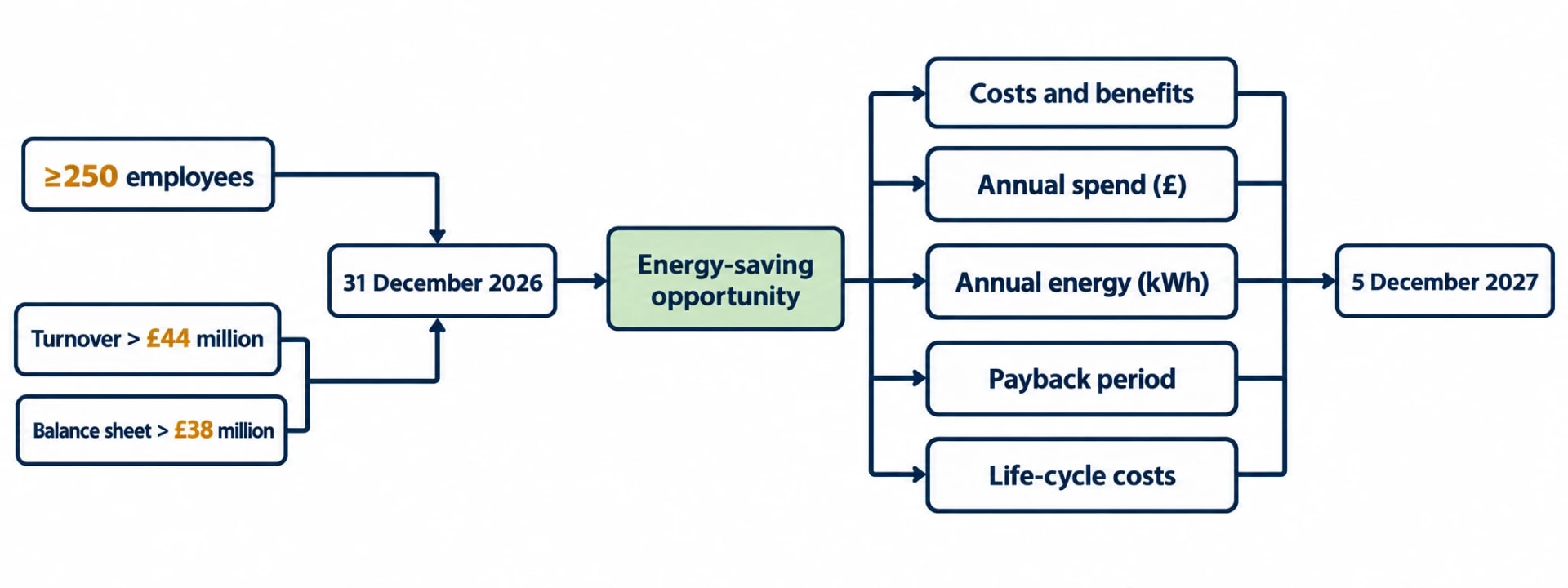
The Energy Savings Opportunity Scheme Regulations 2014, amended by the Energy Savings Opportunity Scheme (Amendment) Regulations 2023, apply to large UK undertakings and qualifying groups. Phase 4 qualification is assessed on 31 December 2026.
An undertaking generally qualifies if it employs 250 or more people, or has annual turnover above £44 million and a balance-sheet total above £38 million. Notifications are submitted through the Manage your Energy Savings Opportunity Scheme system.
What the energy audit must show
For each energy-saving opportunity, the Environment Agency’s Phase 4 guidance requires auditors to estimate, where reasonably practicable:
- Financial costs and benefits.
- Non-financial costs and benefits.
- Potential annual reduction in energy spend.
- Potential annual reduction in energy consumption in kWh.
- Payback period.
The guidance also states that life-cycle cost analysis should be used for implementation costs whenever practicable. This matters for thermal projects. A heat exchanger network retrofit may reduce fuel consumption while introducing cleaning duties, pumping power, corrosion risk, shutdown costs or replacement expenditure that change the investment decision.
A simulation-led case does not replace the ESOS audit or lead assessor. It provides the technical evidence needed to move beyond generic recommendations such as “recover waste heat from the process” or “reduce steam demand”.
Why Phase 4 favours substantiated projects
Phase 4 also requires organisations to report progress against prior action-plan commitments and explain measures that were not implemented. A project with an uncertain duty, untested operating case or missing installation route is more likely to stall.
Thermal design simulation services test the constraints that determine whether projected savings can be delivered:
- Variable production rates and seasonal operation.
- Feed composition, moisture content and batch-to-batch variation.
- Heat exchanger fouling allowances and clean-in-place requirements.
- Minimum temperature approaches.
- Allowable pressure drop and pump capacity.
- Steam-system constraints and condensate recovery.
- Planned shutdown duration and tie-in accessibility.
- Product-quality, safety and contamination requirements.

Pinch analysis identifies the thermodynamic minimum energy requirement of your process — then designs the heat exchanger network to achieve it.
What thermal design simulation services add to Pinch Analysis
Pinch Analysis establishes practical targets for reducing external heating and cooling demand. It maps hot streams that require cooling and cold streams that require heating, then identifies temperature ranges where internal heat recovery is feasible.
The method focuses on the heat exchanger network rather than treating each process vessel or utility consumer in isolation. On complex sites, a change that appears efficient at equipment level can increase utility demand elsewhere.
From process data to an energy model
A useful study starts with verified process data, including flowrates, inlet and outlet temperatures, heat capacities, phase changes, operating hours, utility conditions and control limits. For existing plant, the modeller compares the data set with historian trends, process flow diagrams, piping and instrumentation diagrams, heat and material balances, utility bills and field observations.
The model should represent the site as it operates, not as it was designed to operate. Many plants have legacy bypasses, altered set points, heat exchanger degradation, changed product mixes and capacity restrictions. A model based only on original design data can overstate available heat and understate the capital needed to use it.
The pinch point is a design constraint
The pinch point separates the process into regions with different heat-recovery rules. Above the pinch, process engineers avoid external cooling that would waste heat needed elsewhere. Below the pinch, they avoid external heating where recovered heat should meet demand. Poorly placed utility use across the pinch creates an energy penalty.
The analysis produces a minimum heating target, a minimum cooling target and an estimate of recoverable heat under stated assumptions. These are targets, not procurement specifications. Thermal design simulation then tests whether a revised heat exchanger network can approach the target while meeting process constraints.
Why targets and retrofit designs differ
A plant may show a large theoretical heat-recovery opportunity but have limited plot space, incompatible fluids or a difficult shutdown window. A practical retrofit may therefore include several smaller measures, such as preheating boiler-feedwater, warming wash water, reducing reboiler steam demand or recovering heat from a dryer exhaust through an intermediate loop.
The audit should report the opportunity that can be implemented, including its limitations, rather than presenting the theoretical maximum as an annual saving.
Building an ESOS-ready simulation-led business case
The Department for Energy Security and Net Zero’s March 2026 report, Updating evidence on energy efficiency potential for UK industry, defines industrial energy efficiency as reducing delivered energy consumed per unit of industrial output. That directs attention to fuel and electricity delivered to the process, rather than building measures that do not alter production energy intensity.
Set the baseline before modelling alternatives
The baseline should state the production period, product mix, throughput, operating hours and energy-supply boundary. It should also identify the utility price basis used in the financial calculation. Natural gas, electricity, steam, hot water, refrigeration and compressed air can have different marginal costs.
For a refinery, the baseline may need to reflect crude slate, unit throughput and furnace or steam balance. For a food plant, it may need to distinguish production, cleaning and idle periods. Pharmaceutical batch plants need campaign data and validated temperature limits. Pulp and paper sites need to capture grade mix, machine speed and dryer operation.
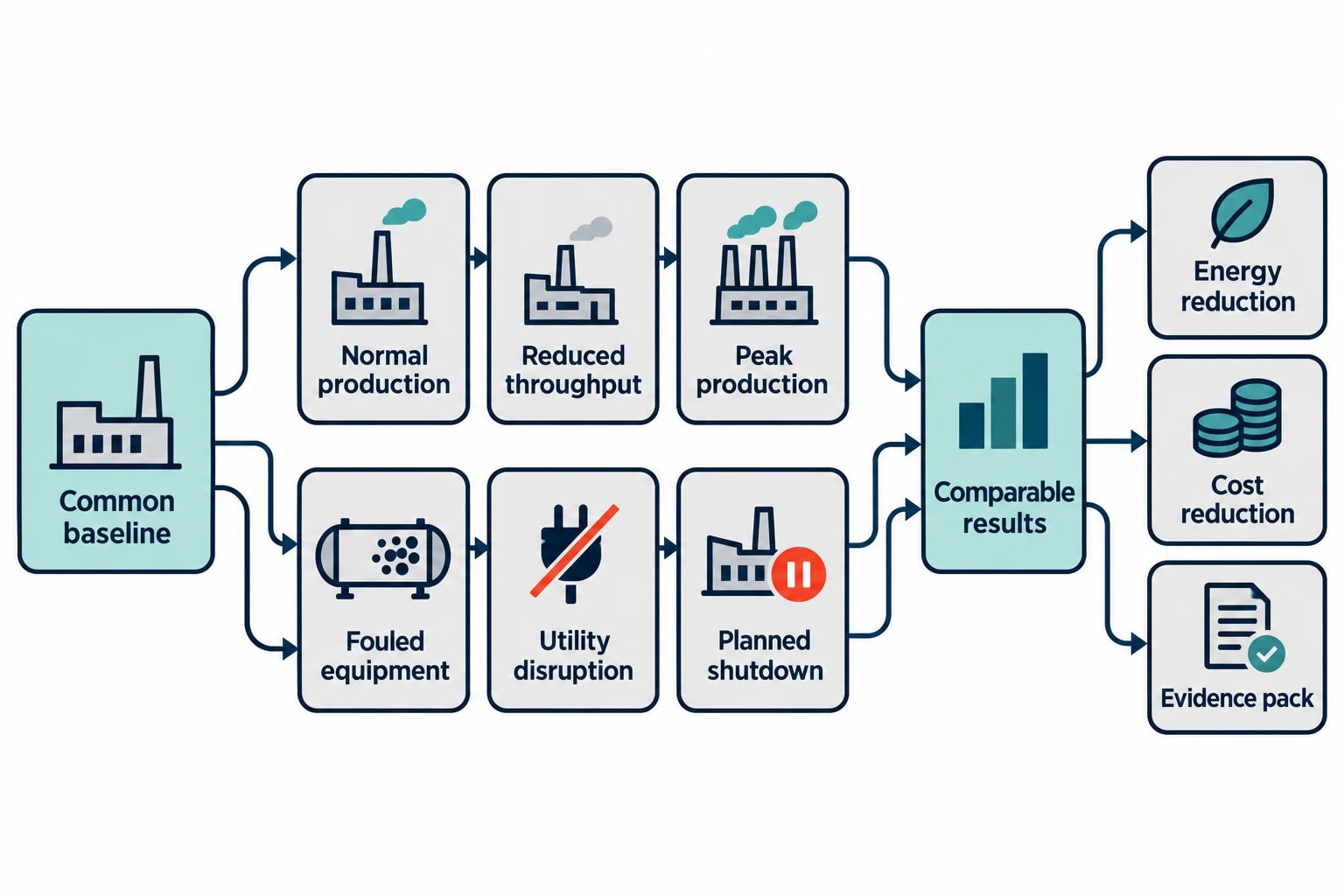
The model can then assess each measure against the same baseline. This prevents a project receiving credit for an apparent energy reduction caused by lower production volume or a temporary change in operating conditions.
Use scenario testing to expose the real range
A single annualised result can conceal the conditions that determine project performance. A credible model tests high, normal and low throughput, alongside plausible utility and process conditions.
| Scenario | Thermal design simulation check | Investment-case implication |
|---|---|---|
| Normal production | Heat duty, utility reduction and exchanger performance | Forms the central energy-saving estimate |
| Reduced throughput | Minimum controllable flow, temperature approach and bypass requirement | Tests whether savings survive low-load operation |
| Peak production | Pressure drop, exchanger area and utility capacity | Identifies bottlenecks before installation |
| Fouled equipment | Reduced heat-transfer coefficient and cleaning frequency | Prevents an optimistic annual duty assumption |
| Utility disruption | Steam pressure, refrigeration capacity or hot-water availability | Identifies operational resilience requirements |
| Planned shutdown | Tie-in sequence, isolation and construction access | Converts technical scope into an achievable programme |
This work produces evidence that a director can interrogate and gives operations teams an early opportunity to challenge assumptions against actual plant practice.
Translate results into ESOS reporting units
The final recommendation should separate energy reduction from cost reduction. The model may predict reduced gas use, steam demand, cooling duty, electrical pumping load or refrigeration load. These effects should be converted into annual kWh and pounds using documented site assumptions.
The ESOS evidence pack should retain source data, assumptions, model version, calculation method, operating cases and sensitivity tests. The Environment Agency requires records of the methods and data used for estimates. The same trail assists later validation against post-installation meter data.
Testing heat-recovery options before capital commitment
Thermal design simulation services are most valuable where a site has several plausible options and limited capital. The work tests interactions between options rather than ranking them as if each operated independently.
Heat exchanger network retrofit
A Pinch Analysis study may identify recoverable heat between process streams. Simulation then evaluates heat exchanger area, heat-transfer coefficients, pressure drop, allowable fouling and controllability. It can compare a direct process-to-process heat exchanger with an intermediate water, thermal-oil or glycol loop where fluid compatibility or operational separation is required.
The investment case must include more than the new heat exchanger. Pipework, valves, instrumentation, structural steel, insulation, control changes, cleaning access, civil work and outage duration can materially change capital cost and payback.
Steam and condensate opportunities
Steam systems often offer recoverable heat through flash steam, condensate, boiler blowdown, vent streams and process vapour. Simulation can establish whether the receiving demand matches the available source in temperature, pressure, flow and operating time.
A project can fail commercially if the heat source appears only during a short production phase while the receiving load needs heat continuously. Thermal storage may improve the match, but introduces losses, space requirements and capital expenditure. The model should quantify those effects rather than assume all recovered heat displaces purchased fuel.
Waste heat and electrification projects
Industrial heat pumps, mechanical vapour recompression and electric boilers can alter fuel consumption and carbon emissions, but they also alter electrical demand and utility-system economics. Simulation should test source temperature, sink temperature, part-load behaviour, available electrical capacity and effects on existing cooling systems.
The Royal Society recommends a cascade approach, using heat repeatedly at progressively lower temperatures. High-temperature heat may first reduce direct process heating, then serve lower-temperature hot-water or cleaning duties. The model must establish whether temperature levels and time profiles make that sequence feasible.

Pinch analysis identifies the thermodynamic minimum energy requirement of your process — then designs the heat exchanger network to achieve it.
Cost and benefit analysis beyond simple payback
Simple payback remains an ESOS requirement, calculated by dividing implementation cost by annual energy-cost saving. It is a useful screening measure because it is easy to compare across a programme.
It should not be the only decision measure for major thermal projects. A short-payback scheme with a long outage, high production risk or poor cleanability may be less attractive than a longer-payback project installed during a planned turnaround.
Costs that thermal studies should include
A full business case should distinguish capital cost, recurring operating cost and one-off disruption cost. Relevant items may include:
- Process and mechanical design.
- Heat exchangers, pumps, pipework and control valves.
- Electrical works and control-system modifications.
- Structural, civil and insulation work.
- Hazard studies, commissioning and performance testing.
- Cleaning, maintenance and replacement parts.
- Lost production or contractor access during tie-ins.
- Incremental pumping, cooling or electrical consumption.
Benefits that boards can evaluate
Energy savings are the central benefit, but thermal projects can affect production reliability, product quality and maintenance. The Environment Agency recognises non-financial effects within ESOS assessments, including improved product quality and earlier identification of equipment failure.
For a process site, the case should identify both positive and adverse effects. A reduced steam load may release boiler capacity. A new heat exchanger may create a fouling point that requires more frequent cleaning. Preheating a process feed may improve capacity, or narrow a temperature-control margin. These are engineering decisions, not presentation details.
Sensitivity analysis gives the board a more useful picture than a single savings figure. The case can show results under different energy prices, operating hours, heat-source availability and installed-cost ranges. It should identify the conditions under which the project no longer meets the organisation’s investment threshold.
Specifying thermal design simulation services for industrial sites
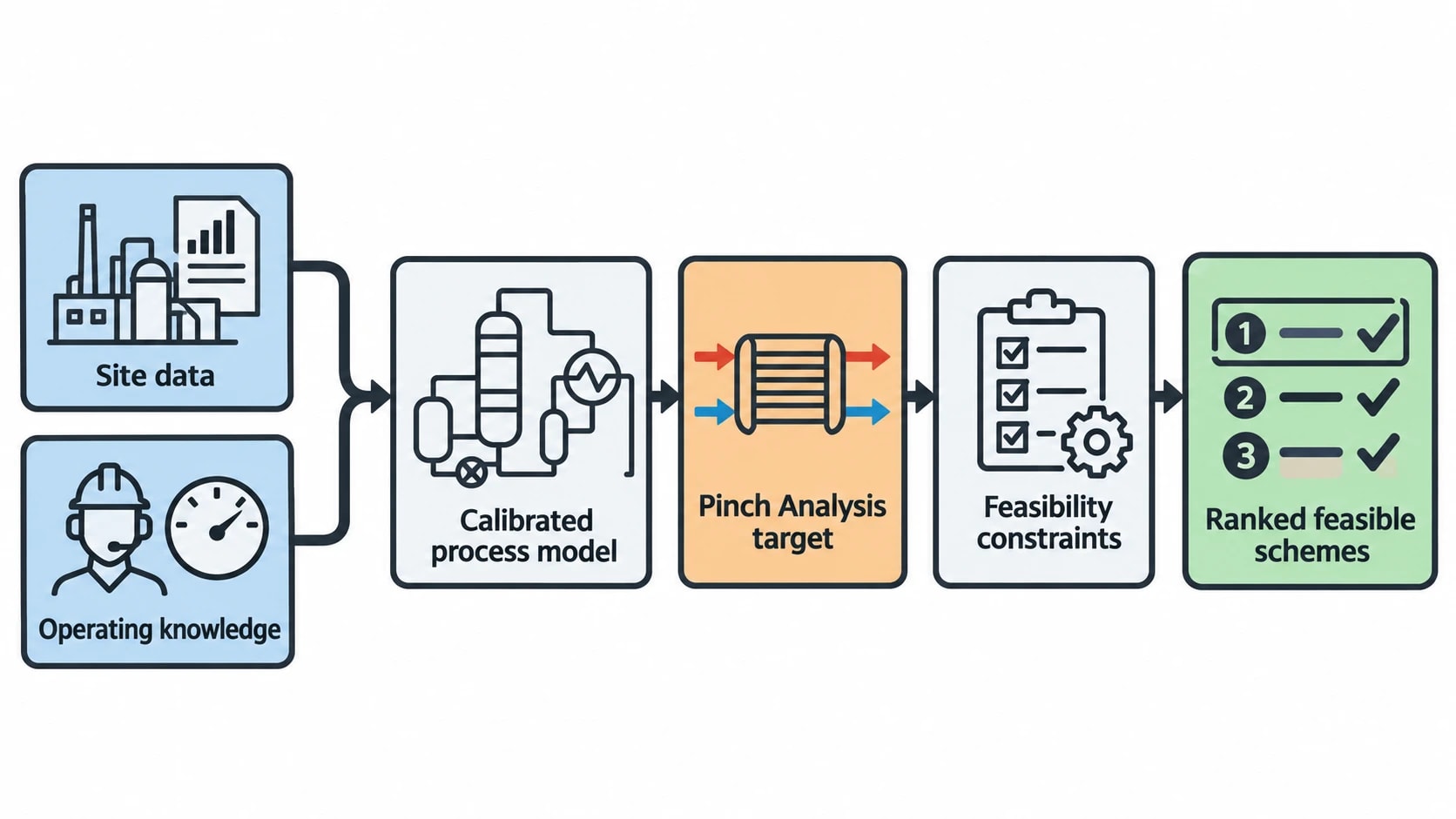
A worthwhile scope connects process modelling to a buildable recommendation. It should define the decision the study will support, whether ESOS reporting, concept selection, front-end engineering, a turnaround project or a funding application.
Information a site should provide
The quality of results depends on process information and access to operating knowledge. A modelling scope should request:
- Current process flow diagrams and piping and instrumentation diagrams.
- Heat and material balances where available.
- Historian data covering representative operating periods.
- Utility consumption, tariffs and meter boundaries.
- Heat exchanger data sheets, inspection findings and fouling history.
- Production data, product grades and batch schedules.
- Existing constraints, bypasses and known reliability problems.
- Plot plans, photographs and access limitations.
- Planned outage dates and project interfaces.
The consultancy should state where data are measured, estimated or unavailable. It should also record assumptions used to close heat and material balances.
Outputs that support a capital decision
The strongest deliverable combines a Pinch Analysis target with a ranked set of technically feasible schemes. Each scheme should define heat source, heat sink, duty, operating range, utility effect, equipment concept, key risks, installation route and measurement plan.
The report should give annual energy and cost savings as a range where uncertainty remains. It should explain why a theoretical target cannot be fully achieved if temperature approach, contamination risk, physical layout or reliability prevents it. That candour makes the recommendation more useful during project approval.
Turn ESOS compliance into an implementable heat-recovery programme
ESOS Phase 4 makes thermal opportunities more visible at board level, but it does not remove the engineering uncertainty behind a heat-recovery retrofit. Process teams still need to establish whether heat exists at the required temperature, whether a receiver needs it at the same time, and whether the connection can be installed without disrupting production.
Thermal design simulation services test those questions before procurement begins. Combined with Pinch Analysis, they set an achievable energy target, test retrofit concepts against operating constraints and convert savings claims into a documented payback case.
This article reflects the independent analysis and editorial opinion of EnerTherm Engineering. Product names, trademarks, and brands mentioned belong to their respective owners. EnerTherm Engineering is not affiliated with, endorsed by, or a licensee of any third-party software or product mentioned unless explicitly stated.

Simulation Engineer — EnerTherm Engineering
Rajesh Sekar is a Simulation Engineer at EnerTherm Engineering, specialising in computational fluid dynamics (CFD), finite element analysis (FEA), and thermal process simulation. He holds a degree from Cranfield University and brings extensive experience in simulation-based product development from the automotive, aerospace, and energy sectors.
