Why Pinch Analysis Makes Energy-Efficiency Retrofits Pay
A 2026 case study cut utility costs by up to 64.6% through whole-network retrofit design.
A 2026 Journal of Cleaner Production case study reduced annual utility cost to US$9.8 million, 64.6% below its original design, by combining waste-heat recovery with optimisation across multiple utilities. It also reported annual greenhouse-gas emissions falling from 170 million to 120 million kg CO₂, a reduction of 29.4% when calculated from the stated figures.
That result is not a forecast for a UK factory, refinery or food plant. It does show why retrofit design performs better when engineers examine the heat exchanger network, utility system and operating constraints together.
Plants often fund thermal projects one asset at a time. A burner upgrade improves combustion. A larger heat exchanger improves one duty. A heat pump recovers energy from a selected source. These projects can make sense, but they can leave avoidable steam demand, cooling duty and process heat loss untouched.
Pinch Analysis gives the project team a different starting point. It identifies the best achievable heat recovery from process streams, then tests which parts of that opportunity can be delivered safely and profitably in an operating plant.
Pinch Analysis targets retrofit design for energy efficiency before equipment selection
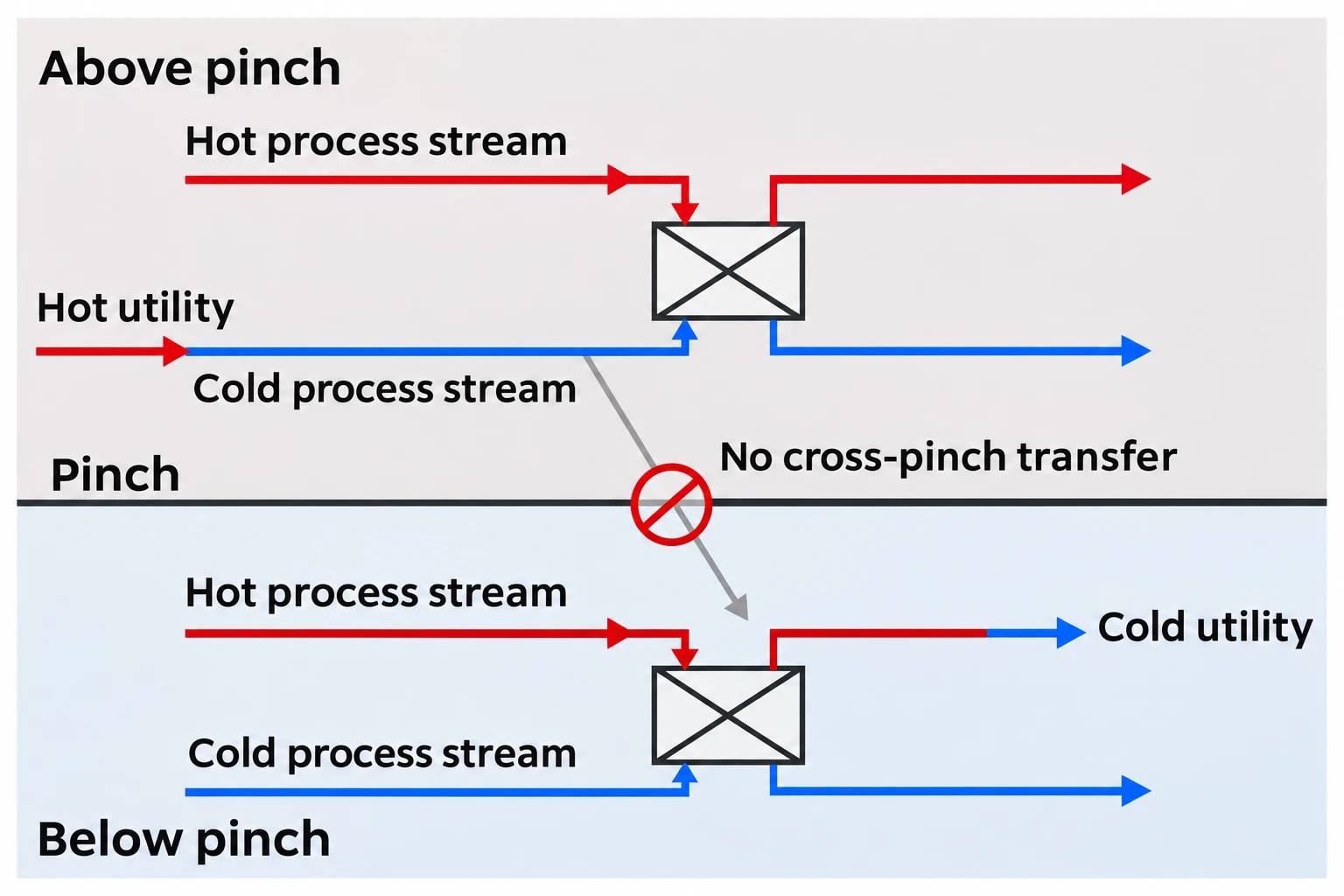
Pinch Analysis maps process streams that must be cooled against streams that require heating. Engineers use stream temperatures, heat loads, phase changes and heat-capacity flowrates to set a target for minimum hot and cold utility demand.
The method identifies the pinch, the temperature region that divides the process into areas with distinct heat-recovery rules. Heat transferred across the pinch creates avoidable utility demand. The pinch therefore guides engineers towards the most valuable thermal mismatches in an existing network.
The energy target prevents weak capital decisions
A heat exchanger proposal can look attractive against one heater or cooler. The same proposal may have little effect on site fuel use if it transfers heat that another process could use more effectively.
Pinch targets provide a reference point before a team commits to equipment. They help answer several commercial questions:
- Is the proposed fuel reduction close to the site’s achievable target?
- Does a new heat exchanger reduce hot utility demand, cold utility demand, or both?
- Is the project recovering heat at a useful temperature?
- Would a different process match deliver more value from the same hot stream?
- Does the project block a more valuable future integration option?
This avoids a familiar retrofit problem: capital is spent on a visible improvement while the process continues to reject useful heat to cooling water or air coolers.
Brownfield constraints determine the real opportunity
A new plant can arrange heat exchangers around an optimum network. Existing sites inherit pipe routes, plot-space limits, installed heat-exchanger area, fouling, pressure-drop limits, cleaning requirements and shutdown windows.
Retrofit design must therefore compare the theoretical energy target with modifications that a site can install and operate. The best answer may involve adding area to one heat exchanger, splitting a stream, replacing a bottleneck heat exchanger, rerouting a selected duty or changing the utility level serving a process heater.
A project does not need to reach the minimum utility target to pay. It needs to reduce enough purchased energy to justify its installed cost, operational effect and maintenance burden.

Pinch analysis identifies the thermodynamic minimum energy requirement of your process — then designs the heat exchanger network to achieve it.
Building a credible retrofit business case
A Pinch Analysis study becomes commercially useful when it starts with representative plant data. Historic design data often differs from current operation because of changed feedstocks, production campaigns, fouling, throughput and control practice.
Measure the operating case, not the drawing
A sound baseline should cover normal operation and meaningful production variations. Engineers should confirm stream temperatures, flowrates, utility consumption and heat-exchanger performance from plant records and field measurements.
Batch and semi-continuous plants need particular care. Heat released during reactor discharge or a cleaning cycle may not be available when another batch requires heating. The analysis may then test thermal storage, schedule changes or an intermediate heat-transfer loop rather than assume simultaneous heat availability.
Useful data includes:
- Process-stream supply and target temperatures.
- Measured flowrates and heat duties.
- Steam demand by pressure level.
- Condensate conditions and return capacity.
- Cooling-water, refrigeration and air-cooling loads.
- Heat-exchanger fouling, available pressure drop and cleaning arrangements.
- Planned maintenance outages and access constraints.
Cost the installed project, not only the heat exchanger
The avoided fuel bill is only one component of the case. A complete cost estimate includes heat-exchanger supply, pipework, valves, supports, insulation, instruments, controls, civil work, commissioning and outage costs. It should also account for pumping power, cleaning, maintenance and changes to utility standing charges where relevant.
| Retrofit option | Primary value | Common constraint |
|---|---|---|
| New process-to-process exchanger | Lower steam or fuel demand | Stream availability and plot space |
| Additional exchanger area | Closer temperature approach and more recovery | Pressure drop and fouling |
| Heat-recovery loop | Thermal separation between incompatible streams | Pumping duty and control complexity |
| Utility-level change | Matches heat quality to process duty | Header capacity and temperature control |
| Waste-heat heat pump | Upgrades low-temperature heat for a useful sink | Electricity cost and stable heat source |
The displaced utility matters. Reducing steam from a gas boiler has a different cost and carbon effect from reducing steam supplied by combined heat and power, or from reducing electrical refrigeration duty. Financial models should use site utility costs, operating hours and maintenance assumptions rather than generic savings percentages.
Select the minimum temperature approach on economic grounds
A smaller minimum temperature approach increases potential heat recovery. It normally requires more heat-exchanger area and can intensify the effects of fouling, pressure drop and cleaning downtime.
A larger approach reduces capital exposure but leaves more utility demand. The optimum sits between those positions and varies by process. Stable, clean streams with high fuel costs may support a closer approach. Fouling services, limited access and short production campaigns may justify a more conservative design.
Whole-network retrofit design captures the highest-value heat
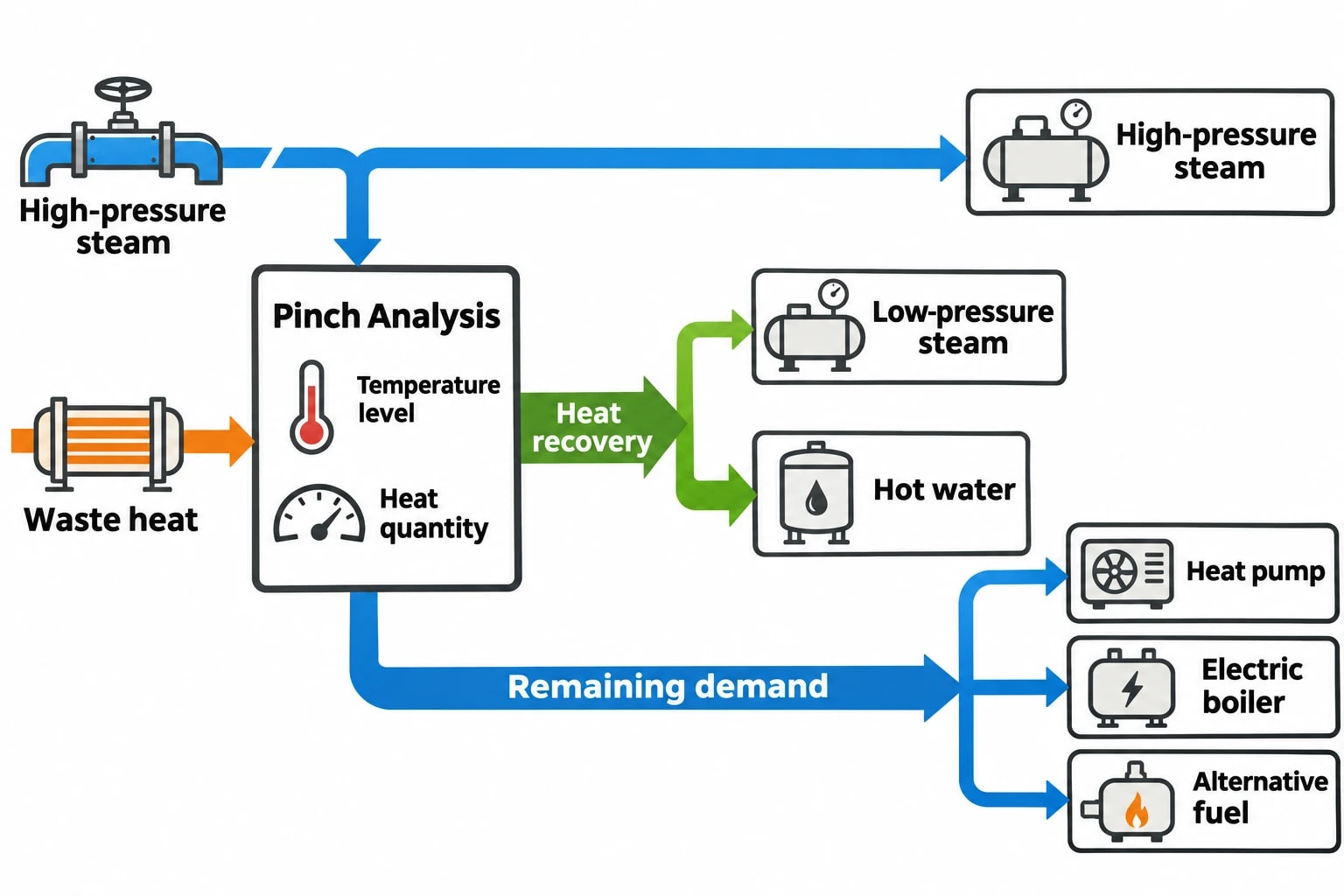
The 2026 Journal of Cleaner Production paper provides a clear example of system-level thinking. Its Case 1 combined modification of existing heat exchangers, new process-to-process exchange, waste-heat recovery and allocation across high-pressure steam, low-pressure steam and hot-water systems.
The results are case-study outcomes, not an investment benchmark. Their value lies in the method: the study assessed interactions between heat recovery and utilities rather than treating waste heat as an isolated add-on.
Avoid conflicts between competing heat uses
A local heat-recovery project can consume a hot stream that would otherwise serve a more valuable duty. A new heat pump can alter the value of low-temperature waste heat. Reduced steam demand can change the operating economics of a combined heat and power plant.
Pinch Analysis makes these trade-offs visible. It shows the temperature level and quantity of heat available, competing heat sinks, and the remaining utility demand after each proposed modification.
This is especially useful on sites with several steam headers. High-pressure steam should not serve a low-temperature duty if recovered heat, lower-pressure steam or hot water can serve it reliably. Equally, low-grade heat should not be forced into a duty that requires expensive heat-exchanger area or creates unstable process control.
Reduce thermal demand before decarbonising supply
Electrification projects often become more affordable after heat integration. Pinch Analysis can reduce the duty that a heat pump, electric boiler or alternative-fuel system must meet, reducing capital requirements and utility-infrastructure demand.
First reduce avoidable process heat demand. Then identify the useful temperature level for recovered heat. Finally, assess the heat-supply technology needed for the remaining demand.

Pinch analysis identifies the thermodynamic minimum energy requirement of your process — then designs the heat exchanger network to achieve it.
Where industrial plants find viable retrofit opportunities
Food, beverage and pharmaceutical plants
Pasteurisation, cooking, evaporation, chilling and clean-in-place systems can create substantial heating and cooling overlap. Product hygiene, validation and cleaning remain decisive constraints.
A direct process-stream match may be unacceptable where product segregation or cleaning requirements apply. An intermediate circuit can preserve thermal separation while retaining part of the recovery value. Pinch Analysis helps identify whether that additional equipment still supports the business case.
Chemical processing and refining
Distillation, reaction, solvent recovery and evaporation create dense thermal interactions. Condenser heat, reactor discharge and hot product streams may offer useful heating duties elsewhere in the process.
Fouling, corrosion, pressure difference, relief protection and turnaround timing determine whether a match can proceed. A study should rank options by installed practicality as well as annual fuel savings.
Paper, pulp and power-generation sites
These facilities commonly operate multiple steam pressure levels alongside large heat-exchanger networks. The opportunities can be substantial, but heat recovery must fit production reliability and maintenance practice.
A retrofit may include targeted heat-exchanger area, revised condensate handling, a new hot-water loop or a change in utility allocation. The right scope depends on which change removes the most purchased energy with the least operational disruption.
Regulation increases the value of a defensible evidence trail
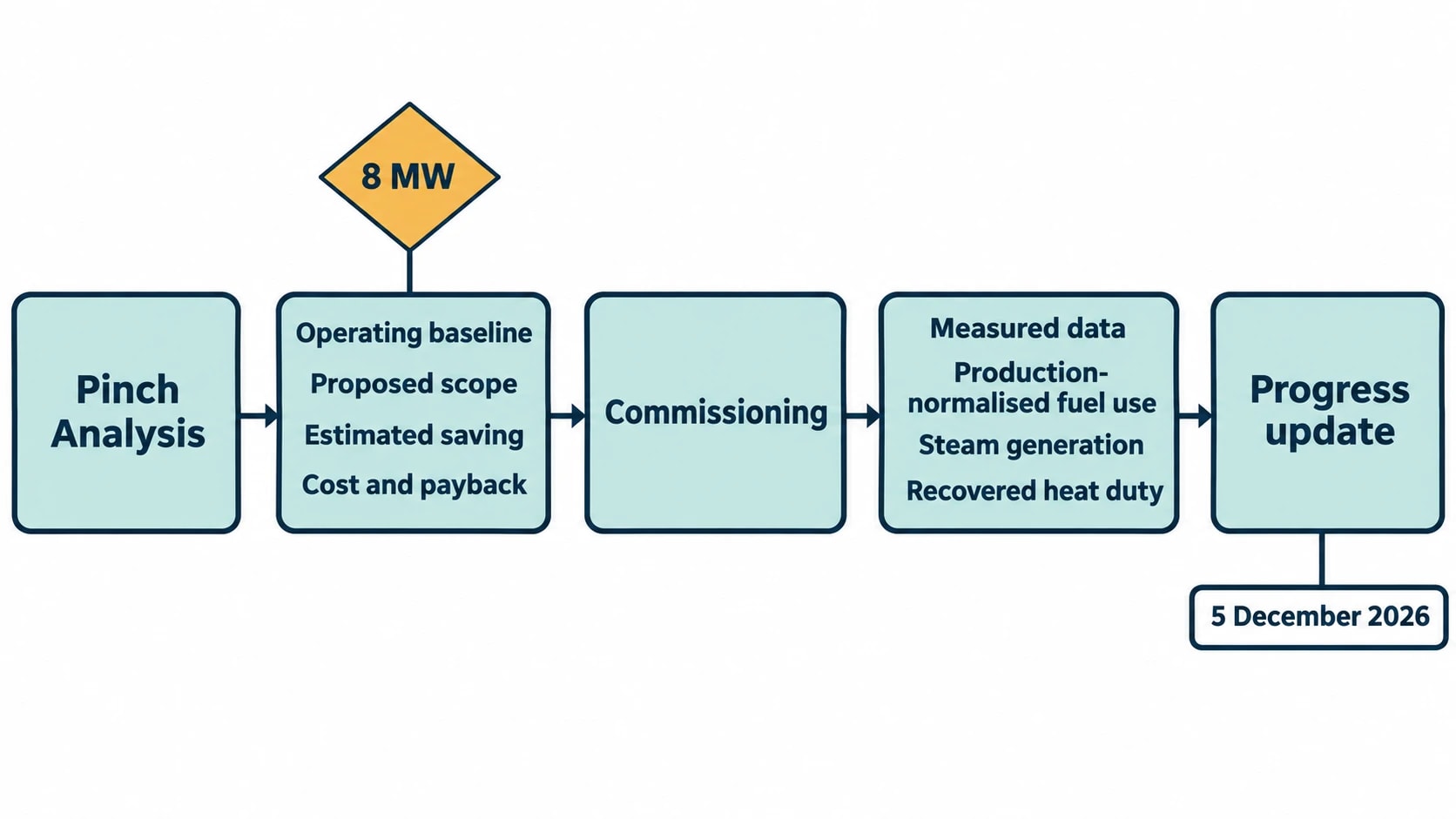
For UK ESOS Phase 3 participants, the second progress update is due by 5 December 2026. The Energy Savings Opportunity Scheme Regulations 2014, S.I. 2014/1643, were amended by the Energy Savings Opportunity Scheme (Amendment) Regulations 2023.
A Pinch Analysis study can provide evidence for an action-plan measure: the operating baseline, proposed scope, estimated energy saving, implementation date, cost and payback. The amended regulations require estimated costs and benefits, annual reductions in energy spend and consumption, and a payback period for each identified energy-saving opportunity.
Measured data after commissioning strengthens the progress update. Production-normalised fuel use, steam generation by pressure level, heat-exchanger approach temperatures and recovered heat duty help distinguish genuine savings from changes in output, product mix or weather.
EU installations face a specific waste-heat assessment
Directive (EU) 2023/1791 applies through implementation by EU Member States. Article 26(7) requires an installation-level cost-benefit analysis for newly planned or substantially refurbished industrial installations with average annual total energy input above 8 MW, subject to the directive’s exemptions.
The assessment must consider on-site and off-site waste-heat utilisation. Annex XI requires a financial analysis based on actual cash flows from investment and operation. It also requires assessment of direct use and temperature upgrading, including heat exchangers, heat pumps and heat-to-power technologies for on-site recovery.
The system boundary should include the heat source, potential heat sinks and infrastructure required to connect them.
Turning Pinch Analysis into a paid-back retrofit programme
Pinch Analysis pays when a site treats it as an investment process rather than a theoretical heat-recovery report.
A practical programme starts with measured plant data and representative operating cases. It then sets utility targets, develops feasible network modifications and costs each option as an installed project. Safety review, operability, fouling, control response, access and outage requirements should shape the shortlist early.
ISO 50001:2018/Amd 1:2024 provides a useful structure for baselines, energy performance indicators and measured improvement. It helps plant teams demonstrate whether a completed retrofit has delivered against the approved case.
This article reflects the independent analysis and editorial opinion of EnerTherm Engineering. Product names, trademarks, and brands mentioned belong to their respective owners. EnerTherm Engineering is not affiliated with, endorsed by, or a licensee of any third-party software or product mentioned unless explicitly stated.

Technical Manager — EnerTherm Engineering
John Naranjo is Technical Manager at EnerTherm Engineering, bringing specialist expertise in chemical and environmental engineering. He recently led the implementation of Omni Vision, EnerTherm's real-time energy and utility monitoring platform. He holds an MSc in Environmental Engineering from the University of Huelva and a BSc in Chemical Engineering, with memberships in both the Energy Institute and IChemE.
