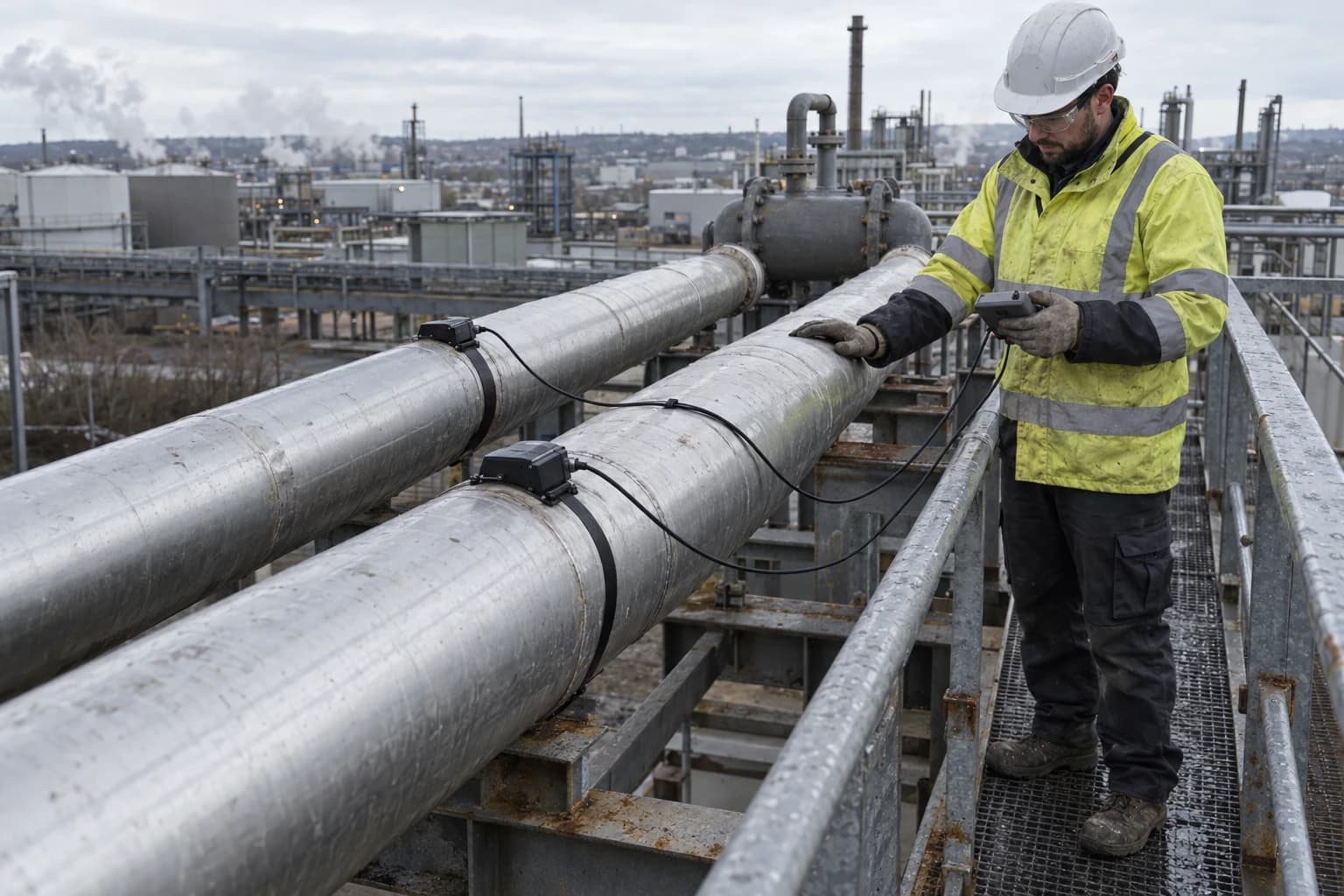
How Pinch Analysis Shapes a UK Net Zero Industrial Strategy
A practical route from heat exchanger network data to industrial decarbonisation planning.
Pinch Analysis is a process-integration method that identifies an industrial process’s minimum heating and cooling demand, then uses that target to guide practical heat-recovery and utility-reduction projects.
For a UK chemicals site, paper mill, refinery or food plant, that definition has board-level consequences. Steam, fired heat, cooling and refrigeration often account for a large share of operating cost and Scope 1 emissions. A decarbonisation plan that selects electrification, hydrogen or carbon capture before establishing the site’s heat-recovery potential can lock in larger equipment, higher energy demand and unnecessary capital expenditure.
The Climate Change Committee’s 2026 progress report sets a demanding context. It describes an industrial pathway in which emissions fall from 40.3 MtCO₂e in 2025 to an annual average of 13.0 MtCO₂e during the Sixth Carbon Budget period. The principal measures are industrial electrification, supported by lower-carbon fuels, carbon capture and storage, resource efficiency and energy efficiency.
Pinch Analysis gives plant teams a disciplined way to put energy efficiency first. It converts process data into heat targets, identifies where recovery is thermodynamically feasible, and provides an engineering basis for a phased net zero industrial strategy.
Why Pinch Analysis belongs at the start of a net zero industrial strategy
UK industrial policy has moved from high-level emissions ambition towards long-term investment decisions. HM Government’s Industrial Decarbonisation Strategy, published in 2021, set the direction for a competitive low-carbon industrial sector by 2050. The UK’s Modern Industrial Strategy, published in June 2025, adds a ten-year investment framework for growth-driving sectors, including advanced manufacturing and clean-energy industries.
Those policies create a planning challenge for energy-intensive manufacturers. A site may face decisions on electric boilers, high-temperature heat pumps, hydrogen-ready furnaces, carbon capture, waste-heat export or new production capacity at the same time. Each choice changes the heat balance.
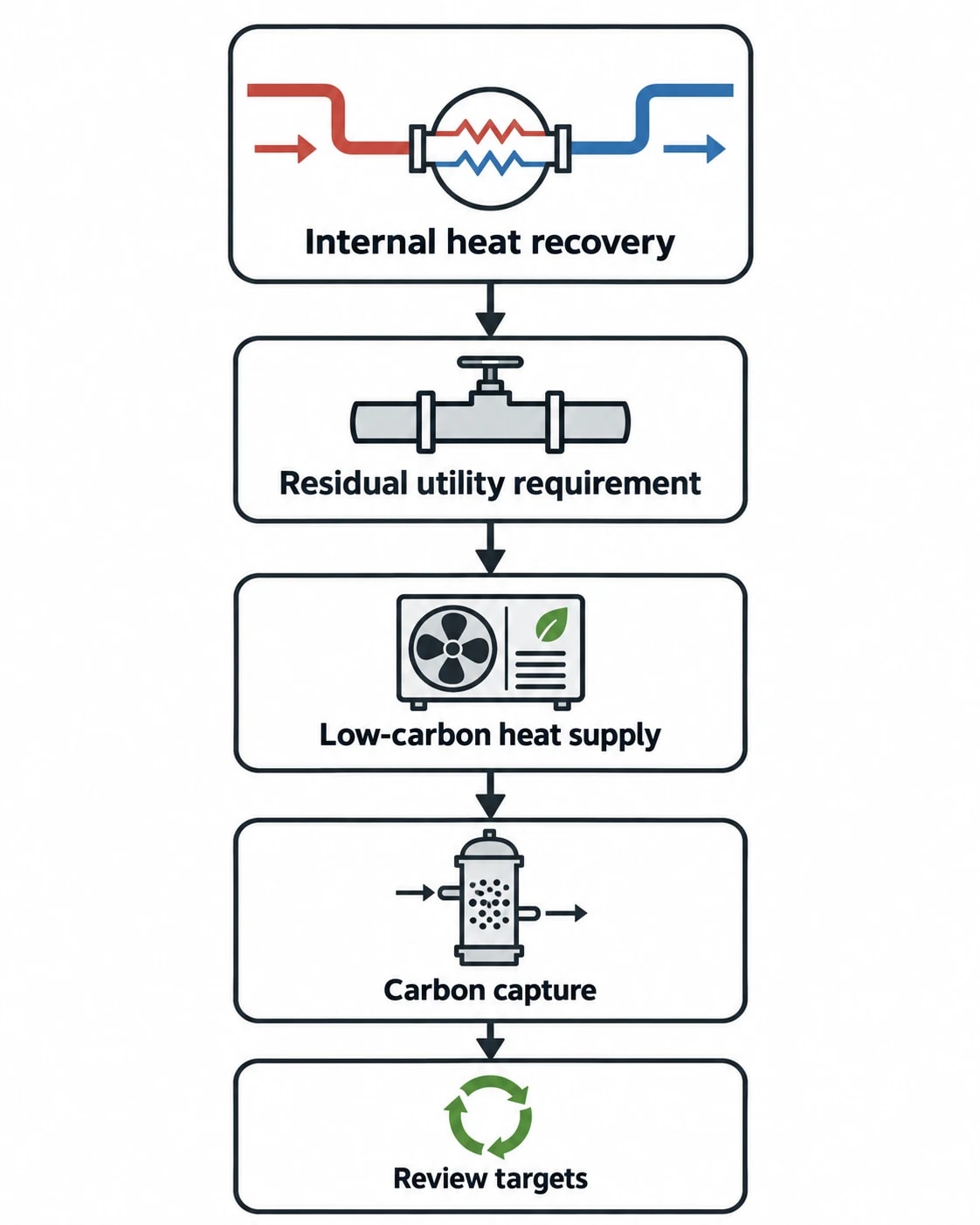
Pinch Analysis establishes the order of work:
- Reduce process heating and cooling demand through internal heat recovery.
- Specify the remaining utility requirement at useful temperature levels.
- Select low-carbon heat supply for the residual duty.
- Size carbon capture and shared infrastructure around the residual emissions.
- Revisit the targets when production, feedstocks or product specifications change.
This sequence avoids treating energy supply as a substitute for efficient process design. Replacing a gas boiler with an electric boiler may lower direct site emissions, depending on the electricity supply and reporting boundary, but it does not remove avoidable steam demand. Reducing demand first can reduce the electrical connection capacity, boiler size and operating exposure associated with electrification.
The cost of designing from utility consumption alone
A utility bill shows how much gas, electricity and purchased steam a site consumes. It does not reveal which hot process streams could heat cold process streams, where temperature gaps prevent recovery, or whether a heat-exchanger network breaches basic heat-integration rules.
Two plants with similar annual gas consumption can have very different recovery potential. One may have several large, clean hot streams cooling through the temperature range needed by cold process feeds. Another may reject most of its heat at low temperature, where useful recovery requires a heat pump or a different process arrangement.
Pinch Analysis tests these constraints before projects are ranked. It produces a more credible industrial energy-efficiency roadmap than a list of isolated opportunities.

Pinch analysis identifies the thermodynamic minimum energy requirement of your process — then designs the heat exchanger network to achieve it.
What a Pinch Analysis measures in an industrial plant
Pinch Analysis starts with process streams rather than equipment names. A hot stream needs cooling; a cold stream needs heating. Engineers define each stream’s supply temperature, target temperature, heat-capacity flowrate, phase-change duty where relevant, operating hours and practical constraints.
The method then establishes how much heat can be transferred internally before external utilities are necessary.
Building a reliable stream data set
Data quality determines whether a pinch study produces an actionable target or an impractical chart. The study boundary should be explicit. It may cover a single batch train, a continuous process unit, a boiler house and its main users, or a whole integrated site.
For each material stream, the data set should account for:
- Normal, minimum and maximum operating cases.
- Batch timing and campaign changes.
- Fouling, viscosity, corrosion and cleanability.
- Permitted pressure drops.
- Heat-transfer coefficients and available exchanger area.
- Safety separation between streams.
- Product-quality and contamination risks.
- Existing controls, bypasses and seasonal utility conditions.
A refinery’s crude preheat train, for example, cannot be assessed solely from annual averages. Crude slate, furnace throughput, exchanger fouling and turnaround condition all affect practical recovery. A food and beverage site may need separate assessments for cleaning-in-place, production and refrigeration loads because their timings and temperature levels differ.
The pinch temperature and minimum utility targets
Engineers apply a minimum approach temperature, commonly called ΔTmin, to reflect the temperature difference needed for heat transfer. The selected value affects the target. A smaller ΔTmin can increase theoretical recovery, but it also implies more heat-exchanger surface area, more difficult control and, in some services, greater fouling risk.
Composite curves combine the heat available from hot streams and the heat required by cold streams across temperature intervals. Their closest approach identifies the pinch. The grand composite curve helps teams identify the remaining heating and cooling demand by temperature level.
The outputs are often more useful to senior decision-makers than a long equipment register:
| Pinch output | Strategic question it answers |
|---|---|
| Minimum hot utility target | How much external heating remains after feasible internal recovery? |
| Minimum cold utility target | How much cooling remains after process heat has been used? |
| Pinch temperature | Where is recovery most constrained and where should design rules be protected? |
| Temperature-level profile | Which residual duties suit steam, heat pumps, electric heating, hydrogen or other low-carbon options? |
| Heat exchanger network target | How much additional recovery area and network modification may be required? |
The targets are thermodynamic benchmarks, not automatic project savings. Engineers must then assess existing equipment, layout, controllability, operability and capital cost.
How heat recovery planning changes decarbonisation choices
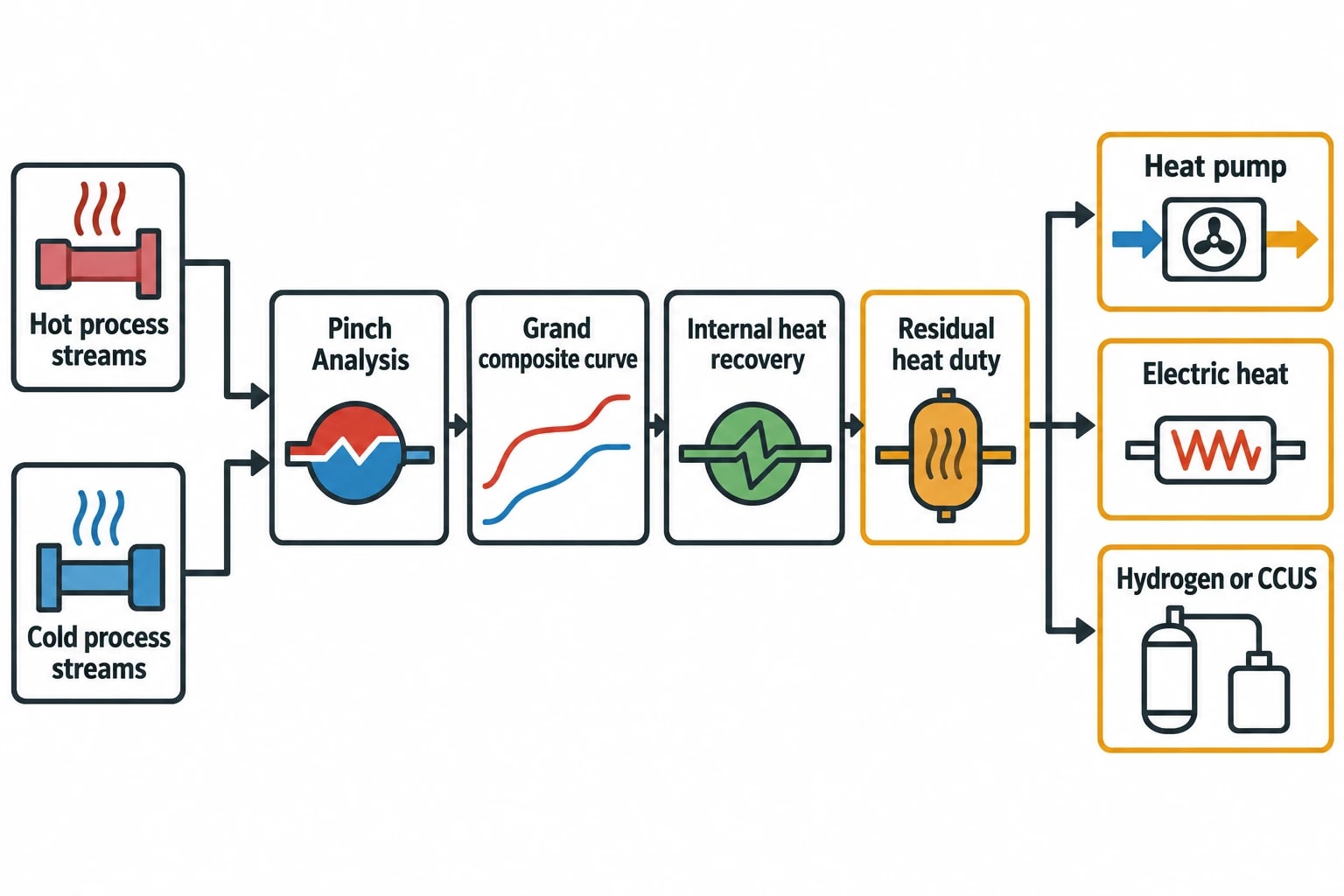
Heat recovery reduces fuel use and defines the scale and quality of heat that remains to be decarbonised.
Industrial electrification solutions after targeting
Electrification is prominent in the CCC’s industrial pathway, particularly for dispersed industrial sites. Pinch Analysis helps determine where it is best deployed.
A heat pump can upgrade lower-temperature rejected heat to a useful process temperature. Its suitability depends on the source temperature, required delivery temperature, heat duty, refrigerant selection, electricity capacity and operating profile. The grand composite curve can show whether a site has a stable low-temperature heat source and a nearby heat sink that justify this intervention.
Direct electric technologies may suit residual high-temperature demand, but the analysis should establish whether a process can first receive heat from a hotter internal stream. Where recovery displaces steam demand, it may also create a smaller, more stable residual load for an electric or electrode boiler.
A large electric heat source introduced before heat integration can obscure recoverable heat and distort the business case for exchange-area upgrades.
Hydrogen and carbon capture for industrial heat
Some processes require temperatures, reaction conditions or fuel flexibility that make electrification difficult. Hydrogen and carbon capture may form part of a site’s eventual pathway, particularly in industrial clusters with access to shared infrastructure.
Pinch Analysis still has a role. Reducing furnace or boiler duty reduces the fuel that must be substituted with hydrogen and the combustion emissions entering a capture system. It can also identify opportunities to recover heat from furnace flue gas, product cooling or compressor aftercoolers before larger supply-side investments are considered.
The method does not decide that hydrogen or carbon capture is appropriate. It defines the residual heat duty those options must serve. Project teams can then compare options against a common basis: temperature requirement, annual operating hours, fuel displacement, emissions effect, capital cost, space, outage requirement and production risk.
Heat recovery across industrial clusters
The 2021 Industrial Decarbonisation Strategy recognised the importance of clusters. In the right location, heat integration can extend beyond a site boundary. A plant with surplus low-temperature heat may be close to another industrial heat user, a district-heating opportunity, a treatment works or a future energy centre.
Offsite recovery requires more than a favourable composite curve. Developers must establish simultaneous availability, pipe-route practicality, metering, ownership, outage arrangements, water chemistry, temperature loss and commercial allocation of benefits. A site-level pinch study can provide the first evidence of an exportable heat profile and distinguish firm heat from intermittent surplus.

Pinch analysis identifies the thermodynamic minimum energy requirement of your process — then designs the heat exchanger network to achieve it.
From analysis to an industrial energy efficiency roadmap
A useful pinch study creates a portfolio, not one oversized heat-exchanger proposal. The strongest roadmaps separate immediate modifications from projects that need a planned outage or wider process change.
A practical project hierarchy
A heat-integration opportunity register should group projects by intervention type and maturity.
| Project type | Typical examples | Main decision factors |
|---|---|---|
| Operational changes | Correcting bypasses, adjusting utility temperatures, improving exchanger cleaning practices | Product quality, control margin, rapid payback |
| Retrofit recovery | New exchangers, exchanger repiping, condensate recovery, preheating feeds | Plot space, fouling, pressure drop, shutdown duration |
| Utility-system changes | Steam pressure rationalisation, heat pump integration, cooling-system changes | Temperature profile, electricity capacity, resilience |
| Process redesign | Separation changes, reactor integration, revised batch scheduling | Production impact, safety case, capital cycle |
| Cluster opportunity | Heat export, shared utilities, common CO₂ infrastructure | Counterparty demand, contracts, route and infrastructure risk |
Each project needs a baseline and a named owner. Energy managers should retain stream data, assumptions and pinch targets as living engineering records. A new product, throughput increase or plant modification can change the heat balance and invalidate an earlier target.
Sequencing capital against shutdown windows
Turnarounds often determine what can be delivered. A three-year or five-year turnaround cycle can make a project’s implementation date more important than its simple payback period.
Teams should therefore build a programme that distinguishes:
- Measures that can be installed during routine maintenance.
- Changes requiring a short shutdown.
- Modifications that need a major turnaround.
- Studies needed before a commitment to electrification, hydrogen, carbon capture or heat export.
- Longer-term projects dependent on grid reinforcement, cluster infrastructure or planning consent.
This approach gives sustainability directors a delivery path that operations teams can own. It also reduces the risk of producing a net zero transition for chemical plants with no credible route through production constraints.
Pinch Analysis, ESOS compliance and energy management
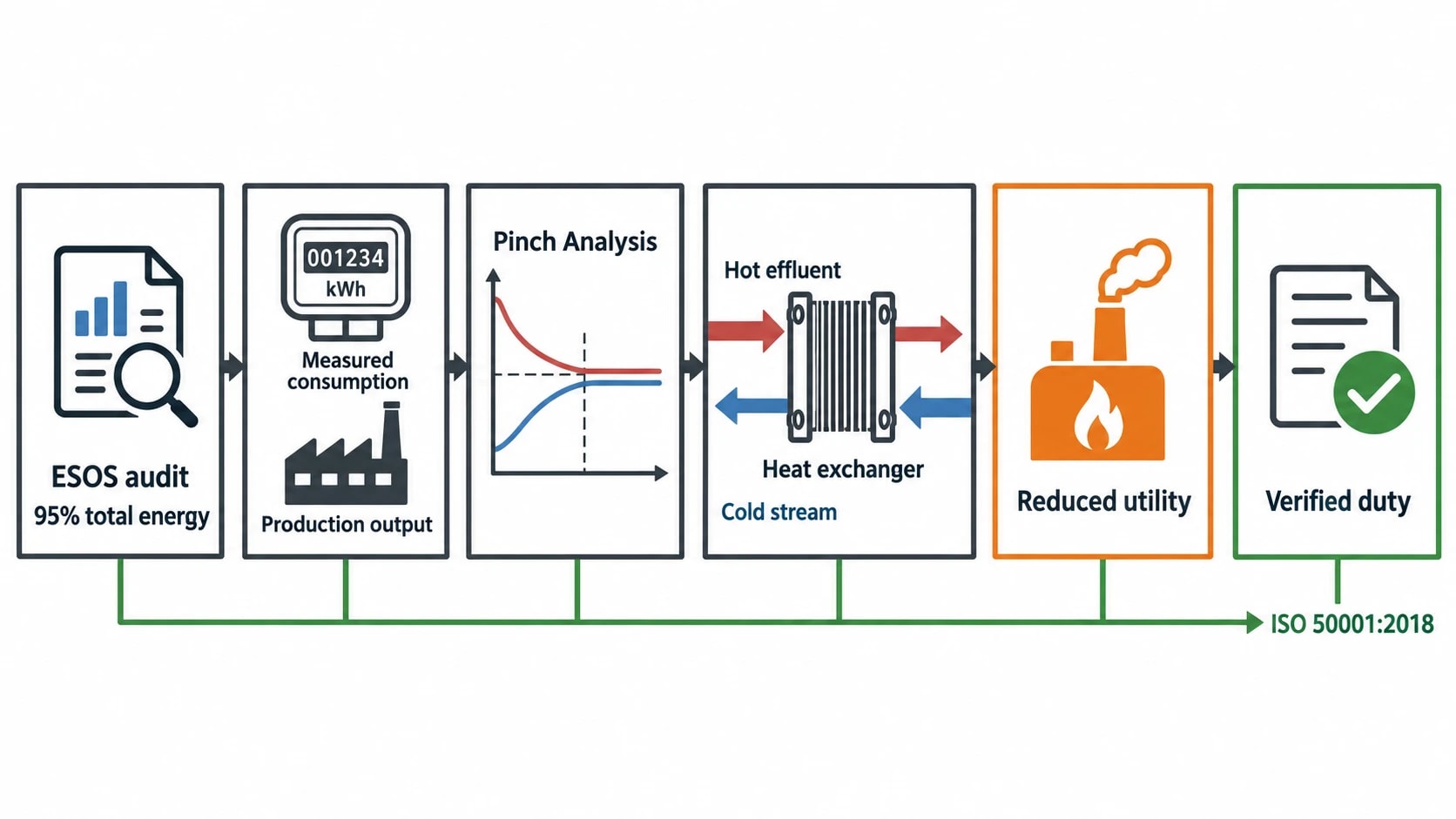
ESOS Phase 4 makes detailed energy assessment timely for qualifying UK businesses. Organisations that meet the large-undertaking criteria on 31 December 2026 must submit their Phase 4 notification of compliance by 5 December 2027. The assessment must identify areas of significant energy consumption covering at least 95% of total energy consumption, alongside energy-intensity ratios for industrial processes and other categories.
An ESOS audit can identify a need for deeper thermal analysis. Pinch Analysis provides that work where process heat dominates energy use. It can turn an audit observation such as “recover waste heat from hot effluent” into a defined engineering question: what stream receives the heat, at what temperature, with what exchanger arrangement, and with what utility reduction?
ISO 50001:2018 provides the management framework around this work. The standard remains current following confirmation in 2024 and requires organisations to improve energy performance through a systematic energy-management approach. Within that framework, pinch targets can become energy-performance indicators, while implemented projects can be tracked against measured utility consumption and production output.
Measuring delivered savings
A project should not be closed when an exchanger is commissioned. Teams need to verify performance under representative production conditions.
Measurement plans should define:
- The baseline period and production-normalisation method.
- Fuel, steam, electricity and cooling measurements.
- Feedstock, throughput and ambient conditions that affect consumption.
- Heat-exchanger cleanliness and control configuration.
- Calculation ownership and reporting frequency.
- The expected difference between design duty and verified duty.
This discipline matters for carbon reporting as well as project economics. A heat-recovery project may reduce gas use directly, reduce imported steam, release capacity for production growth, or change electricity use through pumping and heat pumping. The net effect needs to be stated clearly within the site’s reporting boundary.
What plant leaders should ask before approving a decarbonisation project
A net zero manufacturing roadmap gains credibility when its major heat investments can answer direct questions.
Questions for sustainability directors
Does the roadmap show a clear residual heat demand after internal recovery? Does it separate direct fuel emissions from electricity-related emissions? Does it identify dependencies on grid capacity, hydrogen supply, CO₂ transport and storage, or external heat users?
Questions for plant managers
Can the proposed network operate through start-up, turndown, grade changes and cleaning? Is there enough plot space? Which modifications require a shutdown, and what happens if an exchanger fouls or fails?
Questions for energy managers
Are stream temperatures measured or estimated? Are batch and seasonal conditions represented? Has the selected ΔTmin been tested against exchanger cost, controllability and fouling? Are pinch targets retained for future capital reviews?
These questions bring the net zero industrial strategy back to process reality. Pinch Analysis does not replace fuel switching, carbon capture or investment in clean electricity. It sets the thermal foundation that makes those choices smaller, clearer and easier to justify.
This article reflects the independent analysis and editorial opinion of EnerTherm Engineering. Product names, trademarks, and brands mentioned belong to their respective owners. EnerTherm Engineering is not affiliated with, endorsed by, or a licensee of any third-party software or product mentioned unless explicitly stated.

Managing Director — EnerTherm Engineering
Dr. François Pierrel is Managing Director of EnerTherm Engineering with over two decades of expertise in thermal design, heat transfer, and industrial energy optimisation. He holds a PhD in Heat Transfer from Cranfield University and a Post-Doctorate from Heriot-Watt University.
