Heat Exchanger Network Optimisation: The ΔTmin Trade-Off
Pinch analysis can cut refinery heating fuel by 8%-25%, subject to site economics.
Heat exchanger network optimisation systematically matches and designs process heat exchangers to maximise useful heat recovery while meeting process, safety and economic constraints.
For an industrial site, ΔTmin is where thermodynamics meets the capital plan. A smaller minimum temperature approach can recover more heat internally, cutting steam, fired-heater fuel and cooling demand. A larger approach allows smaller, cheaper exchangers that are easier to accommodate, but increases utility consumption.
That trade-off sits at the centre of heat exchanger network optimisation. It affects crude preheat trains, paper-machine heat-recovery schemes, pharmaceutical solvent-recovery processes and food plants with constrained hot-water capacity. A well-run pinch study does not seek the smallest technically possible temperature approach. It identifies the approach and network changes that deliver the strongest economic result within the plant’s operating envelope.
Ipieca reports that pinch-analysis applications in oil refining have reduced purchased heating fuel by 8% to 25%. It also identifies potential reductions of up to 25% of total refinery GHG emissions, depending on the starting level of heat integration. These are refinery-based ranges, not a universal promise for other sectors or sites.
What ΔTmin means in heat exchanger network optimisation
The minimum temperature approach
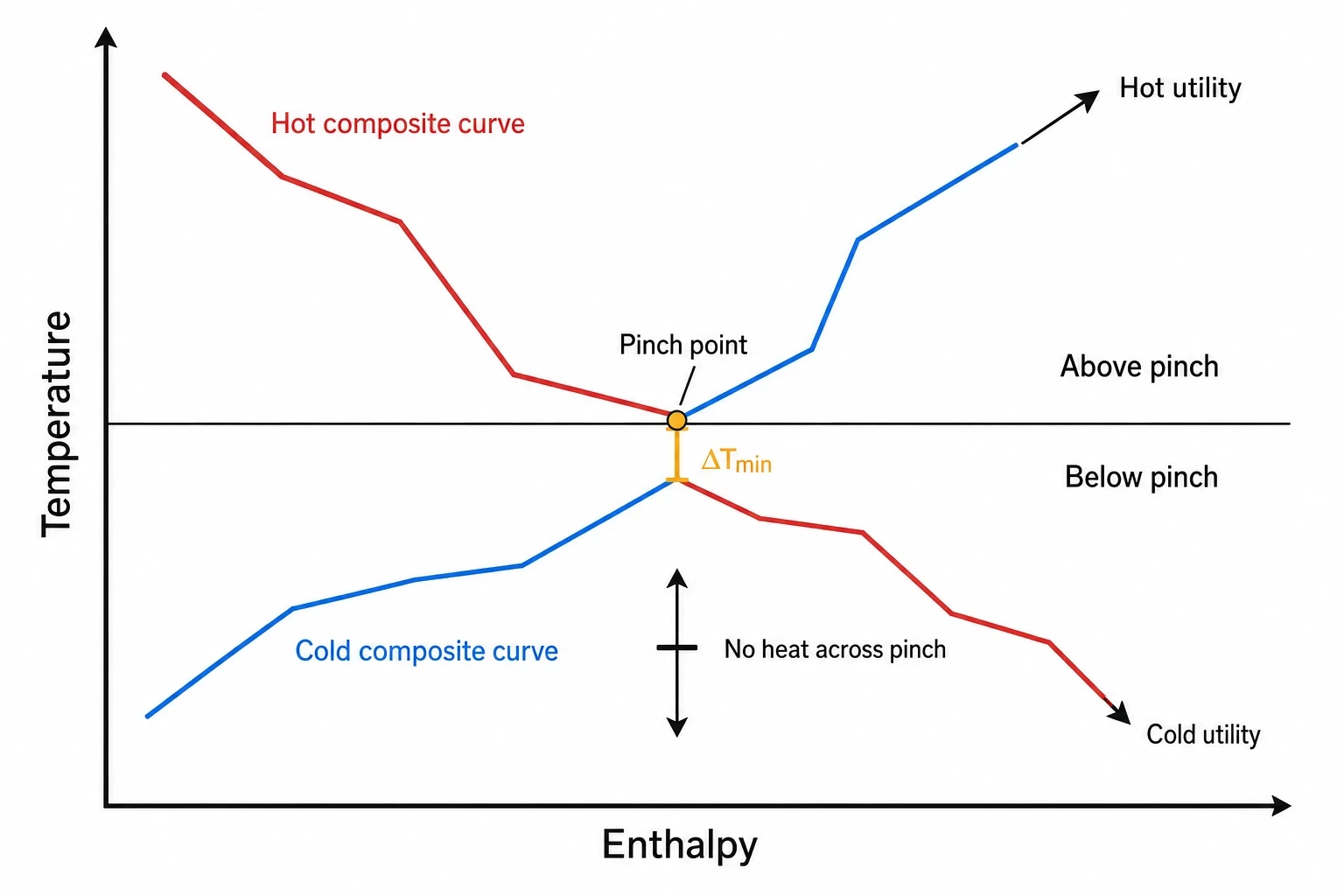
ΔTmin is the minimum permitted temperature difference between hot and cold process streams in a heat exchanger network. It is the practical driving force available for heat transfer.
A hot stream can transfer heat only to a colder stream. As the temperature difference narrows, more heat-transfer area is needed to deliver the same duty. The heat exchanger becomes larger and its installed cost rises. Very small approaches may also increase pressure drop, fouling sensitivity, mechanical complexity and control difficulty.
Pinch analysis applies ΔTmin to the full set of hot and cold streams rather than treating each heat exchanger in isolation. It produces energy targets for minimum hot and cold utility. Composite curves show the total heat released by process hot streams and the total heat required by process cold streams. Their closest allowable approach is the pinch point.
The pinch separates the process into two thermodynamic regions:
- Above the pinch, the process needs external heating.
- Below the pinch, the process needs external cooling.
- Heat transferred across the pinch increases both hot- and cold-utility demand above their theoretical minimum.
This rule explains why a seemingly sensible heat-exchanger addition may fail to deliver its expected fuel saving. A network may recover considerable heat yet consume excessive steam because its matches transfer duty across the pinch or use high-grade utility where process heat could meet the duty.
Why a single site does not have a universal ΔTmin
A process plant does not have one universally correct ΔTmin. The appropriate value depends on stream temperatures, heat-transfer coefficients, fouling tendency, pressure levels, materials, plot space, heat-exchanger type, operating hours and utility prices.
A viscous food product, a fouling crude stream and a clean liquid-liquid pharmaceutical duty may each justify different temperature approaches. A network constrained by cooling-water temperature faces different limits from one using air coolers or refrigeration. Steam levels also matter. Heat that displaces high-pressure steam usually has a different economic value from heat that displaces low-pressure steam or cooling water.
A credible heat exchanger network optimisation study therefore tests a range of ΔTmin values, converts energy targets into annual operating cost and estimates the capital required to achieve each target.

Pinch analysis identifies the thermodynamic minimum energy requirement of your process — then designs the heat exchanger network to achieve it.
The ΔTmin trade-off between capital and utility cost
Larger ΔTmin: less exchanger area, more purchased energy
A larger ΔTmin keeps the hot and cold composite curves farther apart, reducing the maximum feasible process heat recovery. More external heating and cooling are required.
The capital case may look attractive because a larger temperature driving force can reduce heat-exchanger area and simplify piping or rearrangement work. It can also reduce the number of new shells, plates and supports needed in a retrofit.
The operating penalty can be substantial where unrecovered duty would otherwise displace fired-heater fuel, boiler steam or mechanical refrigeration. This matters particularly for continuously operating process units, where a modest hourly loss becomes material over a year.
Smaller ΔTmin: greater heat recovery, greater retrofit burden
Reducing ΔTmin brings the composite curves closer and raises the theoretical heat-recovery target. In a new design, this can reduce utility-system capacity, including furnaces, boilers, cooling towers and refrigeration equipment.
The heat-exchanger network must pay for that recovery. More surface area is normally required. Brownfield projects may need new heat-exchanger shells, bundles, plate packs, pipework, control valves, structural steel, electrical work and insulation. Tie-ins may require a shutdown window. A tightly integrated network can also create difficult start-up and turndown behaviour unless control requirements are addressed.
Ipieca summarises the relationship plainly: a larger ΔTmin generally lowers equipment cost and increases utility cost. Its 2021 crude-preheat-train case study found that energy targets varied with ΔTmin and that the cost index was sensitive to the selected value. Heat-exchanger rearrangement combined with economic analysis achieved 8% total energy savings against the base case.
The economic optimum is not the energy minimum
The lowest utility target may require an impractical amount of heat-exchanger surface or modification work. The lowest-capital option can lock in avoidable fuel consumption for years. The economic optimum lies where the annualised cost of additional heat recovery no longer justifies the installed cost and risk.
A practical evaluation should include:
| Cost or constraint | Why it changes the ΔTmin decision |
|---|---|
| Fuel and steam cost | Determines the value of reducing hot utility |
| Cooling-water, air-cooler or refrigeration cost | Determines the value of reducing cold utility |
| Operating hours and load profile | Converts design duty into annual value |
| Heat-exchanger area and material | Drives equipment cost |
| Fouling allowance and cleaning access | Affects long-term heat transfer and availability |
| Pressure drop | Can add pumping or compression cost |
| Pipe routing and plot space | Can dominate brownfield installation cost |
| Turnaround access | Sets implementation timing and outage cost |
| Control and operability | Determines whether the design works outside normal operation |
The calculation must use site-specific prices and operating assumptions. A pinch target based on nominal design temperatures has limited value if the unit spends much of the year at reduced throughput, in campaign operation or with altered feed composition.
How to set ΔTmin for an existing heat exchanger network
Start with trustworthy stream data
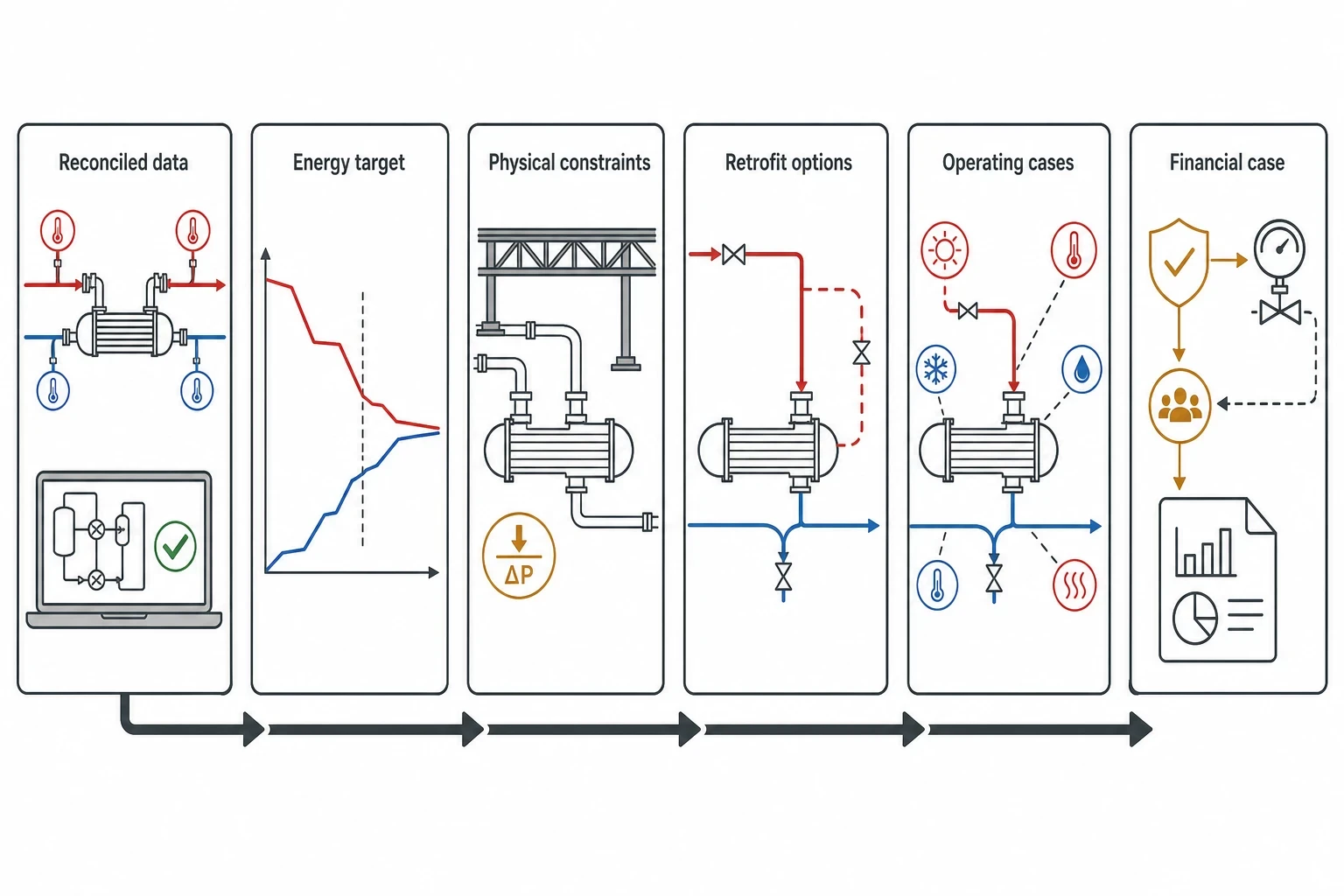
The quality of a heat exchanger network optimisation depends on data reconciliation before targeting begins. Engineers need supply and target temperatures, mass flow, heat-capacity flowrate, phase changes, heat duty, pressure, allowable pressure drop, fouling information and operating variability.
Measured heat-exchanger performance should be checked against the process model. A cold-end approach that appears poor on a data sheet may result from an isolation bypass, a faulty temperature measurement, changed feed properties, tube plugging or a control valve in an unsuitable position. Conversely, an apparent heat-recovery opportunity may disappear once minimum product temperatures, viscosity limits or batch sequencing are included.
The data set should distinguish between process and utility streams. It should also identify streams that cannot be matched because of contamination risk, pressure difference, metallurgy, product-quality restrictions or physical separation on site.
Test more than one operating case
Brownfield networks frequently operate across multiple cases: summer and winter cooling conditions, high and low throughput, different crude slates, recipe changes, seasonal products and variable steam-system conditions. A design that performs strongly in one case can create utility peaks or poor controllability in another.
A multi-case study should test the candidate network under commercially relevant conditions. This may mean accepting a small energy penalty in the main design case to maintain stable operation during start-up, shutdown, turndown or a lower-throughput campaign.
Use the targets to focus the retrofit
Composite curves and the problem table algorithm establish the energy target. The retrofit then examines what the existing network can physically deliver. An ideal grass-roots network can add heat exchangers and select stream matches freely. An operating site inherits heat-exchanger locations, pipe-rack capacity, nozzle sizes, pressure-drop limits and outage constraints.
Typical retrofit options include:
- Re-routing existing heat exchangers to change the heat-recovery sequence.
- Adding area to a limiting heat exchanger through a new shell, bundle or plate heat exchanger.
- Splitting a stream to create a better temperature match.
- Replacing a utility heat exchanger where process-to-process recovery can take its duty.
- Removing or reducing a bypass that destroys heat recovery during normal operation.
- Changing utility levels to make better use of available steam or hot water.
Each option should be screened for process safety, maintainability and control response before entering the financial case. Ipieca cautions that ideal pinch designs may require changes to address operability, flexibility and control, and that large pressure differences or cross-contamination hazards can rule out otherwise attractive matches.

Pinch analysis identifies the thermodynamic minimum energy requirement of your process — then designs the heat exchanger network to achieve it.
Technical limits that change the optimum
Fouling changes both the duty and the economics
Fouling needs explicit treatment in ΔTmin selection. A tight approach can lose performance quickly when deposits reduce the overall heat-transfer coefficient. The resulting utility penalty may erase the projected saving before the next cleaning interval.
The engineering case should use realistic fouling allowances, cleaning frequency and production-loss implications. A design that preserves access for mechanical or chemical cleaning can deliver a better life-cycle result than a compact arrangement that is difficult to maintain.
This is especially relevant in crude preheat, black-liquor processing, food evaporation and streams containing solids, waxes, salts or biologically active material. The process team should identify expected fouling mechanisms before a proposed match reaches detailed design.
Control and operability set hard boundaries
Heat integration couples process temperatures that previously moved independently. It can improve energy performance while allowing a disturbance to travel further through the process.
Control studies should therefore assess:
- Start-up, shutdown and emergency conditions.
- Minimum and maximum throughput.
- Loss of a major heat exchanger or utility system.
- Product-temperature control.
- Pressure-control interactions.
- The need for bypasses, trim heaters and trim coolers.
- Minimum-flow requirements and low-velocity fouling risk.
A trim heater or cooler may remain necessary even where pinch targets suggest it can be eliminated. It provides control authority when feed temperature, ambient conditions or production rate vary. The aim is to minimise avoidable utility duty without compromising specification or safe operation.
Distance and construction can outweigh thermodynamic merit
A heat match may be thermodynamically excellent but require long pipe runs between distant process areas. This introduces heat loss, pressure drop, pipe supports, civil works, heat tracing, insulation and tie-in risk. In congested plants, access can be more limiting than heat-exchanger cost.
The study boundary should be broad enough to identify major opportunities, then narrowed through constructability reviews. A short, accessible match with slightly lower heat recovery can be the better project if it avoids a complex shutdown and delivers a faster return.
Regulation, energy management and the investment case
EU waste-heat assessment requirements
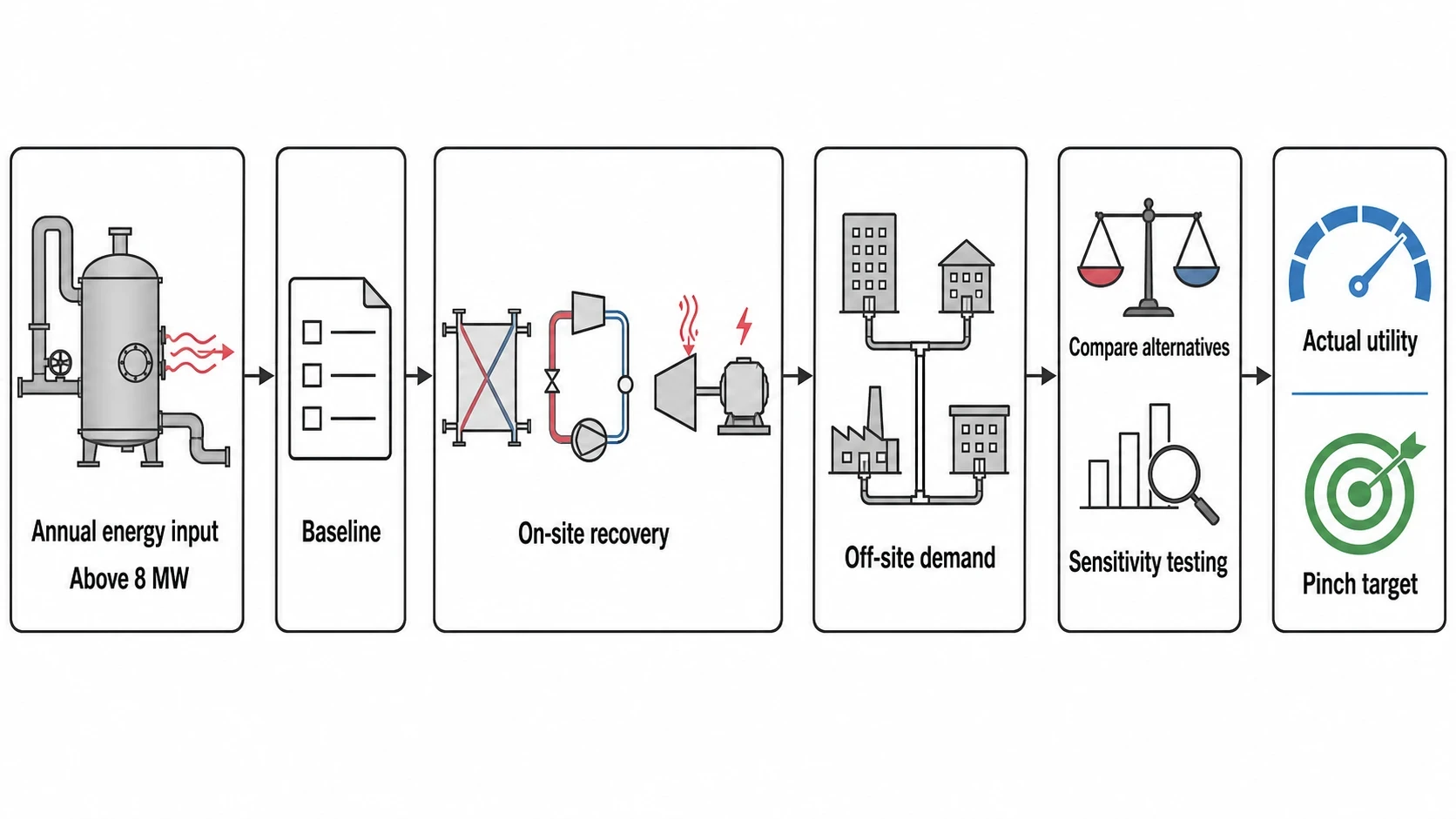
For EU industrial sites, Directive (EU) 2023/1791 requires heat-recovery assessment before major investment. Article 26(7)(b) requires Member States to ensure that a planned new or substantially refurbished industrial installation with an average annual total energy input exceeding 8 MW undergoes a cost-benefit analysis of on-site and off-site waste-heat utilisation.
The assessment should not treat a new utility plant as an isolated asset. Annex XI requires comparison of the planned arrangement with alternatives that recover waste heat and consideration of current recovery technologies. On-site options include heat exchangers, heat pumps and heat-to-power technologies. Off-site demand points can include industrial users, agriculture and district-heating networks.
A lower ΔTmin does not satisfy this requirement by itself. The project needs a transparent baseline, realistic annual operating conditions, capital and operating costs, utility-price assumptions and sensitivity testing.
UK funding and operational drivers
The UK Industrial Energy Transformation Fund closed to new applications in July 2025. The Department for Energy Security and Net Zero states that no successor fund is planned, while projects awarded under Phases 1 and 2 and the first Phase 3 competition window remain funded through completion. Sites should build project economics around their own fuel, carbon and production assumptions rather than assume a new IETF competition will support the work.
Heat exchanger network optimisation also fits the continuous-improvement discipline of ISO 50001:2018. A useful energy-performance indicator can compare actual hot- and cold-utility consumption with the pinch target, normalised for production rate, feed quality or product mix where required. The gap between actual operation and target is a more useful management measure than a single annual gas-consumption figure.
Turning ΔTmin analysis into an implementable project
Build a decision-ready package
Technical directors and energy managers need more than a composite curve. The investment package should show the achievable utility reduction, selected ΔTmin range, project cost, operational risks, implementation sequence and constraints that prevent further recovery.
A sound package includes:
- A reconciled stream table and defined operating cases.
- Pinch targets at several ΔTmin values.
- The existing network performance against those targets.
- A shortlist of feasible heat-exchanger, rerouting and utility changes.
- Installed-cost estimates that include piping, controls, civils and shutdown work.
- Annual fuel, power, water and carbon impacts.
- Sensitivity tests for energy price, throughput, fouling and project cost.
- A commissioning and measurement plan.
Keep the target alive after installation
The finished network requires monitoring. Review heat-exchanger duty, approach temperatures, pressure drop, bypass position and utility consumption against the design case. A gradual loss of performance often points to fouling, leakage, changed operating practice or a control issue before it appears in the monthly energy bill.
This article reflects the independent analysis and editorial opinion of EnerTherm Engineering. Product names, trademarks, and brands mentioned belong to their respective owners. EnerTherm Engineering is not affiliated with, endorsed by, or a licensee of any third-party software or product mentioned unless explicitly stated.

Managing Director — EnerTherm Engineering
Dr. François Pierrel is Managing Director of EnerTherm Engineering with over two decades of expertise in thermal design, heat transfer, and industrial energy optimisation. He holds a PhD in Heat Transfer from Cranfield University and a Post-Doctorate from Heriot-Watt University.
