
Grand Composite Curve Utility Selection: Steam Levels
How profile matching identifies feasible heating and cooling utilities around the pinch
A grand composite curve utility-selection method is a pinch-analysis technique that plots process heat deficit and surplus against shifted temperature to select feasible steam, cooling-water and refrigeration levels.
A refinery may operate high-pressure, medium-pressure and low-pressure steam headers while sending high-grade steam to duties that a lower-temperature utility could serve. The boiler house can appear efficient in isolation, yet the process still consumes more valuable steam than its temperature requirements justify.
The Grand Composite Curve, or GCC, exposes that mismatch. It shows the residual process heat balance after maximum feasible process heat recovery at a selected minimum temperature approach. Engineers can place candidate utilities against the curve and assign each duty to the lowest practical heating level or highest practical cooling level.
For chemical, refining, food, beverage and pharmaceutical plants, the GCC provides a defensible basis for steam-header selection and heat-integration retrofit decisions. For sites coupled to power generation, it also clarifies where steam extraction, let-down or flash recovery may fit the process temperature profile.
What does a Grand Composite Curve show?
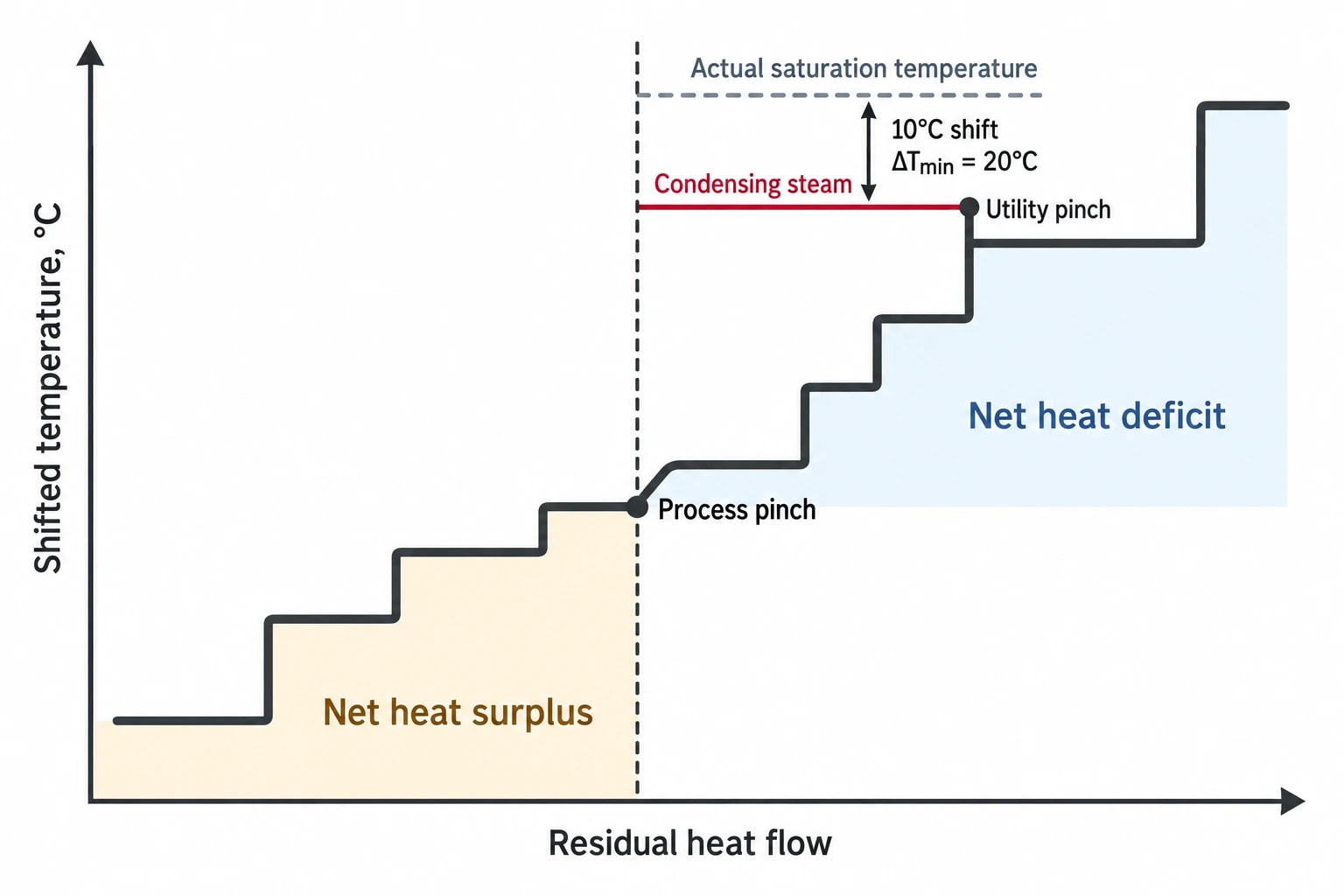
The GCC plots shifted temperature on the vertical axis and residual heat flow on the horizontal axis. It is derived from the heat cascade or shifted composite curves.
Above the process pinch, the process has a net heat deficit. External hot utility supplies that deficit. Below the pinch, the process has a net heat surplus and cold utility removes it.
The curve establishes three core targets:
- Minimum hot-utility demand, QHmin.
- Minimum cold-utility demand, QCmin.
- Maximum feasible process heat recovery at the chosen minimum temperature approach.
Composite curves show the overall heating and cooling requirement. The GCC adds the temperature detail needed to decide whether a heating duty needs high-pressure steam, medium-pressure steam, low-pressure steam, hot oil or another source.
Shifted temperature keeps the utility match honest
Pinch analysis shifts stream temperatures to account for the selected minimum temperature difference, ΔTmin. With a uniform ΔTmin of 20°C, hot process streams shift down by 10°C and cold process streams shift up by 10°C.
Candidate utilities need the same treatment. A condensing steam header is placed on the GCC at its shifted saturation temperature rather than its actual saturation temperature. This preserves the minimum driving force required in the real exchanger.
An analyst who places actual steam temperature directly on a shifted GCC can overstate the load available from that header. The resulting allocation may fail once the exchanger approach temperature is restored.
The process pinch and utility pinch have different roles
The process pinch sets the overall minimum utility targets. It marks the temperature constraint that governs QHmin and QCmin.
A utility pinch is the contact point between a utility profile and the GCC. It limits the heat load that a specific steam level, cooling-water circuit or refrigerant system can provide without breaking temperature feasibility.
A medium-pressure steam line may match a large heating pocket but stop at a high-temperature section of the GCC. Higher-temperature steam then serves the remaining duty above that utility pinch. A plant can therefore reduce high-pressure steam use without changing QHmin.

Pinch analysis identifies the thermodynamic minimum energy requirement of your process — then designs the heat exchanger network to achieve it.
How Grand Composite Curve utility selection targets steam levels
Condensing steam releases most of its heat at an approximately constant saturation temperature. On the GCC, it appears as a horizontal hot-utility line.
Grand composite curve utility selection starts by positioning available steam levels against the process curve. The analyst then identifies how much heat each header can supply before it touches the curve or reaches the boundary of a feasible heating region.
The allocation follows a temperature-quality rule: use the lowest-temperature feasible heating utility first, then use higher-temperature steam only where the GCC requires it.
Apply the profile-matching rule
Profile matching seeks the closest feasible correspondence between a utility temperature and the process heating requirement.
For heating utilities, the sequence is:
- Place the lowest-temperature available steam level on the shifted GCC.
- Assign the maximum feasible heating load to that steam level.
- Add the next higher steam level only for duties beyond the lower level’s temperature reach.
- Continue until the high-temperature process deficit has been met.
The same principle applies below the pinch in reverse temperature order. Cooling water should remove the highest-temperature feasible surplus first. Chilled water or refrigeration then serves only the lower-temperature surplus that cooling water cannot accept.
This allocation avoids using high-grade steam for low-temperature heating and refrigeration for heat rejection that a cooling tower can handle.
Steam pressure is a temperature decision
Header names alone provide little design information. One site’s medium-pressure steam may have a higher saturation temperature than another site’s high-pressure header. The GCC should use verified steam conditions at the point of use.
That check includes:
- Header pressure during normal load, start-up and peak demand.
- Pressure loss through pipework, control valves and pressure-reducing stations.
- Saturation temperature at the exchanger inlet.
- Condensate backpressure and the effect on trap discharge.
- Whether the exchanger receives condensing, superheated or desuperheated steam.
A utility diagram may state the nominal header pressure, but pressure at the process unit can differ materially during plant operation. The GCC target should reflect the temperature that the exchanger can actually receive.
Using 180°C, 200°C and 230°C shifted steam levels
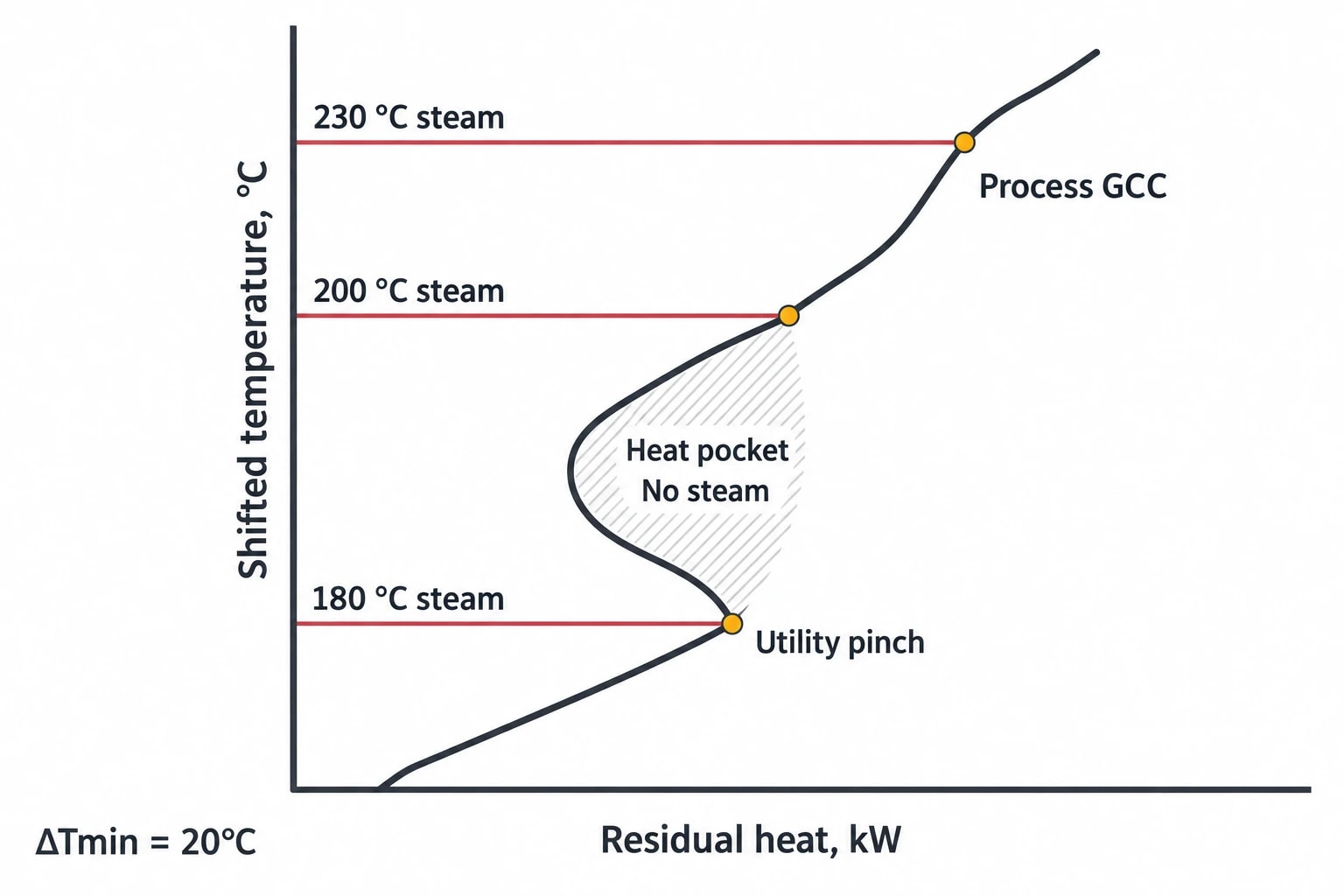
A common teaching example uses three steam utilities at shifted temperatures of 180°C, 200°C and 230°C. These values describe utility positions on the GCC. They do not define universal low-pressure, medium-pressure and high-pressure steam headers.
The sequence starts with steam at 180°C. Its horizontal utility line extends across the feasible heating region until it reaches the GCC. That contact establishes the maximum heat duty that the 180°C utility can provide.
Steam at 200°C then supplies the part of the process deficit beyond the 180°C level’s reach. Steam at 230°C covers the final high-temperature requirement.
What this allocation changes
The GCC does not assume that the lowest-pressure steam is the least expensive steam. Marginal steam cost depends on fuel use, boiler efficiency, turbine extraction, power export or import, condensate return, water treatment and the condition of the wider utility system.
The curve answers a thermodynamic question first: which steam level can physically meet each process duty while respecting ΔTmin?
A site utility model then answers the economic question: which feasible allocation gives the strongest operating and capital case?
For a combined heat and power site, that distinction matters. Reducing steam pressure through a valve may meet a process demand but sacrifice electrical generation compared with expansion through a turbine. Conversely, a lower-pressure process demand may suit an extraction point or recovered flash steam that otherwise has limited value.
Heat pockets prevent wasteful steam placement
An inward region of the GCC is often called a heat pocket. It is a temperature interval where internal process heat recovery can satisfy the local heating and cooling requirement.
Steam should not be placed inside a heat pocket. The added heat becomes a surplus that must later be rejected by cold utility, increasing steam consumption and cooling duty without improving the process heating target.
Heat pockets are particularly useful in retrofit studies. They identify where a proposed steam heater would displace recoverable process heat instead of solving a genuine utility deficit.

Pinch analysis identifies the thermodynamic minimum energy requirement of your process — then designs the heat exchanger network to achieve it.
Cooling utility selection below the pinch
Grand composite curve utility selection is not only a steam exercise. Cold utility placement determines whether refrigeration is reserved for duties that genuinely require it.
Cooling water has a sensible temperature rise, so it appears as a sloping utility profile rather than a horizontal line. Its feasible duty depends on supply temperature, return temperature, flow rate and exchanger approach.
A cooling-water circuit should be placed against the GCC using realistic operating conditions. Summer wet-bulb temperature, cooling-tower approach, fouling and water-quality constraints can reduce the available cooling-water temperature margin.
Cooling water before refrigeration
The practical order below the pinch is to use the warmest feasible cold utility first. Cooling water often serves the upper part of the process heat surplus. Chilled water, glycol circuits and refrigeration serve progressively lower-temperature duties.
A GCC can reveal that refrigeration supports a genuine low-temperature process target, such as a crystalliser, chilled storage system or low-temperature condenser. It can also reveal refrigeration applied because of missed recovery or unsuitable utility allocation.
For food and beverage plants, the distinction may arise between cooling a hot product stream with cooling water and supplying a chilled-water duty for temperature-sensitive product handling. In pharmaceutical production, the analysis may separate a low-temperature batch cooling requirement from a higher-temperature solvent-condensation duty.
Variable-temperature utilities need full profiles
Cooling water, hot oil, boiler feedwater and flue gas change temperature as they exchange heat. Their GCC representation must use a sloping profile based on inlet and outlet temperatures.
Treating a variable-temperature utility as a single temperature can create a false match. The profile may fit at one end of the duty and violate the minimum approach at the other.
Once-through utilities also need separate consideration from recirculating circuits. Boiler flue gas has a finite temperature glide as it cools, while a recirculating hot-oil system returns to its heater and has a different operating constraint.
Using GCC targets for steam-system retrofit decisions
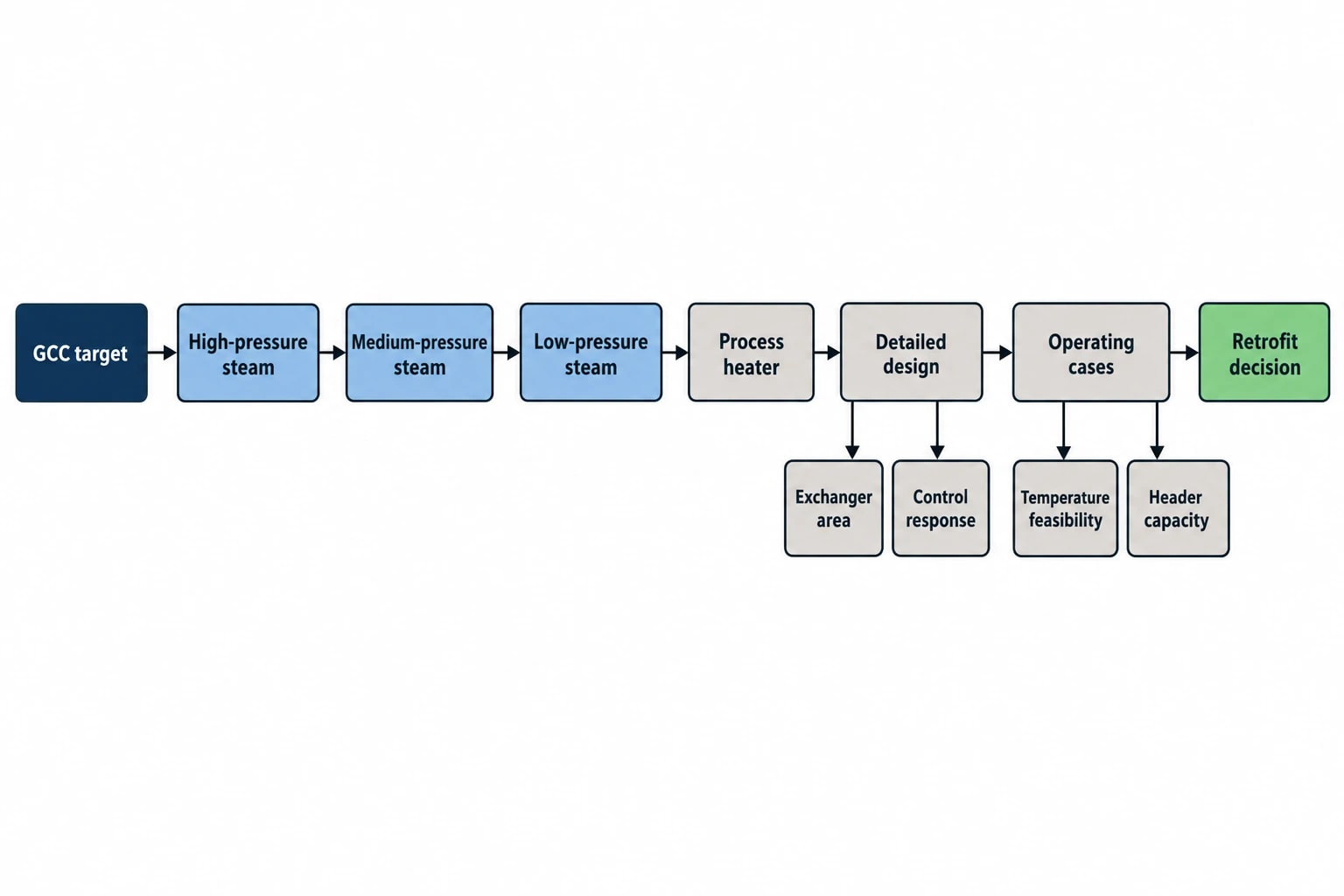
The GCC is valuable where sites have multiple headers, let-down stations, turbine extraction points and condensate pressure levels. It links these utility-system features to actual process temperature demand.
A site may generate high-pressure steam for power production and then reduce pressure before process use. The GCC identifies whether part of that demand belongs on a lower steam level and whether the process has a temperature match for flash steam or another recovered source.
Typical retrofit concepts
A GCC utility study can screen several technically credible options:
- Moving process-heater duty from high-pressure to medium-pressure or low-pressure steam.
- Recovering flash steam into a lower-pressure header.
- Using turbine extraction where the steam and power balance supports it.
- Adding or modifying a pressure-reducing and desuperheating station.
- Increasing exchanger surface where a lower steam temperature reduces driving force.
- Recovering process heat to displace imported low-temperature steam.
Each option needs more than a GCC plot before implementation. The target sets the direction and feasible temperature level. Detailed design then tests exchanger area, fouling, hydraulics, control response, materials, condensate handling and plant operability.
Batch operations need more than one GCC
A single steady-state GCC can conceal short steam peaks in batch plants. Sterilisation, evaporation, cleaning-in-place, vessel heating and campaign changeovers may determine header capacity and control-valve sizing.
Process teams should build representative cases for normal production, maximum throughput, cleaning cycles, start-up and the highest utility-demand period. Time-slice pinch analysis may be appropriate where stream availability and batch timing change materially through the schedule.
A steam substitution that works at average load may fail during a concentrated heating period. The operating cases should therefore test both temperature feasibility and utility capacity.
A practical GCC utility-selection workflow
A disciplined workflow prevents the GCC from becoming a presentation graphic detached from plant conditions.
- Collect stream data for each relevant operating case, including supply and target temperatures, heat-capacity flow rates, phase changes, heat duties and stream availability.
- Select and document a justified ΔTmin for the process area.
- Complete the heat cascade and establish QHmin, QCmin and the process pinch.
- Generate the GCC in shifted temperatures.
- Add candidate steam levels at verified shifted saturation temperatures.
- Add cooling water, chilled water, refrigeration, hot oil and recovered-heat profiles where relevant.
- Allocate the largest feasible heating load to the lowest-temperature utility and the largest feasible cooling load to the highest-temperature utility.
- Test utility capacity, marginal cost, power effects, exchanger area, controllability and condensate recovery.
- Develop retrofit concepts and subject proposed steam-system modifications to the applicable safety review before detailed design.
This article reflects the independent analysis and editorial opinion of EnerTherm Engineering. Product names, trademarks, and brands mentioned belong to their respective owners. EnerTherm Engineering is not affiliated with, endorsed by, or a licensee of any third-party software or product mentioned unless explicitly stated.

Technical Manager — EnerTherm Engineering
John Naranjo is Technical Manager at EnerTherm Engineering, bringing specialist expertise in chemical and environmental engineering. He recently led the implementation of Omni Vision, EnerTherm's real-time energy and utility monitoring platform. He holds an MSc in Environmental Engineering from the University of Huelva and a BSc in Chemical Engineering, with memberships in both the Energy Institute and IChemE.
