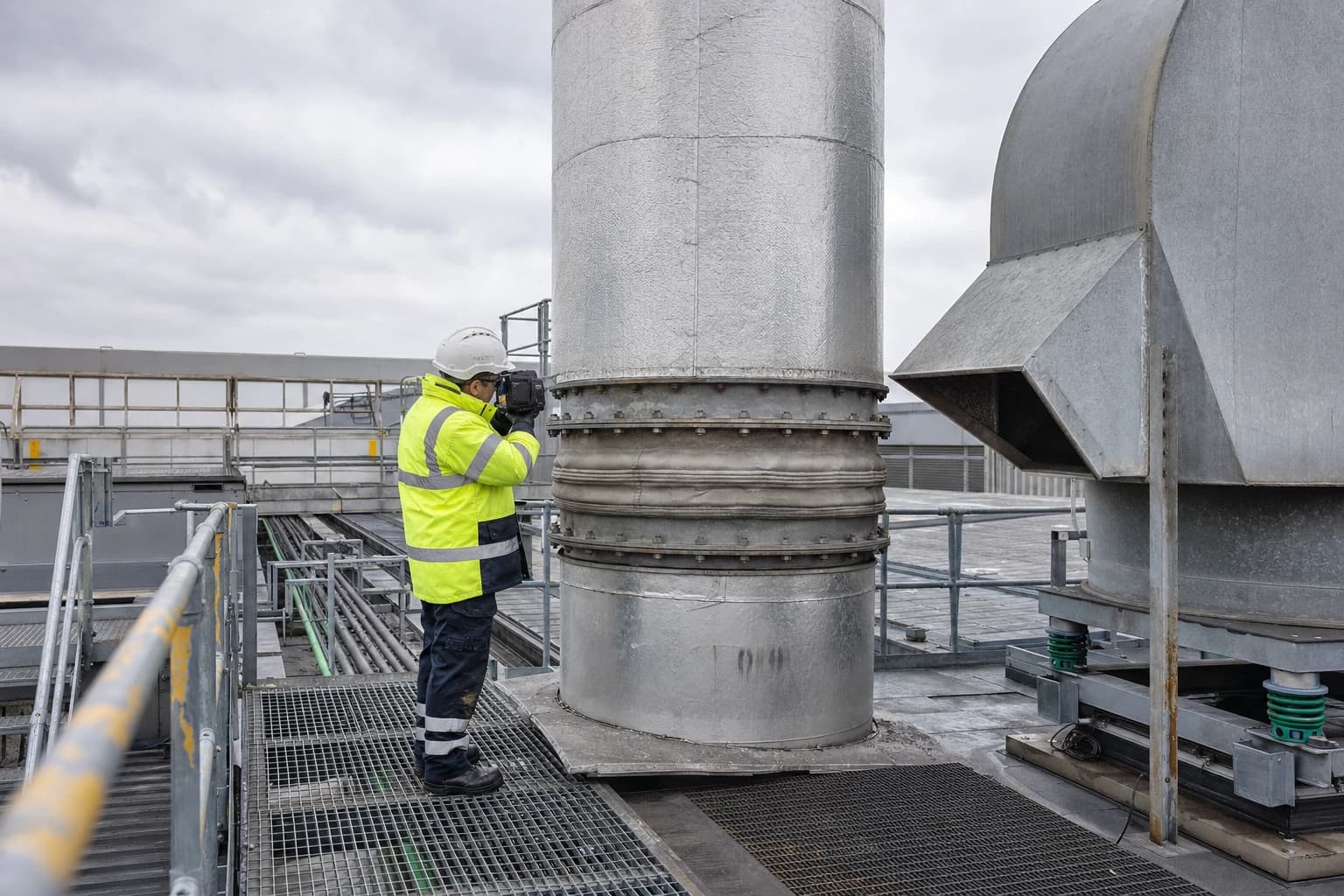
Pinch Analysis vs Energy Audit: Which Cuts More Heat?
How BS EN 16247-3:2022 audits compare with process heat-integration studies.
UK organisations that qualify for ESOS Phase 4 must notify compliance by 5 December 2027, and their assessment must cover at least 95% of total energy consumption through audits or other valid routes. For energy-intensive factories, that deadline raises a more valuable engineering question: should the site commission a conventional energy audit, or go further with pinch analysis?
An energy audit usually provides the broader baseline and compliance route. Pinch analysis usually identifies the larger opportunity to cut purchased heating and cooling where several process streams reject and demand heat at useful temperatures.
Neither study replaces the other. They answer different questions. An audit asks where energy is used, how efficiently equipment operates and which improvements deserve action. Pinch analysis asks how much external heating and cooling a process theoretically requires, then tests how much of that demand can be displaced by recovering heat within the process.
For a site with boilers, ovens, dryers, refrigeration and heat exchangers, the choice affects project selection, capital planning and decarbonisation sequencing.
Energy audit vs pinch analysis: the decision in brief
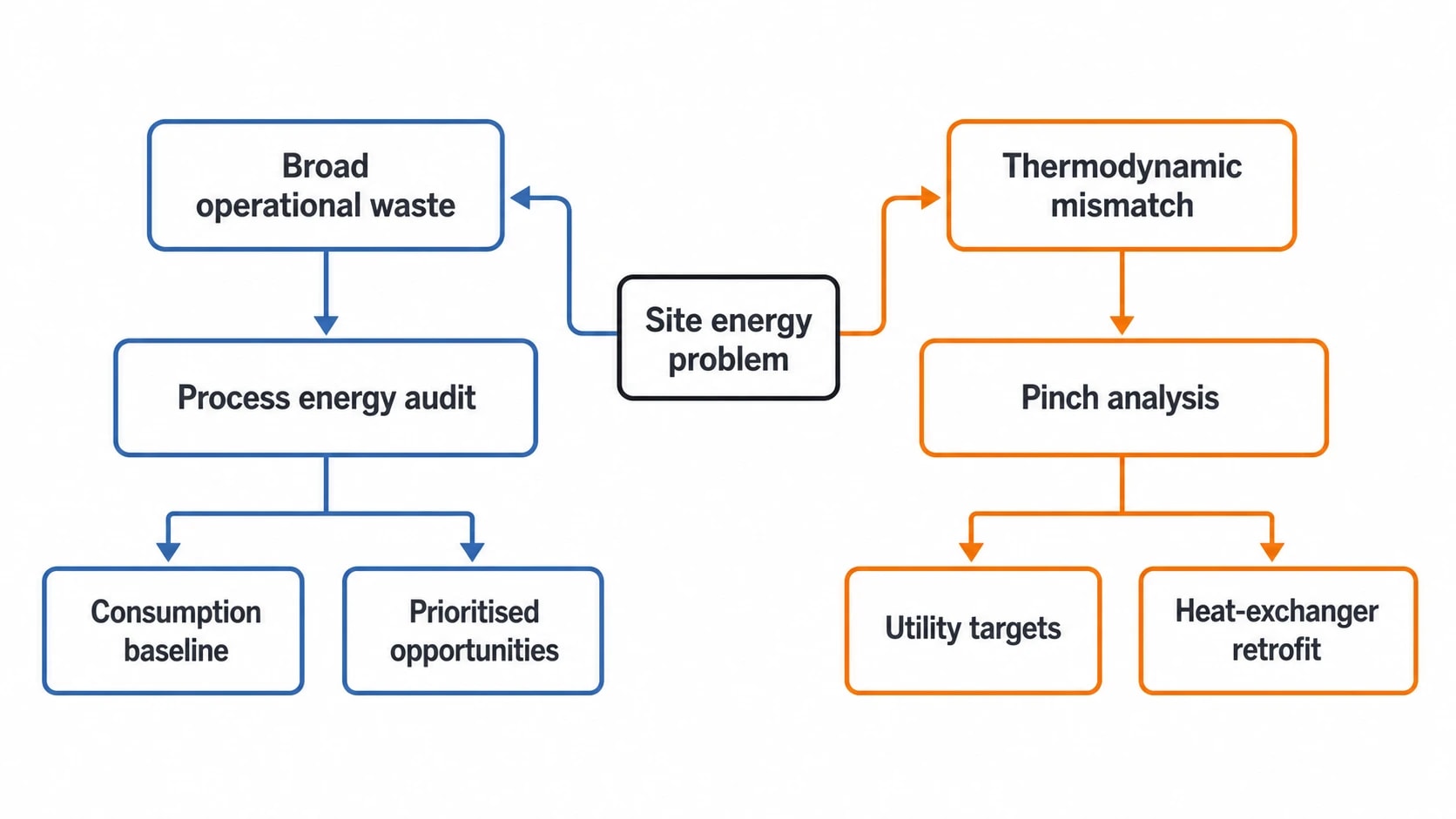
A process energy audit maps consumption across a facility or defined production area. It can identify inefficient boilers, compressed-air losses, poor insulation, excessive idling, high fan or pump loads, control problems and poor operating practice. It produces a practical list of energy-saving opportunities, often ranked by cost, payback and implementation difficulty.
Pinch analysis works at a tighter process level. It gathers stream temperatures, heat-capacity flow rates, phase changes and operating constraints, then calculates minimum heating and cooling targets. The method identifies the temperature point that constrains heat recovery, known as the pinch, and guides changes to the heat-exchanger network.
A site can run well-maintained equipment and still buy unnecessary steam or reject unnecessary heat to cooling water. That loss often sits between process units rather than within one asset.
| Decision factor | Process energy audit | Pinch analysis |
|---|---|---|
| Main purpose | Establish consumption, efficiency and improvement opportunities | Minimise external heating and cooling through process heat recovery |
| Typical scope | Whole site, building, transport or a process area | Interacting process streams, utilities and heat exchangers |
| Main output | Energy profile and prioritised opportunities | Utility targets and heat-integration retrofit options |
| Best early use | Compliance, baseline setting and broad opportunity finding | High thermal demand, complex processes and heat-exchanger retrofit planning |
| Key data | Bills, meters, production, operating hours and asset condition | Stream temperatures, flow rates, duties, utility conditions and operating constraints |
| Common project types | Controls, insulation, maintenance, drives, combustion tuning and operating changes | New or revised exchanger matches, utility changes, heat recovery and network modifications |
| Main limitation | May miss cross-process heat-recovery potential | Does not substitute for a broad site energy-management assessment |
The practical question is whether the site's material energy problem is broad operational waste or a thermodynamic mismatch between hot and cold process streams.

Pinch analysis identifies the thermodynamic minimum energy requirement of your process — then designs the heat exchanger network to achieve it.
What a process energy audit delivers
BS EN 16247-3:2022 specifies requirements, methodology and deliverables for energy audits of processes. It is the relevant reference when an industrial site needs a structured examination of how process energy is consumed and where savings could be made.
A defensible energy baseline
An effective audit starts with consumption data and production context. Monthly gas and electricity bills rarely explain a process plant's thermal performance. Auditors need to distinguish between energy used for production, cleaning, start-up, standby, utilities and weather-sensitive building loads.
This creates a baseline for management. It can show whether steam demand rises with throughput, whether a dryer consumes energy during non-production periods, or whether a refrigeration system operates outside its required temperature range.
For ESOS participants, the compliance task is broader than the factory process. Total energy consumption includes buildings, industrial processes and transport. An audit route must address the areas selected as significant energy consumption, while a certified ISO 50001 energy-management system can provide an alternative route for the energy it covers.
Asset-level opportunities
A conventional audit is the right first study where obvious site losses have not been measured or managed. Typical findings include:
- Boiler excess air and poor combustion control.
- Uninsulated valves, flanges and distribution pipework.
- Steam leaks, failed steam traps or condensate recovery issues.
- Excessive ventilation, pump throttling and fixed-speed motor operation.
- Heat loss from ovens, furnaces, dryers and process vessels.
- Equipment left running during shutdowns, cleaning or product changeovers.
- Inadequate sub-metering that obscures energy use by line, batch or utility system.
These projects can be commercially attractive because they often require limited process changes. They also reduce uncertainty before a larger heat-integration study.
The audit's thermal blind spot
An energy audit may quantify a large steam bill and identify the biggest individual users. It does not necessarily establish the lowest feasible steam demand for the combined process.
Consider a food plant where one operation cools a product stream while another heats wash water. An asset-by-asset audit could recommend better insulation on the hot-water system and improved refrigeration controls. Both may be valid. Pinch analysis examines whether rejected process heat can heat the wash-water stream directly or through an intermediate circuit, reducing both hot-utility and cold-utility demand.
An audit can therefore identify useful projects without revealing the full heat-recovery opportunity.
How pinch analysis cuts purchased heat
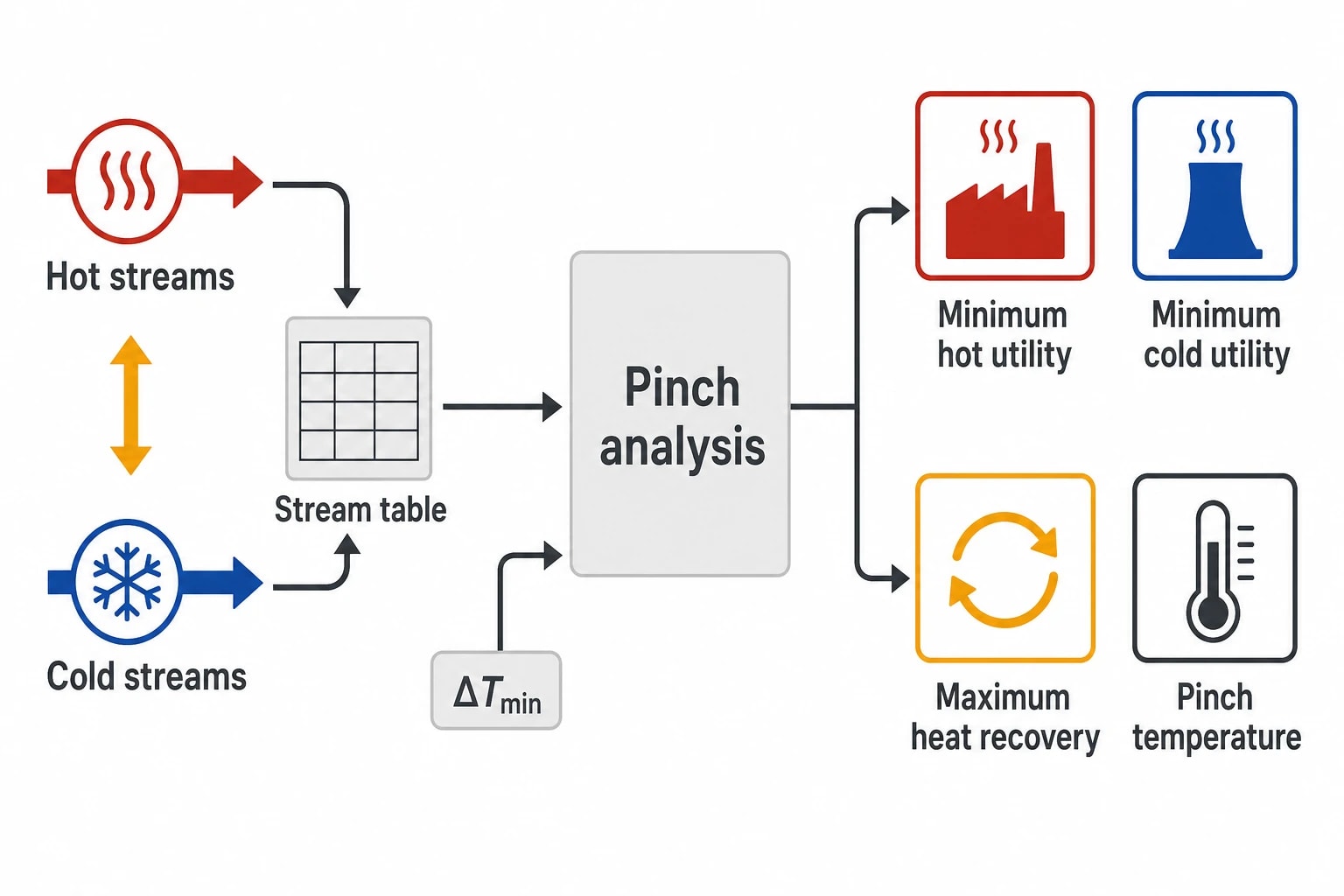
Pinch analysis is a process-integration method that sets thermodynamic minimum targets for heating and cooling demand before engineers select heat exchangers or change utility systems. It is especially relevant where process streams heat, cool, condense or evaporate across a range of temperatures.
The 2026 technical note published in Process Integration and Optimisation for Sustainability describes pinch analysis as a continuing tool for energy efficiency, decarbonisation and retrofit studies in chemicals, pulp and paper, food and refining.
From stream data to utility targets
The study begins with a stream table. Each hot stream has heat available as it cools. Each cold stream needs heat as it warms. Engineers include inlet and target temperatures, mass-flow information or heat-capacity flow rates, latent heat where phase changes occur, and realistic operating cases.
The selected minimum temperature approach, often written as ΔTmin, has a major effect on the result. A smaller temperature approach can recover more heat but generally needs more exchanger area. A larger approach reduces capital exposure but leaves more utility demand. The value must reflect the process, exchanger type, fouling behaviour, control requirements and available plot space.
Pinch analysis then produces targets for:
- Minimum hot-utility demand, such as steam, thermal oil or furnace duty.
- Minimum cold-utility demand, such as cooling water, chilled water or air cooling.
- Maximum process heat recovery.
- The pinch temperature, where heat recovery is constrained.
- Potential utility levels and heat-exchanger-network changes.
These targets establish a technical ceiling on heat recovery before a retrofit concept is designed. They do not promise that a plant can reach the target at acceptable cost or without disrupting production.
Heat exchanger network retrofit
Existing plants require a different discipline from new-build design. A heat-exchanger network has fixed exchanger locations, pipe routes, control loops, pressure-drop limits, cleanability requirements and shutdown constraints. Some streams cannot be connected because of hygiene, contamination, corrosion, product quality or operability risks.
A retrofit study compares the thermodynamic target with what the existing network can achieve. It looks for practical changes such as:
- Reassigning stream matches where temperatures and process constraints permit.
- Adding exchanger area to an existing train.
- Installing a new exchanger in parallel or series.
- Recovering heat to boiler-feedwater, wash water or another process load.
- Revising steam levels after process-to-process recovery has reduced demand.
- Reducing cooling-water or refrigeration duty after better heat recovery.
The pinch provides rules that prevent a design transferring heat in a way that raises utility demand elsewhere. Those rules do not replace hazard review, process-control design, mechanical-integrity assessment or plant trials.
Why pinch analysis often finds deeper savings
Thermal processes can contain simultaneous heat surplus and heat demand. A conventional audit may treat them as separate utility loads because they sit in separate units or departments. Pinch analysis treats them as one heat-recovery problem.
This approach is particularly useful in continuous chemical operations, evaporation systems, distillation, pasteurisation, sterilisation, drying, pulp processing, refining and metals processing. It also applies to batch facilities, although the analysis must represent time-dependent operation rather than assume all streams are available at the same time.
Which method cuts more heat at a UK manufacturing site?
Pinch analysis can cut more purchased heat where a site has enough compatible hot and cold streams to support meaningful process-to-process recovery. It identifies the lowest heating demand consistent with the stream data and selected temperature approach.
An energy audit can cut more total energy where the main losses lie outside process integration. A poorly controlled boiler plant, unmetered electrical loads, compressed-air leakage or excessive idle running may yield larger near-term savings than a complex heat-exchanger retrofit.
Choose an energy audit first when
An audit is usually the first commission when the site lacks a reliable energy baseline, has limited sub-metering, has not assessed its principal utilities recently, or needs a structured ESOS workstream.
It also suits sites where thermal loads are simple or physically separated. A warehouse with comfort heating, a single boiler house and limited process heat exchange is unlikely to justify a detailed pinch study before basic controls, maintenance and insulation are addressed.
The same applies where production has changed repeatedly and process data is poor. Pinch analysis depends on credible stream information. An audit can expose missing measurement and provide a practical data-improvement plan.
Choose pinch analysis first when
Pinch analysis should move to the front of the queue when steam and cooling are both material costs, the plant contains several process heating and cooling duties, and the site faces major utility replacement or heat-exchanger capital decisions.
It is also timely before a boiler replacement, electrification programme, heat-pump feasibility study or low-carbon heat procurement. Reducing the underlying process heat demand first avoids sizing a new utility system around avoidable waste.
A pinch study has particular value where management already suspects stranded heat. Common signals include hot effluent sent to drain, cooling-water demand near heating loads, large temperature drops across hot product streams, repeated exchanger fouling, or steam used for duties that could accept lower-temperature recovered heat.

Pinch analysis identifies the thermodynamic minimum energy requirement of your process — then designs the heat exchanger network to achieve it.
A better buying sequence: audit, target, design
For many energy-intensive sites, the strongest procurement route combines both methods in sequence. The audit establishes the baseline, confirms compliance needs and identifies quick operational savings. Pinch analysis then focuses engineering effort on process areas where heat recovery can materially reduce utility demand.
Stage 1: establish the energy picture
Start with a process energy audit aligned to BS EN 16247-3:2022 where applicable. Establish annual energy use, production-normalised indicators, major utility loads and the operating patterns that drive them.
The audit should identify data gaps. If a process area lacks temperature, flow or duty information, this must be resolved before pinch targets can be trusted.
Stage 2: screen for heat-integration potential
Use the audit findings to select a bounded process area. Good candidates have high heating and cooling demand, multiple heat exchangers, stable operating cases and a planned shutdown or capital programme.
A preliminary stream review can determine whether a full pinch study is justified. This screening should include batch timing, heat-transfer limitations, hygiene requirements and the condition of existing heat exchangers.
Stage 3: develop the retrofit case
A full pinch analysis should produce utility targets and a shortlist of feasible heat-exchanger-network modifications. The final investment decision still needs site-specific design work.
Project appraisal should include exchanger area, materials, pressure drop, fouling allowance, cleanability, controls, tie-in work, downtime, safety and product-quality constraints. A project that reaches less than the theoretical target may still be the better investment if it can be installed during a routine shutdown and operated reliably.
Questions to ask before appointing a consultant
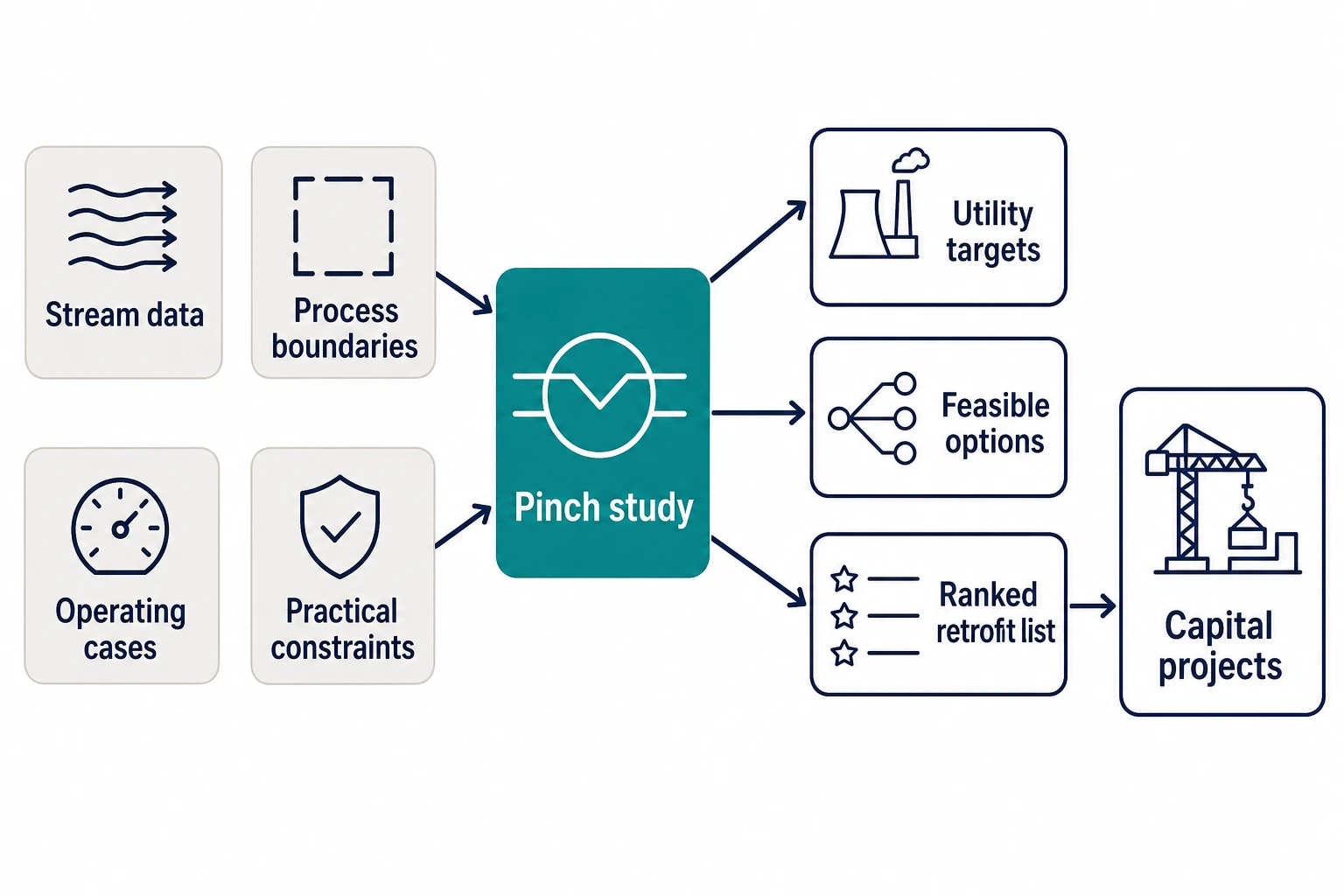
A well-defined brief prevents an audit becoming a generic survey and a pinch study becoming an academic exercise.
Ask whether the scope will cover the process streams that dominate steam and cooling demand. Confirm which operating cases will be analysed, especially for batch plants and seasonal production. Request a clear distinction between theoretical targets, technically feasible options and costed projects.
For a pinch-analysis commission, the brief should also state:
- The available stream data and who will validate it.
- The selected process boundaries, utilities and production cases.
- Constraints on cross-contamination, cleanability, pressure drop and control.
- The required output, including utility targets, heat-exchanger-network options and a ranked retrofit list.
- The relationship between the study and planned boiler, heat-pump, refrigeration or capital projects.
For an ESOS-linked audit, the organisation should keep the regulatory purpose distinct from the deeper engineering objective. GOV.UK states that PAS 51215-1:2025, covering process energy and decarbonisation assessment, may be used voluntarily for ESOS Phase 4. Existing requirements and Phase 4 guidance should be checked before finalising the compliance route.
The practical verdict
A process energy audit provides the baseline and compliance route across process, buildings and transport. Pinch analysis is the higher-resolution tool for thermal processes with interlocking heating and cooling duties, setting minimum utility targets and structuring heat-recovery retrofit options.
Sites with immature energy data should begin with an audit. Sites with high steam and cooling demand, established process data and upcoming utility investment should commission pinch analysis early enough to influence the capital plan.
This article reflects the independent analysis and editorial opinion of EnerTherm Engineering. Product names, trademarks, and brands mentioned belong to their respective owners. EnerTherm Engineering is not affiliated with, endorsed by, or a licensee of any third-party software or product mentioned unless explicitly stated.

Managing Director — EnerTherm Engineering
Dr. François Pierrel is Managing Director of EnerTherm Engineering with over two decades of expertise in thermal design, heat transfer, and industrial energy optimisation. He holds a PhD in Heat Transfer from Cranfield University and a Post-Doctorate from Heriot-Watt University.
