How Pinch Analysis Reduces Boiler Fuel Consumption
How heat integration recovers process heat and cuts demand for new boiler capacity.
A pinch analysis is a thermodynamic method that identifies the minimum external heat a process requires and shows how recoverable heat can displace boiler-generated steam. For energy-intensive UK plants, that target can turn a familiar boiler-house problem into a heat-integration project across the process.
Boiler fuel consumption does not begin at the burner. It begins with the temperature and heat-demand profile of reactors, evaporators, dryers, distillation columns, pasteurisers, washing systems and other process equipment. A site may operate well-maintained boilers, tuned combustion controls and condensate recovery, yet still burn unnecessary gas because hot process streams are rejected to cooling water or air while another part of the plant demands steam.
Pinch analysis exposes that mismatch. It quantifies the practical scope for heat recovery before engineers select exchanger duties, alter steam pressure levels or consider new boiler capacity. The work can reduce the fired duty carried by a steam system, provided the heat exchanger network, operating cases and control arrangements achieve the target safely.
Why boiler fuel consumption is often set by process heat integration
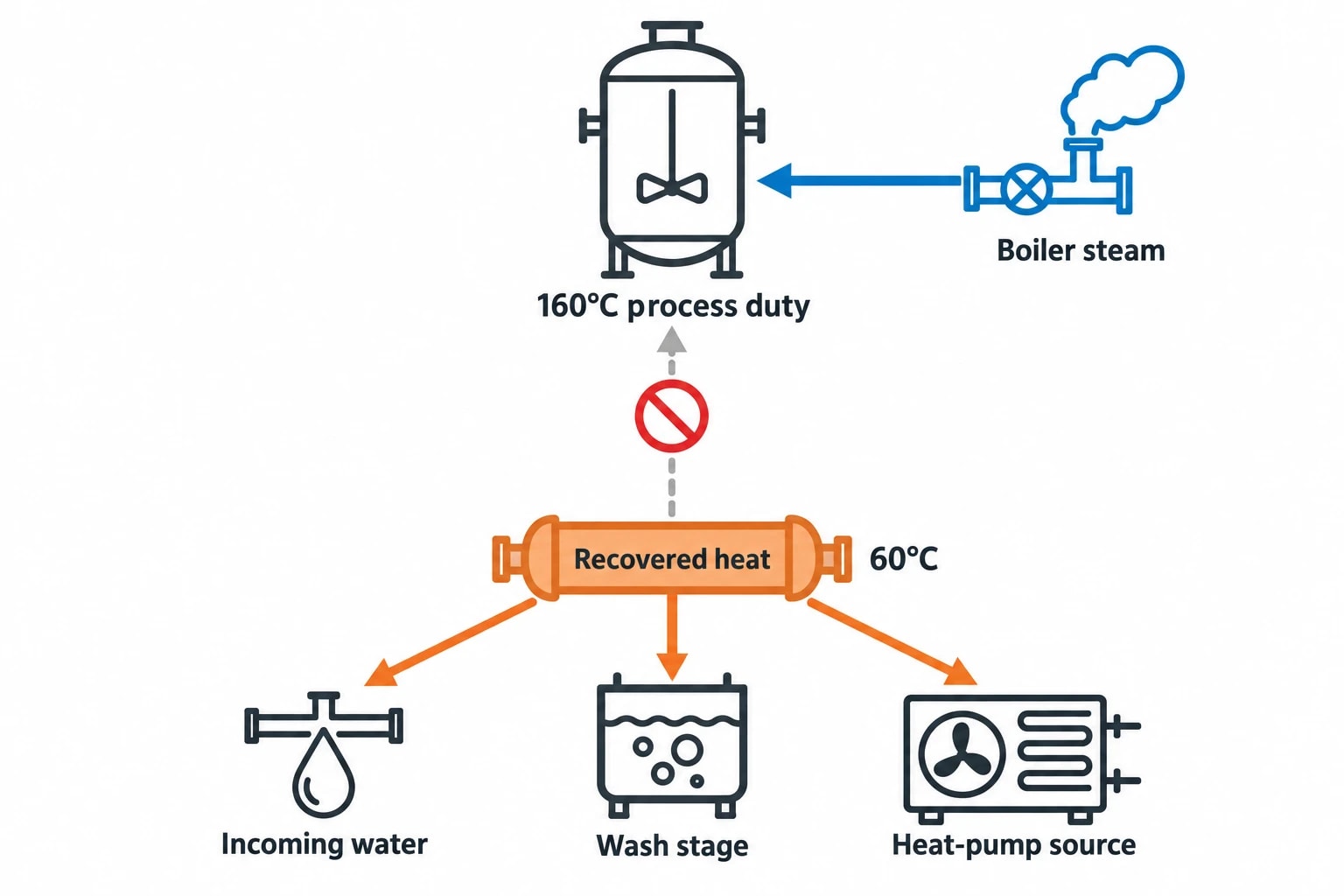
A boiler supplies the difference between the heat that a plant needs and the heat it can recover internally. Where a site sends hot liquid, vapour or flue gas to cooling while using steam to heat another stream, it creates an opportunity for heat integration.
This does not mean that all rejected heat can replace boiler fuel. Temperature determines usefulness. Heat at 60°C may suit incoming water, a wash stage or a heat-pump source, but it cannot directly deliver the duty needed by a 160°C process. Pinch analysis puts that temperature constraint at the centre of the assessment.
The hidden boiler load
Steam demand can appear fixed in utility records because it is expressed as tonnes per hour. In practice, part of that demand may result from avoidable process heating. Common causes include:
- Product or effluent streams cooled before their heat is recovered.
- Steam heaters operating upstream of coolers.
- Boiler feedwater heated only in an economiser despite available process heat.
- A high-pressure steam header serving duties that lower-pressure steam or recovered heat could meet.
- Condensate returned at a lower temperature than the system could accommodate.
- Batch production schedules that separate a heat source from a heat demand in time.
A conventional energy audit can identify individual losses. Pinch analysis adds a system view. It identifies whether an apparently attractive exchanger conflicts with a better heat-recovery match elsewhere and establishes the minimum hot-utility target for the process.
Boiler optimisation has a process boundary
Combustion optimisation, flue-gas oxygen control, blowdown management and insulation remain important. They improve the efficiency with which a boiler converts fuel into steam. Pinch analysis reduces the steam that the process asks the boiler to generate.
A burner upgrade may reduce fuel per tonne of steam. Heat integration can reduce tonnes of steam required per tonne of product. Both measures can work together, but they answer different questions.

Pinch analysis identifies the thermodynamic minimum energy requirement of your process — then designs the heat exchanger network to achieve it.
How pinch analysis finds the minimum boiler duty
The study starts by defining process streams that need heating or cooling. Each stream is characterised by supply temperature, target temperature, heat-capacity flowrate or duty, phase change where applicable, operating pressure, availability and allowable pressure drop.
Hot streams release heat as they cool. Cold streams require heat as they warm. The analyst applies a selected minimum temperature approach, usually written as ΔTmin, to account for the driving force required in real heat exchangers.
Composite curves and the pinch point
Hot and cold composite curves combine the heat-temperature behaviour of relevant streams. Shifting the temperature scale by half the selected ΔTmin allows the curves to be compared while preserving a feasible exchanger approach.
The closest point between the curves is the pinch point. It governs the process heat-recovery target. From this relationship, engineers determine:
- Minimum hot utility demand, the lowest theoretical external heating requirement at the selected ΔTmin.
- Minimum cold utility demand, the lowest theoretical cooling requirement.
- Maximum recoverable process heat.
- The temperature levels where steam, hot water, cooling water, refrigeration or heat pumps fit the process.
The target is not an installation drawing. It is a thermodynamic benchmark. Engineers then develop a heat exchanger network that aims to meet the target while respecting plot space, fouling, cleaning access, control stability, pressure drop, maintenance shutdowns and capital cost.
The three pinch design rules
For a maximum-energy-recovery design, the traditional pinch rules are straightforward:
- Do not transfer heat across the pinch in the wrong direction.
- Do not use external cooling above the pinch.
- Do not use external heating below the pinch.
Breaking these rules increases hot or cold utility demand. Existing plants often break them for operational reasons, including batch flexibility, safety separation, product-contamination risk and equipment layout. The analysis identifies the energy penalty, tests alternatives and distinguishes justified constraints from inherited design choices.
Choosing ΔTmin affects the fuel target
A smaller ΔTmin gives a lower boiler-duty target because it allows more process heat recovery. It also requires more exchanger area and can increase fouling sensitivity. A larger ΔTmin reduces exchanger area but leaves more duty for steam and cooling utilities.
The correct value depends on the streams involved. Clean liquid-to-liquid duties can support closer approaches than dirty, viscous, crystallising or phase-changing services. The analyst should test practical temperature differences rather than present a single theoretical target as a project guarantee.
Pinch analysis opportunities that cut boiler fuel use
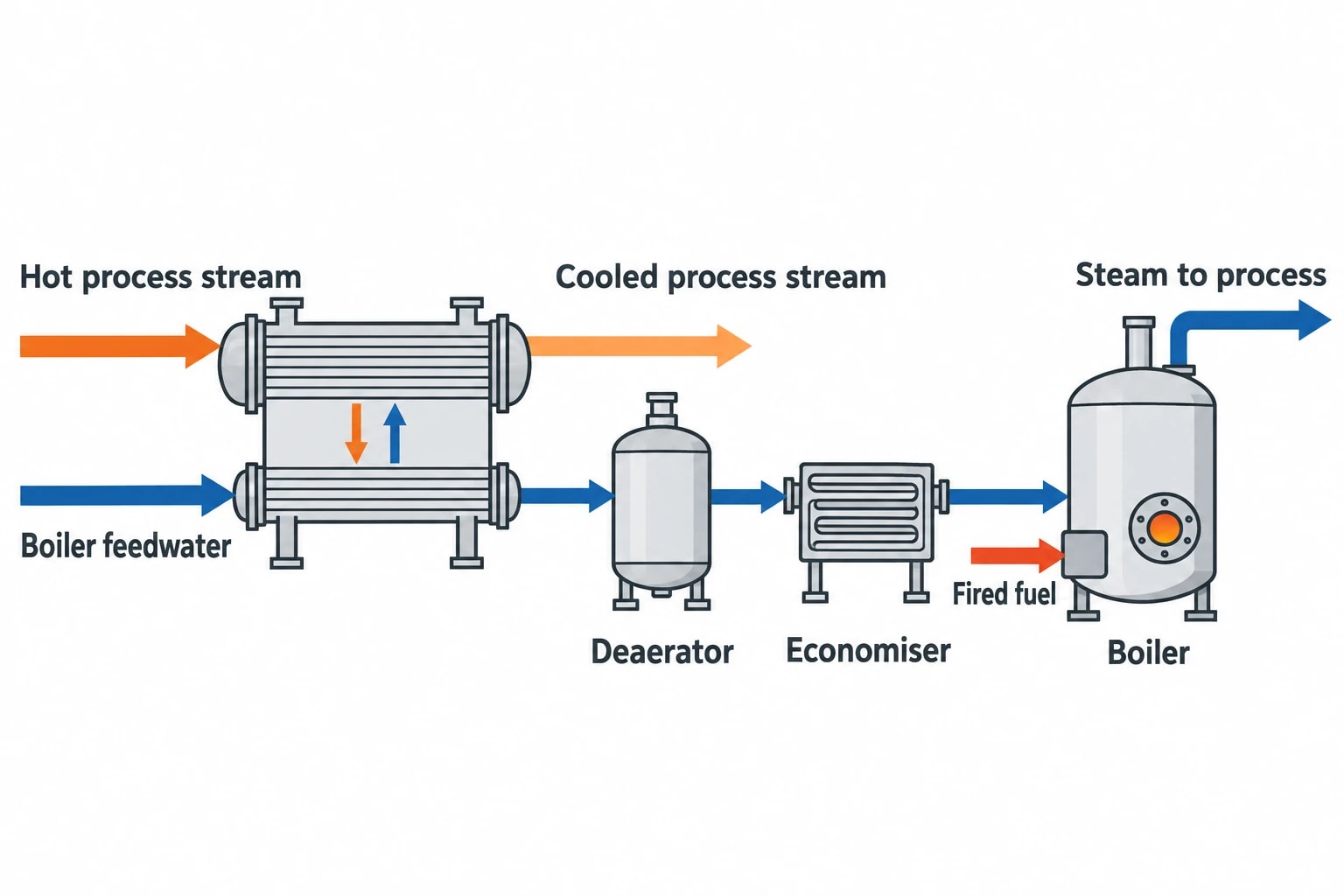
The best projects match recovered heat to a stable, useful demand at the highest feasible temperature. Boiler feedwater preheating can be attractive because the feedwater flow is often predictable and the duty directly offsets fuel.
Boiler feedwater preheating
A hot process stream, compressor aftercooler circuit, condensate stream or suitably clean effluent can preheat boiler feedwater before the deaerator or economiser. This lowers the fuel needed to raise feedwater to steam conditions.
Engineers must assess several practical points before committing to the arrangement:
- Water chemistry and contamination risk.
- The effect on deaerator performance and oxygen removal.
- Whether the new exchanger bypasses or reduces useful duty in the flue-gas economiser.
- Fouling rate, cleaning method and standby arrangements.
- Feedwater temperature limits set by boiler design or economiser operation.
- Boiler-load variation and the risk of unstable exchanger control.
The Environment Agency has recorded boiler-feedwater preheating from process heat as a practical refinery example in a permit review. It shows how process heat that would otherwise reach cooling equipment can reduce the thermal load on the fired system.
Replacing steam heaters with process-to-process exchange
Many steam-saving projects involve a cold process feed that receives heat from a hotter process outlet. The recovered heat can reduce steam use in a preheater, reboiler feed train, dryer air heater or product-conditioning step.
For food and drink production, separation between process streams may be essential. Double-wall exchangers, intermediate loops, hygienic design and validated cleaning arrangements can preserve product protection, but each adds temperature loss and capital cost. Pharmaceutical applications may face similarly demanding requirements for cleanability, material selection and segregation.
In chemical and refining duties, corrosive streams, fouling and varying composition can determine whether a heat exchanger network is viable. The pinch target should therefore be followed by detailed exchanger selection, materials assessment and a review of upset conditions.
Steam pressure levels and utility integration
A site with several steam headers may use pinch analysis to identify whether heat recovery can reduce demand on the highest-pressure header or whether a lower-pressure steam level better suits a duty. It can also reveal opportunities to use flash steam, recover condensate heat or reconfigure let-down arrangements.
Steam is a high-value utility because it carries latent heat at a controlled temperature. Using high-pressure steam for low-temperature duties can increase boiler fuel consumption and make later heat recovery harder. Utility targeting helps define the appropriate level of steam, hot water or recovered heat for each duty.
For mineral oil and gas refineries, European BAT Conclusion 2 includes integrated process control and optimisation, process-related heat recovery, steam-system management, combined heat and power, and power recovery among relevant energy-efficiency techniques.

Pinch analysis identifies the thermodynamic minimum energy requirement of your process — then designs the heat exchanger network to achieve it.
Turning a pinch target into a boiler fuel project
The analysis must represent normal operation, not merely clean design data. Process plants change grade, throughput, pressure, season and cleaning status. A heat exchanger network that delivers an excellent target at one operating point can become impractical if the source temperature collapses during another production campaign.
Build a credible stream data set
A useful data set should include measured temperatures and flows rather than relying solely on process design documents. Plant teams should reconcile the data against known utility consumption and production rates.
For each stream, the study team should establish:
- Normal, minimum and maximum flow.
- Supply and target temperature for each operating case.
- Heat capacity, latent heat and phase-change conditions.
- Allowable pressure drop.
- Fouling, corrosion and cleaning requirements.
- Isolation and maintenance needs.
- Process safety, contamination and operability constraints.
- Whether the source and demand exist at the same time.
Batch sites need particular care. A hot discharge may occur hours before a cold charge requires heat. Thermal storage, revised scheduling or an intermediate hot-water loop may make the opportunity workable, but those measures need their own economic and control assessment.
Screen projects using annualised performance
A heat exchanger duty at design conditions is not an annual fuel saving. Engineers should calculate heat recovery across representative operating cases and production hours. The annual fuel reduction also depends on boiler efficiency, fuel type, steam losses, condensate return and changes in electricity use for pumps or heat pumps.
The business case should include exchanger installation cost, pipework, structural work, insulation, instruments, control valves, maintenance access, cleaning frequency and production outage. Process integration projects often require more site work than utility-side modifications because the new network connects operating process equipment.
Verify the saving after commissioning
A sound measurement and verification plan avoids disputes over performance. It should define the baseline period, production normalisation method, fuel-meter boundaries, steam measurements and treatment of changed product mix.
Useful operating indicators include boiler fuel per tonne of steam, steam per tonne of product, condensate return temperature, recovered-heat duty and cooling utility demand. Direct measurement of recovered duty provides the strongest basis for verification.
Regulation and BAT context for UK combustion plant
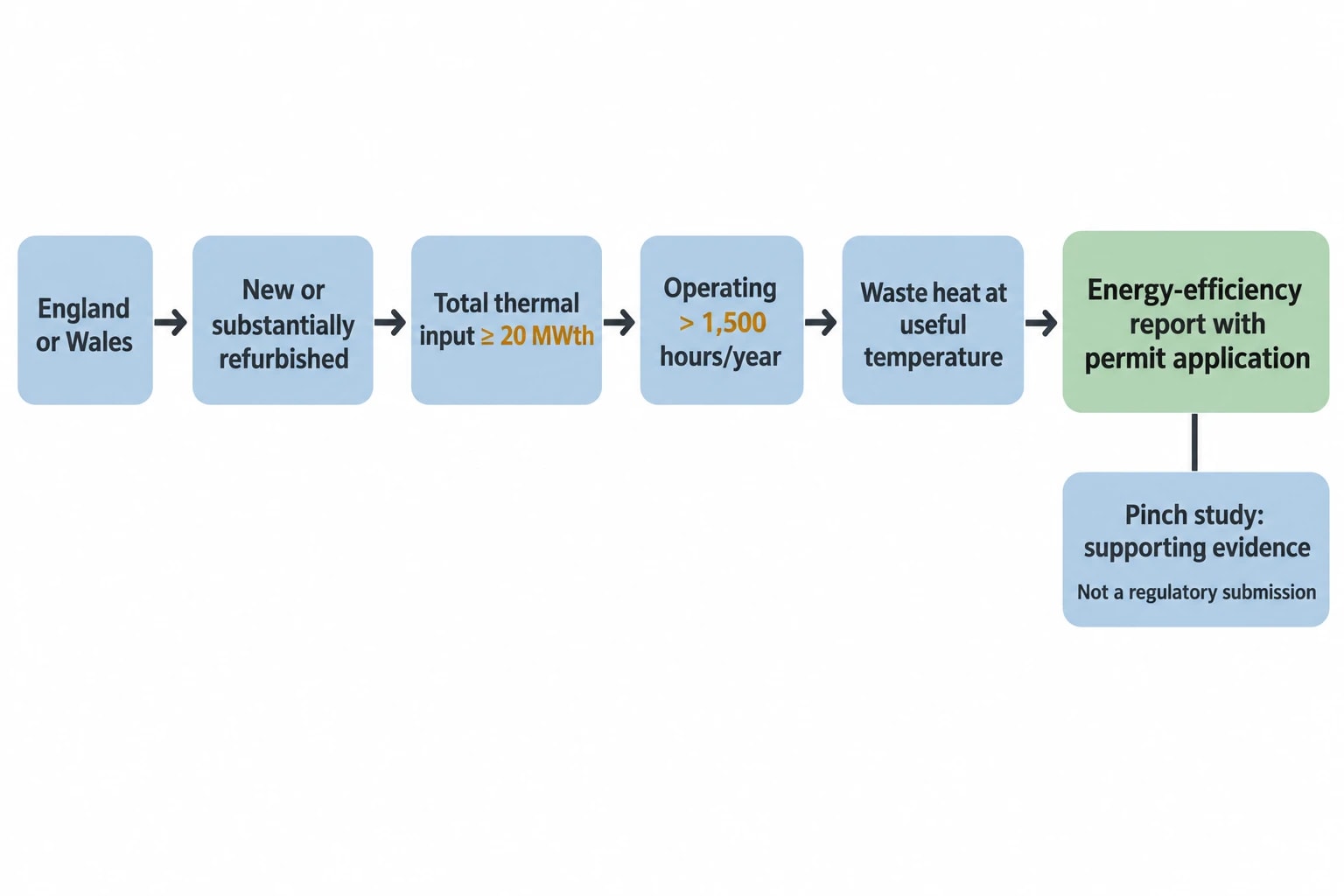
For plants in England and Wales, energy efficiency and waste-heat assessment can form part of environmental permitting. Schedule 24 of the Environmental Permitting (England and Wales) Regulations 2016 addresses cost-benefit assessment and the use of waste heat in defined circumstances.
Natural Resources Wales states that certain new or substantially refurbished installations with a total thermal input of 20 MWth or more, operating for more than 1,500 hours per year and producing waste heat at a useful temperature, must submit an energy-efficiency report with a permit application. Operators should confirm the exact scope with the relevant regulator, particularly where multiple combustion units share a site.
Environment Agency guidance also identifies potential cost-benefit assessment requirements for new or substantially refurbished combustion plant above 20 MWth, including high-efficiency cogeneration and supply to a district heating or cooling network. A pinch study can provide evidence for the internal heat-recovery element of that assessment, though it does not replace the regulatory submission.
BAT expectations and sector relevance
European BAT conclusions remain useful technical reference material for sites assessing established energy-efficiency techniques. For mineral oil and gas refineries, BAT Conclusion 2 includes process-related heat recovery and steam-system management among techniques for increasing energy efficiency.
The same principle applies across the target sectors:
- Paper mills can recover secondary heat and reduce direct steam use through process integration.
- Food plants can use clean or intermediate circuits to recover heat from pasteurisation, cooking or refrigeration systems.
- Chemical plants can reduce steam consumption by integrating reactor, distillation and separation duties.
- Pharmaceutical plants can assess recoverable heat while preserving validated process controls and segregation.
- Refineries can target heat exchanger network improvements alongside furnace, steam and power-system optimisation.
Pinch analysis before boiler replacement or electrification
A boiler replacement project can lock in excessive capacity if it uses historical fuel consumption as the sole demand basis. Pinch analysis allows teams to calculate what the steam system should supply after feasible heat-recovery measures have been installed.
That sequencing also matters for electrification. The International Energy Agency reports that large-scale industrial heat pumps are established for heat delivery up to 150°C, while electric boilers can generate steam up to 350°C at around 70 bar. Recovered low-grade heat may therefore become a heat-pump source or directly serve a low-temperature process, reducing the electrical capacity required for an electric boiler.
This article reflects the independent analysis and editorial opinion of EnerTherm Engineering. Product names, trademarks, and brands mentioned belong to their respective owners. EnerTherm Engineering is not affiliated with, endorsed by, or a licensee of any third-party software or product mentioned unless explicitly stated.

Managing Director — EnerTherm Engineering
Dr. François Pierrel is Managing Director of EnerTherm Engineering with over two decades of expertise in thermal design, heat transfer, and industrial energy optimisation. He holds a PhD in Heat Transfer from Cranfield University and a Post-Doctorate from Heriot-Watt University.
