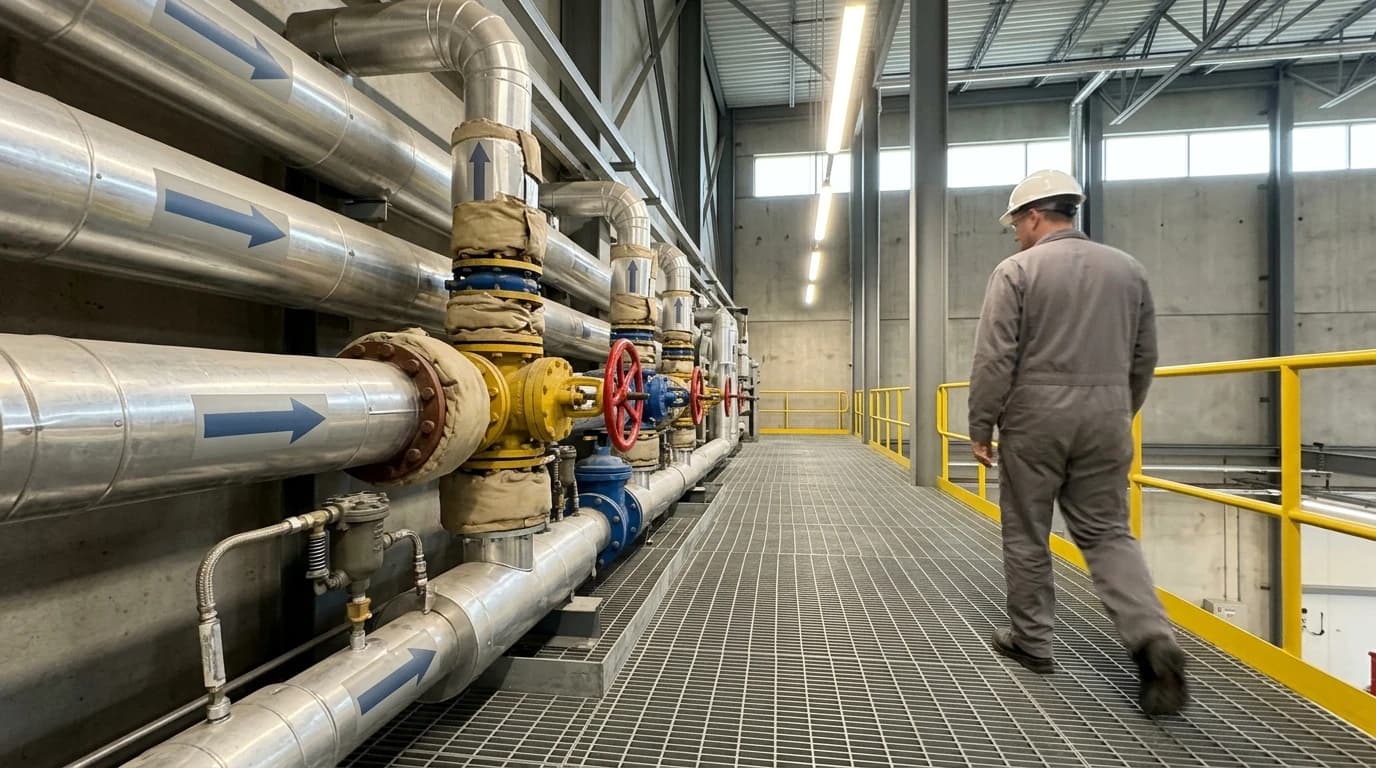
Pinch Analysis Cuts Paper Mill Steam by up to 17%
Reducing average mill emissions by 58,000 tonnes per year with a sub-two-year payback.
Process integration in pulp and paper operations refers to the systematic, thermodynamic analysis of heat and water networks. It allows engineers to design, optimise, and retrofit mill-wide thermal systems to achieve minimum utility demand. Pulp and paper manufacturing is one of the most heat-intensive industrial processes worldwide. Chemical pulping, mechanical refining, bleaching, and paper drying require immense volumes of high- and medium-pressure steam. With highly volatile energy prices, improving thermal efficiency directly drives mill profitability. Historically, engineers tried to cut energy use by upgrading isolated unit operations. For example, upgrading a single heat exchanger in the bleaching plant might reduce local steam use, but it often cools the effluent stream destined for wastewater treatment. This simply increases the heating load elsewhere. Process integration avoids this by treating the entire mill as an interconnected thermodynamic system, ensuring that every heat recovery modification reduces net steam usage.
Industry Benchmarks: Process Integration in Pulp and Paper Industry Systems

Pulp and paper mills applying Pinch analysis achieve significant, measurable reductions in primary steam consumption. Extensive industrial data from approximately 500 applications across more than 300 mills reveal average practical steam savings of 17 per cent. For a typical large-scale integrated facility, this efficiency gain equates to saving approximately 100 MMBtu/h of thermal energy.
These thermal optimisations provide rapid financial returns. The average simple payback period for heat recovery networks designed using Pinch principles is less than two years. Furthermore, these capital projects yield an average reduction of 58,000 metric tonnes of CO₂ emissions annually per mill, assuming the displacement of natural gas in the utility boilers. For European and British mills, these emissions reductions assist in meeting compliance targets under the UK Climate Change Agreement (CCA) and the EU Emissions Trading System (EU ETS), directly reducing carbon taxation overheads.
Constructing Composite Curves to Locate the Thermodynamic Pinch Point
Implementing a Pinch analysis begins with a mill-wide thermal stream data extraction process. Process engineers audit the facility to identify every stream requiring heating or cooling. For each stream, they record four parameters: supply temperature (Ts), target temperature (Tt), mass flow rate (m), and specific heat capacity (Cp).
Using these values, engineers calculate the heat capacity flow rate (CP) — the product of mass flow rate and specific heat capacity. The total thermal load (Q) is determined by the temperature difference:
Q=CP⋅(Tt−Ts)where:
- Q is the thermal load, expressed in kilowatts (kW).
- CP is the heat capacity flow rate, expressed in kilowatts per Kelvin (kW/K).
- Ts is the supply temperature, expressed in Kelvin (K).
- Tt is the target temperature, expressed in Kelvin (K).
Streams requiring cooling are classified as hot streams (heat sources), while those requiring heating are cold streams (heat sinks).
Engineers plot these combined streams as Hot and Cold Composite Curves on a Temperature-Enthalpy (T-H) diagram. The curves are separated by a chosen minimum temperature approach, designated as ΔTmin. The point where they come closest represents the Pinch Point. This thermodynamic bottleneck divides the mill into two distinct thermal regions:
- The region above the Pinch has a net heat deficit, requiring external hot utility such as high-pressure boiler steam.
- The region below the Pinch has a net heat surplus, requiring external cold utility such as cooling tower water.

Pinch analysis identifies the thermodynamic minimum energy requirement of your process — then designs the heat exchanger network to achieve it.
The Fundamental Thermodynamic Rules of Pinch Technology
The power of Pinch technology lies in three thermodynamic rules governing heat exchanger network design. Violating these rules introduces severe energy penalties that negate potential efficiency gains:
- Do not transfer heat across the pinch point. Transferring heat from above the pinch to below the pinch increases both the mill's steam consumption and cooling water demand by the exact amount of heat transferred.
- Do not use cold utility above the pinch point. Cooling a process stream above the pinch using cooling water or ambient air is inefficient. It extracts thermal energy from a heat-deficit region, forcing the boilers to generate additional steam to compensate.
- Do not use hot utility below the pinch point. Introducing steam to heat a stream below the pinch is wasteful. This region already has a net thermal surplus; adding utility heat merely increases the load on cooling towers or wastewater treatment facilities.
By designing retrofits that adhere strictly to these constraints, thermal design teams ensure that every new heat exchanger directly reduces the primary fuel demand of the utility boilers.
Latent Heat Recovery: Energy Efficiency via Pinch Analysis in Pulp and Paper Mills
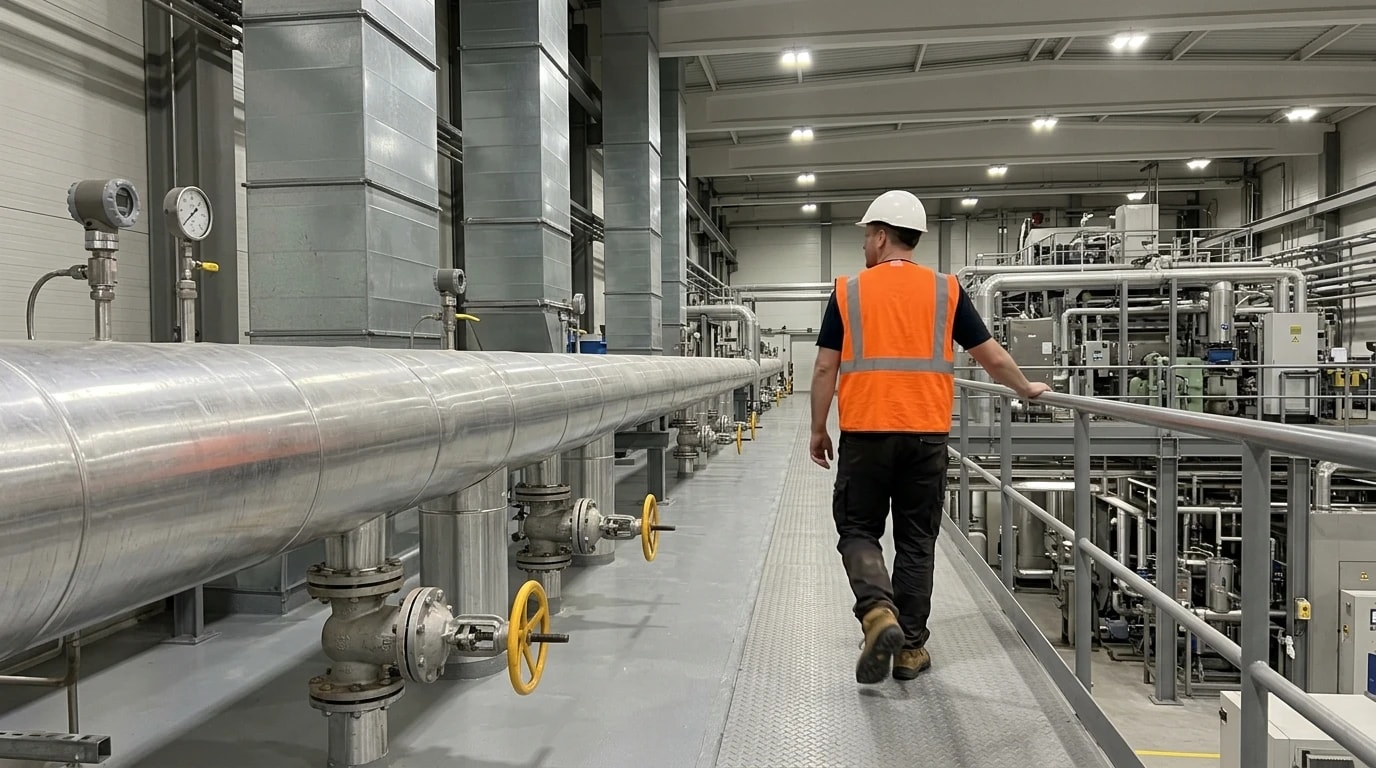
The paper machine dryer section is the most energy-intensive part of paper manufacturing, frequently accounting for more than 60 per cent of total mill steam demand. Paper machines remove water from the moving paper web by passing it over steam-heated, rotating, cast-iron cylinders. The evaporated moisture is carried away by the dryer hood exhaust.
This hood exhaust represents an abundant source of high-grade waste heat. The exhaust air typically carries heavy moisture loads of approximately 150 g H₂O per kg of dry air at 80°C, with dew points near 60°C. Because water vapour has a high latent heat of vaporisation (approximately 2,260 kJ/kg at atmospheric pressure), condensing this moisture releases far more energy than cooling dry air. Reclaiming this latent heat is a primary objective of modern pinch-analysis-driven heat recovery programmes. By targeting this moist exhaust, process engineers capture high-value thermal energy and reuse it within the mill.
Pillow Plate Technology: Eliminating Fouling in Process Integration Networks
While dryer hood exhaust offers immense latent heat potential, recovering this energy is technically challenging. The exhaust air contains airborne cellulose fibres, chemical additives, and paper dust. In this harsh environment, conventional shell-and-tube or plate-and-frame heat exchangers quickly fail. Fibres accumulate in narrow clearances, creating an insulating layer that degrades thermal efficiency. This fouling increases the pressure drop, destabilising the dryer hood balance and forcing unscheduled shutdowns for manual cleaning.
To prevent fouling, process engineers specify advanced, fouling-resistant pillow plate heat exchangers, such as the BUCOair system. Pillow plates (or thermo-plates) are constructed from two stainless steel sheets laser-welded in a precise spot pattern and hydraulically inflated. This process creates a characteristic wavy, three-dimensional profile.
The wavy interior geometry induces high fluid turbulence even at low Reynolds numbers, resulting in exceptionally high heat transfer coefficients. On the outside, smooth, flat duct flow prevents fibres and particles from snagging. Furthermore, as the moist exhaust air cools below its dew point, the continuous condensation of water vapour on the smooth plate surfaces creates a self-cleaning wash. This automatic washing action carries away accumulating particulates, allowing the heat exchanger to operate continuously without thermal degradation.

Pinch analysis identifies the thermodynamic minimum energy requirement of your process — then designs the heat exchanger network to achieve it.
Multi-Stage Thermal Cascades for Process Water and Air Heating
To maximise the utility of the recovered latent heat, process design teams configure multi-stage heat recovery cascades. These cascades match the temperature of the reclaimed thermal energy to the heating demands identified by the Pinch composite curves.
- Stage 1 (Sensible Heat Recovery): The hot exhaust air first preheats the dry incoming pocket ventilation air for the dryer hood. Because this step requires high-temperature air, it utilises the initial sensible portion of the exhaust heat, directly reducing the steam demand of the hood air heaters.
- Stage 2 (Latent Heat Recovery for Process Water): The exhaust air then enters the condensing pillow plate stage. The condensing moisture releases latent heat, heating clean process water and paper machine shower water from 10°C to over 50°C. This directly displaces the primary low-pressure steam historically used for water heating.
- Stage 3 (Low-Grade Heat Recovery): The remaining low-temperature saturated air, now depleted of high-grade heat, passes through a final stage to preheat building ventilation air or feed local district heating networks.
This cascaded approach ensures that all recovered heat is extracted at the highest possible thermodynamic level, preventing the degradation of thermal quality.
Integrating Industrial Heat Pumps Across the Thermodynamic Pinch Point
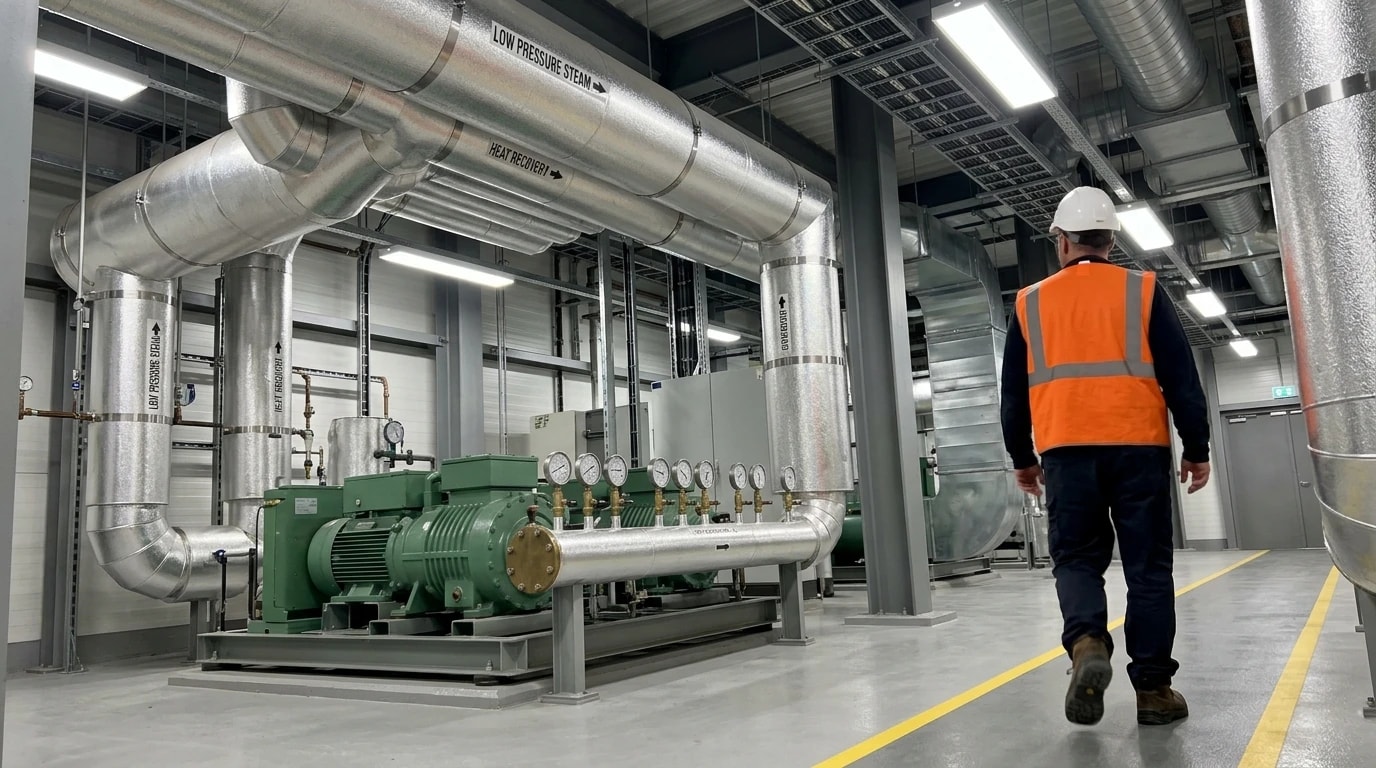
Passive heat exchange between hot and cold process streams is typically the first step in thermal optimisation. However, a mill often possesses large quantities of low-temperature waste heat that cannot be directly transferred because it exists below the temperature demands of the cold streams. For example, wastewater effluent or vacuum pump seal water may be discharged at 40°C, while the closest cold streams require heating to 70°C.
To reclaim this low-grade energy, process engineers integrate industrial heat pumps. These systems use mechanical compression to lift thermal energy from a low-temperature source to a higher-temperature sink.
Successful integration requires strict adherence to Pinch principles: the heat pump must operate across the pinch point to achieve a net utility reduction. The evaporator must absorb waste heat from a source located below the pinch point, where the mill has a thermal excess. The condenser must then deliver this upgraded heat to a sink located above the pinch point, where the mill has a thermal deficit.
Integrating a heat pump entirely below the pinch point is thermodynamically useless. It merely shifts excess heat within an area that already has a thermal surplus, resulting in zero net reduction in primary steam consumption while wasting compressor electricity. Similarly, placing a heat pump entirely above the pinch point is redundant, as simple passive heat exchange could have satisfied the heating duty.
The efficiency of an industrial heat pump is evaluated using the Coefficient of Performance (COPHP). The theoretical thermodynamic limit is defined by the Carnot COP relationship:
COPHP=Tsink−TsourceTsinkwhere:
- COPHP is the dimensionless theoretical coefficient of performance.
- Tsink is the absolute heat delivery temperature to the process sink above the pinch, expressed in Kelvin (K).
- Tsource is the absolute waste heat absorption temperature from the process source below the pinch, expressed in Kelvin (K).
In practice, industrial heat pumps operate at approximately 50 to 60 per cent of this Carnot limit due to mechanical, thermal, and frictional losses. To maximise this operating efficiency, process engineers must minimise the temperature lift (Tsink−Tsource). Selecting waste heat sources as close to the Pinch temperature as possible ensures the compressor achieves high performance with minimal electrical power.
Technical Assessment: Traditional Shell-and-Tube vs. Pillow Plate Systems
Selecting the correct heat exchanger technology is vital for implementing Pinch-designed networks, especially when handling contaminated, high-moisture streams. The table below compares traditional shell-and-tube heat exchangers with advanced pillow plate (thermo-plate) technology:
| Engineering Parameter | Traditional Shell-and-Tube Exchanger | Pillow Plate (Thermo-Plate) Exchanger |
|---|---|---|
| Fouling Susceptibility | High; fibres and chemical particulates lodge in tube clearances | Low; smooth outer surfaces and flat channel flow resist blockages |
| Turbulence Induction | Requires high fluid velocities; prone to laminar dead zones | Turbulent flow induced at low Reynolds numbers by wavy geometry |
| Pressure Drop | High pressure drop per unit of heat transferred; increases fan loads | Low pressure drop on the outer channel; optimises fan and pump power |
| Cleanability | Difficult; requires mechanical brush-outs or intensive chemical soaking | Simple; highly compatible with continuous Clean-In-Place (CIP) systems |
| Space Requirement | Large; demands substantial clearance for tube bundle extraction | Highly compact; provides a large heat-transfer area in a small footprint |
| Material Efficiency | Low; requires thick tube walls to withstand high pressures | High; thin, laser-welded sheets provide high burst-pressure ratings |
| Corrosion Risk | High; crevice corrosion common in tube-to-tubesheet joints | Low; crevice-free, fully-welded construction minimises corrosion |
This comparison demonstrates why modern thermal design teams select pillow plate technology for exhaust air heat recovery. Traditional shell-and-tube systems require high fluid velocities to maintain turbulent flow, increasing fan energy consumption. Conversely, the wavy geometry of pillow plates maintains turbulent flow at low velocities, minimising fan power requirements while resisting fibre accumulation.
Practical Retrofit Barriers and Software-Assisted Network Modelling
While Pinch analysis identifies clear thermodynamic opportunities, plant operations directors must overcome physical and operational barriers during retrofit projects. Older pulp and paper mills have often expanded incrementally over decades. Consequently, the optimal waste heat source and the target process sink are frequently in different buildings hundreds of metres apart. Connecting them requires extensive piping runs, increasing capital expenditure, pressure drops, and thermal distribution losses.
Furthermore, physical space inside existing machine halls is often extremely constrained. Fitting large heat recovery units can require expensive structural modifications. The compact design of pillow plate heat exchangers resolves this issue by providing a high heat-transfer surface area within a minimal footprint.
To resolve these layout and economic complexities, thermal design teams utilise advanced process integration software, such as the PinCH tool or Aspen Pinch. These software packages automate data extraction, generate composite curves, and model various heat exchanger network configurations.
By varying the minimum temperature approach (ΔTmin), process engineers perform detailed economic sensitivity analyses. A lower ΔTmin increases heat recovery and reduces steam utility costs but requires larger, more expensive heat exchangers due to the smaller temperature driving force. Conversely, a higher ΔTmin reduces initial capital expenditure but results in higher ongoing steam costs. Software modelling allows engineers to identify the exact economic optimum, ensuring the mill achieves maximum steam savings with the lowest possible capital investment.
This article reflects the independent analysis and editorial opinion of EnerTherm Engineering. Product names, trademarks, and brands mentioned belong to their respective owners. EnerTherm Engineering is not affiliated with, endorsed by, or a licensee of any third-party software or product mentioned unless explicitly stated.

Managing Director — EnerTherm Engineering
Dr. François Pierrel is Managing Director of EnerTherm Engineering with over two decades of expertise in thermal design, heat transfer, and industrial energy optimisation. He holds a PhD in Heat Transfer from Cranfield University and a Post-Doctorate from Heriot-Watt University.
