Heat Pump Integration Cuts Process Capex by Up to 30%
How pinch analysis delivers COP values of 2.5 to 7.0 under DESNZ IETF guidelines.
With EU carbon price benchmarks hovering around €89 per tonne and the UK's industrial sectors facing a phased reduction in free carbon allocations, the operational cost of burning natural gas has reached a critical threshold. Manufacturing plants across the UK and continental Europe, particularly in energy-intensive sectors like chemical synthesis, paper manufacturing, and dairy processing, face immense pressure to electrify their thermal operations. However, transitioning from natural gas boilers to industrial heat pumps presents a formidable financial barrier. High upfront capital expenditure frequently stalls electrification projects before they can clear corporate hurdle rates.
Numerous industry reports document the high initial capital cost of industrial heat pumps compared to conventional boilers. While a standard 5 MW gas boiler might require an initial capital expenditure of under £150,000, an industrial heat pump of equivalent thermal capacity can demand between £5 million and £15 million, depending on the delivery temperature and site-specific installation complexities. For site operations directors and energy managers struggling with tight operational budgets, justifying this capital outlay based on direct energy savings is often impossible.
To bridge this financial gap, process designers must move away from basic like-for-like equipment replacement. Instead, they must target the root cause of high capital costs: oversized equipment. This is where the systematic integration of heat pumps via Pinch Analysis becomes a critical engineering tool. By optimising the existing thermal network first, engineers can reduce the net heating and cooling deficits of the plant. This structural reduction in process demand allows for a significantly downsized heat pump, cutting the associated equipment capital expenditure by 30 per cent.
Sizing the Capital Challenge of Process Electrification
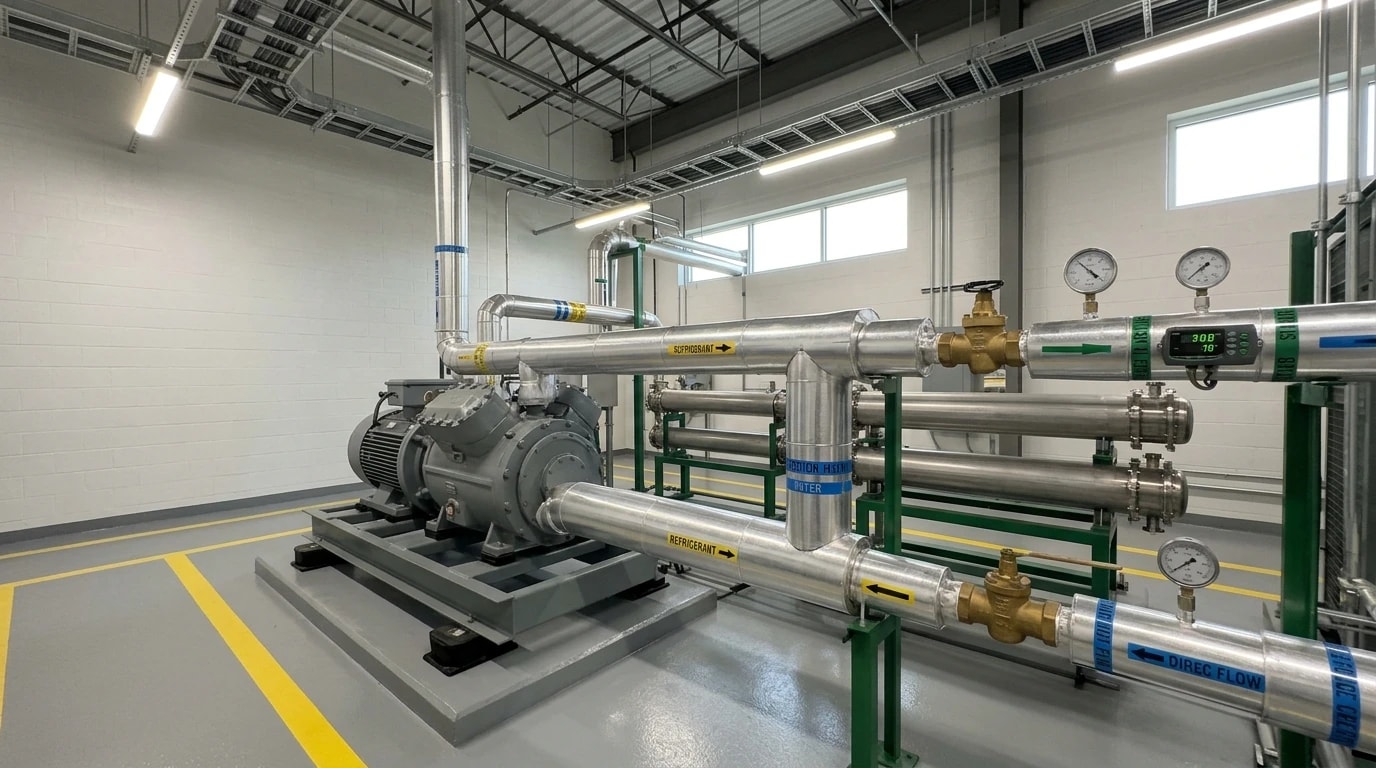
UK manufacturing sites face strict carbon reduction targets, but the cost of the technology required to meet these targets remains exceptionally high.
Sizing Up the Equipment Cost Disparity
Industrial heat pumps are highly bespoke engineering systems, unlike their residential counterparts. They must be designed to withstand high operating pressures, handle variable process flows, and utilise specialised refrigerants that comply with environmental safety regulations. Consequently, the cost of an industrial heat pump installation typically ranges from £1 million to £3 million per megawatt of thermal capacity.
In contrast, industrial gas boilers are highly standardised, mass-produced systems with low capital requirements. A site operations director looking to replace an ageing steam boiler faces a massive capital gap when comparing a cheap fossil-fuel replacement with an electric heat pump. If a plant simply swaps a 10 MW boiler for a 10 MW heat pump without modifying the surrounding process, the capital requirements can easily exceed £15 million, making the project financially unviable.
Sizing the Sizing Problem
The primary driver of this capital inflation is the tendency of engineering teams to size utility systems based on nameplate boiler capacities or peak historical steam demands. Legacies of process expansion and safety-factoring often mean that active boilers are twice as large as the actual process demands. If these safety factors are carried over into heat pump specifications, the resulting capital estimate is needlessly inflated. Electrification requires a precise understanding of the true thermodynamic deficit of the process, which can only be determined through system-wide thermal analysis.

Pinch analysis identifies the thermodynamic minimum energy requirement of your process — then designs the heat exchanger network to achieve it.
The Thermodynamics of Proper Heat Pump Integration
To capture the capital savings of heat pump integration, engineers must first understand the fundamental thermodynamic rules that govern how these systems interact with an industrial process.
The Principle of Proper Placement Across the Pinch
In any industrial facility, Pinch Analysis divides the process thermal demands into a high-temperature region with a net heat deficit (above the pinch temperature) and a low-temperature region with a net heat surplus (below the pinch temperature). The pinch point itself acts as a thermodynamic bottleneck.
To achieve a net reduction in external utility consumption, a heat pump must be integrated across the pinch. The system must extract heat from a waste source below the pinch (where heat is in surplus and would otherwise be rejected to a cooling tower or the atmosphere) and release it to a sink above the pinch (where heat is in deficit and would otherwise require fossil-fuel combustion).
If an engineer integrates a heat pump incorrectly, the thermodynamic benefits collapse. For instance, if both the evaporator and the condenser are placed below the pinch, the heat pump absorbs and rejects heat entirely within the surplus zone. This does not reduce the external heating utility demand above the pinch, meaning the high capital cost of the system yields zero operating cost savings. Proper heat pump integration must always bridge the pinch temperature to deliver economic value.
Temperature Lift and the Limits of Thermodynamic Performance
The operating efficiency of an industrial heat pump is dependent on the temperature difference between the heat source (evaporator) and the heat sink (condenser). This difference is known as the temperature lift (Tlift). The maximum theoretical efficiency of any heat pump is defined by the Carnot Coefficient of Performance (COPCarnot), expressed as:
COPCarnot=Tsink−TsourceTsinkWhere:
- Tsink is the absolute condensing temperature of the heat pump in Kelvin (K).
- Tsource is the absolute evaporating temperature of the heat pump in Kelvin (K).
In actual industrial applications, real mechanical heat pumps operate at approximately 45 to 60 per cent of this theoretical Carnot limit due to thermal losses, pressure drops in the heat exchangers, and compressor inefficiencies.
For applications delivering process heat up to 160°C, typical Coefficient of Performance (COP) values range from 2.5 to 7.0, depending on the temperature lift. If the waste heat source is high-grade (such as condensate or flash steam at 80°C) and the required process temperature is 120°C, the temperature lift is a modest 40 K. This results in a high COP, often exceeding 4.0.
Conversely, if an unoptimised system attempts to lift heat from low-temperature ambient sources (such as 15°C) to generate high-temperature steam (such as 130°C), the temperature lift exceeds 110 K. This extreme lift drops the COP below 2.0 and requires multi-stage compression systems, escalating the equipment size and capital cost. Managing and minimising the temperature lift through smart heat integration is a primary method for protecting both operational efficiency and capital budgets.
How Pinch Analysis Shrinks Capital Demands by 30%
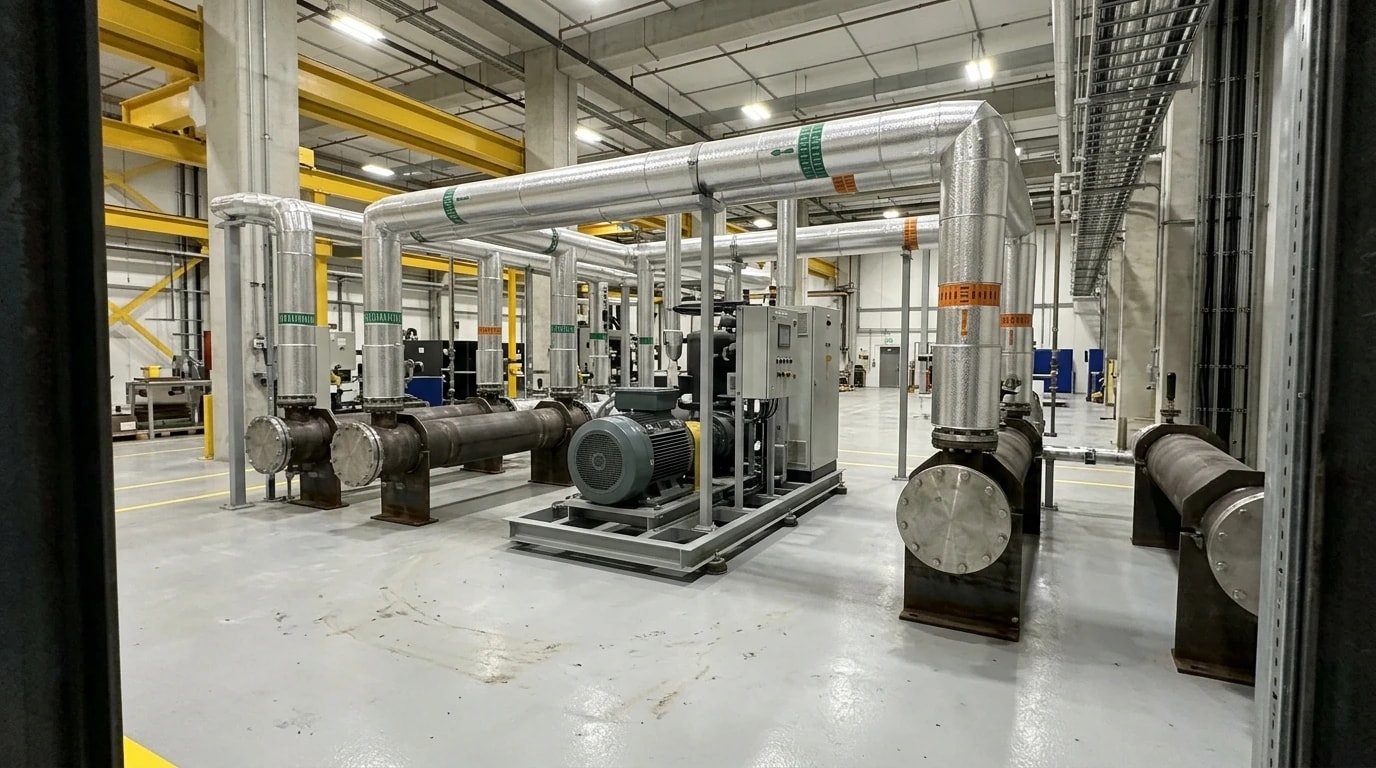
The most effective way to reduce the capital cost of a heat pump is to reduce the thermal load it must deliver. Pinch Analysis achieves this by maximising passive heat recovery before any active utility is specified.
Maximising Passive Heat Recovery First
Before specifying any active heating or cooling equipment, process engineers must apply Pinch Analysis to maximise passive heat exchange within the process. In many legacy manufacturing sites, the heat exchanger network is poorly optimised, with multiple hot streams being cooled by utility water while cold streams are simultaneously heated by high-pressure steam.
By redesigning the heat exchanger network, engineers can match these streams directly. For example, matching a hot reactor effluent stream with a cold feed stream can recover a significant portion of the thermal energy passively.
By maximising passive recovery first, the net heating and cooling utilities required by the plant are drastically reduced. A plant that originally required a 10 MW steam boiler might only require 4 MW of external heating utility after process optimisation. Consequently, if the site opts to electrify this remaining load, the heat pump only needs to be sized for 4 MW rather than 10 MW. Sizing the system for the net deficit rather than the gross load is the most direct path to capital savings.
Quantifying Capital Savings: The Walden et al. Case Study
To understand how proper heat pump integration avoids excessive capital costs, it is useful to examine recent engineering research on non-continuous processes. Industrial processes in sectors like food and beverage and batch chemical manufacturing are rarely steady-state, creating variable heating and cooling loads that complicate sizing decisions.
In a study published in Applied Energy (2023), researchers Walden, Wellig, and Stathopoulos analysed heat pump integration in non-continuous processes using Dynamic Pinch Analysis Targeting. They compared a conventional Time Average Model—which averages heat loads over a batch period to size the equipment—with a dynamic optimisation model that accounts for real-time thermal fluctuations and thermodynamic constraints.
The results demonstrated that:
- The standard, non-optimised approach resulted in a heavily oversized heat pump with an unnecessarily high heating capacity and capital cost.
- The dynamic Pinch-integrated approach allowed engineers to specify a 33 per cent smaller heat pump while still fully meeting the process thermal demands.
- This reduction in equipment size directly cut the initial capital expenditure (CAPEX) while drastically increasing the project's profitability, raising the Internal Rate of Return (IRR) from 18.4 per cent to over 56.3 per cent.
This case study highlights that integrating heat pumps using Pinch Analysis is not merely an exercise in energy conservation. It is a systematic capital-reduction strategy that directly addresses the primary financial barrier to industrial electrification.
Sizing and CAPEX Comparison: Traditional vs. Pinch-Integrated
The following table compares a traditional, non-integrated boiler replacement with a system-wide, Pinch-integrated heat pump design for a typical mid-sized manufacturing facility.
| Parameter | Traditional Electrification | Pinch-Integrated Heat Pump System | Impact / Benefit |
|---|---|---|---|
| Gross Process Heating Load | 10.0 MW | 10.0 MW | Baseline process requirement |
| Passive Heat Recovery (HEN) | Minimal (Unoptimised network) | Maximised (Optimised network) | Reduces baseline thermal deficit |
| Remaining Utility Heat Load | 10.0 MW | 5.5 MW | Utility load reduced by 45% |
| Heat Pump Thermal Capacity | 10.0 MW | 5.5 MW | Requires 45% smaller heat pump |
| Typical Heat Pump COP | 2.5 (Due to high lift from ambient) | 4.0 (Due to optimised waste heat source) | 60% higher operational efficiency |
| Estimated Equipment CAPEX | £15.0 million (at £1.5M/MW) | £8.25 million (at £1.5M/MW) | Direct CAPEX saving of 45% |
| Project Payback Period | 12 to 15+ years | 4 to 7 years | Financially viable under standard metrics |

Pinch analysis identifies the thermodynamic minimum energy requirement of your process — then designs the heat exchanger network to achieve it.
Financial Indicators: Spark Spread, Payback, and Capital Grants
While capital savings of 30 per cent are achievable through proper sizing, the long-term operational viability of an industrial heat pump depends on energy price ratios and available government funding.
Understanding the Spark Spread
The operating economics of any industrial heat pump are fundamentally governed by the spark spread—the ratio of electricity prices to natural gas prices per equivalent unit of energy (e.g., pence per kWh).
For example, if a chemical manufacturing site in the UK pays 16p/kWh for electricity and 4p/kWh for natural gas, the spark gap is:
Spark Gap=4 p/kWh16 p/kWh=4.0To achieve lower utility operating costs with a heat pump than with a natural gas boiler, the heat pump's COP must exceed the spark gap divided by the boiler's thermal efficiency:
Minimum COP=Boiler EfficiencySpark Gap=0.804.0=5.0If the heat pump's actual operating COP is less than 5.0, the facility will pay more for utility energy after electrifying, even though its carbon footprint is reduced.
However, if the spark gap is lower—for instance, when a site contracts cheap off-peak renewable power or when rising carbon taxes increase the effective cost of natural gas—the economic threshold changes. If the spark gap drops to 2.5, a heat pump with a COP of 3.125 will break even, and any higher COP will generate direct operational cost savings. In sites where the spark gap is low, projects routinely achieve payback periods of under 5 years, making them highly attractive to corporate CFOs.
Securing Capital Subsidies and UK IETF Frameworks
For UK manufacturers, the capital challenge is partially mitigated by government decarbonisation initiatives. The Department for Energy Security and Net Zero (DESNZ) has historically administered the Industrial Energy Transformation Fund (IETF), which provides capital grants to support deep decarbonisation, fuel switching, and energy efficiency upgrades in energy-intensive sectors.
While Phase 3 of the IETF closed to new applications in July 2025, the UK government committed £163 million in the 2024 Autumn Budget to ensure that all approved projects from previous rounds are fully funded through to completion. This sustained funding demonstrates the government's commitment to industrial electrification. For sites planning new thermal network upgrades, utilising capital allowances, regional energy transition grants, and energy-as-a-service financing models can bridge the remaining capital gap, enabling companies to meet their net-zero targets without straining their balance sheets.
Beyond Energy: Sizing the Process Co-Benefits of Electrification
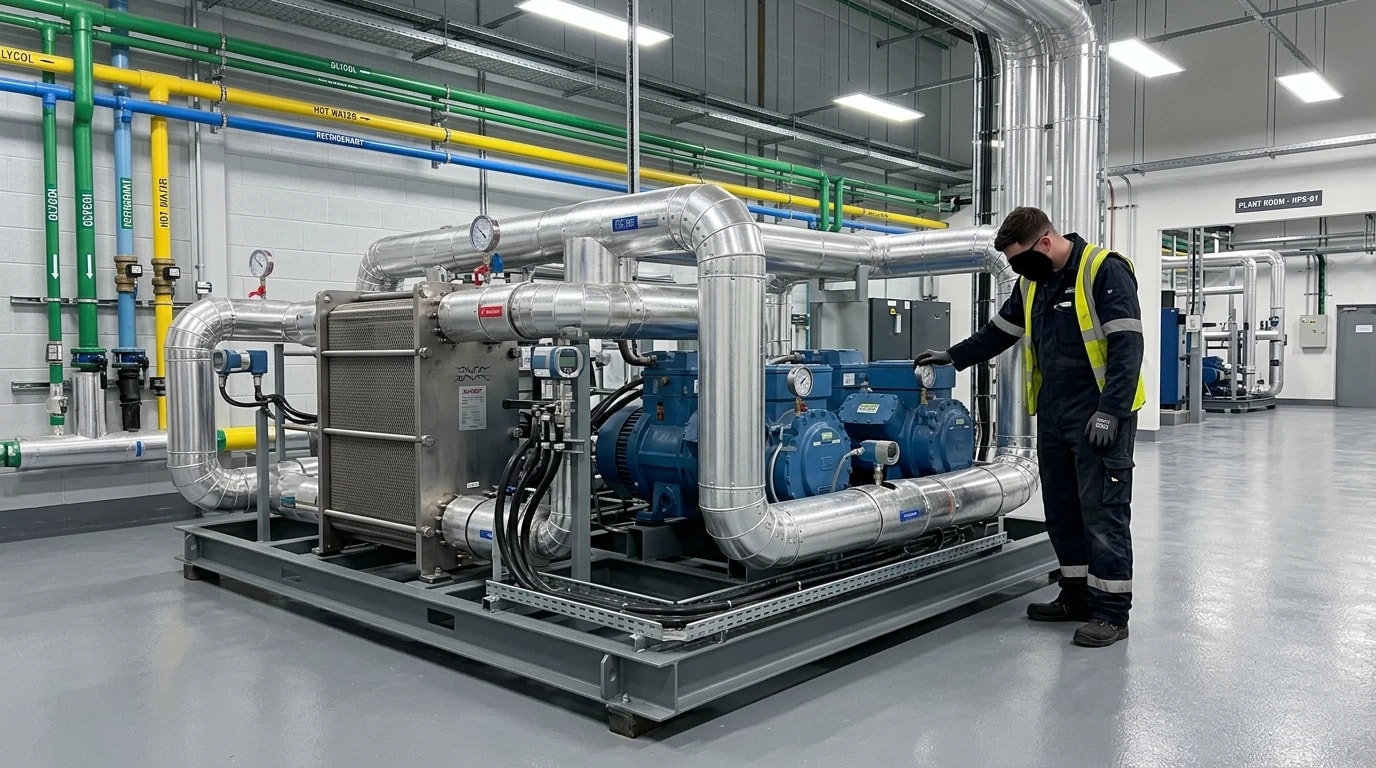
Evaluating heat pump integration purely on utility bill differentials fails to capture the true value of the technology. To build a robust business case, site operations directors must quantify the operational co-benefits that arise from integrating advanced thermal systems.
Incorporating Co-Benefits into the ROI Framework
The "Industrial Heat Pump Opportunity" frameworks suggest that modern heat pump systems provide value far beyond simple energy savings. These co-benefits include:
- Precise Temperature Regulation: Unlike steam or direct-fired gas systems, which can suffer from temperature overshoot and control lag, modern industrial heat pumps utilise variable-speed compressors and electronic expansion valves. This allows for extremely precise temperature control, often within ±0.2°C, which is highly valuable in sensitive chemical synthesis and food processing.
- Increased Production Throughput: Improved temperature control directly reduces batch cycle times and product waste. For a high-capacity food processing facility, a 2 per cent reduction in batch cycle time can yield additional annual product revenues that completely dwarf the direct energy savings of the heat pump.
- Reduced Water Consumption: Many industrial plants reject waste heat to the atmosphere via wet cooling towers, consuming vast quantities of water through evaporation. By using a heat pump evaporator to extract heat from these cooling loops, the plant cools the water closed-loop, reducing both water makeup costs and sewer discharge fees.
Simultaneous Heating and Cooling Utility Displacement
The most dramatic financial returns occur when a heat pump is integrated into a process that requires concurrent heating and cooling. For instance, in dairy processing, incoming milk must be pasteurised (heated to 72°C–75°C) and then immediately chilled (cooled to 4°C) for packaging and storage.
Historically, plants have met these demands using two separate, unintegrated utility systems: a steam boiler for heating and an ammonia refrigeration chiller for cooling. This approach requires paying for energy twice: once to add heat, and once to extract it.
By deploying a heat pump integrated across the process pinch, the system extracts heat from the chilling loop and rejects it directly into the pasteurisation loop. In this dual-service configuration, the effective COP of the system is the sum of the heating and cooling COPs, frequently exceeding 6.0. By displacing both the boiler fuel consumption and the chiller electricity consumption, the payback period of the heat pump is slashed from a decade to under 3 years. Furthermore, the capital cost is reduced because a single integrated machine replaces the need for separate boiler and chiller capacity expansions.
A Step-by-Step Engineering Protocol for Retrofits
To successfully execute a heat pump integration project and secure the 30 per cent CAPEX savings, engineering teams must follow a rigorous, structured thermal retrofitting protocol.
1. Data Extraction and Process Auditing
The first step is a comprehensive energy audit to extract the exact thermodynamic parameters of all process streams. For every stream requiring a temperature change, the engineering team must record:
- The source temperature (Tin) and target temperature (Tout).
- The mass flow rate (m).
- The specific heat capacity (Cp).
- The hourly or batch-wise variability of the stream.
2. Stream Temperature Adjustment
To account for the heat transfer resistance across future heat exchangers, engineers apply a minimum temperature approach (ΔTmin). In industrial retrofits, a ΔTmin of 10 K to 15 K is standard, balancing the capital cost of the heat exchangers against the potential for heat recovery. Adjusted temperatures are calculated as:
- Tadjusted=T−2ΔTmin for hot streams.
- Tadjusted=T+2ΔTmin for cold streams.
3. Construction of the Grand Composite Curve (GCC)
Thermal design teams typically select specialised thermodynamic modelling software to construct these composite curves. Many consultancies evaluate tools such as PinCH software developed by the Lucerne University of Applied Sciences and Arts, or AspenTech's Aspen Pinch, to model heat exchanger networks and heat pump operations. These independent tools allow engineers to simulate various refrigerant cycles and compressor efficiencies before making capital commitments.
The GCC plots the net heat deficit of the process against the adjusted temperatures, identifying the exact pinch point where the curve touches the temperature axis. The region above the pinch represents the net heating utility required, while the region below represents the net cooling utility.
4. Defining the Heat Pump Pocket and Sizing the Equipment
The GCC reveals pockets where heat can be extracted below the pinch and delivered above the pinch. This visual representation defines the exact maximum capacity of the heat pump. By sizing the heat pump compressor to fit this thermodynamic pocket, engineers avoid the common mistake of over-specification. Sizing the heat pump to match the net process deficit rather than the gross peak load is the mechanism that delivers the 30 per cent CAPEX reduction.
5. Refrigerant Selection and Compressor Strategy
Finally, the engineering team selects the optimal refrigerant and compressor configuration based on the target delivery temperature. For temperatures up to 120°C, high-efficiency screw compressors using natural refrigerants like ammonia (R717) are common. For higher temperatures up to 160°C, specialised water-based (R718) or butane-based refrigerants are specified alongside multi-stage piston compressors to manage the high pressure ratios safely and efficiently.
This article reflects the independent analysis and editorial opinion of EnerTherm Engineering. Product names, trademarks, and brands mentioned belong to their respective owners. EnerTherm Engineering is not affiliated with, endorsed by, or a licensee of any third-party software or product mentioned unless explicitly stated.

Managing Director — EnerTherm Engineering
Dr. François Pierrel is Managing Director of EnerTherm Engineering with over two decades of expertise in thermal design, heat transfer, and industrial energy optimisation. He holds a PhD in Heat Transfer from Cranfield University and a Post-Doctorate from Heriot-Watt University.
