Industrial Energy Efficiency: How Pinch Analysis Cut Costs
A UK food-factory case study reports a 790 kW gas-and-steam reduction and 2.7-year payback.
The second ESOS Phase 3 progress update is due on 5 December 2026, renewing attention on industrial projects that document energy savings, cost reductions and delivery progress. Pinch analysis gives energy-intensive sites a disciplined way to identify those projects, quantify their value and avoid capital spending on heat-recovery schemes that cannot work in day-to-day production.
For chemical plants, food factories, refineries, paper mills, pharmaceutical facilities and power-generation sites, fuel costs sit within a web of steam systems, exhaust streams, refrigeration loads, thermal-oil circuits and process-heating duties. A heat exchanger may look attractive in isolation, yet the wider site may offer a better use for the heat or show that its temperature is too low to provide the expected benefit.
Industrial energy-efficiency investment succeeds when a site can show both the thermodynamic opportunity and the commercial case. Pinch analysis connects the two.
What pinch analysis means for industrial energy efficiency
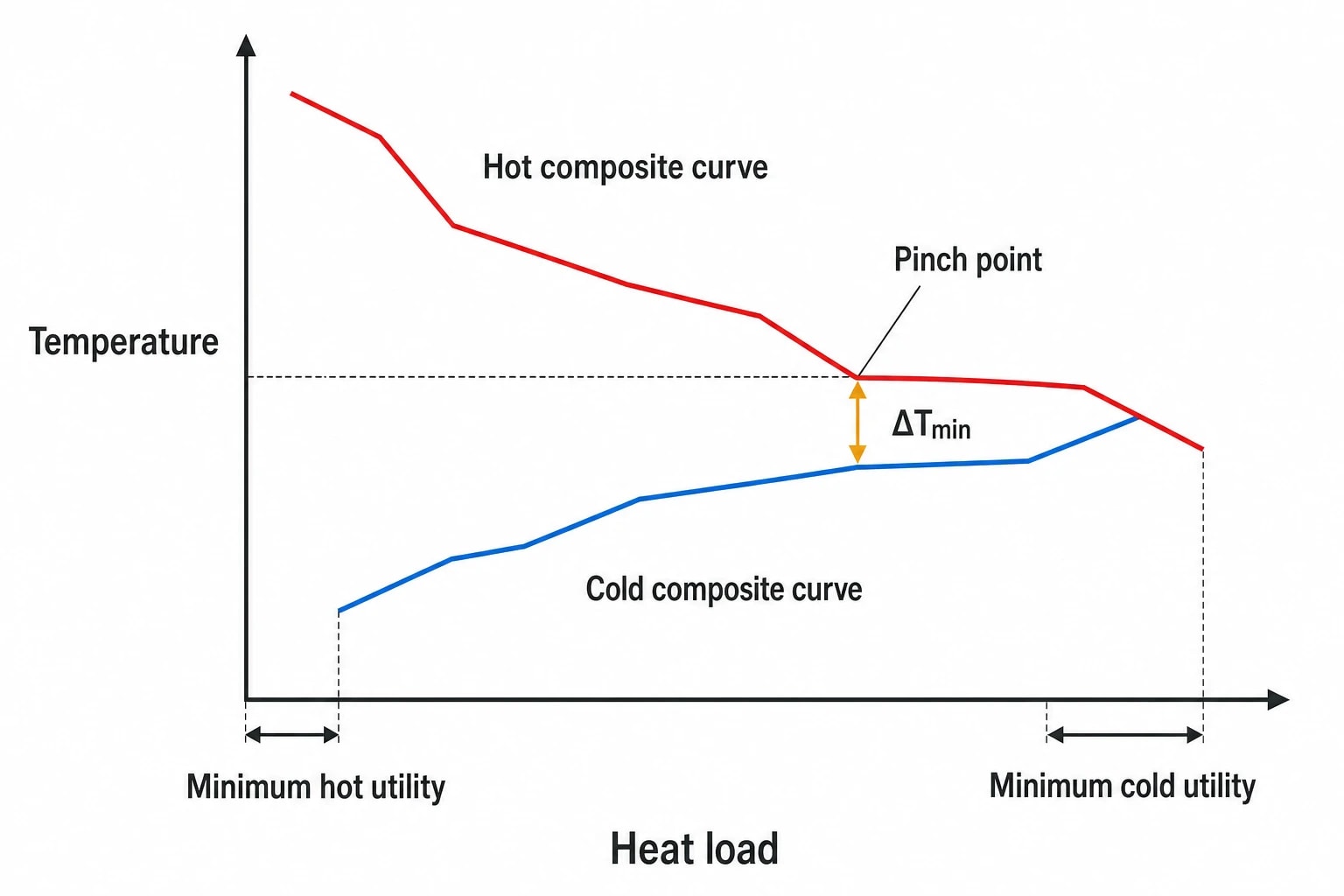
Pinch analysis is a process-integration method that sets the minimum heating and cooling demand for a process, then guides the design of heat exchanger networks that recover heat between process streams.
The method starts with a physical question: which streams need cooling, which need heating, and at which temperatures? A hot process stream can provide useful heat only where a cold stream needs heat at a compatible temperature. Pinch analysis maps those relationships across the process rather than assessing each utility user separately.
From scattered heat loads to a site energy target
A plant may have several apparent waste-heat sources:
- Oven exhaust, furnace flue gas or boiler exhaust.
- Hot product leaving a dryer, evaporator or reactor.
- Condensate, cooling-water return or refrigeration condenser heat.
- Thermal oil returning from process users.
- Ventilation air from high-temperature production areas.
It may also have competing heat demands, including boiler-feedwater heating, combustion-air preheat, process-water heating, cleaning-in-place systems, air heating, product preheating and low-pressure steam generation.
Pinch analysis compiles these streams into a common thermal model. The result identifies the maximum practical heat recovery before detailed exchanger layouts, pipe routes or equipment quotations are considered. This separates the energy target from the eventual design.
The pinch point and minimum temperature difference
The pinch point is the temperature constraint that limits heat transfer from hot streams to cold streams. Above and below that point, the design follows established rules to prevent avoidable utility use.
The selected minimum temperature difference, often written as ΔTmin, directly affects capital cost. A smaller temperature difference can recover more energy but requires greater heat-transfer area, larger heat exchangers or more demanding equipment. A larger temperature difference reduces exchanger area and cost but leaves more recoverable heat unused.
The best industrial energy-efficiency project does not seek the smallest possible ΔTmin. It selects an economically justified value that reflects fuel prices, operating hours, heat exchanger type, fouling risk, maintenance access and asset life.
Pinch analysis identifies the thermodynamic minimum energy requirement of your process — then designs the heat exchanger network to achieve it.
How pinch analysis builds a cost-benefit case
A heat-integration study should give directors more than a list of technically possible ideas. It should show which options reduce annual operating cost, what capital expenditure they require and how reliably they can deliver the forecast benefit.
Start with measured, representative stream data
The economic model is only as sound as the stream data. Engineers normally establish, verify or measure:
| Data item | Why it affects project value |
|---|---|
| Supply and target temperature | Determines whether the heat source can meet the receiving duty |
| Mass flow and heat capacity | Determines available heat duty |
| Operating hours and production pattern | Converts duty into annual energy and cost savings |
| Fuel, steam and electricity tariffs | Sets the monetary value of displaced utility consumption |
| Fouling and cleaning requirements | Influences heat-exchanger area, pressure drop and maintenance cost |
| Stream composition and contamination risk | Determines material selection and whether indirect recovery is required |
| Turndown and batch operation | Tests whether savings persist outside nominal production conditions |
Plant historians, utility meters, P&IDs, heat and mass balances and site measurements all have a role. Missing measurements should be treated as an engineering task, not replaced with optimistic assumptions. A flue-gas recovery proposal, for example, requires credible information on temperature, flow, oxygen content, moisture, contaminants and variation across production states.
Convert energy targets into annual financial value
The annual saving from heat recovery depends on the utility genuinely displaced. Replacing gas-fired steam has a different value from replacing electrically driven refrigeration or reducing cooling-tower duty. The model should state the baseline clearly: fuel input, purchased steam, electricity, cooling water, refrigeration power or a combination.
A credible calculation also distinguishes between:
- Gross recovered heat.
- Useful heat delivered to the cold process stream.
- Fuel or electricity displaced after boiler, heater or refrigeration-system efficiency.
- Additional electricity for pumps, fans or controls.
- Maintenance, water-treatment and cleaning costs.
- Expected availability during normal operation, changeovers and shutdowns.
This prevents a familiar error: valuing every kilowatt of recovered heat at the fuel tariff. A recovery system may capture heat when the receiving process is not running, require a bypass at low load, or displace a utility with a lower marginal cost than assumed.
Use more than simple payback
Simple payback remains useful because it is easy to understand and quickly compares competing projects. It does not account for savings after the payback period, fuel-cost changes, replacement expenditure or a staged implementation programme.
The investment paper should therefore present simple payback alongside net present value and internal rate of return where the site capital process requires them. Scenario testing is valuable for projects exposed to volatile fuel prices or uncertain production volumes.
A useful decision pack will test at least three operating cases:
- Expected production and current utility prices.
- Lower operating hours or reduced throughput.
- A conservative case with lower recovered duty, added maintenance cost or delayed commissioning.
This identifies options that remain investable when operating conditions move away from the design case. It also exposes projects whose payback depends on a narrow set of assumptions.
Where heat-integration projects create and lose value
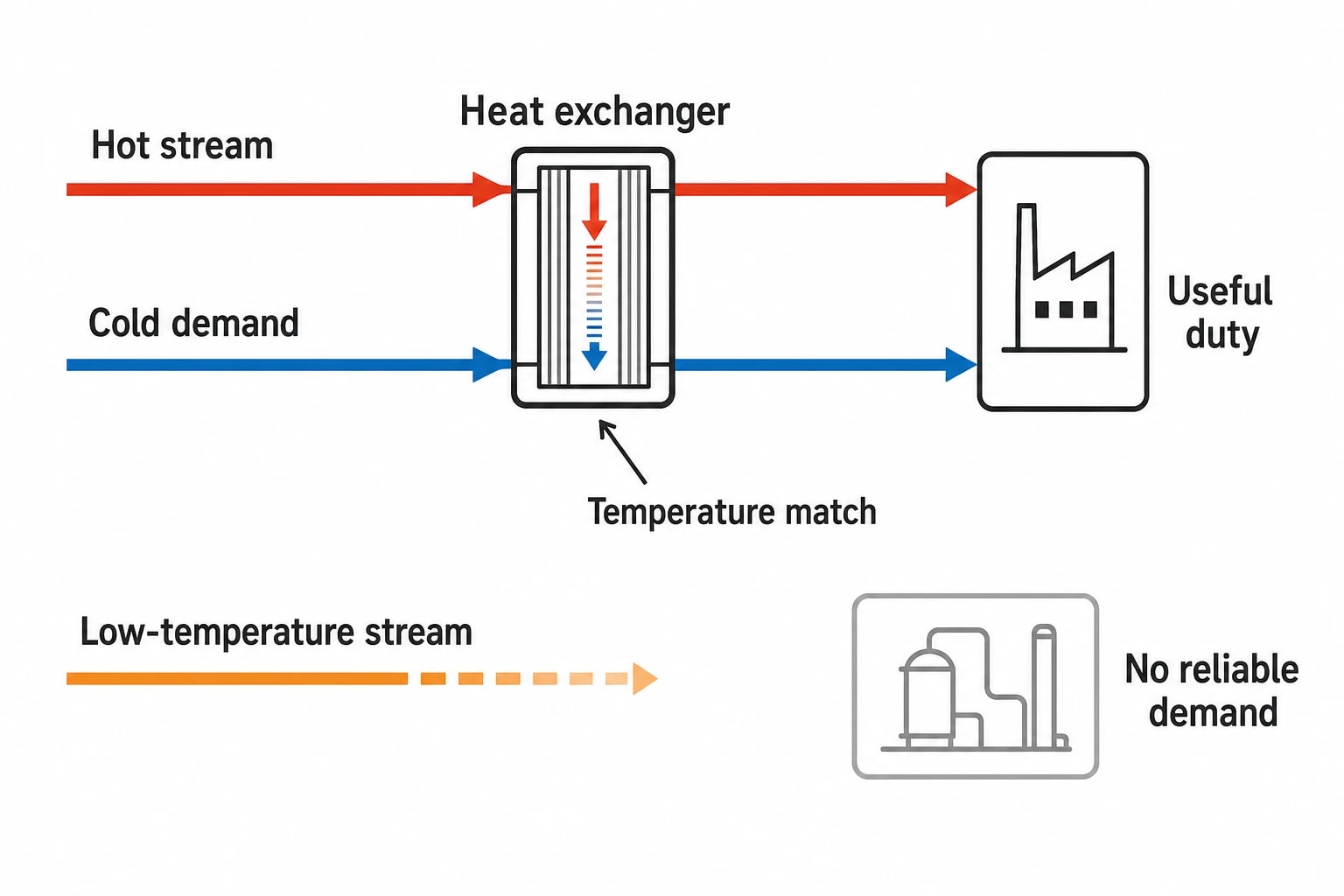
Pinch analysis identifies the theoretical target. Front-end engineering determines whether the target can become a dependable asset.
High-value heat matches
The strongest opportunities often match a continuous hot stream to a continuous cold demand at a nearby temperature. They can reduce utility consumption with limited storage, control complexity or production disruption.
Examples include preheating boiler feedwater with a suitable hot return, using furnace exhaust to preheat combustion air, recovering refrigeration condenser heat for process-water heating, or using hot product cooling duty to preheat an incoming process stream.
The best match depends on the site. A food factory may prioritise hygienic separation, cleaning-in-place requirements and seasonal production. A refinery may focus on heat-exchanger fouling, crude variability, pressure drop and furnace duty. A pharmaceutical site may need to protect validated conditions and separate clean utilities from process-side streams.
Heat quality is more important than heat quantity
A large low-temperature stream can contain substantial energy but offer limited value if no process needs heat at that temperature. Conversely, a smaller high-temperature exhaust stream can displace valuable fuel where it meets a well-matched demand.
This is why a whole-site temperature model matters. It prevents a project team from installing recovery equipment that produces warm water with no reliable use, or diverting heat from a more valuable existing duty.
Capital costs that change the outcome
The heat exchanger may account for only part of project cost. A proper estimate includes:
- Ductwork, pipework, supports and insulation.
- Pumps, fans, valves, controls and electrical work.
- Access platforms, structural modifications and lifting requirements.
- Materials compatible with corrosive, fouling or food-contact service.
- Fire, explosion, pressure-system and hygiene requirements where relevant.
- Production shutdown time, commissioning support and performance testing.
- Future cleaning, inspection and replacement access.
A low-cost concept can become expensive if it requires long pipe runs, major access work or a shutdown outside the normal maintenance window. Pinch analysis ranks heat matches, while detailed design confirms the constructability of the preferred scheme.
A UK food-factory benchmark for pinch-analysis payback
EnerTherm Engineering’s published food-factory pinch-analysis case study provides a useful benchmark for a well-targeted heat-integration project. The study assessed processing lines using site data and additional measurements, mapped hot and cold streams, set minimum utility targets and modelled several heat exchanger networks.
The selected design reported 790 kW of gas and steam savings, approximately £125,000 annual savings and a 2.7-year payback.
The study did not begin with a pre-selected heat exchanger. It assessed the factory’s thermal system, compared network options and selected the design with the best performance.
A later EnerTherm Engineering case study of a food-processing facility examined 13 design options. It reported 2.5 million kWh of potential annual energy savings and a range of two to six years for the better-performing options. Its options included CHP flue-gas integration, thermal-oil preheating and multi-line air preheating.
A site may find several technically viable projects, each with a different capital requirement, production interface and payback. Pinch analysis gives decision-makers a basis for prioritising the work rather than treating heat recovery as one indivisible investment.
Pinch analysis identifies the thermodynamic minimum energy requirement of your process — then designs the heat exchanger network to achieve it.
Managing delivery risks after the study
Heat-recovery equipment must work with production rather than impose a fragile operating regime. The implementation plan should reflect the practical risks identified during the study.
Protect product quality and process control
Heat integration can alter temperatures, response times and utility-system behaviour. Process teams should define the operating envelope before approving a modification. This includes start-up, shutdown, cleaning, product changeover, batch operation and utility failure.
The control philosophy should preserve the primary process duty. Bypass arrangements, temperature control, isolation valves and alarms can prevent a heat-recovery loop from constraining production. For food and pharmaceutical applications, indirect heat transfer and hygienic design may be required to prevent cross-contamination.
Design for fouling and maintenance
Flue gas, oily vapours, product residues, scale and particulates can rapidly reduce heat-exchanger performance. A business case should include the expected fouling allowance, cleaning method, inspection interval and outage requirement.
Design choices may include larger flow passages, removable bundles, accessible plate packs, online cleaning arrangements or an intermediate loop. Each adds capital or operating cost, but may protect availability and preserve savings across the asset life.
Verify savings against a defined baseline
Commissioning should establish meter locations, calculation boundaries, production normalisation and reporting frequency. Energy managers need to distinguish a genuine heat-recovery gain from changes in throughput, ambient conditions, product mix or boiler efficiency.
The post-project record should track utility consumption, recovered duty where metering permits, availability, cleaning events and process disruption. This evidence supports future capital decisions and demonstrates that the predicted industrial energy-efficiency improvement has transferred into operating performance.
Why UK compliance now strengthens the investment case
Heat integration can support compliance, but compliance should not replace engineering judgement. The value comes from using the same evidence for plant improvement, investment approval and regulatory reporting.
ESOS Phase 3 turns recommendations into tracked commitments
The Energy Savings Opportunity Scheme requires qualifying organisations to assess energy used by buildings, transport and industrial processes. Phase 3 introduced requirements for energy-intensity ratios, action plans and annual progress updates.
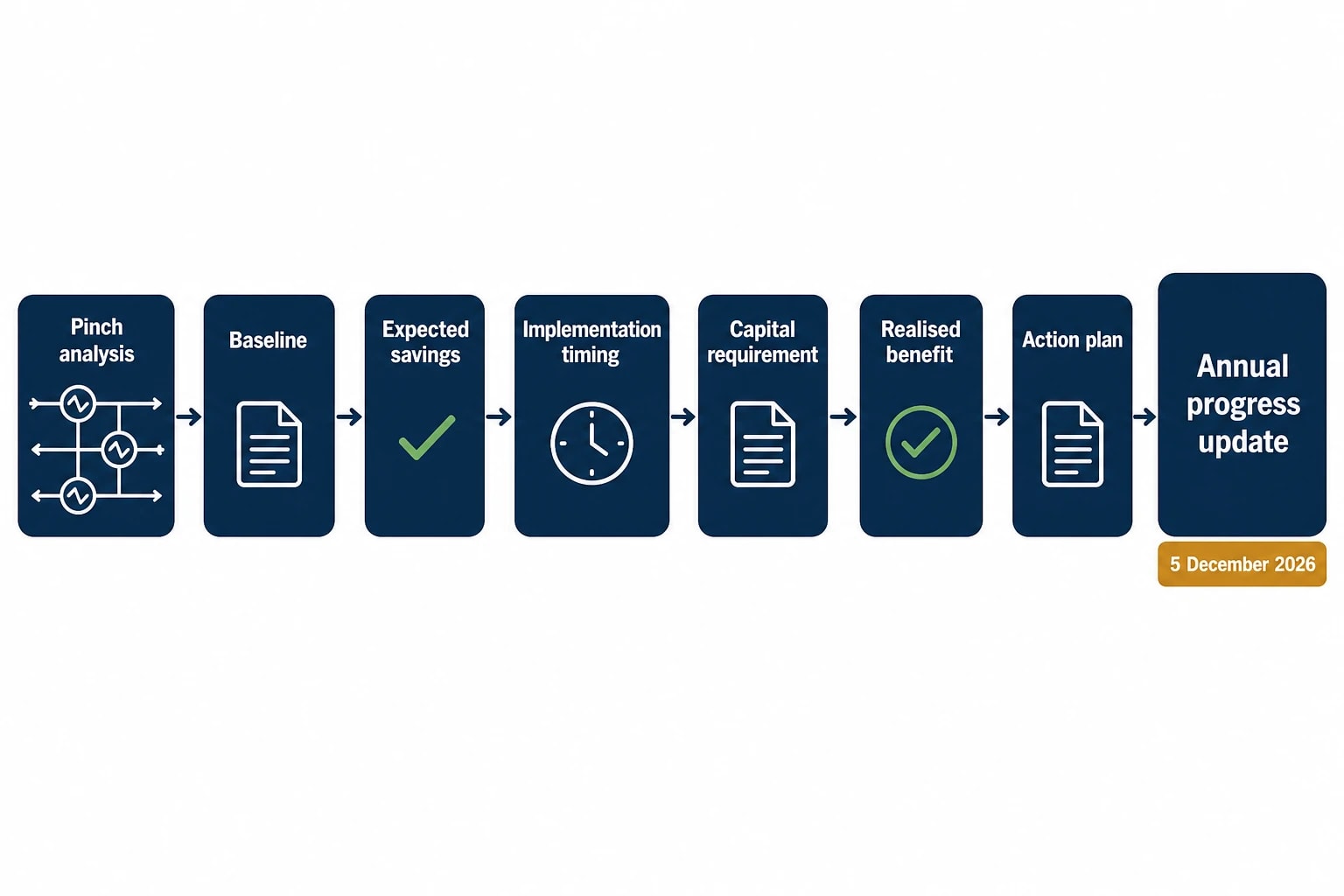
For organisations that qualified in Phase 3, the second annual progress update is due on 5 December 2026. A pinch-analysis project can provide a clear action-plan measure when it records the baseline, expected savings, implementation timing, capital requirement and realised benefit.
An energy-intensity ratio should relate consumption to an appropriate activity indicator. For a factory, that may mean fuel or total energy per tonne of saleable product, per batch, or another quantifiable measure linked to the industrial process. The selected measure should remain consistent enough to show whether heat recovery is improving performance over time.
Environmental permits require energy-efficiency evidence
For Part A(1) installations in England, the Environment Agency requires applicants and operators to demonstrate energy-efficiency measures under the Environmental Permitting (England and Wales) Regulations 2016, as amended. The guidance refers to the Energy Efficiency BREF and sector-specific BAT reference documents or BAT conclusions.
The Environment Agency may require a cost-benefit assessment to demonstrate that selected options meet best available techniques requirements. A pinch-analysis study can provide the technical and economic evidence needed for that discussion, provided it includes realistic capital estimates, operating costs and site-specific constraints.
New or substantially refurbished combustion plants above 20 MW net thermal input may also need a cost-benefit assessment covering high-efficiency cogeneration or the supply of waste heat to district heating or cooling. For a site planning major combustion investment, that assessment should start early enough to influence the layout, heat-export route and utility design.
Building an investment programme from pinch-analysis results
The most effective programmes combine quick, low-disruption measures with larger heat-integration projects that require shutdown planning.
A sensible sequence is:
- Establish the stream-data set and validate major utilities with site measurements.
- Set minimum energy targets and identify the pinch constraints.
- Screen heat matches for temperature fit, operability, hygiene, fouling and constructability.
- Develop capital estimates and savings forecasts for the strongest options.
- Rank projects by payback, net present value, shutdown requirement, delivery risk and compliance value.
- Install and verify early projects, then use the results to refine the next phase.
This article reflects the independent analysis and editorial opinion of EnerTherm Engineering. Product names, trademarks, and brands mentioned belong to their respective owners. EnerTherm Engineering is not affiliated with, endorsed by, or a licensee of any third-party software or product mentioned unless explicitly stated.

Managing Director — EnerTherm Engineering
Dr. François Pierrel is Managing Director of EnerTherm Engineering with over two decades of expertise in thermal design, heat transfer, and industrial energy optimisation. He holds a PhD in Heat Transfer from Cranfield University and a Post-Doctorate from Heriot-Watt University.
