Refinery Debottlenecking: Solving the Network Pinch
How heat integration can unlock refinery throughput without major plant expansion.
Refinery debottlenecking through process integration uses pinch analysis and heat-exchanger-network retrofit to release throughput or utility constraints by recovering more process heat within an existing refinery. In a crude distillation unit, this often centres on the preheat train, where fouling, a changed crude slate or an inherited exchanger sequence can push fired-heater duty towards its limit before major equipment reaches a mechanical limit.
A refinery may have worthwhile theoretical heat-recovery potential yet remain constrained by the way its existing exchangers connect hot and cold streams. This is the network pinch. It can determine whether a capacity increase requires a new furnace, more steam capacity or a smaller package of targeted changes.
Commission Implementing Decision 2014/738/EU gives the subject added weight in Europe. BAT 2 lists pinch analysis and heat integration among the techniques for efficient energy use in mineral oil and gas refining. The task is to turn that recognised technique into an operable scope that fits the plant, its permits and its turnaround window.
What Is a Network Pinch in a Refinery?
A network pinch is the heat-recovery limit imposed by the existing configuration of a heat exchanger network.
Pinch analysis establishes thermodynamic utility targets from process-stream data and a selected minimum temperature approach. It identifies the minimum external heating and cooling required for a defined operating case. The crude preheat train must then meet those targets through actual exchangers, pipework, bypasses, control valves, pressure-drop allowances and process constraints.
The gap between these positions matters. A process may theoretically recover more heat, while the operating network cannot transfer that heat to the crude stream at the temperature where it has value. Heat may be available in the wrong sequence, at the wrong temperature level, or behind an exchanger match that constrains the whole train.
Process Pinch and Network Pinch
The process pinch comes from process-stream data. Composite curves and the grand composite curve establish its position and set utility targets for the chosen temperature approach.
The network pinch belongs to the installed heat exchanger network. It appears when engineers map the actual exchanger matches against process targets and find a match that prevents further useful recovery under the current topology.
A theoretical target does not identify where to add exchanger area. Extra surface on a non-controlling exchanger may improve its local approach temperature while leaving furnace duty largely unchanged. The critical question is whether the modification changes the limiting route through the network.
The Pinching Match
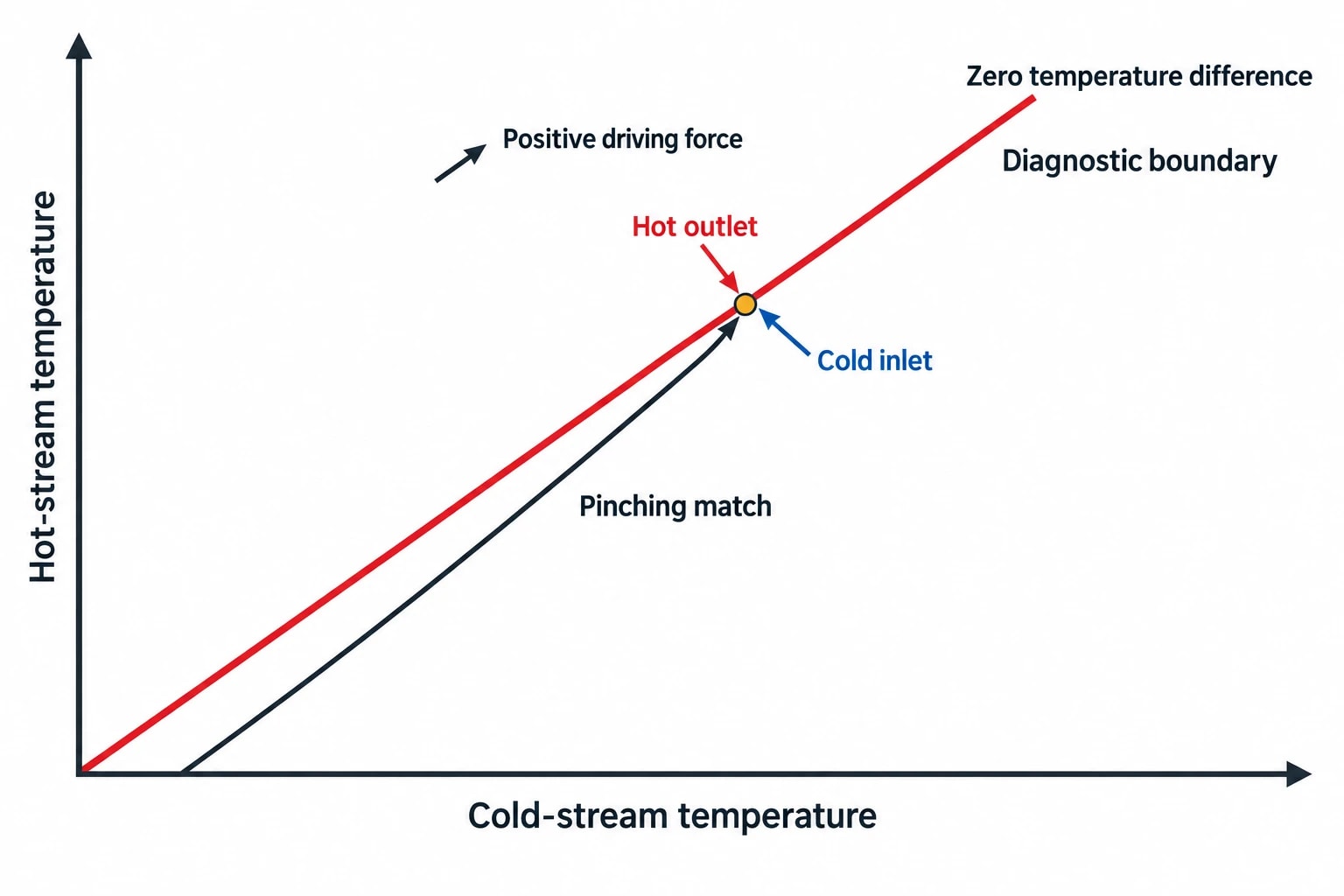
Graphical network-pinch methods plot an exchanger match using hot-stream temperature against cold-stream temperature. A pinching match reaches the condition where the hot outlet temperature equals the cold inlet temperature. In theoretical terms, this represents zero temperature difference and maximum recovery for the installed configuration.
An operating exchanger needs positive temperature driving force. The zero-temperature condition is therefore a diagnostic boundary, not an operating target. It identifies the limiting match and directs engineering attention towards changes that can move, relax or bypass it.

Pinch analysis identifies the thermodynamic minimum energy requirement of your process — then designs the heat exchanger network to achieve it.
Why Crude Preheat Trains Become a Debottlenecking Constraint
A crude preheat train recovers heat from product streams, pumparounds and other available hot streams before crude enters the fired heater. Its performance directly affects heater duty and the available margin for higher crude throughput.
The train also faces changing conditions. A configuration that performed well for one crude blend, throughput and cleanliness state may become restrictive after years of operation.
Conditions That Expose the Network Pinch
Several refinery conditions can reveal a preheat-train constraint:
- Higher crude throughput increases cold-side heat demand and can raise pressure drop through exchangers and associated pipework.
- A changed crude slate alters heat-capacity flowrates, viscosity and the temperature profile through the train.
- Fouling reduces exchanger conductance and moves duty back to the fired heater.
- Changed pumparound duty, product rundown temperature or side-draw operation alters the quantity and temperature level of available process heat.
- Existing bypass arrangements can direct a useful hot stream away from the most valuable crude-side duty.
- Fired-heater limits, including firing rate, coil outlet temperature, bridgewall temperature and stack conditions, can become the first visible production constraint.
High furnace duty is a symptom rather than a diagnosis. A furnace revamp can add capacity, but it may leave economic heat recovery unrealised. Equally, an exchanger project can fail to release throughput if the limiting condition lies in column hydraulics, crude desalting, steam availability or cooling-water performance.
Fouling Changes the Retrofit Case
Fouling must form part of the operating case. A network that achieves an attractive target immediately after cleaning may lose the required fired-heater margin before the next planned cleaning opportunity.
Vasilyev and Boldyryev’s 2018 crude-distillation study combined pinch retrofit analysis with historical fouling performance, exchanger bypasses, furnace duty and pumping limits. A viable refinery revamp must work through the planned cleaning cycle, not only in a clean-exchanger simulation.
How Pinch Analysis Finds the Refinery Network Pinch
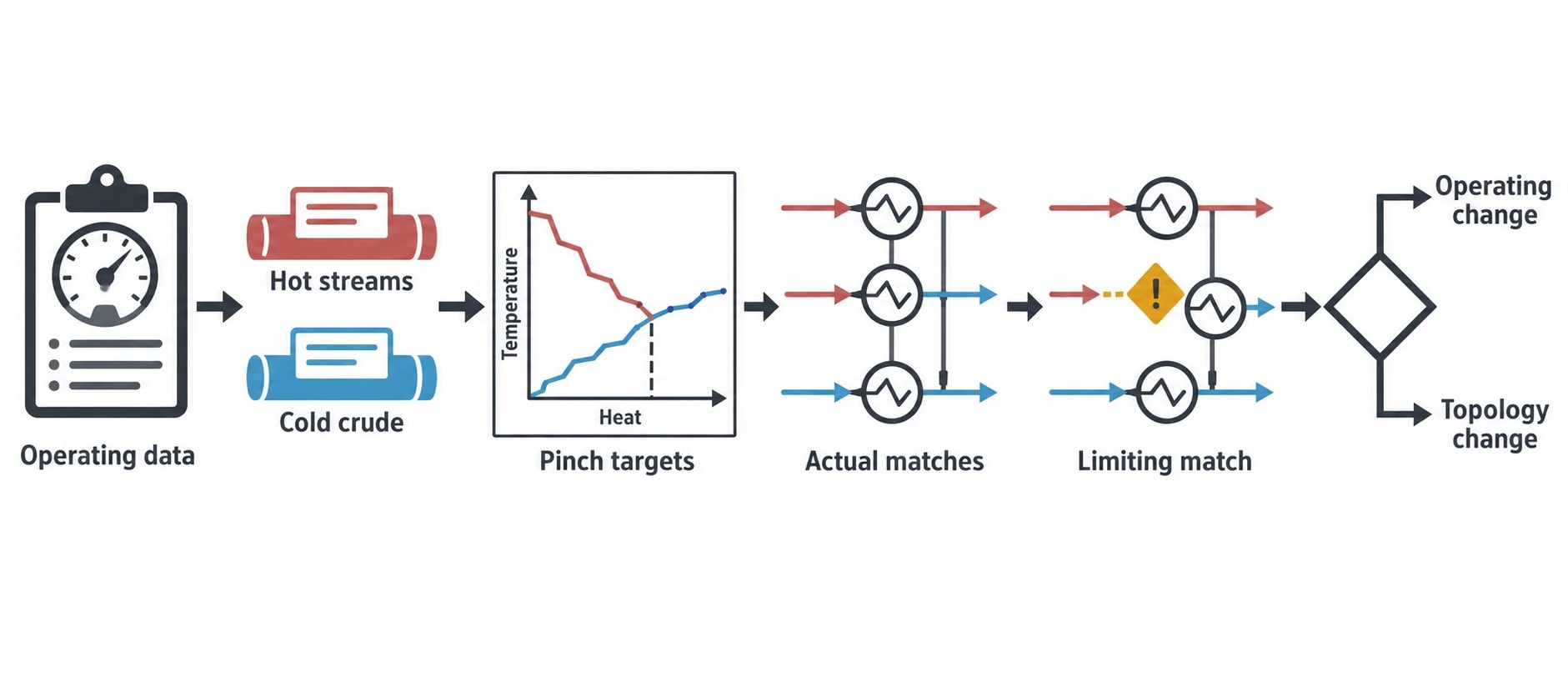
Refinery debottlenecking through process integration begins with disciplined plant data. A polished network diagram cannot compensate for unreliable flowrates, incorrect line-up assumptions or unrepresentative temperatures.
Build a Defensible Stream Data Set
The study team identifies hot streams requiring cooling and cold streams requiring heating. For each stream, the model needs a defined operating flowrate, inlet and outlet temperature, phase behaviour or enthalpy change, allowable pressure drop and relevant operating limits.
For a crude preheat train, the data review should include:
- Measured exchanger duties, terminal temperatures and pressure losses.
- Actual bypasses, recirculation paths, spare shells and parallel trains.
- Crude assays and the relationship between temperature, viscosity and hydraulic behaviour.
- Cleaning history and the exchanger condition expected at the constraint point.
- Corrosion and salt-deposition temperature restrictions.
- Pumparound and product rundown conditions.
- Fired-heater fuel, duty and operating limits.
Field verification is valuable. Long-running refinery units often accumulate temporary arrangements that do not appear on current process flow diagrams. A model must reflect the as-operated plant before it can support a capital decision.
Set the Operating Envelope
A single favourable operating point can produce a misleading retrofit. The engineering basis should test the conditions the modification must handle, such as maximum planned throughput, credible crude extremes, summer cooling conditions, a fouled preheat train and reduced-rate operation.
The selected minimum temperature approach must reflect exchanger type, fouling allowance, available area, controllability and economic value. An aggressive approach can produce an attractive heating target while demanding impractical surface area or leaving little operating margin.
Utility assumptions also need clear treatment. Fired fuel, high-pressure steam, lower-pressure steam, cooling water and air cooling operate at different temperature levels. A reduction in high-temperature furnace duty can release a hard capacity constraint. The same amount of low-temperature heat recovery may displace cooling duty without increasing throughput.
Map the Existing Network
The network model overlays actual exchanger matches onto the pinch targets. Engineers can then identify where available hot-stream duty fails to reach the cold crude stream at a useful temperature level.
This stage should separate three questions:
- Which match limits recovery in the present topology?
- Can an operating change alter the stream conditions that create that limit?
- Does the required gain justify a physical topology change?
This produces a more useful result than ranking exchangers by apparent fouling or duty alone.

Pinch analysis identifies the thermodynamic minimum energy requirement of your process — then designs the heat exchanger network to achieve it.
Releasing Heat Recovery Before Building New Plant
Operational changes can sometimes move the network pinch while retaining the existing exchanger topology. Each option requires assessment against process safety, corrosion, hydraulics, column performance, product quality and control limits.
Operational Changes to Test
Process integration can screen established actions before a project team selects new equipment:
- Reallocating crude flow between parallel exchanger paths.
- Revising pumparound circulation rate or temperature within approved operating limits.
- Adjusting bypass strategy to direct heat towards a more valuable crude-side duty.
- Rebalancing parallel trains after cleaning and performance assessment.
- Reviewing product draw and rundown conditions that alter hot-stream availability.
- Prioritising cleaning on exchangers that control fired-heater duty.
- Changing the sequence of existing exchangers where pipework, isolation and control arrangements permit.
Gadalla, Abdelaziz and Ashour examined this method in “Conceptual insights to debottleneck the Network Pinch in heat-integrated crude oil distillation systems without topology modifications”, published in Energy Conversion and Management, volume 126, 2016, pages 329 to 341. Their illustrative atmospheric and vacuum distillation case processed 85,000 barrels per day and used a minimum temperature approach of 20 °C. The authors reported a 14% increase in energy recovery beyond the maximum reached under the original process conditions through process-operation changes, without topology modifications. The result belongs to that case study. For a refinery project, the method is to identify the pinching match first, then test the operating variables that affect it.
When Topology Must Change
A physical modification is appropriate where operational changes cannot deliver the required headroom. Options can include:
- Adding surface area to a controlling exchanger.
- Installing a new exchanger match.
- Re-piping to relocate an exchanger.
- Re-sequencing exchangers.
- Splitting a process stream.
- Revising a utility connection.
These changes affect more than heat transfer. The project scope may require pipe supports, foundations, isolation valves, relief review, controls, instruments, electrical work, insulation and access. A revised preheat train also changes the fired heater’s control response and the crude unit’s temperature profile.
The preferred option often falls short of the theoretical maximum heat target. It may still be the best project because it offers sound control behaviour, manageable pressure drop, a shorter outage and stronger economics.
Making the Retrofit Turnaround-Ready
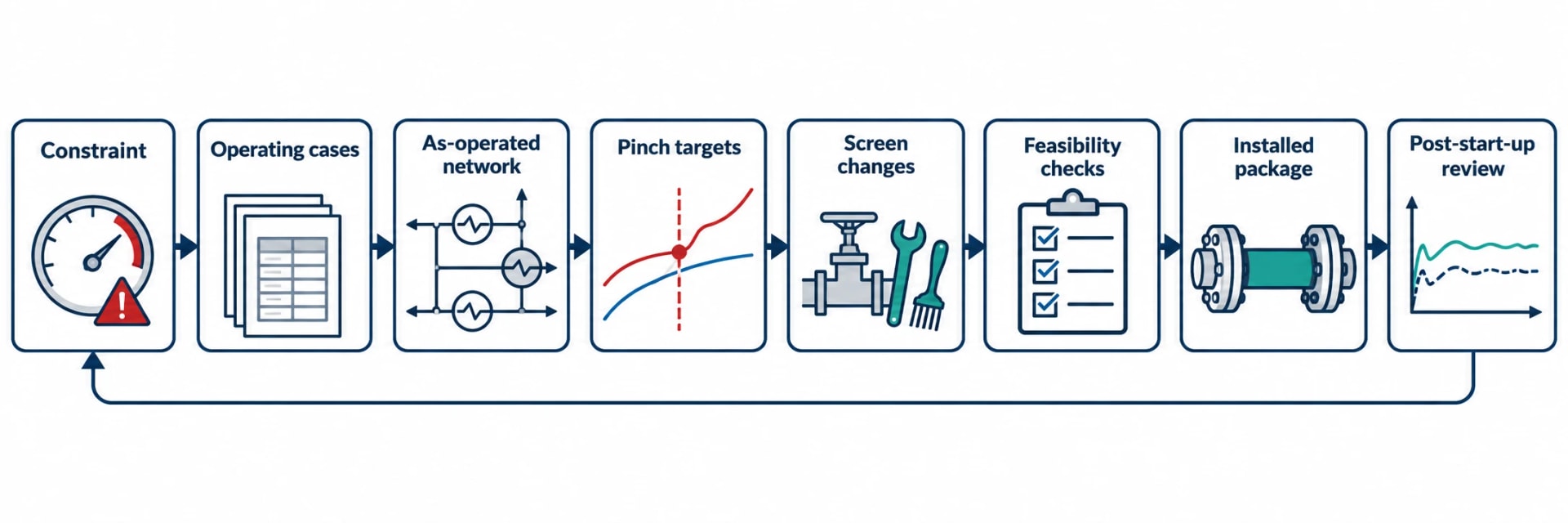
A debottlenecking study should move from a heat target to an installable change package through staged engineering.
A Practical Project Sequence
- Define the binding throughput, utility or emissions constraint.
- Agree the operating cases and reconcile process data.
- Model the as-operated exchanger network, including field line-up and fouling condition.
- Establish pinch targets and locate the network pinch for each material case.
- Screen operating changes, cleaning actions and topology modifications.
- Test preferred options against hydraulics, corrosion, materials, process safety, control and product specifications.
- Estimate installed cost, tie-in work, outage duration, utility impact and post-start-up performance requirements.
The post-start-up review should compare actual furnace duty, crude throughput, utility demand and exchanger temperature approaches against the project basis. This confirms whether the predicted constraint has moved and identifies the next limiting element.
Protect Operability
A highly integrated preheat train has less temperature margin to absorb disturbances. Feed changes, exchanger fouling and shifts in pumparound operation can change the balance quickly.
Detailed design should consider start-up, shutdown, turndown, bypass arrangements and the control authority retained by the fired heater. Process control engineers should participate before the exchanger arrangement is frozen. A modification that lowers fuel use but creates unstable crude-temperature control will not provide dependable production capacity.
BAT Context for Refinery Heat Integration
Commission Implementing Decision 2014/738/EU establishes BAT Conclusions for the refining of mineral oil and gas under the Industrial Emissions Directive. A BAT Conclusion is distinct from a BAT reference document, or BREF. BAT 2 calls for an appropriate combination of energy-efficiency techniques, including pinch analysis and heat integration.
BAT 2 defines pinch analysis as the systematic calculation of thermodynamic targets to minimise process energy consumption. It describes heat integration as supplying a substantial proportion of process heat demand through exchange between streams being heated and streams being cooled. These descriptions match the purpose of refinery preheat-train retrofit.
For England, GOV.UK guidance updated in January 2026 states that permit conditions may specify BAT, set emission limits, or define other BAT-based environmental outcomes. An operator applying for a permit must explain how it will follow an applicable BAT Conclusion or set out an alternative technique that delivers equivalent environmental protection.
A documented process-integration study can provide a traceable record of plant data, feasible heat-recovery options, technical constraints and the selected improvement package.
This article reflects the independent analysis and editorial opinion of EnerTherm Engineering. Product names, trademarks, and brands mentioned belong to their respective owners. EnerTherm Engineering is not affiliated with, endorsed by, or a licensee of any third-party software or product mentioned unless explicitly stated.

Simulation Engineer — EnerTherm Engineering
Rajesh Sekar is a Simulation Engineer at EnerTherm Engineering, specialising in computational fluid dynamics (CFD), finite element analysis (FEA), and thermal process simulation. He holds a degree from Cranfield University and brings extensive experience in simulation-based product development from the automotive, aerospace, and energy sectors.
