How Crude Distillation Unit Optimisation Cuts Preheat Demand
A 150,000 BPSD case reported a reduction of 20,000,000 kcal/h in preheat energy use.
Crude distillation unit optimisation is the systematic adjustment of crude preheating, column operation, heat recovery and product constraints to reduce fired-heater and steam demand while maintaining safe operation and on-specification refinery products.
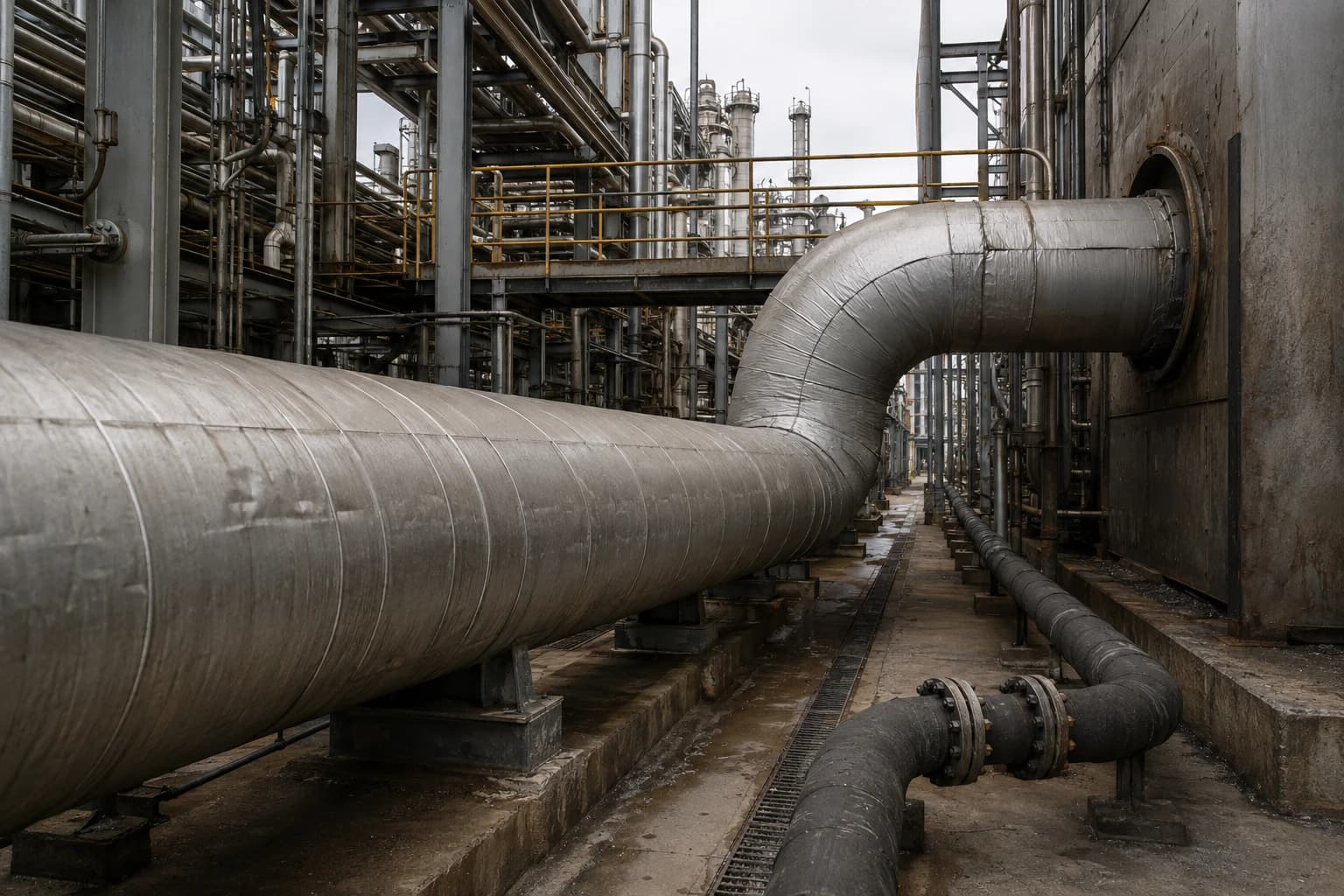
A CDU is often the refinery’s largest continuous heat sink. Cold crude enters the unit near ambient temperature and must reach a sufficiently high coil-inlet temperature before the crude furnace supplies the final rise to flash-zone conditions. Every degree recovered from hot products, pumparounds and column streams reduces the duty supplied by fuel gas or liquid fuel.
The practical challenge is that preheat demand is not controlled by the exchanger train alone. Lower crude-furnace duty can affect atmospheric-column reflux, pumparound heat removal, stripping steam, side-cut quality, vacuum-unit feed temperature and sour-water handling. Process engineers therefore need a whole-unit heat and mass balance before changing exchanger duties or operating targets.
The European Commission’s Refining of Mineral Oil and Gas BREF identifies CDU heat integration as a means of reducing refinery energy use and associated CO₂ emissions. Its guidance is clear: improve crude-preheat recovery, apply pinch analysis, minimise heat losses to air and cooling water, and optimise energy use within the crude unit.
Why crude distillation unit optimisation reduces preheat demand
The preheat train displaces furnace duty
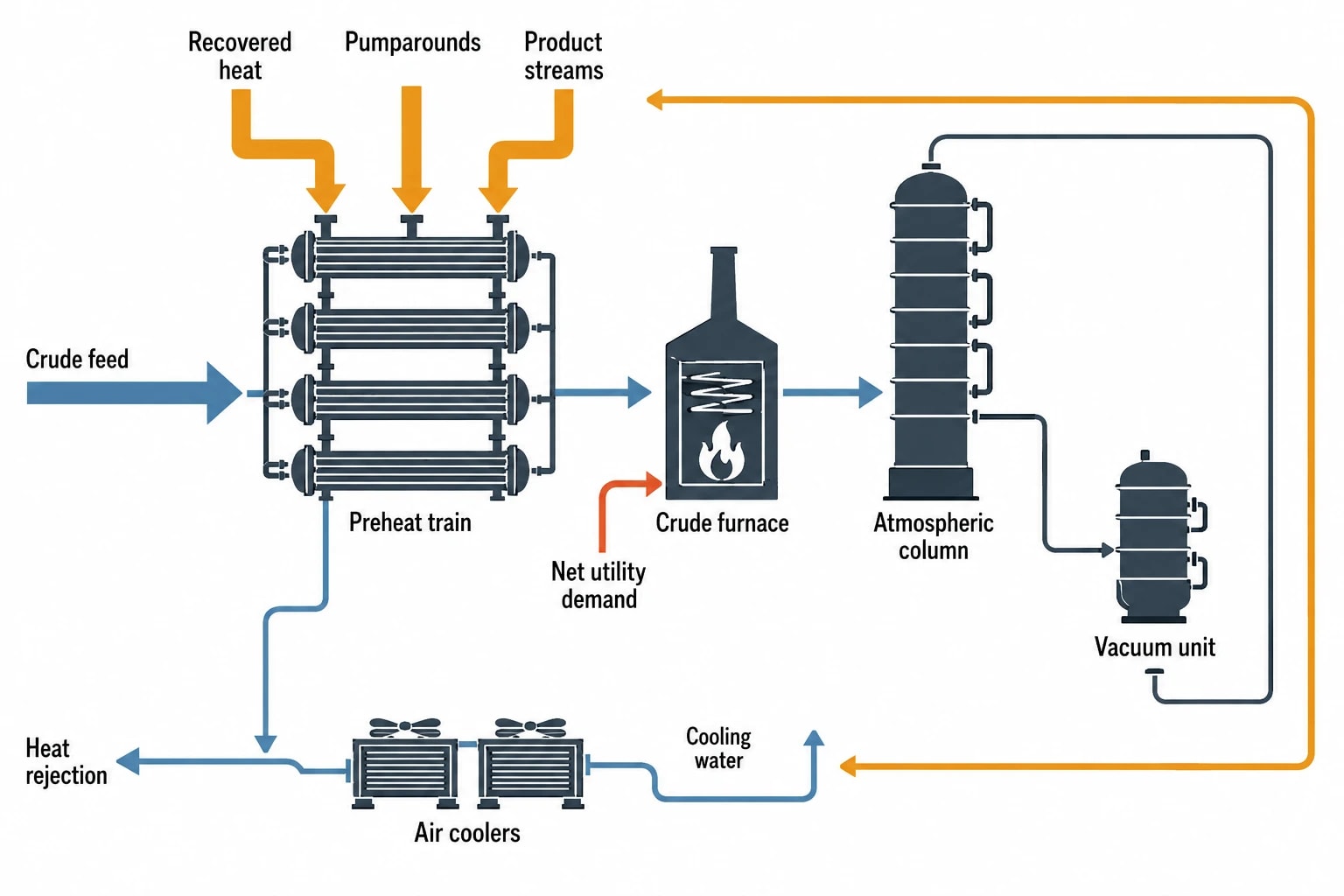
The crude preheat train recovers sensible heat from hot refinery streams before crude reaches the furnace. Typical sources include atmospheric-column pumparounds, atmospheric residue, diesel and gas-oil product streams, vacuum-column streams and selected downstream process returns.
Heat recovered at the highest viable temperature raises crude coil-inlet temperature and reduces required furnace duty. Heat rejected to cooling water, air coolers or an unsuitable low-temperature service offers a recovery opportunity only where another stream can accept it without upsetting separation, hydraulics or equipment limits.
A CDU heat balance should separate:
- Heat recovered into crude before the furnace.
- Heat supplied by the crude furnace.
- Heat rejected through condensers, air coolers and cooling water.
- Heat removed by pumparounds.
- Steam added for stripping and associated condensate returns.
- Heat transferred to, or received from, the vacuum distillation unit and connected units.
This accounting shows whether an apparent saving is genuine. Reducing pumparound duty may cut exchanger duty while increasing condenser duty, steam demand or furnace firing elsewhere. A successful optimisation reduces net utility demand across the defined refinery boundary.
Furnace duty is constrained by more than coil-inlet temperature
Higher crude-preheat temperature generally lowers fired-heater duty, but the operating window has limits. Crude properties, salt carry-over, exchanger metallurgy, pressure drop, tube-side velocity, fouling risk and heater coil-inlet temperature all matter. A preheat change can also alter crude viscosity and hydraulic distribution through the train.
The atmospheric column imposes further constraints. Flash-zone temperature and pressure, overflash, wash-zone performance, side-stripper duty, pumparound circulation and top reflux must continue to meet product cut points and flash-point requirements. Optimisation should treat furnace firing as the residual duty after safe heat recovery, not as an independent control variable.

Map every energy and material flow in your process with detailed heat and mass balance calculations — the foundation for any optimisation or design project.
Build the whole-unit heat and mass balance first
Define a useful optimisation boundary
A useful HMB boundary begins at crude receipt, the desalter or crude-charge pumps and extends through the atmospheric and vacuum columns, stabiliser, crude furnace, pumparounds, side strippers, major exchangers and utility interfaces. It should include streams that materially alter energy demand, even where another operating area controls them.
That scope avoids a common error: optimising the atmospheric preheat train while ignoring the vacuum unit, which may provide a hotter recovery route or impose a temperature constraint on vacuum-feed conditioning.
The European Commission’s BREF notes that high-vacuum-unit side-stream selection can be driven by maximising heat integration between temperature levels, rather than simply matching the required number of products. This matters in revamps. A refinery may have a valuable heat source available, but its flow, contamination risk or product disposition can make recovery impractical.
Reconcile plant data before drawing conclusions
A steady-state model built on unreconciled historian data creates false opportunities. Instrument bias, drifting temperature elements, unmeasured bypass leakage and uncertain crude assays can make an exchanger appear to underperform when the fault lies in the data set.
The HMB should reconcile measured flows, temperatures, pressures, product rates and utility consumption against conservation of mass and energy. Engineers should test the balance against several stable operating periods, not a single attractive day from the historian.
| Data group | What to confirm | Why it affects preheat demand |
|---|---|---|
| Crude assay and blend | TBP curve, density, sulphur, salt and water | Changes flash behaviour, enthalpy and fouling tendency |
| Exchanger train | Inlet and outlet temperatures, flow, pressure drop, bypass position | Identifies lost duty and hydraulic restrictions |
| Atmospheric column | Flash-zone conditions, pumparounds, reflux and side-draw rates | Defines heat sources and separation limits |
| Vacuum section | Vacuum-feed conditions, vacuum-column streams and condenser load | Reveals cross-unit heat-recovery opportunities |
| Utilities | Fuel flow, furnace stack oxygen, steam flow and condensate | Confirms whether reduced duty becomes a real utility saving |
A model should retain the crude-assay basis used for each data period. A change in crude slate can alter heat capacity and product yields enough to invalidate comparison with an earlier run.
Use the HMB as a single operational reference
EnerTherm Engineering’s 11-step HMB methodology can turn P&IDs, laboratory information, operating logs and field measurements into a single operational reference: a process flow diagram with validated stream tables and energy mapping. For a CDU, the output should make each heat source, heat sink and utility boundary visible.
It gives operations, process engineering and planning teams a common basis for deciding whether a proposed change improves fuel consumption, product value or both.
Where preheat demand is commonly lost
Fouling and exchanger bypasses
Fouling is often the first cause of declining crude-preheat performance. Deposits reduce the heat-transfer coefficient, raise pressure drop and can force operators to change flow distribution or open bypasses. The furnace then supplies the missing temperature rise.
The BREF identifies antifouling treatment in crude heat-exchanger trains as a method that can extend exchanger run length, improve heat recovery and prevent hydraulic losses, subject to the crude’s fouling characteristics. Chemical treatment should follow a clear diagnosis. It cannot correct an exchanger with damaged internals, a leaking bypass valve or a poor stream match.
A fouling review should compare exchanger approach temperatures, pressure drops and duty trends at comparable crude throughput and blend quality. A sudden step change often points to valves, controls or flow distribution. A gradual decline commonly indicates fouling, but inspection evidence remains necessary before setting a cleaning programme.
Pumparound duty and temperature level
Pumparounds control column internal traffic and recover heat. Their duty cannot be increased solely to raise crude-preheat temperature. Each circulation loop affects liquid and vapour traffic, draw-tray temperature, fractionation and condenser load.
The BREF states that two or three reflux streams are normally kept in continuous circulation at several points in the top and middle pumparounds, and that some configurations increase crude-column pumparounds from two to four. The objective is to recover heat at useful temperature levels while maintaining the required separation.
A process model should test pumparound circulation rate, return temperature and heat-removal duty together. If an exchanger network can accept hotter recovery, a revised pumparound target may reduce furnace firing. If the change compromises side-cut quality or causes column hydraulic limits, the theoretical energy gain has little operational value.
Cooling water and air-cooler rejection
Cooling services can hide recoverable heat. A hot product routed to cooling water before reaching the preheat train may be a feasible retrofit candidate, but only after evaluating product-temperature specifications, exchanger area, pressure drop and contamination consequences.
Low-temperature heat has limited value for crude near the furnace. Pinch analysis distinguishes between heat that is technically recoverable and heat that can be recovered at a temperature level that reduces fuel use. This prevents capital being spent on exchangers that lower cooling duty but do not reduce fired-heater duty.
Apply pinch analysis within CDU operating constraints
Match heat sources and sinks by temperature
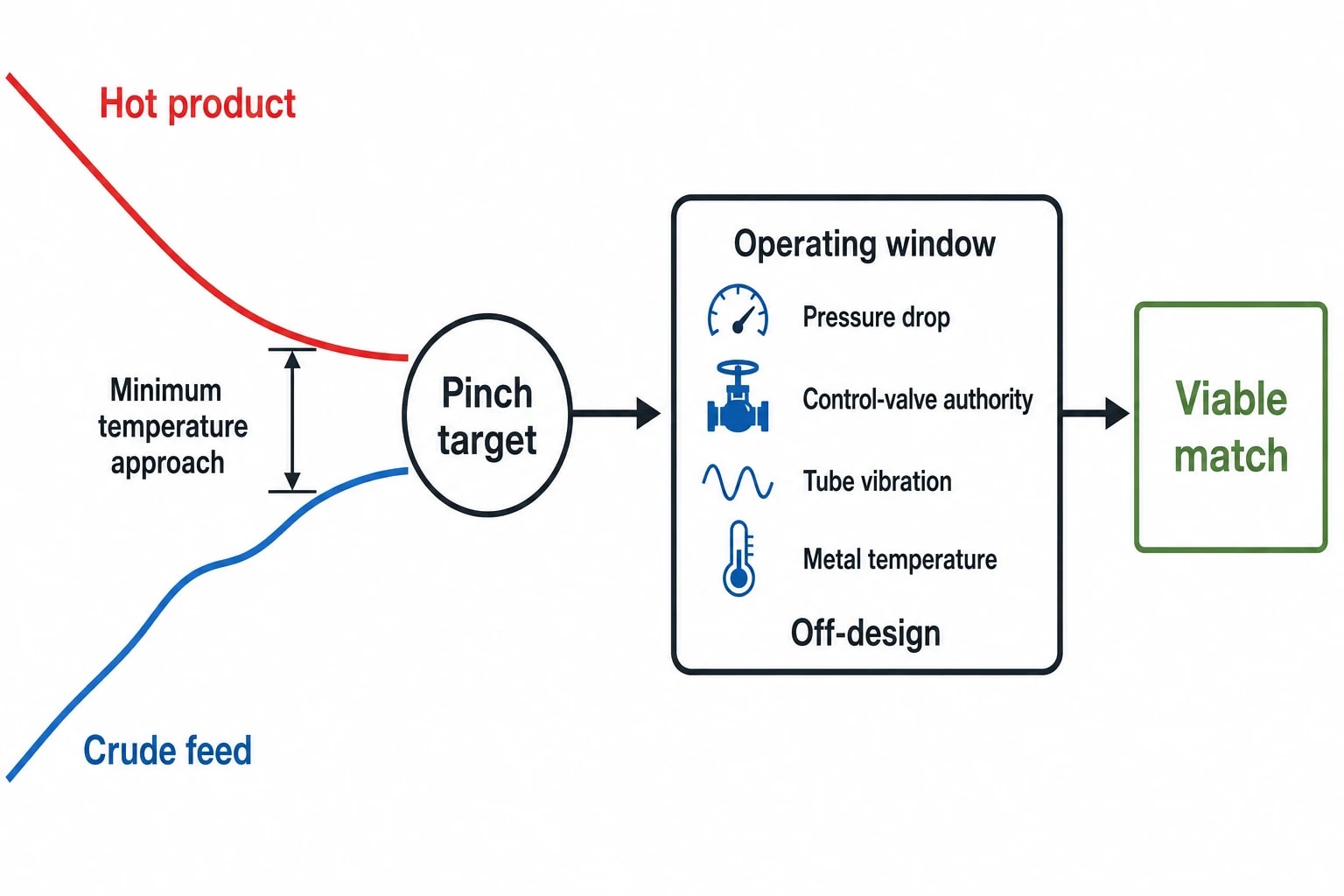
Pinch analysis identifies temperature intervals where the CDU lacks heat and where it rejects it. For crude preheat, it helps engineers determine whether the limiting factor is insufficient recovery area, an unsuitable match sequence, excessive minimum temperature approach or an unavoidable process constraint.
The exercise should use corrected stream data, including phase behaviour and realistic exchanger approach temperatures. Multi-component crude and partially vaporising streams should not be represented as simple constant-heat-capacity streams where that approximation distorts the temperature profile.
Treat pressure drop and operability as design constraints
A proposed exchanger match can look compelling in a heat cascade and still fail in the field. Crude-side pressure drop may approach pump limits. A hot product stream may impose unacceptable back-pressure on a column side draw. A low-flow service may have poor controllability at reduced throughput.
The evaluation should include:
- Allowable pressure drop for crude and hot-side circuits.
- Minimum flow requirements and control-valve authority.
- Exchanger tube velocity and vibration risk.
- Maximum metal temperatures and materials compatibility.
- Isolation, bypass and cleaning arrangements.
- Start-up, shutdown and turndown behaviour.
Highly integrated units can become more sensitive to disturbances in an individual unit. The BREF highlights this cross-media operating issue. A credible study therefore tests off-design cases as well as the normal operating point.

Map every energy and material flow in your process with detailed heat and mass balance calculations — the foundation for any optimisation or design project.
Protect product yields and specifications
Energy changes alter fractionation
Crude distillation unit optimisation must preserve the product slate required by refinery planning. Changes in flash-zone conditions, pumparound heat removal or stripping steam can shift light ends, distillation endpoints, flash point, density and sulphur distribution between products.
Process engineers should set product specifications and yield targets as hard constraints. The study should also test crude-assay uncertainty, blend variability and refinery throughput changes. A heat-recovery configuration that works for one medium crude may create a quality problem when a heavier or higher-sulphur blend enters the unit.
Link the CDU to refinery planning
Lower furnace duty is valuable, but the best economic operating point may depend on downstream-unit feed quality and marginal product value. For example, a small change in diesel endpoint or atmospheric gas-oil quality can affect hydrotreater load, FCC feed quality or blend-component availability.
The HMB should therefore feed refinery LP planning with reconciled yields, utility use and stream properties. This allows the refinery to compare an energy-saving change with its full margin effect, rather than judging it on heater fuel alone.
Permit and wastewater consequences of CDU heat integration
Distillation changes need environmental review
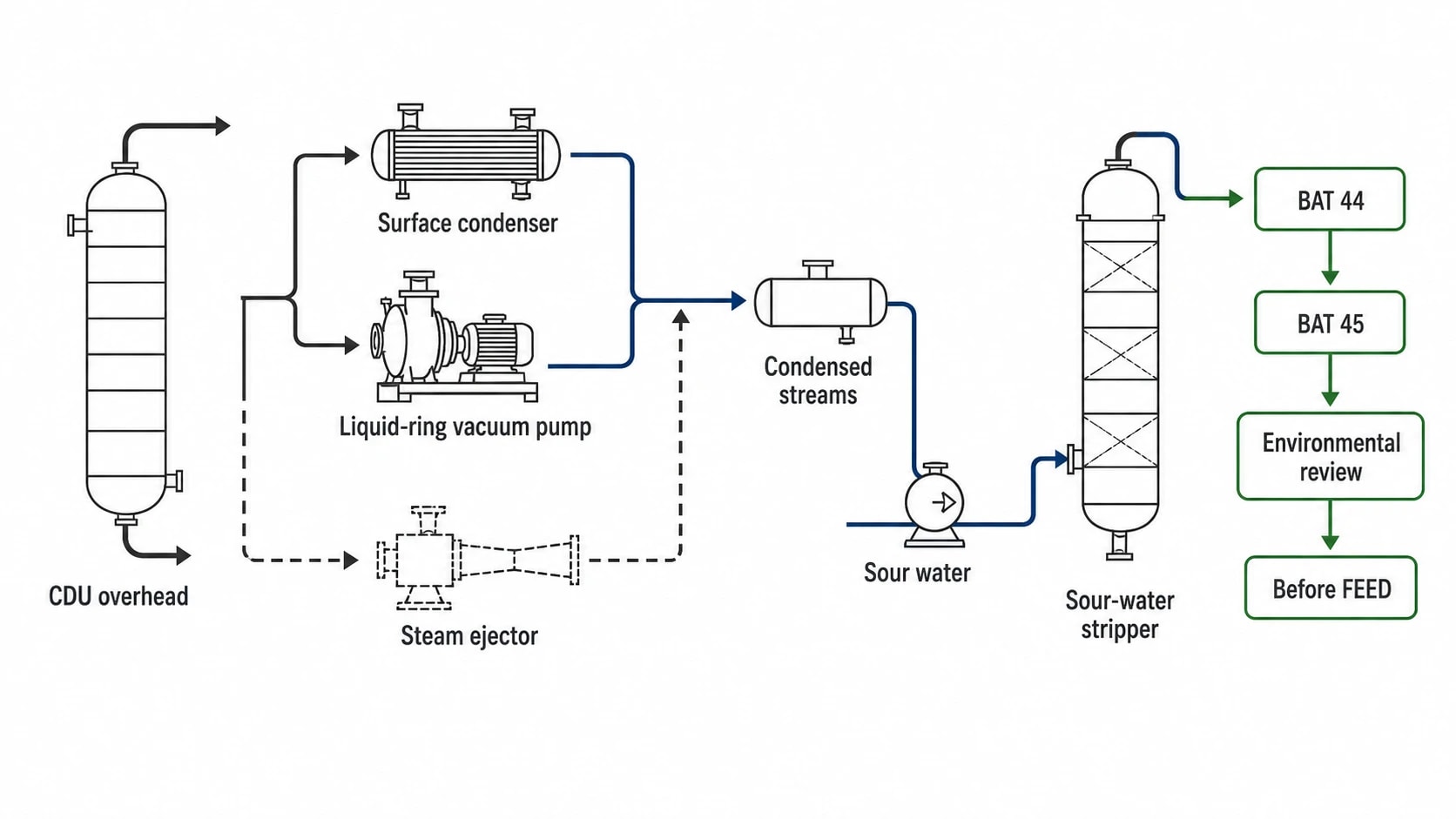
Heat-integration changes can affect more than fuel use and CO₂ emissions. Revised condenser loading, vacuum arrangements, stripping duty and water handling can alter wastewater volumes and sour-water routing.
Commission Implementing Decision 2014/738/EU, adopted under the Industrial Emissions Directive 2010/75/EU, remains the EU BAT Conclusions reference for mineral oil and gas refining. BAT 44 specifies liquid-ring vacuum pumps or surface condensers to prevent or reduce wastewater generation from distillation. BAT 45 requires routing sour water from distillation to a stripping unit to prevent or reduce water pollution.
A CDU revamp involving vacuum-system changes, condensers or steam ejectors should examine these requirements during concept selection. Equipment changes can affect sour-water flow, hydrocarbon carry-over, stripper capacity and the destination of condensed streams. The permit review should involve environmental and wastewater specialists before a heat-integration scheme reaches FEED.
Fuel savings and emissions remain linked
The BREF identifies reduced fuel consumption in distillation columns as the environmental benefit of CDU heat integration, with associated CO₂ reductions. That benefit must be demonstrated through measured fuel use and a consistent HMB, particularly where a change shifts fuel demand to steam generation or another fired process.
Furnace combustion constraints remain in force throughout optimisation. Lower duty must not encourage unstable firing, poor draft control or operation outside the site’s approved emissions and safety envelope.
A practical crude distillation unit optimisation programme
A disciplined programme reduces the risk of treating a process symptom as an exchanger problem.
-
Establish the operating objective: fuel reduction, throughput, product yield, fouling resilience or a defined combination of these outcomes.
-
Gather stable operating data across representative crude blends and throughput ranges. Confirm field measurements where the historian indicates a large apparent opportunity.
-
Reconcile a whole-unit mass and energy balance covering the preheat train, furnace, atmospheric column, vacuum unit, stabiliser, stripping and utilities.
-
Identify constraints first: product specifications, column hydraulics, furnace limits, exchanger pressure drop, fouling, vacuum capacity, sour-water handling and permit conditions.
-
Test operating changes before capital projects. Pumparound targets, exchanger sequencing, bypass position, cleaning strategy and steam targets can reveal savings with limited capital.
-
Apply pinch analysis to screened cases and develop realistic exchanger matches with minimum approach, controllability and maintenance requirements.
-
Quantify fuel, steam, cooling and CO₂ effects on the same boundary. Then assess yield, margin and environmental consequences.
-
Convert approved options into operating procedures, monitoring points and FEED-ready documentation where modifications are justified.
What the published CDU case study shows
A 2001 study of a commercial 150,000 BPSD CDU optimised the preheat train, atmospheric and vacuum columns, and light-naphtha stabiliser as one connected system. The researchers reported an illustrative reduction of approximately 20,000,000 kcal/h in crude-preheat energy use for their optimal case. Their annual capital-plus-operating-cost objective fell from US$10.649 million per year to US$9.185 million per year, a 14% reduction.
Those results are not a savings guarantee for another refinery. Their value lies in the method: the investigators did not tune the preheat train in isolation. They optimised operating conditions across the connected distillation system.
A durable reduction in preheat demand comes from recovering the right heat at the right temperature while retaining fractionation, hydraulic, fouling, safety and environmental control. A reconciled HMB turns that objective into decisions an operating refinery can test, measure and sustain.
This article reflects the independent analysis and editorial opinion of EnerTherm Engineering. Product names, trademarks, and brands mentioned belong to their respective owners. EnerTherm Engineering is not affiliated with, endorsed by, or a licensee of any third-party software or product mentioned unless explicitly stated.

Managing Director — EnerTherm Engineering
Dr. François Pierrel is Managing Director of EnerTherm Engineering with over two decades of expertise in thermal design, heat transfer, and industrial energy optimisation. He holds a PhD in Heat Transfer from Cranfield University and a Post-Doctorate from Heriot-Watt University.
