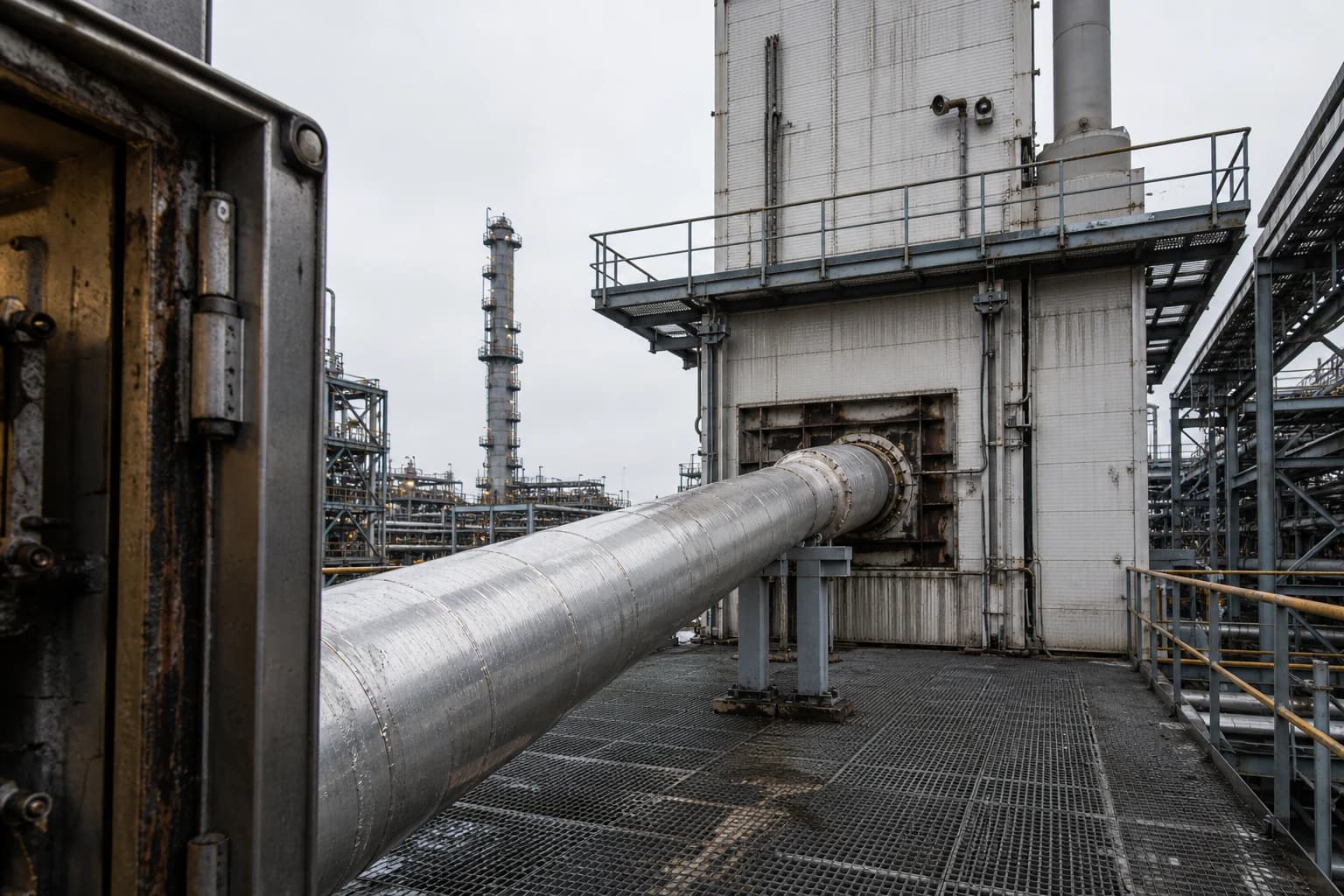
Why Crude Preheat Train Optimisation Cuts CDU Fuel Use
A 2021 CDU retrofit reported 8% total-energy savings after exchanger rearrangement.
Crude preheat train optimisation improves heat recovery from hot refinery streams to incoming crude before it reaches the crude distillation unit furnace. In a typical CDU, crude must approach the flash-zone temperature before distillation can begin. Heat recovered in the preheat train reduces the duty left for the fired heater, cutting refinery fuel-gas consumption and associated stack emissions.
The preheat train is therefore a valuable heat-integration target in an oil refinery. Product streams and CDU pumparounds already carry heat away from the fractionator. Every recoverable megawatt transferred into crude is a megawatt the furnace does not need to supply, subject to exchanger area, fouling, hydraulics, controllability and safe operating margins.
Published pinch-analysis evidence gives the scale of the opportunity. IPIECA reports 8% total-energy savings in a 2021 crude-unit preheat-train retrofit that combined exchanger rearrangement with economic analysis. Its wider compendium reports energy savings of up to 25% for refinery pinch applications, depending on the starting level of heat integration.
How the crude preheat train affects CDU furnace fuel use
The furnace supplies the heat-recovery shortfall
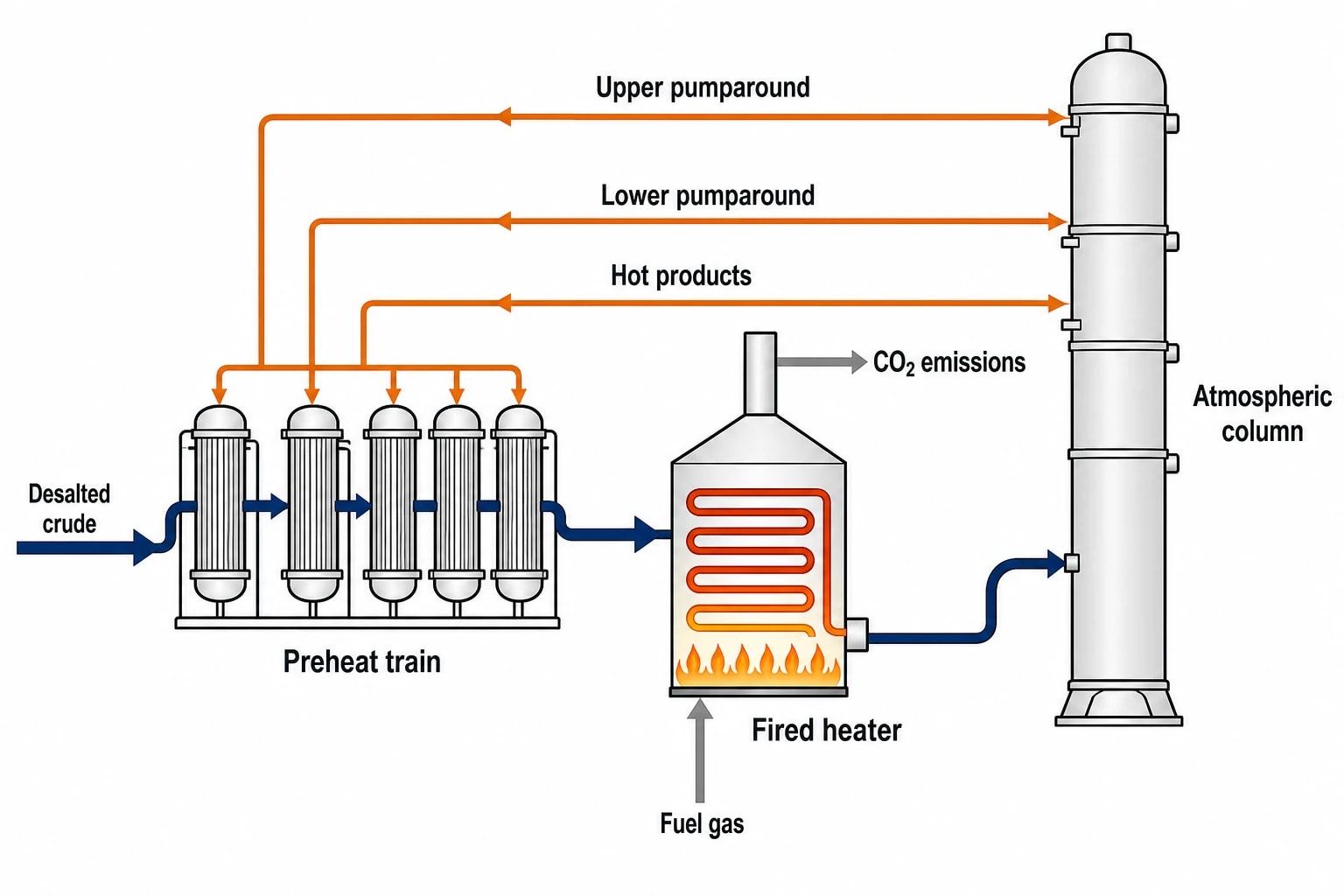
The CDU preheat train sits between crude desalting and the fired heater. It transfers heat from hot products, circulating refluxes and pumparounds into the crude feed. The furnace then supplies the remaining temperature rise before the partially vapourised crude enters the atmospheric column.
If fouling, unsuitable exchanger matches or bypassing lower the crude outlet temperature from the train, operators must increase furnace firing to protect flash-zone conditions and product separation. Furnace duty rises even though substantial heat may still leave the unit through hot-product coolers or cooling-water services.
- Higher crude temperature at the furnace inlet reduces required fired duty.
- Lower fired duty reduces refinery fuel-gas use.
- Reduced combustion cuts CO₂ emissions and can reduce associated NOₓ and SO₂ emissions, subject to fuel composition and burner operation.
- Better heat recovery can release furnace capacity where throughput is constrained by firing limits.
A preheat train can look mechanically sound while imposing a material energy penalty. An exchanger network may pass product flows and hold pressure, yet recover less heat than its design basis requires.
The temperature levels matter as much as the heat duty
A hot stream does not provide useful heat merely because it leaves the CDU at a high temperature. It must offer heat at a temperature level that can warm crude without impractical exchanger area or unstable operation.
Upper and lower pumparounds are particularly important because they remove heat from the atmospheric column while providing internal reflux. Their duties and temperatures reflect column operation as well as heat-recovery potential. Product draws can also heat crude, but their temperatures, target product temperatures, pressure differences and fouling tendencies constrain the available exchanger matches.
The aim is to recover economically available heat while retaining safe pressure containment, workable control and reliable exchanger performance.

Pinch analysis identifies the thermodynamic minimum energy requirement of your process — then designs the heat exchanger network to achieve it.
Pinch analysis identifies the real heat-recovery target
Composite curves expose the fuel penalty
Pinch analysis converts process-stream data into thermodynamic targets for minimum hot- and cold-utility demand. For a CDU preheat train, the principal cold stream is the crude feed. Hot streams commonly include pumparounds and products that require cooling before further processing, storage or blending.
The hot and cold composite curves show aggregate heat supply and demand at each temperature level. Their closest permitted approach is the pinch, which depends on the selected minimum temperature difference, ΔTmin.
A large ΔTmin generally lowers exchanger-area requirements and capital cost, but increases residual hot-utility demand. A smaller ΔTmin may reduce furnace fuel consumption while demanding more exchanger surface and raising concerns about fouling, control response and retrofit practicality.
IPIECA notes that crude-unit energy targets and economic results are sensitive to the selected ΔTmin. An attractive heat-recovery target can become an expensive or unreliable project if it assumes exchanger approaches that an existing refinery cannot sustain through a fouling cycle.
Pinch rules show where a network wastes fuel
The pinch divides the process into regions above and below the pinch. In an ideal minimum-utility design, engineers add external heating above the pinch and external cooling below it. Heat transfer across the pinch increases both hot- and cold-utility requirements.
In an operating CDU, a cross-pinch penalty often appears when a hot stream is cooled against water or air while the crude heater burns more fuel to deliver a temperature rise the process could have supplied. The corrective action may be an added exchanger, a different exchanger sequence, a revised stream split, a changed bypass strategy or altered pumparound heat recovery.
Pinch analysis gives the project team a quantified target before it selects modifications. It separates a thermodynamic opportunity from an apparent one created by incomplete data or an unrealistic temperature approach.
Where crude preheat trains lose heat-recovery performance
Fouling shifts duty back to the furnace
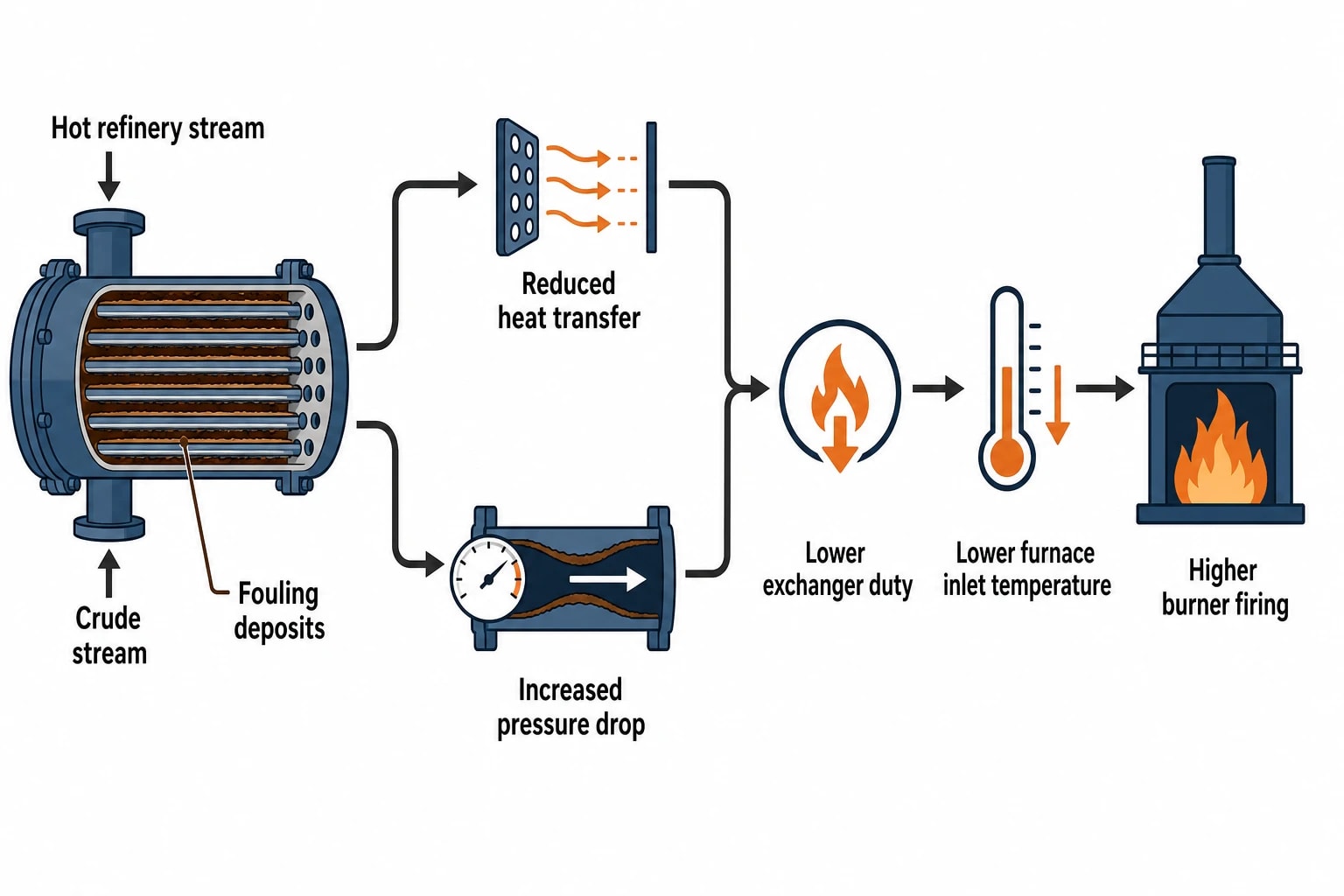
Fouling is a persistent cause of lost crude preheat. Deposits on the crude or hot side reduce the overall heat-transfer coefficient, increase pressure drop and force bypassing or lower throughput. Crude variability can change fouling behaviour, particularly where heavier fractions, salts, corrosion products or unsuitable temperature profiles affect deposition.
As individual exchangers lose duty, the train temperature profile changes. A downstream exchanger may lose driving force, the furnace inlet temperature falls, and burner firing rises to hold CDU operation.
Useful monitoring indicators include:
| Indicator | What it can reveal |
|---|---|
| Crude temperature entering the furnace | The net heat-recovery result seen by the heater |
| Exchanger temperature approach | Loss of heat-transfer performance or a changed operating condition |
| Pressure drop across exchanger channels | Fouling, flow restriction or a flow-distribution problem |
| Furnace firing rate at comparable crude rate | The financial consequence of heat-recovery deterioration |
| Product and pumparound outlet temperatures | Whether available heat is being rejected rather than recovered |
Trend the indicators against crude throughput, crude assay, exchanger configuration and seasonal cooling conditions. A single daily temperature reading rarely distinguishes fouling from a throughput change, bypass position or altered fractionation targets.
Bypasses and exchanger order can conceal available duty
Refineries install bypasses for start-up, control, maintenance and protection. They can become a long-term workaround after exchanger performance deteriorates. A partly open bypass may protect a local temperature target while increasing furnace duty.
Exchanger sequence matters for the same reason. A hot stream can have sufficient total duty but sit at a temperature level where it contributes little to the crude’s final temperature rise. Rearranging existing matches can sometimes produce savings without a new exchanger, although rerouting, isolation, plot space and outage duration may dominate retrofit cost.
IPIECA’s reported crude-unit case study achieved its energy reduction through exchanger rearrangement and economic analysis, rather than treating new heat-transfer area as the only route to savings.
Column operation changes the available heat
A CDU preheat train cannot be optimised in isolation from the column. Pumparound flow, draw temperature, reflux requirements, crude rate and fractionation targets change both the heat available to the train and the column’s operating margin.
Greater pumparound heat recovery may be attractive, but it must preserve tower hydraulics and product quality. A preheat study needs operating cases that represent the refinery’s crude slate, seasonal operation, throughput range and product targets. A design that meets its pinch target at one crude rate can create control difficulty or miss specification at another.

Pinch analysis identifies the thermodynamic minimum energy requirement of your process — then designs the heat exchanger network to achieve it.
A practical pinch-analysis workflow for a CDU retrofit
Build the study from reconciled operating data
The first stage is a defensible data set. Process engineers should reconcile representative plant data with the process model and verify stream temperatures, heat capacities, phase changes, flow rates and pressure constraints.
The study scope should state which streams are included, their temperature limits and which existing equipment changes are permissible. Include real constraints early: allowable pressure drop, exchanger metallurgy, fouling margins, plot space, pipe-rack routes, isolation requirements and turnaround timing.
A credible study normally proceeds through five steps:
- Define operating cases for crude slate, rate and key product modes.
- Extract and reconcile hot and cold stream data.
- Set a realistic ΔTmin and calculate energy targets.
- Identify exchanger-network bottlenecks, cross-pinch matches and cooling penalties.
- Compare retrofit options on energy, capital cost, operability, maintainability and outage requirements.
Screen the options against operations, not only the energy target
A theoretical heat-recovery maximum is not a project scope. The best option must tolerate dirty service, retain cleaning access and avoid unacceptable pressure-differential or cross-contamination risks.
Thermal design teams should examine whether an exchanger addition requires a pump upgrade, whether a proposed match affects product rundown temperature, and whether flow splits remain controllable across the expected operating envelope. Dynamic behaviour requires attention where the modification changes crude-feed temperature response or column pumparound control.
Economic analysis should include fuel savings, carbon cost where applicable, maintenance effects, incremental pumping power, exchanger cleaning frequency and the value of released furnace capacity. The most attractive project may be a staged retrofit that removes the largest fuel penalty during the next turnaround, then assesses performance before committing to a larger network change.
UK and EU BAT make heat integration a permit-relevant issue
Pinch analysis is named in the EU refining BAT conclusions
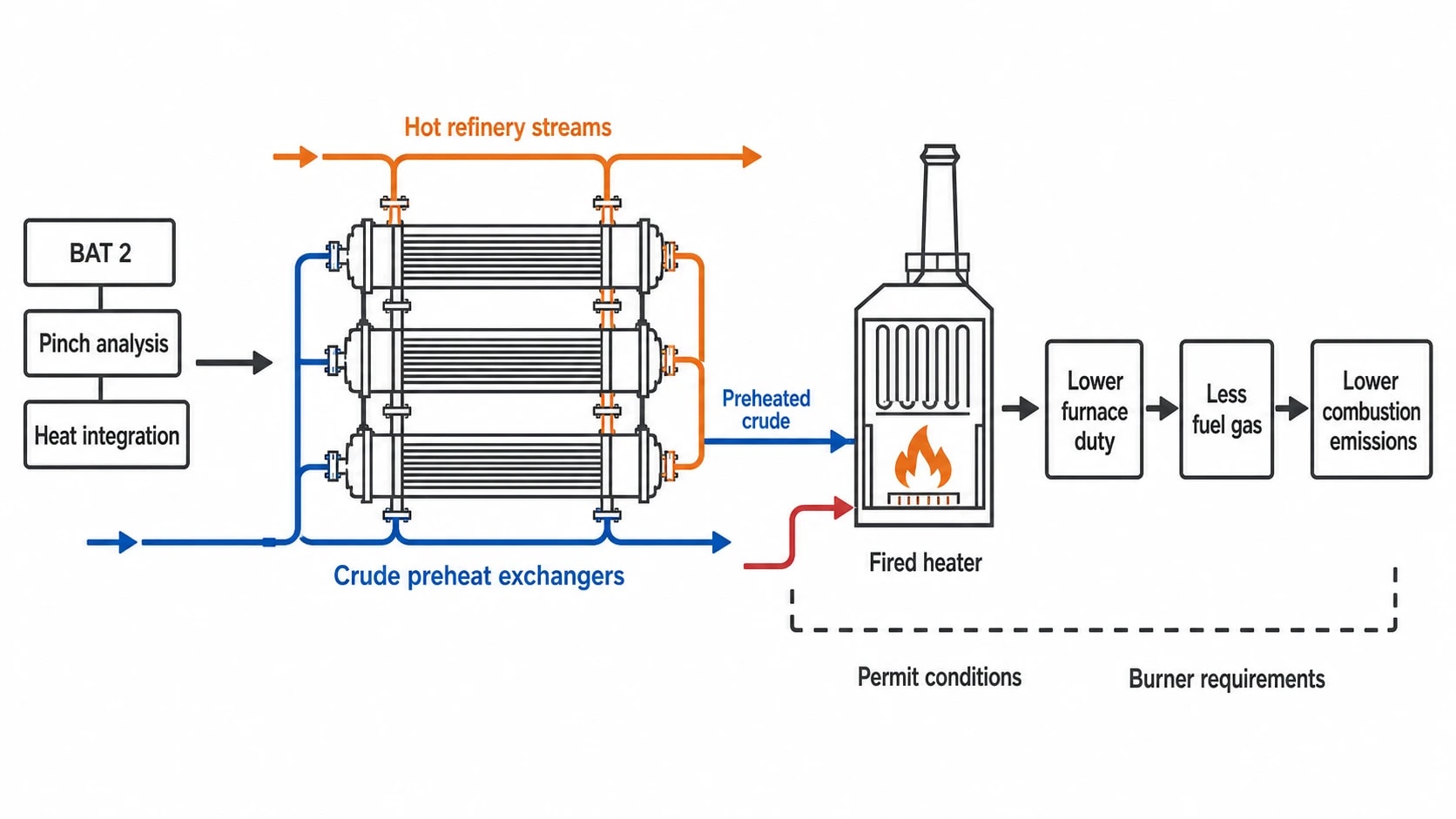
Commission Implementing Decision 2014/738/EU sets BAT conclusions under the Industrial Emissions Directive for mineral-oil and gas refining. Under BAT 2 on energy efficiency, the decision identifies pinch analysis and heat integration as design techniques for minimising process energy consumption.
That gives crude preheat train optimisation a regulatory as well as commercial context for European refineries. Lower furnace duty supports energy-efficient operation and reduces combustion emissions at source. It does not remove the need to meet permit conditions or burner-specific emissions requirements, but it can reduce the fuel requirement driving those emissions.
UK guidance points directly to CDU heat integration
The Environment Agency’s EPR 1.02 guidance for gasification, liquefaction and refining installations identifies energy-optimisation analysis of the crude preheat train as indicative BAT. It also points to greater CDU pumparounds, heat-transfer-oil sidestripper reboiling and advanced process control as measures that can improve heat integration.
For a UK refinery, the project case should combine plant evidence with this BAT framing. Document the baseline furnace duty, crude inlet temperature, exchanger condition, selected operating cases and proposed change, then show how it improves heat recovery without transferring an unacceptable operational, safety or maintenance burden elsewhere in the unit.
Turning a heat-recovery target into sustained fuel savings
Maintain the gain after the retrofit
A preheat-train project only delivers its business case if the operating organisation holds the improved condition. Monitoring should therefore form part of the project deliverable alongside mechanical modifications.
Set target ranges for furnace inlet temperature, exchanger approach, pressure drop and firing at normalised CDU throughput. Review deviations after crude-slate changes and cleaning campaigns. Where the plant model supports it, compare actual hot-utility demand with the pinch target to distinguish unavoidable process changes from lost exchanger performance.
Focus the next investigation on the largest gap
The first question is how much furnace duty the existing CDU can avoid at realistic operating conditions. Pinch analysis provides the target, field data identifies the constraints, and retrofit engineering determines which opportunity can withstand fouling, piping, control and the turnaround calendar.
This article reflects the independent analysis and editorial opinion of EnerTherm Engineering. Product names, trademarks, and brands mentioned belong to their respective owners. EnerTherm Engineering is not affiliated with, endorsed by, or a licensee of any third-party software or product mentioned unless explicitly stated.

Managing Director — EnerTherm Engineering
Dr. François Pierrel is Managing Director of EnerTherm Engineering with over two decades of expertise in thermal design, heat transfer, and industrial energy optimisation. He holds a PhD in Heat Transfer from Cranfield University and a Post-Doctorate from Heriot-Watt University.
