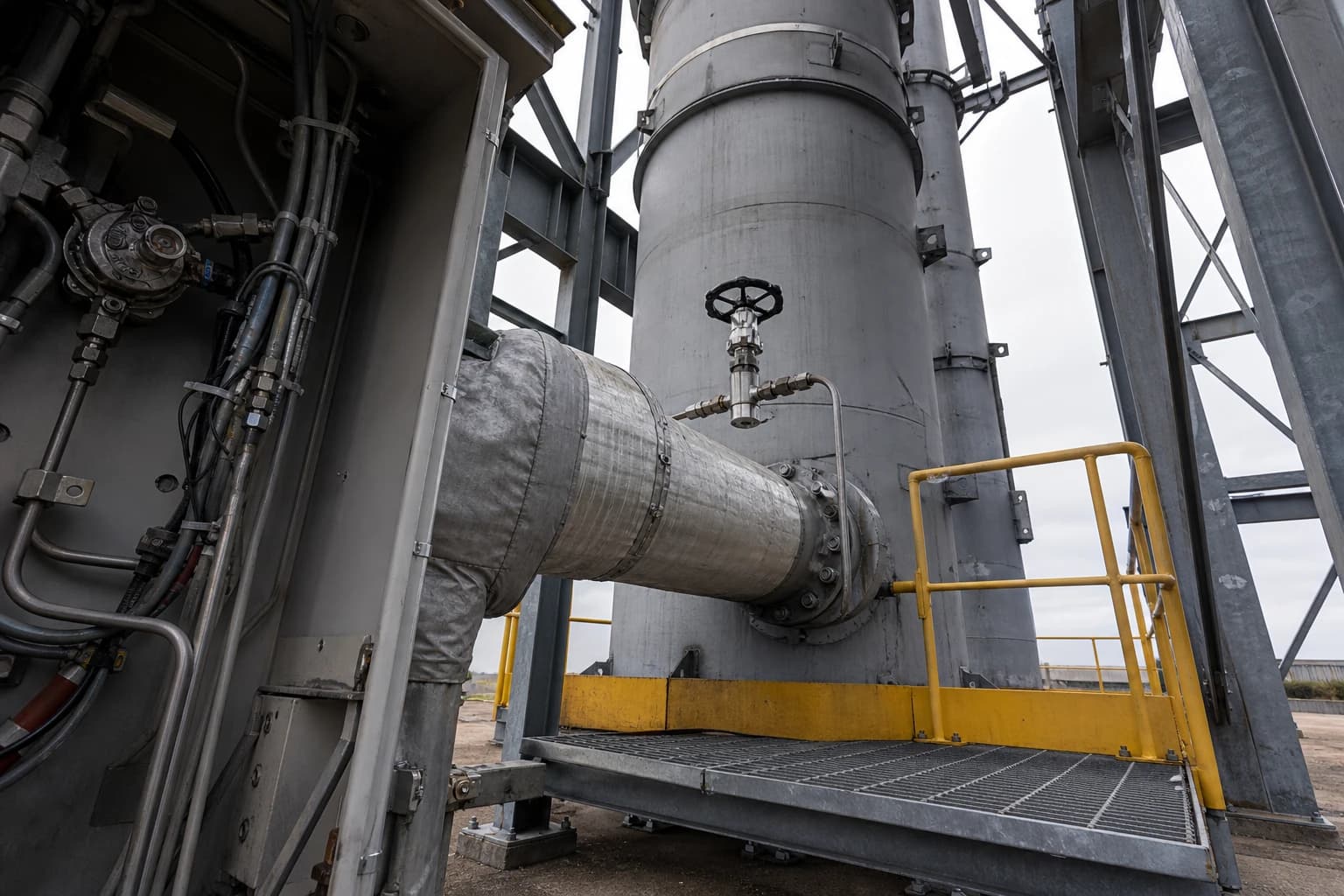
How Hydrotreater Process Modelling Predicts Sulphur Removal
Validated kinetic models link hydrogen use, feed changes and outlet sulphur.
Hydrotreater process modelling uses reconciled heat and mass balances, feed characterisation and catalytic reaction kinetics to predict sulphur removal under specified refinery operating conditions.
A VGO blend change can alter sulphur species, density, hydrogen demand and reactor exotherm at the same time. The operating team needs to know whether the new feed will meet the product sulphur target before increasing charge rate or reactor inlet temperature. A plant-grade model provides that forecast, with defined uncertainty, from measured feed properties, reactor conditions and catalyst state.
The model must represent more than total feed sulphur. Hydrodesulphurisation performance changes with hydrogen partial pressure, liquid hourly space velocity, feed boiling range, catalyst activity, gas-liquid contacting, quench flow and temperature through each bed. A 2009 industrial VGO study developed a dynamic lumped-parameter model from refinery data across 14 plants. It tracked catalyst deactivation, wetting efficiency, feed properties and operating conditions to estimate required operating temperature, outlet sulphur composition and chemical hydrogen consumption.
Hydrotreater process modelling predicts how an operating decision will affect sulphur removal, hydrogen use, reactor temperature profile and remaining operating margin.

Map every energy and material flow in your process with detailed heat and mass balance calculations — the foundation for any optimisation or design project.
What Hydrotreater Process Modelling Predicts
Product sulphur and hydrodesulphurisation conversion
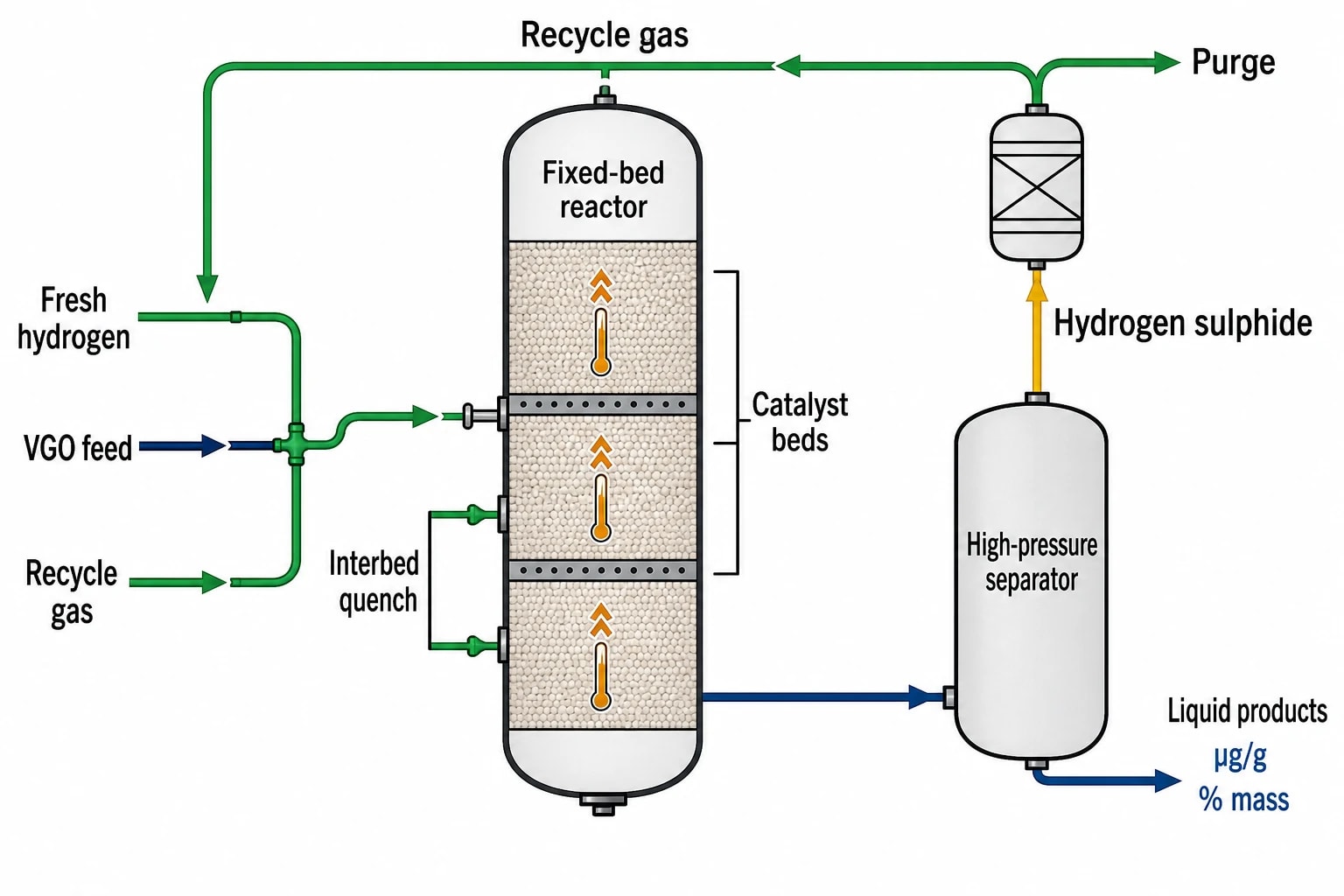
The central output is product sulphur concentration on a stated mass basis, usually µg/g or mass percentage. The model should also calculate the sulphur mass entering in feed and leaving in liquid products, reactor gas and hydrogen sulphide. This prevents a misleading conclusion based on concentration alone.
Hydrodesulphurisation converts organically bound sulphur into hydrogen sulphide in the presence of hydrogen and catalyst. The feed does not contain one uniform sulphur compound. Sulphides, thiophenes, benzothiophenes and substituted dibenzothiophenes respond differently to severity. Heavier aromatic sulphur species can require substantially more severity than simple sulphides.
A model based only on total sulphur can work within a narrow calibration range. It becomes less reliable when a refinery changes crude slate, introduces cracked stock or shifts the VGO cut point. The model must therefore preserve enough feed detail to distinguish feeds with the same total sulphur but different sulphur-species distributions.
Hydrogen consumption and gas-loop behaviour
Chemical hydrogen consumption includes more than sulphur removal. Hydrogen also participates in hydrodenitrogenation, olefin saturation, aromatic saturation and hydrocracking. The balance must distinguish chemical consumption from dissolved hydrogen, purge losses, separator losses and changes in recycle inventory.
Hydrogen partial pressure is more meaningful than total reactor pressure as a kinetic input. Recycle gas contains hydrogen, hydrocarbons, hydrogen sulphide and other gases. Methane and other inerts reduce the hydrogen partial pressure available to the catalyst. Hydrogen sulphide can also inhibit hydroprocessing reactions.
The model should reconcile:
- Fresh hydrogen and recycle-gas flow
- Recycle-gas composition and purge rate
- Hydrogen dissolved in liquid products
- Hydrogen sulphide production and removal from the recycle loop
- Reactor inlet and outlet pressure by bed
- Liquid yield, off-gas yield and separator splits
A forecast that predicts product sulphur while missing hydrogen demand is unsuitable for feed-change planning. Hydrogen availability can become the binding constraint before the reactor temperature limit.
Bed temperatures, quench and heat release
Hydrodesulphurisation and associated hydrogenation reactions release heat. In an adiabatic fixed-bed reactor, that heat increases temperature through the catalyst bed and changes the reaction rate. Interbed quench limits the temperature before the next bed.
A single average reactor temperature loses this interaction. Hydrotreater process modelling should calculate bed-by-bed enthalpy balances, reaction heat and quench mixing. This shows whether a feed change concentrates the exotherm in the lead bed, increases final-bed temperature or shifts required quench duty beyond the operating range.
Feed Characterisation Sets the Quality of the Prediction
Crude assay data need reconciliation before kinetic fitting
A hydrotreater feed is a complex petroleum mixture rather than a set of pure components. Its model representation starts with assay and operating data, typically including true boiling point distribution, density, sulphur, nitrogen, hydrogen content, distillation cut points and stream flow.
The modeller converts this evidence into pseudo-components and kinetic lumps. Pseudo-components represent boiling range, density, enthalpy and vapour-liquid behaviour. Kinetic lumps represent groups of material that react at comparable rates. The two representations need a traceable mapping so reactor conversion remains consistent with downstream separation and product properties.
Kinetic calibration must follow data reconciliation. If feed flow, density, sulphur or reactor gas composition do not close around the hydrotreater, regression can absorb measurement error into kinetic constants. The model may then match a historical period but fail during a feed change.
Choose the resolution for the decision
The appropriate level of feed detail depends on the task.
| Decision | Modelling representation | Why it matters |
|---|---|---|
| Routine severity adjustment on a stable VGO | Calibrated kinetic lumps | Focuses on product sulphur and hydrogen use |
| VGO blend or cut-point study | TBP pseudo-components mapped to kinetic lumps | Preserves boiling range and feed-property changes |
| High-conversion or residue service | Detailed heavy-fraction representation | Captures changes in yield, hydrogen demand and refractory material |
| Reactor and fractionator study | Reactor delumping linked to separation pseudo-components | Maintains consistency between conversion and product cuts |
More lumps do not automatically improve a model. Each additional parameter needs identifiable data. A detailed representation calibrated only against sparse plant sulphur data can produce unstable parameters and false precision. The selected lumping scheme should match the available assay information, operating range and decision the model must support.
Feed properties that should enter the model
For VGO hydrotreating, a useful feed-data set includes total sulphur, density, TBP curve, nitrogen, aromaticity or hydrocarbon-type data where available, and final boiling point. For heavier feeds, metals, carbon residue, viscosity and asphaltenes become material variables for activity and pressure-drop forecasting.
The 2024 study of Kazakhstan and West Siberian VGO mixtures illustrates why feed variation must remain explicit. Its model assessed changing VGO compositions rather than treating the feed as fixed. The study reported lower predicted sulphur content as reactor temperature increased, but its numerical results apply to the specified feed, catalyst and operating conditions. A refinery should not transfer those values directly to another hydrotreater.
Map every energy and material flow in your process with detailed heat and mass balance calculations — the foundation for any optimisation or design project.
Building a Hydrotreater Kinetic Model
Start with the physical unit configuration
Most refinery hydrotreaters use trickle-flow fixed beds with hydrogen-rich gas, liquid feed and catalyst in concurrent downward flow. The model needs the physical configuration before rate parameters are fitted.
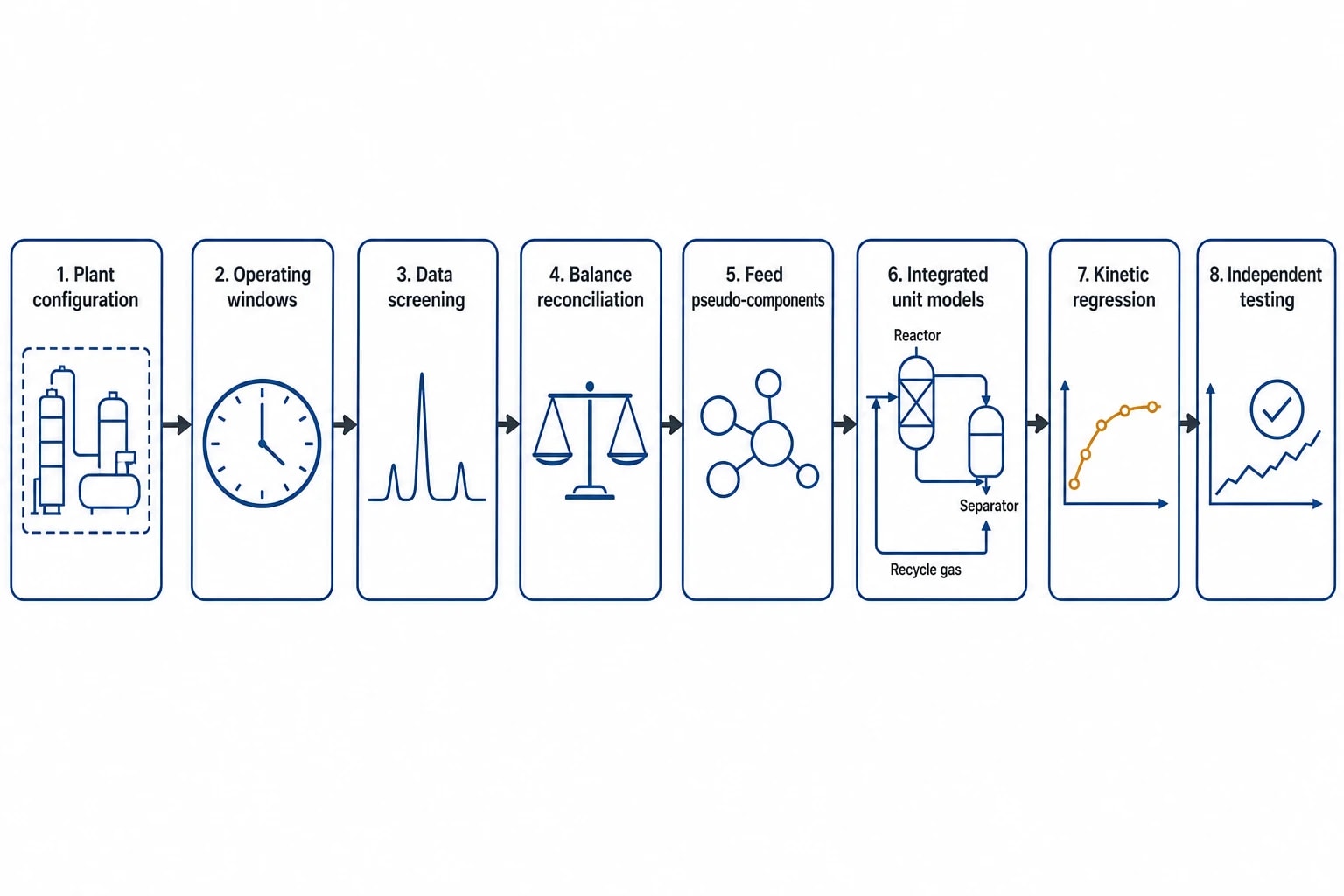
A practical build sequence is:
- Define battery limits, reactor volumes, catalyst loading, bed sequence, quench points, separators and recycle loop.
- Select steady operating windows and align process data with material residence time.
- Screen analyser faults, laboratory outliers, equipment trips and known maintenance periods.
- Reconcile mass, sulphur, hydrogen and energy balances against measured uncertainty.
- Build the feed pseudo-component slate and map it to kinetic lumps.
- Implement reactor, separator and recycle-gas models with consistent thermodynamics.
- Regress reaction and activity parameters against calibration data.
- Test the model against independent operating periods and feed cases.
The result is an engineering model rather than a reactor correlation disconnected from the plant gas loop and separation system.
Reaction kinetics must respond to severity
Kinetic rate expressions convert local temperature, pressure, hydrogen availability and reactant concentration into reaction rates. Published hydrotreater models commonly use power-law or Langmuir-Hinshelwood-type expressions, depending on available data and the mechanism represented.
The key requirement is physical consistency. Temperature affects rate, but reaction heat changes bed temperature. Hydrogen consumption reduces hydrogen partial pressure along the reactor. Hydrogen sulphide formation changes recycle-gas composition and can inhibit reaction rate. The simulation should calculate these effects together through each bed.
The model should also state its range of validity. A kinetic regression built from normal VGO operation does not automatically predict residue service, high cracked-stock blends or ultra-low-sulphur operation. Extrapolation needs separate evidence.
Deactivation and wetting require separate treatment
Catalyst activity declines over a run through coke formation, metal deposition, fouling and feed contaminants. Operating teams compensate by increasing weighted average bed temperature, reducing charge rate or changing hydrogen conditions. A dynamic model treats activity as a changing state, using plant history from start of run through later operating periods.
Wetting efficiency measures effective liquid contact with catalyst. A fall in liquid distribution quality can resemble catalyst deactivation in plant data, yet the operating response may differ. The 2009 industrial VGO model treated wetting efficiency and intrinsic reaction-rate change separately, alongside feed and operating variables. This distinction supports more useful diagnosis after a feed or throughput change.
Validating Hydrotreater Process Modelling
Separate calibration from validation
Calibration estimates model parameters using one group of operating periods. Validation tests whether those parameters predict separate periods not used in regression. The independent data set should span feed quality, charge rate, reactor temperature, hydrogen partial pressure, recycle purity and catalyst age.
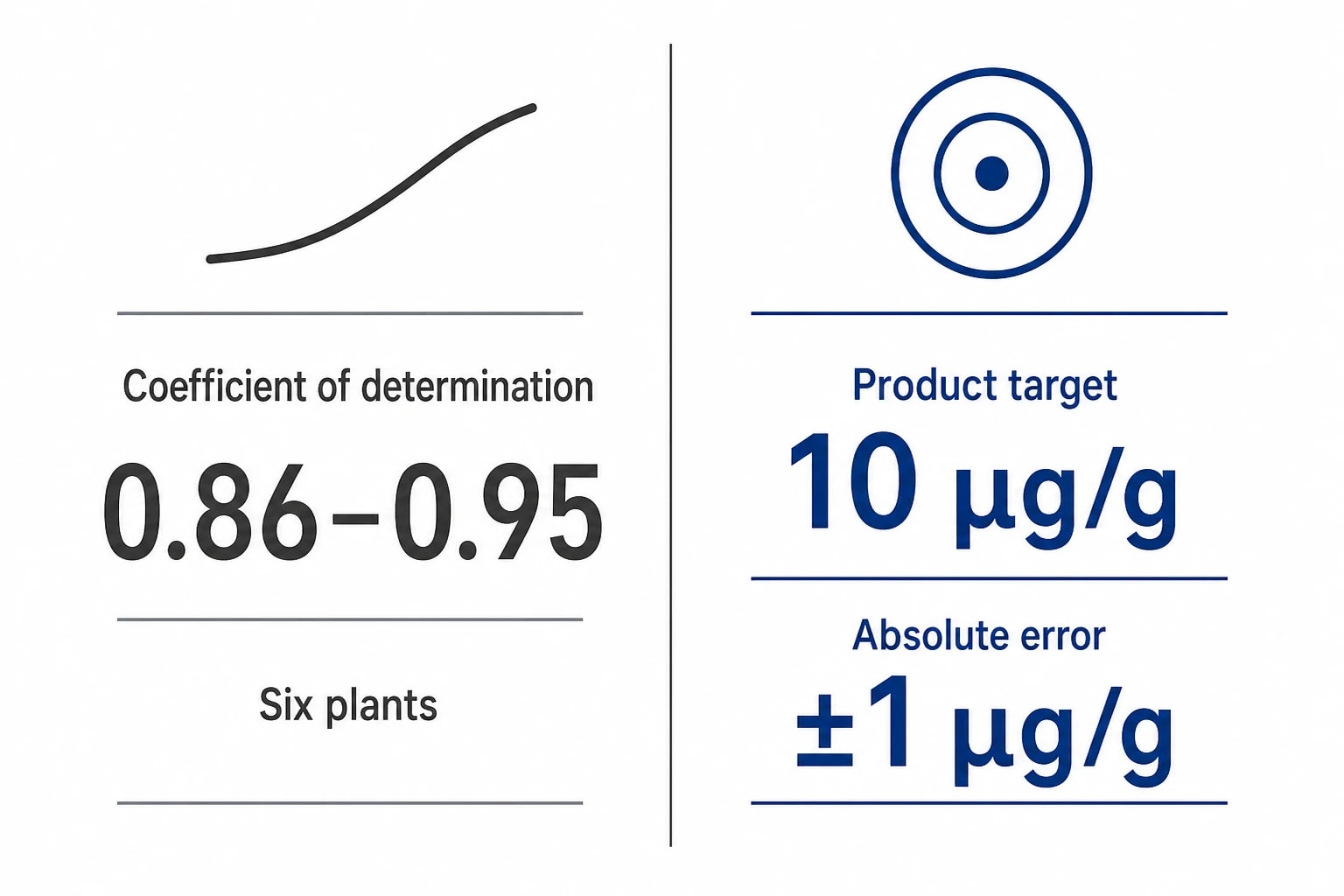
A 2009 industrial VGO study reported sulphur-prediction coefficients of determination from 0.86 to 0.95 across six plants, and weighted average bed temperature values from 0.91 to 0.935. Those results are useful benchmarks for a lumped dynamic model, but coefficient of determination alone does not show whether the model is accurate enough at the sulphur specification.
Validation must test absolute error at the product target, not only goodness of fit across a wide sulphur range.
Set quantitative acceptance criteria before regression
Acceptance limits should reflect analyser and laboratory uncertainty, process risk and the decision being made. They should be agreed before the model is tuned. The following targets offer an evidence-based starting point for a hydrotreater model, then require adjustment to site measurement capability and product specification.
| Validation output | Practical project target | Published reference point |
|---|---|---|
| Overall mass-balance closure | Within ±1.0% of total inlet mass over each accepted steady window | A 2023 refinery mass-balance study reported typical industrial random variation of approximately ±0.67% |
| Product sulphur at low-sulphur specification | Absolute error within ±1 µg/g where the product target is around 10 µg/g | A 2021 fixed-bed residuum model predicted products measured at 10 and 9 µg/g as 10 and 8 µg/g |
| Fresh hydrogen flow | Within ±1% of measured make-up flow | The same 2021 model showed deviations of 0.1 and -0.2 thousand m³/h against 25.0 and 26.1 thousand m³/h |
| Average bed temperature | Within ±2 °C for each modelled bed | The 2021 case reported maximum bed-temperature deviation of 1.8 °C across two operating cases |
| Sulphur mass closure | Reconcile feed sulphur against liquid-product and hydrogen-sulphide sulphur, with residual less than the agreed laboratory uncertainty | Product concentration alone cannot establish whether sulphur inventory and gas separation are represented correctly |
The numerical limits are model-acceptance criteria, not universal hydrotreater design limits. A 10 µg/g product requires an absolute sulphur tolerance because a percentage-only error can disguise a specification failure. A residue product at several thousand µg/g needs a separate limit based on the intended operating decision.
Diagnose residual patterns, not only averages
Systematic error gives the model team a direction for investigation.
Product sulphur that is consistently underpredicted after a VGO blend change points towards feed characterisation, sulphur-lump allocation or unrepresented inhibition. Error that grows with run length points towards deactivation treatment. Accurate overall reactor outlet temperature with poor individual bed temperatures can expose quench mixing, heat-capacity or reaction-distribution errors.
The review should retain rejected data, reasons for exclusion, laboratory timestamps, analyser lag assumptions and the reconciliation result for each accepted period. This makes later feed-change forecasts auditable.
Using Hydrotreater Process Modelling for Feed Changes
Convert an assay change into operating limits
Once validated, the model can run proposed feed blends before they enter the hydrotreater. For each blend, engineers can calculate the reactor inlet temperature required to meet product sulphur, chemical hydrogen consumption, hydrogen sulphide production, bed temperature rise and recycle-gas purity.
The useful output is an operating envelope rather than a single predicted number. It should define charge-rate and temperature ranges that meet the product target while remaining below bed-temperature, heater-duty, quench-flow and hydrogen-availability constraints.
A blend may meet sulphur specification at a higher temperature but consume more hydrogen or reduce remaining catalyst-cycle margin. The model makes that trade-off explicit before the refinery commits to the feed.
Connect reactor performance to the heat and mass balance
Hydrotreater HMB optimisation links reactor severity with the feed-effluent exchanger train, fired heater, recycle compressor and separation section. Higher severity can alter feed preheat, heater duty, quench demand and hydrogen-loop composition. Those effects should remain in the same reconciled model as the sulphur prediction.
The final model package should include:
- A reconciled process flow diagram and stream table
- Feed-assay and pseudo-component assumptions
- Reactor kinetic, activity and wetting assumptions
- Bed-by-bed mass, sulphur, hydrogen and enthalpy balances
- Independent validation cases and acceptance results
- A stated operating range and uncertainty for feed-change forecasts
This article reflects the independent analysis and editorial opinion of EnerTherm Engineering. Product names, trademarks, and brands mentioned belong to their respective owners. EnerTherm Engineering is not affiliated with, endorsed by, or a licensee of any third-party software or product mentioned unless explicitly stated.

Senior Process Engineer — EnerTherm Engineering
Masab Javed is a Senior Process Engineer at EnerTherm Engineering with extensive expertise in chemical process design, decarbonisation, and sustainable industrial solutions. He holds an MSc from TUM School of Management and a BEng in Chemical Engineering from NUST, with experience spanning ammonia production, CO2 capture, and semiconductor manufacturing optimisation.
