How Waste Heat Recovery Cuts Gas Use in UK Food Plants
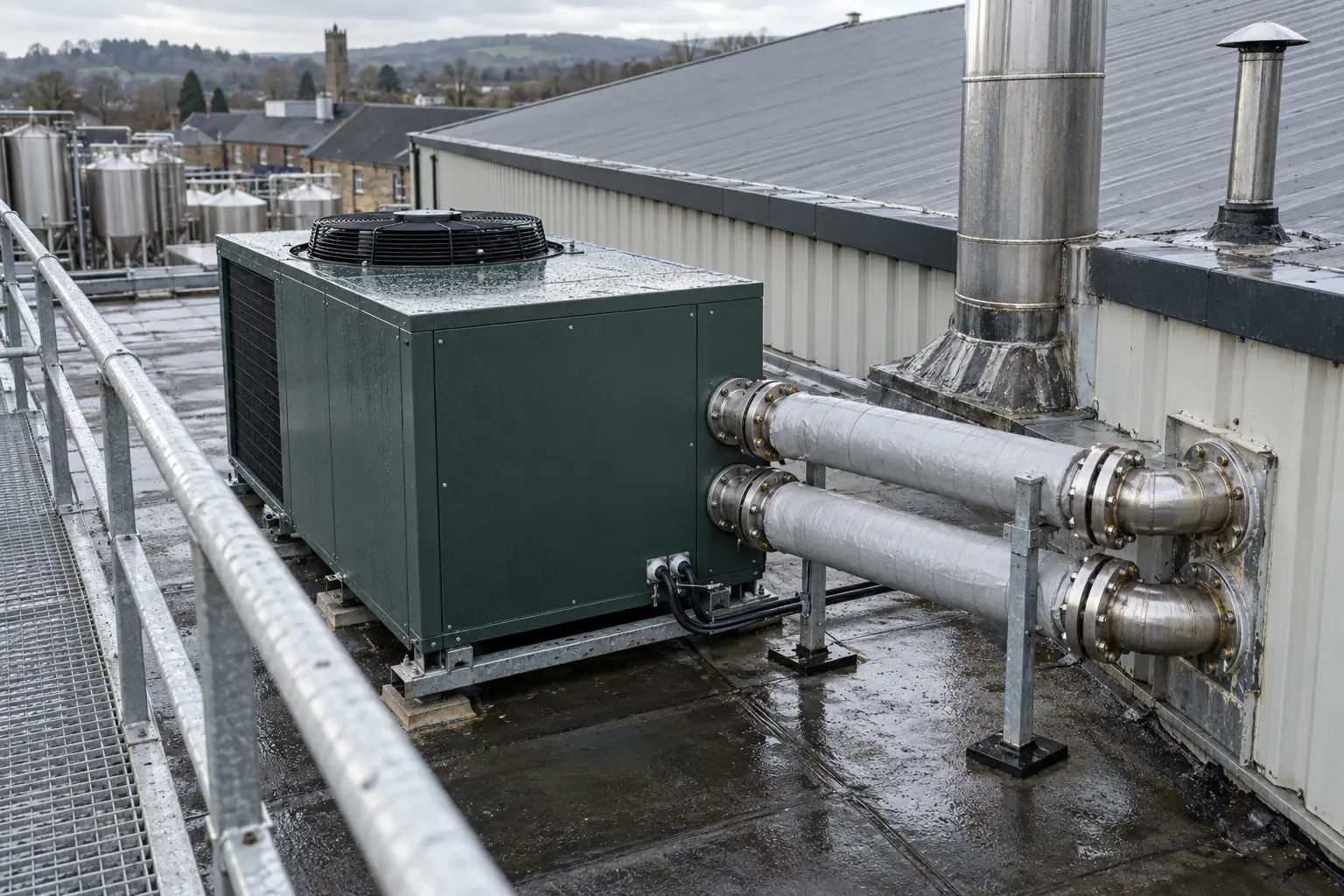
A UK brewery upgrades 100°C wort-boil heat to 130°C, returning up to 300 kWt.
Waste heat recovery in food processing captures and reuses heat that would otherwise leave a plant through refrigeration condensers, oven exhausts, steam systems, hot product streams or wastewater. A UK brewery demonstration showed the potential: heat from wort vapour at 100°C was upgraded and returned to the brewing process at up to 300 kWth.
For food and beverage sites, every kilowatt-hour of useful recovered heat is a kilowatt-hour that a gas boiler, oil boiler or steam system does not need to supply. The engineering challenge is to match the temperature, timing, hygiene requirements and production profile of each heat source with demand.
Dairies, bakeries, breweries and prepared-food factories are well suited to this work. They often operate cooling and heating systems in parallel. Refrigeration removes heat from milk, beer, ingredients and cold stores while boilers generate steam or hot water for pasteurisation, cooking, cleaning-in-place and washdown. Pinch Analysis identifies where those streams can be brought together before a plant burns more fuel.
Why waste heat recovery matters in food processing
Food factories use heat for repeated duties: raising product temperature, maintaining process vessels, producing hot water, supplying steam, cleaning equipment and drying product. Much of that heat then leaves the process.
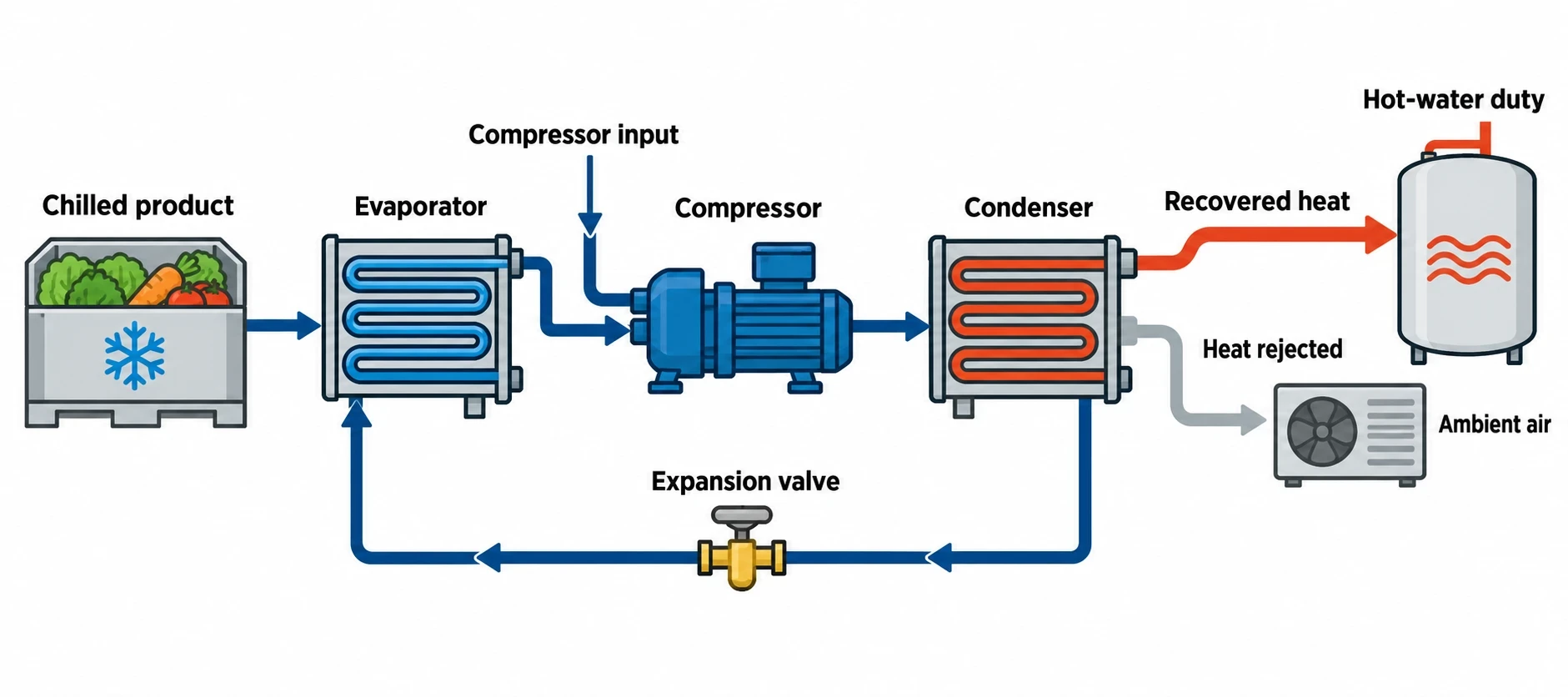
A refrigeration system illustrates the opportunity. The evaporator removes heat from a chilled product or space, while the condenser rejects that heat, plus compressor input, to ambient air or cooling water. If the site also needs hot water, the condenser is a potential heat source rather than a heat-rejection problem.
The same principle applies elsewhere:
- Oven exhaust can preheat combustion air, incoming process water or make-up air where contamination risk is controlled.
- Boiler blowdown and flue gases can preheat boiler feedwater or process water.
- Condensate can return sensible heat and treated water to the boiler house.
- Hot pasteurised product can preheat cold incoming product through regeneration.
- Wort vapour can provide heat for hot-water duties or supply a high-temperature heat pump.
- Warm wastewater may support a heat pump where the duty, fouling risk and treatment arrangements are suitable.
The objective is not to collect heat indiscriminately. A food plant needs useful heat at the right temperature, in the right place and at the right time. Heat available at 35°C may preheat water or support a heat pump, but it will not directly replace steam for a 125°C cooking process.
Gas savings depend on the whole heat system. A sound project reduces boiler firing, steam losses or gas-fired hot-water generation. It does not simply shift heat around while boiler controls and operating practice remain unchanged.

Pinch analysis identifies the thermodynamic minimum energy requirement of your process — then designs the heat exchanger network to achieve it.
Where food plants find recoverable heat
Refrigeration condensers and chilled-process loads
Refrigeration is often the first area to investigate in dairy, brewery, prepared-food and cold-chain operations. Condensers reject heat continuously while plants need hot water for cleaning, crate washing, defrosting or process preparation.
A heat-recovery condenser or desuperheater can recover higher-grade heat from compressor discharge. A heat pump can then raise lower-temperature condenser heat to a useful hot-water temperature. The best arrangement depends on refrigerant type, compressor operating conditions, heat-demand profile and required delivery temperature.
The Food, Drink and Milk BREF records a UK dairy example in which an ammonia heat pump recovered refrigeration heat for pasteurisation. More recent dairy research has examined ammonia heat-pump integration to preheat cleaning-in-place fluids and reduce steam demand.
Pasteurisation and hot product streams
Regeneration is established practice in continuous pasteurisation. Warm outgoing product transfers heat across a plate or tubular heat exchanger to colder incoming product. The incoming stream then reaches the final heater at a higher temperature, reducing the steam or hot-water duty.
Dairy plants require close attention to product separation, pressure balance, cleanability and validation. The heat exchanger must suit the product. Plate heat exchangers offer high heat-transfer performance for many liquid duties, while tubular heat exchangers may suit viscous, particulate or fouling products.
Commission Implementing Decision (EU) 2019/2031 identifies regenerative heat exchange in pasteurisation as a dairy energy-efficiency technique. It describes incoming milk being preheated by warm milk leaving pasteurisation.
Steam, condensate and boiler-house losses
Steam systems still supply much of the process heat in UK food manufacturing. They also offer several recovery routes:
- Returning clean condensate reduces boiler fuel demand and water-treatment demand.
- Flash steam can serve lower-pressure users when nearby demand exists.
- Boiler blowdown heat can preheat make-up water through a heat exchanger.
- Economisers can recover flue-gas heat into boiler feedwater.
- Steam-distribution surveys can expose leaking traps, uninsulated valves, pressure-reduction losses and oversized pressure levels.
These measures reduce the heat load that a larger recovery project must serve. They also create a better baseline for evaluating future heat-pump integration.
Oven, fryer and thermal-process exhaust
Bakery and prepared-food sites may have substantial exhaust heat from ovens, fryers, dryers and thermal oxidisers. Exhaust temperatures can look attractive, but fouling, grease, moisture, fire risk, cleaning access and odour control determine whether recovery is practical.
Indirect recovery is often preferred. A heat exchanger transfers heat into a closed intermediate loop, which can then preheat water or air without placing a food-contact or clean utility directly in the exhaust path. Design teams must assess condensate formation and corrosive conditions before selecting materials and heat-exchanger geometry.
How Pinch Analysis directs waste heat recovery
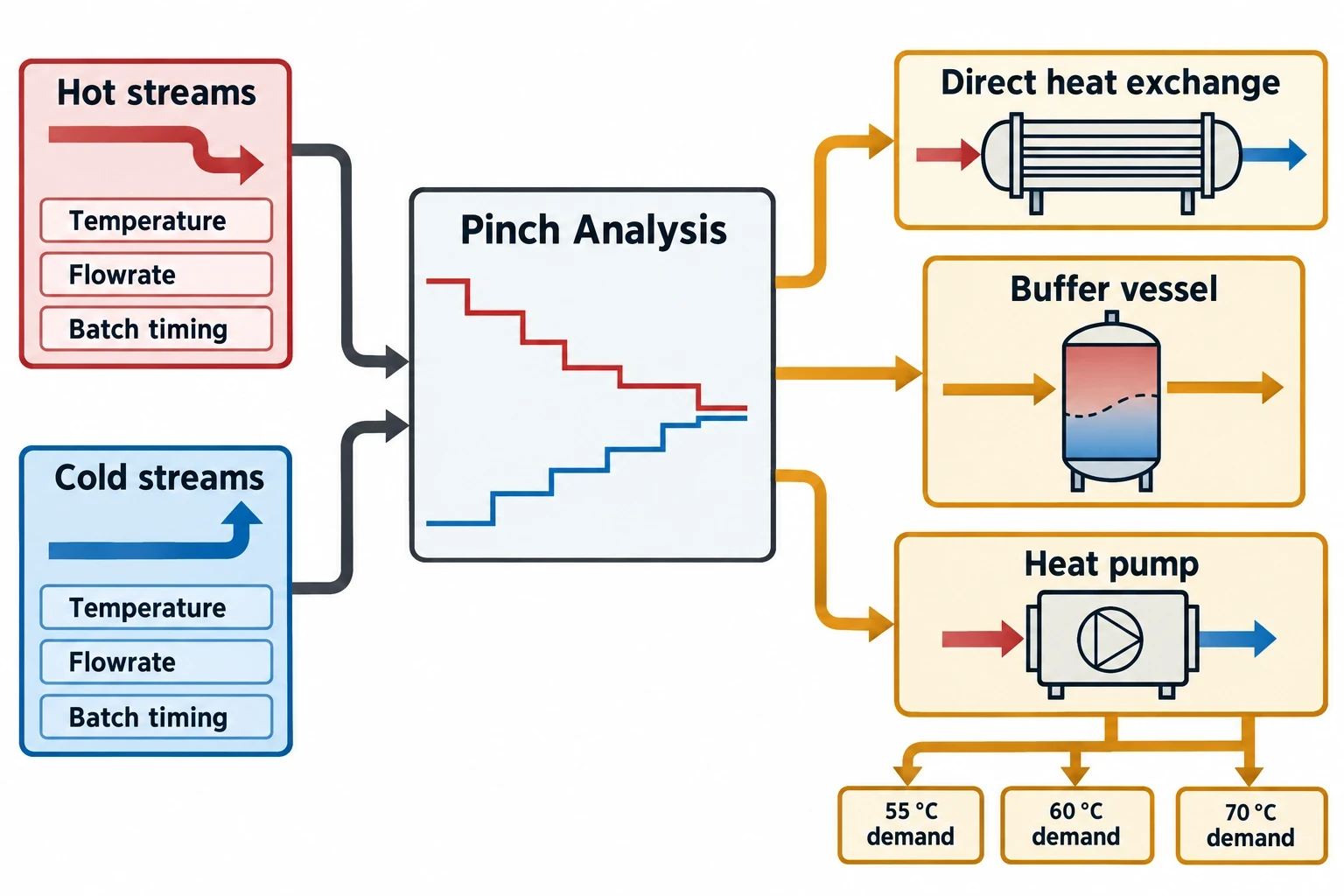
Pinch Analysis turns an energy survey into a structured heat-integration design. It maps hot streams that require cooling and cold streams that require heating, using actual temperatures, flowrates, operating hours and batch timings.
The output establishes the practical heat-recovery target before engineers select a heat exchanger, thermal store or heat pump.
Start with a reliable stream inventory
A useful stream list includes more than nameplate data. It should record:
- Supply and target temperature for each hot and cold stream.
- Flowrate, product characteristics and phase change.
- Hours of operation, batch sequence and seasonal variation.
- Existing utility used for heating or cooling.
- Fouling, cleaning and food-safety constraints.
- Location, pipe route and access restrictions.
- Whether the duty is continuous, intermittent or present only during cleaning.
Temporary metering is often necessary. A steam meter may show that cleaning demand occurs in short peaks while refrigeration heat is available steadily. That mismatch does not rule out recovery. It may point to a hot-water buffer vessel, an altered cleaning schedule or a different target duty.
Match direct recovery before adding temperature lift
Direct heat exchange usually uses the least energy because it moves heat without compressor work. A hot product stream can preheat a cold product stream. Condensate can preheat feedwater. Oven exhaust can preheat an intermediate water circuit.
A heat pump becomes attractive where a sound heat source exists but a temperature gap prevents direct use. It extracts heat from the source and uses electricity to raise the delivery temperature. Performance falls as the temperature lift rises, so the design should reduce unnecessary delivery temperature wherever process requirements allow.
A plant should first assess whether a 55°C hot-water demand can replace part of a 60°C or 70°C demand. Supplying that duty directly or with a moderate-temperature heat pump may displace more gas per pound invested than producing high-pressure steam.
Treat time as an engineering variable
Food production is often batch-based. Brewing, cooking, cleaning-in-place, shift changes and defrost routines create peaks that a steady-state process diagram can miss.
Thermal storage connects the timing of a heat source and sink. A buffer vessel can capture condenser heat during refrigeration operation and release it when the plant starts a cleaning cycle. Storage also allows a heat pump to run for longer periods at stable load rather than cycling against short demand spikes.
Storage temperature affects usable capacity. A tank charged to a higher temperature can serve more demanding uses, but a higher heat-pump delivery temperature can reduce efficiency. Pinch Analysis establishes the best site-specific compromise.
Selecting the right recovery technology
Direct heat exchangers
Direct recovery commonly uses plate-and-frame, shell-and-tube or tubular heat exchangers. Selection must account for product viscosity, suspended solids, pressure, fouling, cleanability and the required separation between streams.
For milk, beverages and process water, plate heat exchangers can support close temperature approaches and are widely used in regeneration. For viscous sauces, particulate food and difficult fouling duties, tubular heat exchangers may offer better cleanability and lower blockage risk.
The heat exchanger is only part of the project. Isolation arrangements, bypasses, instrumentation, cleaning procedures and inspection access determine whether recovery remains available through years of production.
Heat pumps and high-temperature heat pumps
Heat pumps suit situations where recovered heat is below the target process temperature. Condenser heat from refrigeration may be raised for hot-water systems. Higher-temperature heat pumps can serve more demanding duties, including some steam and process-heating applications.
The Hepworth Brewery demonstration in West Sussex provides a useful UK reference point. The project recovered 100°C wort-boil waste heat, raised it to 120°C and returned up to 300 kWth to the process. Its initial project profile projected an approximate 80% reduction in energy consumption and at least an 80% reduction in carbon emissions for the targeted duty, with anticipated fuel-cost savings of around 35%.
Later operational reporting described consistent steam output at 125°C and an 85.8% energy saving for the kettle-boiling process compared with the existing fuel-oil boiler. These results are project-specific. Source temperature, load factor, electricity price, boiler efficiency and annual running hours determine the result at each site.
Thermal stores and heat-distribution networks
A recovery project can fail commercially if it ignores distribution. A heat pump may produce efficient 75°C water, yet the nearest viable demand may sit behind a steam-only system or across a congested production area.
A low-temperature hot-water network can create useful sinks for recovered heat, including cleaning-water preheat, process-water heating, space heating and low-temperature process duties. Heat exchangers can separate the new circuit from legacy process systems. Thermal stores absorb short-term variation and reduce compressor cycling.

Pinch analysis identifies the thermodynamic minimum energy requirement of your process — then designs the heat exchanger network to achieve it.
Food safety, hygiene and operational resilience
Waste heat recovery projects in food processing must protect product integrity as well as reduce gas use. That requirement shapes the scheme from the first concept.
Separate streams where risk requires it
Product and utility streams need suitable physical separation. Indirect loops, double-wall heat exchangers, pressure control, leak detection and appropriate drainage can reduce cross-contamination risk. The final arrangement depends on the product, duty, local food-safety plan and site procedures.
Equipment must tolerate cleaning-in-place chemicals, operating temperatures and repeated thermal cycling. A design that saves energy but cannot be cleaned, inspected or maintained during planned shutdowns will quickly lose value.
Protect production availability
A recovery system should not leave a pasteuriser, cooker or cleaning operation without heat when a pump, heat exchanger or buffer vessel is unavailable. Plants commonly retain existing boilers or provide backup arrangements to meet production and hygiene requirements.
Controls should prioritise product temperature, process safety and cleaning performance. Recovery equipment can then operate within those constraints. Commissioning should include minimum and maximum production loads, cleaning cycles, refrigeration changes and planned utility outages.
Measure useful heat, not only electricity
Metering should distinguish recovered heat delivered to a real process from heat circulated around a loop without useful displacement. A credible measurement plan records:
- Heat delivered to the defined sink.
- Electricity used by compressors, pumps and auxiliary equipment.
- Gas or steam reduction at the affected utility.
- Source and sink temperatures.
- Runtime, load factor and periods of bypass.
- Production volume and product mix.
This creates a fair before-and-after comparison. It also identifies performance drift caused by fouling, altered schedules, control changes or an expanding production load.
UK regulatory and energy-management context
For larger regulated food, drink and milk installations, Commission Implementing Decision (EU) 2019/2031 remains relevant in UK environmental permitting. GOV.UK states that European Commission BAT reference documents published before 1 January 2020 apply in the UK.
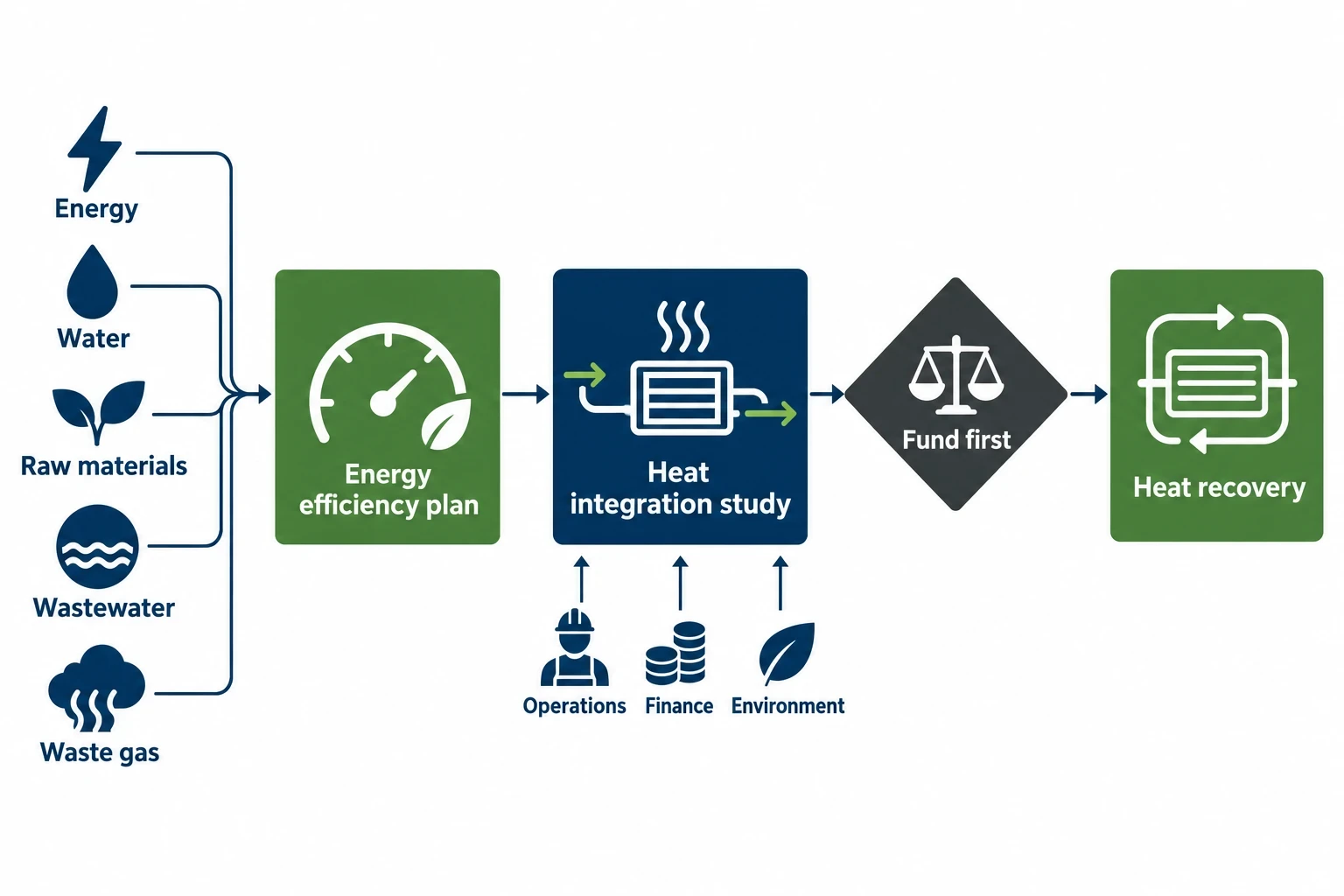
The Food, Drink and Milk BAT Conclusions require an energy-efficiency plan within the environmental management system. The plan includes defining and calculating specific energy consumption, setting annual key performance indicators and planning periodic improvement targets. BAT 7 lists heat recovery using heat exchangers or heat pumps, including mechanical vapour recompression, among common energy-efficiency techniques.
This does not mean every site needs the same technology. It does mean engineering managers should maintain an evidence-based view of energy use, heat losses and recovery opportunities. A current inventory of energy, water, raw materials, wastewater and waste-gas streams is part of that evidence.
A documented heat-integration study gives operations, finance and environmental teams a common basis for deciding which gas-saving project to fund first.
A practical route from survey to gas savings
The strongest projects begin with a defined target: reduce gas consumption in a pasteuriser hot-water circuit, cut boiler firing during cleaning-in-place, or replace part of steam demand at a brewery kettle. The work then follows a disciplined sequence.
- Establish the baseline using fuel, steam, electricity, production and temperature data.
- Identify hot and cold streams, including batch timings and standby conditions.
- Apply Pinch Analysis to establish direct-recovery opportunities and the remaining utility targets.
- Test heat-pump options only after identifying the lowest viable delivery temperature.
- Assess hygiene, fouling, maintainability, pipe routes, utility resilience and production constraints.
- Build the financial case from measured useful heat, realistic runtime and displaced boiler fuel.
- Commission with metering, clear operating procedures and a seasonal performance review.
The first viable project may be modest: condensate return, refrigeration heat recovery into preheat water, or improved pasteuriser regeneration. These measures reduce the thermal burden on the boiler house and produce the operating data needed for larger electrified-heat projects.
This article reflects the independent analysis and editorial opinion of EnerTherm Engineering. Product names, trademarks, and brands mentioned belong to their respective owners. EnerTherm Engineering is not affiliated with, endorsed by, or a licensee of any third-party software or product mentioned unless explicitly stated.

Managing Director — EnerTherm Engineering
Dr. François Pierrel is Managing Director of EnerTherm Engineering with over two decades of expertise in thermal design, heat transfer, and industrial energy optimisation. He holds a PhD in Heat Transfer from Cranfield University and a Post-Doctorate from Heriot-Watt University.
