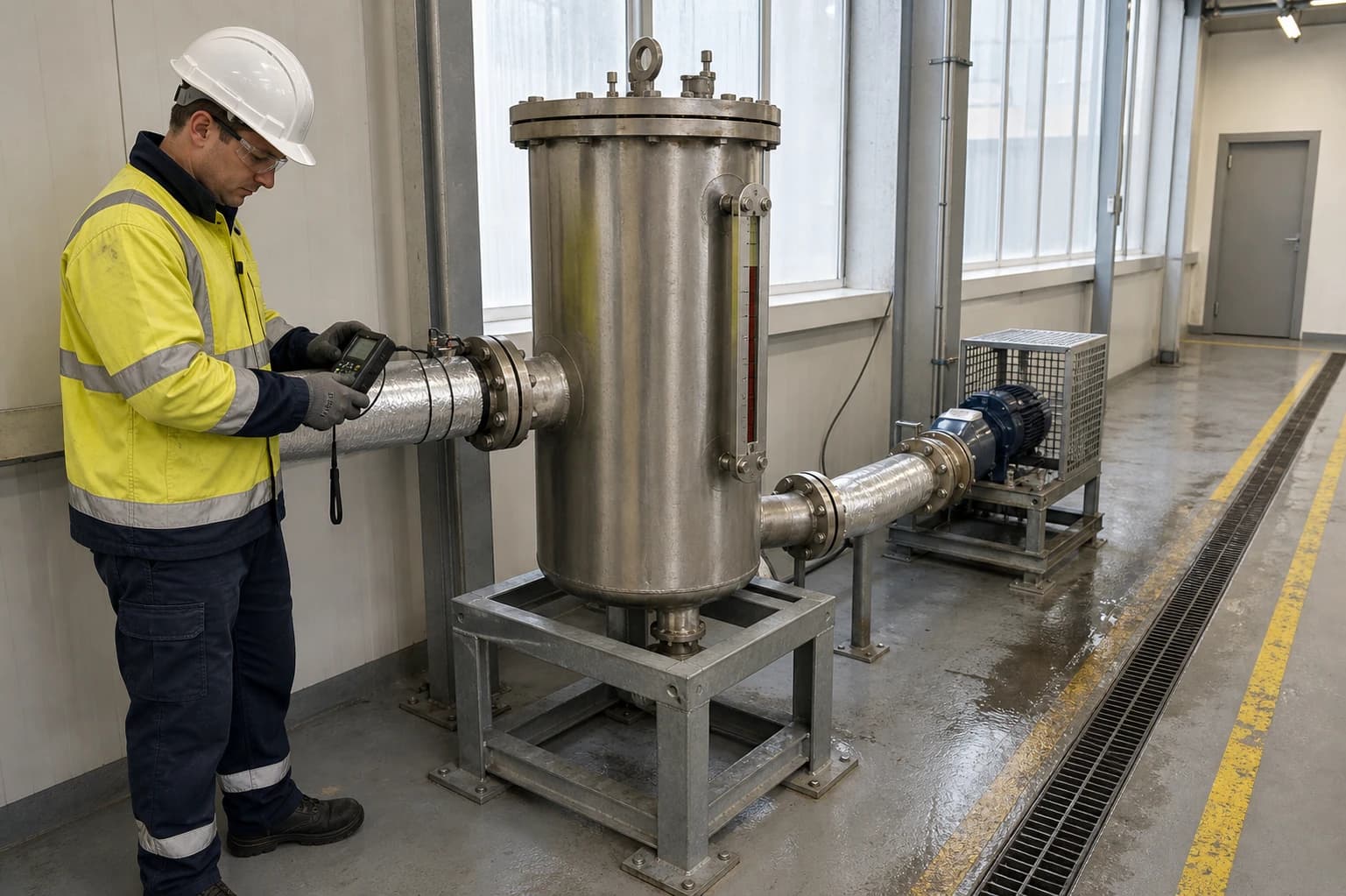
Food Processing Plant Energy Audits: Find Steam Losses
How UK sites assess steam, refrigeration, ovens and compressed air under ESOS.
An energy audit of a food processing plant is a structured examination of fuel, heat and electricity use that identifies practical reductions while protecting food safety, validated process conditions and production output. For UK large undertakings, the ESOS Phase 4 notification deadline is 5 December 2027. The engineering value lies in tracking steam from boiler outlet to condensate return, rather than treating gas consumption as a single unexplained number.
Steam losses often sit outside routine production reporting. A cooker may reach its setpoint, a CIP programme may pass validation and a retort may maintain temperature while live steam escapes through a failed-open trap, an unnecessary bypass or a leaking valve gland. Condensate may reach a drain instead of the boiler feedtank. Excess pressure may serve low-temperature duties that need far less.
Those conditions increase boiler firing without adding value to the product. A well-scoped energy audit food processing plant programme separates productive steam demand from distribution loss, poor condensate management and avoidable heat rejection. It also provides the measured process data needed to set credible Pinch Analysis targets.
Why steam losses distort food processing energy performance
Steam provides predictable, controllable heat for blanching, cooking, pasteurisation, sterilisation, evaporation, washdown, CIP, air-handling coils, ovens and hot-water generation. Yet a site-level gas meter cannot show which duties consumed the energy.
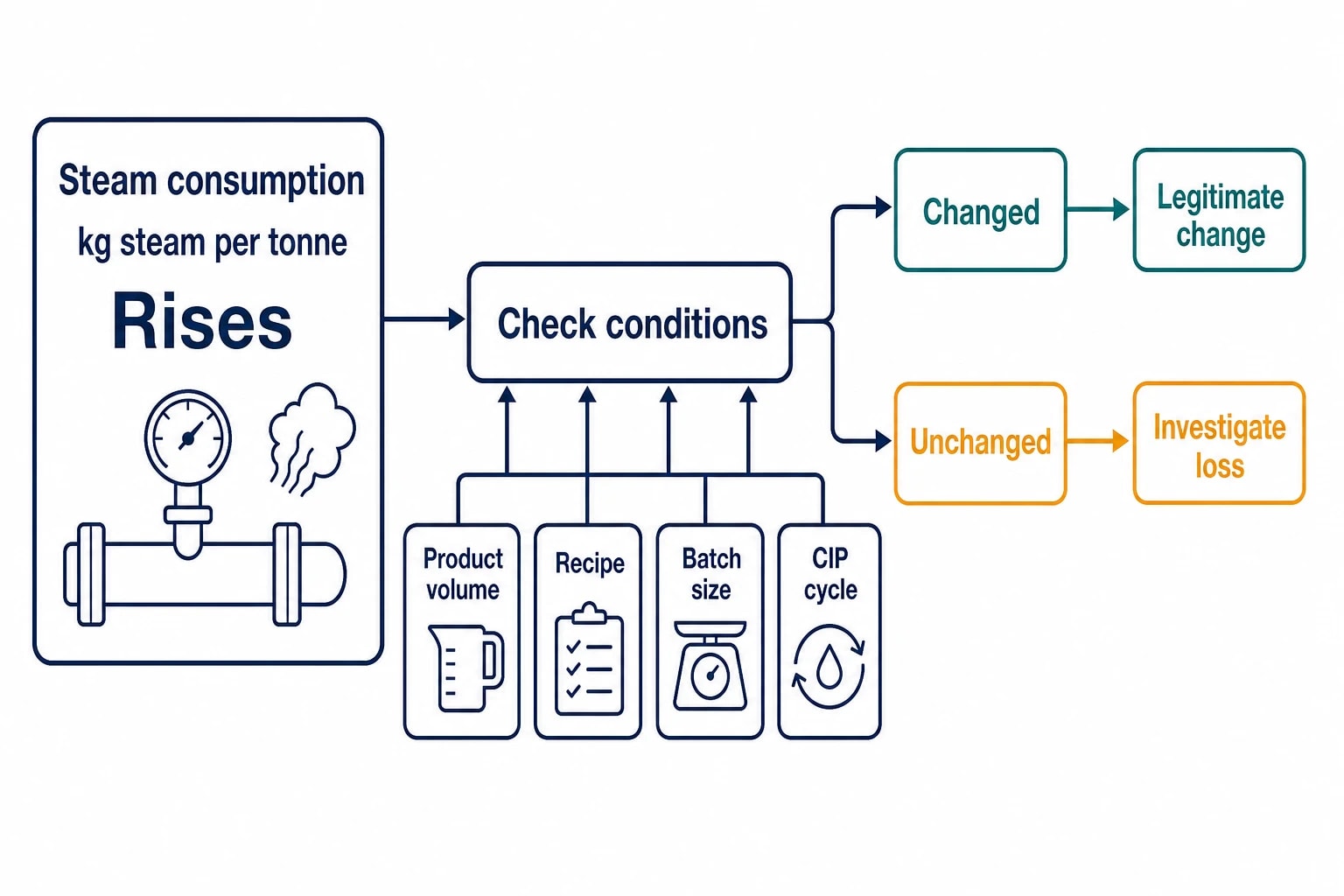
A monthly rise in gas use may reflect higher output, a changed product mix, colder incoming water, extra sanitation cycles or higher steam loss. An audit must separate these drivers before proposing a boiler replacement, heat-recovery project or lower-carbon heat source.
Commission Decision (EU) 2017/1508 identifies process-level metering, regular energy audits and management of heat, cold and steam demand as food and beverage best environmental management practice. Its indicators provide a practical structure for the baseline.
| Audit measure | Unit or basis | Audit question |
|---|---|---|
| Overall energy use per product unit | kWh per tonne, litre, case or other stable unit | Has energy intensity changed at comparable output? |
| Energy use for specific processes | kWh per process or production area | Which process has the highest thermal demand? |
| Steam consumption | kg steam per tonne or batch | Does the process use more steam than its operating profile indicates? |
| Condensate return | Percentage of generated condensate or m³ per shift | Where is treated hot water failing to return? |
| Refrigeration COP, COSP or EER | System performance measure | Has cooling efficiency changed independently of production? |
| Refrigeration energy | kWh per cooled area or product unit | Is cooling demand proportionate to throughput and storage use? |
Establish a baseline that production teams can use
Choose an output denominator that represents the thermal process. Tonnes of finished product suit many sites, but can mislead mixed-product factories. A bakery producing both high-moisture bread and dry biscuits may need line-specific measures. A dairy may need separate measures for milk intake, litres filled and tonnes of powder.
Where ESOS audit requirements apply, the baseline should cover at least 12 months using verifiable meter and purchasing data. It also needs operational context:
- Product volumes, recipes and batch sizes.
- Incoming and final product temperatures.
- Production shifts, shutdowns and seasonal campaigns.
- CIP frequency, duration and water temperatures.
- Boiler blowdown, feedwater use and condensate return.
- Refrigeration load, ambient conditions and cold-store occupancy.
- Maintenance events affecting boilers, traps, pumps and valves.
This context turns an energy graph into an engineering record. A rise in steam per tonne after a recipe change may be legitimate. The same rise with unchanged product conditions requires investigation.

Pinch analysis identifies the thermodynamic minimum energy requirement of your process — then designs the heat exchanger network to achieve it.
Map steam from the boiler to the return system
A steam audit should follow the physical route during normal production, from fuel input to final condensate destination. Boiler combustion efficiency remains relevant, but boiler-house data alone cannot identify distribution and end-use losses.
Set a clear thermal boundary
The asset map should include boiler fuel, feedwater, blowdown, steam headers, pressure-reducing stations and distribution mains. It should extend to process users including jacketed vessels, plate heat exchangers, cookers, blanchers, retorts, ovens, dryers and hot-water generators.
The return side requires equal attention. Record drip legs, separators, steam traps, condensate pumps, flash vessels, receiver vents, return lines and drains. A drain receiving hot condensate represents a measurable loss of energy, water-treatment chemicals and recovered boiler feedwater.
Tag each asset with its process, pressure level, operating hours and isolation arrangement. A plant drawing may not reflect changed pipework, bypasses or removed process equipment, so field verification matters.
Inspect insulation, leaks and pressure reduction
Uninsulated valves, flanges, strainers and short pipe sections lose heat throughout the shift. Damaged or waterlogged insulation also performs poorly. The audit record should identify pipe size, line pressure, surface condition, insulation condition, service hours and whether removable covers exist for routine maintenance.
Treat recurring defects as a system issue rather than a list of isolated repairs. Repeatedly missing valve covers may indicate that specified covers are difficult to refit, maintenance access is poor or responsibility is unclear after shutdown work.
Steam leaks need direct observation during operation. Visible plumes at flange joints and valve glands are straightforward, but small leaks can disappear in humid production areas. Acoustic inspection and targeted observation help identify them. Record the leak location, upstream pressure, estimated operating hours and whether production permits isolation.
Pressure-reducing stations need process scrutiny. A high-pressure header may be necessary for a particular duty, while hot-water generation or lower-temperature vessels operate more effectively from a lower-pressure supply. Excess downstream pressure raises flash-steam generation, increases trap loading and can destabilise temperature control.
Find live-steam loss through traps, bypasses and condensate faults
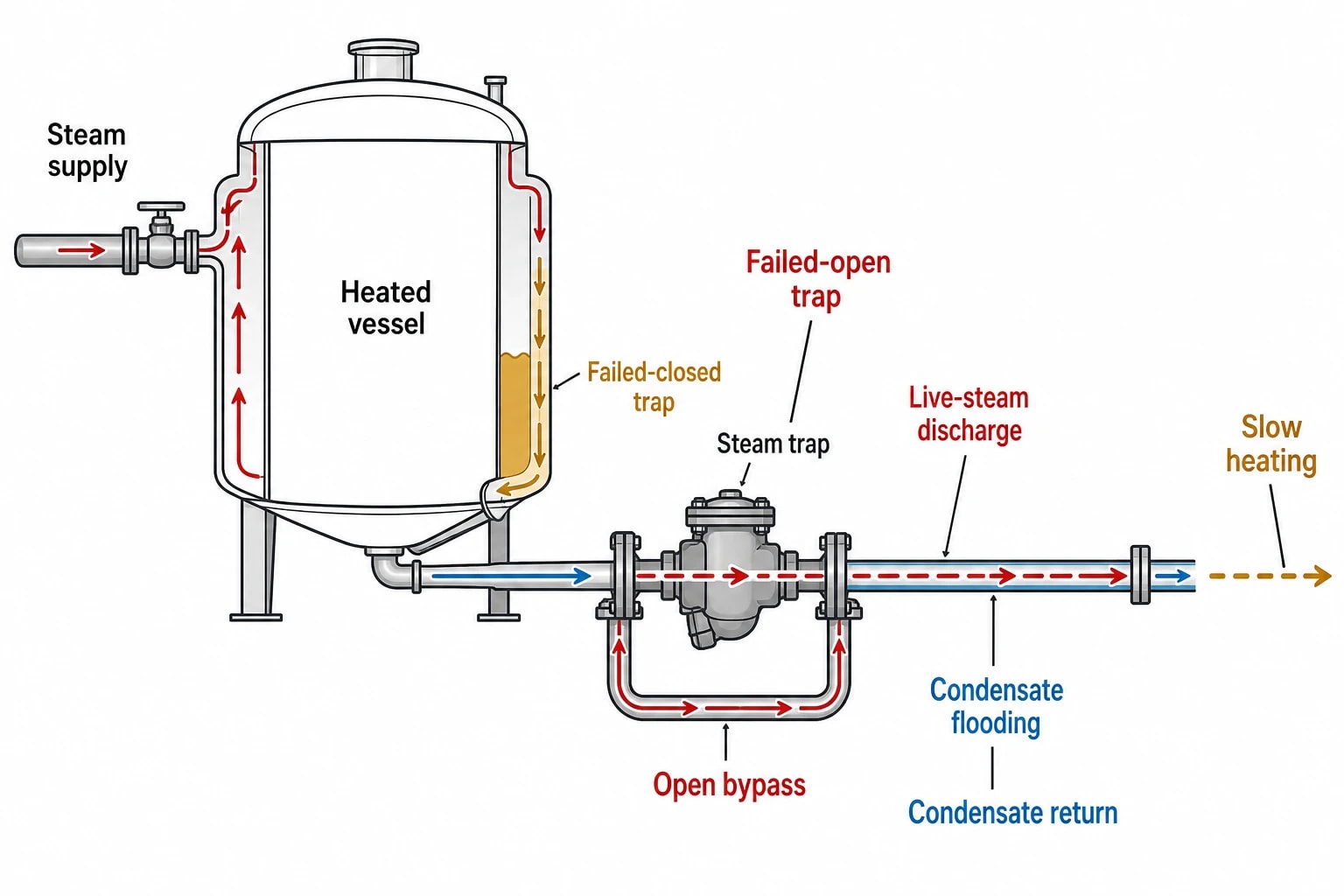
Steam traps remove condensate and non-condensable gases while restricting the passage of live steam. Their performance affects energy use, heat-transfer rate and process consistency.
A failed-open trap can release live steam to the condensate system. A failed-closed trap can flood a heat exchanger or vessel jacket, reduce heat transfer and cause slow heating. Both faults affect energy performance, though operators often identify the second through poor temperature control.
Build a steam-trap survey that supports repair decisions
A survey needs more than a pass-or-fail label. It should capture the process consequence and support a retest after repair.
- Record the asset identification, location and process served.
- Identify trap type, nominal size and operating pressure.
- Record the inspection method, such as ultrasonic, temperature or visual assessment.
- Note upstream and downstream temperature observations where meaningful.
- Record evidence of live-steam discharge, blockage, leakage, waterhammer or inadequate drainage.
- Assign a repair action, completion date and retest requirement.
Prioritise continuous duties, high-pressure headers, large process vessels and food-safety-critical heating processes. A trap serving a continuously heated vessel has a different energy exposure from one serving a short intermittent batch.
Check bypasses and drainage arrangements
An open bypass around a functioning trap can pass steam directly into the condensate line. Audit teams should trace and physically check bypass valve position rather than relying on drawings or valve tags.
Poor drainage creates a different problem. Low points without suitable drip legs, undersized condensate pumps, failed pump controls and blocked return lines can cause flooding and waterhammer. These faults damage equipment, reduce heat transfer and increase operator intervention.
Condensate return deserves a quantified review. Compare boiler feedwater flow, condensate flow and known process losses by shift. A sudden reduction in returned condensate at stable steam generation indicates a changed discharge route, a trap fault, a failed pump or a system overflow. The audit should locate the cause before estimating a heat-recovery project.
Measure steam demand at process level
The boiler main provides the site total. Temporary or permanent sub-metering identifies where the steam goes. The highest-value meter positions are major production areas and thermal processes with substantial operating hours.
Match utility data with production events
Log steam flow, pressure, boiler firing, feedwater flow, condensate return and gas use. Match them to batch start times, line speed, product temperature, CIP cycles and shutdowns.
This reveals conditions that annual gas data conceals:
- Steam demand that continues between batches because a vessel remains hot or an isolation valve passes.
- Peak demand caused by simultaneous CIP cycles, producing boiler cycling and avoidable peak capacity.
- A header pressure held for one difficult duty while many users require lower-temperature steam.
- Reduced condensate return during a shift with unchanged product output.
- Steam use rising during a thermal hold because a control valve hunts around setpoint.
Trend control-valve position against process temperature and steam flow. A poorly sized valve or unstable control loop can alternate between overheat and underheat, wasting steam and increasing process variability. The audit must maintain validated temperature limits while identifying the extra heat needed to overcome poor control.

Pinch analysis identifies the thermodynamic minimum energy requirement of your process — then designs the heat exchanger network to achieve it.
Recover heat only after reducing avoidable steam demand
Pinch Analysis evaluates the relationship between temperature and heat flow in hot and cold process streams. In food manufacturing, the energy audit provides the measured temperatures, flow rates, operating periods and hygiene constraints that make the analysis useful.
Create a practical hot and cold stream list
Typical hot streams include condensate, flash steam, refrigeration condenser heat, cooker discharge, pasteuriser cooling sections, oven exhaust and dryer exhaust. Cold streams may include boiler feedwater, process make-up water, CIP water, product preheating duties and space-heating circuits.
For each stream, record:
- Supply and target temperature.
- Flow rate or duty rate.
- Hours of availability by shift, day and production campaign.
- Fouling, cleaning and contamination constraints.
- Existing heat exchanger arrangement.
- Whether the source and sink run at the same time.
Annual heat alone does not establish a project. A source producing 300 kW for two hours after a batch cannot meet a continuous 100 kW hot-water demand without storage or a changed operating schedule.
Use the pinch target before selecting equipment
A Pinch Analysis target establishes the minimum external heating and cooling requirement for defined process streams and temperature assumptions. It prevents a visible heat source from attracting capital while a better source-sink match remains unexplored.
Steam-loss repairs should usually precede major recovery equipment. Restoring insulation, repairing traps, closing bypasses and reducing unnecessary pressure lowers the heat load that a new heat exchanger would otherwise serve. The resulting system may require smaller pipework, pumps and heat-transfer area.
The design brief must retain food-safety and operability requirements. Heat exchangers contacting process or CIP streams need a cleanable arrangement. Utility and product circuits need separation appropriate to contamination risk. Isolation, drainage, inspection and cleaning access should form part of the energy project specification.
Use refrigeration heat against a defined steam or gas duty
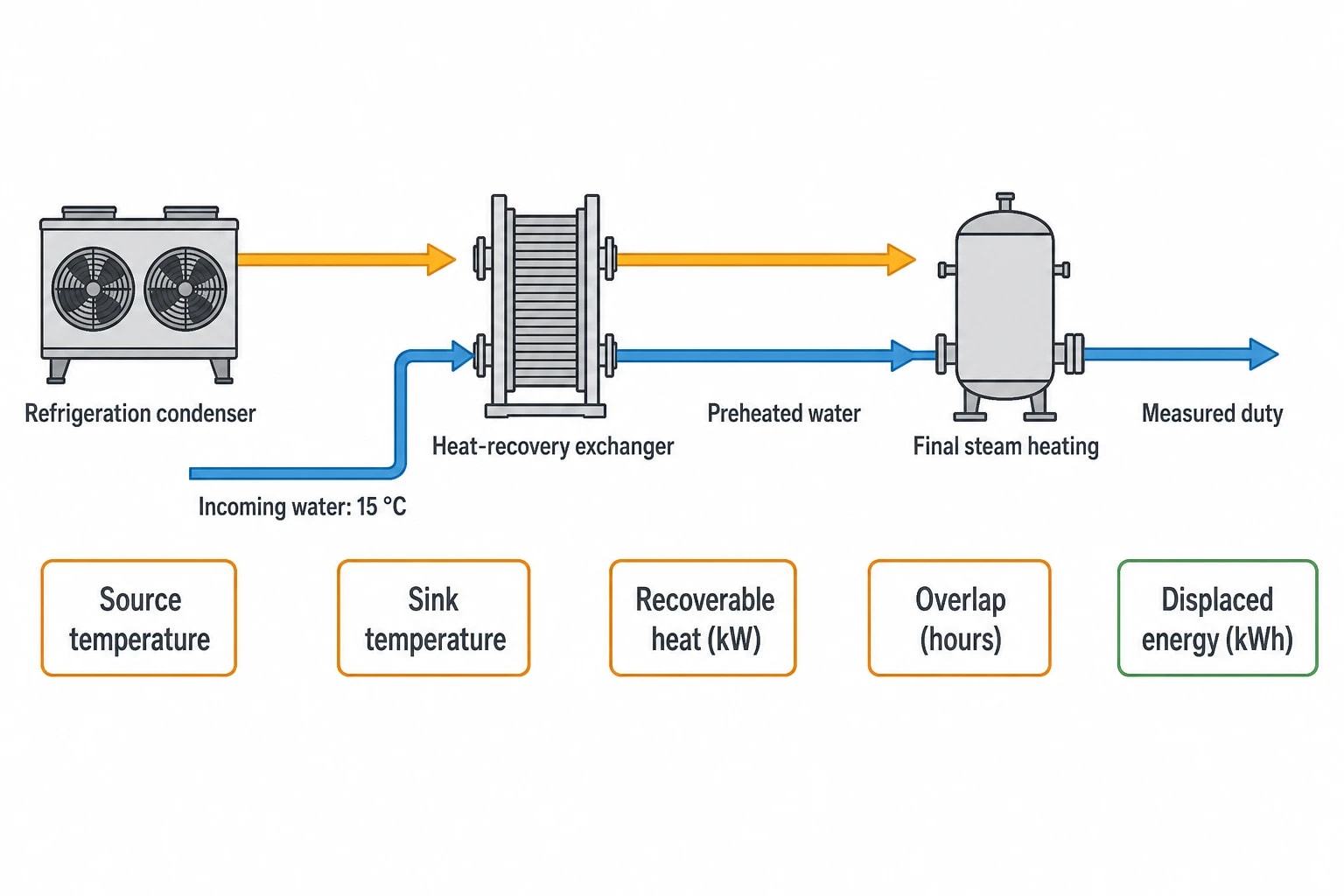
Refrigeration waste-heat recovery is a food-sector best practice under Commission Decision (EU) 2017/1508. Its value depends on measured source temperature, sink temperature, operating overlap and the steam or gas duty displaced.
Quantify the recoverable heat opportunity
The audit should meter or calculate the refrigeration condenser heat rate over representative production periods, then identify the heat available above the required sink temperature. It should compare this with a measured hot-water, CIP or feedwater-heating duty.
A useful project calculation needs four results:
- The recoverable heat rate in kW at the available source temperature.
- The required sink temperature and its hourly or batch demand in kW.
- The number of operating hours when source and sink overlap.
- The annual displaced steam, gas or electricity in kWh.
For example, a condenser heat source may preheat incoming water from 15 °C to an intermediate temperature before final steam heating. The verified saving is the reduction in metered steam or boiler fuel for the same water volume, inlet temperature, outlet temperature and production schedule. It is not the full refrigeration heat rejection unless the sink accepts and uses it.
Report refrigeration COP, coefficient of system performance or EER alongside kWh per cooled area or product unit. A falling COP may indicate that refrigeration changes, rather than steam losses, drive the site’s energy intensity.
Turn the audit into a verifiable steam-reduction programme
For ESOS participants, significant energy consumption must account for at least 95% of total energy consumption. Current UK guidance states that Phase 4 requirements and the reporting system are planned for publication before the 5 December 2027 notification deadline.
PAS 51215-1:2025 is a voluntary specification for the energy and decarbonisation assessment process. PAS 51215-2:2025 sets voluntary competence requirements for lead assessors and assessment teams using that process. They provide a useful framework for an audit that distinguishes immediate steam-loss repairs from longer-term heat-recovery and decarbonisation work.
Specify savings and verification before approval
Each action should state its predicted annual fuel reduction in kWh, steam reduction in tonnes or kg, annual cost saving, capital cost, implementation window and expected effect on kWh per tonne, litre or case. The report should identify the process owner, maintenance owner and meter used for verification.
Set comparison conditions before work starts. These should include product type, batch size, throughput, inlet water temperature, process temperature, production hours and CIP schedule. Compare several normal operating weeks before and after implementation, excluding shutdowns, abnormal product runs and known plant faults. Where conditions differ, normalise the result to the agreed production denominator.
For a trap repair programme, verify both the repaired asset and the process outcome. Retest the trap, confirm stable condensate removal and compare steam consumption per batch or tonne under matched production conditions. For condensate-return projects, trend returned condensate volume, feedwater demand and boiler fuel together. For refrigeration heat recovery, verify the source temperature, delivered heat rate and measured reduction in steam or gas heating.
This article reflects the independent analysis and editorial opinion of EnerTherm Engineering. Product names, trademarks, and brands mentioned belong to their respective owners. EnerTherm Engineering is not affiliated with, endorsed by, or a licensee of any third-party software or product mentioned unless explicitly stated.

Managing Director — EnerTherm Engineering
Dr. François Pierrel is Managing Director of EnerTherm Engineering with over two decades of expertise in thermal design, heat transfer, and industrial energy optimisation. He holds a PhD in Heat Transfer from Cranfield University and a Post-Doctorate from Heriot-Watt University.
