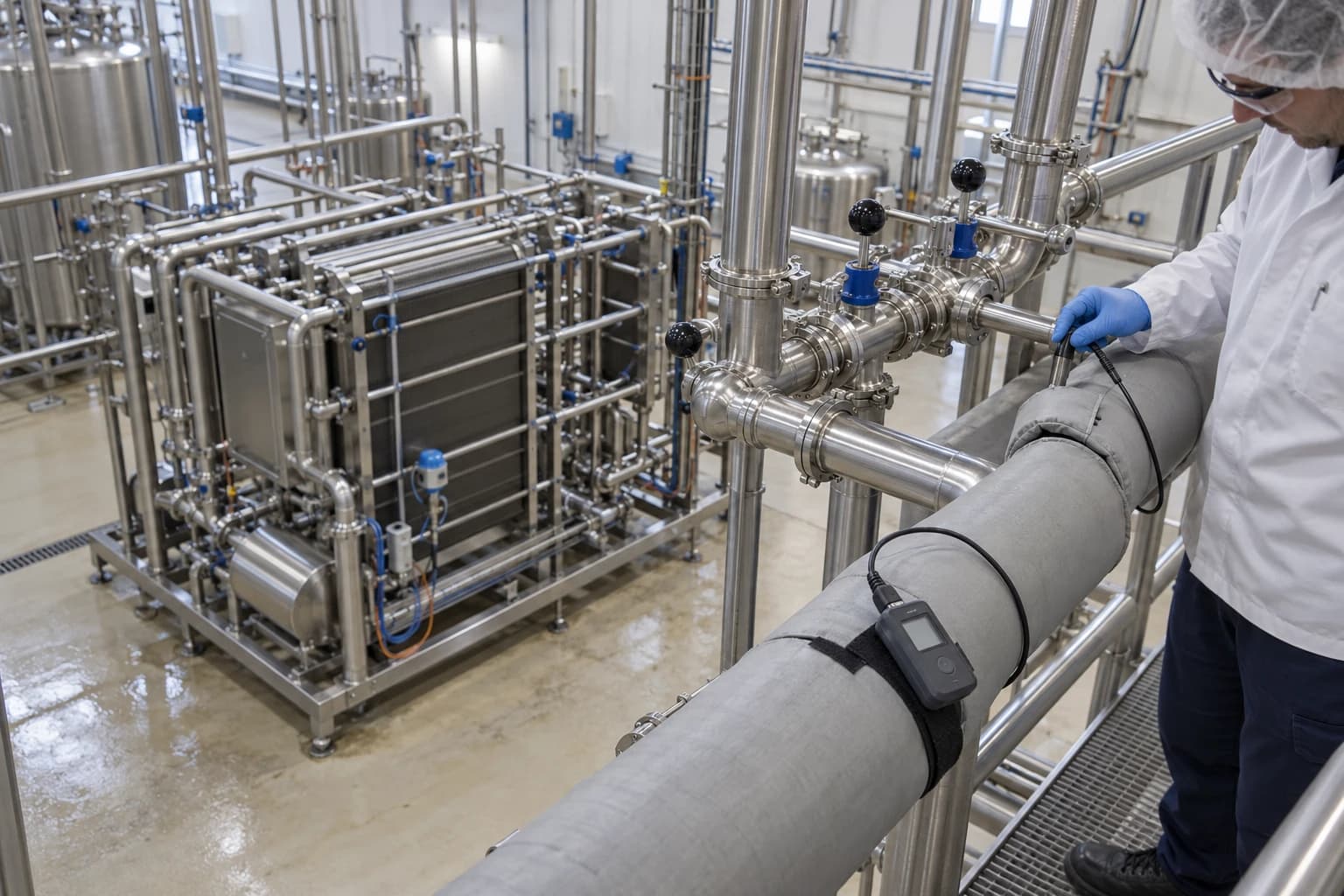
How Pinch Analysis Cuts Energy Use in Food Manufacturing
The sector used 2,719 ktoe in 2022, with natural gas remaining its main energy source.
Pinch analysis is a systematic thermodynamic method that identifies the minimum heating and cooling utilities a food process needs, then guides heat recovery between its hot and cold streams. The Royal Society estimates that UK food and drink manufacturing uses about 31.4 TWh of energy each year, with natural gas supplying 59% and electricity 35%. Boilers account for 65% of thermal-energy emissions, while direct-fired ovens account for 16%.
For energy managers, that creates a clear focus. A plant may have efficient boilers, well-maintained refrigeration plant and insulated pipework, yet still waste usable heat because one process rejects heat while another demands it. Pinch analysis exposes those mismatches.
The UK Food Security Report records food and drink manufacturing energy consumption at 2,719 ktoe in 2022, followed by a 0.9% increase in 2023. Energy efficiency in the food industry is therefore a production issue as much as a utility-cost issue. Reducing steam demand, cooling duty and gas consumption can protect margins without changing recipes, throughput or critical food-safety controls.
Why energy efficiency in food industry depends on heat integration
Food factories operate many heating and cooling duties at the same time. Pasteurisation heats milk or liquid product. Refrigeration removes heat from chilled ingredients and finished goods. Steam heats vessels, CIP circuits and cooking equipment. Ovens reject hot flue gas. Dryers exhaust warm, moisture-laden air.
These loads often sit in separate departments and use separate utility systems. Pinch analysis considers them as one thermal system.
The problem with isolated projects
A site may fit a more efficient boiler while leaving process heat demand unchanged. It may install refrigeration heat recovery that produces hot water when the process has little use for it. It may recover oven exhaust heat at a temperature unsuitable for the intended duty.
Those projects can still be worthwhile, but their performance depends on temperatures, timing and demand profiles across the factory. Pinch analysis establishes the heat-recovery target before equipment is selected.
Food production creates useful temperature matches
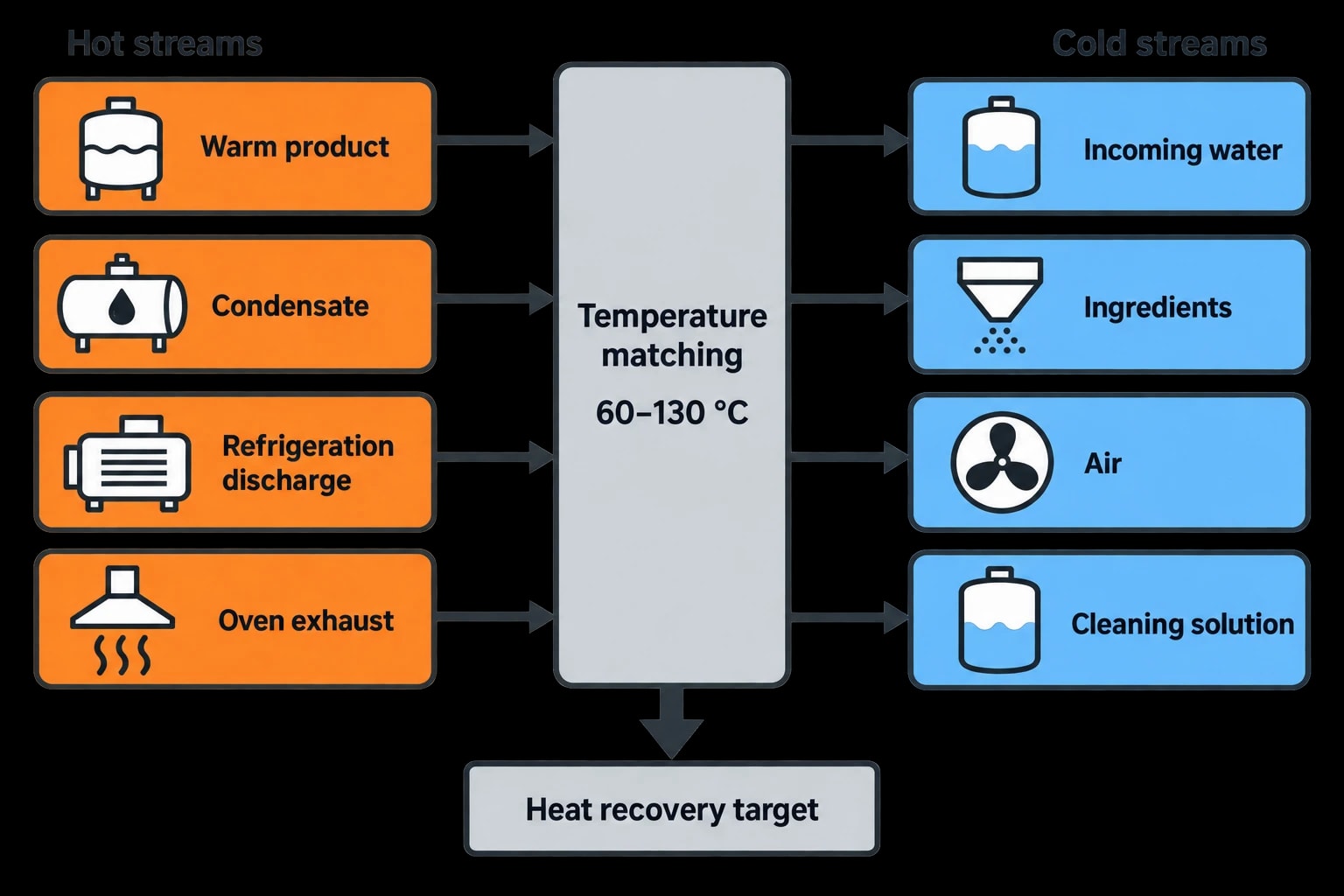
Many food operations work at relatively modest temperatures. The Royal Society identifies 60 to 130°C as the primary range for much food processing, with frying at 170 to 195°C and baking at 190 to 210°C. Temperature matching is therefore important.
Heat from a process cannot meet a duty requiring a higher temperature without additional energy input. However, warm product, condensate, refrigeration discharge heat and exhaust streams can often preheat incoming water, ingredients, air or cleaning solutions.

Pinch analysis identifies the thermodynamic minimum energy requirement of your process — then designs the heat exchanger network to achieve it.
How Pinch Analysis works in a food factory
A pinch study begins with process data, not heat-exchanger selection. Engineers identify streams that need cooling and streams that need heating, then record their temperatures, flow conditions, heat-capacity flow rates, operating hours and hygiene constraints.
Building the stream list
A hot stream releases heat as it cools. A cold stream needs heat as it warms. Typical examples include:
| Process area | Hot stream | Cold stream |
|---|---|---|
| Dairy | Pasteurised milk leaving a heat-treatment section | Raw milk entering the process |
| Brewery | Hot wort or process water | Brewing liquor or boiler feedwater |
| Bakery | Oven exhaust or hot cooling air | Combustion air, process water or make-up air |
| Prepared foods | Cooling cooked product or hot wash water | Incoming water, CIP solution or ingredients |
| Refrigeration | Compressor discharge heat or condenser water | Domestic hot water, washdown water or low-temperature process heat |
| Drying | Warm exhaust air | Incoming air or product feed, subject to contamination controls |
The data must reflect real operation. A line may run at different product temperatures, flow rates and shift patterns. Batch processes need particular care because heat availability and demand can occur hours apart.
Setting the minimum temperature approach
Engineers select a minimum temperature approach, often called ΔTmin. It is the smallest practical temperature gap between two streams in a heat exchanger.
A smaller approach can increase heat recovery, but it also requires more heat-transfer area and may make fouling, cleaning and control more difficult. A larger approach can reduce capital cost but increase utility consumption. The appropriate value depends on product properties, heat-exchanger type, pressure drop, cleanability and the temperatures needed to protect food quality.
Finding the pinch point
The analysis shifts stream temperatures by half the selected minimum approach and performs a heat cascade through the temperature intervals. This identifies the pinch point, where the process has its tightest thermal balance.
The pinch divides the site into two design regions:
- Above the pinch, the process has a heat deficit and needs hot utility.
- Below the pinch, the process has excess heat and needs cooling utility.
This distinction guides design decisions. Heat recovery across the pinch can increase both hot and cold utility requirements. External cooling above the pinch and external heating below it also work against the energy target.
Pinch Analysis targets gas, electricity and refrigeration demand
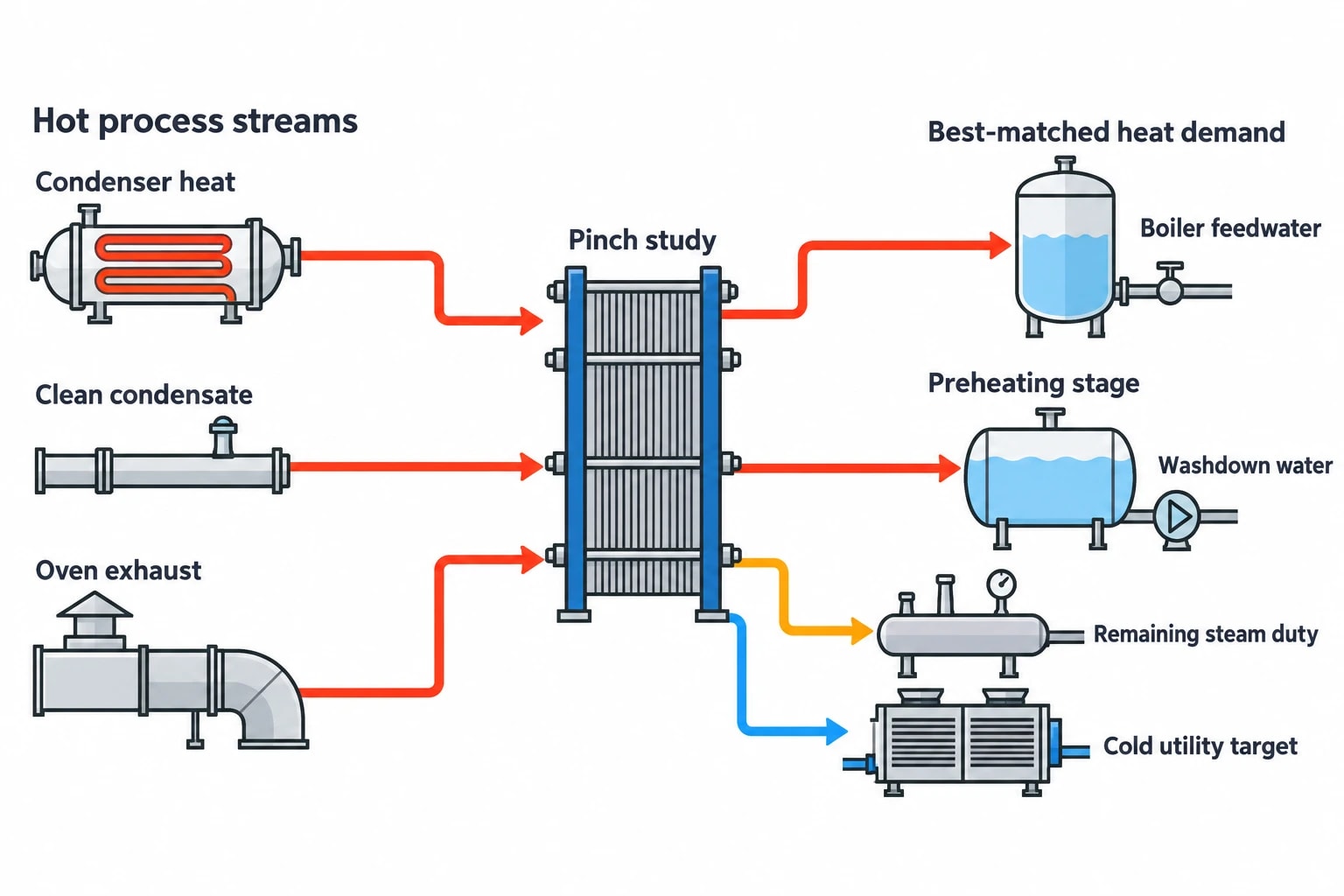
The first output from a pinch study is a target. It shows the minimum hot-utility and cold-utility demand that the analysed process could reach under the selected assumptions. The gap between the current position and the target identifies the scale of the opportunity.
Reducing steam demand before replacing heat sources
Steam remains the main heating medium for pasteurisation, sterilisation, cooking and drying in many UK food factories. Pinch analysis can reduce steam duty by recovering process heat first.
Examples include preheating:
- Boiler feedwater with suitable hot process streams.
- CIP make-up water with heat from refrigeration plant or cooling duties.
- Raw milk with pasteurised milk in regenerative heat exchangers.
- Incoming process water using clean condensate or heat-recovery loops.
- Combustion air or water with recovered energy from bakery oven exhaust, where contamination and dew-point risks have been assessed.
This order matters. A smaller, better-matched heat demand can change the size and operating profile of a heat pump, electric boiler, biomass system or renewable-heat installation.
Managing refrigeration as a heat source
Refrigeration plant rejects heat continuously while chilled-storage, cooling and freezing loads consume electricity. A pinch study identifies whether condenser heat aligns with a genuine site heat demand.
Refrigeration heat may suit lower-temperature washdown water or preheating stages. It may not meet the final temperature required for a thermal process. In that case, a heat pump may lift the recovered heat to a useful level, provided its electricity use, seasonal performance and operating hours support the business case.
The study should consider winter and summer conditions. Condenser heat may be abundant at one time of year while cleaning demand falls. Heat-storage requirements and alternative heat sinks can then determine the value of recovery.
Separating high-grade and low-grade heat
Exhaust from a gas-fired oven can contain heat at a high temperature, but its composition, moisture content and fouling potential affect recovery options. A warm-water stream has a lower temperature but may be clean, consistent and easier to integrate.
Pinch analysis ranks these streams by thermal value and identifies the duty each can best meet. This prevents a plant allocating a high-temperature stream to a low-temperature load while a harder-to-serve duty remains on steam.
Food safety and cleanability define the practical design
Food manufacturers cannot pursue theoretical heat recovery at the expense of hygiene, allergen control or product integrity. The technical target must pass through disciplined engineering and food-safety review.
Protecting product and process separation
Direct product-to-product recovery can be highly effective, particularly in regenerative pasteurisation. It requires hygienic heat-exchanger design, pressure control and procedures that prevent cross-contamination.
Indirect recovery loops often provide an alternative. An intermediate water or glycol circuit can transfer heat between areas while keeping product and utility streams physically separated. The temperature loss and pumping duty must be included in the assessment.
Accounting for fouling and CIP
Milk solids, sugars, starches, proteins, fats and baked deposits can reduce heat-transfer performance. A design based only on clean heat-exchanger conditions may miss its energy target after production begins.
The stream data should therefore include:
- Expected fouling behaviour and cleaning frequency.
- Pressure-drop limits and pumping energy.
- CIP temperatures, volumes and timing.
- Product changeovers and allergen segregation.
- Minimum flow rates needed for stable heat transfer.
- Temperature limits linked to product quality and validated process controls.
Plant managers should assess proposed changes through the site’s food-safety management system before implementation. Heat recovery must retain the required temperatures, hold times and cleaning performance.

Pinch analysis identifies the thermodynamic minimum energy requirement of your process — then designs the heat exchanger network to achieve it.
Applications in dairies, breweries, bakeries and prepared-food factories
The strongest projects usually involve repeated duties with stable operating patterns. Pinch analysis makes those patterns visible across production areas.
Dairies
Dairies combine pasteurisation, chilled storage, hot-water demand and refrigeration. The food, drink and milk BAT conclusions, set out in Commission Implementing Decision (EU) 2019/2031, identify heat recovery as an energy-efficiency technique. Regenerative heat exchange in pasteurisation, flow-through pasteurisers and precooling of ice-water can also reduce energy use.
A pinch study can extend beyond one pasteuriser. It can compare hot-water generation, separator loads, refrigeration heat rejection, CIP demand and boiler operation across the site.
Breweries
Breweries often have boiling, wort cooling, cleaning and refrigeration operating in close succession. Wort cooling may offer recoverable heat for brewing liquor or hot-water duties, subject to production timing and storage capacity. Pinch analysis can test the trade-off between direct recovery, hot-water storage and utility demand across brews.
Bakeries
Bakeries rely heavily on direct-fired ovens, proofing, cooling and compressed air. Oven exhaust may contain substantial recoverable heat, but recovery equipment must manage moisture, contaminants, condensate and fire risk. A pinch study can establish whether recovered heat is better suited to process water, make-up air or a heat-pump source.
Prepared-food factories
Prepared-food sites often have many batch operations, cooking kettles, retorts, cooling tunnels, washdown and refrigeration. Batch timing can limit direct exchange. Thermal storage or intermediate loops may create workable matches where direct recovery cannot.
Turning a Pinch target into an energy project
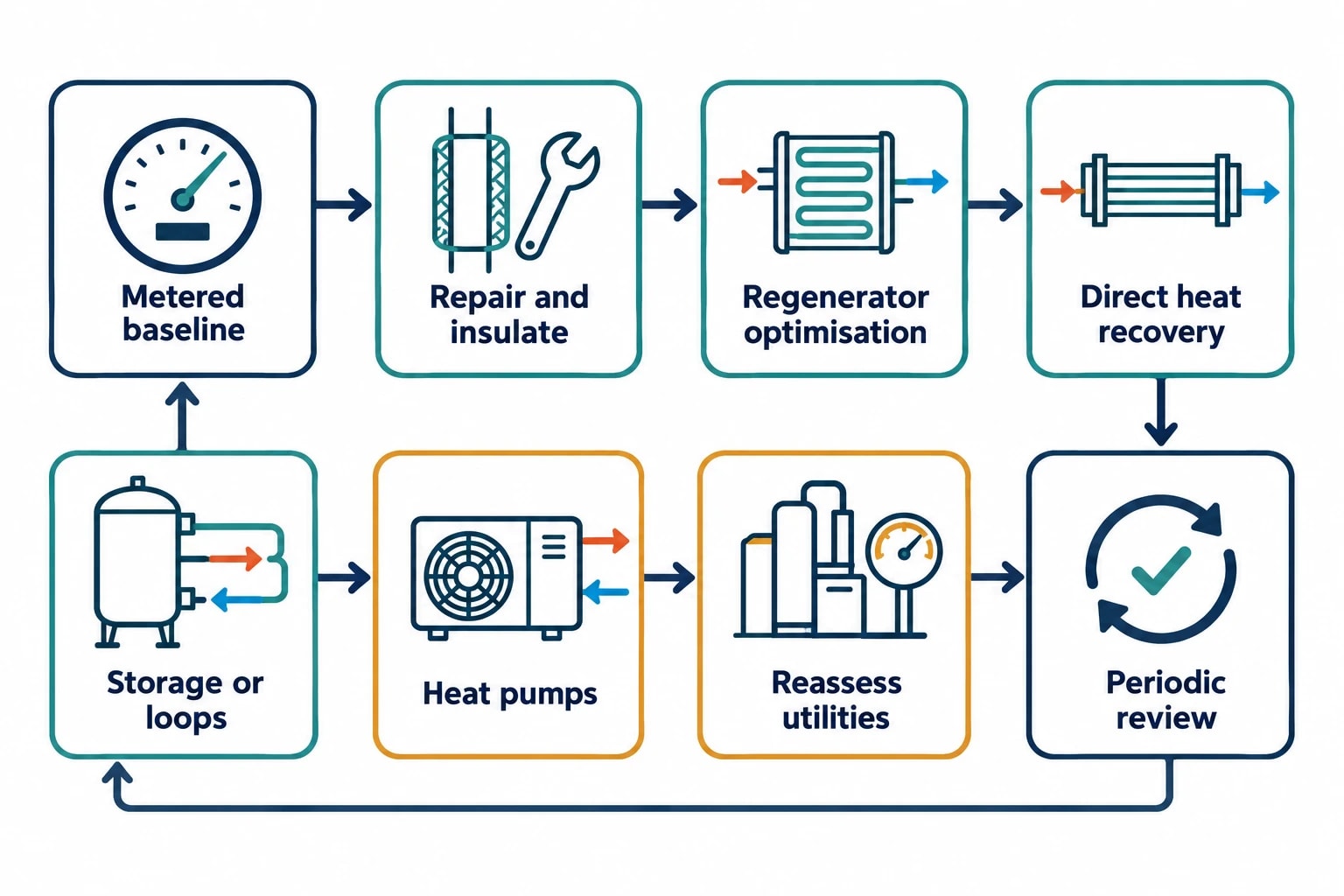
Pinch analysis is most useful when it leads to a staged implementation plan. The heat-integration target sets direction, while plant constraints determine the final scheme.
Start with measurement
European Commission Decision (EU) 2017/1508 recommends process-level metering, regular energy audits and attention to synergies between heat, cold and steam demand in food and beverage manufacturing.
A practical baseline should include gas, electricity, steam, condensate return, chilled water, hot water and key process temperatures. Measurements should be normalised against production volume, product mix and operating hours.
Develop options in the right order
A site can progress from lower-disruption measures to network modifications and larger utility changes:
- Repair steam leaks, insulate hot surfaces, improve condensate return and correct control faults.
- Optimise existing regenerative heat exchangers and verify bypass arrangements.
- Recover heat between compatible processes operating at the same time.
- Add thermal storage or intermediate loops where timing prevents direct recovery.
- Consider heat pumps where recovered heat needs a temperature lift.
- Reassess boiler capacity, refrigeration plant operation and future low-carbon heat options after demand reduction.
The BAT conclusions for food, drink and milk industries identify heat recovery through heat exchangers or heat pumps, boiler-blowdown reduction, steam-distribution optimisation and feedwater preheating among energy-efficiency techniques.
Track performance after commissioning
ISO 50001:2018 provides a framework for establishing and improving an energy management system. For a pinch project, relevant indicators may include energy per tonne of product, steam per tonne, refrigeration electricity per tonne, boiler fuel input, recovered heat and cooling-water demand.
Metering should verify the predicted reduction in utility use, not merely confirm that the new equipment is running. Production changes, fouling and altered cleaning schedules can shift the heat balance over time. Periodic review keeps the heat-recovery network aligned with factory operation.
Why Pinch Analysis gives food manufacturers a stronger energy strategy
Pinch analysis gives food manufacturers a process-wide view of where heat is available, where it is needed and which temperature matches offer the greatest value. It enables utility engineers to reduce avoidable steam and cooling demand before committing capital to new heat sources.
This article reflects the independent analysis and editorial opinion of EnerTherm Engineering. Product names, trademarks, and brands mentioned belong to their respective owners. EnerTherm Engineering is not affiliated with, endorsed by, or a licensee of any third-party software or product mentioned unless explicitly stated.

Technical Manager — EnerTherm Engineering
John Naranjo is Technical Manager at EnerTherm Engineering, bringing specialist expertise in chemical and environmental engineering. He recently led the implementation of Omni Vision, EnerTherm's real-time energy and utility monitoring platform. He holds an MSc in Environmental Engineering from the University of Huelva and a BSc in Chemical Engineering, with memberships in both the Energy Institute and IChemE.
