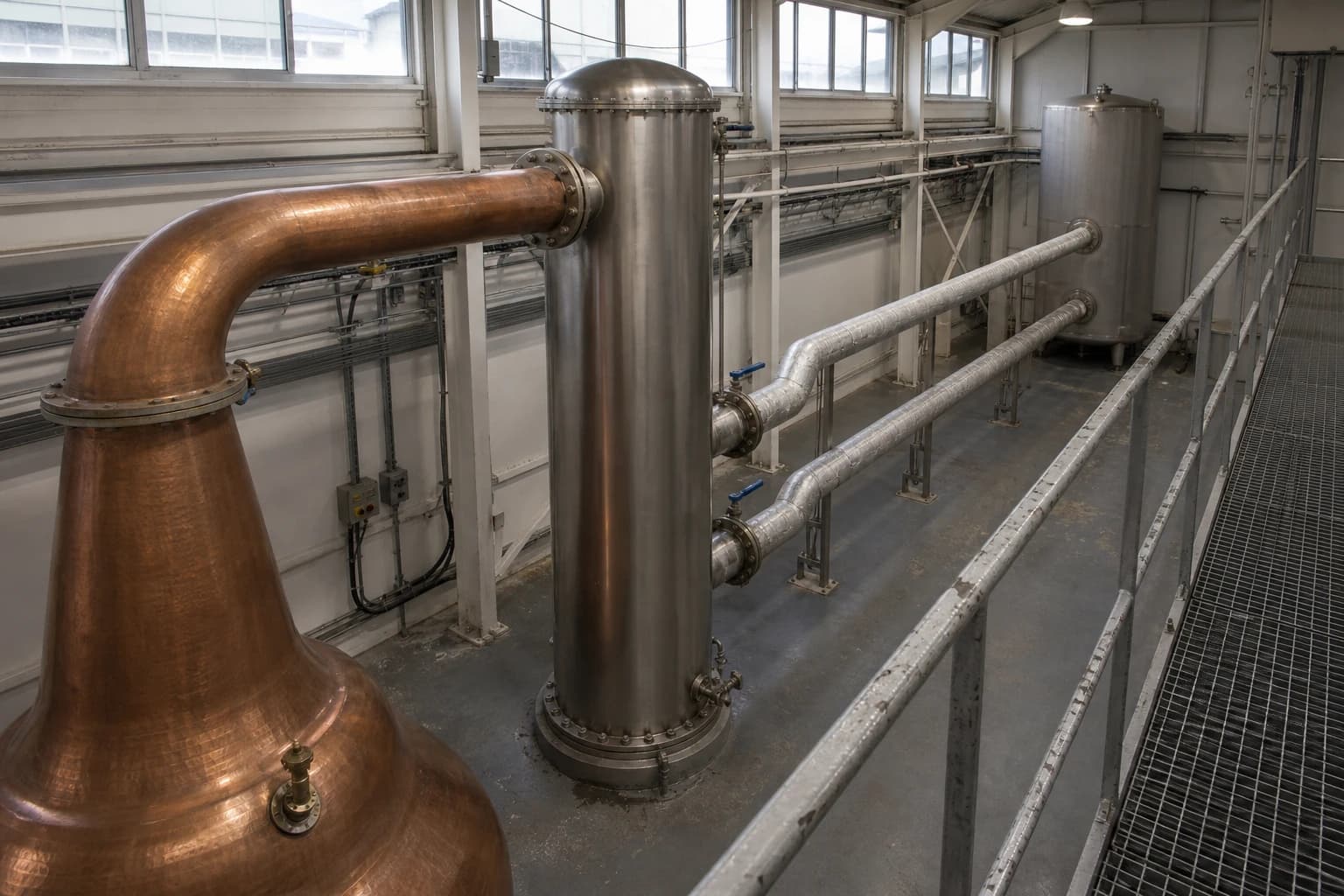
How Distillery Heat Recovery Systems Cut Fuel Use
Eden Mill modelling estimated up to 68% lower net distillery heat consumption.
A distillery heat recovery system captures heat from condensers, stills and hot process streams, then transfers it to a useful heating duty so the site burns less fuel in its boiler or thermal-oil system.
For a whisky, gin or ethanol producer, the largest recoverable opportunity often sits at the condenser. The still needs substantial heat to vaporise alcohol and water. That vapour then condenses before collection, releasing much of the same thermal energy into cooling water. Conventional cooling rejects that heat through a cooling tower, worm tub, radiator or other heat-rejection system. A well-matched recovery system turns it into hot water for the next process demand.
The principle is straightforward, but the engineering is not. A useful scheme must preserve condenser performance, protect spirit quality, supply heat at a usable temperature and continue to cool the still if the downstream heat user stops. Pinch Analysis helps match the available heat source with real site demands.
Why distilleries reject so much usable heat
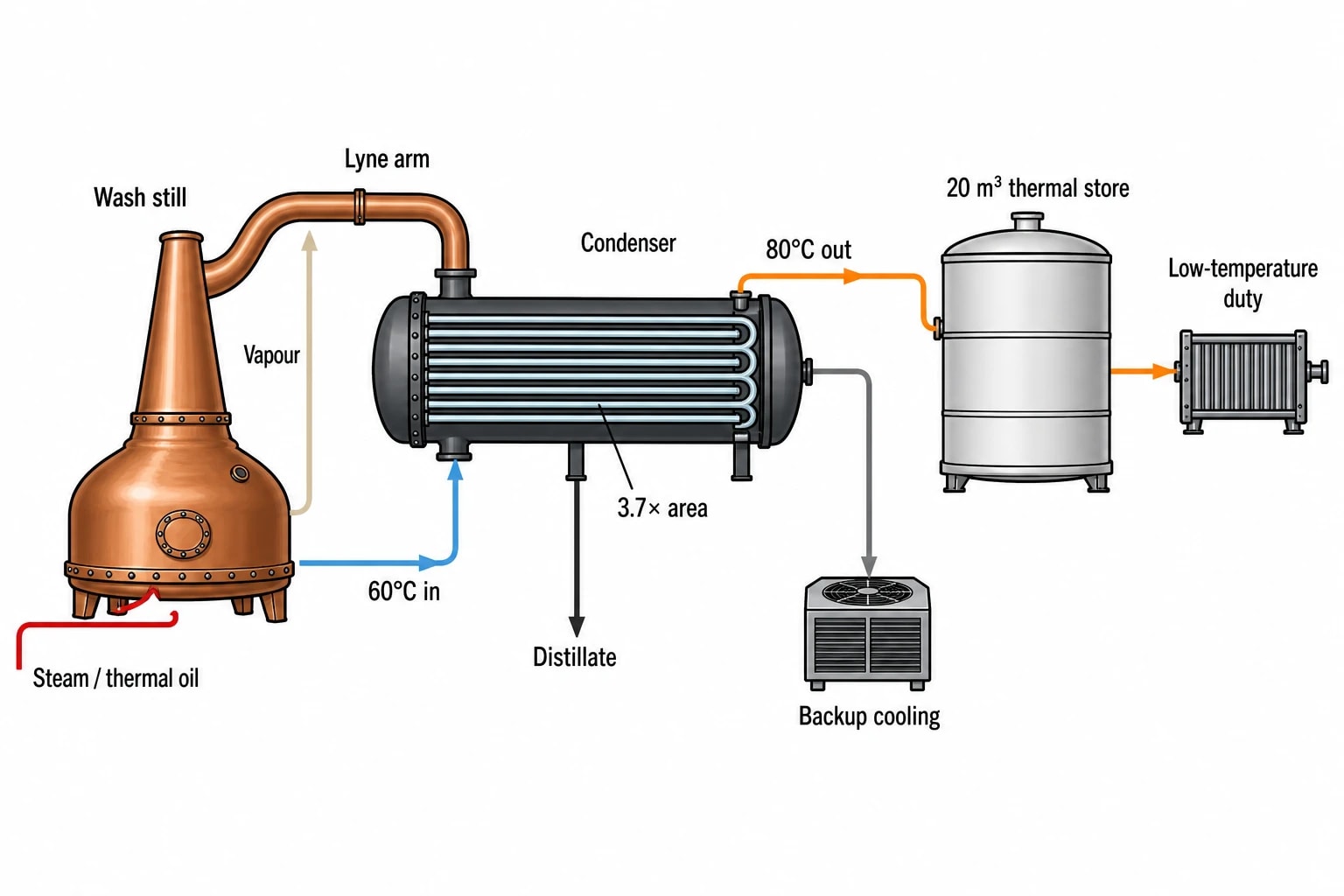
Distillation creates a recurring thermal cycle. Steam, thermal oil or hot water heats the wash still. Vapour rises through the still and lyne arm, then reaches the condenser. Cooling water removes latent heat as the vapour changes back to liquid, followed by sensible heat as the distillate cools.
The condenser water leaves warmer than it arrived. Its temperature determines whether it is a low-value cooling duty or a useful heat source.
The Eden Mill Phase 1 feasibility report illustrates the scale of the issue. It stated that distillation represented approximately 70% of site heat demand, while condenser heat was normally directed to the cooling system. That does not mean 70% of site fuel can automatically be recovered. Heat losses, timing, temperatures and available heat sinks set the practical limit. It does show why an energy study should begin in the still house.
The temperature problem
A conventional condenser commonly operates with cool incoming water and a modest outlet temperature. In the Eden Mill study, the existing case used cooling water at 12°C inlet and 42°C outlet. That water has value for low-temperature duties, but cannot directly replace high-temperature heating for a still charge.
Recovering higher-grade heat requires a warmer condenser-water circuit. The report considered 55°C inlet and 85°C outlet conditions. Its pilot design selected 60°C and 80°C cooling-water flow and return temperatures, supported by warm-water and hot-water storage.
The trade-off is heat-transfer area. Higher cooling-water temperatures reduce the temperature driving force between condensing vapour and cooling water. The Eden Mill assessment found that the revised condenser arrangement would need roughly 3.7 times the original heat-transfer area. Multi-pass condensers can provide that duty without sending large quantities of only moderately warm water to storage.
Heat has to arrive when the process needs it
A distillery may have substantial daily recovery potential and still waste much of it if wash charging, mashing, cleaning and distillation occur at different times. A batch still also produces heat unevenly. Condenser output rises during the run, while the next useful heat demand may occur before boil-up or after the run ends.
Thermal storage bridges that gap. Eden Mill’s proposed pilot incorporated a 20 m³ thermal store and backup cooling for periods when the district-heating network could not accept recovered heat. Condenser cooling protects production first, so heat recovery must not leave the still without sufficient cooling capacity.

Pinch analysis identifies the thermodynamic minimum energy requirement of your process — then designs the heat exchanger network to achieve it.
Where distillery heat recovery systems deliver value
Successful schemes use several heat sinks rather than relying on one. This creates more opportunities to use recovered heat during a production week and reduces the need to dump it.
Preheating wash and spirit charges
Preheating still charges is a clear use for condenser heat. Recovered hot water transfers heat through a dedicated heat exchanger to wash or spirit before the main heating duty begins. The boiler, thermal-oil heater or high-temperature water system then supplies only the remaining temperature lift.
At Glen Grant, a reported project recovered hot water from two wash-still condensers to preheat wash and spirit-still charges to 80°C. The case study reported annual energy-cost savings of £90,000, a reduction of 25 minutes in each distillation cycle and capacity for two additional mashes each week, equating to approximately 460,000 litres of extra spirit annually. Those results belong to that site and should not be transferred directly into another business case. They show how heat recovery can affect throughput as well as fuel consumption.
Mashing, cleaning and hot-water duties
Mashing water and cleaning operations create repeated hot-water demand. They are often better matches for recovered heat than directly replacing the full still-heating duty.
At Eden Mill, the design concept included conventional preheating of stills using waste effluent and hot water, further heating of mashing water with recovered hot water, and cleaning with distillery-produced hot water rather than newly heated cold water. Together, these duties create a steadier heat sink and reduce boiler starts, peak firing and wasted condenser heat.
District heating and external heat sinks
A nearby district-heating return can be valuable because it accepts recovered heat at a lower temperature than a still requires. The Eden Mill study proposed heating the return side of the adjacent network, offsetting biomass heat that would otherwise lift return water to district-heating flow temperature.
External heat use needs a durable commercial and operational arrangement. The heat sink must be available during distillation. Metering, network return-temperature limits, maintenance responsibilities and loss of demand belong in the design basis. The distillery must retain sufficient thermal storage or backup heat rejection for independent operation.
Heat pumps where temperature lift is justified
A heat pump can raise condenser heat to a more valuable temperature, but adds electrical demand, capital cost and operating complexity. Its case depends on source temperature, required supply temperature, electricity price, fuel displaced and annual operating hours.
The Eden Mill report considered a high-temperature heat-pump route using high-grade heat from the site’s district-heating system and condenser recovery. It also recognised the challenge of finding equipment around the desired pilot duty that could provide 120°C process water. For retrofit projects, a heat pump should follow a complete temperature and load analysis rather than substitute for direct heat recovery.
How Pinch Analysis shapes a recoverable heat network
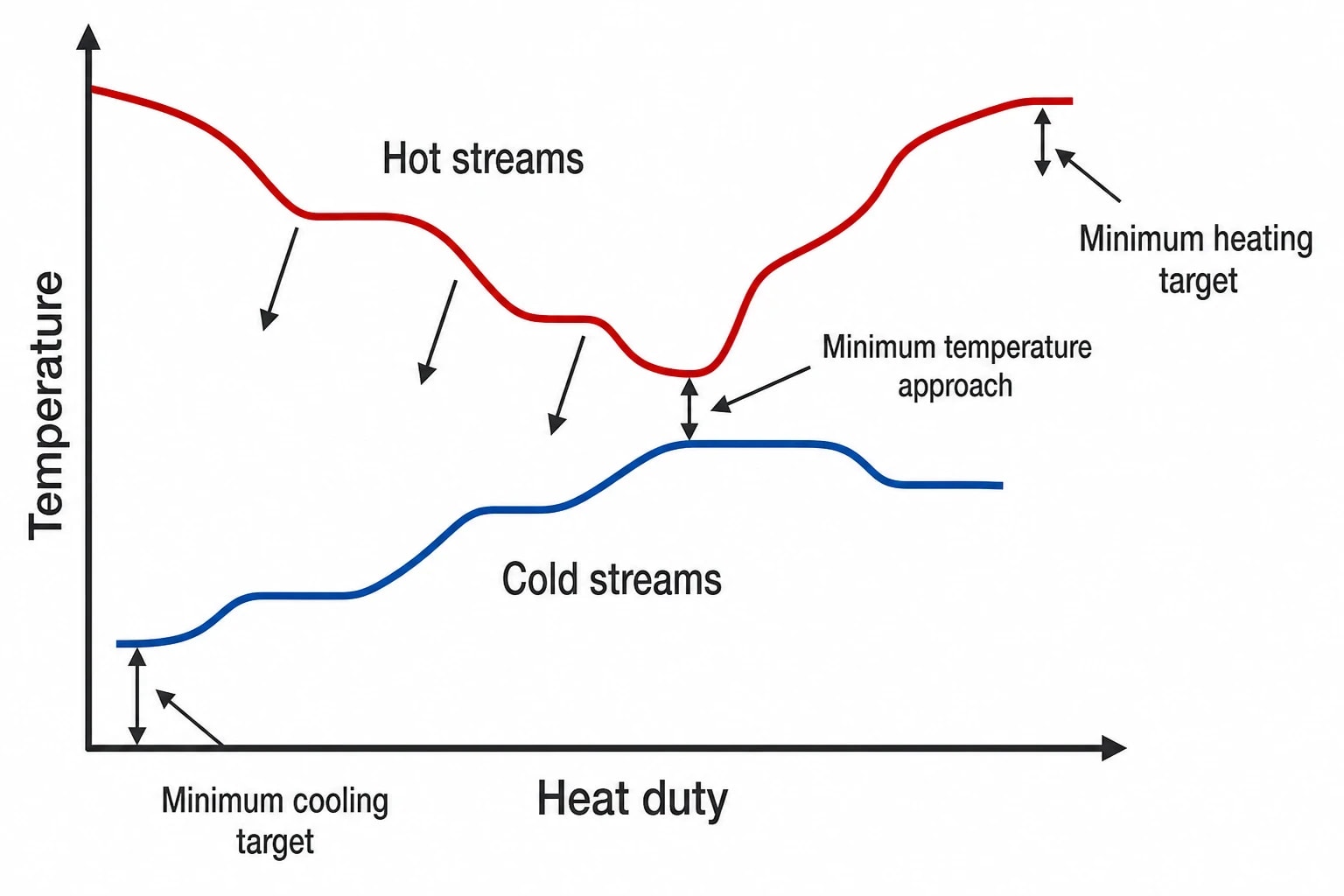
Pinch Analysis maps process heating and cooling requirements by temperature and duty. It identifies minimum external heating and cooling targets before detailed heat-exchanger selection begins. For a distillery, the method prevents a common mistake: sizing a recovery system from one impressive condenser temperature without checking whether the site can absorb that heat across a full operating schedule.
Build the heat and mass balance first
The study should cover all significant hot and cold streams, including:
- Wash-still and spirit-still condenser-water flow, inlet and outlet temperatures, and run profiles.
- Still-charge volume, starting temperature, target temperature and heating times.
- Mash-water preparation, clean-in-place demand, vessel washing and hot-water storage.
- Pot ale, spent lees, wort, cooling-tower return and other process streams where temperature and hygiene constraints allow recovery.
- Boiler fuel consumption, steam or hot-water generation, condensate return and heat-rejection loads.
- Production schedules, batch overlap, shutdown periods and seasonal changes.
Measurements matter. Heat recovery projects often fail at the business-case stage because design teams rely on nameplate flows rather than recorded process behaviour. Temporary flow meters, temperature logging and fuel data can expose short batch peaks, low utility use at weekends and changes between wash and spirit runs.
Set a realistic minimum temperature approach
The heat exchanger needs a temperature difference to transfer duty with a practical surface area. Reducing this approach can increase recovery, but also increases heat-exchanger area, fouling sensitivity and capital cost. The right value depends on stream cleanliness, pressure drop, maintenance access and the cost of lost recovery.
Condenser modifications also need careful review. Raising cooling-water temperature can affect condensation, distillate subcooling and operating stability. The Eden Mill feasibility work expected larger condenser area and high recirculation flows where hot water replaces steam as the heating medium. This is a process change, not a utility-side add-on.
Match heat by temperature before using a heat pump
The preferred order is usually:
- Directly recover heat to the warmest process demand that can accept it.
- Cascade the remaining heat to lower-temperature duties such as preheating, cleaning or hot-water storage.
- Reject residual heat only after assessing useful onsite and nearby external demands.
- Apply a heat pump where the remaining source and sink temperatures support a sound electrical and financial case.
This sequence reduces the temperature lift required from a heat pump and avoids using electricity where a plate heat exchanger could perform the duty.

Pinch analysis identifies the thermodynamic minimum energy requirement of your process — then designs the heat exchanger network to achieve it.
Equipment choices that determine performance
A distillery heat recovery system is a network of process equipment, controls and storage. Performance depends on how each part works under changing batch conditions.
Condensers and heat exchangers
Multi-pass shell-and-tube condensers may enable a higher cooling-water outlet temperature. Plate-and-frame heat exchangers often isolate process fluids, transfer heat into hot-water loops and provide the larger surface area required for high-temperature water heating.
The choice depends on fluid quality and cleanability. Fouling from solids, scale or biological growth reduces heat transfer and raises pressure drop. Designs should include isolation valves, suitable strainers, temperature and pressure points, and access for cleaning. Hygienic separation needs particular attention where recovered heat serves mashing or cleaning water.
Thermal stores
A thermal store holds hot water, absorbs variable condenser output, supplies short high-load periods and protects the recovery loop from abrupt changes in demand. Effective stratification preserves a useful temperature difference between the hot upper portion and cooler return water.
Tank volume should derive from time-resolved process data. A tank sized only from average daily heat can be too small for a production peak and too large to justify its footprint and heat loss. Insulation, temperature limits, circulation rates, legionella controls where applicable, and access for inspection belong in the specification.
Controls and fallback cooling
Control valves and variable-speed pumps manage condenser-water flow, heat-exchanger duty and storage charging. The control strategy should prioritise stable condensation and process safety, then maximise recovery within those limits.
A fallback cooling path is essential. If the hot-water store reaches its upper temperature limit, a downstream user closes, or an external network is unavailable, the system must switch to cooling-tower, chiller or other approved heat-rejection capacity without interrupting the still run.
Safety and UK compliance for ethanol-vapour systems
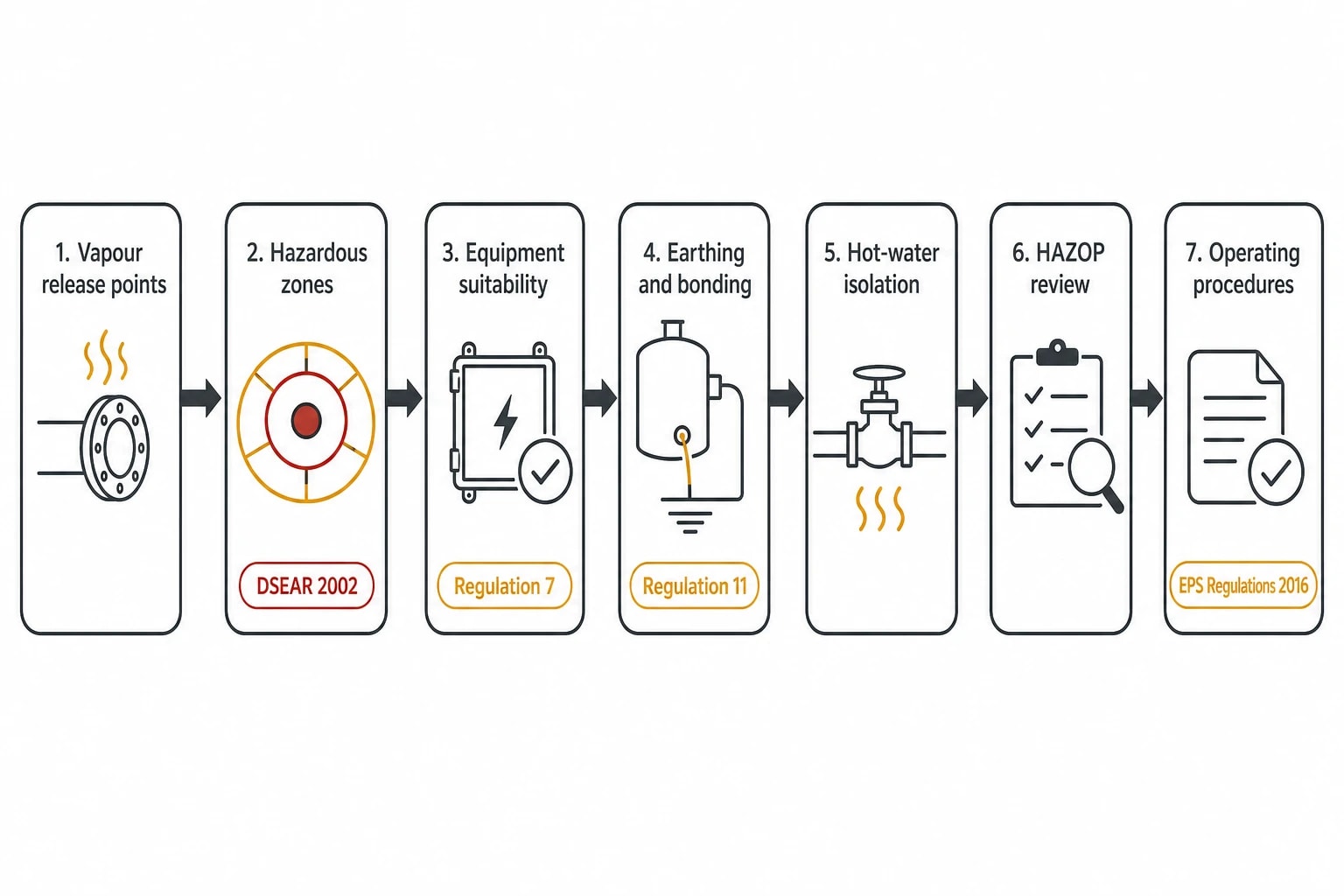
Heat recovery equipment near a still house can change pipe routes, pumps, instrumentation and maintenance activities in areas where flammable ethanol vapour may be present. The project team must include hazardous-area assessment at the earliest design stage.
The Dangerous Substances and Explosive Atmospheres Regulations 2002 apply in Great Britain where potentially explosive atmospheres may occur. The Health and Safety Executive identifies Regulations 7 and 11 as implementing requirements of the ATEX Workplace Directive 1999/92/EC. Regulation 7 covers the classification of hazardous places into zones and protection from ignition sources. Regulation 11 covers arrangements where employers share a workplace and must co-ordinate explosion-protection measures.
For a heat recovery retrofit, the assessment should establish:
- Potential ethanol-vapour release points around stills, spirit receivers, vents, sample points, drains and maintenance connections.
- The extent and classification of hazardous zones.
- Suitability of electrical and mechanical equipment, including pumps, actuators, motors, instruments and portable equipment used in zoned areas.
- Earthing, bonding and electrostatic controls where flammable vapour can occur.
- Isolation, drainage, maintenance and emergency procedures for new hot-water circuits.
Equipment intended for use in hazardous areas also requires appropriate conformity assessment under the Equipment and Protective Systems Intended for Use in Potentially Explosive Atmospheres Regulations 2016. A heat-recovery project should include HAZOP and operating-procedure review before commissioning, particularly where a retrofit introduces new interfaces with still-house operations.
Measuring fuel reduction after commissioning
Fuel savings should be measured against a defined baseline, not inferred from a hot-water meter alone. Production volume, spirit type, batch duration, ambient conditions and operating schedules can all change energy use.
A practical measurement plan tracks boiler fuel or steam generation, recovered heat delivered, cooling duty rejected, batch count, charge temperature and litres of alcohol produced. Engineers should compare energy intensity per relevant production unit across matched operating periods, then investigate deviations rather than assume every recovered kilowatt-hour displaces fuel.
ISO 50001:2018 provides a useful management framework for this work. It supports energy-performance indicators, monitoring and continual improvement. For a distillery, useful indicators include fuel per litre of alcohol produced, recovered heat per batch, condenser-water return temperature and the percentage of condenser heat rejected.
The strongest projects start with measured heat sources and demands, use Pinch Analysis to protect temperature value, provide storage and backup cooling, and commission controls around real batch behaviour.
This article reflects the independent analysis and editorial opinion of EnerTherm Engineering. Product names, trademarks, and brands mentioned belong to their respective owners. EnerTherm Engineering is not affiliated with, endorsed by, or a licensee of any third-party software or product mentioned unless explicitly stated.

Managing Director — EnerTherm Engineering
Dr. François Pierrel is Managing Director of EnerTherm Engineering with over two decades of expertise in thermal design, heat transfer, and industrial energy optimisation. He holds a PhD in Heat Transfer from Cranfield University and a Post-Doctorate from Heriot-Watt University.
