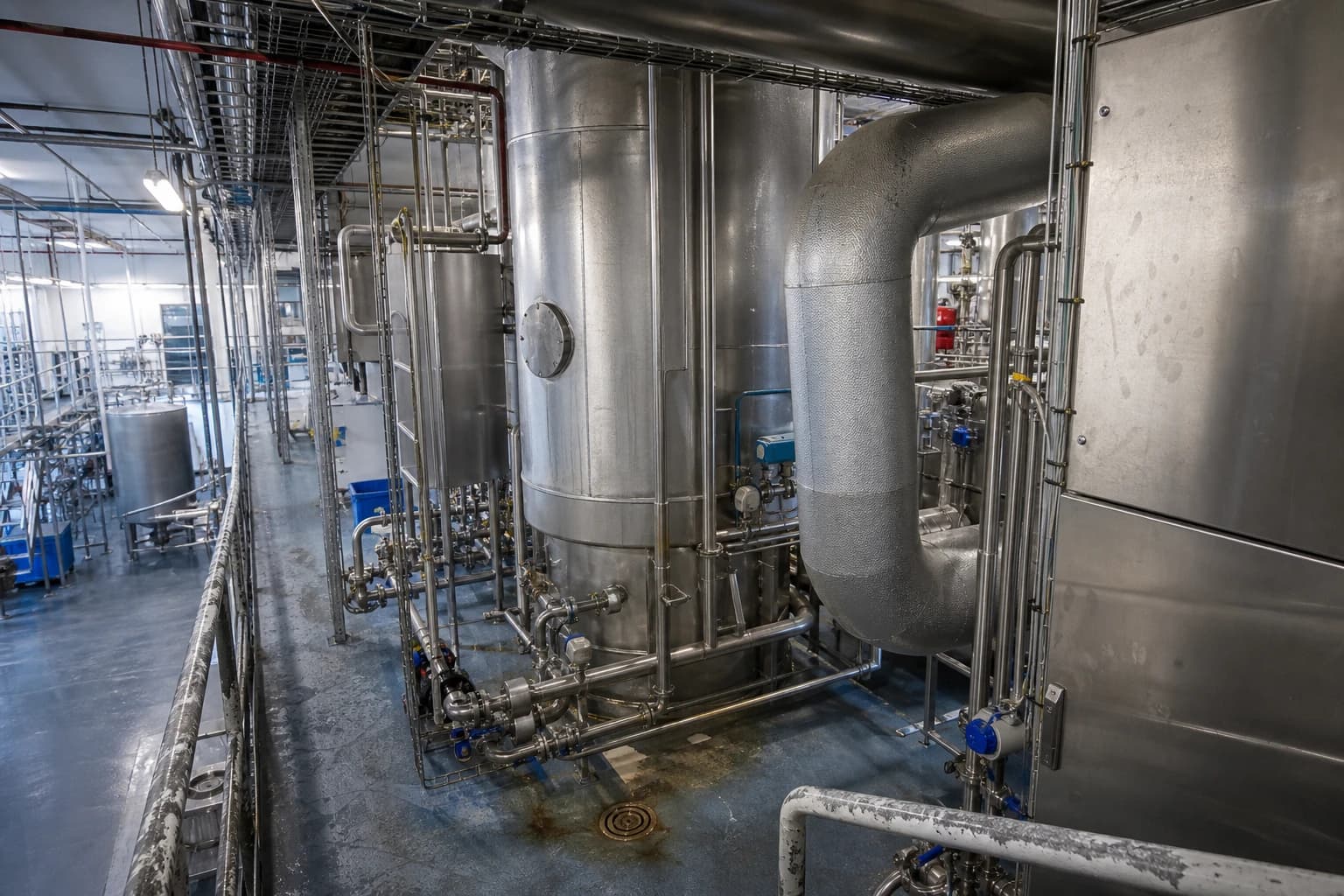
Decarbonisation of Food Industry Starts with Process Heat
Around two-thirds of drink-manufacturing energy demand is process heat.
Decarbonisation of the food industry is the systematic reduction of greenhouse-gas emissions from food manufacturing, beginning with the heat used to cook, pasteurise, clean, dry and concentrate products. The Food & Drink Federation reports that around two-thirds of food and drink manufacturing energy demand is thermal processing heat, and approximately 97% of that UK heat demand is met by natural gas. That concentration makes process heat the practical starting point for food factories seeking lower Scope 1 emissions. Boilers, steam headers, hot-water circuits, ovens, fryers, evaporators and cleaning-in-place systems often account for a large share of a site’s gas bill. Replacing a boiler before reducing and reusing heat can preserve oversized utility demand, shift operating costs and increase electrical-connection requirements. A process-first programme changes that sequence. It identifies where heat enters the factory, where it leaves, which duties need high-grade heat, and where lower-temperature demand can accept recovered energy. Pinch Analysis provides the structure for this work. ## Why process heat dominates food industry decarbonisation 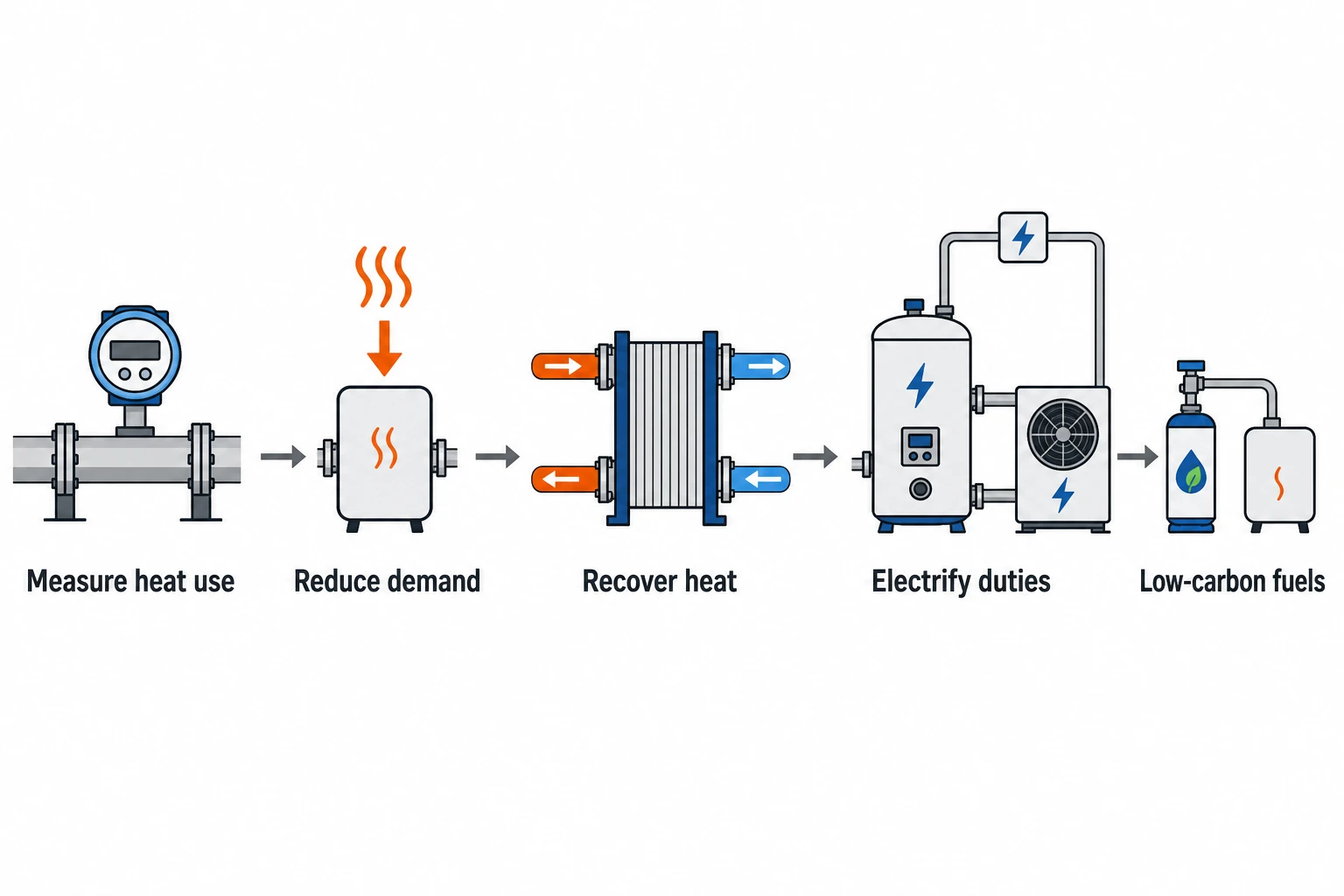 Food manufacturing relies on controlled heating because temperature affects safety, texture, yield, shelf life and cleaning performance. Steam and hot water remain common carriers because they deliver heat reliably across large plants and established production lines. The Department for Energy Security and Net Zero’s 2026 update on industrial energy-efficiency potential identifies steam and hot-water generation as the principal means of carrying heat in the food and drink sector. It groups most food and drink fuel use for heat under “other heating”, covering steam and hot-water production rather than direct-fired processes. ### Heat demand follows the product through the factory A typical site may use heat at several points: - Preheating ingredients and process water - Cooking, blanching, baking and frying - Pasteurisation and sterilisation - Evaporation, concentration and drying - Hot-water production for cleaning-in-place - Boiler-feedwater heating and deaeration - Space heating for process areas linked to production These demands have different temperature levels, load profiles and hygiene requirements. A pasteuriser may require stable, closely controlled heat. A cleaning cycle may create a sharp demand peak. An evaporator can reject substantial quantities of low-grade vapour or condensate. Treating these duties as one boiler load hides opportunities. ### The order of investment matters Fuel switching remains part of food-industry decarbonisation, but it works best after demand reduction. A lower process-heat target can reduce the size of electric boilers, heat pumps, transformers, switchgear, storage and distribution pipework. It can also reduce exposure to electricity-capacity constraints. The practical hierarchy is clear: 1. Measure heat use by process. 2. Reduce avoidable demand. 3. Recover heat internally. 4. Electrify duties that suit available temperature levels. 5. Apply low-carbon fuels to residual heat that cannot yet be electrified or recovered. This sequence protects production capability while reducing emissions at each stage. ## Pinch Analysis for food and beverage process heat Pinch Analysis is a systematic method for matching heat released by hot process streams with the heat required by cold process streams, reducing external heating and cooling demand. For food and beverage plants, it turns a utility-room problem into a whole-process heat-management exercise. The method maps hot streams, such as condensate, pasteuriser discharge, evaporator vapour, oven exhaust and refrigeration-condenser heat. It then maps cold streams, including incoming product, make-up water, cleaning water and boiler feedwater. ### Start with a heat and mass balance A useful study begins at line level rather than with annual gas consumption alone. Annual bills show cost and carbon burden, but not which production steps need heat at the same time. Process teams need representative operating data for normal, high-throughput and changeover conditions. The data set usually includes: | Data point | Why it matters for decarbonisation of food industry | |---|---| | Stream inlet and outlet temperatures | Establishes realistic heat-recovery potential | | Flow rate and operating hours | Converts temperature changes into duty and annual energy use | | Product, water and utility identity | Determines hygiene, fouling and separation requirements | | Batch timing and cleaning schedules | Reveals whether source and demand occur together | | Steam pressure and condensate return | Identifies distribution losses and recovery opportunities | | Cooling and refrigeration loads | Locates potential low-temperature heat sources | | Production throughput | Separates energy changes caused by output from equipment performance | The Food & Drink Federation has urged manufacturers to map processes and improve metering rather than view a factory as a single energy-consuming block. That distinction matters on multi-product sites, where one line may dominate steam demand during a shift while another produces useful recoverable heat. ### Find the pinch before buying equipment The pinch marks the point in the composite heat balance where heat recovery reaches its practical limit under the chosen temperature approach. Above it, the process needs carefully targeted hot utility. Below it, the process rejects heat and needs cooling. For a food plant, this analysis can expose a familiar mismatch: a high-temperature boiler supplies steam for a low-temperature water duty while another process sends warm water, condensate or refrigeration heat to drain or cooling equipment. The opportunity lies in matching the temperature quality of the source to the requirement of the sink. A heat-exchanger network may then recover heat from: - Pasteurised product to incoming product, where hygienic design and product separation permit - Condensate to boiler feedwater or process-water preheat - Refrigeration condensers to hot-water loads - Oven or dryer exhaust through a suitably designed recovery system - Evaporator vapour through mechanical vapour recompression or heat-pump integration - Cooling water to cleaning or wash-water preheat The output should be a ranked set of measures, not a generic technology list. Each measure needs a heat duty, operating window, control strategy, hygiene review, expected maintenance burden and an assessment of its effect on remaining steam demand. ## Reduce avoidable steam and hot-water demand first Heat recovery cannot correct waste that the process does not need. Food manufacturers often find early savings in steam distribution, utility control and production scheduling before major capital work begins. ### Tighten the steam system Steam systems need systematic inspection because small losses accumulate over operating hours. Priority checks include failed steam traps, leaking valves and flanges, poor insulation, uninsulated valves, flash-steam losses, excess boiler pressure and incomplete condensate return. Boiler pressure deserves careful engineering review. Lower pressure can reduce fuel demand in suitable applications, but it changes steam quality, distribution behaviour and equipment operation. The 2026 DESNZ assessment notes that boiler owners should consult suppliers before reducing pressure, as changes can affect moisture carryover, feedwater flow and deaerator operation. Boiler blowdown recovery, feedwater economisers and combustion controls can also improve existing assets while a longer-term electrification project is developed. These measures do not eliminate gas use, but reduce the heat that a future low-carbon supply must provide. ### Match heat supply to production reality A continuous boiler plant often serves batch production. This creates avoidable peaks during cleaning, start-up and product changeovers. Scheduling can reduce the overlap between peak cleaning and peak process demand. Water and thermal storage can retain useful heat for later demand where hygiene and operating requirements allow it. The aim is stable heat demand at the lowest practical utility temperature. That gives heat recovery and heat pumps a stronger operating case. ## Recover waste heat without compromising food safety 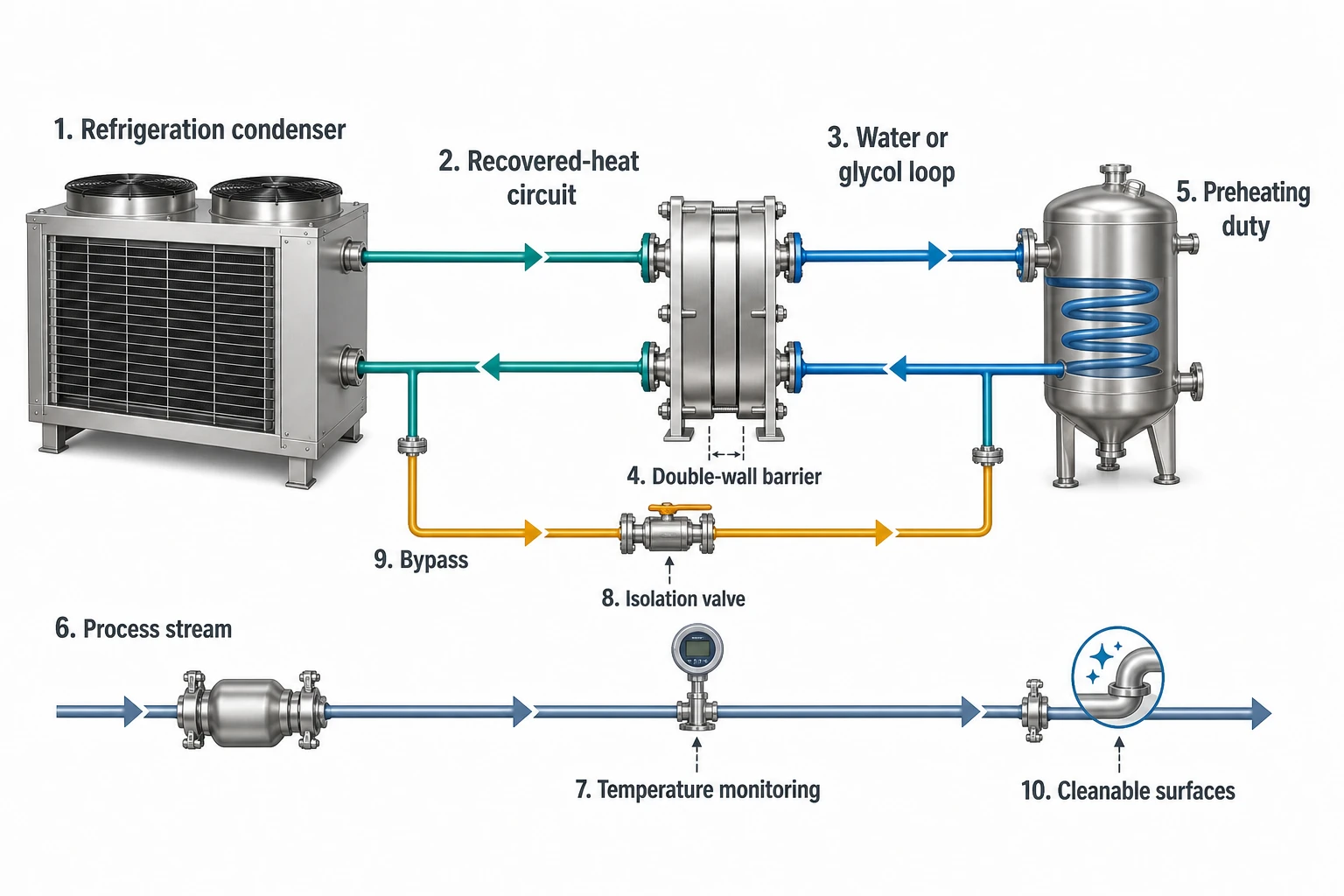 Food safety determines how a thermal-integration project is designed and commissioned. The Food Standards Agency requires HACCP-based food-safety procedures and states that businesses must review them when a product, process or process step changes. A heat-recovery scheme therefore requires input from production, engineering, quality and food-safety teams from the earliest design stage. ### Separate streams where the risk requires it Direct regeneration is efficient where product-to-product exchange has been validated for the application. Other cases require an intermediate water or glycol loop, a double-wall arrangement, or physical separation between the process stream and the recovered-heat circuit. The selection depends on the product, process and hazard assessment. Equipment must also allow cleaning, inspection and maintenance without creating inaccessible fouling zones or routes for cross-contamination. A sound design review addresses: - The hygienic duty and cleanability of heat-transfer surfaces - Pressure relationships between circuits - Leak detection and isolation arrangements - Material compatibility with product and cleaning chemicals - Temperature monitoring, alarms and records - Validation of lethality, hold time and cleaning performance - The effect of fouling on heat transfer and pressure drop ### Make recovered heat useful Low-temperature waste heat is valuable only when the plant has a compatible demand. Refrigeration condensers, for example, can often support preheating duties but may not meet the final temperature required by cleaning or process applications. A heat pump can raise that temperature, provided the source remains available when needed. Condensate is often one of the cleanest and most useful recovery streams because it contains sensible heat and may reduce water-treatment demand when returned under suitable conditions. The design must still account for contamination risk from the process, flash steam, corrosion products and the operating condition of the condensate system. Heat-recovery projects should retain bypasses and control logic that protect product processing during start-up, shutdown, cleaning and abnormal conditions. Food production places a higher value on controlled performance than on a theoretical annual energy figure. ## Electrify food process heat by temperature and duty Electrification changes the energy source, not the temperature requirements of a product or cleaning regime. The strongest projects identify which duties need steam, which need hot water and which can accept direct electric heat. ### Heat pumps suit low and medium-temperature duties Industrial heat pumps recover heat from a lower-temperature source and upgrade it for useful process heat. In food factories, potential sources include refrigeration condensers, cooling water, compressor waste heat, effluent and process vapour. The best applications have a stable source, a consistent sink and a modest temperature lift. Preheating process water, supplying hot-water loops and supporting wash-water duties can be attractive starting points. Higher-temperature heat pumps may also support steam production in specific configurations, although performance, capital cost and source availability need site-specific assessment. Heat pumps reduce electricity demand per unit of delivered heat compared with resistance heating, making them valuable where suitable source heat exists. ### Electric boilers protect established steam processes Electric boilers can supply steam to existing headers without replacing every steam-heated process unit. They can provide a direct route for decarbonising cooking, sterilisation and cleaning duties that still require steam. The case depends on annual operating hours, electricity tariffs, network capacity, the carbon intensity of supplied electricity and the opportunity to use thermal storage. A site must also assess fault response, standby arrangements and the effect of large electrical loads on its connection. ### Direct electric heat can remove utility losses Some ovens, cookers, fryers and heating vessels may suit direct electric technologies at equipment replacement. Direct heating can avoid steam-generation and distribution losses, but product trials remain essential. Heating profile, surface temperature, humidity, residence time and product yield can all change. The European Commission’s IF25 Heat Auction illustrates the policy direction. Its €1 billion budget supports industrial process-heat projects using heat pumps, electric boilers, resistance heating, induction, plasma heating, solar thermal and geothermal heat. In May 2026, the Commission selected 65 projects for grant-agreement preparation, representing 766 MW of thermal capacity. ## Fuel switching for residual food manufacturing heat 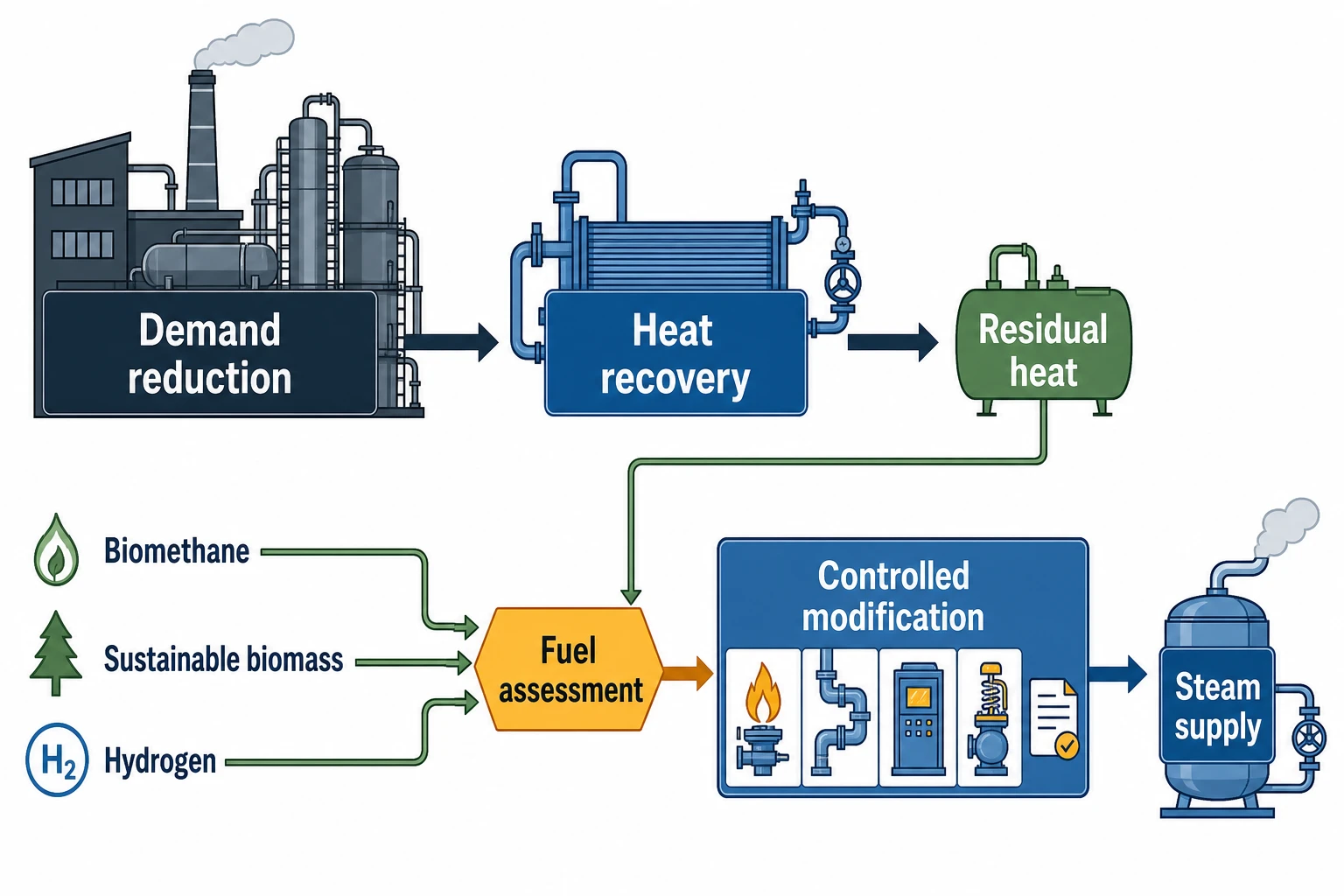 Fuel switching belongs after demand reduction and heat recovery have reduced the residual load. Some high-temperature or direct-fired duties may remain difficult to electrify in the short term, particularly where equipment replacement would disrupt throughput or affect product characteristics. Biomethane, sustainable biomass, hydrogen and other lower-carbon fuel routes need careful assessment of availability, lifecycle emissions, combustion changes, safety requirements, air-quality implications and long-term price exposure. A fuel can reduce direct emissions while creating new supply, storage or permitting issues. Hydrogen requires particular caution. Existing burners, pipework, controls and safety systems may need modification, while fuel availability and carbon intensity depend on how the hydrogen is produced. A future fuel option should not delay projects that can reduce steam demand today. Pressure-system changes also require formal control. HSE guidance on industrial steam and hot-water boilers emphasises that modifications must be planned, recorded and managed to prevent danger. This applies equally to a new electric steam source, revised pipework, or changes to controls and boiler-house operation. ## Policy and measurement are moving towards process-level evidence DESNZ published its report, Updating evidence on energy efficiency potential for UK industry, in March 2026. The work updates the 2015 Industrial Decarbonisation and Energy Efficiency Roadmaps and focuses on measures that reduce delivered energy per unit of industrial output. The earlier roadmaps considered energy efficiency, fuel switching, and carbon capture, utilisation and storage together. That framing is useful for food manufacturers. Efficiency has a separate role from fuel switching: it reduces the scale and cost of later decarbonisation investment, while lower-carbon energy addresses the residual load. For EU-facing operations, the revised Energy Efficiency Directive, Directive (EU) 2023/1791, supports a 2030 target to reduce final energy consumption by at least 11.7% against 2020 projections. The directive reinforces the value of documented energy performance and process-level action. ISO 50001:2018 provides a recognised framework for energy management. Its value in heat decarbonisation lies in maintaining the baseline, energy-performance indicators, measurement plan and management review after the capital project is complete. Without that discipline, a site can lose savings through changes in product mix, cleaning frequency, throughput or control settings. ## A practical route to decarbonisation of food industry heat The first project should create decision-quality evidence rather than commit immediately to a preferred technology. 1. Map thermal processes, utilities and production schedules. 2. Meter the principal steam, hot-water, condensate, cooling and refrigeration streams. 3. Build a Pinch Analysis model using representative operating cases. 4. Implement low-risk demand and distribution measures. 5. Design hygienic heat recovery around validated source-and-sink matches. 6. Recalculate the residual heat demand. 7. Select electrification and fuel-switching options for that reduced duty. 8. Track energy per tonne, per batch or per unit of product after commissioning. Food factories do not decarbonise through one boiler-room decision. They reduce the heat required for each safe, saleable unit of product, recover energy already present in the process, then supply the remaining heat with lower-carbon technology. --- This article reflects the independent analysis and editorial opinion of EnerTherm Engineering. Product names, trademarks, and brands mentioned belong to their respective owners. EnerTherm Engineering is not affiliated with, endorsed by, or a licensee of any third-party software or product mentioned unless explicitly stated.

Managing Director — EnerTherm Engineering
Dr. François Pierrel is Managing Director of EnerTherm Engineering with over two decades of expertise in thermal design, heat transfer, and industrial energy optimisation. He holds a PhD in Heat Transfer from Cranfield University and a Post-Doctorate from Heriot-Watt University.
