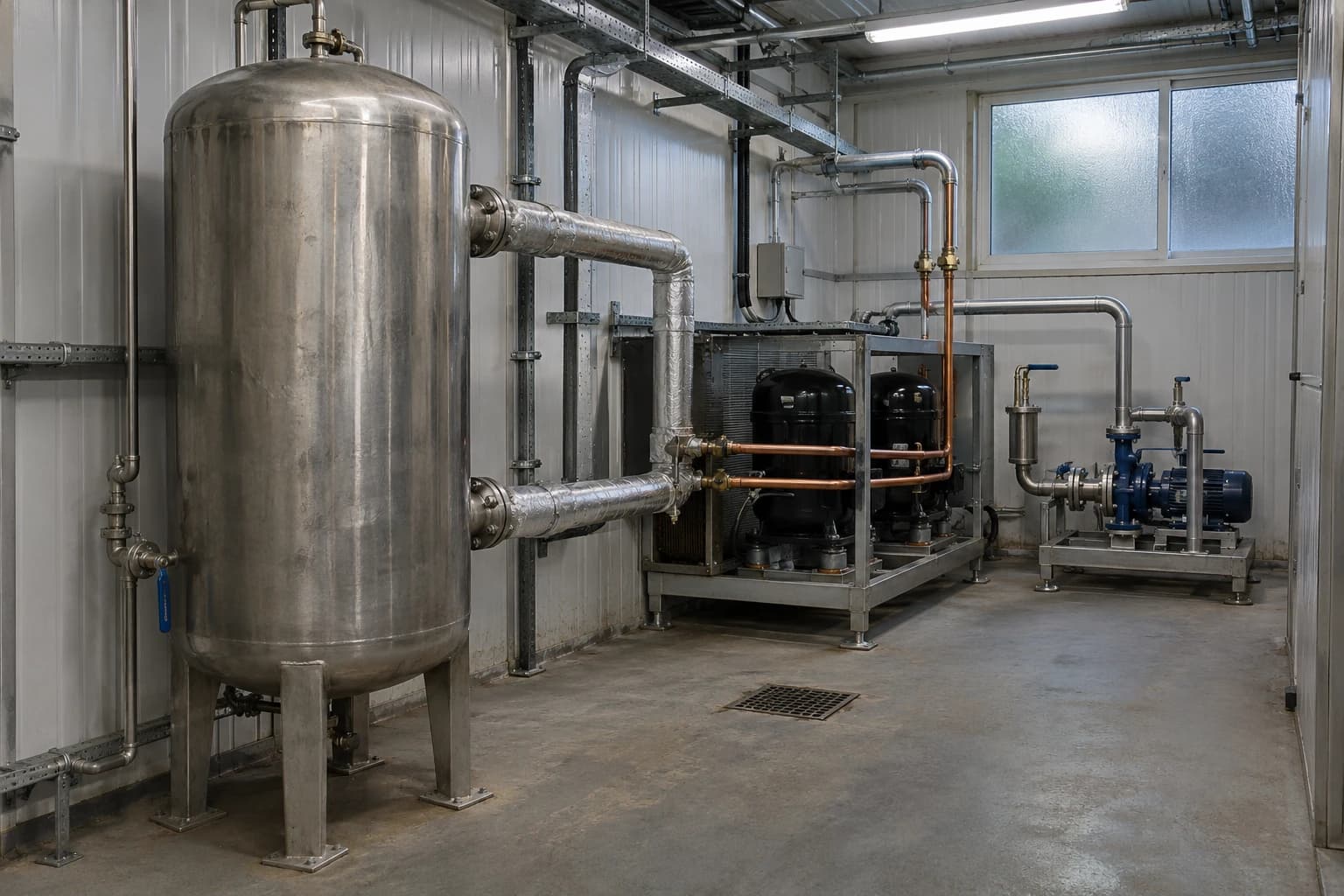
Why UK Food Plants Use Pinch Analysis to Recover Heat
The method maps minimum heating and cooling demand before heat-network design
Pinch analysis is a process-integration method that identifies the minimum external heating and cooling utilities a food plant requires by matching hot process streams with cold process streams.
A dairy factory may cool pasteurised milk while heating water for cleaning. A brewery may reject heat during wort cooling while preparing hot liquor for the next brew. A prepared-food site may operate cookers, retorts, chilling tunnels and washdown systems in the same shift, while each thermal duty is managed separately.
Pinch analysis food industry studies bring these duties into one thermal model. The method identifies where heat can move between processes, where the temperature is insufficient for direct reuse and where the plant must retain steam, hot water, refrigeration or other utilities.
FoodDrinkEurope identifies pinch analysis as a way to determine minimum process-heating and cooling demand, particularly in brewing and milk-powder production. Its decarbonisation roadmap classifies the approach as a mature technology and indicates 5% to 10% reductions in heat demand for the measure category. That figure is a screening indication, not a guaranteed outcome for an individual factory.
For UK food and beverage manufacturers, the value lies in investment sequence. Pinch analysis establishes the practical heat-recovery target before a business commits capital to a larger boiler, chiller, heat pump, thermal store or heat-exchanger network.
Why pinch analysis suits food manufacturing
Food manufacturing combines heating and cooling more often than many industrial operations. Product heating, cooling, refrigeration, clean-in-place systems, condensate, process-water circuits and ventilation exhausts can all carry recoverable energy.
Heating and cooling duties often operate together
A conventional utility review may identify high boiler gas consumption and high refrigeration electricity consumption. Both findings matter, but they do not show whether one process can reduce another’s demand.
Pinch analysis asks a different question: can a hot stream that needs cooling satisfy part of a cold stream’s heating duty?
The answer can change the project list. The best first investment may be a product-to-product heat exchanger, a hot-water loop supplied by recovered refrigeration heat, a condensate-recovery improvement or thermal storage that matches batch operations.
It can also prevent poor sequencing. A site may otherwise install a heat pump before checking whether a higher-temperature process stream can meet the same duty directly.
Food plants impose real design constraints
A theoretical heat match does not automatically become an installable project. Food factories must consider:
- Food safety and hygienic design
- Product contamination and allergen-segregation risks
- Cleanability and clean-in-place requirements
- Fouling and pressure drop
- Product quality and residence-time limits
- Space, access and shutdown windows
- Batch timing and production schedules
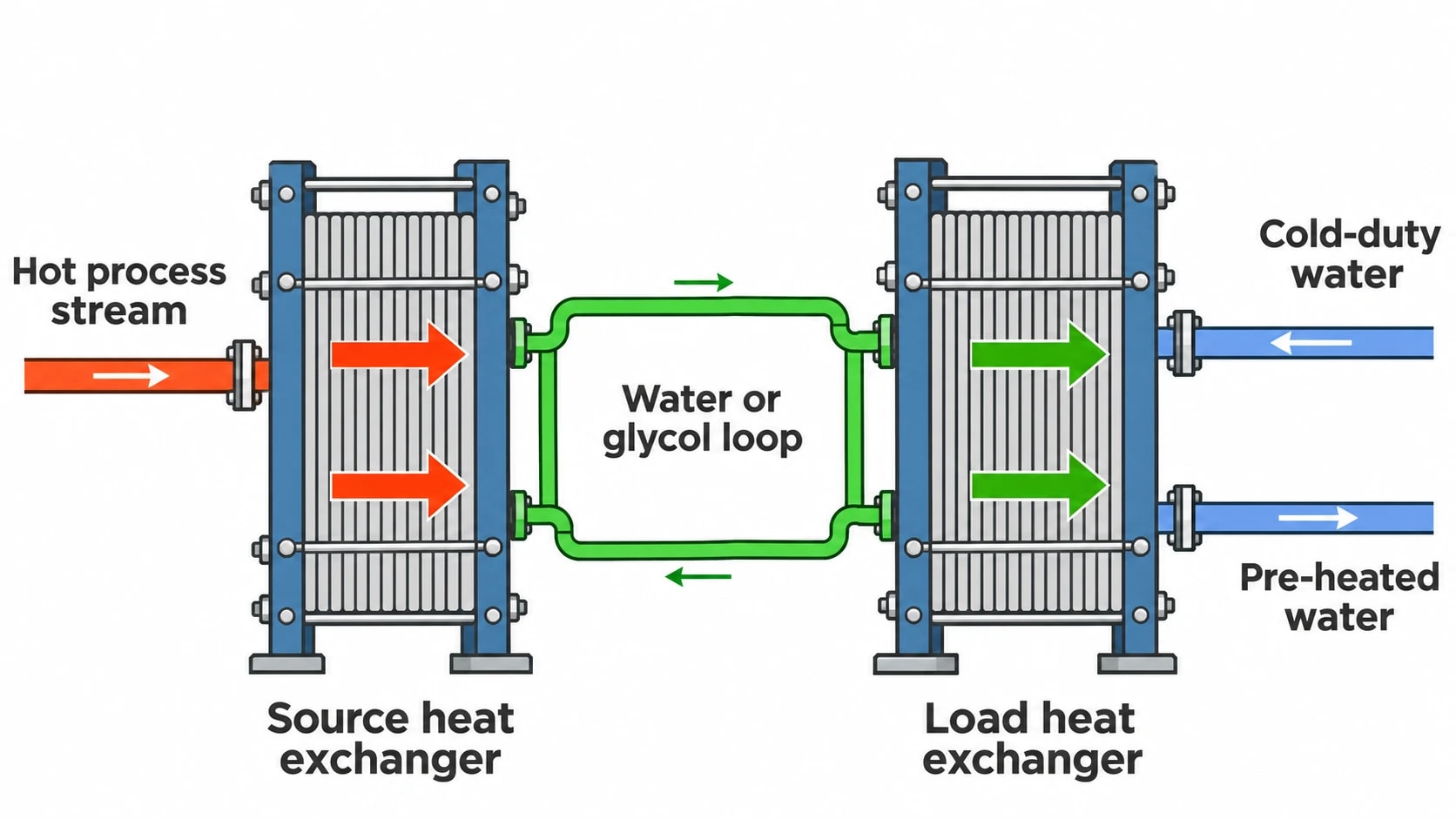
Indirect recovery often provides the practical route. A closed water or glycol loop can transfer energy between areas while keeping product-contact circuits separate. Recovered heat can then preheat water for cleaning, crate washing, boiler feedwater or lower-temperature process duties.
The pinch target sets a ceiling for recovery before engineers select equipment and develop hygiene controls.

Pinch analysis identifies the thermodynamic minimum energy requirement of your process — then designs the heat exchanger network to achieve it.
What a pinch analysis food industry study measures
Pinch analysis starts with process streams rather than equipment names. A stream is any flow that releases heat as it cools or requires heat as it warms.
Each stream needs a supply temperature, target temperature, heat-capacity flowrate, operating period and process constraint. The resulting model captures the site’s thermal demand more accurately than annual utility totals alone.
Hot and cold streams in food processing
Hot streams release heat as they cool. Examples include:
- Pasteurised product before filling or storage
- Wort after boiling
- Hot condensate from steam users
- Clean-in-place return solutions
- Refrigeration condenser heat
- Hot process-water discharge
- Cooker, dryer or oven exhaust where recovery is suitable
Cold streams require heat. They may include incoming process water, make-up water, cleaning solutions, boiler feedwater, hot-liquor preparation and product before cooking or thermal treatment.
The study combines these streams into composite curves or a problem-table calculation. Both methods reveal temperature regions where process heat is available and where the plant requires external utilities.
The pinch point and utility targets
The pinch point is the temperature region where the shifted hot and cold composite curves come closest together. It is the thermodynamic bottleneck for heat recovery.
The main outputs give an engineering team a clear starting point.
| Output | Meaning for the factory |
|---|---|
| Minimum hot-utility target | Lowest external heating demand after feasible internal heat recovery |
| Minimum cold-utility target | Lowest external cooling demand after feasible internal heat recovery |
| Pinch temperature | Temperature region that limits recovery |
| Heat-recovery target | Maximum internal recovery under the selected assumptions |
| Current-to-target gap | Scale of opportunity before detailed design and costing |
The minimum temperature difference requires judgement. A narrow temperature approach increases the theoretical recovery target, but also requires more heat-transfer area and can create control, fouling and cleaning challenges. A wider approach reduces exchanger area but leaves more demand for utilities.
Thermal-design teams test several temperature approaches to establish a sensible trade-off between capital cost, operability and utility savings.
Pinch rules prevent local projects blocking site-wide recovery
Pinch analysis applies simple rules to preserve the target. Engineers avoid adding external heating below the pinch and external cooling above it. They also avoid transferring heat across the pinch unless they understand the resulting utility penalty.
These principles matter on food sites where individual departments pursue isolated projects. A locally attractive recovery scheme can consume a heat source that would deliver greater site-wide savings elsewhere.
Heat-recovery opportunities in food and beverage factories
The strongest projects tend to involve large, repeatable duties with dependable operating temperatures. Continuous processes and batch operations both deserve attention, though the timing of heat sources and demand can differ sharply.
Brewing and beverage production
Breweries are established examples of heat integration because wort heating and cooling, hot-liquor preparation, refrigeration and cleaning create linked thermal loads.
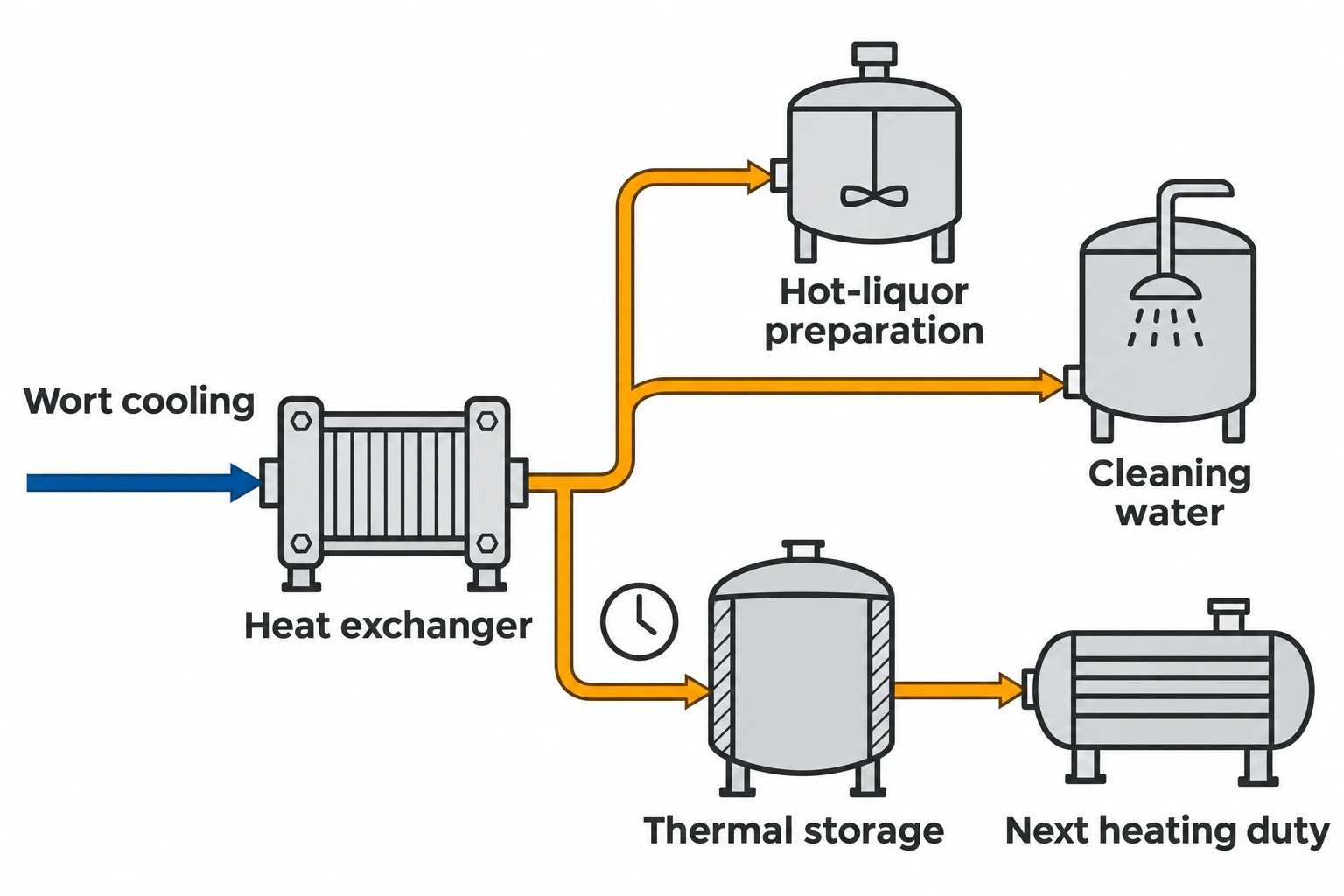
Wort cooling can provide a source for incoming brewing water or hot-liquor preparation, subject to the process arrangement and production schedule. Recovered heat may also reduce the energy needed to raise cleaning water to an intermediate temperature before a final steam or hot-water stage.
Batch timing determines project value. Heat released after one brew may be unavailable when the next heating duty begins. A pinch analysis therefore needs to represent brew length, vessel turnaround, shift arrangements and thermal storage.
Beverage plants can face similar challenges. Pasteurisation, bottle washing, syrup preparation, chilled filling and refrigeration may offer useful heat matches, but production peaks and changeovers must be included in the model.
Dairy and milk-powder manufacture
Dairy plants can combine pasteurisation, chilling, evaporation, drying, cleaning and refrigeration. These processes operate across a broad temperature range, making rigorous targeting valuable.
Regenerative pasteurisation already recovers heat between incoming cold product and outgoing pasteurised product. A site-wide pinch study assesses the remaining opportunities around that exchanger. Process water, condensate, evaporator duties, refrigeration and clean-in-place demand can form part of the same thermal picture.
Milk-powder production deserves particular attention. Evaporation and drying create major heating loads, while condensation and cooling reject substantial heat. The key question is whether lower-temperature recovered heat has a stable use elsewhere in the factory.
A useful study separates direct process recovery from heat that requires temperature upgrading. It also identifies whether a proposed project reduces steam demand during the periods that drive annual fuel consumption.
Prepared foods, canning and frozen products
Cooking, blanching, retorting and washing generate hot streams. Chilling, freezing and cold storage demand cooling. These operations may sit in separate production areas, yet common water circuits or indirect heat-recovery loops can connect them.
A frozen-food factory should examine refrigeration heat alongside hot-water and steam users. Condenser heat may suit preheating duties, while high-temperature cooking loads may retain a steam or electrically supplied heating requirement.
Canning and prepared-food facilities also need to include washdown in the energy model. Cleaning demand can be substantial, frequent and poorly represented by annual utility data. The duration, temperature and volume of each cleaning stage affect the value of recovered heat.

Pinch analysis identifies the thermodynamic minimum energy requirement of your process — then designs the heat exchanger network to achieve it.
Refrigeration heat needs temperature and timing analysis
Refrigeration is an electrical load and a potential source of useful heat. Condensers reject energy while other parts of the plant may heat water using steam, gas or electricity.
Pinch analysis determines whether that heat is usable at the required temperature and time.
Available heat is not automatically useful heat
A condenser can reject a large thermal load, but a lower-temperature source can only meet a duty with a compatible target temperature unless a heat pump raises the temperature.
A practical study separates the options:
- Direct recovery to low-temperature water duties
- Recovery through a central hot-water loop
- Heat-pump upgrading for higher-temperature demand
- Heat with no economical match because of temperature, timing or hygiene constraints
A kilowatt of recovered heat at one temperature has different application options from a kilowatt at another.
Thermal storage can improve batch matching
A brewery or prepared-food site may have a useful heat source in one part of the day and a heating requirement later in the shift. Thermal storage can improve that match, but introduces its own engineering requirements.
The business case needs to include storage losses, footprint, insulation, controls, water quality, maintenance and the effect of charging and discharge temperatures on usable capacity. Storage should emerge from the process model rather than become a generic addition to every recovery concept.
How a food-plant pinch study should be run
A credible pinch analysis is a process-engineering exercise. Utility bills provide context, but they cannot establish stream temperatures, operating overlap or hygiene constraints.
Build a representative stream data set
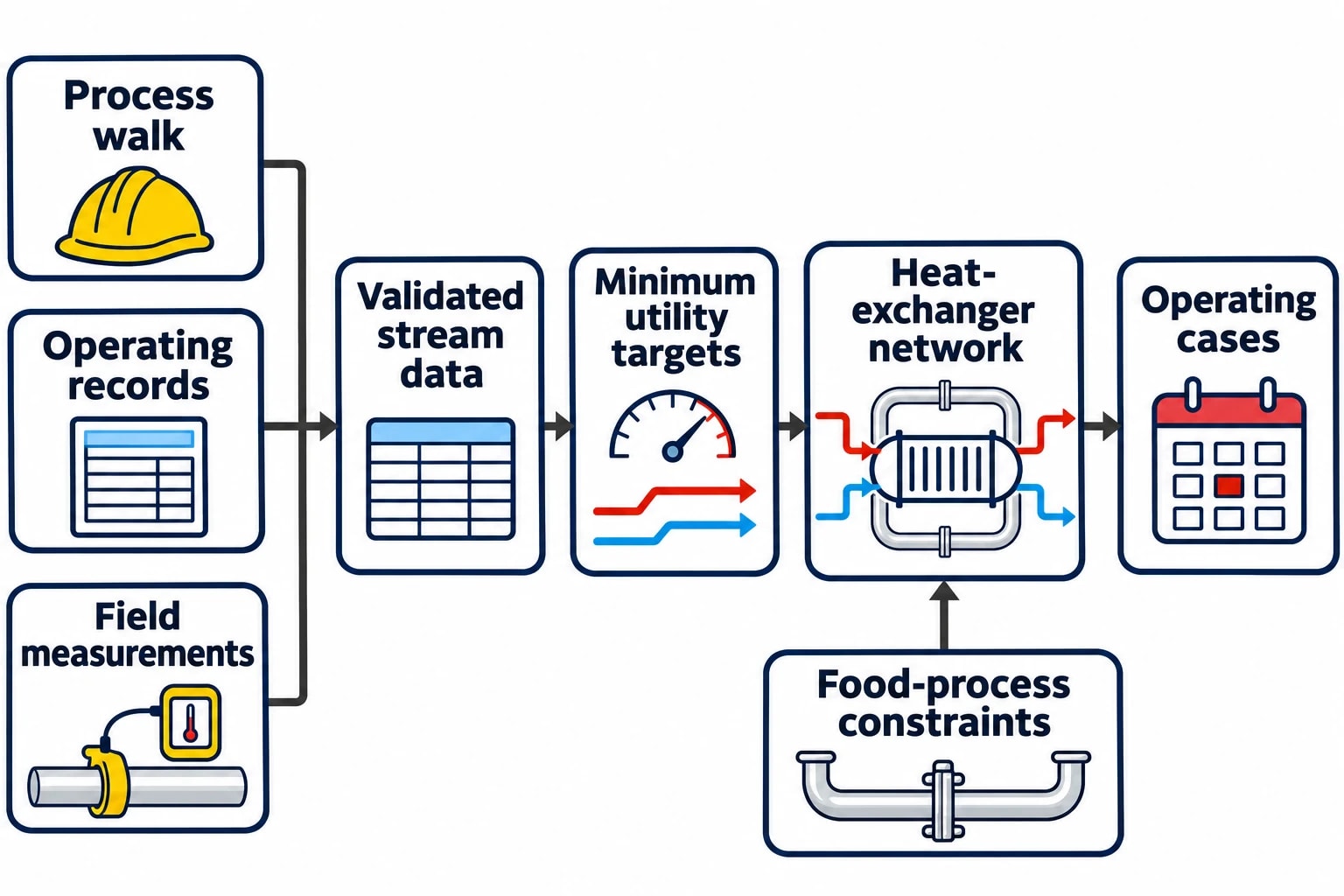
The study team needs to walk the process, review operating records and validate key field measurements. Useful inputs include:
| Data required | Why it matters |
|---|---|
| Stream supply and target temperatures | Defines the recovery opportunity and driving force |
| Flowrates and heat capacities | Establishes heat duty |
| Batch duration and production schedule | Tests whether supply and demand coincide |
| Steam, hot-water and chilled-water use | Establishes present utility consumption |
| Condensate return conditions | Identifies heat and flash-steam opportunities |
| Refrigeration load and condensing conditions | Defines heat availability and variation |
| Clean-in-place cycles | Captures a major hot-water demand |
| Hygiene and maintenance constraints | Removes options that cannot operate safely |
Data quality determines the quality of the target. A control-system display may support early screening, but exchanger sizing requires confidence in temperatures, flows and duty. Bypasses, seasonal conditions, instrument calibration, partial-load operation and product changes can materially alter a project’s outcome.
Separate energy targeting from network design
The first stage establishes minimum utility targets. The second develops an operable heat-exchanger network that respects food-process requirements.
The network design must address fouling, cleanability, pressure drop, product quality, control response, maintenance access and plant shutdowns. Clean liquids may suit plate-and-frame exchangers. Viscous or particulate products may require tubular equipment. Indirect loops can provide separation where direct exchange would create an unacceptable hygiene risk.
The pinch target does not choose the equipment. It gives designers a quantified measure of the utility reduction that remains available.
Test more than one production case
Food production changes with product mix, seasonal intake, cleaning frequency, throughput and shift pattern. A single annual average can conceal a weak project.
Engineers should model the principal operating cases, including reduced throughput, peak production and cleaning periods. A heat-recovery scheme that performs well during one high-volume campaign may deliver modest annual savings if it sits idle for much of the year.
Pinch analysis supports energy audits and capital decisions
Pinch analysis gives an energy manager a structured way to move from a utility baseline to investable projects. It identifies the energy target, the constraints that limit recovery and the data required to prove delivered savings.
A useful foundation for UK process-energy audits
BS EN 16247-3:2022 is the current UK standard for process energy audits. It sets requirements for methodology, data analysis, reporting and documentation in process audits.
For a food manufacturer, pinch analysis can sit within this wider audit structure where heating and cooling form material parts of energy consumption. It adds process detail that a high-level utility review cannot provide.
ESOS guidance recognises BS EN 16247 and ISO 50002 methodologies as potential audit approaches, while leaving organisations responsible for selecting an appropriate method. The next full ESOS compliance notification deadline is 5 December 2027 for Phase 4 participants.
Measure performance after installation
A completed project should be measured against a defined baseline. Relevant indicators may include steam reduction, boiler fuel use, recovered condenser heat, refrigeration electricity, production volume and operating hours.
Product mix and ambient conditions require attention, especially where refrigeration duties change through the year. Measurement should distinguish reduced energy use from changes in output or production scheduling.
This article reflects the independent analysis and editorial opinion of EnerTherm Engineering. Product names, trademarks, and brands mentioned belong to their respective owners. EnerTherm Engineering is not affiliated with, endorsed by, or a licensee of any third-party software or product mentioned unless explicitly stated.

Simulation Engineer — EnerTherm Engineering
Rajesh Sekar is a Simulation Engineer at EnerTherm Engineering, specialising in computational fluid dynamics (CFD), finite element analysis (FEA), and thermal process simulation. He holds a degree from Cranfield University and brings extensive experience in simulation-based product development from the automotive, aerospace, and energy sectors.
