Pasteuriser Heat Recovery: Why 90-94% Regeneration Matters
How product-to-product exchange cuts steam and refrigeration demand on milk lines.
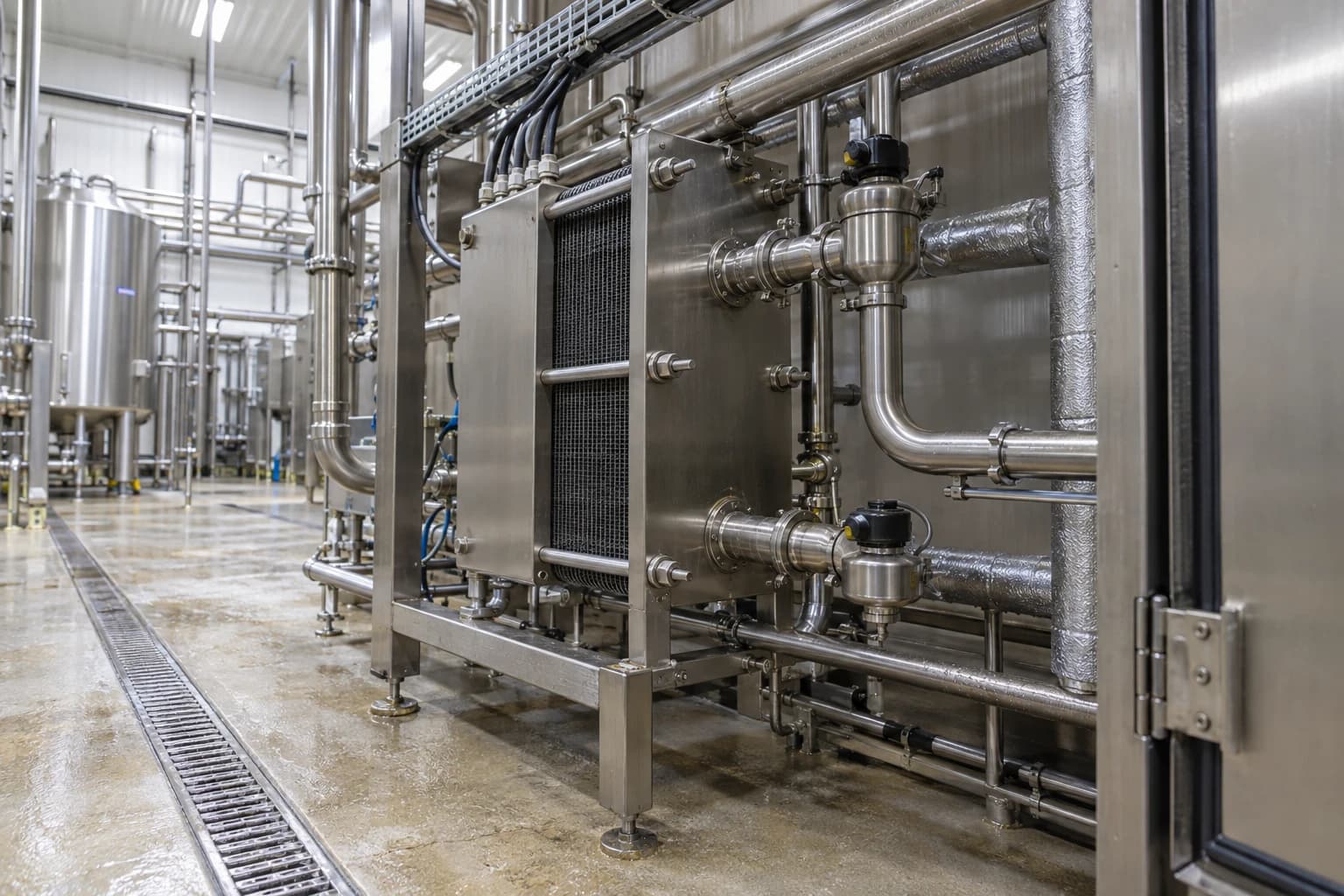
Pasteuriser heat recovery transfers heat from hot pasteurised product to colder incoming product, usually in the regeneration section of a plate heat exchanger. In a modern HTST milk line, 90-94% regeneration leaves only a small final temperature lift for steam or hot water, while reducing the refrigeration duty needed to cool finished product.
That has a substantial effect on a process running through long production shifts. A pasteuriser heating milk from chilled reception temperature to roughly 72°C must add considerable sensible heat. Without regeneration, the heating utility supplies most of that duty and the refrigeration system removes it again. Effective product-to-product regeneration uses the same heat on both sides of the process.
The result is lower boiler or hot-water demand, lower cooling demand and a credible route to reducing gas consumption without changing the validated pasteurisation target.
What 90-94% Regeneration Means in Pasteuriser Heat Recovery
Product heat replaces utility heat
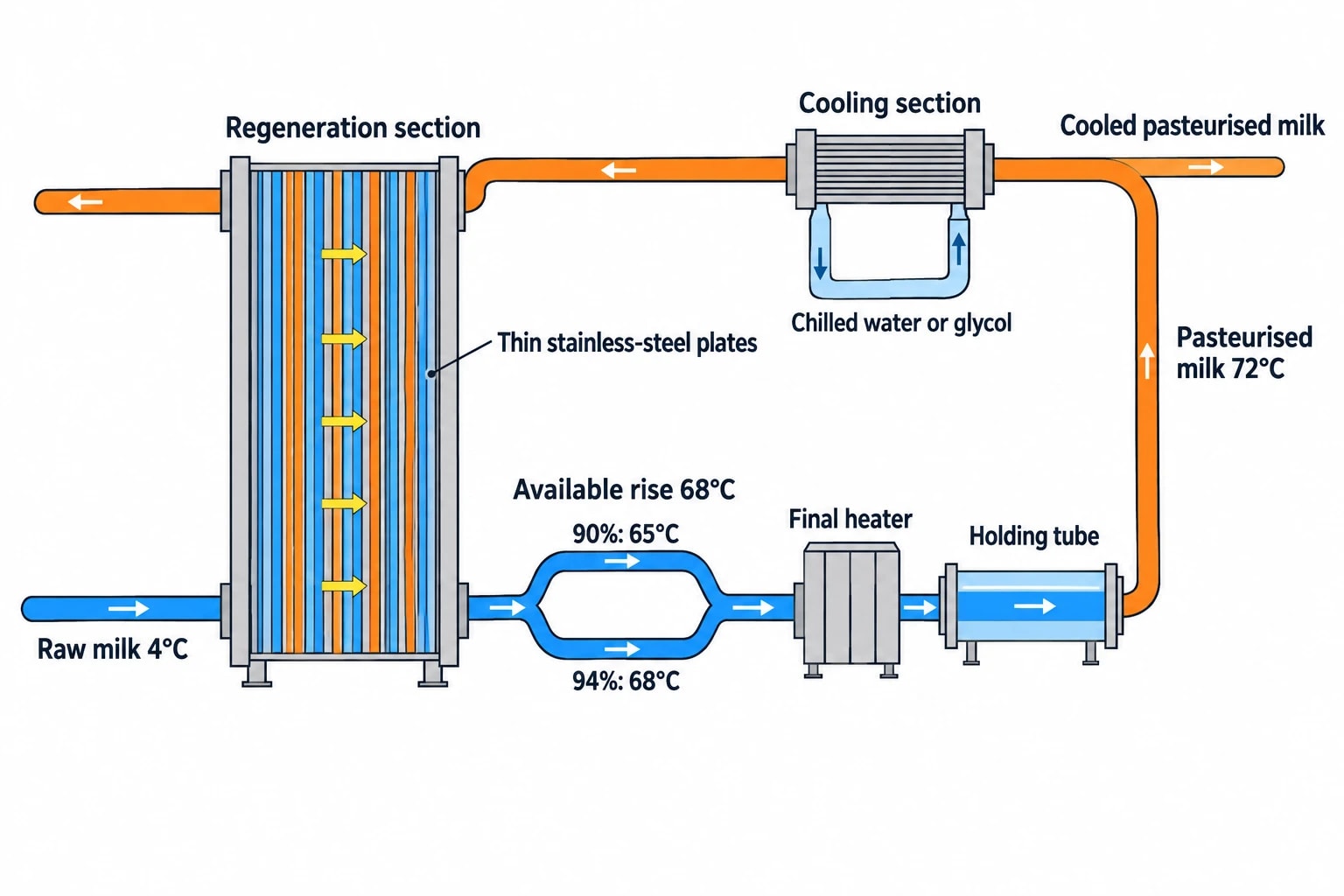
A regenerative pasteuriser places raw and pasteurised product streams on opposing sides of thin stainless-steel plates. Hot pasteurised milk flows towards cooling while cold incoming milk flows towards heating. The temperature difference across the plates transfers heat from the outgoing stream to the incoming stream.
For a liquid milk line receiving product at 4°C and heating it to 72°C, the available temperature rise is 68°C. At 90% regeneration, incoming milk might leave the regeneration section at about 65°C before entering final heating. At 94%, it may leave nearer 68°C, subject to flow balance, product properties, plate design and operating conditions.
The final heater raises the product by only a few degrees to its validated pasteurisation temperature. On the return path, regeneration cools the pasteurised product before chilled water or glycol completes the cooling duty.
Moving from 90% to 94% regeneration further reduces heating duty at the hot end and cooling duty at the cold end on a high-throughput line.
Regeneration is not a blanket energy-saving figure
A 90-94% regeneration figure describes product-to-product heat transfer within the pasteuriser. It does not mean that a plant has cut total site energy use by the same percentage.
Steam, hot water, electricity and refrigeration consumption also depend on:
- Product inlet and outlet temperatures
- Throughput and operating hours
- Start-up, shutdown and changeover losses
- Product viscosity and heat capacity
- Separator, homogeniser and pump loads
- CIP heating requirements
- Plate fouling and pressure drop
- Cooling-water temperature and refrigeration plant performance
Regeneration remains a useful operating metric because it links directly to the two large thermal loads around the pasteurisation hold.
Why milk can achieve high regeneration
Milk and milk-mix products commonly support high regeneration because the hot and cold streams are the same product at closely matched flow rates. Their heat capacities are similar, creating favourable conditions for counter-current heat exchange.
GEA states that its dairy pasteuriser systems target heat recovery above 90% for milk and milk-mix products, while cream applications target above 85%. Cream requires a different design approach because its composition and handling requirements affect heat transfer and pressure drop.

Pinch analysis identifies the thermodynamic minimum energy requirement of your process — then designs the heat exchanger network to achieve it.
How a Regenerative HTST Pasteuriser Works
The typical thermal sequence
A continuous milk pasteuriser contains several temperature zones. The exact arrangement varies by product, but the thermal logic remains consistent.
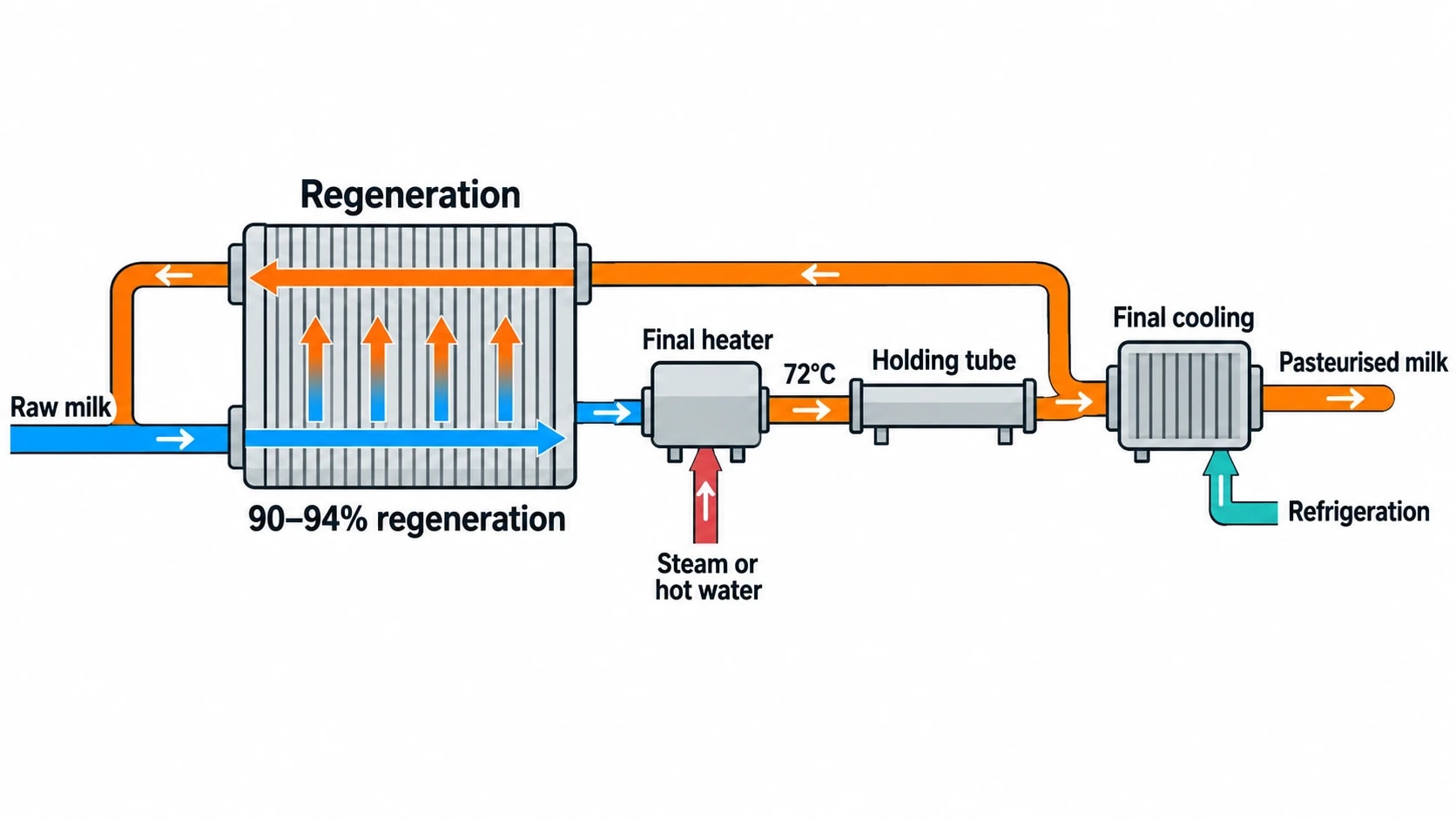
Incoming chilled raw product first passes through regeneration, where outgoing pasteurised product raises its temperature. The product then enters final heating, which uses steam-heated water or another controlled heating medium. It passes through the holding tube at the validated temperature and residence time.
After the holding section, the product returns through regeneration. It gives up most of its heat to the incoming stream before passing through cooling sections and moving to a storage tank or filler.
The product leaving the holding tube is an immediate heat source for a closely matched sink, reducing utility consumption.
Food safety sets the duty
The energy target cannot override the validated heat treatment. The UK Food Standards Agency identifies continuous-flow pasteurisation at 72°C for 15 seconds and batch pasteurisation at 63°C for 30 minutes as example conditions.
Regulation (EC) No 853/2004, Annex III, Section IX, Chapter II specifies at least 72°C for 15 seconds for high-temperature short-time pasteurisation, at least 63°C for 30 minutes for low-temperature long-time treatment, or an equivalent time-temperature combination. It also links the decision to heat treat raw milk and colostrum to HACCP-based procedures under Regulation (EC) No 852/2004.
A pasteuriser heat recovery project must preserve validated heat treatment, holding time, flow-diversion control and hygienic separation. Energy performance comes from reducing utility duty around the critical control point, not from reducing the critical control point.
Pressure control protects the pasteurised side
Plate heat exchangers have a thin barrier between raw and pasteurised product. A pinhole, gasket failure or plate defect can create a route for cross-contamination if the pressure relationship is wrong.
Dairy pasteurisers commonly maintain higher pressure on the pasteurised side than on the raw side in the regeneration section. If a plate leaks, pasteurised product tends to move towards the raw side rather than raw product contaminating the finished stream. Engineers must verify this pressure differential during production, flow diversion, start-up and shutdown.
Why 90-94% Regeneration Matters to Steam and Refrigeration Demand
The final heater becomes a trim duty
The final heating section supplies the temperature rise that regeneration cannot provide. At 90% regeneration, this residual duty is far smaller than the full raw-to-pasteurisation temperature lift. At 94%, it is smaller again.
A lower final-heater duty can reduce the load on hot-water generation, steam-control valves, condensate systems and boiler firing. It can also improve the economics of low-carbon heat where the remaining duty sits within the useful delivery range of a heat pump or high-temperature hot-water system.
The required holding temperature remains fixed, but the energy source and quantity needed to reach it can change materially.
Cooling duty falls at the same time
The outgoing pasteurised product enters the regeneration section hot. Each unit of heat transferred to incoming product is a unit that the final cooling system does not need to remove.
One heat-exchanger improvement reduces heating and refrigeration demand. This can be particularly valuable where refrigeration capacity constrains production in warm weather or cooling-water temperatures rise during peak operation.
Production stability affects savings
Published regeneration performance applies under defined design conditions. Plants rarely operate only at their design point.
Reduced throughput, variable flow, product swaps, short campaigns and frequent stops reduce the time available for stable heat recovery. The pasteuriser still heats and cools product during transients, but the matched product-to-product duty may be interrupted.
Energy managers should assess:
- Regeneration percentage during stable production
- Steam or hot-water use per tonne of product
- Refrigeration electricity per tonne of product
- Product inlet temperature at the start of each run
- Utility demand during start-up and changeover
- Hours spent at design flow versus reduced flow
A site can report a respectable average regeneration figure while losing significant energy during operational events outside the steady-state calculation.

Pinch analysis identifies the thermodynamic minimum energy requirement of your process — then designs the heat exchanger network to achieve it.
Pinch Analysis for Pasteuriser Waste Heat Recovery
Start with the exchanger network already on the line
Pasteuriser heat recovery is a compact heat-exchanger network. Pinch Analysis assesses whether it uses the available temperature difference well and whether further recovery has a credible destination.
The first task is to map the real streams:
- Raw product entering regeneration
- Pasteurised product leaving the holding section
- Heating water or steam condensate loop
- Chilled water, glycol or ice-water circuit
- CIP return and make-up water
- Other warm process-water streams near the line
The analysis needs measured temperatures, flow rates, product type, production schedule and utility consumption. Nameplate figures do not reveal fouling, bypasses, altered plate packs or changed production practice.
Identify the practical temperature limit
A high regeneration target does not mean that hot and cold product streams can approach indefinitely. The plate heat exchanger needs a temperature difference to transfer heat. Hygiene requirements, pressure drop, plate geometry, fouling allowance and control stability also set limits.
A plant should establish the actual temperature approach at each end of the regeneration section. If the cold product outlet temperature falls below its expected value while the hot product outlet temperature rises, causes may include fouling, reduced flow matching, internal bypassing or deteriorated utility conditions elsewhere on the line.
Plate packs age in service, while product formulations, cleaning regimes and production schedules affect thermal performance.
Extend recovery beyond the product loop with care
Once product-to-product regeneration approaches its practical limit, process teams can examine nearby heat sinks. Warm water for cleaning-in-place is often a strong candidate because it requires useful heat at a lower temperature than the pasteurisation hold.
GEA identifies heat-pump applications that use waste heat from elsewhere in a plant to produce water up to 95°C for pasteurisation and cleaning-in-place. This does not remove the need for site-specific engineering. Heat-source temperature, heat-pump performance, required hot-water profile and available operating hours determine whether the installation can displace meaningful boiler load.
Integration projects should preserve high-value product regeneration first, then use residual heat where it still has a viable process use.
Maintaining Pasteuriser Heat Recovery Performance
Fouling erodes heat transfer and raises pumping energy
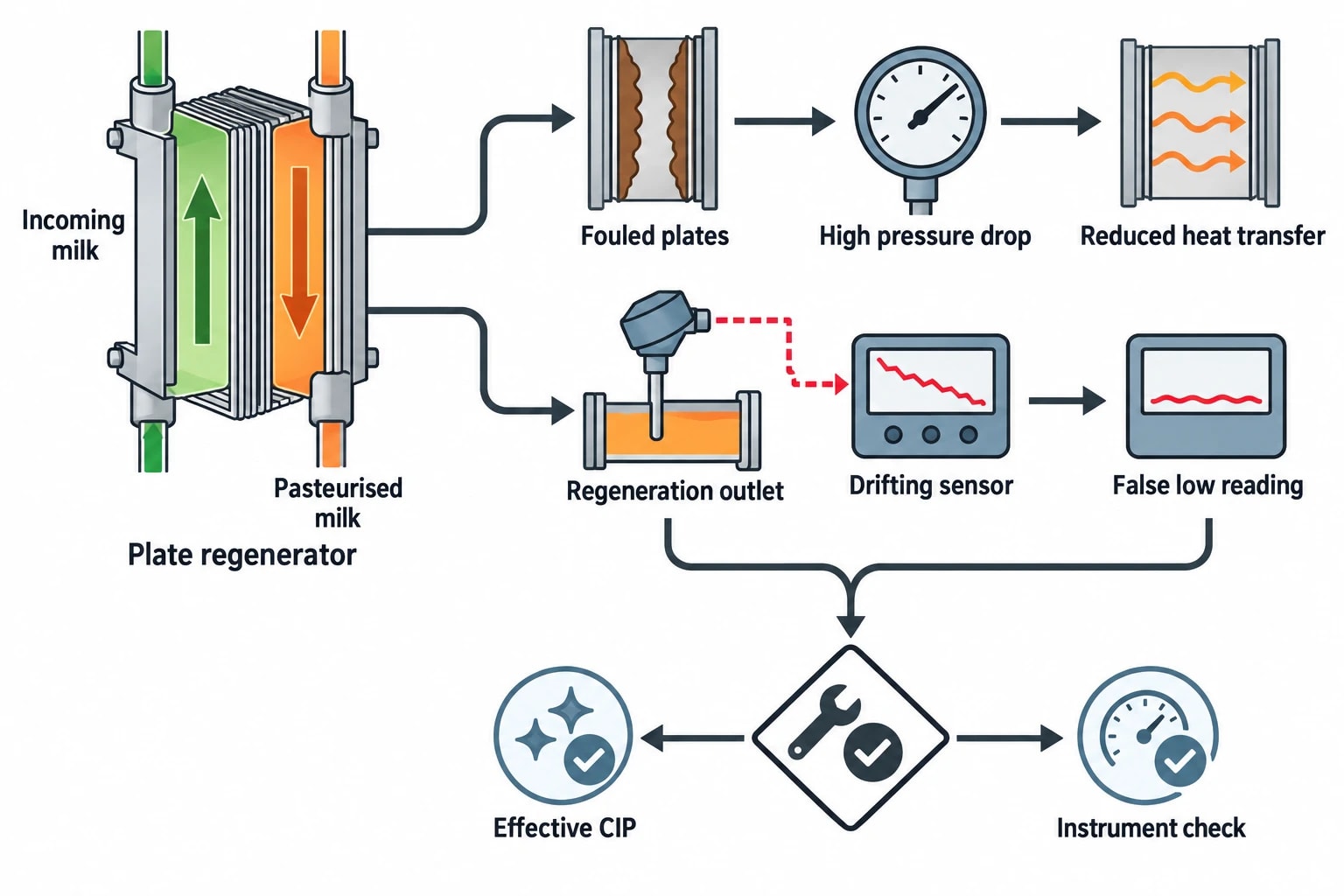
Milk proteins and mineral deposits can reduce heat-transfer performance on heated surfaces. Fouling can require a higher heating-medium temperature, increase final-heater duty or reduce the achievable regeneration temperature rise. A blockage or restrictive plate pack also increases pressure drop, adding pump energy and disturbing pressure control across the regeneration section.
Plants need trend data that distinguishes normal operational variation from sustained loss of heat-exchanger performance. Excessive CIP consumes water, chemicals and heat, while insufficient cleaning risks compromised thermal performance and production reliability.
Useful indicators include differential pressure, product temperatures at each section boundary, heating-medium flow, steam or hot-water consumption, cooling load, and time since the last confirmed effective CIP cycle.
Confirm instrumentation before blaming the plates
Temperature sensors can drift. Flow transmitters can misread. Control valves can stick or hunt. A faulty sensor at a regeneration outlet can create the appearance of poor heat recovery or conceal a real problem.
Instrument checks should cover sensors used for food-safety control and energy-performance calculations. The systems often overlap, but their purposes differ. A validated pasteurisation record establishes that the product achieved its thermal treatment. Energy analysis establishes how much utility the line needed to achieve it.
Both require trustworthy measurements.
Use energy data as part of process improvement
ISO 50001:2018 provides a management framework for using data to understand energy use, set objectives, measure results and improve performance. For a pasteurisation line, this can mean a repeatable review of energy per tonne alongside product quality, output and downtime.
A useful baseline separates milk, cream, milk-mix and other products. It also records throughput because low-flow running can increase energy per tonne even when the pasteuriser remains within its validated operating envelope.
Steam per tonne has more value when reviewed alongside product inlet temperature, production rate and regeneration outlet temperature. This context shows whether a utility increase arose from lower incoming product temperature, reduced heat transfer or a changed operating schedule.
A Practical Project Route for UK Food and Beverage Sites
Establish the thermal baseline
Begin with several representative production runs rather than one shift. Capture stable operation, start-up, a typical changeover and any reduced-throughput period. Measure product temperatures across the regeneration, heating and cooling sections, then reconcile those readings against utility meters.
The objective is to establish where heat enters and leaves the line. A credible baseline also shows whether the plate pack performs close to its design intent.
Prioritise low-disruption improvements
The first opportunities often sit within the existing pasteuriser:
- Calibrate relevant temperature, pressure and flow instruments.
- Review regeneration performance by product and production rate.
- Inspect plate condition, gaskets and plate-pack configuration at the appropriate maintenance interval.
- Review CIP effectiveness against fouling trends.
- Check pressure differential across the regeneration section.
- Investigate bypasses, control instability and unnecessary hot-water circulation.
These actions can recover lost performance before a site commits capital to additional heat-recovery equipment.
Size new equipment around real operation
Where the regeneration section has reached its hygienic and hydraulic limit, an expanded plate pack, revised utility arrangement, thermal store or heat pump may be justified. Engineers should size equipment around actual operating hours and temperature profiles, including cleaning and production gaps.
A heat source that appears generous on a process diagram may be unavailable when the pasteuriser needs it. A hot-water requirement may peak during CIP while the relevant waste-heat source is idle. Pinch Analysis resolves these timing and temperature questions before equipment selection.
This article reflects the independent analysis and editorial opinion of EnerTherm Engineering. Product names, trademarks, and brands mentioned belong to their respective owners. EnerTherm Engineering is not affiliated with, endorsed by, or a licensee of any third-party software or product mentioned unless explicitly stated.

Managing Director — EnerTherm Engineering
Dr. François Pierrel is Managing Director of EnerTherm Engineering with over two decades of expertise in thermal design, heat transfer, and industrial energy optimisation. He holds a PhD in Heat Transfer from Cranfield University and a Post-Doctorate from Heriot-Watt University.
