
Revolutionizing Food Safety: How Process Modelling Prevents Foodborne Illnesses
Foodborne illnesses remain a significant public health concern globally, affecting millions and imposing substantial economic burdens on the food industry through recalls and reputational damage. While traditional food safety measures are crucial, the complexity of modern food supply chains demands more sophisticated preventative strategies. This is where process modeling, a powerful application of process engineering and mathematical modeling, steps in, offering a proactive approach to identify, mitigate, and prevent food safety hazards before they can lead to widespread illness.
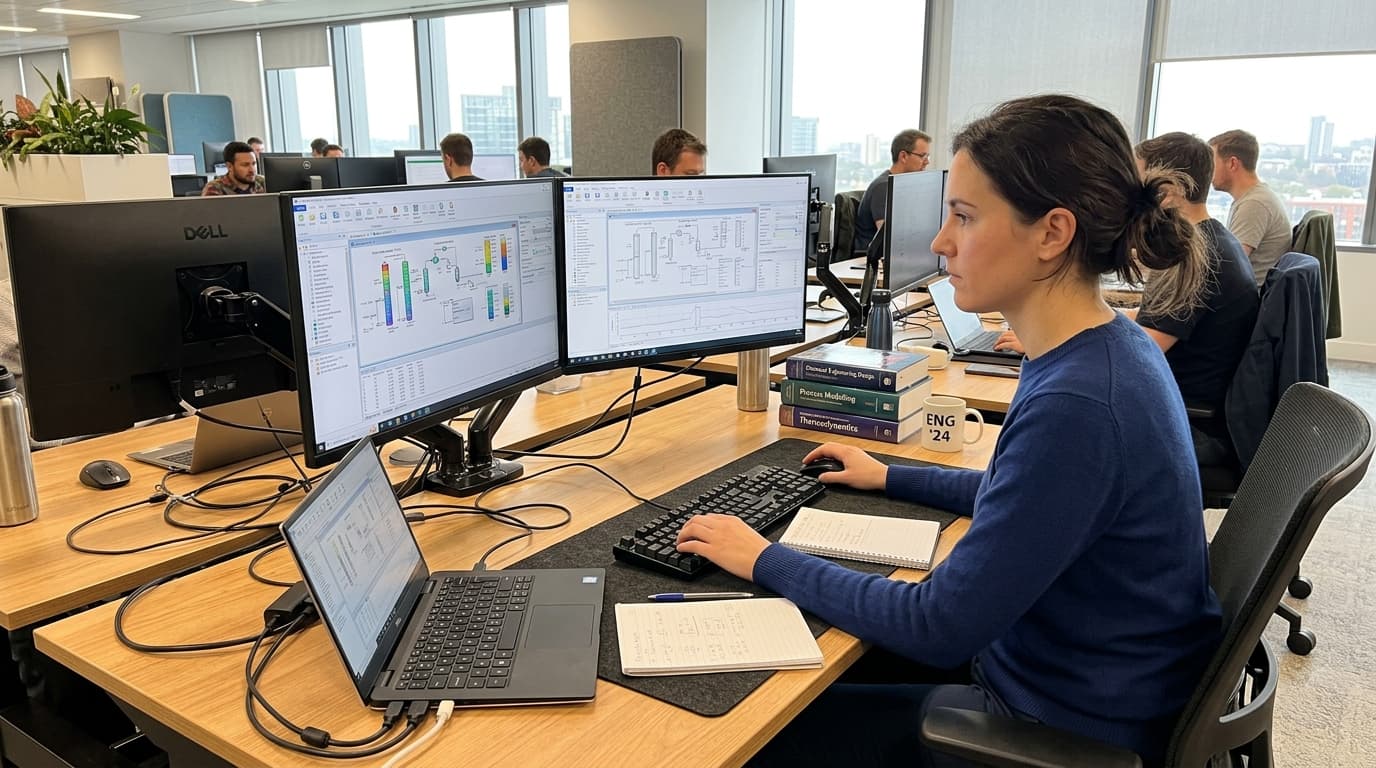
Build a digital twin of your process — from steady-state simulation to dynamic modelling — to test scenarios, optimise control, and predict plant behaviour.
What is Process Modelling in Food Safety?
Process modeling in the context of food safety involves using mathematical and statistical techniques to predict and understand the behavior of microorganisms and other hazards within food products and processes. Its primary goal is to provide a scientific basis for predicting the risk of foodborne illness and developing effective control and prevention strategies. This multidisciplinary field leverages data and computational tools to simulate real-world conditions, allowing food manufacturers and regulatory agencies to anticipate and control the growth and behavior of microorganisms in food products.
Key components of food safety modeling include:
- Microbiological modeling: Using mathematical models to describe the growth, survival, and inactivation of microorganisms in food.
- Risk assessment: Employing statistical models to estimate the risk of foodborne illness associated with specific food products or processes.
- Predictive modeling: Utilizing mathematical models to forecast the behavior of microorganisms under various conditions such as temperature, pH, and water activity.
Core Applications of Process Modelling in Food Safety
Process modeling offers a wide range of applications that significantly enhance food safety protocols throughout the entire food chain, from farm to fork.
Predictive Microbiology: Anticipating Microbial Behavior
Predictive microbiology is a cornerstone of process modeling in food safety. It involves developing mathematical equations to describe how microorganisms behave under different environmental factors (e.g., physical, chemical, competitive conditions). These models can estimate the potential growth of harmful foodborne microorganisms, predict shelf life, and assess microbial risk. This allows for the design of food processing and preservation strategies that reduce the risk of foodborne illness.
For instance, predictive models can assess the effect of heat treatment, refrigeration, or packaging on microbial growth or inactivation. By simulating the temperature at every point in a cooking process, models can determine if safe conditions are achieved throughout a product, ensuring lethality standards are met.
Supporting Hazard Analysis and Critical Control Points (HACCP)
Process modeling is an invaluable tool for strengthening Hazard Analysis and Critical Control Points (HACCP) plans. HACCP is a systematic approach to identify and prevent potential problems throughout food production, distribution, and consumption. Process modeling aids in identifying and controlling critical points where hazards can occur, such as during processing and preservation.
Models developed to predict microbial survival and growth can be integrated into HACCP protocols to evaluate, control, and document the safety designed into a food product. They can help in determining critical control points (CCPs) and critical limits (CLs) by predicting the levels for different parameters that permit microbial growth. This integration provides a scientific basis for decision-making and helps establish effective monitoring systems.
Optimizing Process Parameters and Formulations
Mathematical models play a crucial role in understanding and optimizing various aspects of food processing. They provide a systematic framework for analyzing and optimizing process parameters like heat transfer, mass transfer, fluid flow, and reaction kinetics. This optimization ensures that processes are efficient while maintaining or enhancing food safety. For example, simulations can evaluate the effects of changing parameters (e.g., increasing cooking temperature) much more easily and cost-effectively than physical experiments. This allows for rapid “what-if” analyses to ensure food safety standards are met without compromising quality or increasing costs.
Enhancing Traceability and Supply Chain Management
The food supply chain is complex, with numerous steps where contamination can occur. Process modeling, particularly through advanced concepts like digital twins, significantly improves traceability and risk management. A “digital twin” is a virtual replica of a physical object, system, or process that allows for real-time simulation, analysis, and optimization. In the food industry, digital twins can model supply chains, production lines, and equipment, providing real-time data on production conditions.
This technology can track the entire production data of every good, from source ingredients to the final product, offering end-to-end traceability insights. By integrating real-time sensor data, process data, and raw material information, digital twins can foresee problems and proactively react to them, thus ensuring compliance and better product quality.
Predicting and Preventing Cross-Contamination
Mathematical models are essential for simulating the transfer of foodborne pathogenic bacteria in different food media, enhancing the understanding of pathogen transmission through cross-contamination. Cross-contamination is a significant cause of foodborne disease outbreaks in processing, storage, and household settings. By combining cross-contamination modeling with microbiological risk assessment, key links in microbial cross-contamination can be identified, and novel strategies can be designed to prevent and control its occurrence.
Training and Decision Support
Simulations, often derived from process models, offer a safe and effective environment for training food industry personnel. They allow learners to practice essential skills and apply principles in scenarios that mimic real-life situations without real-world consequences. This hands-on approach helps employees understand not just what to do, but why it's done a certain way, reinforcing positive behavior and better preparing them for real-life situations where mistakes can have serious consequences. Furthermore, process models can serve as powerful decision support systems, allowing companies to test “what-if” scenarios, predict potential disruptions, and evaluate the economic impact of various food safety risks.

Build a digital twin of your process — from steady-state simulation to dynamic modelling — to test scenarios, optimise control, and predict plant behaviour.
Methodologies and Tools in Process Modelling
Developing robust process models for food safety relies on a combination of methodologies and specialized tools:
Data Collection and Analysis
Accurate models require extensive data on microbial behavior under various conditions, food product characteristics (e.g., pH, water activity), and process parameters (e.g., temperature, time). This data can come from laboratory experiments, historical records, and real-time sensors integrated through the Internet of Things (IoT). Techniques like Nuclear Magnetic Resonance (NMR) methods and chemometrics can analyze complex food mixtures and extract “fingerprints” of compounds, aiding in food identification and safety compliance.
Model Development
Models can range from simple empirical models based on observed data to complex mechanistic models that describe the underlying physical, chemical, and biological processes. Predictive microbiology models, for instance, often express microbial responses to environmental factors as mathematical equations. Advanced techniques like machine learning and artificial intelligence are increasingly being integrated to create more efficient and accurate models, capable of recognizing complex patterns in data and predicting future occurrences with high accuracy.
Simulation and Validation
Once models are developed, they are used for simulation to predict outcomes under various conditions. Simulations provide comprehensive predictions of system properties across all positions and times, unlike discrete measurements. It's crucial to validate these models against real-world data to ensure their accuracy and reliability. The USDA's Pathogen Modeling Program and ComBase are examples of publicly available resources that provide predictive models and microbiological databases for various pathogens and food systems.
Challenges and Future Outlook
Despite the significant advancements, challenges remain in the widespread adoption and full potential realization of process modeling in food safety. These include the complexity of food systems, the need for robust data integration, and the requirement for specialized technical skills. Simplified models used in the past sometimes failed to provide a realistic evaluation of observed processes, quality, or safety conditions.
However, the future of process modeling in food safety is promising. The increasing adoption of technologies like digital twins, coupled with advancements in AI and machine learning, will lead to more sophisticated and accurate models. These developments will facilitate real-time monitoring, predictive risk management, and proactive intervention strategies, further enhancing food safety, reducing foodborne illnesses, and fostering greater consumer confidence in the global food supply.
