Clearing the Air: Air-to-Air Heat Exchangers for Enhanced Manufacturing Air Quality
Manufacturing environments often present unique challenges to indoor air quality (IAQ). Processes such as welding, cutting, grinding and chemical applications can release pollutants including particulate matter, volatile organic compounds (VOCs) and fumes. Air-to-air heat exchangers (AAHXs) can reduce the energy needed to ventilate these spaces by recovering heat from exhaust air while replacement outdoor air is supplied.
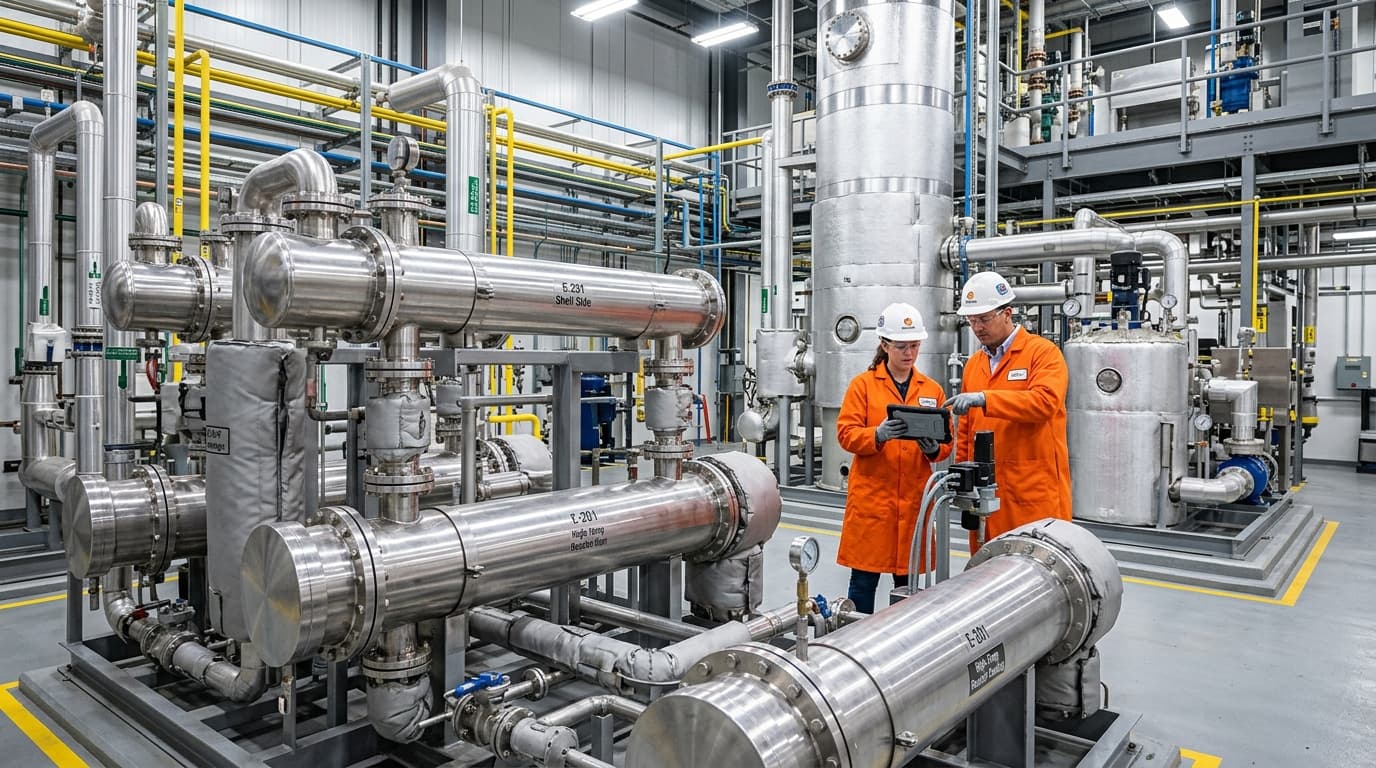
Recover waste heat and cut fuel costs with shell & tube or air-to-air exchangers engineered for continuous industrial duty.
Understanding Air-to-Air Heat Exchangers
An air-to-air heat exchanger (AAHX) transfers heat between two separate air streams without intentionally mixing them. In manufacturing, an AAHX usually recovers heat from exhaust air and uses it to preheat incoming outdoor air. This reduces the heating energy required to bring make-up air to the required supply temperature.
An AAHX is a heat-recovery component, not a substitute for source capture or filtration. Welding fume, combustible dust, chemical vapours and other hazardous contaminants should be controlled at source using suitable local exhaust ventilation, extraction hoods, filters and treatment equipment. Heat recovery should only be applied where the exhaust condition, contamination risk, equipment materials and leakage characteristics have been assessed.
How Air-to-Air Heat Exchangers Work
AAHXs operate through a mechanical ventilation system, typically involving two fans: one supplying fresh air and the other extracting exhaust air. Heat transfer occurs within the exchanger core, which separates the air streams while facilitating heat exchange.
In winter, heat moves from the warmer exhaust stream to the colder supply stream. In warmer weather, the same principle can reduce cooling demand by transferring heat from incoming outdoor air to the cooler exhaust stream, depending on the system configuration and controls.
- Exhaust Air Extraction: Stale, contaminated air is extracted from the manufacturing space.
- Heat Transfer: The warm exhaust air passes through one side of the heat exchanger core.
- Fresh Air Intake: Fresh, cooler air is drawn in from outside and passed through the other side of the core.
- Energy Recovery: Heat transfers from the warm exhaust air to the cool fresh air without direct contact or mixing between the air streams.
- Exhaust Expulsion: The cooled exhaust air is expelled to the atmosphere.
- Preheated Air Supply: The preheated fresh air is supplied to the manufacturing environment, reducing the heating-system load.
Effective AAHX performance depends on balanced airflows, clean heat-transfer surfaces, suitable filtration and a pressure arrangement that limits leakage from exhaust to supply air. Where exhaust contains corrosive, sticky, greasy or high-dust contaminants, upstream treatment and a cleanable, robust exchanger design are particularly important.
Types of Air-to-Air Heat Exchangers
Several AAHX types suit different applications and environments:
- Plate Heat Exchangers: These exchangers use thin, parallel plates to separate the air streams and maximise heat-transfer surface area. Fixed-plate designs provide strong separation between supply and extract air, making them useful where cross-contamination must be minimised. Typical sensible effectiveness is about 50–75% at balanced airflow.
- Tube Heat Exchangers: Tube heat exchangers consist of a bundle of tubes through which one air stream flows, while the other passes over the outside. Their robust design can suit duties involving dust, debris or chemical vapours when materials and cleaning access are selected for the exhaust condition. Typical sensible effectiveness is about 40–60%.
- Rotary Heat Exchangers (Heat Wheels): Rotary heat exchangers feature a rotating wheel filled with heat-absorbing material. They can achieve typical sensible effectiveness of about 65–80%, but rotation and pressure differences can cause carryover or cross-leakage. They require careful assessment where exhaust contains odours, solvents or hazardous airborne contaminants.
- Run-Around Systems: These systems use a circulating fluid to transfer heat between two separate air streams. They can transfer heat over longer distances and physically separate the supply and exhaust airstreams. Typical sensible effectiveness is about 45–65%.
- Energy Recovery Ventilators (ERVs): ERVs integrate heat and, in some designs, moisture-transfer functions into HVAC systems. Their suitability depends on the required separation between air streams and whether moisture transfer is appropriate for the process.
Benefits of Air-to-Air Heat Exchangers in Manufacturing
AAHXs are most useful where a facility ventilates for long operating hours during cold weather or where exhaust air has a consistent temperature above the incoming outdoor-air temperature.
Improved Indoor Air Quality
AAHXs do not remove contaminants; the ventilation and filtration system does that work. Heat recovery can reduce the heating penalty associated with supplying the required quantity of filtered outdoor make-up air.
| IAQ-related function | AAHX contribution | Design condition |
|---|---|---|
| Replacement air | Preheats outdoor make-up air, allowing the designed ventilation rate to be maintained with less heating energy. | Supply and extract airflow must be balanced and commissioned. |
| Particulate control | Does not filter process emissions, but can be paired with supply-air filters selected for outdoor-air quality and process sensitivity. | Filter pressure drop must be included in fan selection and monitored. |
| Moisture management | Sensible-only units do not inherently dehumidify; ERVs may transfer moisture between streams. | Humidity control depends on the selected exchanger and HVAC controls. |
| Contaminant separation | Fixed plates and run-around systems can provide greater airstream separation than rotary devices. | The exhaust-side pressure arrangement and leakage performance must be verified. |
Enhanced Energy Efficiency
The recovered heating load depends on airflow, temperature difference and sensible effectiveness. At balanced airflow, typical sensible effectiveness ranges from about 40–60% for tube and heat-pipe systems, 45–65% for run-around systems, 50–75% for fixed plates and 65–80% for rotary wheels.
During heating operation, an AAHX can recover the corresponding share of the available temperature difference between exhaust and outdoor air before the supply air reaches the heating coil. With 20°C extract air, 0°C outdoor air and 70% sensible effectiveness, for example, the supply air can leave the exchanger at approximately 14°C before supplementary heating. The remaining heating requirement, fan energy, frost-control operation and pressure drop must be included when evaluating annual energy savings.
Published effectiveness figures should be considered alongside actual airflow, exhaust temperature, operating hours, pressure drop, frost-control strategy and fan energy. Fouling raises pressure drop and can reduce airflow or increase fan energy, so high exchanger effectiveness alone does not demonstrate low whole-life energy use.
Other Benefits
AAHXs can support environmental and operational objectives when their performance is measured against the ventilation system’s design duty:
| Outcome | Mechanism | Meaningful measure |
|---|---|---|
| Reduced heating energy | Heat from extract air preconditions outdoor make-up air. | Annual heating energy saved, after fan and frost-control energy. |
| Reduced associated emissions | Lower fuel or electricity use for ventilation heating can reduce site emissions. | Change in annual fuel use or location-based electricity emissions. |
| Maintained ventilation performance | Commissioning confirms that the design outdoor-air and extract rates are delivered despite exchanger pressure drop. | Measured airflow, differential pressure and supply/extract pressure relationship. |
| Stable supply-air temperature | Recovery reduces the temperature step between outdoor air and heated supply air. | Supply-air temperature before and after the exchanger. |
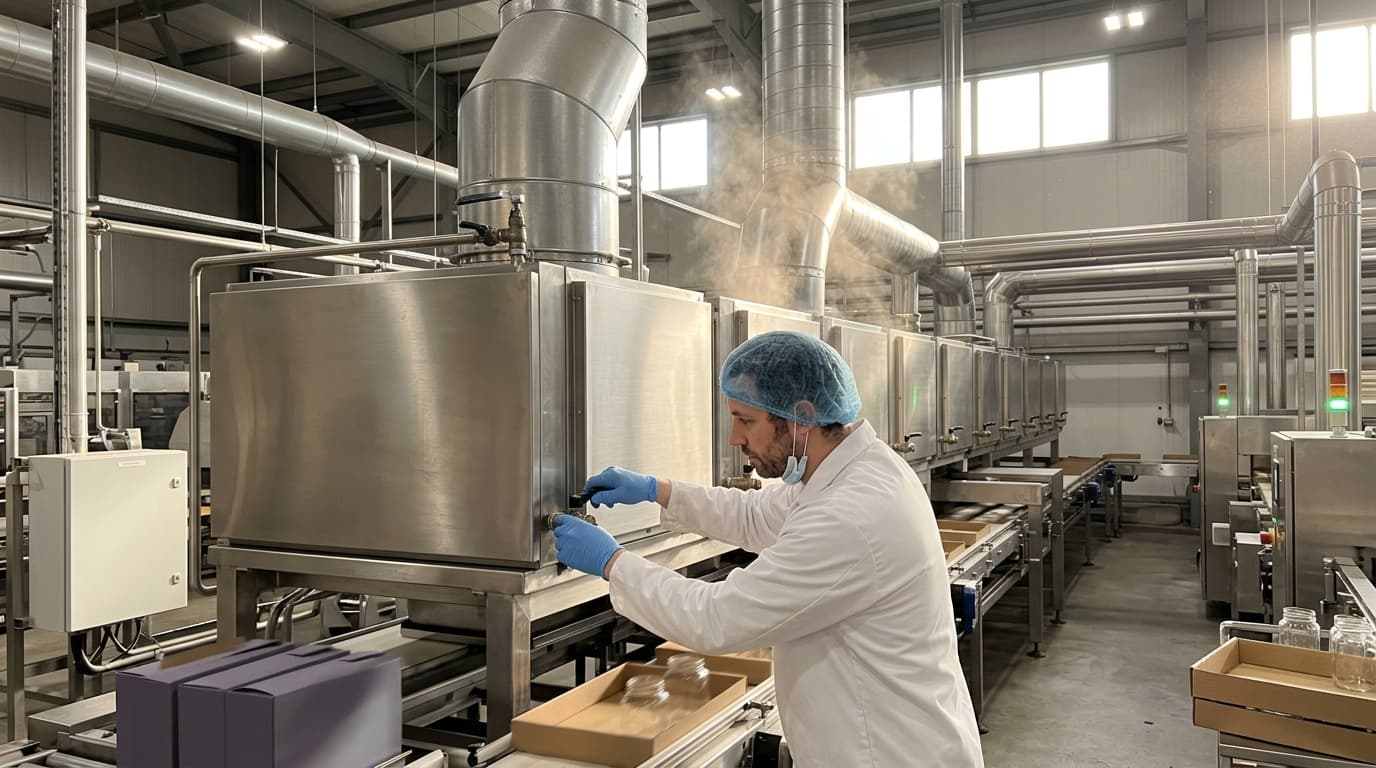
Our ThermStack and EcoStream heat exchanger ranges deliver measurable energy savings across chemical, food, pharma, and power generation processes.
Implementing Air-to-Air Heat Exchangers
- Assess IAQ Needs: Identify pollutants and air-quality challenges in the manufacturing environment. Map contaminant sources, occupancy, operating shifts and areas requiring make-up air.
- Quantify the Heat-Recovery Opportunity: Measure or estimate exhaust and supply airflow, temperature, humidity, operating hours and available installation space. This establishes whether sufficient recoverable energy is available to justify the exchanger and its pressure drop.
- Select the Right Type of AAHX: Choose an AAHX appropriate for the application, considering airflow rates, temperature ranges, cross-contamination risk, corrosion resistance, cleaning access, frost risk and the required separation of supply and exhaust ducts.
- Proper Installation: Ensure the AAHX is correctly installed and integrated with the existing HVAC system. Ductwork should be sealed, condensate managed where necessary, and fan capacity verified so the design ventilation rate is maintained.
- Commission and Balance the System: Confirm airflow direction, pressure relationships, bypass operation, temperature performance and alarms before handover. Commissioning is essential to limit extract-to-supply leakage.
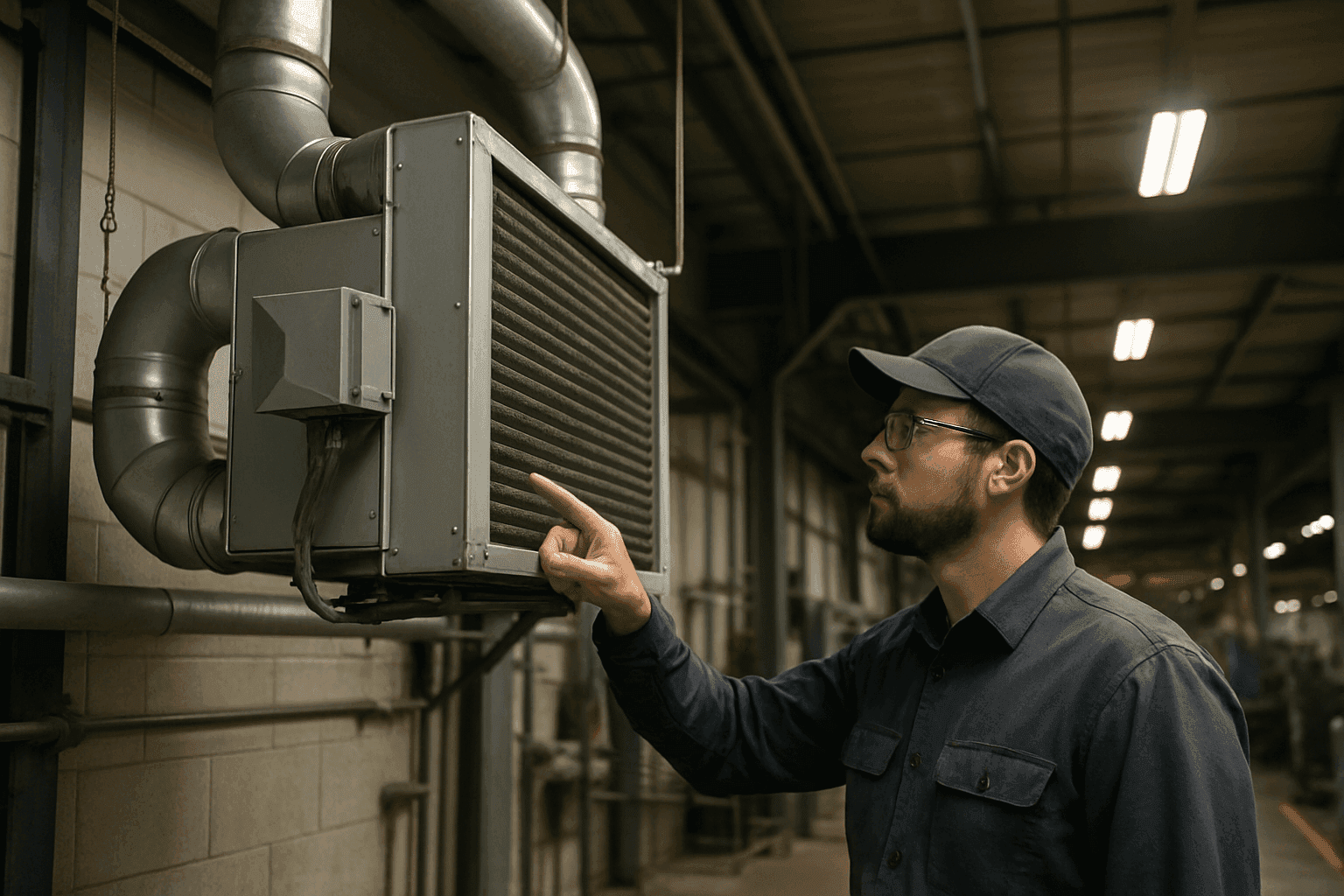
- Regular Maintenance: Establish a maintenance schedule to clean or replace filters and inspect the system. Check exchanger surfaces, seals, drains, fans, belts, bearings and controls, and record pressure drops to identify fouling early.
- Air Quality Monitoring: Monitor relevant parameters to confirm that the ventilation system meets its design intent. Depending on the process, these may include particulate concentration, VOCs, carbon dioxide, temperature, relative humidity and differential pressure.
A maintenance plan should define responsibility for inspection, safe filter changes, cleaning triggers and investigation of deteriorating performance. This preserves energy recovery and the designed ventilation function.
Conclusion
Air-to-air heat exchangers can reduce the heating energy associated with manufacturing ventilation by transferring heat from extract air to incoming outdoor air. Their value is greatest where exhaust airflow, operating hours and the indoor-to-outdoor temperature difference are substantial and consistent.
Select the exchanger according to its measured effectiveness, pressure drop, leakage characteristics, frost-control requirements and compatibility with the exhaust duty. Source capture, filtration and exhaust treatment remain the primary controls for hazardous contaminants; the AAHX should recover heat only where the arrangement can be operated safely and verified through commissioning and maintenance.
