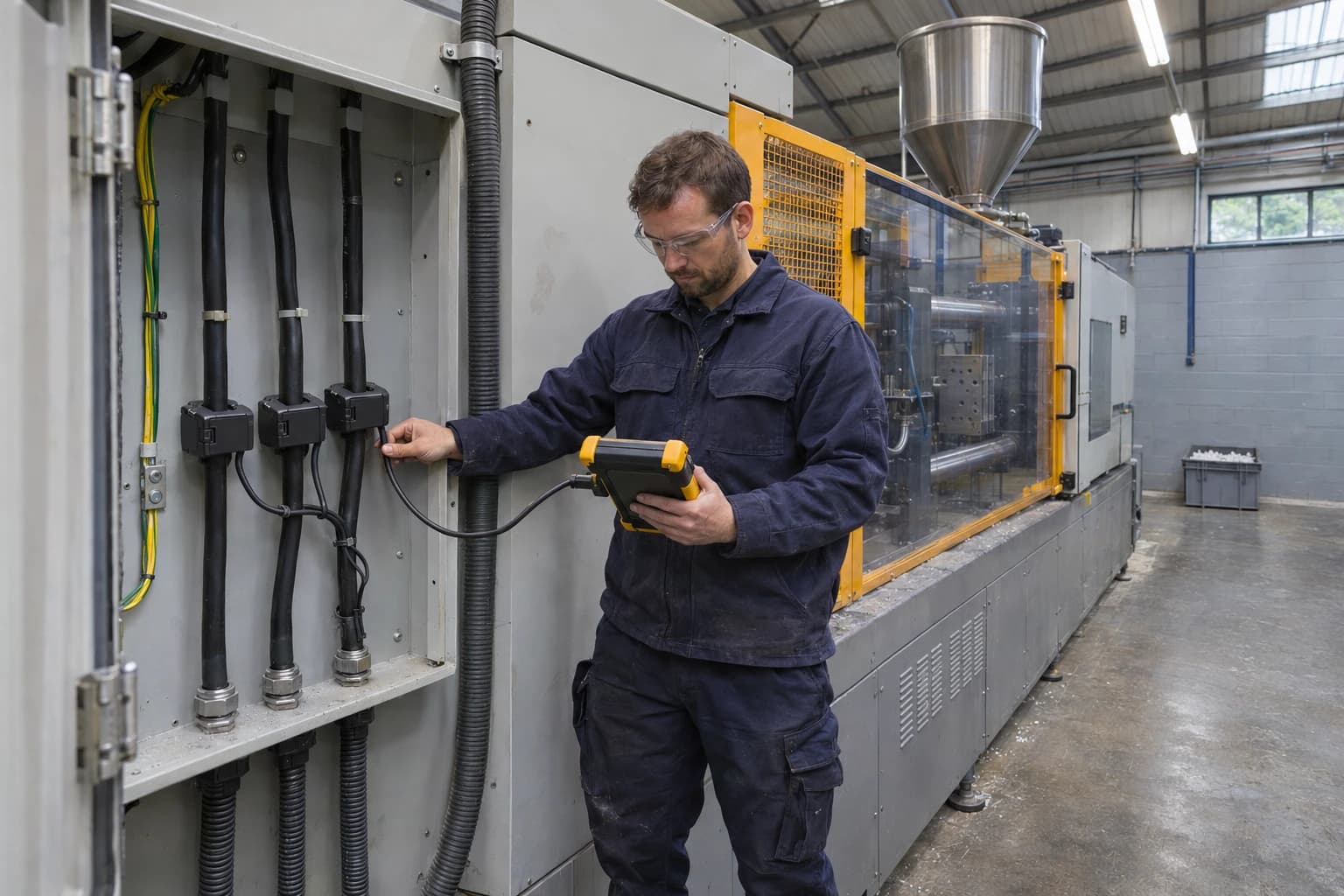
Industrial Decarbonisation Roadmap for ESOS Phase 4
A capital-prioritised plan linking ESOS Phase 4 reporting to NPV, IRR and payback.
Large UK undertakings that meet the ESOS qualification criteria on 31 December 2026 must submit their Phase 4 notification of compliance by 5 December 2027. Manufacturers should begin capital planning now, particularly where decisions on process heat, electrical capacity or production outages lie ahead.
An industrial decarbonisation roadmap turns an ESOS assessment into an ordered investment programme. It identifies energy-intensive assets, establishes a defensible baseline, quantifies projects, and distinguishes measures that can proceed during routine maintenance from those requiring board approval, design work or shutdown time.
The Phase 4 framework sits under the Energy Savings Opportunity Scheme Regulations 2014, with major reforms made by the Energy Savings Opportunity Scheme (Amendment) Regulations 2023. It requires participants to assess at least 95% of total energy consumption, report achieved savings, calculate energy-intensity ratios and review action-plan commitments from the previous period.
For a metals plant, the priority may be furnaces, extraction, compressed air and welding. A plastics manufacturer may focus on moulding machines, dryers, chillers and process heating. Continuous-process sites may find the largest opportunities in combustion control, steam systems, insulation and waste-heat recovery. The projects differ, but the investment discipline is the same.
Why ESOS Phase 4 needs an industrial decarbonisation roadmap
ESOS has always required large undertakings to assess energy used in buildings, transport and industrial processes. Phase 4 gives greater visibility to whether identified measures have progressed.
The assessment report must include energy savings achieved since the previous compliance date. It must also review the existing action plan and explain why proposed measures were not implemented. This links an earlier audit recommendation directly to the next compliance report.
Weak project definition creates implementation delays
Many recommendations fail before procurement. A proposal that identifies “compressed-air savings” without flow data, pressure requirements, repair scope, outage needs or a responsible owner gives a finance director little basis for approval.
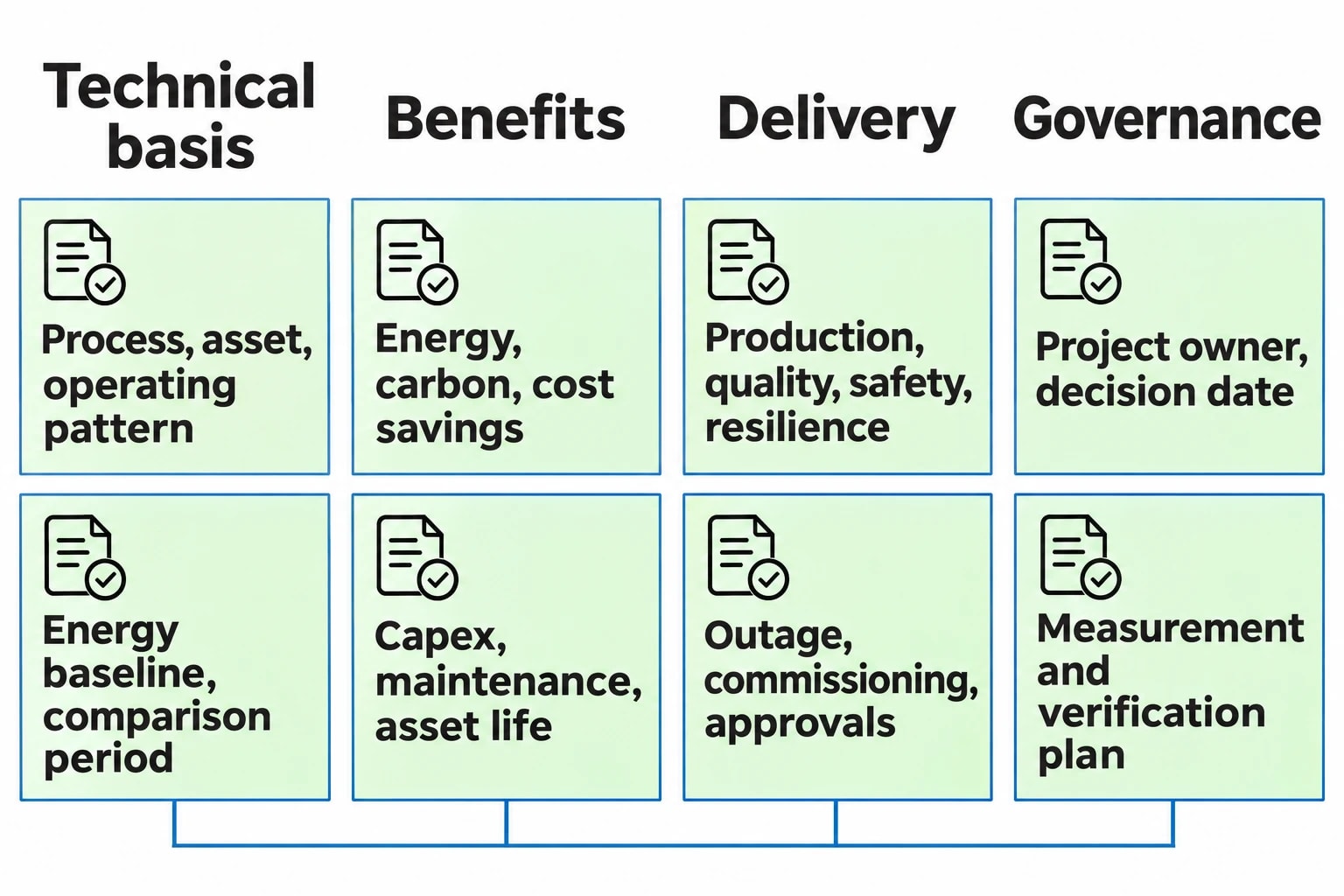
A credible project record should include:
- The relevant process, asset and operating pattern
- Baseline energy use and the comparison period
- Expected energy, carbon and cost savings
- Capital expenditure, maintenance cost and expected asset life
- Production, quality, safety and resilience implications
- Required outage, commissioning period and internal approvals
- A named project owner and proposed decision date
- A measurement and verification plan
This evidence also improves explanations for deferred action-plan measures. A site can distinguish a project requiring electrical-infrastructure studies from one without a viable commercial case.
Group compliance requires site-level ownership
ESOS applies to large UK undertakings and corporate groups. A company qualifies for Phase 4 if, on the qualification date, it employs 250 or more people, or has annual turnover above £44 million and an annual balance-sheet total above £38 million.
The organisational boundary can cover factories, offices, warehouses, transport and leased assets. Manufacturing groups should establish a central ESOS boundary, then create a project register for each site. Central teams need comparable investment data, while plant teams need responsibility for operating conditions, maintenance windows and post-installation performance.

Identify where your plant is losing energy and quantify the savings potential — our audits map every heat source, sink, and waste stream in your facility.
Build an energy baseline that reflects production
An industrial decarbonisation roadmap requires more than annual utility invoices. Production volume, product mix, shift pattern, ambient conditions, uptime and scrap rate can materially affect site consumption.
An ESOS-compliant energy audit must, so far as reasonably practicable, use verifiable consumption data measured over a 12-month period. For Phase 4, that period must begin no earlier than 6 December 2022 and end no more than 24 months before the audit starts. This meets the compliance requirement, but capital decisions often need more granular evidence.
Map energy demand by process
A site energy map should allocate electricity, gas, fuel oil, steam and compressed air to the assets that drive consumption. It should also identify where permanent meters exist and where temporary monitoring is needed.
| Energy area | Evidence to collect | Project decisions supported |
|---|---|---|
| Process heat | Fuel flow, flue oxygen, stack temperature, run hours | Combustion tuning, insulation and heat recovery |
| Compressed air | Compressor kW, pressure, flow, leak survey | Leak repair, pressure reduction and compressor control |
| Motors and drives | Power profile, run hours, load, control method | Variable-speed drives and control improvements |
| Cooling | Electrical demand, temperatures, operating schedule | Chiller loading, maintenance and heat recovery |
| Production equipment | Throughput, product mix, idle consumption | Energy-intensity baseline and production controls |
Temporary power analysers can reveal intermittent electrical loads that monthly billing data conceals. Ultrasonic leak detection can identify compressed-air losses during operation or a planned shutdown. Thermal imaging can highlight damaged insulation, refractory degradation and abnormal electrical temperatures.
EnerTherm Engineering’s seven-step audit methodology provides a useful structure: initial consultation, on-site assessment, specialist measurement, data analysis, opportunity development, prioritisation and implementation support. The required output is a project portfolio, rather than a list of observations.
Use energy intensity ratios that production teams accept
Energy-intensity ratios should connect consumption with a measurable industrial activity. Appropriate ratios include:
- kWh per tonne of finished metal product
- kWh per kilogram of polymer processed
- Gas consumption per tonne of heat-treated product
- kWh per moulded component
- Compressed-air kWh per production hour
A ratio needs operating context. A plant producing a higher-temperature alloy or thicker-gauge product may record higher energy use per tonne for sound technical reasons. The baseline should therefore record product mix, operating temperature, throughput and shift conditions alongside the ratio.
Prioritise demand reduction before heat decarbonisation
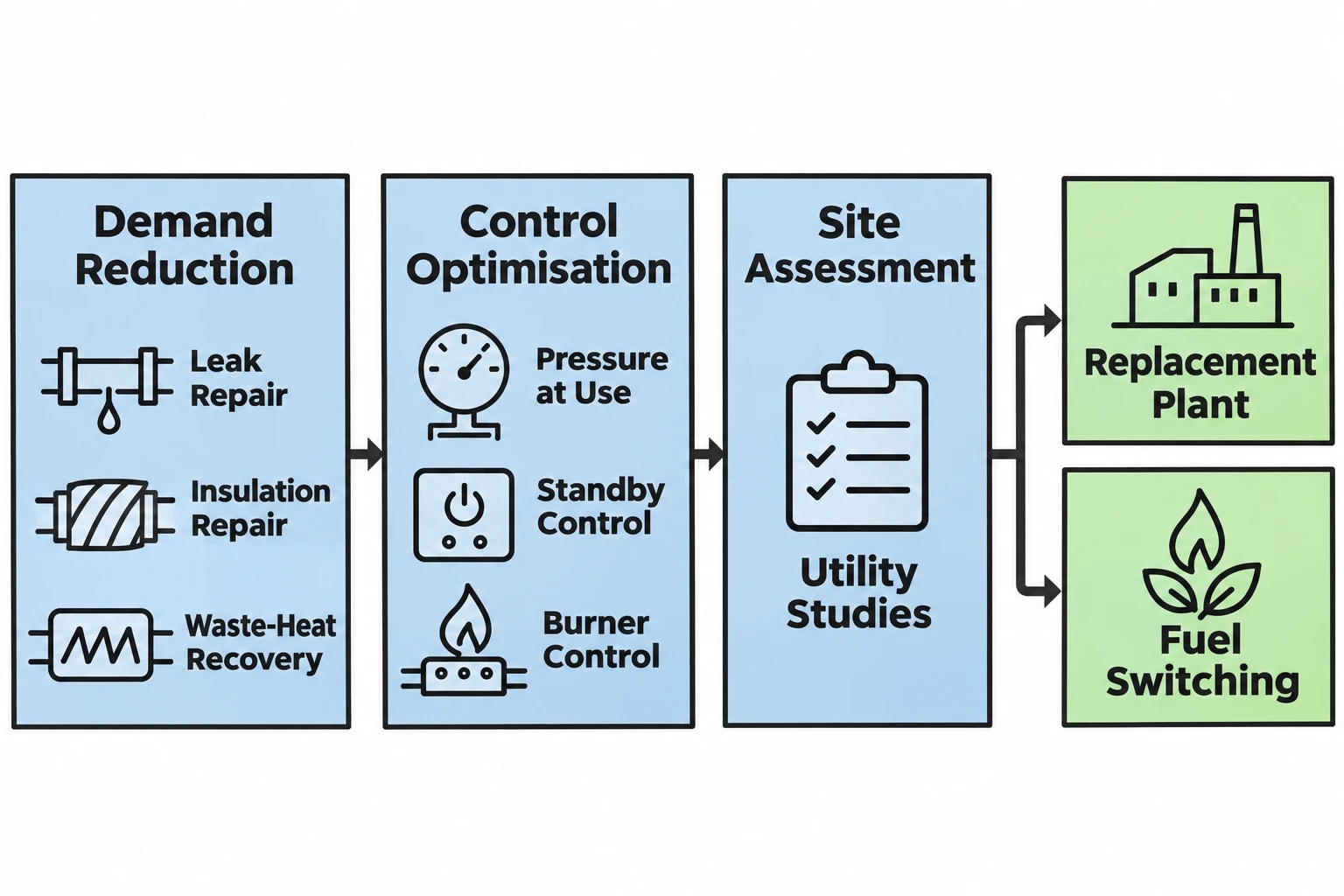
The best industrial decarbonisation roadmaps reduce waste first, improve control second and then consider replacement plant or fuel switching. This sequence avoids oversizing compressors, boilers, electrical infrastructure or low-carbon heat equipment around avoidable demand.
Compressed air and motor drives need measured cases
Compressed air is often a high-value target because leakage, excessive pressure and inappropriate end uses can create a persistent base load. A survey should identify each leak, assign responsibility for repair and verify the result through a repeat survey or compressor-load data.
Demand reduction goes beyond leak repair. Open blowing, poor standby control, artificial demand from high discharge pressure and unsuitable pneumatic equipment can impose avoidable compressor energy use. Pressure should be assessed at the point of use, not assumed from the compressor discharge setpoint.
Variable-speed drives can reduce energy use on pumps, fans and other variable-torque applications. Their suitability depends on the load profile, process requirement, control arrangement and electrical considerations. Motor nameplate rating does not establish normal electrical demand; load profiling does.
Process heat requires operational evidence
Process heat often dominates fuel use at metals, plastics and continuous-process sites. Combustion tuning, burner control, excess-air management, insulation repair and waste-heat recovery can reduce demand before a business evaluates electrification.
For furnaces, ovens and thermal treatment assets, the project evidence should cover:
- Temperature profile and dwell requirements
- Burner turndown and control response
- Flue-gas temperature and available heat sinks
- Door-opening frequency and refractory condition
- Product loading, idle periods and batch scheduling
- Electrical capacity and space for replacement equipment
- Maintenance shutdown dates and outage duration
Electrification requires a site-specific technical and commercial assessment. Network capacity, load coincidence, process temperature, product quality, tariff exposure and resilience requirements can each determine whether a proposal proceeds. The roadmap should separate near-term efficiency measures from projects requiring utility studies, equipment trials or major asset replacement.
Insulation deserves a defined project scope
Damaged insulation produces continuous losses and can create hot-surface safety issues. Thermal imaging can prioritise repairs, while shutdown work packs should specify the required insulation standard and inspection points.
The project evidence should record surface temperature, area, operating hours, insulation condition and access constraints. This supports a credible savings estimate and allows performance to be reviewed after the work.
Make the capital case with NPV, IRR and payback
Simple payback has value for low-cost operational measures, but it can disadvantage larger decarbonisation projects with longer asset lives. Manufacturers should use a consistent financial appraisal method across the opportunity register.
Apply three financial tests
Simple payback shows how quickly annual cash savings recover the initial cost. Net present value tests whether discounted future cash flows exceed the project cost over a stated appraisal period. Internal rate of return identifies the discount rate at which net present value becomes zero.
Each investment case should state its assumptions:
- Energy-price basis and escalation treatment
- Discount rate and appraisal period
- Capital cost, design cost and contingency
- Maintenance cost, replacement cost and residual value
- Expected operating hours and production conditions
- Carbon reduction basis and fuel assumptions
Finance teams can then compare projects on a consistent basis. A project register that changes its energy-price assumption or appraisal period for each proposal cannot provide an impartial ranking.
Operational benefits should be separated from energy savings. Better combustion control may improve temperature stability and reduce rejected product. A compressor replacement may improve resilience and reduce maintenance downtime. These benefits can matter commercially, but need their own evidence and should not inflate an energy-saving forecast.
Rank readiness as well as return
A high-return project may still be unsuitable for immediate delivery if it needs a long shutdown, utility reinforcement or product-quality validation. A practical roadmap ranks financial return alongside implementation readiness.
| Assessment area | Capital-case question |
|---|---|
| Technical definition | Has the duty been measured and the preferred design established? |
| Production impact | Is an outage, trial batch or quality approval required? |
| Site constraints | Are capacity, access, space, drainage and foundations confirmed? |
| Commercial confidence | Are quotations, lead times and lifecycle costs current? |
| Carbon reduction | Does the estimate use measured energy consumption and a stated fuel change? |
| Verification | Can meters and production data demonstrate the result after commissioning? |
This approach creates a realistic sequence. Rapid measures can proceed through maintenance budgets. Larger projects can move through engineering design, procurement and shutdown planning without being presented as implementation-ready too early.

Identify where your plant is losing energy and quantify the savings potential — our audits map every heat source, sink, and waste stream in your facility.
Use PAS 51215 and ISO 50001 to strengthen governance
Participants can comply through ESOS energy audits, ISO 50001 certification, or a combination of routes that covers the required energy consumption. Display Energy Certificates and Green Deal Assessments no longer provide alternative Phase 4 compliance routes.
ISO 50001:2018 provides a framework for establishing, maintaining and improving an energy management system. Where certification covers all significant energy consumption or at least 95% of total energy consumption, it can form an alternative compliance route. The certification must be valid on the Phase 4 compliance date and its scope must match the ESOS boundary.
PAS 51215 connects energy assessment with decarbonisation choices
PAS 51215-1:2025 provides a voluntary process for combined energy and decarbonisation assessments. PAS 51215-2:2025 addresses the competencies of lead assessors and assessment teams.
The assessment can consider energy consumption and energy-related Scope 1 and 2 emissions from buildings, transport and industrial processes. It can also include business-travel Scope 3 emissions and further emissions selected by the organisation.
For manufacturers, the value lies in separating projects by timescale and dependency. Compressed-air control, insulation repairs and combustion tuning may be ready for delivery. Furnace replacement, heat electrification or major electrical upgrades may require a longer development path, with design studies and board decisions before capital approval.
Verify savings after commissioning
Installed equipment does not, by itself, prove savings. Each priority project should have a measurement and verification plan agreed before procurement.
The International Performance Measurement and Verification Protocol provides established principles for defining a measurement boundary, baseline, reporting period, adjustments and uncertainty. The appropriate method depends on the measure.
A compressor project may require kW, flow, pressure and production-hours data. A furnace project may need fuel flow, throughput, operating hours and process-temperature records. A site-wide control measure may need a baseline adjusted for production changes, weather or product mix.
Make verification part of handover
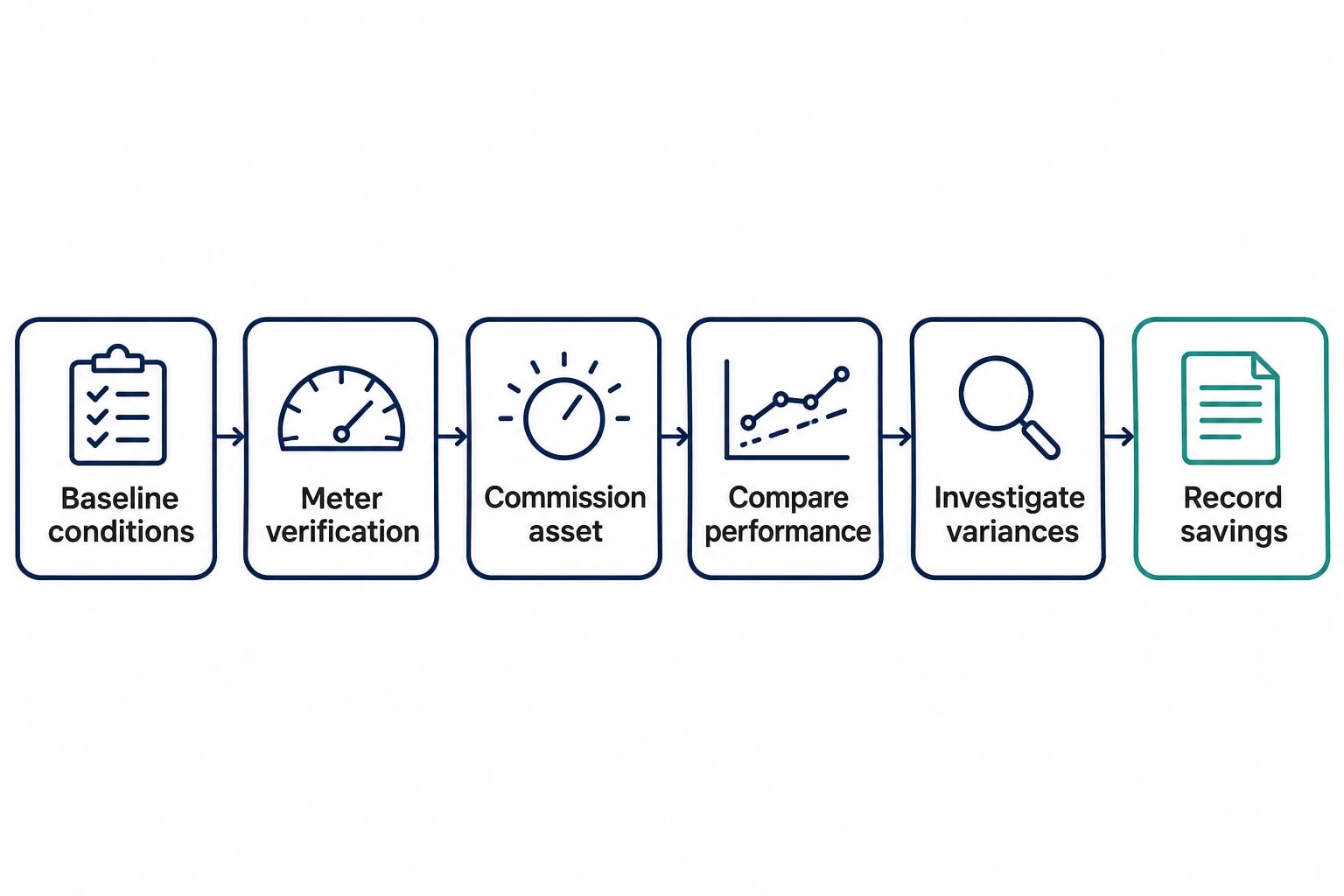
The post-project process should include:
- Record baseline conditions before work begins.
- Confirm meter location, calibration status and data intervals.
- Commission the asset against the agreed control sequence.
- Compare post-installation performance with the baseline.
- Investigate material variances with production and maintenance teams.
- Record achieved savings in the ESOS evidence pack and project register.
Verified savings strengthen the next capital submission and identify projects needing operational adjustment before performance shortfalls become embedded.
A delivery programme for 2026 and 2027
Manufacturers should first confirm the ESOS participant boundary, calculate total energy consumption and identify the significant energy-consumption areas requiring assessment. They should then review Phase 3 action-plan commitments, including measures still awaiting technical development or capital approval.
During 2027, sites should develop energy maps, intensity ratios, project registers and investment cases. Projects needing electrical-capacity studies, process trials, utility applications or shutdowns should move first because their lead times will exceed those for maintenance-led measures.
The final Phase 4 assessment should give directors an ordered programme, distinguishing early demand-reduction and control measures from asset-renewal and heat-decarbonisation projects that require further technical evidence, operating approval and investment returns.
This article reflects the independent analysis and editorial opinion of EnerTherm Engineering. Product names, trademarks, and brands mentioned belong to their respective owners. EnerTherm Engineering is not affiliated with, endorsed by, or a licensee of any third-party software or product mentioned unless explicitly stated.

Managing Director — EnerTherm Engineering
Dr. François Pierrel is Managing Director of EnerTherm Engineering with over two decades of expertise in thermal design, heat transfer, and industrial energy optimisation. He holds a PhD in Heat Transfer from Cranfield University and a Post-Doctorate from Heriot-Watt University.
