
ESOS Compliance Requirements: Phase 4 Rules for UK Plants
Qualification is assessed on 31 December 2026; notification is due by 5 December 2027.
UK manufacturers that meet the ESOS large-undertaking test on 31 December 2026 must submit a Phase 4 notification of compliance by 5 December 2027. That leaves limited time to settle group boundaries, assemble defensible energy data, complete representative site visits and obtain director sign-off.
The Energy Savings Opportunity Scheme (ESOS) is the UK’s mandatory energy-assessment and energy-saving scheme for qualifying large undertakings and corporate groups. Phase 4 runs from 6 December 2023 to 5 December 2027. It retains the audit requirement while increasing reporting on implemented measures, savings achieved and deferred action-plan commitments.
For metals, plastics, assembly and general manufacturing businesses, ESOS compliance requirements should prompt a practical review of energy-intensive operations. Compressed-air leakage, unnecessary base load, poorly controlled combustion, motor operation and heat loss can turn a regulatory assessment into a prioritised investment programme.
ESOS Phase 4 deadlines for UK manufacturing plants
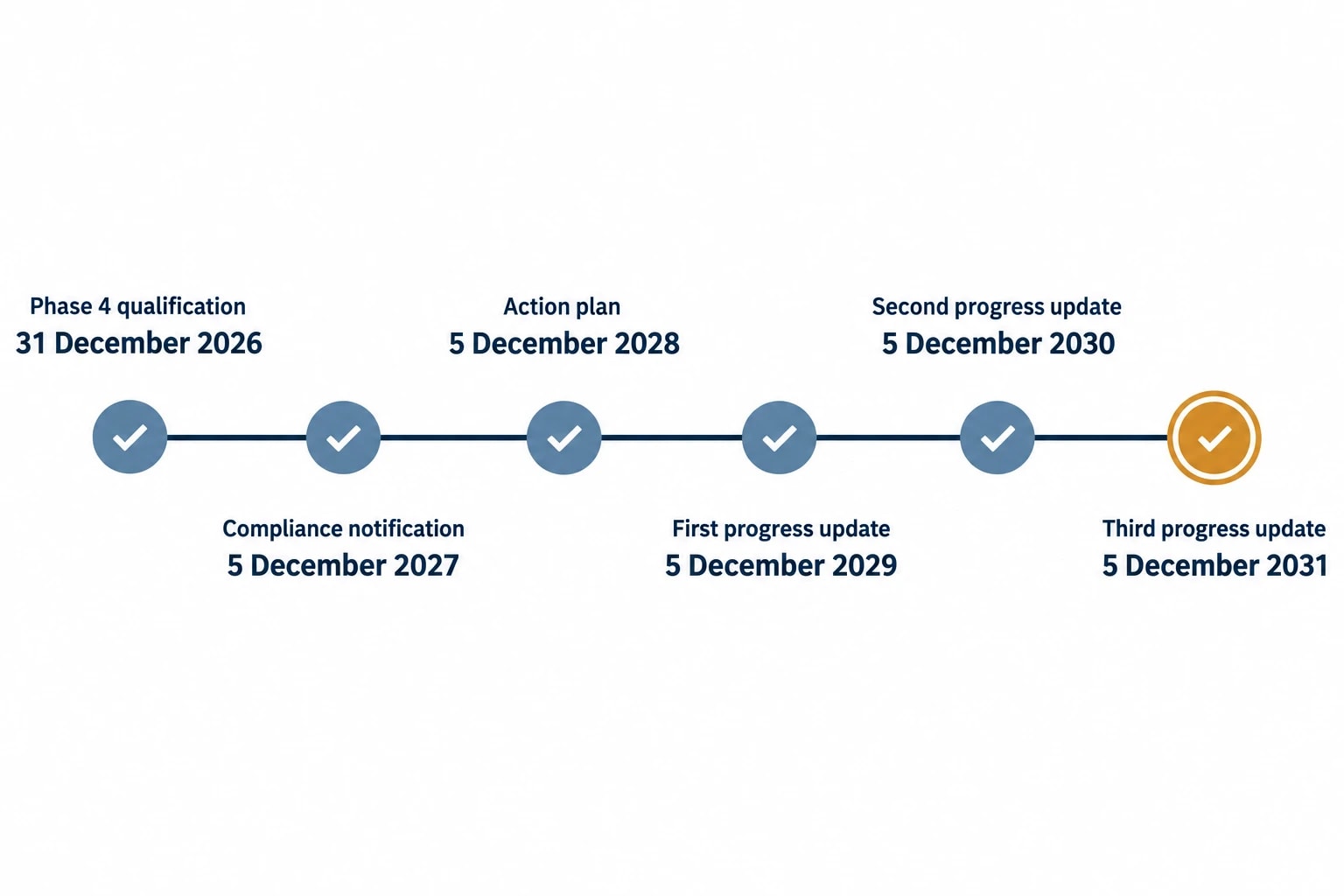
The compliance notification is only the first formal Phase 4 deadline. Manufacturers must also plan for action-plan reporting through 2031.
| Requirement | Deadline |
|---|---|
| Phase 4 qualification date | 31 December 2026 |
| Phase 4 notification of compliance | 5 December 2027 |
| Phase 4 action plan | 5 December 2028 |
| First action-plan progress update | 5 December 2029 |
| Second action-plan progress update | 5 December 2030 |
| Third action-plan progress update | 5 December 2031 |
The Phase 4 action plan covers the following four years, from 6 December 2027 to 5 December 2031. Participating organisations must submit the action plan after their Phase 4 notification, then provide annual progress updates. The third update is new for Phase 4.
Phase 3 obligations remain live
A manufacturer that qualified for Phase 3 must submit its second annual progress update by 5 December 2026. This reports progress against the existing action plan and requires board-level director, or equivalent, sign-off.
The deadline falls before the Phase 4 qualification date. Energy and sustainability managers should avoid treating the phases as separate exercises. The Phase 3 progress update can identify unimplemented projects, data gaps that will affect Phase 4, and measures whose savings need a stronger evidence trail.
Start data work before the audit programme
A plant can have a complete set of utility invoices and still lack the data needed for a useful assessment. One fiscal meter may supply several production areas. Fuel-delivery records may not distinguish process heat from space heating. Production records may sit outside the energy team’s reporting systems.
Early preparation gives teams time to reconcile electricity, gas, LPG, fuel oil, biomass and transport-fuel records; review sub-meter coverage; and arrange surveys around production schedules. It also allows projects to reach maintenance and capital-planning meetings before budgets are committed.

Identify where your plant is losing energy and quantify the savings potential — our audits map every heat source, sink, and waste stream in your facility.
Which businesses must meet ESOS compliance requirements?
An undertaking qualifies for ESOS Phase 4 if it meets the definition of a large undertaking on the qualification date. A UK undertaking is large if it meets either of these tests:
- It employs 250 or more people.
- It has annual turnover above £44 million and an annual balance-sheet total above £38 million.
The employee figure includes employees, owners or managers, and partners. Full-time and part-time status does not change whether someone is an employee for ESOS purposes. The calculation uses the average number employed each month during the relevant accounting period.
For the financial route, the undertaking must exceed both thresholds. The balance-sheet total is the aggregate value of assets before current and long-term liabilities are deducted.
Group qualification brings smaller factories into scope
If one UK member of a corporate group qualifies as a large undertaking, the group’s entire UK operation normally participates in ESOS. A factory below the employee and financial thresholds in its own accounts may therefore fall within the group assessment.
The highest UK parent generally acts as the responsible undertaking. It coordinates the assessment and submits the notification for the group. A different group undertaking can take that role only where all relevant undertakings agree in writing and retain the agreement in their evidence packs.
Groups can also disaggregate for ESOS compliance. This requires a written agreement with the highest UK parent. Manufacturers that have acquired or sold sites, created subsidiaries or changed their holding structure should settle responsibility before defining audit scope.
Organisations close to a threshold need a two-year review
The regulations use a two-consecutive-accounting-period rule for businesses moving between large and small or medium status. A company that grew above the threshold in its latest accounts may not qualify immediately if it has not maintained large-undertaking status for two consecutive accounting periods.
The reverse applies to a business that has contracted. A manufacturer that was large for many years and falls below a threshold for one accounting period can remain in scope. Finance, legal and sustainability teams should retain the calculation and accounting-period evidence supporting their conclusion.
How much energy must a Phase 4 assessment cover?
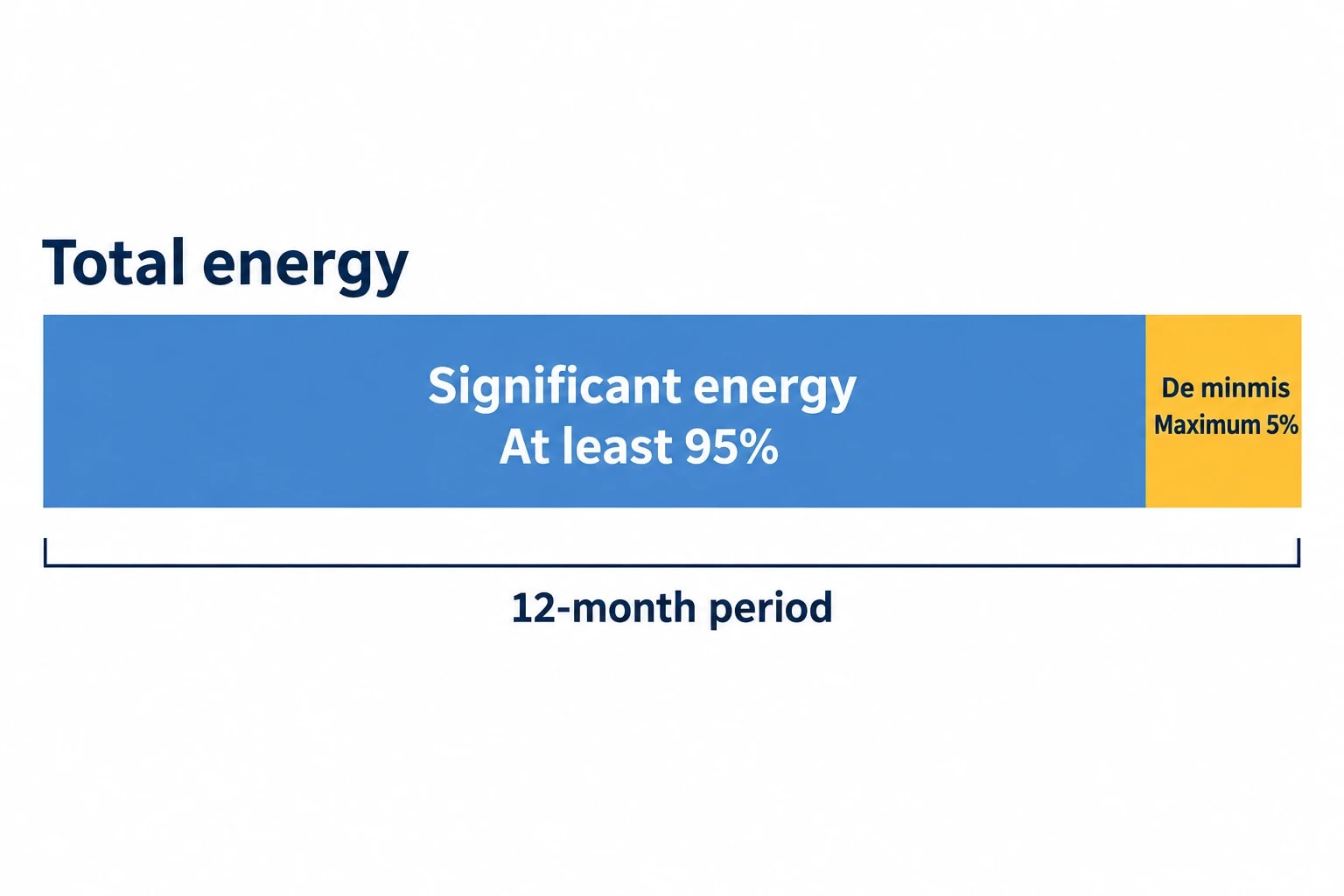
ESOS begins with total energy consumption. This covers energy supplied to and consumed by assets held, or activities carried out, by the participant in the UK, including buildings, industrial processes and transport.
Energy includes combustible fuels, imported heat, renewable energy, electricity and transport fuel. There are no fuel-type exemptions. Where a boiler converts gas to heat on site, the organisation accounts for the gas input rather than both the gas and heat output.
Significant energy consumption must reach 95%
The participant must identify areas of significant energy consumption accounting for at least 95% of total energy consumption. The remaining maximum 5% is the de minimis allowance.
An organisation can apply that allowance by asset, site, activity, fuel or undertaking. The decision needs a clear rationale. For a manufacturer, the scope will often include major process loads, compressed-air generation, furnaces or ovens, steam systems, high-demand motors, material handling, buildings and fleet fuel where relevant.
The total-energy calculation uses a 12-month reference period that includes the qualification date. It should use verifiable information where reasonably practicable. Where data is unavailable, a reasonable estimate may be used, but the method, input data and reason for estimation must be retained.
Energy intensity ratios are a mandatory reporting item
Phase 4 requires energy-intensity ratios for buildings, transport, industrial processes and other energy uses. Each indicator must be quantifiable, related to the applicable energy-consuming activity and calculated from verifiable data where reasonably practicable.
For industrial processes, relevant indicators may include:
- kWh per tonne of product
- kWh per finished unit
- kWh per batch
- kWh per machine hour
A well-chosen ratio can expose performance that total consumption masks. A plastics plant may see electricity consumption fall during a quieter month while kWh per tonne rises. A furnace may consume less gas in absolute terms but operate less efficiently because production throughput has fallen.
What must an ESOS energy audit include?
An ESOS energy audit must analyse energy consumption and energy efficiency, identify energy-saving opportunities and include site visits. Where audits form the compliance route, they must cover significant energy consumption not covered by ISO 50001 certification.
The audit should use verifiable data measured in energy units rather than expenditure, so far as reasonably practicable. Suitable records include meter data, half-hourly electricity records, fuel invoices, delivery notes, stock records, equipment logs and temporary measurement results.
The audit data period has defined limits
The audit normally requires 12 consecutive months of energy-consumption data. For Phase 4, that period cannot begin before 6 December 2022. It must also begin no earlier than 24 months before the audit starts.
Different audits can use different 12-month periods for different assets or activities. This is useful where a manufacturer has completed a recent process study or has data that captures a representative production period.
Where 12 months of verifiable data cannot be obtained, the business may use a shorter verifiable period or a reasonable estimate. It must document the gap, the reason the full period was unavailable, the method used and the supporting data.
Site visits must be representative
A multi-site group does not need to visit every factory, warehouse and office. It must, however, document the number of sites in scope, the number visited and why the selected sites represent the energy uses, assets and activities covered.
Identical assembly plants may support a limited sample. A portfolio containing an aluminium foundry, injection-moulding operation, warehouse, headquarters and distribution depot requires a broader sampling rationale. The regulator expects a documented explanation of how findings from visited sites apply to those not visited.
Opportunities need quantified, usable evidence
The ESOS report must set out each identified opportunity or measure, its relevant organisational purpose and energy-saving category. It must estimate annual energy-consumption reduction in kWh and annual energy-spend reduction, so far as reasonably practicable.
The report must also include implementation considerations and a recommended programme with timescales. For plant measures, credible appraisals commonly depend on operating-hours records, production conditions, maintenance history, meter readings and site observations.
Typical industrial audit work may examine:
- Compressed-air leaks, pressure settings, inappropriate uses and demand profiles.
- Motor, fan and pump loading, control arrangements and operating schedules.
- Combustion efficiency, excess air, burner controls and process-temperature requirements.
- Thermal losses from ovens, furnaces, steam systems, pipework and insulation.
- Base load during non-production hours, shutdowns and shift changes.

Identify where your plant is losing energy and quantify the savings potential — our audits map every heat source, sink, and waste stream in your facility.
Which compliance routes are available in ESOS Phase 4?
Phase 4 allows three routes to compliance:
- ESOS energy audits.
- ISO 50001 certification.
- A combination of ISO 50001 certification and audits for the remaining scope.
Display Energy Certificates and Green Deal Assessments are no longer alternative compliance routes. Businesses that used either approach in previous phases must now cover relevant energy consumption through ISO 50001, ESOS audits or both.
ISO 50001 can cover all or part of the required scope
ISO 50001 certification can provide a deemed-compliance route where it covers the relevant total or significant energy consumption. For Phase 4, the certification must be valid on 5 December 2027.
Where ISO 50001 covers all required consumption, the participant does not need an ESOS report or lead assessor. It must still submit its notification of compliance and retain a suitable evidence pack.
PAS 51215:2014 remains the competence standard for ESOS lead assessors. PAS 51215-1:2025 and PAS 51215-2:2025 support voluntary integrated energy-and-decarbonisation assessments, which do not provide an alternative ESOS compliance route.
What has changed in Phase 4 reporting and evidence?
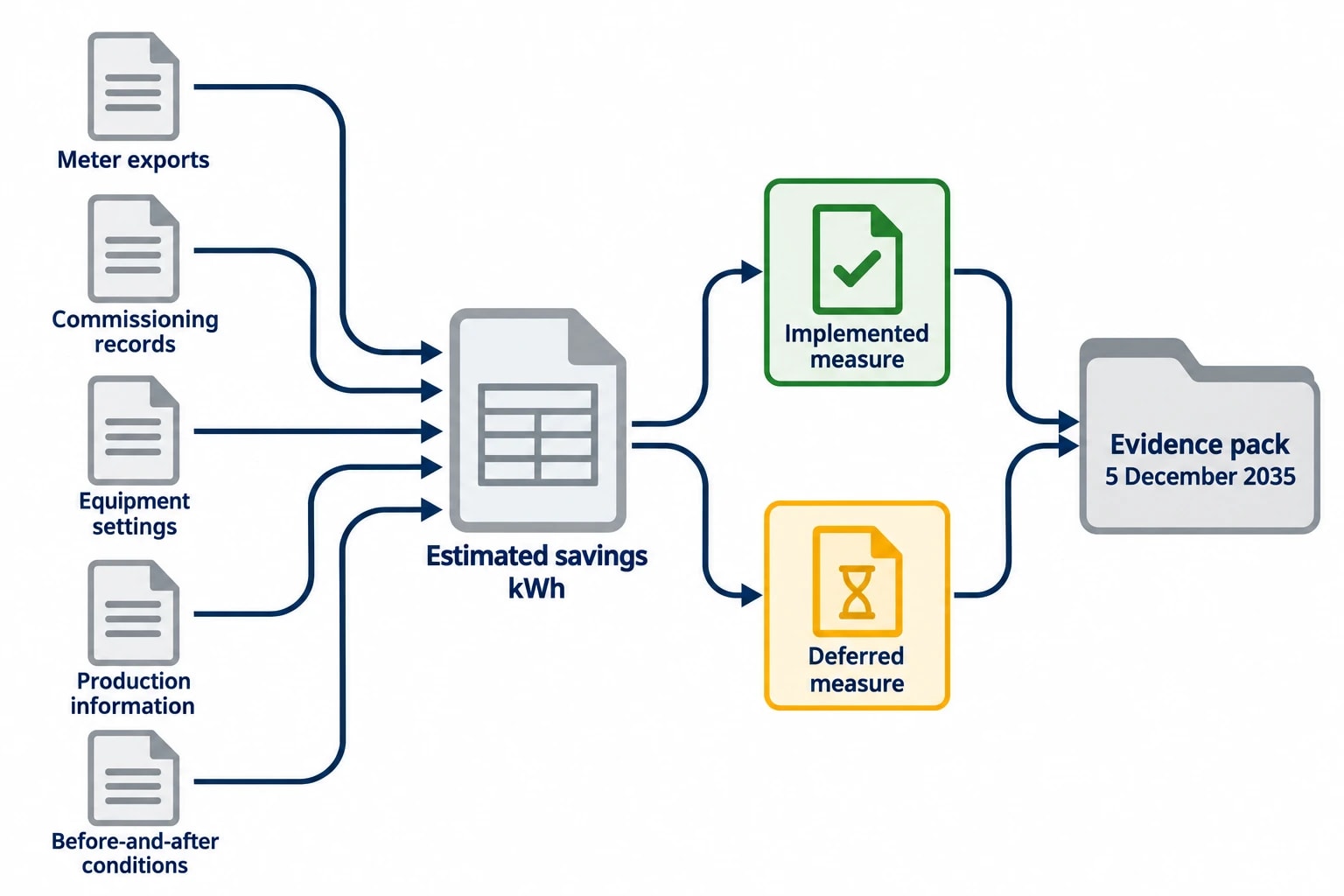
Phase 4 requires organisations to report progress since the previous compliance period. The report and notification must include energy savings achieved, measures implemented, estimated savings for each measure in kWh and the appropriate energy-saving category.
The categories are energy-management practices, behaviour-change interventions, training, controls improvements, capital investments and other measures.
Previous action plans require a formal review
Participants must identify proposed action-plan measures that were not implemented and explain why. This creates a record of deferrals arising from changed production volumes, equipment replacement plans, technical constraints, shutdown windows, budget decisions or safety work.
The review should distinguish a cancelled project from a deferred project. A deferred compressed-air project may need a revised survey and cost estimate if production demand, compressor configuration or maintenance history has changed since the original audit.
Evidence packs must remain available until 2035
A Phase 4 evidence pack must be retained for the compliance period and the following two compliance periods, until 5 December 2035.
It should contain energy data and calculations, audit reports, lead-assessor evidence, ISO 50001 evidence where used, site-visit sampling rationale, estimation methods, group agreements, director sign-off, the notification, action plan and progress updates.
A plant should preserve the raw records behind estimated savings. Meter exports, commissioning records, equipment settings, production information and before-and-after operating conditions provide a stronger basis for future reporting than an unsupported figure in a project register.
Director sign-off, notification and enforcement
The responsible undertaking submits the Phase 4 notification through the Manage your Energy Savings Opportunity Scheme Reporting system (MESOS). Before submission, a board-level director or equivalent must sign off the assessment and notification content.
Where the lead assessor is external, one director provides sign-off. Where the lead assessor is internal, two directors must sign off. Directors need access to the ESOS report and evidence pack, not merely a summary of recommendations.
The Environment Agency will publish most compliance-notification information, excluding personal and commercially sensitive details. Action plans and progress updates will also be published under the scheme timetable.
Financial penalties can be substantial
Failure to notify can lead to a fixed penalty of up to £5,000, plus £500 for each working day after the penalty notice, up to 80 days. Failure to undertake a required energy audit can result in a fixed penalty of up to £50,000, alongside daily penalties, publication and a requirement to undertake an assessment.
This article reflects the independent analysis and editorial opinion of EnerTherm Engineering. Product names, trademarks, and brands mentioned belong to their respective owners. EnerTherm Engineering is not affiliated with, endorsed by, or a licensee of any third-party software or product mentioned unless explicitly stated.

Technical Manager — EnerTherm Engineering
John Naranjo is Technical Manager at EnerTherm Engineering, bringing specialist expertise in chemical and environmental engineering. He recently led the implementation of Omni Vision, EnerTherm's real-time energy and utility monitoring platform. He holds an MSc in Environmental Engineering from the University of Huelva and a BSc in Chemical Engineering, with memberships in both the Energy Institute and IChemE.
